
Joshua 6 to 11 · Subject · Featured Study
Hard Questions in the Old Testament
What Deuteronomy and Joshua say about the destruction of the Canaanites, the sun over Gibeon and the hardened hearts of Joshua 11.
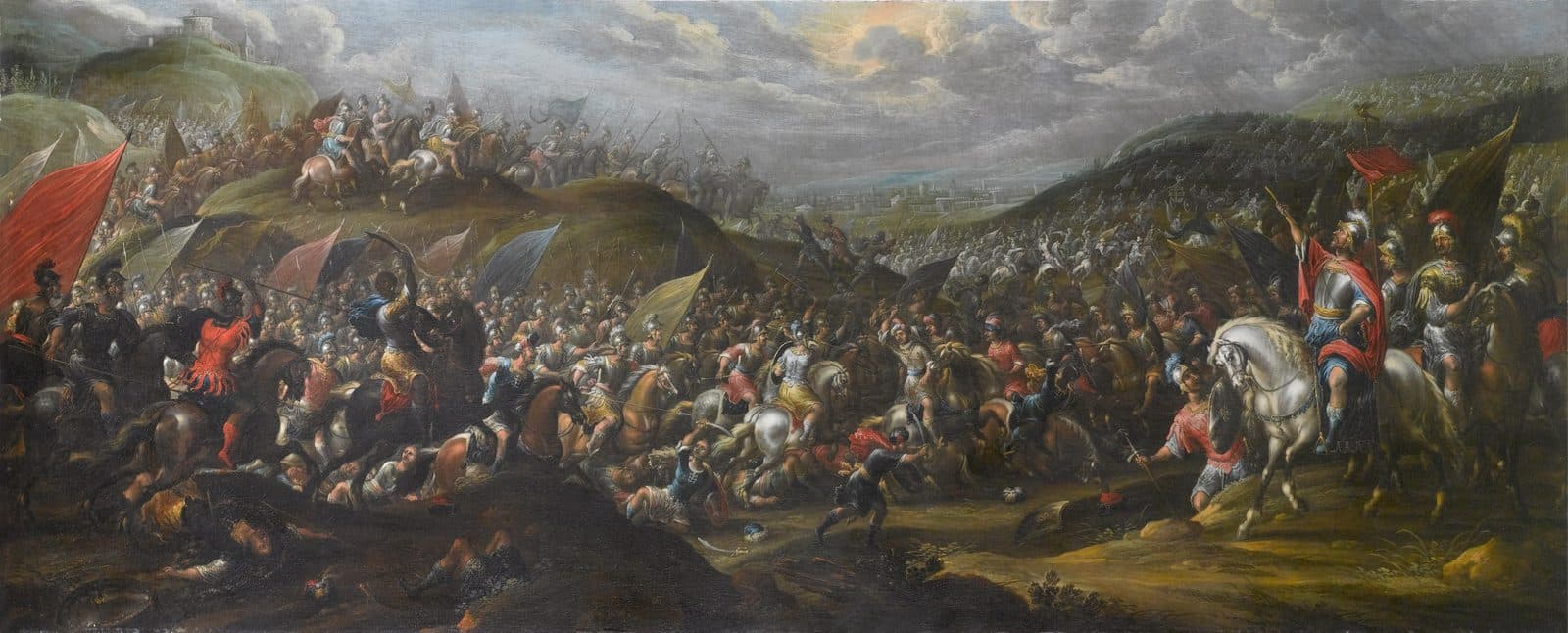
Pauwels Casteels, Joshua Stopping the Sun, painted between 1649 and 1677. Public domain (published before 1930), via Wikimedia Commons.
THE ARTWORKCasteels painted the battle of Joshua 10 with Joshua on a white horse at the right, his arm raised toward the sun. Below him the armies of the five kings break, and a walled city stands in the distance.
Near Jericho, Joshua asked the man with the drawn sword whether He was for Israel or for its enemies, and He answered, Neither.
Summary
Joshua holds some of the hardest questions of the Old Testament, where Israel devotes the cities of Canaan to destruction.
- Genesis 15:16 delays the gift of the land until the iniquity of the Amorites is complete.
- Joshua 6:21 counts the young and the old of Jericho among the dead.
- Joshua 11:20 traces the refusal of peace by the kings of Canaan to the LORD's hardening of their hearts.
- Joshua's summaries of victory stand beside verses that list the peoples who remained in the land.
- Teachers read the conquest as judgment, as the language of victory, or as a figure of the war against sin.
Four Questions from Joshua
Four passages raise the questions readers ask most often.
However, in the cities of the nations that the LORD your God is giving you as an inheritance, you must not leave alive anything that breathes. For you must devote them to complete destruction—the Hittites, Amorites, Canaanites, Perizzites, Hivites, and Jebusites—as the LORD your God has commanded you, so that they cannot teach you to do all the detestable things they do for their gods, and so cause you to sin against the LORD your God.The first question is why God commanded the destruction of whole cities, and verse 18 gives the reason in the gods those cities served.
At the edge of the sword they devoted to destruction everything in the city—man and woman, young and old, oxen, sheep, and donkeys.The second question is how the children of a city stand in that command.
On the day that the LORD gave the Amorites over to the Israelites, Joshua spoke to the LORD in the presence of Israel: “O sun, stand still over Gibeon, O moon, over the Valley of Aijalon.” So the sun stood still and the moon stopped until the nation took vengeance upon its enemies. Is this not written in the Book of Jashar? “So the sun stopped in the middle of the sky and delayed going down about a full day.” There has been no day like it before or since, when the LORD listened to the voice of a man, because the LORD fought for Israel.The third question is what happened in the sky over Gibeon on the day of the battle.
No city made peace with the Israelites except the Hivites living in Gibeon; all others were taken in battle. For it was of the LORD to harden their hearts to engage Israel in battle, so that they would be set apart for destruction and would receive no mercy, being annihilated as the LORD had commanded Moses.The fourth question is what it means for the LORD to harden a heart.
Why the Land Was Taken
Seven texts give the reason Scripture states for the conquest.
- What the text says
- Abram's descendants return in the fourth generation, when the Amorites' iniquity is complete.
- What the text says
- The nations defiled the land by the practices of Leviticus 18.
- What the text says
- A defiled land will vomit Israel out as it did the nations.
- What the text says
- The nations are driven out for their wickedness and for the oath to the fathers.
- What the text says
- The cities must not teach Israel the detestable things done for their gods.
- What the text says
- Rahab and her household live among the Israelites.
- What the text says
- Israel is exiled for the customs of the nations driven out.
Seven texts in canon order, each with what it adds.
Rahab and the Gibeonites
Joshua records two exceptions to the command, one at Jericho and one at Gibeon.
Rahab of Jericho hid the two spies on her roof and asked them to spare her family when the city fell.
The Gibeonites came to Joshua at Gilgal in threadbare clothing, claimed to live in a distant land and won a treaty for their four cities. Joshua 11:19 says no other city made peace with Israel.
and said to them, “I know that the LORD has given you this land and that the fear of you has fallen on us, so that all who dwell in the land are melting in fear of you. For we have heard how the LORD dried up the waters of the Red Sea before you when you came out of Egypt, and what you did to Sihon and Og, the two kings of the Amorites across the Jordan, whom you devoted to destruction. When we heard this, our hearts melted and everyone’s courage failed because of you, for the LORD your God is God in the heavens above and on the earth below.Rahab's confession shows that Jericho had heard of the Red Sea and of Sihon and Og, and she alone turned to the God of Israel.
The Gibeonites answered, “Your servants were told clearly that the LORD your God had commanded His servant Moses to give you all the land and wipe out all its inhabitants before you. So we greatly feared for our lives because of you, and that is why we have done this.The Gibeonites knew the command of Moses and sought a treaty because they feared for their lives.
Whether the command allowed an exceptionJoshua 6:25 and Deuteronomy 7:2
Matthew 1:5 names Rahab as the mother of Boaz in the line of David.
John Wesley, on Joshua 6:25, judged that the general command to root out the Canaanites had an exception for any who had sincerely and seasonably cast off their wickedness and submitted to the Israelites.
Adam Clarke, on Deuteronomy 7:2, held that the nations were to be destroyed only if they did not renounce their idolatry and receive the true faith.
Matthew Henry, on Joshua 11:19, wrote that other cities might have made as good terms for themselves if they had humbled themselves, but they never so much as desired conditions of peace.
By faith the prostitute Rahab, because she welcomed the spies in peace, did not perish with those who were disobedient.Hebrews names faith as the reason Rahab lived, which is the turning Wesley and Clarke read as the exception to the command.
What the Text Says of the Conquest
Two things often said of the conquest, each set beside the verse that answers it.
JOSHUA COMMANDED THE SUN ON HIS OWN AUTHORITY
Joshua 10:12 says he spoke to the LORD before he spoke to the sun, and verse 14 says the LORD listened to the voice of a man.
ISRAEL WAS TO DESTROY EVERY CITY IT FOUGHT
Deuteronomy 20:10 to 15 told Israel to offer peace to the cities far away, and the command of verse 16 to leave nothing alive was for the cities of the land itself.
The Summaries and the Survivors
Four rows set the summaries of Joshua 10 and 11 beside Joshua 11, 13, 15 and 16.
| The summary | Who remained |
|---|---|
| Joshua 10:40: leaving no survivors in the hill country, the Negev and the foothills | Joshua 15:63: the Jebusites live in Jerusalem among Judah to this day |
| Joshua 10:40: he devoted to destruction everything that breathed | Joshua 16:10: the Canaanites dwell in Gezer among Ephraim as forced laborers |
| Joshua 11:22: no Anakim were left in the land of the Israelites | The same verse: only in Gaza, Gath and Ashdod did any survive |
| Joshua 11:23: Joshua took the entire land | Joshua 13:1: very much of the land remains to be possessed |
The Hebrew Words
Two Hebrew words carry the hardest commands of Joshua.
Cherem, the devoted thingStrong's H2764
The noun cherem names a thing devoted to the LORD, and the Berean text renders its verb as devote to destruction in Deuteronomy 7:2 and Joshua 6:21. The lexicon of Brown, Driver and Briggs defines the devoted thing as hostile to God's rule. It was destroyed, or else set apart to sacred use, as the metals of Jericho were.
For all the silver and gold and all the articles of bronze and iron are holy to the LORD; they must go into His treasury.”The lexicon cites this verse for the second use of a devoted thing, the metals kept for the LORD.
Chazaq, to make strongStrong's H2388
The verb behind harden in Joshua 11:20 is chazaq, which the same lexicon gives as to strengthen, to make firm and to harden. The Hebrew of the verse reads that it was from the LORD to strengthen their heart to meet Israel in battle.
Be strong and courageous, for you shall give these people the inheritance of the land that I swore to their fathers I would give them.The book opens with the same verb, when the LORD tells Joshua to be strong as he leads Israel into the land.
What the Text Leaves Unsaid
Two things Joshua 10 leaves unexplained, the manner of the sun's halt and the book it cites.
Joshua 10 gives the length of the day and leaves untold how it came about. John Calvin, on Joshua 10:13, wrote that he gave himself no great anxiety as to the number of the hours.
The Book of Jashar that Joshua 10:13 cites is lost, and Scripture names it in one other verse.
and he ordered that the sons of Judah be taught the Song of the Bow. It is written in the Book of Jashar:David's lament for Saul and Jonathan stood in the same book, so the Book of Jashar held songs.
Where the Questions Point
The New Testament takes up the patience and the judgment Joshua records.
For God did not send His Son into the world to condemn the world, but to save the world through Him.The Son was sent to save, so the gospel meets the reader of Joshua first as an offer of rescue.
Take notice, therefore, of the kindness and severity of God: severity to those who fell, but kindness to you, if you continue in His kindness. Otherwise you also will be cut off.Paul writes to Gentile believers who stand where broken branches stood, so the warning of the past is addressed to them.
The Lord is not slow in keeping His promise as some understand slowness, but is patient with you, not wanting anyone to perish but everyone to come to repentance.Peter answers the scoffers who ask where the promise of His coming is, and he names the delay patience.
To this He replied, “Do you think that these Galileans were worse sinners than all the other Galileans, because they suffered this fate? No, I tell you. But unless you repent, you too will all perish.Jesus refuses to treat the dead as worse sinners than the living and calls the living to repent.
Voices of the Fathers and the Commentators
Origen, Jerome, and Jamieson, Fausset and Brown each answer the conquest in their own way.
Origen reads the rest that followed Joshua's wars as a picture of what Christ has done across the earth.
“I do not see that Jesus [Joshua] the son of Nun took possession of all the earth. For how much of the earth does one take who seizes only Judea? But our Lord Jesus truly took possession of all the earth, because a multitude of believers from all over the earth and out of all the nations flock to him. After these things, after ‘Jesus [Joshua] took possession of all the earth,’ it is also added, ‘And the earth rested from wars.’”
Origen of Alexandria · Homilies on Joshua 15.7 · on Joshua 11:23Patristic
Jerome takes the hardening of Joshua 11:20 to the question Paul answers in Romans 9.
“‘There was no city which the Lord did not deliver to the children of Israel, except perhaps those who lived in Gibeon. Israel violently overthrew all of them because the Lord hardened their hearts that they would fight Israel and be killed and not be shown mercy and die, just as the Lord had commanded Moses.’ If it happened by the will of the Lord that Israel not receive or accept peace, then let us say with the apostle, ‘Why, therefore, does he object? For who can resist the will of the Lord?’”
Jerome · Against the Pelagians 1.33 · on Joshua 11:20Patristic
A Victorian commentary sets the conquest beside the Flood and the judgment of Sodom and Gomorrah.
“If they were to be swept away like the antediluvians or the people of Sodom and Gomorrah, as incorrigible sinners who had filled up the measure of their iniquities, it mattered not to them in what way the judgment was inflicted; and God, as the Sovereign Disposer, had a right to employ any instruments that pleased Him for executing His judgments.”
Jamieson, Fausset & Brown · Commentary Critical and Explanatory on the Whole Bible · on Deuteronomy 7:2 to 6Reformed
Three Readings of the Conquest
Each reading names its holders, its case from the text and the strongest objection to it.
God's judgment on nations whose sin was completeCalvin, Augustine, Gill
John Calvin, on Joshua 6:21, wrote that the slaughter of every age and sex might seem an inhuman massacre had it not been done at God's command. The nations, he wrote, had been borne with for four hundred years, until their iniquity was complete.
Calvin raised the objection himself, that the children at least were free from fault, and he answered that they perished justly because the race was accursed. He held that the same deed done from Israel's own lust and rage would have been barbarous cruelty.
Augustine, in his Reply to Faustus 22.74, wrote that in wars carried on by divine command Moses showed obedience rather than ferocity, and that God in giving the command acted in righteous retribution. John Gill, on Joshua 6:21, named idolatry and incest among the capital crimes of Jericho.
Fathers shall not be put to death for their children, nor children for their fathers; each is to die for his own sin.The Law forbids putting children to death for their fathers' sin, which is the verse readers set against the deaths of Jericho's children.
The language of victory over a land many survivedClarke, Barnes
Adam Clarke read the summary of Joshua 10:40 as the destruction of those who kept fighting, while many submitted or escaped. He asked whether the command of Deuteronomy 20:17 could mean to subdue a people as a nation. Albert Barnes, on Joshua 11:23, read the taking of the whole land as the end of open resistance.
The objection is the command itself, since Deuteronomy 20:16 says to leave alive nothing that breathes in the cities of the land, and Joshua 6:21 records Jericho's young and old put to the sword.
The Benjamites, however, failed to drive out the Jebusites living in Jerusalem. So to this day the Jebusites live there among the Benjamites.The opening of Judges records the Jebusites still living in Jerusalem, one of the survivors this reading points to.
A figure of the believer's war against sinOrigen, Cassian
Origen, in his Homilies on Joshua, read the wars as the believer's war against what is worldly in him, and on Joshua 6:18 he told his hearers to let worldly ways be anathema to them. John Cassian, in his Conferences, read the seven nations as seven vices.
The objection is that Joshua records the battles with their places and kings named, thirty-one kings in Joshua 12, and a figure drawn from the events does not answer why the events took place.
Books on the Hard Questions
Two older works a reader can open free.
Commentaries on the Book of Joshua
John Calvin · 1564 (English by Henry Beveridge, 1854)
Calvin states each objection to Joshua 6:21 and 11:20 before he answers it.
Read it on ccel.orgReply to Faustus the Manichaean
Augustine of Hippo · about 400
Book 22 answers Faustus, who charged the books of the Law with calumnies against God.
Read book 22 on newadvent.orgThe Kindness and Severity of God
Acts 17 and 2 Corinthians 10 set the judgment of Canaan beside the day of Christ and the warfare of the church.
The hard questions of Joshua ask the reader to take no credit for his standing before God, and to turn to Christ while the kindness of God holds out its time.
Although God overlooked the ignorance of earlier times, He now commands all people everywhere to repent. For He has set a day when He will judge the world with justice by the Man He has appointed. He has given proof of this to everyone by raising Him from the dead.”Paul names Christ as the judge of the world and His resurrection as the proof, so the judgment Joshua carried out points to a greater one.
The weapons of our warfare are not the weapons of the world. Instead, they have divine power to demolish strongholds.The church fights with weapons of divine power against strongholds, the war Origen and Cassian read in the book of Joshua.
Keep studying
Studies6
Doctrines9
Peoples and groups1