
Zechariah 1 to 6 · Story · Featured Study
The Night Visions of Zechariah
The eight visions and the crowning of Zechariah 1:7 to 6:15, given to the people of the return while they rebuilt the temple.
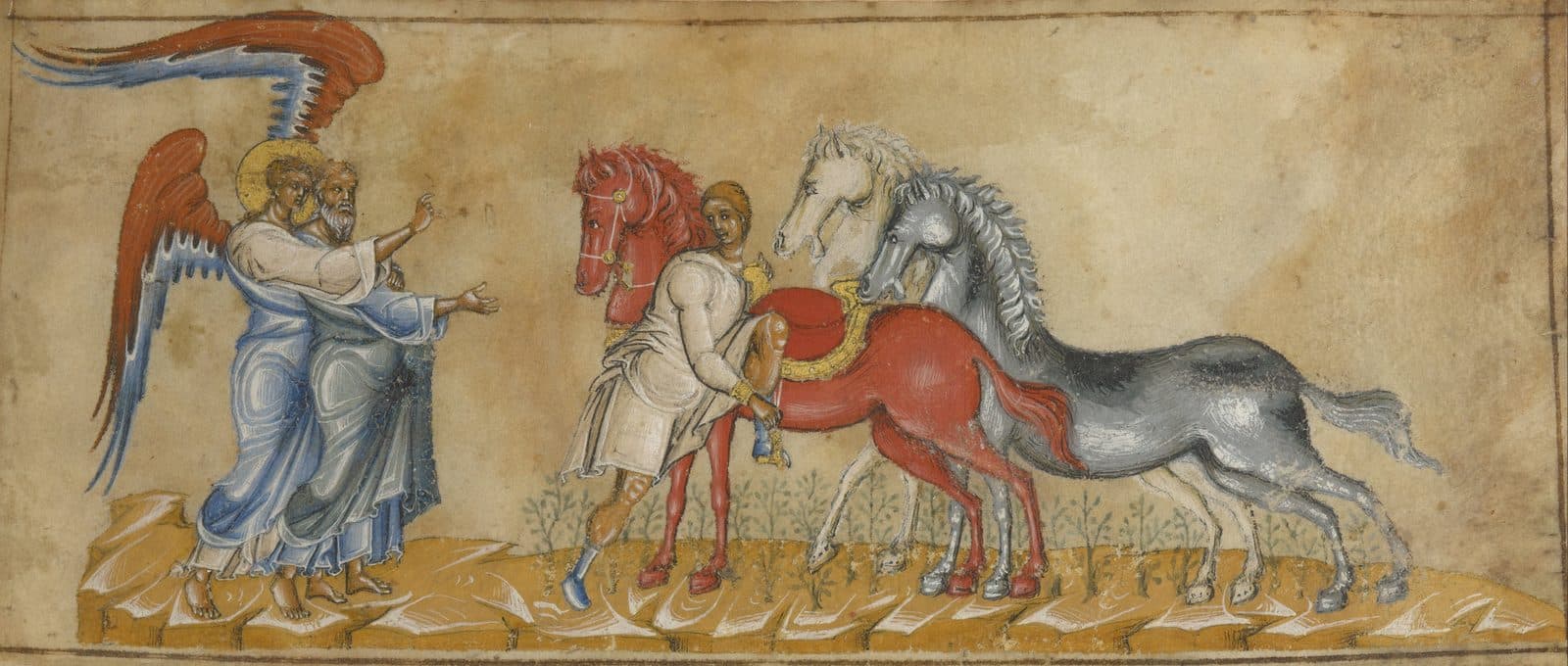
Unknown Sicilian painter, The Vision of Zechariah, about 1300, tempera and gold on parchment, J. Paul Getty Museum, MS. 35, leaf 2. Public domain, via Wikimedia Commons.
THE ARTWORKA painter in Sicily set Zechariah and the angel at the left of a page from a book of the prophets. The angel points to the man mounting the red horse among the myrtles, the first scene of the night.
The riders sent through the earth came back to report that the whole earth was at rest, while the house of the LORD in Jerusalem was still unfinished.
Summary
On the twenty-fourth of Shebat in the second year of Darius, Zechariah saw eight visions in the night, and an angel who spoke with him answered his questions.
- By the Babylonian calendar tables the night fell on 15 February 519 BC.
- The foundation of the temple had been laid two months before, and the house was finished four years later.
- Readers divide over who rides the red horse and over where the promises to Jerusalem land.
- After the visions a crown is set on Joshua, and the LORD speaks of a man named the Branch.
The Word on the Twenty-Fourth of Shebat
Zechariah 1:7 to 11, the date and the first vision
Zechariah dates the night himself, three months after his first word to the people.
On the twenty-fourth day of the eleventh month, the month of Shebat, in the second year of Darius, the word of the LORD came to the prophet Zechariah son of Berechiah, the son of Iddo.No other date is given from here to Zechariah 7:1, so all eight visions stand under this one.
I looked out into the night and saw a man riding on a red horse. He was standing among the myrtle trees in the hollow, and behind him were red, sorrel, and white horses. “What are these, my lord?” I asked. And the angel who was speaking with me replied, “I will show you what they are.”The angel who speaks with Zechariah, his guide through the visions that follow, is first heard here.
And the riders answered the angel of the LORD who was standing among the myrtle trees, “We have patrolled the earth, and behold, all the earth is at rest and tranquil.”The horsemen report to the angel of the LORD, who stands where Zechariah 1:8 placed the man on the red horse, so the two are one figure.
The Eight Visions in Order
What Zechariah saw in each vision and what he was told
| Vision | What Zechariah saw | What he was told | Verses |
|---|---|---|---|
| The rider among the myrtles | A man on a red horse among myrtle trees, with red, sorrel and white horses behind him | The LORD is very jealous for Jerusalem and will return to it with mercy, and His house will be rebuilt | Zechariah 1:8 to 17 |
| Four horns and four craftsmen | Four horns, and then four craftsmen | The horns scattered Judah, Israel and Jerusalem, and the craftsmen have come to throw them down | Zechariah 1:18 to 21 |
| The measuring line | A man going out to measure Jerusalem | Jerusalem will be a city without walls, and the LORD will be a wall of fire around it and the glory within it | Zechariah 2:1 to 13 |
| Joshua the high priest | Joshua in filthy garments before the angel of the LORD, with Satan at his right hand to accuse him | The LORD rebukes Satan, Joshua's iniquity is removed, and the LORD will bring His servant the Branch | Zechariah 3:1 to 10 |
| The lampstand and the two olive trees | A gold lampstand with seven lamps, and an olive tree on each side of it | The work stands by the LORD's Spirit, Zerubbabel will finish the house, and the trees are the two anointed ones | Zechariah 4:1 to 14 |
| The flying scroll | A flying scroll twenty cubits long and ten cubits wide | It is the curse going out over the land against the thief and the one who swears falsely | Zechariah 5:1 to 4 |
| The woman in the basket | A woman shut in a measuring basket under a lead cover, carried off by two women with wings like a stork's | She is Wickedness, and the basket is taken to a house built for it in the land of Shinar | Zechariah 5:5 to 11 |
| The four chariots | Four chariots with red, black, white and dappled horses, coming out from between two mountains of bronze | They are the four spirits of heaven, and those going north have given rest to the LORD's Spirit | Zechariah 6:1 to 8 |
- What Zechariah saw
- A man on a red horse among myrtle trees, with red, sorrel and white horses behind him
- What he was told
- The LORD is very jealous for Jerusalem and will return to it with mercy, and His house will be rebuilt
- Verses
- Zechariah 1:8 to 17
- What Zechariah saw
- Four horns, and then four craftsmen
- What he was told
- The horns scattered Judah, Israel and Jerusalem, and the craftsmen have come to throw them down
- Verses
- Zechariah 1:18 to 21
- Vision
- The measuring line
- What Zechariah saw
- A man going out to measure Jerusalem
- What he was told
- Jerusalem will be a city without walls, and the LORD will be a wall of fire around it and the glory within it
- Verses
- Zechariah 2:1 to 13
- Vision
- Joshua the high priest
- What Zechariah saw
- Joshua in filthy garments before the angel of the LORD, with Satan at his right hand to accuse him
- What he was told
- The LORD rebukes Satan, Joshua's iniquity is removed, and the LORD will bring His servant the Branch
- Verses
- Zechariah 3:1 to 10
- What Zechariah saw
- A gold lampstand with seven lamps, and an olive tree on each side of it
- What he was told
- The work stands by the LORD's Spirit, Zerubbabel will finish the house, and the trees are the two anointed ones
- Verses
- Zechariah 4:1 to 14
- Vision
- The flying scroll
- What Zechariah saw
- A flying scroll twenty cubits long and ten cubits wide
- What he was told
- It is the curse going out over the land against the thief and the one who swears falsely
- Verses
- Zechariah 5:1 to 4
- Vision
- The woman in the basket
- What Zechariah saw
- A woman shut in a measuring basket under a lead cover, carried off by two women with wings like a stork's
- What he was told
- She is Wickedness, and the basket is taken to a house built for it in the land of Shinar
- Verses
- Zechariah 5:5 to 11
- Vision
- The four chariots
- What Zechariah saw
- Four chariots with red, black, white and dappled horses, coming out from between two mountains of bronze
- What he was told
- They are the four spirits of heaven, and those going north have given rest to the LORD's Spirit
- Verses
- Zechariah 6:1 to 8
From the Myrtles to the Chariots
Zechariah 1:12 to 6:8, from Jerusalem to the land of the north
The first vision ends on a plea and its reply.
Then the angel of the LORD said, “How long, O LORD of Hosts, will You withhold mercy from Jerusalem and the cities of Judah, with which You have been angry these seventy years?”The seventy years are the span Jeremiah set for the desolation of the land, so the time of anger has run its course.
Then the angel who was speaking with me said, “Proclaim this word: This is what the LORD of Hosts says: ‘I am very jealous for Jerusalem and Zion,The LORD's jealousy for Jerusalem is the ground of every promise in the later visions.
“Shout for joy and be glad, O Daughter of Zion, for I am coming to dwell among you,” declares the LORD.The LORD promises to dwell in the city Himself, the glory within it that Zechariah 2:5 names.
The land of the north is Babylon: earlier in the night the LORD calls the exiles to flee from it, and in the next breath He names it the Daughter of Babylon.
Then the LORD summoned me and said, “Behold, those going to the land of the north have given rest to My Spirit in the land of the north.”The LORD's own word ends the eighth vision, with His purpose done in Babylon itself.
The priest and the governorZechariah 3:4 and Zechariah 4:6
So the angel said to those standing before him, “Take off his filthy clothes!” Then he said to Joshua, “See, I have removed your iniquity, and I will clothe you with splendid robes.”The priest must be made clean before he can serve, so the cleansing comes before the crown of Zechariah 6:11.
So he said to me, “This is the word of the LORD to Zerubbabel: Not by might nor by power, but by My Spirit, says the LORD of Hosts.The governor who laid the foundation is told where the strength to finish the house will come from.
How the first and the last visions answer each otherZechariah 1:10 and Zechariah 6:7
Only these two visions have horses, and in both the horses patrol the earth.
Then the man standing among the myrtle trees explained, “They are the ones the LORD has sent to patrol the earth.”The man on the red horse explains here who the horses are, as the angel explains the chariots in the last vision.
As the strong horses went out, they were eager to go and patrol the earth; and the LORD said, “Go and patrol the earth.” So they patrolled the earth.Here the horses go out at a command, the last time horses appear in the night.
What the Text Says in Three Details
The scroll, Shinar and two Hebrew words
THE SCROLL HAS A KNOWN SIZE
The portico at the front of Solomon's temple was twenty cubits by ten, the measure of the flying scroll.
AN OLD NAME FOR BABYLONIA
Genesis names Shinar, where the basket is taken, as the plain where the builders of Babel settled.
TWO RENDERINGS OF THE HEBREW
At Zechariah 5:6 the Hebrew reads their eye, where the Berean reads their iniquity. At Zechariah 6:6 it sends the white horses after them, where the Berean reads toward the west.
The Builders and the Years
The return, the halt, the foundation and the finished house
Cyrus king of Persia let the exiles go home in his first year, and the builders laid the foundation of the temple before the work was halted.
By the Babylonian tables the foundation was laid again on 18 December 520 BC, in the ninth month of Darius's second year.
The same tables put the day the temple was finished at 12 March 515 BC.
Joshua was the son of Jehozadak, the priest who went into captivity when the LORD sent Judah into exile by the hand of Nebuchadnezzar.
The halt and the foundationEzra 4:24 and Haggai 2:18
Thus the construction of the house of God in Jerusalem ceased, and it remained at a standstill until the second year of the reign of Darius king of Persia.This is the halt Haggai and Zechariah were sent to end, as Ezra 5:1 to 2 records.
Consider carefully from this day forward—from the twenty-fourth day of the ninth month, the day the foundation of the LORD’s temple was laid—consider carefully:Haggai's promise of blessing falls on the twenty-fourth of the ninth month, two months to the day before the visions.
The finished house and the two leadersEzra 6:15 and Haggai 1:1
And this temple was completed on the third day of the month of Adar, in the sixth year of the reign of King Darius.Ezra counts the finish by the years of Darius, the reckoning Zechariah used for the night.
In the second year of the reign of Darius, on the first day of the sixth month, the word of the LORD came through Haggai the prophet to Zerubbabel son of Shealtiel, governor of Judah, and to Joshua son of Jehozadak, the high priest, statingHaggai's first word comes two months before Zechariah's first, so the two prophets speak to one generation side by side.
How the Targum and the Rabbis Read the Night
Three Jewish readings, from about 150 BC to AD 1105
Targum Jonathan is the Aramaic rendering of the Prophets that was read verse by verse beside the Hebrew in the synagogue. Sefaria dates it between about 150 BC and AD 350.
It renders the Branch of Zechariah 3:8 as my servant the Messiah. At Zechariah 6:12 it renders the man whose name is the Branch as the man whose name is Messiah.
The Babylonian Talmud was compiled in Babylonia between about AD 450 and 550. In tractate Sanhedrin 93a it reads the myrtle trees of the first vision as the righteous, and names Hananiah, Mishael and Azariah.
Rashi, Rabbi Shlomo Yitzchaki of Troyes in France (1040 to 1105), reads the myrtles in the hollow as the myrtle trees of Babylon. He reads the two anointed ones of Zechariah 4:14 as the priesthood and the kingship, both anointed with the anointing oil.
What the Text Leaves Unsaid
The crowning's date, the colours, the horns, the inscription, the two names and the count
The text is silent on whether the crowning of Zechariah 6:9 to 15 came on the same night.
It leaves the meaning of the myrtles and of the colours of the horses unexplained.
It leaves the four horns unnamed.
It gives no words for the inscription on the stone set before Joshua.
It calls the two of Zechariah 4:14 the anointed ones, in the Hebrew the sons of fresh oil, and gives them no personal names.
It gives the visions no numbers; the count of eight belongs to its readers.
A Priest on His Throne
Zechariah 6:9 to 15, the Branch, and the night in Hebrews and Revelation
Zechariah is told to make an ornate crown from the silver and gold of three exiles who had come from Babylon. The crown goes on Joshua's head.
And you are to tell him that this is what the LORD of Hosts says: ‘Here is a man whose name is the Branch, and He will branch out from His place and build the temple of the LORD. Yes, He will build the temple of the LORD; He will be clothed in splendor and will sit on His throne and rule. And He will be a priest on His throne, and there will be peaceful counsel between the two.’One man here holds the two offices that Joshua and Zerubbabel held apart, the priest's and the ruler's.
The Branch in JeremiahJeremiah 23:5
The Branch is the Hebrew tsemach, a sprout.
Behold, the days are coming, declares the LORD, when I will raise up for David a righteous Branch, and He will reign wisely as King and will administer justice and righteousness in the land.Jeremiah gave the name to the coming king of David's line before Zechariah used it, so the Branch of the crowning is that king.
Hebrews and RevelationHebrews 8:1 and Revelation 11:4
The point of what we are saying is this: We do have such a high priest, who sat down at the right hand of the throne of the Majesty in heaven,The priest of this verse sits enthroned, as Zechariah 6:13 says the Branch will.
These witnesses are the two olive trees and the two lampstands that stand before the Lord of the earth.John draws his two witnesses with the image of the fifth vision, so the anointed pair of Zechariah 4:14 stands again in the last days.
John Calvin on the Night Visions
Two passages from his lectures on Zechariah.
On the third vision and the eighthIn John Owen's translation of 1849
On the third vision Calvin answers why an angel is called a man.
“Hence Zechariah says, that he saw in the hand of a man a measuring line. He calls him a man, who appeared in the form of man; and it is well known, and a common thing, that angels are called men. For though they put on a human form only for a time, yet as it was the Lord's will that they should be seen in that form, they are called men, though with no propriety.”
John Calvin · Commentaries · on Zechariah 2:1Reformed
For the eighth vision he gives his rule for obscure visions.
“But as the vision is obscure, interpreters have given it different meanings. They who think that the four Gospels are designated by the four chariots, give a very frigid view. I have elsewhere reminded you, that we are to avoid these futile refinements which of themselves vanish away.”
John Calvin · Commentaries · on Zechariah 6:3Reformed
Four Questions and Who Holds Each Answer
One night or many, the rider, the fours, and where the promises land
One night or a seriesBaron, The Visions and Prophecies of Zechariah (1918); Calvin, lectures on Zechariah (1849)
Baron holds that the eight visions and the crowning were all shown to the prophet in one night, and he reads them as one design that leads up to the last days.
Calvin holds that time passed between some of them, and on the eighth vision he writes that they were not continued visions.
Then the angel who was speaking with me returned and woke me, as a man is awakened from his sleep.The case for intervals rests on this opening of the fifth vision: the prophet had to be woken, which its holders take as time passed since the fourth vision.
Who rides the red horseBaron (1918); Calvin (1849); Rashi on Zechariah 1:8; Sanhedrin 93a
Baron identifies the rider as the angel of the LORD, the second person of the Trinity before the incarnation.
Calvin allows that reading, and writes that to regard this angel as Christ is consistent with the common usage of Scripture.
Rashi reads the rider as an angel, and the Talmud in Sanhedrin 93a reads him as the Holy One.
The objection to the rider as God Himself: at Zechariah 1:12 the angel of the LORD prays to the LORD of Hosts, so the two speak as two.
What the fours stand forRashi on Zechariah 6:1; Clarke, Commentary on the Bible (1832); Calvin (1849)
Rashi reads the four chariots as the kingdoms of Babylon, Media, Greece and Edom, and Adam Clarke reads them as four monarchies or empires.
Calvin reads the four horns as enemies from the four quarters of the world and sets the four monarchies aside.
The objection to the empires: the text names no kingdom, and the chariots go out by directions, toward the land of the north, toward the west and toward the south.
Where the promises landSpurgeon, Sermon 604, The Man with the Measuring Line (1864); Calvin (1849)
Spurgeon reads the promises of the night as promises to the city of Jerusalem, still to be kept: Jerusalem is spoken of and Jerusalem is meant. MannaFest's own Wesleyan-Pentecostal, premillennial tradition reads them the same way.
Calvin reads them as kept in the kingdom of Christ and His church, since he finds no time between the return and Christ when Judah's enemies became its prey.
That reading has to take the places named in the verse below as figures of the church.
And the LORD will take possession of Judah as His portion in the Holy Land, and He will once again choose Jerusalem.Judah and Jerusalem are named here as places, the ground on which Spurgeon keeps the promise with the city.
Books to Read Next
Three works on the visions and their dates
Commentaries on the Twelve Minor Prophets, volume 5: Zechariah and Malachi
John Calvin, translated by John Owen · 1849
Owen's translation gives Calvin's reading of every verse of the book.
Read it free at CCELThe Visions and Prophecies of Zechariah
David Baron · 1918
Baron gives a chapter to each vision and to the crowning that follows.
Read it free at the Internet ArchiveBabylonian Chronology, 626 B.C. to A.D. 45
Richard A. Parker and Waldo H. Dubberstein · 1942
Its tables turn the dates of the Persian kings into the dates of our calendar.
Read it free at the Internet ArchiveReturn to Me
Before the night the LORD told the people, Return to Me and I will return to you. In the night He answers that call Himself.
The night asks a small and tired people to trust the LORD's Spirit with the work. It points past Joshua to Jesus Christ.
Keep studying
People1
Symbols2