
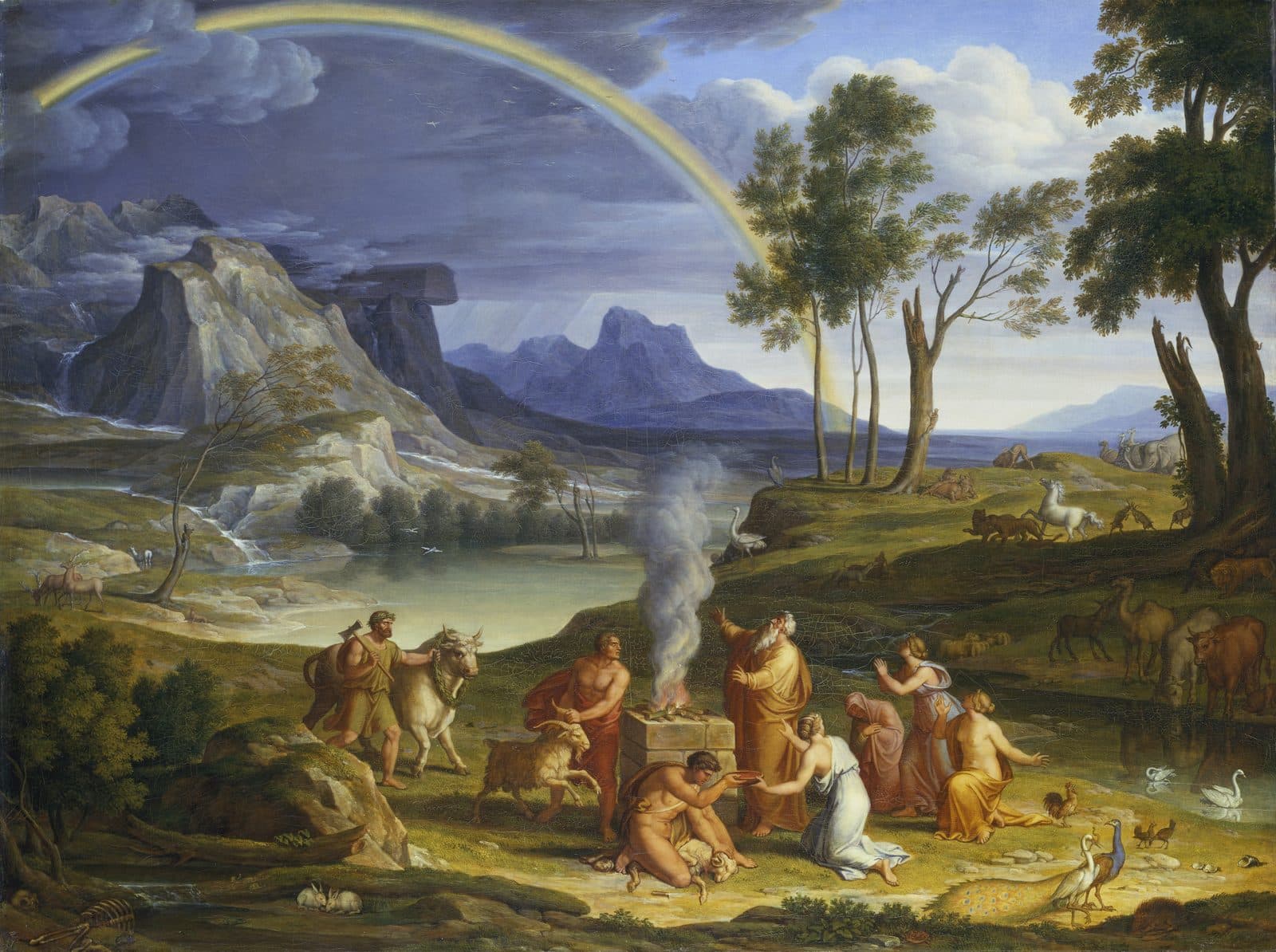
Joseph Anton Koch and Gottlieb Schick, Landscape with Noah's Thank Offering, 1803. Public domain.
Genesis 9 to Hebrews 8 · Doctrine · Featured Study
The Covenants
Each covenant has its sign, from the bow in the cloud to the cup of the Last Supper.
Five covenants carry God's promise from Noah to Christ, and each covenant builds on the last.
And I establish My covenant with you: Never again will all life be cut off by the waters of a flood; never again will there be a flood to destroy the earth.”
- First taught
- Genesis 6:18 “But I will establish My covenant with you,…”
- Fullest statement
- Hebrews 8:6 to 13 “Now, however, Jesus has received a much more…”
- Confessed by
- Reformed, Dispensational, Baptist
Five covenants carry God's promise from Noah to Christ, and each covenant builds on the last.
Summary
A covenant in Scripture is a binding promise sealed by an oath.
- The Hebrew word for covenant, berith, first appears at Genesis 6:18, in God's promise to Noah.
- In Genesis 15 God alone passes between the divided animals, so the promise to Abram rests on God's own oath.
- At Sinai God sets blessings on Israel if it keeps the law and curses if it breaks the law.
- Jeremiah promises a new covenant written on the heart, and Jesus calls the cup the new covenant in His blood.
- Three traditions read these texts and part over how God keeps His word on the land and the throne.
Six texts where God makes covenant
The texts run from the flood to the last years before Jerusalem fell.
And I establish My covenant with you: Never again will all life be cut off by the waters of a flood; never again will there be a flood to destroy the earth.”This covenant asks nothing of Noah in return, so it stands on God's word alone.
When the sun had set and darkness had fallen, behold, a smoking firepot and a flaming torch appeared and passed between the halves of the carcasses. On that day the LORD made a covenant with Abram, saying, “To your descendants I have given this land—from the river of Egypt to the great River Euphrates— the land of the Kenites, Kenizzites, Kadmonites, Hittites, Perizzites, Rephaites, Amorites, Canaanites, Girgashites, and Jebusites.”This is the first covenant Scripture shows cut with a rite of divided animals.
I will establish My covenant as an everlasting covenant between Me and you and your descendants after you, to be your God and the God of your descendants after you.Leviticus 26:12 and Jeremiah 31:33 repeat this promise, to be their God.
So Moses took the blood, sprinkled it on the people, and said, “This is the blood of the covenant that the LORD has made with you in accordance with all these words.”Hebrews 9:18 says that even the first covenant was not put into effect without blood.
Your house and kingdom will endure forever before Me, and your throne will be established forever.”Psalm 89:3 and 2 Samuel 23:5 call this promise to David a covenant.
“But this is the covenant I will make with the house of Israel after those days, declares the LORD. I will put My law in their minds and inscribe it on their hearts. And I will be their God, and they will be My people.This oracle is the one place in the Old Testament that names a new covenant.
Read in order, the six texts narrow from every living creature to one family, one nation and one royal house.
When the sun had set and darkness had fallen, behold, a smoking firepot and a flaming torch appeared and passed between the halves of the carcasses. On that day the LORD made a covenant with Abram, saying, “To your descendants I have given this land—from the river of Egypt to the great River Euphrates— the land of the Kenites, Kenizzites, Kadmonites, Hittites, Perizzites, Rephaites, Amorites, Canaanites, Girgashites, and Jebusites.”This is the first covenant Scripture shows cut with a rite of divided animals.
I will establish My covenant as an everlasting covenant between Me and you and your descendants after you, to be your God and the God of your descendants after you.Leviticus 26:12 and Jeremiah 31:33 repeat this promise, to be their God.
So Moses took the blood, sprinkled it on the people, and said, “This is the blood of the covenant that the LORD has made with you in accordance with all these words.”Hebrews 9:18 says that even the first covenant was not put into effect without blood.
Your house and kingdom will endure forever before Me, and your throne will be established forever.”Psalm 89:3 and 2 Samuel 23:5 call this promise to David a covenant.
“But this is the covenant I will make with the house of Israel after those days, declares the LORD. I will put My law in their minds and inscribe it on their hearts. And I will be their God, and they will be My people.This oracle is the one place in the Old Testament that names a new covenant.
Read in order, the six texts narrow from every living creature to one family, one nation and one royal house.
Exodus 24:8, 2 Samuel 7:16, Jeremiah 31:33, Genesis 9:11
Five covenants, each with its texts, its sign and its mediator
Genesis, Exodus, 2 Samuel and Jeremiah hold the first texts of the five covenants.
- First and fullest text
- Genesis 6:18; Genesis 9:8 to 17
- Sign
- the bow in the cloud
- Mediator
- Noah
- First and fullest text
- Genesis 12:1 to 3; Genesis 17:1 to 14
- Sign
- circumcision
- Mediator
- Abraham
- First and fullest text
- Exodus 19:5 to 6; Deuteronomy 28
- Sign
- the Sabbath
- Mediator
- Moses
- First and fullest text
- 2 Samuel 7:12 to 16; Psalm 89:28 to 37
- Sign
- the throne, an emblem established forever
- Mediator
- David, through Nathan
5New
- First and fullest text
- Jeremiah 31:31 to 34; Hebrews 8:6 to 13
- Sign
- the cup of the Last Supper
- Mediator
- Christ
God also made a covenant of lasting priesthood with Phinehas (Numbers 25:12 to 13). It belongs with the covenants of Scripture and stands outside this chain of five.
Thirteen threads from the covenant texts into the rest of Scripture (1 table)1 table or figure
Four of the thirteen threads end in Hebrews, more than in any other book.
| From | To | What the later text does with it |
|---|---|---|
| Genesis 15:6 | Romans 4:3; Galatians 3:6; James 2:23 | Abram's faith credited to him as righteousness is quoted three times, as the charter of justification by faith. |
| Genesis 17:11 | Romans 4:11 | Paul reads circumcision as a seal of the righteousness Abraham had by faith before he was circumcised. |
| Genesis 17:10 | Colossians 2:11 to 12 | Circumcision in the flesh points to the circumcision of the heart that Christ performs. |
| 2 Samuel 7:14 | Hebrews 1:5 | God's promise to be a Father to David's son is applied to the Son of God, with Psalm 2:7. |
| 2 Samuel 7:12 | Acts 2:30 | Peter reads the promise of David's throne as kept in the risen and enthroned Christ (Acts 2:29 to 36). |
| Jeremiah 31:31 | Hebrews 8:8 | Hebrews quotes the whole oracle of Jeremiah 31:31 to 34, the longest Old Testament quotation in the New Testament. |
| Jeremiah 31:33 | Hebrews 10:16 | Hebrews quotes the law written on the heart again, to show that the new covenant makes the worshipper perfect. |
| Jeremiah 31:33 | Ezekiel 36:26 | The new heart and the Spirit within, and the law written on the heart, are the two great promises of the new covenant, and each explains the other. |
| Exodus 24:8 | Hebrews 9:20 | Hebrews quotes Moses' words over the blood of the covenant as the shadow of the blood of Christ (Hebrews 9:18 to 20). |
| Exodus 19:6 | 1 Peter 2:9 | Peter gives Israel's calling, a kingdom of priests and a holy nation, to the church. |
| Genesis 9:13 | Revelation 4:3 | The bow after the flood is seen again as the rainbow around the throne. Jonathan Edwards read it as a figure in Images of Divine Things, a reading of the church's tradition. |
| Genesis 16 and 21 | Galatians 4:24 | Paul sets two covenants side by side: Hagar and Sinai in slavery, and Sarah and the Jerusalem above in freedom. |
| Exodus 34:29 to 35 | 2 Corinthians 3:6 | Paul calls the apostles ministers of a new covenant, not of the letter but of the Spirit, set against Moses' veiled face. |
Jeremiah 31:33, Jeremiah 31:33, Exodus 24:8, Exodus 19:6, Genesis 9:13, Genesis 16 and 21, Exodus 34:29 to 35
From the first cutting to the cup
The covenant moves from Abram to Sinai, to David, and to the new covenant.
In Genesis 15 God passes between the pieces while Abram sleeps. Hebrews 6:13 gives the reason the promise holds: since God had no one greater to swear by, He swore by Himself.
At Sinai the covenant takes the shape of a treaty with terms, and Israel promises to keep them (Exodus 24:7). Jeremiah 31:32 records that Israel broke it.
With David the promise passes to a son of his line (2 Samuel 7:12 to 16).
Jeremiah then promises a new covenant, with the law written on the heart and sins remembered no more. At the Last Supper Jesus takes the cup and calls it the new covenant in His blood (Luke 22:20). Paul reads the seed promised to Abraham as One, who is Christ (Galatians 3:16). He says the law that came 430 years later does not revoke the covenant previously established by God (Galatians 3:17).
The promise to David, element by element (1 table)1 table or figure
Charles Ryrie holds in Dispensationalism (2007) that two of the five, the throne forever and the house forever, wait for Christ's return and His eternal kingdom.
| Element | The promise to David | Where it is kept |
|---|---|---|
| Throne | The throne of David's offspring will be established forever (2 Samuel 7:13 and 2 Samuel 7:16). | Luke 1:32, where the angel tells Mary that God will give Jesus the throne of His father David |
| House | David's house and kingdom will endure forever before God (2 Samuel 7:16). | Luke 1:33, where His kingdom will never end |
| Son | God will be a Father to David's offspring, and he will be God's son (2 Samuel 7:14). | Hebrews 1:5 |
| Discipline | God will discipline that son when he does wrong (2 Samuel 7:14). | Psalm 89:30 to 32, on the sons of David who forsake the law |
| Mercy | God's loving devotion will never be taken from him, as it was from Saul (2 Samuel 7:15). | Psalm 89:33 to 34, where God's loving devotion stays and His covenant stands |
Genesis 15, from the stars to the divided animals (2 verses, 1 quotation, 2 engravings)2 paintings, 1 quotation, 1 verse
And the LORD said to him, “Bring Me a heifer, a goat, and a ram, each three years old, along with a turtledove and a young pigeon.” So Abram brought all these to Him, split each of them down the middle, and laid the halves opposite each other. The birds, however, he did not cut in half.These verses prepare the rite that verse 17 completes.
“According to these ideas, which have been from time immemorial engraven on the minds of Eastern people, the Lord Himself condescended to enter into covenant with Abram. The patriarch did not pass between the sacrifice and the reason was that in this transaction he was bound to nothing.”
Jamieson, Fausset & Brown · Commentary Critical and Explanatory on the Whole Bible (1871), on Genesis 15:9-21Evangelical
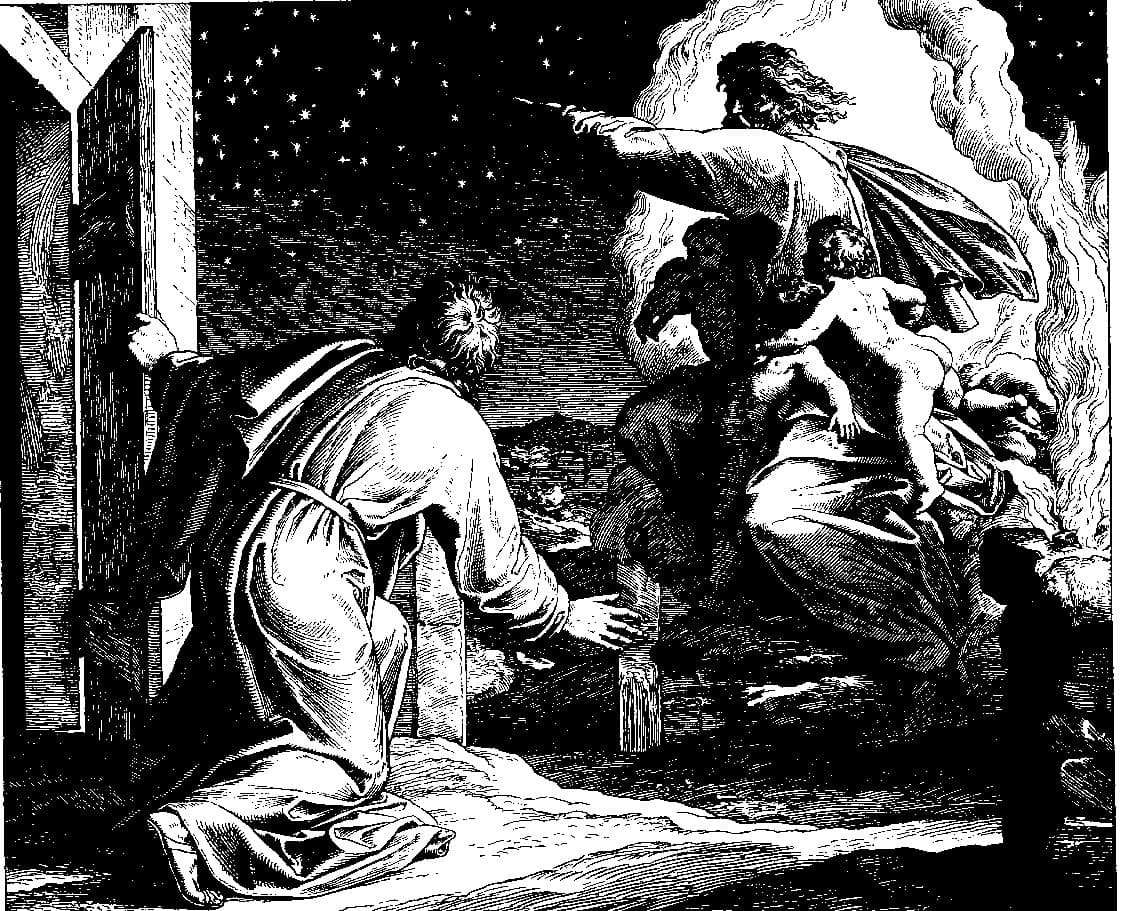
Julius Schnorr von Carolsfeld, The Covenant with Abram, Die Bibel in Bildern, 1860. Public domain.
Schnorr von Carolsfeld draws God showing Abram the stars, the promise of offspring that opens Genesis 15.
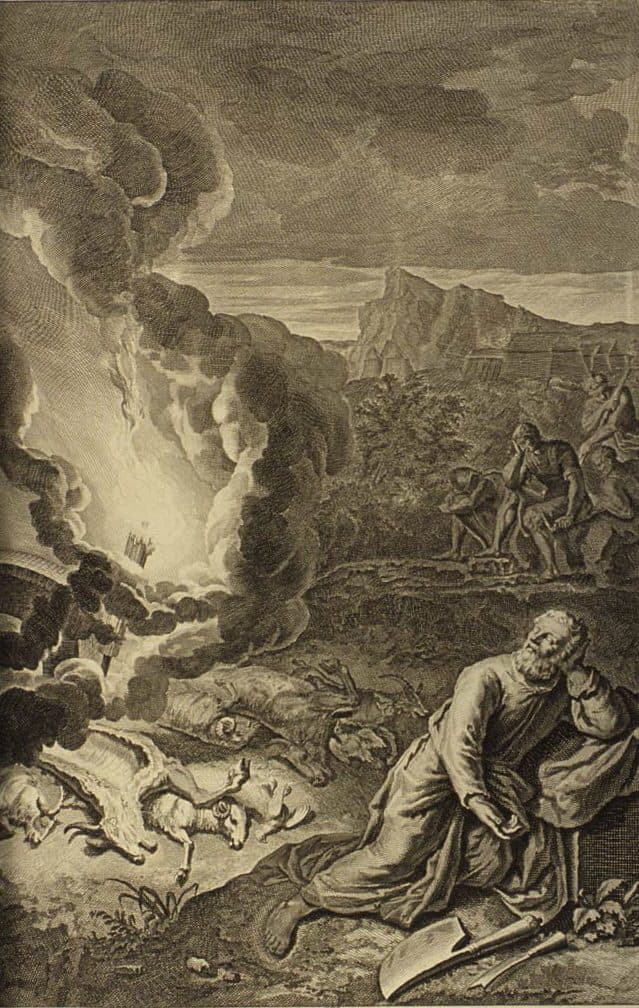
Gerard Hoet, A Deep Sleep Fell Upon Abram, Figures de la Bible, 1728. Public domain.
Hoet engraves Abram beside the divided animals as the smoke and the fire pass over them.
Royal grant and vassal treaty (2 forms)2 paragraphs
Moshe Weinfeld compared the covenants with two kinds of Ancient Near Eastern document. In a vassal treaty a great king binds a lesser king to terms under blessings and curses, the pattern of Sinai. In a royal grant a king gives land or a dynasty to a loyal servant as a lasting gift. That is the pattern of the covenants with Abraham and David.
Weinfeld set out the comparison in The Covenant of Grant in the Old Testament and in the Ancient Near East, Journal of the American Oriental Society 90 (1970).
Where the covenant lines meet in Christ (3 texts)3 verses, 2 paragraphs
Paul says the law merely brings awareness of sin (Romans 3:20) and came in so that the trespass would increase (Romans 5:20).
So the law became our guardian to lead us to Christ, that we might be justified by faith.Hebrews says the covenant Christ mediates is better and is founded on better promises, with better sacrifices (Hebrews 8:6 to 13; Hebrews 9:15 and Hebrews 9:23).
I will give you a new heart and put a new spirit within you; I will remove your heart of stone and give you a heart of flesh. And I will put My Spirit within you and cause you to walk in My statutes and to carefully observe My ordinances.Ezekiel spoke this promise to the exiles in Babylon in the same years as Jeremiah's oracle.
“This is the covenant I will make with them after those days, declares the Lord. I will put My laws in their hearts and inscribe them on their minds.” Then He adds: “Their sins and lawless acts I will remember no more.”Hebrews rests the end of sacrifice on this promise (Hebrews 10:18).
Karath berith: to cut a covenant
Scholars read the phrase two ways: as a self-curse in every covenant, or as an idiom whose root says little.
Karath berith is the Hebrew phrase for making a covenant, and the verb karath means to cut or to cut off. The phrase is used of covenants between God and people and between people.
Meredith Kline, in By Oath Consigned (1968), reads every covenant as an oath with a curse on the one who broke it. The divided animals carry that curse where the rite stands in the text, in Genesis 15 and in Jeremiah 34:18 to 20. In Jeremiah the leaders of Judah who walked between the halves of a calf are given over to their enemies.
Genesis 15 beside the standard rite of the Ancient Near East (1 table)1 table or figure
Delbert Hillers described the standard rite in Covenant: The History of a Biblical Idea (1969).
| Element | Genesis 15 | The standard rite |
|---|---|---|
| Verb | karath, to cut | karatu in Akkadian, from the same root |
| Animals | a heifer, a goat, a ram, a turtledove and a young pigeon | a bull, a sheep or a donkey |
| Division | the animals cut in half and the birds left whole | the animals cut in half |
| Path | God alone passes between the pieces | both parties pass between the pieces |
| Curse | taken on by God | taken on by both parties |
| Parties | God, with Abram asleep | both kings, present |
The root fallacy, and the Greek word diatheke (2 paragraphs)2 paragraphs
Most covenants in the Old Testament are made with no divided animals. Don Carson warns in Exegetical Fallacies against reading a word's meaning from its root alone.
The Greek word the New Testament uses is diatheke, which can mean a covenant or a will. Hebrews 9:16 to 17 uses the second sense: a will takes effect only when the one who made it has died.
The treaty world behind the covenants
Hittite treaties and the laws of Hammurabi are the nearest Ancient Near Eastern parallels to the covenant texts.
The six parts of the treaty form, and where Deuteronomy carries each (1 table, 1 photograph)1 table or figure, 1 painting
Viktor Korošec described the form in 1931, George Mendenhall set it beside the covenants of Israel in 1954, and Meredith Kline read Deuteronomy by it in 1963.
| Part | Treaty part | What it does | Deuteronomy |
|---|---|---|---|
| 1 | Preamble | names the great king and his titles | Deuteronomy 1:1 to 5 |
| 2 | Historical prologue | recounts the king's past kindness, so the vassal's duty rests on gratitude | Deuteronomy 1:6 to 4:49 |
| 3 | Stipulations | sets the terms the vassal must keep | Deuteronomy 5 to 26 |
| 4 | Deposit and public reading | stores the treaty in the sanctuary and reads it aloud at set times | Deuteronomy 27; Deuteronomy 31:9 to 13 |
| 5 | Witnesses | calls the gods to witness, and in Israel heaven and earth | Deuteronomy 30:19; Deuteronomy 32:1 |
| 6 | Blessings and curses | sets the rewards for keeping the treaty and the penalties for breaking it | Deuteronomy 27 to 28 |
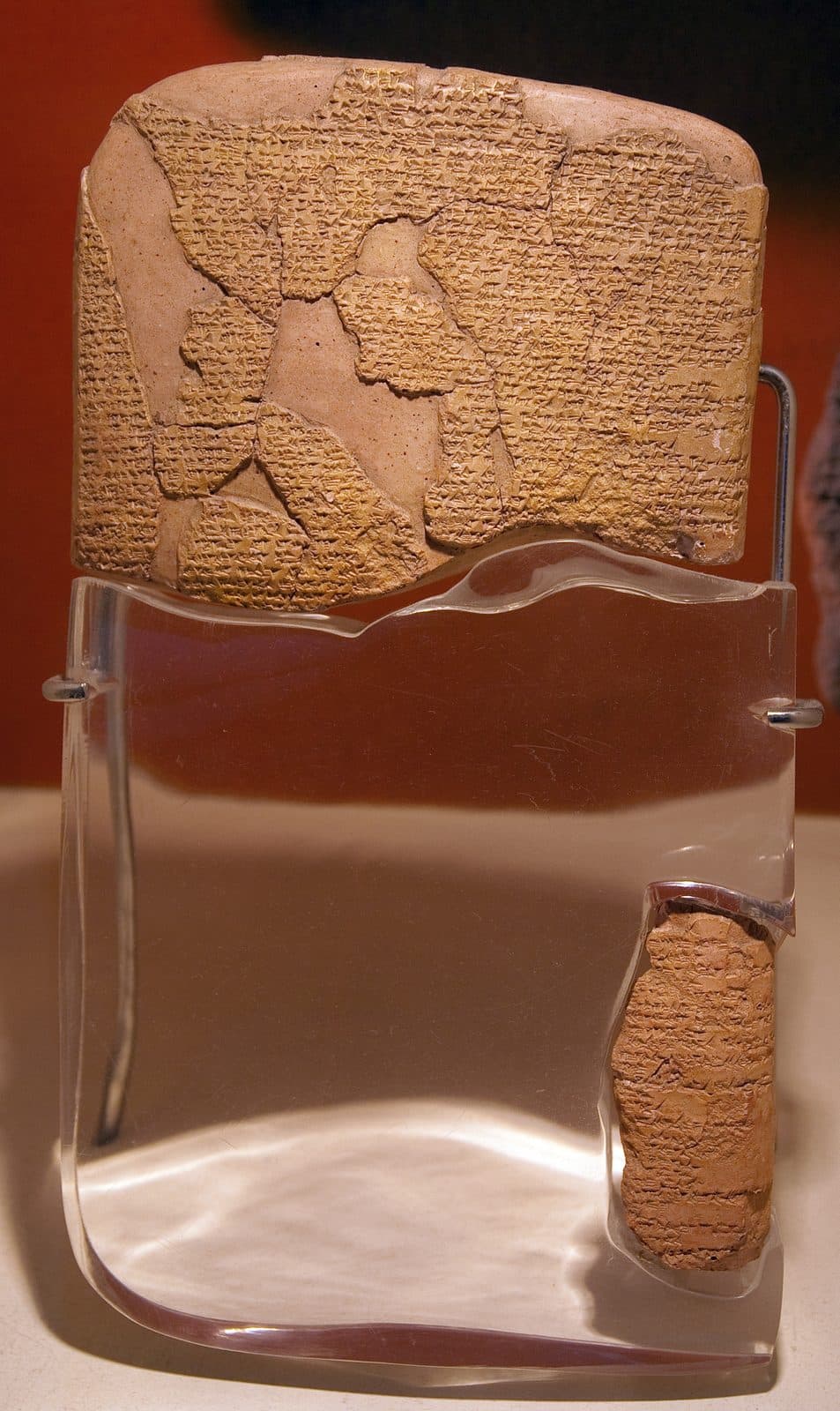
The Treaty of Kadesh tablet, Istanbul Archaeology Museums. Photograph by Iocanus, CC BY, Wikimedia Commons.
The tablet records the treaty between the Hittite king and Egypt of about 1259 BC, the oldest international treaty that survives.
Injury in the laws of Hammurabi and of Sinai (1 comparison)1 paragraph
The talion of the Covenant Code, eye for eye and tooth for tooth (Exodus 21:24), stands beside laws 196 and 197 of Hammurabi. Hammurabi's penalties differ by the social class of the one injured. The Torah sets the same standard of law for the foreign resident and the native (Leviticus 24:22), and Exodus 21:26 to 27 frees a slave who loses an eye.
Do the treaty parallels date Deuteronomy early? (2 readings)2 paragraphs
Kenneth Kitchen (2003) and Meredith Kline (1963) hold that the full six-part treaty form with a historical prologue belongs to the Hittite treaties of the second millennium BC. The Neo-Assyrian treaties of the first millennium drop the prologue and put the curses first. Deuteronomy has the prologue, so they date its form to the time of Moses.
Moshe Weinfeld, in Deuteronomy and the Deuteronomic School (1972), dates the form of Deuteronomy to the seventh century BC, citing close parallels in the Vassal Treaties of Esarhaddon (672 BC). Ernest Nicholson (1986) reads covenant as a late development in Israel's theology.
Three ways the traditions read the covenants
Covenant theology comes from the Reformed churches, progressive covenantalism from Baptist scholars, and dispensationalism from the Plymouth Brethren of the nineteenth century.
All three frameworks hold that the covenants find their goal in Christ.
| Framework | How it reads the covenants | Holders and works | Strongest objection | Tier |
|---|---|---|---|---|
| Covenant theology | One covenant of grace runs through every covenant after the fall, following a covenant of works with Adam. The promises of land and throne are fulfilled in Christ, His church and the new creation. | The Westminster Confession states it in chapter 7 (1646). Herman Witsius (The Economy of the Covenants, 1677), Palmer Robertson (The Christ of the Covenants, 1980) and Michael Horton (God of Promise, 2006) teach it. | Scripture never names a covenant of grace or a covenant of works. The land promised to Abraham's offspring is read as a type where the text does not call it one. | A |
| Dispensationalism | Each covenant stands on its own terms, and national Israel and the church stay distinct. The land and the throne promised to Israel are fulfilled literally in a kingdom still to come. | Cyrus Scofield (Scofield Reference Bible, 1909), Charles Ryrie (Dispensationalism, 2007), Craig Blaising and Darrell Bock (Progressive Dispensationalism, 1993) and Michael Vlach (Dispensationalism, 2008) teach it. | Paul calls Abraham heir of the world (Romans 4:13). Hebrews 11:16 says the patriarchs were longing for a better country, a heavenly one, so the land promise reads as enlarged in Christ. | A |
| Progressive covenantalism | The covenants unfold one plan that reaches its goal in Christ. The land and kingdom promises are fulfilled in Christ and the new creation, with no covenant of works and no separate future program for Israel. | Peter Gentry and Stephen Wellum argued it in Kingdom through Covenant (2012, second edition 2018). | Dispensational readers take Romans 11:26 to 29 as a promise to the nation still to be kept. | A |
The Westminster Confession on the covenant of grace (1 quotation)1 quotation
“Man by his fall having made himself incapable of life by that covenant, the Lord was pleased to make a second, commonly called the covenant of grace: wherein He freely offereth unto sinners life and salvation by Jesus Christ.”
Westminster Confession of Faith 7.3 · 1646, public domain
The two texts where the frameworks part (2 passages)2 verses
And so all Israel will be saved, as it is written: “The Deliverer will come from Zion; He will remove godlessness from Jacob. And this is My covenant with them when I take away their sins.” Regarding the gospel, they are enemies on your account; but regarding election, they are loved on account of the patriarchs. For God’s gifts and His call are irrevocable.For the promise to Abraham and his offspring that he would be heir of the world was not given through the law, but through the righteousness that comes by faith.How the covenants have been taught
Four voices across fourteen centuries, from Hippo to Scotland.
died 430 · Augustine of Hippo
Augustine of Hippo, a bishop in North Africa in the fifth century, answers why Jeremiah calls the covenant new.
“It is then on account of the offence of the old man, which was by no means healed by the letter which commanded and threatened, that it is called the old covenant; whereas the other is called the new covenant, because of the newness of the spirit, which heals the new man of the fault of the old. Then consider what follows, and see in how clear a light the fact is placed, that men who bare faith are unwilling to trust in themselves: ‘Because,’ says he, ‘this is the covenant which I will make with the house of Israel; After those days, saith the Lord, I will put my law in their inward parts, and write it in their hearts.’”
Augustine of Hippo · On the Spirit and the Letter 35 · on Jeremiah 31:31Patristic
1509 to 1564 · John Calvin
John Calvin, who led the Reformation in Geneva in the sixteenth century, takes up Paul's question, did God reject His people?
“This objection is what he anticipates in this passage, and he so modifies what he had previously said respecting the repudiation of the Jews, that no one might think that the covenant formerly made with Abraham is now abrogated, or that God had so forgotten it that the Jews were now so entirely alienated from his kingdom, as the Gentiles were before the coming of Christ.”
John Calvin · Commentaries · on Romans 11:1Reformed
1703 to 1791 · John Wesley
John Wesley, who led the Methodist revival in eighteenth-century England, gives a second answer to Augustine's question.
“Behold - And not only with the Jews, but all those who should be ingrafted into that Olive. It is not called the new covenant, because it was as to the substance new, for it was made with Abraham, Gen. xvii, 7, and with the Jews, Deut. xxvi, 17, 18, but because it was revealed after a new manner, more fully and particularly, plainly and clearly.”
John Wesley · Explanatory Notes upon the Old Testament · on Jeremiah 31:31Evangelical
1802 to 1910 · Jamieson, Fausset & Brown
Robert Jamieson, Andrew Fausset and David Brown, Scottish commentators of the nineteenth century, take up the question that parts the three frameworks.
“The new covenant is made with literal Israel and Judah, not with the spiritual Israel, that is, believers, except secondarily, and as grafted on the stock of Israel (Ro 11:16-27).”
Jamieson, Fausset & Brown · Commentary Critical and Explanatory on the Whole Bible (1871), on Jeremiah 31:31-34Evangelical
John Wesley, Jamieson, Fausset & Brown
Was there a covenant before Noah?
Both positions were first named in Reformed theology.
A covenant with Adam is a reading of Genesis 2:16 to 17 with Hosea 6:7.
| Position | Holders | Tradition | Strongest objection | Tier |
|---|---|---|---|---|
| God made a covenant with Adam in Eden, named the covenant of works, the Edenic covenant or the Adamic covenant. | Chapter 7.2 of the Westminster Confession calls it the covenant of works, and Geerhardus Vos (The Doctrine of the Covenant in Reformed Theology, 1891), Palmer Robertson and Michael Horton teach it. Cyrus Scofield named Edenic and Adamic covenants (1909). | Reformed, with some dispensational writers | The word berith does not appear in Genesis 1 to 3. Hosea 6:7 reads like Adam in the Berean Standard Bible; read as at Adam, it names a town by the Jordan. John Murray, in The Adamic Administration (1977), names Eden an administration of grace and declines the word covenant. | A |
| Before time the Father, the Son and the Spirit made a covenant of redemption: the Father gives a people to the Son, the Son undertakes redemption, and the Spirit applies it. | John Owen in The Death of Death in the Death of Christ, and Herman Witsius in The Economy of the Covenants. | Reformed | Dispensational and most other evangelical traditions hold no covenant of redemption as a distinct category. | A |
He who promised is faithful
Paul writes that all the promises of God are “Yes” in Christ (2 Corinthians 1:20).
Let us hold resolutely to the hope we profess, for He who promised is faithful.Hebrews makes this call straight after its teaching on the new covenant (Hebrews 8:1 to 10:18).
Sources
Scripture is the Berean Standard Bible.
- The Westminster Confession of Faith, chapter 7 (1646)
- Augustine of Hippo, On the Spirit and the Letter; John Calvin, Commentary on Romans; John Wesley, Explanatory Notes upon the Old Testament.
- Jamieson, Fausset and Brown, Commentary Critical and Explanatory on the Whole Bible (1871), on Genesis 15 and Jeremiah 31:31.
- The site's Hebrew and Greek word studies: berith (H1285), karath (H3772) and diatheke (G1242)
- Moshe Weinfeld, The Covenant of Grant in the Old Testament and in the Ancient Near East, Journal of the American Oriental Society 90 (1970)
- Donald A. Carson, Exegetical Fallacies (Baker, 1984; second edition 1996)
- Cyrus I. Scofield, The Scofield Reference Bible (1909)
- Herman Witsius, The Economy of the Covenants between God and Man (1677)
- O. Palmer Robertson, The Christ of the Covenants (1980)
- Michael Horton, God of Promise: Introducing Covenant Theology (2006)
- Charles Ryrie, Dispensationalism (Moody, 2007)
- Craig Blaising and Darrell Bock, Progressive Dispensationalism (1993)
- Michael Vlach, Dispensationalism: Essential Beliefs and Common Myths (2008)
- Peter Gentry and Stephen Wellum, Kingdom through Covenant (Crossway, 2012; second edition 2018)
- Jonathan Edwards, Images of Divine Things (written 1728 to 1758)
- John Owen, The Death of Death in the Death of Christ (1647)
- Geerhardus Vos, The Doctrine of the Covenant in Reformed Theology (1891)
- The Code of Hammurabi, translated by L. W. King (1915), public domain.
- Ernest W. Nicholson, God and His People: Covenant and Theology in the Old Testament (Oxford, 1986)
- Kenneth A. Kitchen, On the Reliability of the Old Testament (Eerdmans, 2003)
- Meredith G. Kline, Treaty of the Great King (Eerdmans, 1963)
- George E. Mendenhall, Law and Covenant in Israel and the Ancient Near East (1955; first in The Biblical Archaeologist 17, 1954), after Viktor Korošec, Hethitische Staatsverträge (1931)
- Delbert R. Hillers, Covenant: The History of a Biblical Idea (Johns Hopkins, 1969)
- John Murray, The Adamic Administration, in Collected Writings, volume 2 (Banner of Truth, 1977)
- Moshe Weinfeld, Deuteronomy and the Deuteronomic School (Oxford, 1972)
- Meredith G. Kline, By Oath Consigned (Eerdmans, 1968)
Keep Studying
Studies18
Doctrines24
- The Scarlet Thread
- The Abrahamic Covenant
- Chesed, the Loyalty No Law Compels
- The Edenic Covenant
- Hesed, the LORD's Loving Devotion
- Israel and the Olive Tree: Romans 9-11