
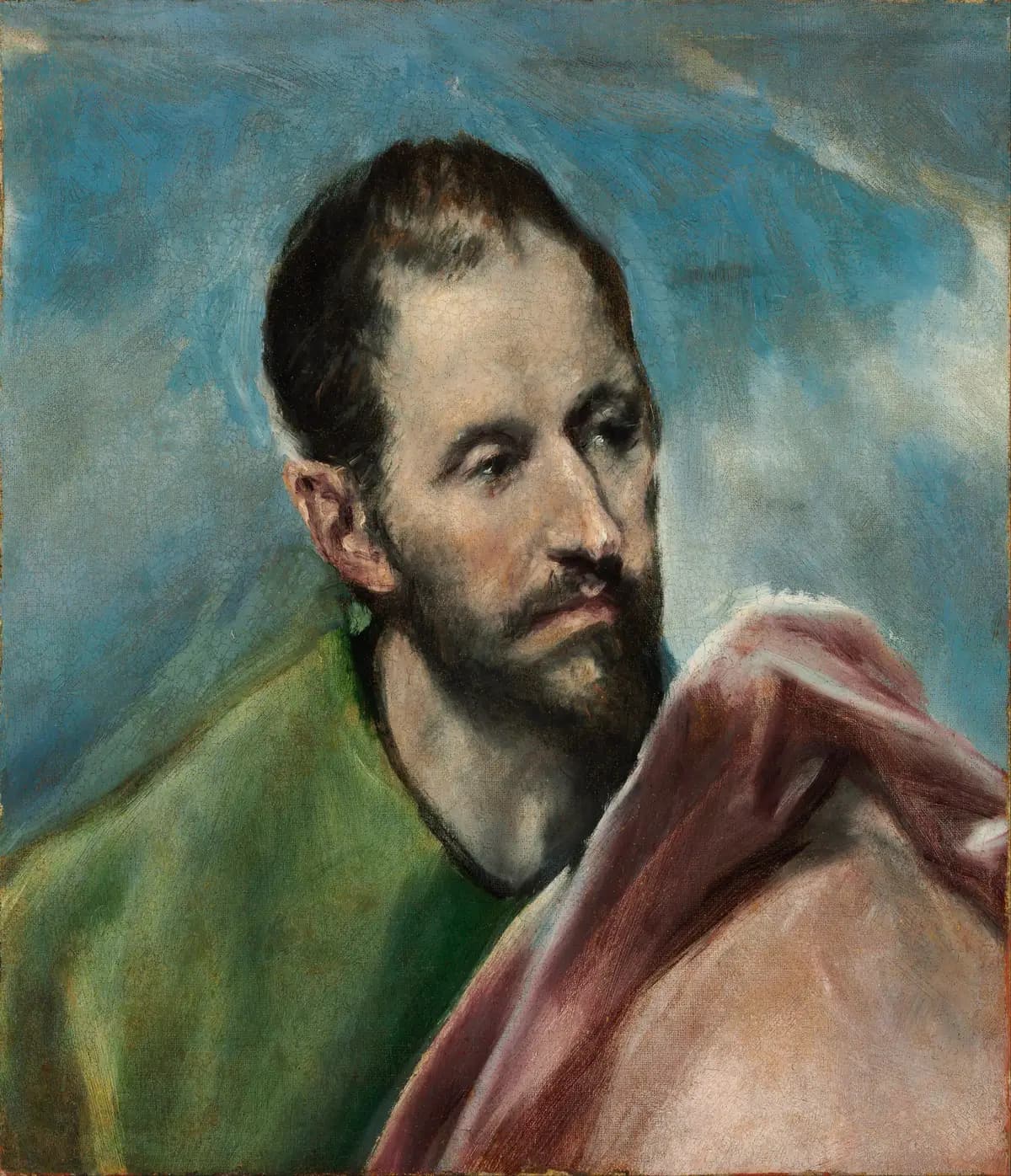
Saint James the Younger, El Greco, 1600. Public domain.
New Testament · Book 59 of 66
James
James is a letter from James to the twelve tribes scattered abroad, full of practical teaching for daily life. He writes about trials, the tongue, care for the poor, and a faith that shows itself in works.
James is a letter from James to the twelve tribes scattered abroad, full of practical teaching for daily life. He writes about trials, the tongue, care for the poor, and a faith that shows itself in works.
What is James about?
James is a letter of five chapters from James, a servant of God, to the twelve tribes scattered in the Dispersion. It opens with joy in trials and with wisdom asked of God, who gives generously, and it asks one thing of every reader: “Be doers of the word, and not hearers only” (1:22). It then tests faith in four places: the poor man shamed in the meeting, the tongue no man can tame, friendship with the world, and patience and prayer until the Lord comes. It ends with the call to bring back a brother who wanders.
All 5 chapters
Every chapter of the book, in one grid. Each cell opens that chapter.
- Trials and the wordChapter 1
- Faith and worksChapter 2
- The tongue and the two wisdomsChapter 3
- Friendship with the worldChapter 4
- Patience and prayerChapter 5
The colour is the movement of the letter the chapter stands in, one movement to a chapter, and every cell opens that chapter's Study level.
Who wrote it, where, when, for whom, and why?
The letter opens with its writer's name and no title but servant: James, a servant of God and of the Lord Jesus Christ (1:1). He counts himself among the teachers who will be judged more strictly (3:1). The New Testament names a James as the brother of the Lord (Galatians 1:19), a witness of the risen Christ (1 Corinthians 15:7) and the man who gave the ruling at the council in Jerusalem (Acts 15:13 to 19).
James, a servant of God and of the Lord Jesus Christ, To the twelve tribes of the Dispersion: Greetings.
James 1:1, Berean Standard Bible.
The letter is sent out to the twelve tribes in the Dispersion (1:1). Its pictures come from the land: the meeting where the rich man is seated (2:2), the fields and the harvesters (5:4), the farmer waiting for the fall and spring rains (5:7), and the fig tree, the olive and the vine (3:12).
The letter speaks of the Lord's coming as near and the Judge as standing at the door (5:8 to 9), and it says the rich have hoarded treasure in the last days (5:3). Acts names James in Jerusalem after Peter's release (Acts 12:17) and at the council (Acts 15:13).
The readers are the twelve tribes in the Dispersion (1:1), called brothers thirteen times. They meet in an assembly (2:2), know the law (2:8 to 11), and know Abraham, Rahab, Job and Elijah by name. Some are poor and dragged into court by the rich (2:6), some trade from city to city (4:13), and some are workmen whose wages are withheld (5:4).
The letter gives its reason in its commands. The readers are to count trials as joy (1:2), to be doers of the word and not hearers only (1:22), to show no favouritism (2:1), to prove their faith by their deeds (2:18), to submit to God (4:7), and to wait with patience for the Lord (5:7). It ends by calling them to bring back any who wander from the truth (5:19 to 20).
The world of the letter is one of landowners and day labourers. The rich wear gold rings and fine clothes (2:2), take the poor to court (2:6) and hold back wages (5:4); merchants plan a year of business abroad (4:13). The sick call the elders of the church (5:14), and oaths are sworn by heaven and by earth (5:12).
Sources. James 1:1, 1:2, 1:22, 2:1, 2:2, 2:6, 2:8 to 11, 2:18, 3:1, 3:12, 4:7, 4:13, 5:3, 5:4, 5:7 to 9, 5:12, 5:14 and 5:19 to 20; Galatians 1:19; 1 Corinthians 15:7; Acts 12:17 and 15:13 to 19. Every verse is read in the Berean Standard Bible.
How is James arranged, and what is it for?
The five movements, one to a chapter, then what the letter teaches and what it was written to do.
- Trials and the wordChapter 1, 27 verses, the turn at verse 22
Joy in trials, wisdom asked in faith, every good gift from the Father, and the word heard and done.
- Faith and worksChapter 2, 26 verses, the turn at verse 17
The poor man shamed in the meeting, the royal law, and a faith with no deeds called dead.
- The tongue and the two wisdomsChapter 3, 18 verses, the turn at verse 17
Teachers judged more strictly, the restless tongue, and the wisdom from below and from above.
- Friendship with the worldChapter 4, 17 verses, the turn at verse 7
Quarrels traced to desire, friendship with the world named hostility to God, and the call to submit.
- Patience and prayerChapter 5, 20 verses, the turn at verse 16
Woe to the rich, patience until the Lord comes, the prayer of faith for the sick, and Elijah.
The theme
Faith that is real is seen in what it does. James tests it in five places: under trial, in how the poor are treated, in what the tongue says, in whom a believer takes as a friend, and in patience and prayer while the Lord's coming is awaited. Behind each test stands the God who gives wisdom generously, gives more grace to the humble and hears the prayer offered in faith.
The purpose
James writes to scattered believers whose meetings favour the rich, whose talk has turned bitter and whose faith has grown idle, so that they will do the word they have heard. He calls them to receive wisdom from above, to submit to God, and to wait for the Lord with patience, and he closes by asking them to bring back any who wander.
James beside the Sermon on the Mount, 10 pairs
- 1Joy under trialProbable allusion
“Consider it pure joy, my brothers, when you encounter trials of many kinds” (James 1:2)
“Rejoice and be glad, because great is your reward in heaven” (Matthew 5:11 to 12)
- 2Ask and receiveProbable allusion
“he should ask God, who gives generously to all without finding fault” (James 1:5)
“Ask, and it will be given to you” (Matthew 7:7)
- 3Hearing and doingProbable allusion
“Be doers of the word” (James 1:22)
“everyone who hears these words of Mine and acts on them is like a wise man” (Matthew 7:24 to 27)
- 4The poor and the kingdomProbable allusion
“Has not God chosen the poor of this world to be rich in faith and to inherit the kingdom” (James 2:5)
“Blessed are the poor in spirit, for theirs is the kingdom of heaven” (Matthew 5:3)
- 5MercyProbable allusion
“Mercy triumphs over judgment” (James 2:13)
“Blessed are the merciful, for they will be shown mercy” (Matthew 5:7)
- 6The tree and its fruitProbable allusion
“can a fig tree grow olives, or a grapevine bear figs?” (James 3:12)
“Are grapes gathered from thornbushes, or figs from thistles?” (Matthew 7:16)
- 7PeacemakersProbable allusion
“Peacemakers who sow in peace reap the fruit of righteousness” (James 3:18)
“Blessed are the peacemakers, for they will be called sons of God” (Matthew 5:9)
- 8Judging a brotherProbable allusion
“who are you to judge your neighbor?” (James 4:11 to 12)
“Do not judge, or you will be judged” (Matthew 7:1)
- 9Treasure and mothProbable allusion
“Your riches have rotted and moths have eaten your clothes” (James 5:2 to 3)
“Do not store up for yourselves treasures on earth, where moth and rust destroy” (Matthew 6:19 to 20)
- 10No oathProbable allusion
“do not swear, not by heaven or earth or by any other oath” (James 5:12)
“not to swear at all” (Matthew 5:34 to 37)
Trials and the word, James 1
What the text says in these 27 verses, and the pages they open on.
James writes to the twelve tribes in the Dispersion and opens with joy in trials, because the testing of faith develops perseverance and perseverance makes a believer mature and complete (1:2 to 4). Whoever lacks wisdom should ask God, who gives generously, and ask in faith (1:5 to 8). The poor brother is lifted up, and the rich man fades like a flower of the field (1:9 to 11). The man who stands the test receives the crown of life. Each one is tempted by his own desire: desire conceives sin, and sin grows to death, while every good gift comes down from the Father of lights (1:12 to 18). So the readers are to be quick to listen, to receive the word planted in them, and to do it, because a hearer who does nothing is a man who forgets his face in a mirror. Religion God accepts cares for orphans and widows and keeps clean from the world (1:19 to 27).
Be doers of the word, and not hearers only. Otherwise, you are deceiving yourselves.
- Study
James 1joy in trials, wisdom asked in faith, and doers of the wordShow the summary and 4 pagesShow summary, 4 pagesHide the summary
'James, a servant of God and of the Lord Jesus Christ, To the twelve tribes of the Dispersion', then the hardest counsel in the New Testament: 'Consider it pure joy … when you encounter trials of many kinds, because you know that the testing of your faith develops perseverance' (1:2-3). Let him that lacketh wisdom ask of God, 'who gives generously to all without finding fault', but ask in faith, for the doubter is like the surge of the sea driven by the wind. Lust conceives and brings forth sin, and sin full-grown brings forth death. The good comes from God: 'Every good and perfect gift is from above, coming down from the Father of the heavenly lights' (1:17). Be doers of the word, not hearers only.
On this chapter (4)
- Faith under fire
Faith tested and proved under trial.
- Which James wrote the letter, and when, before or after the council of Acts 15?
Answered under Where do readers disagree, lower on this page, with each reading and who holds it.
- Who are the twelve tribes in the Dispersion of 1:1?
Answered under Where do readers disagree, lower on this page, with each reading and who holds it.
- James 1:5
The verse on its own page, with the commentators on it by era.
- Faith under fire
Two chains in chapter 1, one to the crown and one to death
The trial that ends in the crown (4 steps)
- 1. Trials“trials of many kinds” (1:2)
- 2. Perseverance“the testing of your faith develops perseverance” (1:3)
- 3. Maturity“so that you may be mature and complete” (1:4)
- 4. The crown“he will receive the crown of life” (1:12)
The end of the chain: The crown of life.
Characters (3)
Who the text names. A name with a page carries its door.
- James
The writer, who calls himself a servant (1:1).
- The twelve tribes in the Dispersion
The readers the letter greets (1:1).
- The brother in humble circumstances
Told to exult in his high position (1:9).
Places (1)
Where the chapter stands.
- The Dispersion
Where the twelve tribes the letter greets are scattered (1:1).
Themes (3)
What the chapter raises, each on its own page where one stands.
- Trials
Joy in trials of many kinds, and the crown of life (1:2, 1:12).
- Wisdom from above
Wisdom asked of God, who gives generously (1:5).
- The word done
Doers of the word, and the mirror (1:22 to 25).
Where these chapters take up the Old Testament (1)each marked as a quotation or an allusion, with the evidence
- Probable allusionIsaiah 40:6 to 7 at James 1:10 to 11. The rich man passes away like a flower of the field, and the sun withers the plant. Isaiah's grass that withers and flower that falls stand behind the picture of the rich man fading at 1:10 to 11.
Beside Matthew 5 to 7: joy under trial, asking and receiving, and the house built by hearing and doing. Beside Proverbs: wisdom given to those who ask.
Faith and works, James 2
What the text says in these 26 verses, and the pages they open on.
A man in a gold ring is given the good seat and a poor man in shabby clothes is told to stand, and James calls that favouritism a sin (2:1 to 9) against the royal law, “Love your neighbor as yourself” (2:8). God has chosen the poor of this world to be rich in faith, and whoever breaks one point of the law is guilty of all of it, so mercy triumphs over judgment (2:10 to 13). Then the question: can a faith with no deeds save? Telling a hungry brother to go in peace feeds nobody, and faith with no action is dead (2:14 to 17). The demons believe that God is one and shudder. Abraham offered Isaac and his faith was perfected by what he did, and Rahab welcomed the spies. As the body without the spirit is dead, so is faith without deeds (2:18 to 26).
So too, faith by itself, if it does not result in action, is dead.
- Study
James 2the gold ring, the royal law, and faith without deedsShow the summary and 4 pagesShow summary, 4 pagesHide the summary
Faith in the Lord of glory cannot be held 'do not show favoritism', and James stages the scene, the man with a gold ring given the good seat, the poor man in vile clothing told to stand. Did not God choose the poor of this world to be rich in faith? The royal law is 'Love your neighbor as yourself'; stumble at one point and you are guilty of all. Then the famous half: 'What good is it … if someone claims to have faith, but has no deeds? Can such faith save him?' A hungry brother sent away with 'Go in peace; stay warm and well fed' settles it. 'So too, faith by itself, if it does not result in action, is dead' (2:17); the demons believe, and shudder.
On this chapter (4)
- Faith and works
How faith and deeds belong together.
- Rahab and the scarlet cord
The woman of Jericho named beside Abraham.
- Do James 2 and Paul agree on how a person is justified?
Answered under Where do readers disagree, lower on this page, with each reading and who holds it.
- James 2:26
The verse on its own page, with the commentators on it by era.
- Faith and works
Abraham in Genesis, in James and in Paul
Abram believed the LORD, and it was credited to him as righteousness.
Was not our father Abraham justified by what he did when he offered his son Isaac on the altar? You see that his faith was working with his actions, and his faith was perfected by what he did. And the Scripture was fulfilled that says, “Abraham believed God, and it was credited to him as righteousness,” and he was called a friend of God. As you can see, a man is justified by his deeds and not by faith alone.
What then shall we say that Abraham, our forefather, has discovered? If Abraham was indeed justified by works, he had something to boast about, but not before God. For what does the Scripture say? “Abraham believed God, and it was credited to him as righteousness.” Now the wages of the worker are not credited as a gift, but as an obligation. However, to the one who does not work, but believes in Him who justifies the wicked, his faith is credited as righteousness.
Characters (4)
Who the text names. A name with a page carries its door.
Places (1)
Where the chapter stands.
- The assembly
The meeting where the rich man is given the seat of honour (2:2).
Themes (3)
What the chapter raises, each on its own page where one stands.
- Faith and works
Faith by itself, with no action, is dead (2:17).
- Justification by faith
How James 2 stands beside Paul (2:24).
- Rahab and the scarlet cord
The woman of Jericho James names beside Abraham.
Where these chapters take up the Old Testament (4)each marked as a quotation or an allusion, with the evidence
- Explicit quotationLeviticus 19:18 at James 2:8. If you really fulfill the royal law stated in Scripture, “Love your neighbor as yourself,” you are doing well. Marked a quotation in the store; James introduces it as stated in Scripture.
- Explicit quotationExodus 20:13 to 14 at James 2:11. He who said, “Do not commit adultery,” also said, “Do not murder.” Marked a quotation in the store; James gives the two commandments in the reverse of their order in Exodus.
- Explicit quotationGenesis 15:6 at James 2:23. Abraham believed God, and it was credited to him as righteousness. Marked a quotation in the store; James says the Scripture was fulfilled when Abraham offered Isaac.
- Probable allusionJoshua 2:1 to 21 at James 2:25. Rahab welcomed the spies and sent them off on another route. James names Rahab and retells the welcome of the spies in his own words (2:25).
Beside Matthew 5 to 7: the poor who inherit the kingdom and the merciful shown mercy. Beside Proverbs: the rich and the poor meet together.
The tongue and the two wisdoms, James 3
What the text says in these 18 verses, and the pages they open on.
Not many should become teachers, because teachers will be judged more strictly and everyone stumbles in what he says (3:1 to 2). A bit turns a horse, a small rudder steers a ship, and a small spark sets a forest on fire; the tongue is a fire set on fire by hell (3:3 to 6). Every kind of animal has been tamed, but no man can tame the tongue, and with it people bless God and curse men made in his likeness. A spring gives one kind of water, and a fig tree bears figs (3:7 to 12). Then James sets two wisdoms side by side. One is earthly and full of jealousy and selfish ambition, and it brings disorder. The other comes from above and is pure, peace-loving and full of mercy, and peacemakers reap its harvest (3:13 to 18).
But the wisdom from above is first of all pure, then peace-loving, gentle, accommodating, full of mercy and good fruit, impartial, and sincere.
- Study
James 3the bit, the rudder and the fire; the two wisdomsShow the summary and 2 pagesShow summary, 2 pagesHide the summary
'Be not many of you teachers… knowing that we shall receive heavier judgment', because teaching is talking, and talking is the problem. Bits turn horses and a small rudder turns a great ship, and 'the tongue is a little member, and boasteth great things. Behold, how much wood is kindled by how small a fire!' Every kind of beast has been tamed, but the tongue can no man tame. With it we bless the Lord and Father, and curse men made after the likeness of God: 'these things ought not so to be.' Two wisdoms then divide, the earthly, sensual, devilish, and 'the wisdom that is from above,' first pure, then peaceable, full of mercy and good fruits (3:17).
On this chapter (2)
- The tongue
What Scripture says of speech.
- James 3:2
The verse on its own page, with the commentators on it by era.
- The tongue
The tongue in 6 pictures
- 1The bit“we put bits into the mouths of horses” (3:3)
A small thing turns the whole animal.
- 2The rudder“steered by a very small rudder” (3:4)
A small thing steers a great ship against strong winds.
- 3The spark“how small a spark sets a great forest ablaze” (3:5)
A small thing does great damage.
- 4The fire“The tongue also is a fire” (3:6)
The tongue pollutes the whole person.
- 5The untamed beast“no man can tame the tongue” (3:7 to 8)
Every kind of animal is tamed by man, and the tongue stays a restless evil.
- 6The spring and the tree“Can both fresh water and salt water flow from the same spring?” (3:11 to 12)
One source gives one kind, so blessing and cursing from one mouth is wrong.
Characters (2)
Who the text names. A name with a page carries its door.
- The teachers
Those who teach will be judged more strictly (3:1).
- The wise and understanding
Those who show wisdom by good conduct (3:13).
Places (1)
Where the chapter stands.
- The forest and the spring
The pictures of a spark and of fresh and salt water (3:5, 3:11).
Themes (2)
What the chapter raises, each on its own page where one stands.
- The tongue
A small part of the body, a restless evil full of deadly poison (3:5, 3:8).
- Wisdom from above
Pure, peace-loving and full of mercy (3:17).
Where these chapters take up the Old Testament (1)each marked as a quotation or an allusion, with the evidence
- Probable allusionGenesis 1:26 at James 3:9. With the tongue people curse men made in God's likeness. The likeness of Genesis 1:26 is the ground of the charge at 3:9.
Beside Matthew 5 to 7: the tree known by its fruit and the peacemakers blessed. Beside Proverbs: death and life in the power of the tongue.
Friendship with the world, James 4
What the text says in these 17 verses, and the pages they open on.
The quarrels among the readers come from desires at war within them. They lack because they fail to ask, or they ask to spend on their pleasures (4:1 to 3). Friendship with the world is hostility toward God, yet God gives more grace, opposing the proud and giving grace to the humble (4:4 to 6). So come the commands: submit to God, resist the devil, draw near, cleanse your hands, purify your hearts, grieve and be humbled, and he will exalt you (4:7 to 10). No one is to slander a brother, for there is one Lawgiver and Judge (4:11 to 12). The traders who plan a year of business are told that life is a mist, and they ought to say, If the Lord is willing (4:13 to 17).
Submit yourselves, then, to God. Resist the devil, and he will flee from you.
- Study
James 4quarrels, friendship with the world, and if the Lord willsShow the summary and 3 pagesShow summary, 3 pagesHide the summary
'What causes conflicts and quarrels among you? Don’t they come from the passions at war within you?' 'You do not have, because you do not ask. And when you do ask, you do not receive, because you ask with wrong motives, that you may squander it on your pleasures.' Friendship of the world is enmity with God, but he giveth more grace, for Proverbs 3 says he resisteth the proud and giveth grace to the humble. Hence the pivot: 'Submit yourselves, then, to God. Resist the devil, and he will flee from you. Draw near to God, and He will draw near to you' (4:7-8). Then the merchants' presumption (to-morrow we will go into this city and get gain), 'What is your life? You are a mist that appears for a little while and then vanishes.'
On this chapter (3)
- In the world, not of it
The believer and the world.
- Which Scripture does 4:5 quote?
Answered under Where do readers disagree, lower on this page, with each reading and who holds it.
- James 4:14
The verse on its own page, with the commentators on it by era.
- In the world, not of it
10 commands in four verses
Characters (2)
Who the text names. A name with a page carries its door.
- The merchants
Those who plan a year of business in another city (4:13).
- The one Lawgiver and Judge
The One able to save and destroy (4:12).
Places (1)
Where the chapter stands.
- This or that city
Where the traders plan to go and make a profit (4:13).
Themes (2)
What the chapter raises, each on its own page where one stands.
- Friendship with the world
Hostility toward God (4:4).
- Humility
God gives grace to the humble and exalts them (4:6, 4:10).
Where these chapters take up the Old Testament (1)each marked as a quotation or an allusion, with the evidence
- Explicit quotationProverbs 3:34 at James 4:6. God opposes the proud, but gives grace to the humble. Marked a quotation in the store; James reads it from the Greek form, where the Hebrew reads He mocks the mockers.
Beside Matthew 5 to 7: do not judge. Beside Proverbs: God gives grace to the humble, quoted at 4:6.
Patience and prayer, James 5
What the text says in these 20 verses, and the pages they open on.
The rich are told to weep: their riches have rotted, and the wages kept back from the harvesters cry out to the Lord of Hosts (5:1 to 6). The brothers are to be patient until the Lord's coming, as the farmer waits for the fall and spring rains, for the Judge stands at the door (5:7 to 9). The prophets and Job are the examples of patience, and the Lord is full of compassion and mercy (5:10 to 11). Above all they are to let their yes be yes and their no be no (5:12). The sick call the elders, who pray and anoint with oil, and the prayer offered in faith restores the sick. So they confess their sins to one another and pray, as Elijah prayed and the rain stopped and came again (5:13 to 18). The letter ends with the one who brings a wanderer back and saves his soul from death (5:19 to 20).
Therefore confess your sins to each other and pray for each other so that you may be healed. The prayer of a righteous man has great power to prevail.
- Study
James 5the rich, the farmer's patience, and the prayer of faithShow the summary and 5 pagesShow summary, 5 pagesHide the summary
'Come now, you who are rich, weep and wail over the misery to come upon you'. Gold and silver rusted, and the wages kept back by fraud from the mowers crying out, the cries entering into the ears of the Lord of Sabaoth. To the wronged, patience: like the husbandman waiting for the early and latter rain, establish your hearts, 'because the Lord’s coming is near.' Take the prophets for suffering, and Job for endurance. Then the closing orders: let the suffering pray, the cheerful sing praise, and the sick call for the elders, 'to pray over him and anoint him with oil in the name of the Lord' (5:14). Elijah, a man of like passions with us, prayed, and it rained not.
On this chapter (5)
- Healing
The prayer of faith and the sick.
- Oaths
Yes that is yes.
- What is the anointing with oil of 5:14 to 15?
Answered under Where do readers disagree, lower on this page, with each reading and who holds it.
- What is the confession of 5:16?
Answered under Where do readers disagree, lower on this page, with each reading and who holds it.
- James 5:20
The verse on its own page, with the commentators on it by era.
- Healing
Four examples of patience and prayer, each from the Old Testament
- 1The farmerPatience
“the farmer awaits the precious fruit of the soil” (James 5:7)
“the autumn and spring rains” (Deuteronomy 11:14)
- 2The prophetsPatience in affliction
“take the prophets who spoke in the name of the Lord” (James 5:10)
“scoffing at His prophets” (2 Chronicles 36:16)
- 3JobPerseverance
“You have heard of Job’s perseverance” (James 5:11)
“the LORD restored his prosperity” (Job 42:10)
- 4ElijahPrayer
“He prayed earnestly that it would not rain” (James 5:17 to 18)
“there will be neither dew nor rain in these years” (1 Kings 17:1)
Characters (4)
Who the text names. A name with a page carries its door.
- The rich
Told to weep over the misery to come (5:1).
- The elders of the church
Called to pray over the sick and anoint them (5:14).
- Job
The example of perseverance (5:11).
- Elijah
A man like us whose prayer stopped the rain (5:17).
Places (1)
Where the chapter stands.
- The fields
Mowed by workmen whose wages were withheld (5:4).
Themes (3)
What the chapter raises, each on its own page where one stands.
- Patience until the coming
The Lord's coming is near (5:8).
- Healing
The prayer of faith restores the sick (5:15).
- Oaths
Let your yes be yes (5:12).
Where these chapters take up the Old Testament (2)each marked as a quotation or an allusion, with the evidence
- Probable allusionJob 1:21 to 22 and 42:10 at James 5:11. You have heard of Job’s perseverance and have seen the outcome from the Lord. James names Job and the outcome the LORD gave him (5:11).
- Probable allusion1 Kings 17:1 and 18:42 to 45 at James 5:17 to 18. Elijah prayed that it would not rain, and prayed again and the heavens gave rain. James retells the drought and the rain of Elijah's days (5:17 to 18).
Beside Matthew 5 to 7: treasure where moth destroys, and yes that is yes. Beside Proverbs: do not boast about tomorrow.
- Author
- James the Lord's brother (traditional: cf. Gal 1:19), leader of the Jerusalem church
- Date
- Early: possibly mid-40s AD, making it likely the earliest NT letter
- Audience
- ‘The twelve tribes which are scattered abroad’ (1:1): likely Jewish Christians in the diaspora
Where do readers disagree?
One list: the readings with their holders, and what the evidence does not settle.
Which James wrote the letter, and when, before or after the council of Acts 15?
- The Lord's brother, before the council. Held by Joseph B. Mayor, The Epistle of St. James (1892), and by Douglas J. Moo, The Letter of James, Pillar New Testament Commentary (2000).
- The Lord's brother, near the end of his life. Held by Peter H. Davids, The Epistle of James, New International Greek Testament Commentary (1982), and by Matthew Henry, who dates the letter A.D. 61 in his commentary.
- A later writer, under the name of James. Held by Martin Dibelius, James, Hermeneia (English translation 1976).
What the evidence does not settle: The letter names its writer as James (1:1) and speaks of the Lord's coming as near (5:8), so its place before or after the council rests on its setting and its argument.
The argument in full
The Lord's brother, before the council. The letter addresses Jewish believers who keep the whole law (2:10) and meet in a synagogue (2:2), the church before the council took up the Gentile question, so it was written in the 40s.
The Lord's brother, near the end of his life. James was killed about AD 62, and 2:14 to 26 reads as an answer to men repeating Paul's words, which places the letter after Paul's letters were known.
A later writer, under the name of James. The Greek is polished, the letter was slow to be received in the West, and its sayings are gathered as wisdom teaching with no crisis of its own.
Do James 2 and Paul agree on how a person is justified?
Faith and Works, argued in full→- James is set below the gospel letters. Held by Martin Luther, Preface to the New Testament (1522), who called James an epistle of straw beside John, Romans and 1 Peter.
- Justified before God, and shown to be just. Held by John Calvin, Commentaries on the Catholic Epistles (1551), and by John Wesley, Explanatory Notes upon the New Testament, on 2:21 and 2:24.
- Justification increased by works. Held by the Council of Trent, Decree on Justification (1547), which cites 2:24 in its chapter 10, and by Robert Bellarmine, Disputations on the Controversies of the Christian Faith (1586 to 1593).
What the evidence does not settle: Whether James answers Paul's letters or Paul's words as others repeated them; the objector of 2:18 is introduced as someone who will say, and James answers him with Abraham and Rahab.
The argument in full
James is set below the gospel letters. Luther read 2:24 as ascribing justification to works and ranked the letter by how clearly it preached Christ; he kept it in his Bible and dropped the phrase from later editions.
Justified before God, and shown to be just. Paul speaks of the verdict given when Abraham first believed, and James of the proof given years later when he offered Isaac; they speak of a living faith and a dead one.
Justification increased by works. The council reads the verse of the growth of the justified in righteousness through faith working with good works, and reads James and Paul as one teaching.
What is the anointing with oil of 5:14 to 15?
Healing→- A sacrament of the sick. Held by the Council of Trent, Doctrine on the Sacrament of Extreme Unction, Session XIV (1551), which reads 5:14 to 15 as its institution promulgated by James.
- A medicine joined to prayer. Held by Robert Jamieson, A. R. Fausset and David Brown, Commentary Critical and Explanatory on the Whole Bible, on 5:14, who note that oil in the East was much used as a curative agent and was also a sign of grace.
- The sign of the prayer of faith, meant to remain. Held by Wesley, on 5:14, who says the practice seems to have been designed to remain always.
What the evidence does not settle: What the oil adds to the prayer, since 5:15 credits the healing to the prayer offered in faith and to the Lord.
The argument in full
A sacrament of the sick. The elders anoint in the name of the Lord, and the promise joins raising up with the forgiveness of sins, which marks a rite of the church.
A medicine joined to prayer. The word for anoint is the everyday one for rubbing oil on the body, the ordinary care of the time.
The sign of the prayer of faith, meant to remain. James gives the promise to the prayer offered in faith (5:15), and the oil goes with the prayer as the Lord raises the sick up.
Who are the twelve tribes in the Dispersion of 1:1?
- Believing Israelites scattered abroad. Held by Wesley, on 1:1, who reads the twelve tribes of Israel, those of them that believe.
- The scattered Israelites, the unbelieving included. Held by Jamieson, Fausset and Brown, on 1:1.
- The church as the true Israel. Held by Martin Dibelius, James, Hermeneia (English translation 1976).
What the evidence does not settle: The address at 1:1 is where the letter names its readers, and it names them by their people, the twelve tribes, and by their scattering.
The argument in full
Believing Israelites scattered abroad. The readers meet in an assembly (2:2), know the law, and know Abraham, Rahab, Job and Elijah by name.
The scattered Israelites, the unbelieving included. James writes as an apostle to the circumcision and addresses Israel generally, which is why he omits the title apostle.
The church as the true Israel. The twelve tribes is a name for the whole people of God, and the Dispersion is the believers' life away from their heavenly home.
Which Scripture does 4:5 quote?
- The account of man's heart in Genesis. Held by Henry, on 4:5, who points to Genesis 6:5.
- Many Scriptures, no single one. Held by Wesley, on 4:5.
- The tenor of several passages, Proverbs among them. Held by Jamieson, Fausset and Brown, on 4:5, who name Numbers 14:29, Proverbs 21:10 and Galatians 5:17.
What the evidence does not settle: James introduces 4:5 with the words the Scripture says, and the Greek can be read of the human spirit that envies or of the Spirit God made to dwell in us.
The argument in full
The account of man's heart in Genesis. Scripture says the imagination of man's heart is evil continually, and James sums that up as the spirit in man that yearns with envy.
Many Scriptures, no single one. The phrase the Scripture says gathers the sense of many passages, and the spirit that dwells in believers stands against envy (Galatians 5:17).
The tenor of several passages, Proverbs among them. James gathers the sense of Scripture under inspiration as Paul does at Ephesians 5:14, and then quotes Proverbs 3:34 in the next verse.
What is the confession of 5:16?
- Confession to any believer who prays. Held by Wesley, on 5:16, who says we may confess to any who can pray in faith.
- Faults against one another. Held by Jamieson, Fausset and Brown, on 5:16.
- Confession made when the elders are called. Held as the reading of some expositors by Henry, on 5:16.
What the evidence does not settle: Whether 5:16 reaches beyond the sick man of 5:14, since the therefore joins the two and the command is given to every reader.
The argument in full
Confession to any believer who prays. James says to one another (5:16), so the confession and the prayer belong to the whole church, sick or well.
Faults against one another. The word used means falls and offences between believers, as in Matthew 5:23 to 24, where a brother is reconciled before the gift is offered.
Confession made when the elders are called. The verse follows the elders' prayer over the sick (5:14 to 15), so the sick man confesses to those who pray over him.
The Text and the Spade
- First-century synagogue buildings and the Theodotus inscriptionthe inscription usually dated before AD 70; the buildings at Gamla, Magdala, Masada and Herodium excavated from the 1960s onward
The Greek word for the meeting at 2:2 is synagogue, 'Suppose a man comes into your meeting wearing a gold ring and fine clothes' (2:2), which is one of the marks of an early and Jewish setting. The Theodotus inscription, a Greek limestone plaque found in the City of David in 1913, records a priest and synagogue ruler who built a synagogue for the reading of the law and a guest house for travellers from abroad. Together with the excavated first-century assembly halls in Galilee and Judea it establishes that the word named a real building with seating and a recognized order well before the destruction of the temple, which is the setting the seating quarrel of 2:2-4 assumes.
- The mansions of Jerusalem's Upper City and the Burnt HouseHerodian, destroyed in AD 70; excavated by Nahman Avigad from 1969
Excavation in the Jewish Quarter uncovered large houses of the priestly and wealthy families, with mosaic floors, frescoed walls, imported glass and stone tableware, and private ritual baths, one of them destroyed by fire in the year the city fell. They give a face to the wealth James addresses in 5:1-6 and to the courts of 2:6, and they sit within a short walk of the congregations that were told 'the wages you withheld from the workmen who mowed your fields are crying out against you' (5:4). The find bears on the setting rather than on the text. It shows the gap between the rich and the harvesters standing as wide in Judea as James says.
- The James ossuary inscriptionthe limestone box itself is a genuine first-century burial container; the inscription is disputed
A bone box surfaced on the antiquities market and was published in 2002 bearing an Aramaic inscription naming James, son of Joseph, brother of Jesus. The Israel Antiquities Authority declared the second half of the inscription a modern forgery and the owner was prosecuted. He was acquitted in 2012 because the prosecution failed to prove forgery beyond reasonable doubt, and the judge said plainly that the ruling did not authenticate the inscription. The box has no recorded findspot, which is the deeper problem, since an unprovenanced object cannot be tied to a tomb or a stratum. It is presented here as a contested item and is not used as evidence for anything in this letter.
The pages James opens on
Studies72
Show the next 6 titles
- Faith Under Fire
- The Second Coming
- 1 John, the Study Guide
- The General Epistles
- James the Brother of the Lord
- Jude, the Study Guide
Show the next 6 titles
- Strength Under Control
- Patience
- The Farmer Waits for the Rain
- The early and the latter rain
- The Widow, the Orphan & the Stranger
- Anger and Murder of the Heart
Show the next 6 titles
- Ask, Seek, Knock
- George Müller and the Orphans of Bristol
- Generosity
- The Words Nadab and Haplotes
- Goodness
- Gratitude
Show the next 6 titles
- Gratitude, Anxiety and the Brain
- Thanks for Who He Is
- Hope That Does Not Disappoint
- How to Study the Bible
- Joy
- The Lord's Prayer
Show the next 6 titles
- Lust and Adultery of the Heart
- Meekness
- A Gentle Answer Turns Away Wrath
- Pentecost
- Be Faithful Even unto Death
- The Word Hypomone
Show the next 6 titles
- Born Again
- Sirach beside James
- Solomon and the Two Mothers: 1 Kings 3
- The Crown
- The Two Builders
- Wisdom Before Christ
Show the next 6 titles
- Words of Knowledge & Wisdom
- Abraham
- Demonology
- How Scripture Shapes Christian Ethics
- Isaac
- Blessed Are the Merciful
Show the next 6 titles
Words8
Sources for this page
The painting in the band is Saint James the Younger, El Greco, 1600. Public domain. The movements, the chapter entries, the figures and the Context are read off the text of James. The pairs with the Sermon on the Mount and the uses of the Old Testament follow the store's cross-reference and quotation tables. The works behind the readings under Where do readers disagree are Martin Luther, Preface to the New Testament (1522); John Calvin, Commentaries on the Catholic Epistles (1551); the Council of Trent, Decree on Justification (1547) and Doctrine on the Sacrament of Extreme Unction (1551); Robert Bellarmine, Disputations on the Controversies of the Christian Faith (1586 to 1593); Matthew Henry, Commentary on the Whole Bible (1710); John Wesley, Explanatory Notes upon the New Testament (1755); Robert Jamieson, A. R. Fausset and David Brown, Commentary Critical and Explanatory on the Whole Bible (1871); Joseph B. Mayor, The Epistle of St. James (1892); Martin Dibelius, James (1976); Peter H. Davids, The Epistle of James (1982); and Douglas J. Moo, The Letter of James (2000). Every verse quoted on this page is the Berean Standard Bible, read from the store.