
Deuteronomy 8:17 to 18 · Debate · Featured Study
The Prosperity Message
Three readings of the blessings and curses of Deuteronomy 28, from the church fathers to the Word of Faith teachers, each set out with its holders and their works.
Moses tells Israel that the LORD gives the power to gain wealth, and Christians have long differed over whether that promise reaches every believer who has faith.
- The question
- Do the blessings of Deuteronomy 8 and 28 promise wealth and health to every believer who has faith, or do they belong to Israel's covenant in the land and find their fullness in Christ?
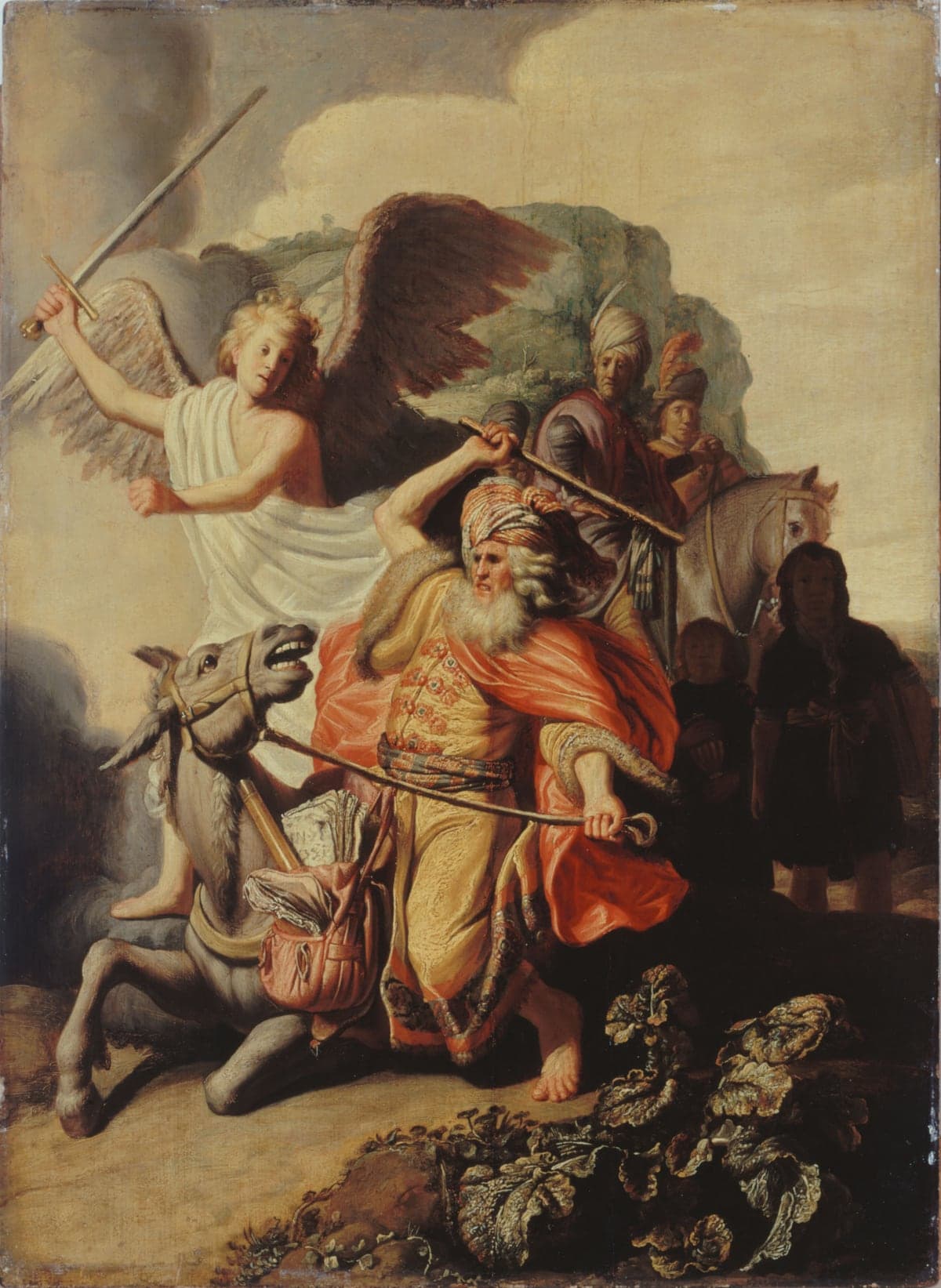
Rembrandt, Balaam and his Ass, 1626, Musée Cognacq-Jay, Paris. Public domain by date; photograph by Paris Musées, CC0. Wikimedia Commons file L'Ânesse du prophète Balaam, J 95.jpg.
THE ARTWORKRembrandt painted Balaam beating his donkey while the angel of the LORD stands over him with a drawn sword, as Balaam rides out to curse Israel for the fees Balak sent.
Summary
The prosperity message holds that God wills wealth and health for every believer who receives them by faith.
- One reading opens the blessings of Deuteronomy 28 to every believer through Christ's redemption from the curse of the law.
- A second reading confines them to the nation Moses addressed on the edge of Canaan.
- A third reading finds in them the church's portion in Christ and the life of the soul.
- The chapter gives more of its verses to the curses than to the blessings, and its curses end in exile.
- Paul warns Timothy that those who want to be rich fall into temptation.
The Texts Every Reading Weighs
Deuteronomy gives the promise of wealth and the blessings, John gives his prayer for Gaius, and Paul gives his warning.
You might say in your heart, “The power and strength of my hands have made this wealth for me.” But remember that it is the LORD your God who gives you the power to gain wealth, in order to confirm His covenant that He swore to your fathers even to this day.Every reading turns on this verse, which names wealth as God's gift and ties it to the covenant He swore to the fathers.
“Now if you faithfully obey the voice of the LORD your God and are careful to follow all His commandments I am giving you today, the LORD your God will set you high above all the nations of the earth. And all these blessings will come upon you and overtake you, if you will obey the voice of the LORD your God:The blessings come to Israel on the condition of obedience, and the readings differ over whether that condition and that nation still define who receives them.
Beloved, I pray that in every way you may prosper and enjoy good health, as your soul also prospers.John joins bodily health and success in every way to the prosperity of the soul, so the readings must say what his prayer asks.
Those who want to be rich, however, fall into temptation and become ensnared by many foolish and harmful desires that plunge them into ruin and destruction. For the love of money is the root of all kinds of evil. By craving it, some have wandered away from the faith and pierced themselves with many sorrows.Paul's warning about the desire to be rich stands beside every promise of wealth, and each reading must account for it.
The Three Readings Side by Side
The readings differ on what Moses promised and to whom.
| The question | A blessing received by faith | Israel's covenant in the land | Read through Christ |
|---|---|---|---|
| What does Deuteronomy 8:18 give? | The power to gain wealth, which God still gives to His people. | Wealth in the land, given to Israel to confirm the oath to the fathers. | Provision as God sees good, beneath the kingdom sought first. |
| Whom do the blessings of Deuteronomy 28 reach? | Every believer, since Christ became a curse for us. | Israel as a nation, while it kept the law in Canaan. | The soul that bears fruit, and the church that seeks the kingdom. |
| Which text does the reading lean on? | Galatians 3:13 to 14. | The condition of obedience in the chapter's first verse. | Matthew 6:33. |
| Who holds it? | Kenneth Hagin; Charles Capps; Derek Prince on Deuteronomy 28 | John Calvin; John Gill; Jamieson, Fausset and Brown; Albert Barnes | Matthew Henry; Basil of Caesarea; Ambrose of Milan |
The Three Readings of the Promise
Each reading has its holders, its works and its case from the text.
A blessing received by faith
Kenneth Hagin founded Rhema Bible Training Center in 1974. In Redeemed from Poverty, Sickness, and Spiritual Death (1983) he reads Galatians 3:13 to 14 as Christ's redemption from the curse of the law. He gives one chapter each to the curse of poverty, of sickness and of spiritual death. Charles Capps, of the same Word of Faith stream, divides the curse into the same three parts in The Tongue: A Creative Force (1976). He teaches the believer to confess from Galatians 3:14 that Abraham's blessings are his. In Fear Is Faith in Reverse, which Capps Ministries published in 2019, after his death in 2014, he writes that faith-filled words give God the authority to move on the believer's situation in life. In Blessing or Curse: You Can Choose (1990) Derek Prince writes that Moses gives in Deuteronomy 28 full lists of the forms that blessings and curses take. In his devotional Redeemed from the Curse he reads Galatians 3:13 as Christ becoming a curse for us. Smith Wigglesworth wrote in Ever Increasing Faith (1924) that many children of God refuse their blood-purchased portion of health in Christ.
Christ redeemed us from the curse of the law by becoming a curse for us. For it is written: “Cursed is everyone who is hung on a tree.” He redeemed us in order that the blessing promised to Abraham would come to the Gentiles in Christ Jesus, so that by faith we might receive the promise of the Spirit.The written curse Paul cites stands in Deuteronomy 21:23, where anyone hung on a tree is under God's curse, so the first reading draws its case from Deuteronomy's own law.
Israel's covenant in the land
The second reading takes the blessings of Deuteronomy 28 as the terms of God's covenant with Israel as a nation in Canaan. John Gill, in his Exposition of the Old Testament, makes obedience to the law the condition of their coming and continuance, and he writes that only temporal blessings in the land of Canaan are intended. John Calvin, in his commentary on the last four books of Moses (1563), reads the promise of verse 9 as sure if the Israelites continued in the covenant by keeping the law. Jamieson, Fausset and Brown (1871) write that on Israel's first entrance into the land its whole destiny was laid before it. Albert Barnes sets the chapter beside Exodus 23 and Leviticus 26 and reads its last part as a prophecy of the dispersion of the Jewish nation.
The LORD will make you prosper abundantly—in the fruit of your womb, the offspring of your livestock, and the produce of your land—in the land that the LORD swore to your fathers to give you.This reading stands on the verse's last words, which place the abundance in the land the LORD swore to the fathers.
Read through Christ
The third reading finds in the blessings a word to the church through Christ and the life of the soul. Matthew Henry, in his Commentary on the Whole Bible (1708 to 1710), writes that temporal blessings take less room in the promises of the New Testament than in those of the Old. He holds that Christ's word in Matthew 6:33 is enough, so that all other things are added as far as Infinite Wisdom sees good. On Deuteronomy 8:16 he writes that the manna typified Christ, the bread of life. Basil of Caesarea, in his Exegetic Homilies (14.5), reads Deuteronomy 28:5 as the prosperity of a soul filled with works of every kind. His Greek Bible blesses the barns in that verse, where the Berean reads basket and kneading bowl. Ambrose of Milan, in his letters, reads the rain from God's treasury in verse 12 as the utterance of the Law that makes the soul fruitful in good works.
Therefore do not worry, saying, ‘What shall we eat?’ or ‘What shall we drink?’ or ‘What shall we wear?’ For the Gentiles strive after all these things, and your heavenly Father knows that you need them. But seek first the kingdom of God and His righteousness, and all these things will be added unto you.Henry reads the temporal promises through these words of Jesus, who tells His hearers that the Father knows they need food and clothing.
The Blessings and the Curses of Deuteronomy 28
The blessed sayings fill four verses, 3 to 6, and the cursed sayings answer them in four, 16 to 19.
Deuteronomy 28 gives 14 of its 68 verses to the blessings and 54 to the curses.
- Blessing
- Curse
The six counts as a table
| The part of the chapter | Verse counts | Blessing or curse | Verse |
|---|---|---|---|
| Obedience, verses 1 to 2 | 2 | Blessing | Deuteronomy 28:1 to 2 |
| Blessed, verses 3 to 6 | 4 | Blessing | Deuteronomy 28:3 to 6 |
| Promises, verses 7 to 14 | 8 | Blessing | Deuteronomy 28:7 to 14 |
| Disobedience, verse 15 | 1 | Curse | Deuteronomy 28:15 |
| Cursed, verses 16 to 19 | 4 | Curse | Deuteronomy 28:16 to 19 |
| Threats, verses 20 to 68 | 49 | Curse | Deuteronomy 28:20 to 68 |
Each bar counts the verses of one part of the chapter in the Berean text, and its colour marks the part as blessing or curse.
The power to gain wealth
Adam Clarke, in his Commentary on the Bible (1810 to 1826), asks who gives the wisdom, skill, bodily strength and health without which no wealth is gained, and he answers that God gives them. John Gill reads the boast of verse 17 as ascribing to labour and diligence what belongs to the bounty and blessing of God. Clement of Alexandria, in the Stromata (Book 2), reads the verse as a charge to sow God's gifts so that a neighbour also flourishes.
Otherwise, when you eat and are satisfied, when you build fine houses in which to dwell, and when your herds and flocks grow large and your silver and gold increase and all that you have is multiplied, then your heart will become proud, and you will forget the LORD your God who brought you out of the land of Egypt, out of the house of slavery.Moses names the danger of wealth before he names its giver, since a full house can make the heart proud.
The curses end in exile
Just as it pleased the LORD to make you prosper and multiply, so also it will please Him to annihilate you and destroy you. And you will be uprooted from the land you are entering to possess. Then the LORD will scatter you among all the nations, from one end of the earth to the other, and there you will worship other gods, gods of wood and stone, which neither you nor your fathers have known.The same LORD who made the nation prosper uproots it, so the second reading keeps both halves of the chapter with the people it addresses.
Godliness and gain in 1 Timothy 6
Adam Clarke reads the godliness of 1 Timothy 6:6, eusebeia, as the true religion, and its contentment, autarkeia, as the portion of secular things needed to support life. Strong's dictionary defines eusebeia as piety and autarkeia as contentedness or a competence. John Wesley, in his Explanatory Notes upon the New Testament (1755), reads the men of verse 5 as thinking the best religion is the getting of money.
and constant friction between men of depraved mind who are devoid of the truth. These men regard godliness as a means of gain. Of course, godliness with contentment is great gain. For we brought nothing into the world, so we cannot carry anything out of it. But if we have food and clothing, we will be content with these.Both Greek words Clarke defines stand in these verses, so his reading of contentment can be checked against the text.
Wealth in the Law of Moses
Three passages outside chapter 28 speak of wealth in the land.
And when the LORD your God brings you into the land He swore to your fathers, to Abraham, Isaac, and Jacob, that He would give you—a land with great and splendid cities that you did not build, with houses full of every good thing with which you did not fill them, with wells that you did not dig, and with vineyards and olive groves that you did not plant—and when you eat and are satisfied, be careful not to forget the LORD who brought you out of the land of Egypt, out of the house of slavery.Israel receives houses, wells and vineyards it did not make, and the gift itself becomes the occasion of the warning against forgetting the LORD.
He must not take many wives for himself, lest his heart go astray. He must not accumulate for himself large amounts of silver and gold.This law shows that the book which promises abundance to the nation limits the riches of its ruler.
So keep and follow the words of this covenant, that you may prosper in all you do.Moses ties prospering in all Israel does to keeping the words of the covenant.
How the Promise Was Read
Fifteen works trace the readings from the early church to the twentieth century.
The early churchfive works, by AD 215 to AD 735
| Author died | Reading | Work |
|---|---|---|
| AD 215 | Read through Christ | Clement of Alexandria, The Stromata, Book 2 |
| AD 379 | Read through Christ | Basil of Caesarea, Exegetic Homilies 14.5 |
| AD 397 | Read through Christ | Ambrose of Milan, Letters 21 to 30 |
| AD 407 | Paul's warning | John Chrysostom, Homily 17 on 1 Timothy |
| AD 735 | Read through Christ | Bede, Commentary on the Catholic Epistles |
The Reformation to the twentieth centuryten works, 1563 to 1990
| Published | Reading | Work |
|---|---|---|
| 1563 | Israel's covenant | John Calvin, Commentaries on the Four Last Books of Moses |
| 1708 to 1710 | Read through Christ | Matthew Henry, Commentary on the Whole Bible |
| 1748 to 1763 | Israel's covenant | John Gill, Exposition of the Old Testament |
| 1755 | Paul's warning | John Wesley, Explanatory Notes upon the New Testament |
| 1810 to 1826 | Paul's warning | Adam Clarke, Commentary on the Bible |
| 1871 | Israel's covenant | Jamieson, Fausset and Brown, Commentary Critical and Explanatory on the Whole Bible |
| 1924 | A blessing received by faith | Smith Wigglesworth, Ever Increasing Faith |
| 1976 | A blessing received by faith | Charles Capps, The Tongue: A Creative Force |
| 1983 | A blessing received by faith | Kenneth Hagin, Redeemed from Poverty, Sickness, and Spiritual Death |
| 1990 | A blessing received by faith | Derek Prince, Blessing or Curse: You Can Choose |
What the Texts Leave Unsaid
The passages leave three questions open.
Deuteronomy 28 speaks to Israel and names no people outside it as heirs of its blessings. John's letter gives his prayer for one man and does not say whether God wills the same for every believer. Paul tells the rich to be generous and leaves their riches in their hands, and he does not say how much wealth is too much.
Instruct those who are rich in the present age not to be conceited and not to put their hope in the uncertainty of wealth, but in God, who richly provides all things for us to enjoy. Instruct them to do good, to be rich in good works, and to be generous and ready to share, treasuring up for themselves a firm foundation for the future, so that they may take hold of that which is truly life.Paul's charge to the rich shows that his warning falls on the desire for riches and on trust in them.
What John Asked for Gaius
The Greek words of the verse and the commentators on it weigh what John asked for his friend.
A prayer in every respect
Albert Barnes reads the verb as a strong and earnest desire, and he renders the phrase as concerning all things. In his reading John wishes that Gaius may prosper in worldly affairs, comfort and bodily health as he prospers in religion. Adam Clarke finds three particulars in the prayer, the health of body, the health of soul and prosperity in secular affairs. Strong's dictionary defines the verb for good health, hygiainō, as to have sound health and be well in body.
The soul's health first
Jamieson, Fausset and Brown hold that John presupposes the prosperity of Gaius' soul, so the bodily health comes next after the spiritual. Bede, who died in 735, reads in his Commentary on the Catholic Epistles the prayer as asking that Gaius complete well what he does well.
For I was overjoyed when the brothers came and testified about your devotion to the truth, in which you continue to walk. I have no greater joy than to hear that my children are walking in the truth.John's joy over Gaius walking in the truth shows what prosperity of the soul means in the letter.
How the Teachers Speak of the Promise
Five quotations speak to the promise of Deuteronomy and to Paul's warning.
Possessing the promise1969
“God had said He would give them the land, but the people had to possess it.”
Kenneth Hagin · Healing Belongs To Us (excerpt: "Possessing the Promise") · on Joshua 1:3Word of Faith
The turn toward blessinga devotional
“So you turn around, towards the sunlight of God's favor. You begin to walk towards it, away from the curses, into the area of blessings.”
Derek Prince · From Curse to Blessing (devotional) · on Deuteronomy 28:2Pentecostal-Charismatic
Grace and healthafter 1714
“This supposes regeneration, and an inward fund of spiritual life; this stock is increasing, and, while spiritual treasures are advancing, the soul is in a fair way to the kingdom of glory. His good wish for his friend that his body may prosper and be in health as well as his soul. Grace and health are two rich companions; grace will improve health, health will employ grace.”
Matthew Henry · Commentary on the Whole Bible · on 3 John 1:2Puritan
The rising estate1708 to 1710
“When the estate rises, the mind is apt to rise with it, in self-conceit, self-complacency, and self-confidence. Let us therefore strive to keep the spirit low in a high condition; humility is both the ease and the ornament of prosperity.”
Matthew Henry · Commentary on the Whole Bible · on Deuteronomy 8:14Puritan
Those who want to be richby AD 407
“‘But they that will be rich’; not those that are rich, but those who wish to be. For a man may have money and make a good use of it, not overvaluing it, but bestowing it upon the poor. Such therefore he does not blame, but the covetous. ‘They that will be rich fall into temptation and a snare, and into many foolish and hurtful lusts, which drown men in destruction and perdition.’ He has justly said, ‘they drown men,’ since they cannot be raised from that depth. ‘In destruction and perdition.’ But what is the ‘temptation and snare,’ which he says, those that would be rich fall into? It causes them to err from the faith, it involves them in dangers, it renders them less intrepid. ‘Foolish desires,’ he says. And is it not a foolish desire, when men like to keep idiots and dwarfs, not from benevolent motives, but for their pleasure, when they have receptacles for fishes in their halls, when they bring up wild beasts, when they give their time to dogs, and dress up horses, and are as fond of them as of their children? All these things are foolish and superfluous, nowise necessary, nowise useful. ‘Foolish and hurtful lusts!’ What are hurtful lusts? When men live unlawfully, when they desire what is their neighbor's, when they do their utmost in luxury, when they long for drunkenness, when they desire the murder and destruction of others. From these desires many have aimed at tyranny, and perished. Surely to labor with such views is both foolish and hurtful.”
John Chrysostom · Homily on 1 Timothy 17 · on 1 Timothy 6:9Patristic
The Readings Weighed
Every reading has one text that its holders must answer.
| Reading | Tradition |
|---|---|
| A blessing received by faith | The Word of Faith movement; Pentecostal and charismatic teachers |
| Israel's covenant in the land | The Reformed churches; evangelical commentators |
| Read through Christ | The church fathers; the Puritans |
The faith reading and the destitute faithful
They were stoned, they were sawed in two, they were put to death by the sword. They went around in sheepskins and goatskins, destitute, oppressed, and mistreated. The world was not worthy of them. They wandered in deserts and mountains, and hid in caves and holes in the ground.The letter counts among the faithful men who went destitute, which this reading must answer when it ties faith to wealth.
The covenant reading and the blessing of Abraham
The reading through Christ and the herds and harvests
Deuteronomy 8:13 and Deuteronomy 28:11 speak of herds, silver, gold and the produce of the ground, and Paul writes in 1 Timothy 6:17 that God richly provides all things for us to enjoy. This reading must say why the gifts of the field are read as gifts of the soul.
Read the Great Books
These six works set out the readings at length.
Redeemed from Poverty, Sickness, and Spiritual Death
Kenneth Hagin · 1983
Kenneth Hagin Ministries published it in Tulsa, and the lists of Hagin's books printed in his other booklets set it first.
In print: find it wherever books are sold.
Blessing or Curse: You Can Choose
Derek Prince · 1990
Prince's title sets the blessings and curses before the reader as a choice.
In print: find it wherever books are sold.
Ever Increasing Faith
Smith Wigglesworth · 1924
Its fourth chapter bears the title Wilt Thou Be Made Whole?
Commentary on the Whole Bible
Matthew Henry · 1708 to 1710
The commentary reads the texts of Deuteronomy 8 and 28 that the three readings weigh. Henry died in 1714 with the work finished at Acts, and other ministers wrote its notes on the epistles.
Exposition of the Old Testament
John Gill · 1748 to 1763
Gill comments on each verse of Deuteronomy and sets the Targum of Jonathan beside the text where it bears on the reading.
Homilies on 1 Timothy
John Chrysostom · by AD 407
In his seventeenth homily on the letter Chrysostom comments on 1 Timothy 6:5 to 9.
Remember the Giver
Deuteronomy 8:10 and 2 Corinthians 8:9 give the reader's part when God gives plenty.
The three readings agree that wealth is God's gift, and the commentators on Moses' warning in chapter 8 forbid the one who has it to boast of his own hands. The texts ask the reader to remember the Giver and to give as Christ gave.
When you eat and are satisfied, you are to bless the LORD your God for the good land that He has given you.Moses makes thanks the first duty of the one who has eaten his fill in the good land.
For you know the grace of our Lord Jesus Christ, that though He was rich, yet for your sakes He became poor, so that you through His poverty might become rich.Paul grounds the church's giving in the grace of Christ, who was rich and became poor.
Keep studying
Studies10