
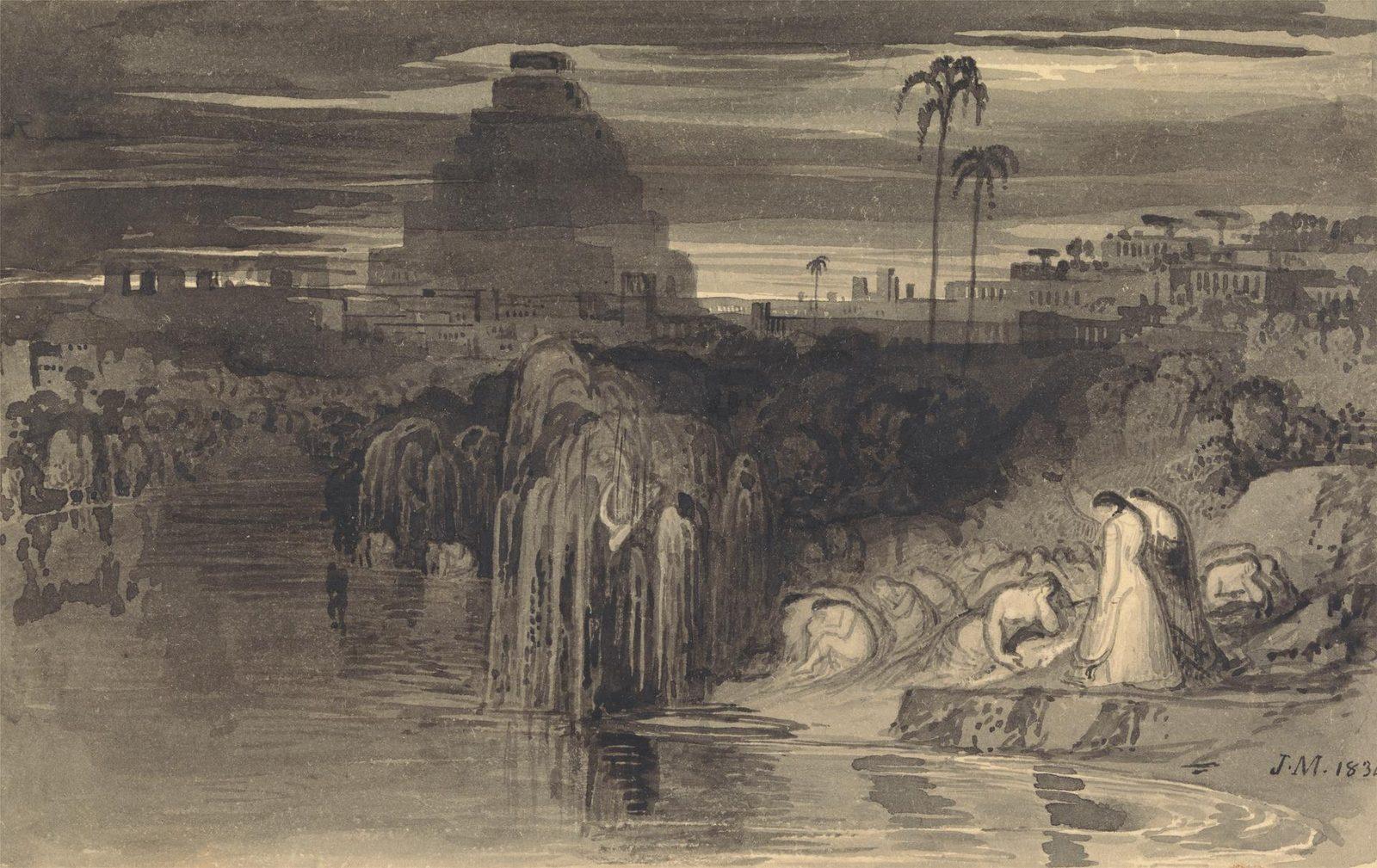
John Martin, The Daughters of Jerusalem Weeping by the Waters of Babylon, 1834. CC0.
Isaiah 63 and 64 · Passage · Featured Study
The Lament of Isaiah 63:7 to 64:12
This lament stands near the end of the book of Isaiah.
If only You would rend the heavens and come down, so that mountains would quake at Your presence,
- The passage
- Isaiah 63:7 to 19, Isaiah 64:1 to 12, 1 Corinthians 2:9
- Books
- Isaiah, 1 Corinthians
- Hold in memory
- Isaiah 64:8
Three times in this prayer the people call God their Father.
Summary
This prayer praises the LORD for the days of Moses and asks where He has gone. It pleads with Him to come down, and it ends over a ruined sanctuary by asking whether He will keep silent.
- The prayer confesses the people's sin before it asks for mercy.
- Paul's words in 1 Corinthians 2:9 are most often traced to this prayer.
- Readers divide over whether Isaiah foresaw the burned temple or the prayer was written after it fell.
The Prayer
The first and last verses frame the whole prayer.
I will make known the LORD’s loving devotion and His praiseworthy acts, because of all that the LORD has done for us—the many good things for the house of Israel according to His great compassion and loving devotion.The prayer opens in praise before it turns to complaint.
John Wesley, in his Explanatory Notes on the prayer's opening verse, marks a new matter here, the prophet's prayer, which runs to the end of chapter 64.
After all this, O LORD, will You restrain Yourself? Will You keep silent and afflict us beyond measure?This question is the prayer's last word.
The Seven Parts
The prayer moves from the mercies of the past to a plea over the ruins of the present.
The Cambridge Bible for Schools and Colleges divides the prayer into seven parts.
- 1Gives thanks for the LORD's goodness in the days of oldIsaiah 63:7 to 9
- 2Recalls Israel's rebellion and longs for the wonders of the sea crossingIsaiah 63:10 to 14
- 3Asks the LORD to look down, for He alone is their FatherIsaiah 63:15 to 16
- 4Asks why He lets them stray and harden their heartsIsaiah 63:17 to 19
- 5Begs Him to rend the heavens and come downIsaiah 64:1 to 3
- 6Confesses that all have sinned and no one calls on His nameIsaiah 64:4 to 7
- 7Appeals to the Potter and Father over the burned templeIsaiah 64:8 to 12
Each part is given with its verses and what the prayer does in it.
The Days of Moses
The prayer remembers the sea crossing and asks where the God of that day has gone.
Then His people remembered the days of old, the days of Moses. Where is He who brought them through the sea with the shepherds of His flock? Where is the One who set His Holy Spirit among them, who sent His glorious arm to lead them by the right hand of Moses, who divided the waters before them to gain for Himself everlasting renown,This verse names the Holy Spirit.
In the Berean text of the Old Testament, God's Holy Spirit is named in only three verses: Psalm 51:11 and two verses of this prayer.
But they rebelled and grieved His Holy Spirit. So He turned and became their enemy, and He Himself fought against them.This is the other verse of the prayer that names the Holy Spirit.
In all their distress, He too was afflictedIsaiah 63:9 in the Hebrew and the Greek
The written Hebrew text of this verse reads not, and the reading the scribes noted beside it reads to Him. The two words differ by one letter. Keil and Delitzsch count it among fifteen such places and prefer to Him. Albert Barnes judges that either reading makes good sense.
The Septuagint, the old Greek translation, reads the line another way. In Brenton's English he saved them himself, in place of an ambassador or a messenger.
The God Who Acts for Those Who Wait
Paul writes words close to Isaiah 64:4, and readers divide over where he found them.
From ancient times no one has heard, no ear has perceived, no eye has seen any God besides You, who acts on behalf of those who wait for Him.This is the older of the two texts set side by side.
Rather, as it is written: “No eye has seen, no ear has heard, no heart has imagined, what God has prepared for those who love Him.”Paul introduces these words as Scripture.
Paul gives the sense of IsaiahAlbert Barnes; John Gill; Matthew Poole; the Cambridge Bible
Albert Barnes says the words are quoted from Isaiah 64:4, not literally, with the sense only given. Gill and Poole agree, and the Cambridge Bible calls them near enough to Isaiah to be taken as a quotation from it. Adam Clarke adds that Clement of Rome, in his first epistle, makes the same quotation in nearly the same words as Paul.
The objection: Meyer judges that the sense and the wording differ too much, which is never so elsewhere with Paul.
Paul draws on a book of ElijahOrigen, as Barnes and Meyer report; Meyer
Barnes reports that the words are found in apocryphal books of Elijah, and that Origen and Jerome supposed Paul quoted from them. Meyer sides with Origen, but holds that Paul took the saying for Scripture by a slip of memory.
The objection: the Expositor's Greek Testament says Jerome found the words in the Ascension of Isaiah and the Apocalypse of Elias but denied that Paul owed anything to them. Ellicott notes that Paul's phrase as it is written introduces only the Old Testament.
Rend the Heavens
The plea runs on across a chapter break, and Calvin reads its image of the torn heavens.
as fire kindles the brushwood and causes the water to boil, to make Your name known to Your enemies, so that the nations will tremble at Your presence! When You did awesome works that we did not expect, You came down, and the mountains trembled at Your presence.The people ask for a coming like the LORD's coming of old.
The Cambridge Bible notes that in the Hebrew, chapter 64 begins at the English Isaiah 64:2, so the plea to rend the heavens closes chapter 63. Ellicott writes that the break hides from the English reader that the plea goes on from the prayer of Isaiah 63:15 to 19.
Calvin gives the reason for the image.
“God is said to ‘rend the heavens,’ when he unexpectedly gives some uncommon and striking proof of his power; and the reason of this mode of expression is, not only that men, when they are hard pressed, commonly look up to heaven, from which they expect assistance, but that miracles, by interrupting the order of nature, open up for themselves an unusual path.”
John Calvin · Commentaries · on Isaiah 64:1Reformed
You Are Our Father
Abraham and Israel are set aside, and the LORD is named Father and potter.
Yet You are our Father, though Abraham does not know us and Israel does not acknowledge us. You, O LORD, are our Father; our Redeemer from Everlasting is Your name.The people claim the LORD as Father when their forefathers fail them.
But now, O LORD, You are our Father; we are the clay, and You are the potter; we are all the work of Your hand.The people place themselves in the Maker's hands.
Henry gives the reason the people turn to God as Father.
“Foolish and careless as we are, poor and despised and trampled upon as we are by our enemies, yet still thou art our Father; to thee therefore we return in our repentance, as the prodigal arose and came to his father; to thee we address ourselves by prayer; from whom should we expect relief and succour but from our Father?”
Matthew Henry · Commentary on the Whole Bible · on Isaiah 64:8Puritan
When Was the Temple Burned?
Albert Barnes, the Cambridge Bible and Benson's Commentary each set the burning at a different time.
Your holy cities have become a wilderness. Zion has become a wasteland and Jerusalem a desolation. Our holy and beautiful temple, where our fathers praised You, has been burned with fire, and all that was dear to us lies in ruins.This verse is the evidence each reading of the date must explain.
Isaiah foresaw the exile and spoke for the exilesAlbert Barnes
The objection: the Cambridge Bible finds it natural to read the burned temple as the Chaldeans' work in 586 BC and the prayer as written after it.
Written in the exile, after the temple fellThe Cambridge Bible for Schools and Colleges
The Cambridge Bible concludes that the prayer was written during the exile, or at least before the rebuilding of the temple began in 520 BC.
The objection: the same commentary admits that it reads the short while of Isaiah 63:18 of the holy land, which is hard to read of the centuries from Joshua to the exile.
The prayer reaches to Rome's burning of the templeMatthew Henry; Benson's Commentary; Jamieson, Fausset and Brown
Matthew Henry reports that some good interpreters think the prayer looks further, to the Jews under their destruction by the Romans. Benson's Commentary applies the burned house to the Romans' burning of the temple. Jamieson, Fausset and Brown hold that Nebuchadnezzar's burning prefigured the burning under Titus.
The objection: the Pulpit Commentary reads the speakers as exiles who remembered the first temple, some of whom had seen it with their own eyes.
Here I Am
“I revealed Myself to those who did not ask for Me; I was found by those who did not seek Me. To a nation that did not call My name, I said, ‘Here I am! Here I am!’The LORD's first words after the prayer begin here.
Sources
Scripture is the Berean Standard Bible.
- The Cambridge Bible for Schools and Colleges, on Isaiah 63:7 and 64:1.
- Keil and Delitzsch; Albert Barnes; John Gill; Ellicott; each on Isaiah 63:9.
- Brenton Septuagint Translation, Esaias 63:9.
- Ellicott on Isaiah 64:1; Albert Barnes, Benson, Jamieson, Fausset and Brown and the Pulpit Commentary on Isaiah 64:10 to 11.
- Albert Barnes, John Gill, Matthew Poole, Meyer, the Expositor's Greek Testament, Ellicott and the Cambridge Bible, each on 1 Corinthians 2:9.
- John Wesley, Explanatory Notes upon the Old Testament (1765), on Isaiah 63:7.
- Matthew Henry, Commentary on the Whole Bible (1710), on Isaiah 63:14 and 64:8.
- John Calvin, Commentaries (1554), on Isaiah 64:1.
- Adam Clarke, Commentary on the Bible (1832), on Isaiah 64:4.
Keep Studying
Read it4
People and groups5
Subjects1
Go further2