
Genesis to Zechariah · Group · Featured Study
The Philistines
The Philistines held five cities on the southern coast of Canaan under five rulers and fought Israel from the judges to the reign of David.
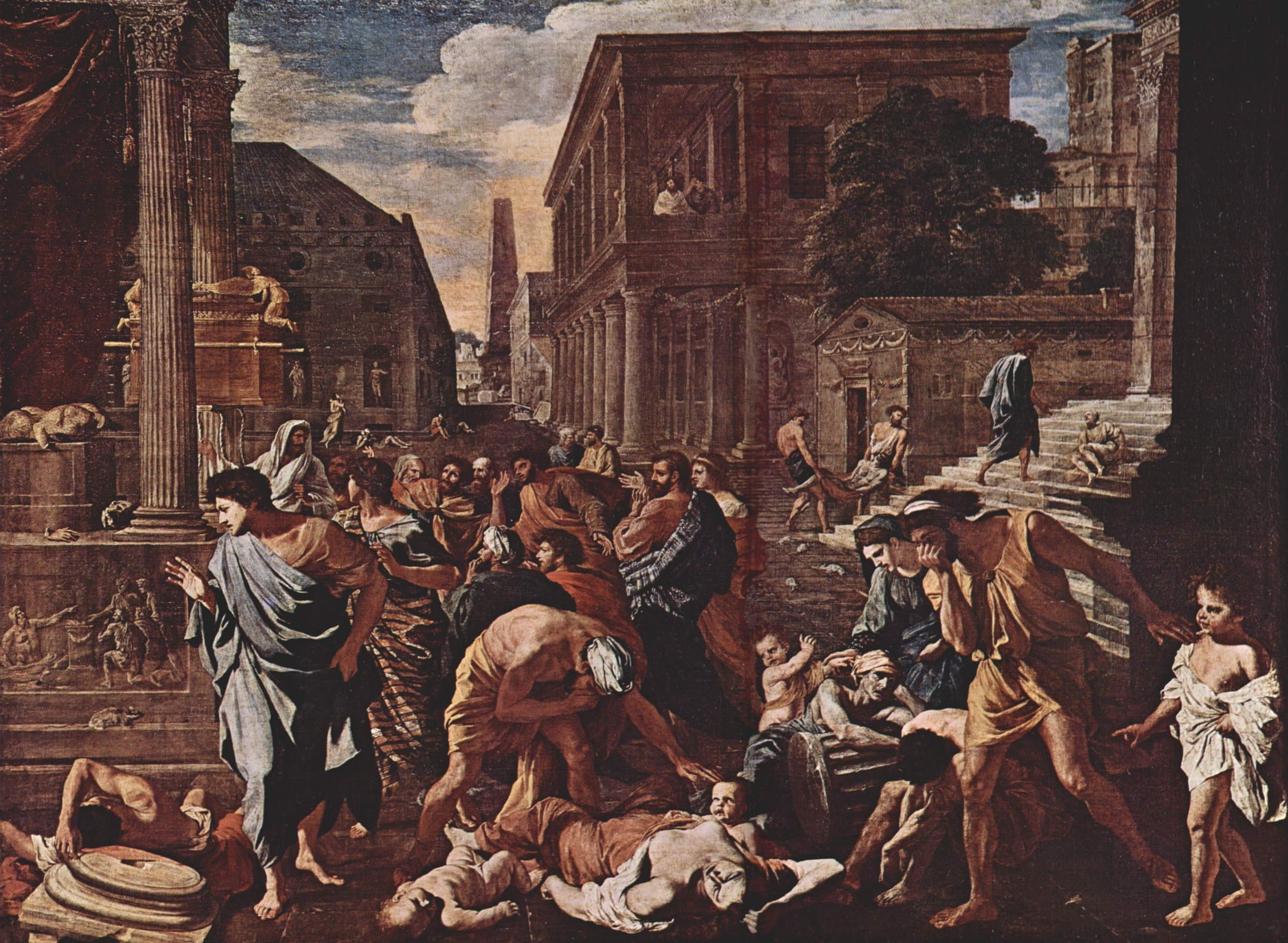
Nicolas Poussin, The Plague at Ashdod, 1630 to 1631, oil on canvas, Louvre. Public domain by date. Wikimedia Commons, File:Nicolas_Poussin_-_La_Peste_à_Ashdod.jpg.
THE ARTWORKPoussin painted the plague of 1 Samuel 5:6, when the hand of the LORD was heavy on the people of Ashdod after the ark was set in the temple of Dagon. He set the broken statue on its plinth at the left, behind the columns, and filled the street with the dead and with people turning away from them.
Amos told Israel that the LORD who brought them up from Egypt had also brought “the Philistines from Caphtor.”
Summary
The Philistines were Israel's neighbours and foes, and Scripture follows them from the table of nations in Genesis 10 to the oracles of the prophets.
- Gaza, Ashdod, Ashkelon, Gath and Ekron were their chief cities.
- Joshua 13 counts their territory among the land that remained to be possessed.
- They captured the ark of God in Eli's day and kept every blacksmith out of Israel in Saul's day.
- David subdued them, and Zechariah foretold that a remnant of them would belong to God.
The People from Caphtor
The table of nations names the Philistines, and later texts name the land behind them and a people beside them.
the Pathrusites, the Casluhites (from whom the Philistines came), and the Caphtorites.The table of nations sets the Philistines and the Caphtorites in the same verse among the descendants of Mizraim.
“Are you not like the Cushites to Me, O children of Israel?” declares the LORD. “Did I not bring Israel up from the land of Egypt, the Philistines from Caphtor, and the Arameans from Kir?The verse sets Israel beside the Cushites, the Philistines and the Arameans, so the exodus gives Israel no claim on God that the nations lack.
The Hebrew name is Pelishti (Strong's H6430), which the King James renders Philistine. Strong defines Kaphtor (H3731) as the original seat of the Philistines.
Caphtor in Deuteronomy and Jeremiah2 texts
And the Avvim, who lived in villages as far as Gaza, were destroyed by the Caphtorites, who came out of Caphtor and settled in their place.)This verse shows the Caphtorites taking the land as far as Gaza from the Avvim before Israel arrived.
For the day has come to destroy all the Philistines, to cut off from Tyre and Sidon every remaining ally. Indeed, the LORD is about to destroy the Philistines, the remnant from the coasts of Caphtor.This verse ties the people Jeremiah addressed to the land their fathers had left.
The Cherethites3 texts
We raided the Negev of the Cherethites, the territory of Judah, and the Negev of Caleb, and we burned down Ziklag.”An Egyptian slave of the Amalekites names the Negev of the Cherethites, and verse 16 calls the same raided ground the land of the Philistines.
therefore this is what the Lord GOD says: Behold, I will stretch out My hand against the Philistines, and I will cut off the Cherethites and destroy the remnant along the coast.Ezekiel sets the Cherethites in parallel with the Philistines in one oracle.
Woe to the dwellers of the seacoast, O nation of the Cherethites! The word of the LORD is against you, O Canaan, land of the Philistines: “I will destroy you, and no one will be left.”This verse joins the two names in one line of address.
Albert Barnes reads the Cherethites of Zephaniah 2:5 as another name for the Philistines, probably first a distinct migration of the same people. Strong defines Kerethi (H3774) as a Kerethite or life-guardsman.
The Five Cities of the Seren
Joshua 13:3 and 1 Samuel 6:17 list the same cities in two different orders.
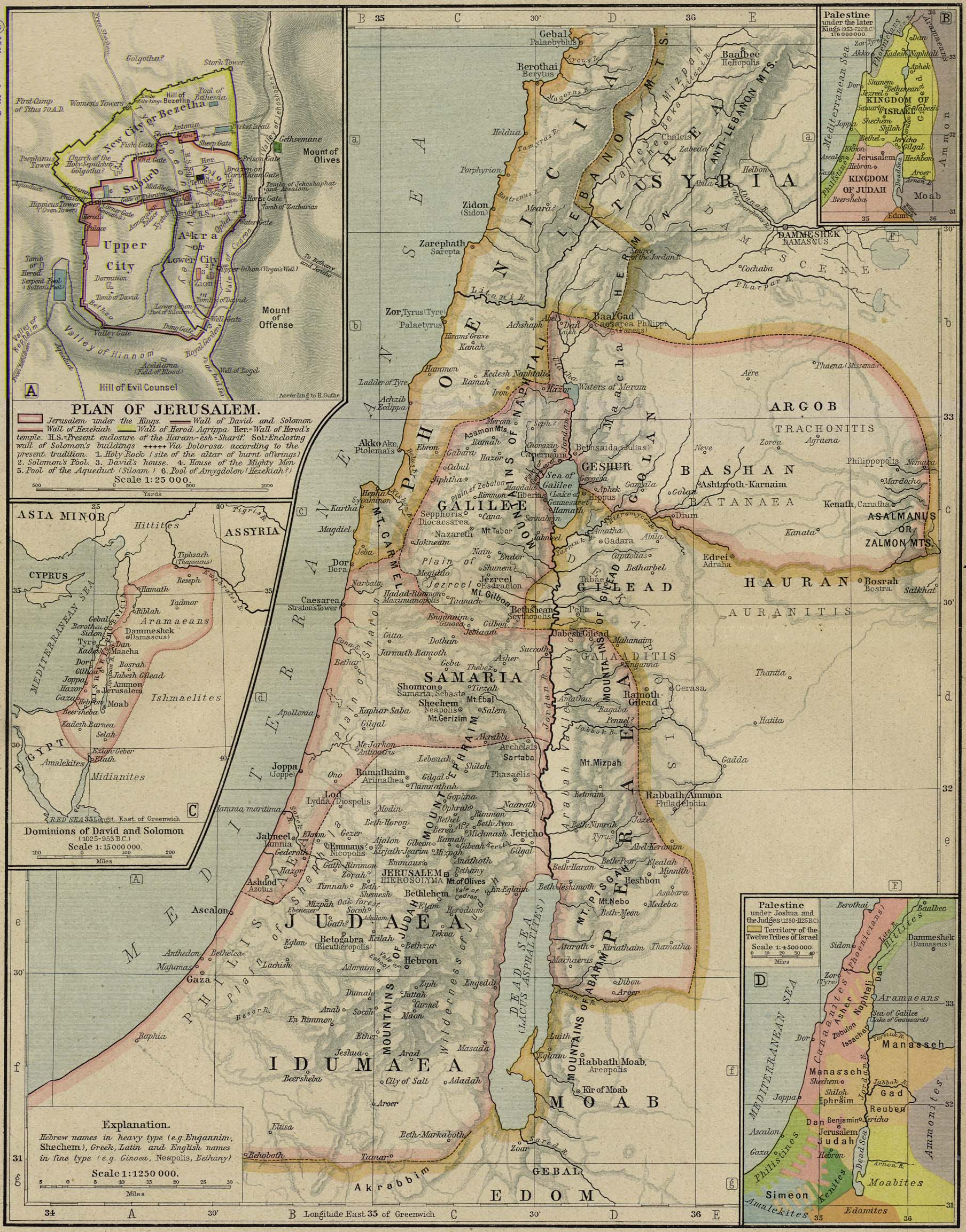
The 1926 plate prints each of the five cities and marks Gath with a query.
- GazaThe Philistines blinded Samson and made him grind grain in the prison there.Judges 16:21
- AshdodThe ark was set beside Dagon in his temple, and Dagon fell before it.1 Samuel 5:1 to 4
- AshkelonJeremiah foretold that Ashkelon would be silenced.Jeremiah 47:5
- GathGoliath came out from Gath, and David later lived there with Achish its king. The plate marks the site with a query, so it is proposed.1 Samuel 17:4
- EkronThe Ekronites cried out when the ark was brought to their city.1 Samuel 5:10
Rand McNally atlas reference map, 1926. Public domain.
The key beside the plate gives each city with its verse.
All the territory of the Philistines and the Geshurites, from the Shihor east of Egypt to the territory of Ekron on the north (considered to be Canaanite territory)—that of the five Philistine rulers of Gaza, Ashdod, Ashkelon, Gath, and Ekron, as well as that of the Avvites;This verse gives the full roll of the Philistine league as Joshua received it.
As a guilt offering to the LORD, the Philistines had sent back one gold tumor for each city: Ashdod, Gaza, Ashkelon, Gath, and Ekron.The gold tumors were sent one for each city, so the league answered for the plague as a body.
The title of the five rulers is seren (Strong's H5633), which Strong defines as an axle and, in a figure, a peer. Albert Barnes notes that the title is used only of the princes of the five Philistine cities, and he thinks it probably Phoenician in origin.
From Shamgar to David
The Philistines stand in Israel's history from Genesis to the prophets, and their wars with Israel run from Shamgar to David.
Samson, the ark in Philistia and Goliath of Gath are taught on Samson, The Ark and Dagon, and David and Goliath.
The Philistines through the canonGenesis to Zechariah
- Genesis 21:32 to 26:1Abraham and Isaac live beside the Philistines of GerarGenesis 21:32 to 34
- Exodus 13:17 to Joshua 13:3Israel passes them by and leaves their cities untakenJoshua 13:1 to 3
- Judges 3:31 to 16:23Shamgar and Samson strike them in the forty years of their ruleJudges 13:1
- 1 Samuel 4 to 7They take the ark and are subdued in the days of Samuel1 Samuel 7:13
- 1 Samuel 13 to 31They fight Saul's Israel until his death1 Samuel 31:9 to 10
- 2 Samuel 5:17 to 8:1David defeats them and takes Metheg-ammah2 Samuel 5:17 to 25
- Isaiah 14:29 to Zechariah 9:7The prophets speak against Gaza, Ashdod, Ashkelon and EkronIsaiah 14:29 to 31
The timeline lays seven spans on one line in the order of the canon.
The places on the atlas plate4 places
- Located: the site is known
- Identified: the point stands for an area, or is rounded
- 1Gaza, Amos announced fire on its walls to consume its citadels. Amos 1:7
- 2Valley of Elah, Saul's army camped there in battle array against the Philistines. 1 Samuel 17:2
- 3Ziklag, Achish king of Gath gave the town to David. 1 Samuel 27:6
- 4Mount Gilboa, Many of Israel fell slain there before the Philistines. 1 Samuel 31:1
Base map: Reference map of ancient Palestine, Rand McNally reference map (1926), public domain. Each place stands at its place page's coordinates, set on the plate by Jerusalem and Damascus, as the plate prints them.
The map draws four places of the Philistine story, each with its verse.
Shamgar and the ark2 passages
After Ehud came Shamgar son of Anath. And he too saved Israel, striking down six hundred Philistines with an oxgoad.The book of Judges counts Shamgar among the deliverers for this one deed.
So the Philistines fought, and Israel was defeated, and each man fled to his tent. The slaughter was very great—thirty thousand foot soldiers of Israel fell. The ark of God was captured, and Eli’s two sons, Hophni and Phinehas, died.This loss opens the chapters in which the ark stayed in Philistine hands.
Saul and the Philistine ban on smiths1 Samuel 13 and 1 Samuel 31
And no blacksmith could be found in all the land of Israel, because the Philistines had said, “The Hebrews must not be allowed to make swords or spears.” Instead, all the Israelites would go down to the Philistines to sharpen their plowshares, mattocks, axes, and sickles.The ban shows how far Philistine rule reached into the daily work of Israel in Saul's reign.
So on the day of battle not a sword or spear could be found in the hands of the troops with Saul and Jonathan; only Saul and his son Jonathan had weapons.The policy of verse 19 shows its result here, an army without weapons.
Matthew Henry adds the penalties of the ban and the ores that Israel was left unable to work.
“They put down all the smiths' shops, transplanted the smiths into their own country, and forbade any Israelite, under severe penalties, to exercise the trade or mystery of working in brass or iron, though they had rich mines of both ( Deut. viii. 9 ) in such plenty that it was said of Asher, his shoes shall be iron and brass, Deut. xxxiii.”
Matthew Henry · Commentary on the Whole Bible · on 1 Samuel 13:19 to 22Puritan
They cut off Saul’s head, stripped off his armor, and sent messengers throughout the land of the Philistines to proclaim the news in the temples of their idols and among their people. They put his armor in the temple of the Ashtoreths and hung his body on the wall of Beth-shan.The victors treated the king's fall as a triumph of their gods.
David with Achish and David the king3 passages
So David set out with his six hundred men and went to Achish son of Maoch, the king of Gath. David and his men settled in Gath with Achish. Each man had his family with him, and David had his two wives: Ahinoam of Jezreel and Abigail of Carmel, the widow of Nabal.David went to a Philistine city to escape Saul.
So David inquired of the LORD, “Should I go up against the Philistines? Will You deliver them into my hand?” “Go,” replied the LORD, “for I will surely deliver the Philistines into your hand.”David asked the LORD before each battle with the Philistines and went up at His word.
Some time later, David defeated the Philistines, subdued them, and took Metheg-ammah from the hand of the Philistines.This verse records the subjection of the Philistines after David's two battles in 2 Samuel 5.
Matthew Henry identifies Metheg-ammah as Gath and the towns belonging to it, the chief and royal city of the Philistines.
The Land That Remained
Joshua 13 lists the Philistine territory as land still to be possessed, and Judges 3 gives the reason it was left.
Now Joshua was old and well along in years, and the LORD said to him, “You are old and well along in years, but very much of the land remains to be possessed. This is the land that remains:This verse puts the unfinished conquest in the LORD's own words at the end of Joshua's life.
These are the nations that the LORD left to test all the Israelites who had not known any of the wars in Canaan, if only to teach warfare to the subsequent generations of Israel, especially to those who had not known it formerly: the five rulers of the Philistines, all the Canaanites, the Sidonians, and the Hivites who lived in the mountains of Lebanon from Mount Baal-hermon to Lebo-hamath.The purpose given here is twofold, a trial of the people and a training for those who had never fought.
John Wesley reads Joshua 13:3 to mean that the Philistines had driven out the Canaanites, so the coast was still part of Canaan and belonged to Israel.
The rest of the peoples left in the land are taught on The Nations Left in the Land.
Judah's capture of three citiesJudges 1:18 to 19
And Judah also captured Gaza, Ashkelon, and Ekron—each with its territory. The LORD was with Judah, and they took possession of the hill country; but they could not drive out the inhabitants of the plains because they had chariots of iron.The verse proves that Judah's hold on the coast was partial, since the plain stayed with its people.
John Gill reads Judges 3:3 beside this verse. He holds that Judah took three of the five cities after Joshua's death and that the Philistines soon recovered them.
The road through the land of the PhilistinesExodus 13:17
When Pharaoh let the people go, God did not lead them along the road through the land of the Philistines, though it was shorter. For God said, “If the people face war, they might change their minds and return to Egypt.”The verse shows the Philistines already a power of war on the coast road when Israel left Egypt.
Dagon and the Ashtoreths
Scripture names the gods of the Philistines in Judges 16, 1 Samuel 5 and 1 Samuel 31.
But when they got up early the next morning, there was Dagon, fallen on his face before the ark of the LORD, with his head and his hands broken off and lying on the threshold. Only the torso remained.The broken statue shows the LORD humbling the god of Ashdod in his own house before the plague fell on the people.
The lords of the Philistines and their offeringJudges 16 and 1 Samuel 6
Now the lords of the Philistines gathered together to offer a great sacrifice to their god Dagon. They rejoiced and said, “Our god has delivered Samson our enemy into our hands.”The verse sets Samson's last day as a contest between the LORD and Dagon.
“What guilt offering should we send back to Him?” asked the Philistines. “Five gold tumors and five gold rats,” they said, “according to the number of rulers of the Philistines, since the same plague has struck both you and your rulers.The offering follows the shape of their government, one gift for each lord.
Matthew Henry weighs the Philistines' guilt offering against the law of Moses.
“Their proposal to offer a trespass-offering for their offence was conformable enough to divine revelation at that time; but to send such things as these for trespass-offerings was very foreign, and showed them grossly ignorant of the methods of reconciliation appointed by the law of Moses; for there it appears all along that it is blood, and not gold, that makes atonement for the soul.”
Matthew Henry · Commentary on the Whole Bible · on 1 Samuel 6:18Puritan
What the Text Leaves Unsaid
Scripture leaves three questions about the Philistines open.
The three verses that name Caphtor do not say where it lay.
Deuteronomy 2:23 and Amos 9:7 do not say when the Caphtorites came out of Caphtor.
First Samuel 6:4 counts five rulers of the Philistines and gives none of them a name.
The Oracles and the Remnant
Six prophets speak against the Philistines, and two of the oracles end with a promise.
The oracles from Isaiah to Zechariah6 oracles
| Prophet | Reference | Cities named | Charge or promise |
|---|---|---|---|
| Isaiah | Isaiah 14:29 to 31 | None by name | Philistia must not rejoice that the rod that struck it is broken |
| Jeremiah | Jeremiah 47:1 to 7 | Gaza and Ashkelon | The LORD will destroy the remnant from the coasts of Caphtor |
| Ezekiel | Ezekiel 25:15 to 17 | None by name | The Philistines took vengeance on Judah with ancient hostility |
| Amos | Amos 1:6 to 8 | Gaza, Ashdod, Ashkelon and Ekron | Gaza exiled a whole population and delivered it up to Edom |
| Zephaniah | Zephaniah 2:4 to 7 | Gaza, Ashkelon, Ashdod and Ekron | The coast will belong to the remnant of the house of Judah |
| Zechariah | Zechariah 9:5 to 7 | Ashkelon, Gaza, Ekron and Ashdod | They too will become a remnant for our God |
Gath is the one city of the five that none of the six oracles names. Jamieson, Fausset and Brown explain its absence from Amos by its earlier conquest under David.
I will remove the blood from their mouths and the abominations from between their teeth. Then they too will become a remnant for our God; they will become like a clan in Judah, and Ekron will be like the Jebusites.Zechariah's oracle against the Philistines ends in mercy, with a remnant of them belonging to God.
Henry on a remnant brought home to GodZechariah 9:6
Matthew Henry finds two fulfilments of the promise, the later one in the gospel.
“The Jews afterwards got ground of the Philistines, Syrians, and others of their neighbours, took some of their cities from them and possessed their countries, as appears by the histories of Josephus and the Maccabees, and this was foretold before, Zeph. ii. Some among them shall be converted, and brought home to God, by his gospel and grace; so some understand”
Matthew Henry · Commentary on the Whole Bible · on Zechariah 9:6Puritan
Three Voices on the Philistines
John Calvin, Matthew Henry and Charles Spurgeon on the road, the remnant and the ark
John Calvin calls the choice of the longer road an admirable design of God.
“I admit, indeed, that God might have otherwise obviated all these evils; but since He is often wont to deal with His people on human principles, He chose to adopt the method which was most suited to their infirmity. Moses now commends this His admirable design, in order that we may know that nothing was omitted by Him which was for the safety and advantage of His people.”
John Calvin · Commentaries · on Exodus 13:17Reformed
Matthew Henry joins the remnant of Caphtor to its kinsmen on the coast.
“Who the remnant of the country of Caphtor were is uncertain, but we find that the Caphtorim were near akin to the Philistines ( Gen. x. 14 ), and probably when their own country was destroyed such as remained came and settled with their kinsmen the Philistines, and were now spoiled with them. Some particular places are here named, Gaza, and Ashkelon,”
Matthew Henry · Commentary on the Whole Bible · on Jeremiah 47:4Puritan
Charles Spurgeon sets the capture of the ark beside the long years in which the priests kept it safe.
“The Ark of the Lord was captured by the Philistines though it was guarded by all the men of arms that Israel could muster for the battle. It came to no hurt when it was surrounded by unarmed priests—although the times were exceedingly disturbed and perilous all through the dreary period of the Judges, yet never was the Ark a captive till it was protected by carnal weapons. When those whom God had ordained to take care of the Ark of the Covenant had it in their charge, it was safe enough.”
Charles Spurgeon · The Metropolitan Tabernacle Pulpit, Sermon No. 1342: “Dagon's Ups and Downs” (lightly modernized text, CCEL edition) · on 1 Samuel 5:2 to 4
How Caphtor and Gerar Are Read
Three readings of where Caphtor lay and two readings of the Philistines at Gerar, each with its holders
Readers divide over the place the Bible calls Caphtor.
Caphtor is CreteS. R. Driver; Jamieson, Fausset and Brown
S. R. Driver, in The Book of Genesis (1904), writes that Caphtor is usually identified with Crete. He rests the case on three texts where the Philistines stand beside the Cherethites, whom he takes to be Cretans. Jamieson, Fausset and Brown read the Cherethites of Zephaniah 2:5 the same way.
The objection: none of the three texts names Crete itself.
Caphtor is Cyprus or CiliciaCalmet, as Adam Clarke reports him; W. Max Müller, as Driver reports him
Adam Clarke, in his Commentary on Genesis 10:14, gives Calmet's reading of the Caphtorim as the people of Cyprus. Driver reports W. Max Müller's argument that Caphtor is the Egyptian Kefto, a people of Cilicia and Cyprus.
The objection: Driver still gives Crete as the usual identification.
Caphtor is CappadociaJohn Wesley; the text of Amos 9:7 in Jerome
John Wesley, in his Explanatory Notes on Deuteronomy 2:23, writes that the learned think Caphtor to be Cappadocia. The text of Amos 9:7 in Jerome's Commentary on Amos reads that the LORD brought the Philistines from Cappadocia.
The objection: Jeremiah 47:4 speaks of the coasts of Caphtor, and Strong reads the name as a wreath-shaped island.
Readers also divide over the Philistines whom Genesis 21 and Genesis 26 place at Gerar beside Abraham and Isaac.
Now there was another famine in the land, subsequent to the one that had occurred in Abraham’s time. And Isaac went to Abimelech king of the Philistines at Gerar.Both readings below turn on the title this verse gives Abimelech.
The Philistines were already at GerarJohn Wesley
On this reading Genesis names the people who lived at Gerar in the patriarchs' day. John Wesley, in his Explanatory Notes on Genesis 26:8, takes Abimelech as the common name of the Philistine kings, as Caesar was of the Roman emperors.
The objection: Genesis 20:2 calls Abimelech only king of Gerar, and Driver holds that a compiler added the Philistine verses of Genesis 21 in the light of Genesis 26.
The name was given in a later dayS. R. Driver
On this reading the writer calls the people of Gerar by the name of the later Philistines. S. R. Driver, in The Book of Genesis (1904), calls the land of the Philistines in Genesis 21 a proleptic expression. He judges the king of the Philistines in Genesis 26:1 an anachronism if the Philistines came from Caphtor.
The objection: Genesis 21:32 and Genesis 26:1 give the Philistines of Gerar a king and a commander of the army, as a people already settled in the land.
Books to Read Next
Four works on the Philistines and their cities
The Book of Genesis, with Introduction and Notes
S. R. Driver · 1904
Driver's notes on Genesis 10:14, Genesis 21:32 and Genesis 26:1 set out the readings of Caphtor and of the Philistines at Gerar.
Read it free at the Internet ArchiveCommentary on the Whole Bible
Matthew Henry · 1710
Henry reads the Philistine chapters from the smiths of 1 Samuel 13 to the remnant of Zechariah 9.
Notes, Explanatory and Practical, on the Old Testament
Albert Barnes · 1832 to 1869
Barnes explains the title of the five rulers and the Cherethites of Zephaniah.
Commentary on Amos
Jerome · early fifth century
Jerome sets the reading of the Septuagint beside his own text of Amos, as he does at Amos 9:7.
A Remnant for Our God
The history of the Philistines asks the reader to trust the LORD who judges every nation and keeps a remnant for Himself even among Israel's enemies.
Zechariah turns from the remnant of the Philistines to the King of Zion, who comes “righteous and victorious, humble and riding on a donkey” (Zechariah 9:9). Matthew 21:4 to 5 says the prophecy was fulfilled when Jesus came to Jerusalem.
Keep studying
Studies6
Places8
Doctrines5
Peoples and groups2