
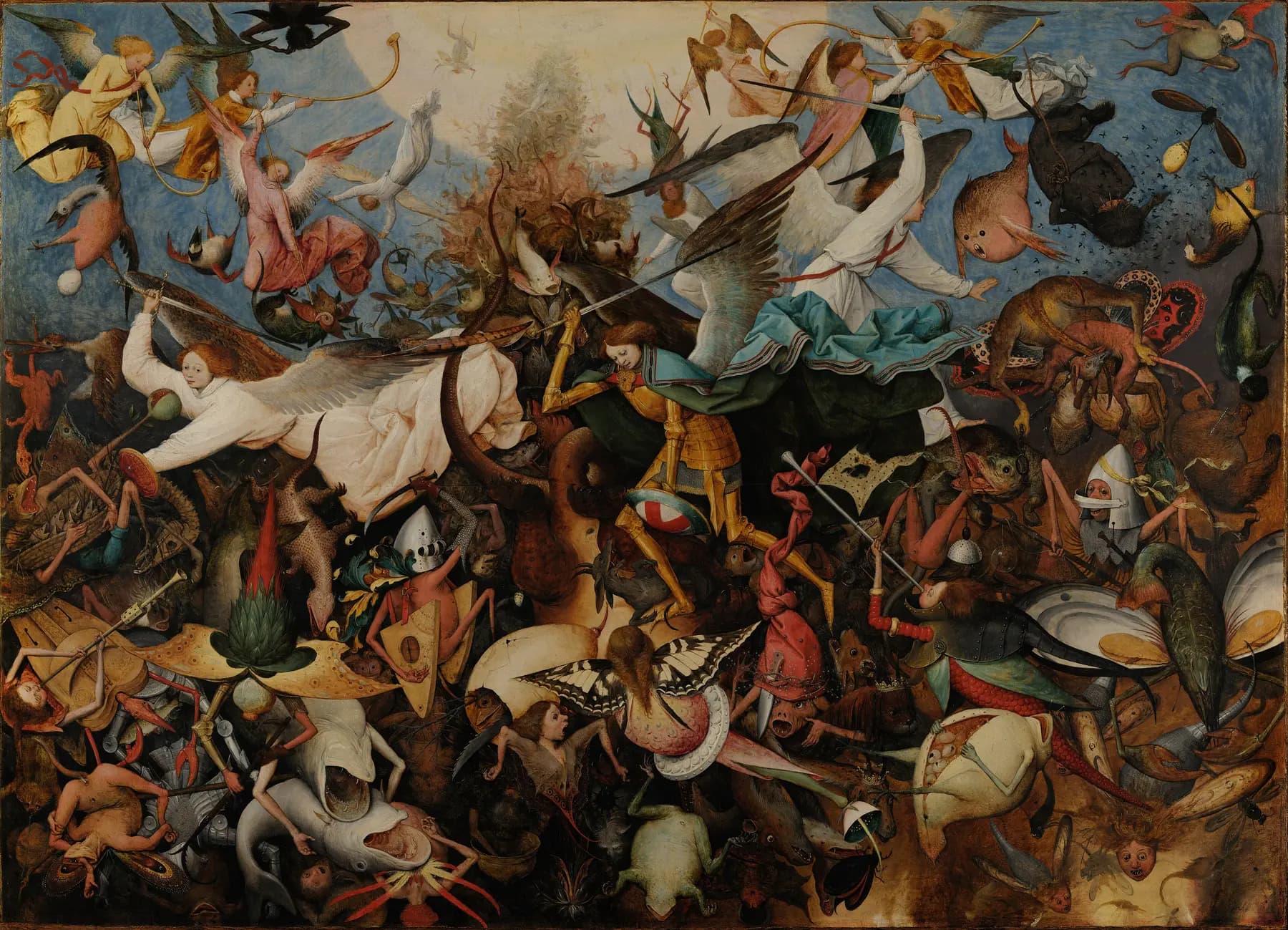
Pieter Bruegel the Elder, The Fall of the Rebel Angels, 1562. Public domain.
Genesis 6:1 to 4 · Doctrine · Featured Study
The Watchers and the Nephilim
Genesis 6:1 to 4 sets the sons of God and the Nephilim in the days before the Flood, and the books from Numbers to 1 Samuel name giants in the land after it.
Three readings of the sons of God have stood for two thousand years: angels who left their place, the line of Seth, and kings or nobles.
Now when men began to multiply on the face of the earth and daughters were born to them, the sons of God saw that the daughters of men were beautiful, and they took as wives whomever they chose. So the LORD said, “My Spirit will not contend with man forever, for he is mortal; his days shall be 120 years.” The Nephilim were on the earth in those days—and afterward as well—when the sons of God had relations with the daughters of men. And they bore them children who became the mighty men of old, men of renown.
- First taught
- Genesis 6:2 “the sons of God saw that the daughters…”
- Fullest statement
- Jude 1:6 “And the angels who did not stay within…”
Three readings of the sons of God have stood for two thousand years: angels who left their place, the line of Seth, and kings or nobles.
Summary
Genesis 6:1 to 4 is four verses long, and its two named groups, the sons of God and the Nephilim, are followed across the Bible from Job to Jude.
- Job 1:6, 2:1 and 38:7 use the phrase sons of God for beings who stand before the LORD.
- 2 Peter 2:4 to 5 and Jude 1:6 to 7 set a sin of angels beside the Flood and beside Sodom.
- 1 Enoch and Jubilees, kept outside the canon, read the passage as the fall of the Watchers.
The Passage
Genesis 6:1 to 4 stands between the line of Adam in Genesis 5 and the account of the Flood.
Now when men began to multiply on the face of the earth and daughters were born to them, the sons of God saw that the daughters of men were beautiful, and they took as wives whomever they chose. So the LORD said, “My Spirit will not contend with man forever, for he is mortal; his days shall be 120 years.” The Nephilim were on the earth in those days—and afterward as well—when the sons of God had relations with the daughters of men. And they bore them children who became the mighty men of old, men of renown.Every reading of the sons of God starts from verses 2 and 4, where the phrase stands twice.
The Nephilim Thread
Four texts follow the giants from Genesis 6 to the Philistine champion of Gath.
Joshua 11:22 says the Anakim survived only in Gaza, Gath and Ashdod, and Goliath came from Gath.
- What the text names
- the first giants Scripture names
- What the text names
- the descendants of Anak whom the spies feared in Canaan
3The Rephaim, and Og of Bashan
- What the text names
- the last of the Rephaim, whose bed of iron is measured
- What the text names
- the Philistine champion whom the shepherd David brought down
The angelic reading takes the chain as one line.
The Case for the Angelic Reading
The angelic reading is argued from the Hebrew phrase, from 2 Peter and Jude, and from the oldest Jewish witness.
The Hebrew idiom1 verse, 2 paragraphs
The phrase bene ha'elohim, sons of God, stands in Job 1:6, 2:1 and 38:7, and each time it names beings who come before the LORD. Justin Martyr, in his Second Apology 5, and Michael S. Heiser, in The Unseen Realm (2015), take Genesis 6:2 to use the phrase for the same class of being, set against the daughters of men.
Jerome, in his Hebrew Questions on Genesis, reports that the Jewish translator Aquila rendered the phrase sons of gods and understood them to be the holy ones or angels.
while the morning stars sang together and all the sons of God shouted for joy?The sons of God shout for joy while God lays the foundations of the earth (Job 38:4), so they stood before him before any man was made.
The reading of 2 Peter and Jude2 verses, 1 paragraph
For if God did not spare the angels when they sinned, but cast them deep into hell, placing them in chains of darkness to be held for judgment; if He did not spare the ancient world when He brought the flood on its ungodly people, but preserved Noah, a preacher of righteousness, among the eight;Peter names the angels God did not spare and, in the next breath, the ancient world he judged by the Flood.
And the angels who did not stay within their own domain but abandoned their proper dwelling—these He has kept in eternal chains under darkness, bound for judgment on that great day. In like manner, Sodom and Gomorrah and the cities around them, who indulged in sexual immorality and pursued strange flesh, are on display as an example of those who sustain the punishment of eternal fire.Jude names angels who abandoned their proper dwelling and sets Sodom's pursuit of strange flesh beside their sin.
Neither letter names Genesis 6, and Heiser takes both to point to it.
The oldest witness2 paragraphs
1 Enoch 6 to 11, the Book of the Watchers, and Jubilees 5 tell of Watchers who came down, defiled the earth and fathered giants. They are the oldest surviving readings of Genesis 6, and both are study resources that stand outside the sixty-six books of the canon.
In 1 Enoch 9 to 11 the archangels Michael, Uriel, Raphael and Gabriel look down from heaven and see much blood shed upon the earth.
The Nephilim and the Mighty Men
The Hebrew names of Genesis 6:4 and how the early translators and commentators rendered them.
The Hebrew nephilim is commonly derived from naphal, to fall. Adam Clarke reads the name as men who had fallen from the true religion, and Rashi says they were so called because they fell and caused the world to fall (Genesis Rabbah 26:7).
The Septuagint rendered the word gigantes, giants, and the English Bibles followed it. Jerome reports that Symmachus rendered it violent ones, and he finds the name of falling ones fitting for the angels and for the children of the saints.
The children of the union are called gibborim, the mighty men of old, men of renown.
What the Text Leaves Unsaid
Genesis 6 names the sons of God and the Nephilim and explains neither.
Genesis does not say who the sons of God were, and the phrase stands nowhere else in the book.
Genesis 6:4 names the Nephilim first and the children of the union second, and it does not say whether the two are the same.
The verse says the Nephilim were on the earth in those days and afterward as well, and Genesis does not say how giants came to stand in Canaan after the Flood.
Judgment and Patience Before the Flood
The union of Genesis 6:1 to 4 opens the account of the corruption that ends in the Flood.
Genesis sets the union of the sons of God and the daughters of men directly before the LORD sees the wickedness of man in Genesis 6:5. Noah then finds favour in his eyes in Genesis 6:8.
Between the union and the Flood stands the LORD's word of Genesis 6:3, and Matthew Henry reads its 120 years as a span of patience granted before judgment.
“Justice said, Cut them down; but mercy interceded, Lord, let them alone this year also; and so far mercy prevailed, that a reprieve was obtained for six-score years. Note, The time of God's patience and forbearance towards provoking sinners is sometimes long, but always limited: reprieves are not pardons; though God bear a great while, he will not bear always.”
Matthew Henry · Commentary on the Whole Bible · on Genesis 6:3Puritan
if all this is so, then the Lord knows how to rescue the godly from trials and to hold the unrighteous for punishment on the day of judgment.Peter draws this conclusion from the three judgments he has just named: the angels who sinned, the Flood and Sodom.
The Voices on Genesis 6
Three teachers of the Genesis 6 school, named with the books that hold their full case.
1934 to 2018 · Chuck Missler
Chuck Missler, in Return of the Nephilim and in Alien Encounters (1997), argues from 1 Enoch, Jubilees and the Septuagint that the sons of God were fallen angels. He names the corruption of the human gene pool as a reason for the Flood.
Gary Wayne, in The Genesis 6 Conspiracy (2014), follows the Nephilim bloodlines and a war over the promised seed across the canon and through history.
Timothy Alberino, in Birthright (2020), treats the Watchers, the Nephilim and the giants of the land as a real incursion of rebel spirits into the created order.
Three Readings of the Sons of God
Each reading with its holders, the work that sets it out, and the answer its critics give.
The study The Sons of God and the Nephilim sets out the full case for the angelic reading.
The sons of God as angels2 paragraphs
Irenaeus holds this reading in The Demonstration of the Apostolic Preaching, and most of the church fathers before Augustine held it with him.
Its critics answer that the judgment of Genesis 6:3 falls on man, and that the Flood is sent for the wickedness of man in Genesis 6:5.
The sons of God as the line of Seth1 quotation, 2 paragraphs
Augustine reads the sons of God and the daughters of men as the line of Seth and the line of Cain in Book 15 of The City of God. Ephrem the Syrian reads them so in his Commentary on Genesis, and John Calvin follows in his Commentaries on Genesis (1554).
“Because the sons of Seth were going into the daughters of Cain, they turned away from their first wives whom they had previously taken.”
Ephrem the Syrian · Commentary on Genesis 6.3.3 · on Genesis 6:2Patristic
Its critics answer that no text calls Seth's descendants by that title, and that bene ha'elohim names beings of heaven in Job.
The sons of God as kings or nobles2 paragraphs
Rashi, on Genesis 6:2, reads the sons of princes and rulers after Genesis Rabbah 26:15, and gives the angelic reading as a second explanation. The Targum of Onqelos, the synagogue's Aramaic rendering, reads the sons of the great ones.
Its critics answer that Genesis 6 names no king and no city, and that the reading draws its royal titles from outside the Bible.
Books to Read Next
Four works on Genesis 6, from the fifth century to the twenty-first.
The City of God
Augustine of Hippo · 426
Augustine traces the city of God and the earthly city through history, from Cain and Abel to his own day.
The Book of Enoch
R. H. Charles (translator) · 1917
Charles's English translation gives the Book of the Watchers, the account the angelic reading draws on, in full.
Genesis 1 to 15 (Word Biblical Commentary 1)
Gordon J. Wenham · 1987
Wenham sets out the three readings of Genesis 6:1 to 4 and weighs the case for each.
In print: find it wherever books are sold.
The Unseen Realm
Michael S. Heiser · 2015
Heiser studies the divine council of the Hebrew Bible, the assembly of heavenly beings around God, and the powers who rebelled against him.
In print: find it wherever books are sold.
The Spirits in Prison and the Risen Christ
Peter writes of the days of Noah to believers who suffer for doing good (1 Peter 3:17).
Whatever the sons of God were, Peter names the spirits who disobeyed in the days of Noah, while the ark was being built (1 Peter 3:19 to 20). He names them in the passage that tells of Christ put to death in the body and made alive in the Spirit (1 Peter 3:18). The text asks the reader to come to God through him, and to walk with God in a corrupt generation as Noah did (Genesis 6:9).
who has gone into heaven and is at the right hand of God, with angels, authorities, and powers subject to Him.The account of rebellion before the Flood ends, in Peter's letter, with every power of heaven subject to the risen Christ.
Sources
Scripture is the Berean Standard Bible.
- Rashi on Genesis, in Pentateuch with Rashi's Commentary, tr. M. Rosenbaum and A. M. Silbermann (1929 to 1934)
- Targum Onqelos on Genesis 6:2.
- R. H. Charles, The Book of Enoch (1917)
- R. H. Charles, The Book of Jubilees (1902)
- Augustine, The City of God, tr. Marcus Dods (1871)
- Justin Martyr, Second Apology.
- Irenaeus, The Demonstration of the Apostolic Preaching.
- John Calvin, Commentaries on the First Book of Moses Called Genesis (1554)
- Michael S. Heiser, The Unseen Realm (2015)
- Gordon J. Wenham, Genesis 1 to 15 (1987)
- Chuck Missler, Return of the Nephilim; Alien Encounters (1997)
- Gary Wayne, The Genesis 6 Conspiracy (2014)
- Timothy Alberino, Birthright (2020)
Keep Studying
Read it7
Studies14
People and groups4
Doctrines9
Subjects1