
Genesis 48:15 to 16 · Passage · Featured Study
The Angel Who Redeemed: the Goel of Genesis 48:16
In this blessing Jacob calls the angel hammal'ak haggo'el, using the Hebrew word for a kinsman who buys back land.
Jacob was nearly blind and close to death when he crossed his hands over Joseph's two sons.
- The passage
- Genesis 48:15 to 16
- Book
- Genesis
- Hold in memory
- Genesis 48:16
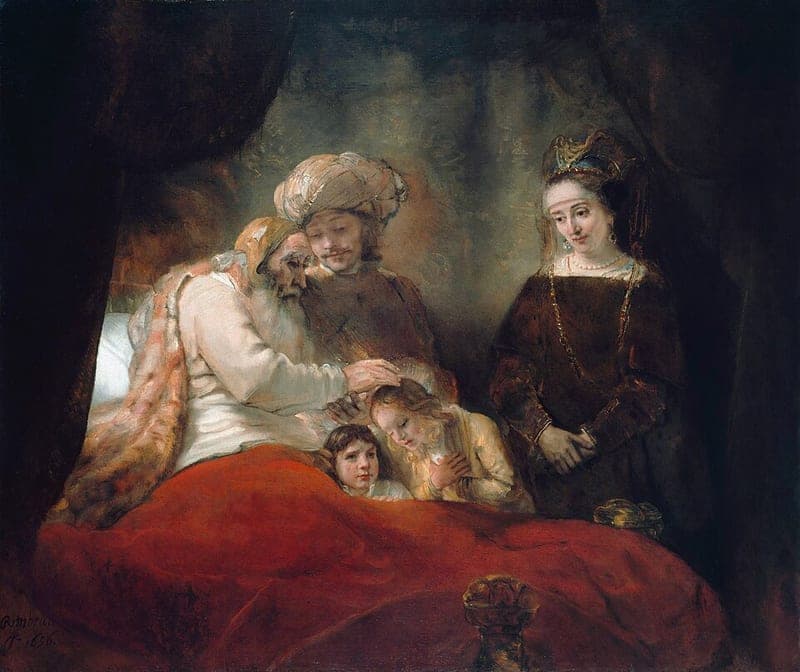
Rembrandt, Jacob Blessing the Children of Joseph, 1656. Public domain, via Wikimedia Commons.
THE ARTWORKRembrandt painted the blessing of Genesis 48:13 to 20 with Jacob's right hand resting on the fair-haired younger boy and Joseph reaching to his father's hand. He set a woman at the right of the bed, a figure Genesis 48 does not mention.
Summary
Jacob blesses Joseph's two sons in the name of the God of his fathers, the God who shepherded him and the angel who redeemed him from all harm.
- Before the blessing Jacob takes Ephraim and Manasseh as his own sons.
- In Genesis the verb ga'al stands only here, and Exodus, Leviticus, Ruth, Job and Isaiah take it up.
- Jacob keeps Ephraim, the younger, first even when Joseph objects.
- Readers divide over whether the angel is God himself, often read as the Son, or a created angel God sent.
A Blessing from a Sickbed
Genesis 48 tells how Joseph brought his two sons to his father's sickbed.
Genesis 48 is set in Egypt near the end of Jacob's life, after he has made Joseph swear to bury him with his fathers in Canaan.
Some time later Joseph was told, “Your father is ill.” So he set out with his two sons, Manasseh and Ephraim. When Jacob was told, “Your son Joseph has come to you,” Israel rallied his strength and sat up in bed.Every word of the blessing that follows is spoken from this bed.
Before he blesses anyone, Jacob claims Joseph's two sons for his own house.
And now your two sons born to you in Egypt before I came to you here shall be reckoned as mine; Ephraim and Manasseh shall be mine, just as Reuben and Simeon are mine.The adoption sets the two boys beside Reuben and Simeon, Jacob's eldest.
Then he blesses Joseph through his sons. Adam Clarke, in his Commentary on the Bible, observes on verse 15 that Joseph is blessed before his sons, as the lesser is blessed by the greater.
Then he blessed Joseph and said: “May the God before whom my fathers Abraham and Isaac walked, the God who has been my shepherd all my life to this day, the angel who has redeemed me from all harm—may He bless these boys. And may they be called by my name and the names of my fathers Abraham and Isaac, and may they grow into a multitude upon the earth.”These two verses are the blessing itself, and its third name is the angel who redeemed Jacob.
Three Names and One Verb
The blessing opens with titles drawn from the whole of Jacob's life.
| Jacob's words | Hebrew | What the name recalls |
|---|---|---|
| The God before whom my fathers Abraham and Isaac walked | ha'elohim | The God of Jacob's father and grandfather |
| The God who has been my shepherd all my life to this day | haro'eh | God's care of Jacob from his youth to his old age |
| The angel who has redeemed me from all harm | hammal'ak haggo'el | The one who brought Jacob out of every danger |
| May He bless these boys | yevarekh | The request itself |
- Hebrew
- ha'elohim
- What the name recalls
- The God of Jacob's father and grandfather
- Hebrew
- haro'eh
- What the name recalls
- God's care of Jacob from his youth to his old age
- Jacob's words
- The angel who has redeemed me from all harm
- Hebrew
- hammal'ak haggo'el
- What the name recalls
- The one who brought Jacob out of every danger
- Jacob's words
- May He bless these boys
- Hebrew
- yevarekh
- What the name recalls
- The request itself
In Hebrew the verb that follows the three names, yevarekh, is in the singular, and the Berean text marks it with a capital: may He bless.
The Chapter in Three Scenes
Genesis 48 moves from the adoption of the two boys to the crossed hands and the order of their names.
1. Genesis 48:3 to 7, the promise at Luz and the adoption1 passage, 2 quotations
Jacob said to Joseph, “God Almighty appeared to me at Luz in the land of Canaan, and there He blessed me and told me, ‘Behold, I will make you fruitful and multiply you; I will make you a multitude of peoples, and will give this land to your descendants after you as an everlasting possession.’The adoption rests on what God Almighty said to Jacob at Luz, which he repeats before he names the boys.
John Calvin reads Jacob's words on his deathbed as the work of a prophet.
“For, since he knew that he was invested by God with no common character, in being made the father of the fathers of the Church, he fulfilled, in the immediate prospect of death, the prophetic office, respecting the future state of the Church, which had been enjoined upon him.”
John Calvin · Commentaries · on Genesis 48:1Reformed
John Wesley sees each boy becoming a tribe with its own lot in Canaan.
“God had promised him two things, a numerous issue, and Canaan for an inheritance. And Joseph's sons, pursuant hereunto, should each of them multiply into a tribe, and each of them have a distinct lot in Canaan, equal with Jacob's own sons. See how he blessed them by faith in that which God had said to him Heb. xi, 21.”
John Wesley · Explanatory Notes upon the Old Testament · on Genesis 48:3Evangelical
2. Genesis 48:8 to 14, the boys brought near2 passages
Now Israel’s eyesight was poor because of old age; he could hardly see. Joseph brought his sons to him, and his father kissed them and embraced them. “I never expected to see your face again,” Israel said to Joseph, “but now God has let me see your children as well.”The blessing comes from a man who can hardly see, and the scene that follows turns on that.
And Joseph took both of them—with Ephraim in his right hand toward Israel’s left hand, and Manasseh in his left hand toward Israel’s right hand—and brought them close to him. But Israel stretched out his right hand and put it on the head of Ephraim, the younger; and crossing his hands, he put his left on Manasseh’s head, although Manasseh was the firstborn.Joseph sets the firstborn at his father's right hand, and Jacob reaches across to the younger.
Clarke notes on verse 14 that this is the first time Scripture mentions the laying of hands on the head to bless.
3. Genesis 48:17 to 22, Ephraim before Manasseh and the promise of return3 passages, 2 quotations
When Joseph saw that his father had placed his right hand on Ephraim’s head, he was displeased and took his father’s hand to move it from Ephraim’s head to Manasseh’s. “Not so, my father!” Joseph said. “This one is the firstborn; put your right hand on his head.” But his father refused. “I know, my son, I know!” he said. “He too shall become a people, and he too shall be great; nevertheless, his younger brother shall be greater than he, and his offspring shall become a multitude of nations.”Jacob answers Joseph's protest by saying twice that he knows what he is doing, and the text rests the choice on those words alone.
Matthew Henry reads the crossed hands as a lesson in how God gives His favour.
“Grace observes not the order of nature, nor does God prefer those whom we think fittest to be preferred, but as it pleases him.”
Matthew Henry · Commentary on the Whole Bible · on Genesis 48:17 to 18Puritan
Wesley traces the greater blessing in the later history of the two tribes.
“Joshua was of that tribe. The tribe of Manasseh was divided, one half on one side Jordan, the other half on the other side, which made it the less powerful and considerable. God, in bestowing his blessings upon his people, gives more to some than to others, more gifts, graces and comforts, and more of the good things of this life.”
John Wesley · Explanatory Notes upon the Old Testament · on Genesis 48:19Evangelical
So that day Jacob blessed them and said: “By you shall Israel pronounce this blessing: ‘May God make you like Ephraim and Manasseh.’” So he put Ephraim before Manasseh.The blessing becomes a saying for all Israel, and the saying names Ephraim first.
Clarke reports on verse 20 that the Jews of his own day still used this form of words to bless their sons.
Then Israel said to Joseph, “Look, I am about to die, but God will be with you and bring you back to the land of your fathers. And to you, as one who is above your brothers, I give the ridge of land that I took from the Amorites with my sword and bow.”The blessing looks past Egypt, since Jacob promises the return and gives Joseph a portion of the land ahead of it.
The Angel in Jacob's Life
Genesis 31 and 32 show Jacob meeting one who speaks or is named as God, and Hosea returns to Genesis 32.
In that dream the angel of God said to me, ‘Jacob!’ And I replied, ‘Here I am.’ ‘Look up,’ he said, ‘and see that all the males that are mating with the flock are streaked, spotted, or speckled; for I have seen all that Laban has done to you. I am the God of Bethel, where you anointed the pillar and made a solemn vow to Me. Now get up and leave this land at once, and return to your native land.’”In this dream the angel of God speaks in God's own name, as the God of Bethel.
So Jacob was left all alone, and there a man wrestled with him until daybreak. When the man saw that he could not overpower Jacob, he struck the socket of Jacob’s hip and dislocated it as they wrestled. Then the man said, “Let me go, for it is daybreak.” But Jacob replied, “I will not let you go unless you bless me.” “What is your name?” the man asked. “Jacob,” he replied. Then the man said, “Your name will no longer be Jacob, but Israel, because you have struggled with God and with men, and you have prevailed.” And Jacob requested, “Please tell me your name.” But he replied, “Why do you ask my name?” Then he blessed Jacob there. So Jacob named the place Peniel, saying, “Indeed, I have seen God face to face, and yet my life was spared.”At Peniel Jacob will not let go until he is blessed, and in Genesis 48 he passes a blessing on.
In the womb he grasped his brother’s heel, and in his vigor he wrestled with God. Yes, he struggled with the angel and prevailed; he wept and sought His favor; he found Him at Bethel and spoke with Him there— the LORD is the God of Hosts— the LORD is His name of renown.Hosea's retelling says Jacob wrestled with God and struggled with the angel, and both readings of the angel of Genesis 48 answer these words.
The Goel, the Kinsman Who Buys Back
The law and the story of Ruth show the goel at work.
The word Jacob uses for the angel's work is ga'al, which the Tyndale House lexicon published with STEP Bible glosses as to redeem, with redeem, avenge and relative among its senses. Clarke explains it from the law of Moses, where the goel is the one whose right it is, as nearest kin, to purchase back a forfeited inheritance.
If your brother becomes impoverished and sells some of his property, his nearest of kin may come and redeem what his brother has sold.Leviticus 25 places this duty among the laws of the Jubilee year.
The kinsman-redeemer replied, “I cannot redeem it myself, or I would jeopardize my own inheritance. Take my right of redemption, because I cannot redeem it.”The nearer kinsman gives up his right of redemption, and it passes to Boaz.
In the Hebrew text of Genesis the verb stands only in Jacob's blessing, so the blessing is its first use in Scripture.
The verb in the Exodus and in Job2 passages
Therefore tell the Israelites: ‘I am the LORD, and I will bring you out from under the yoke of the Egyptians and deliver you from their bondage. I will redeem you with an outstretched arm and with mighty acts of judgment.Here the LORD takes the verb for His own work in bringing Israel out of Egypt.
But I know that my Redeemer lives, and in the end He will stand upon the earth.Job, in the middle of his suffering, gives the kinsman's title to a Redeemer who lives.
The Redeemer in Isaiah2 passages
Do not fear, O worm of Jacob, O few men of Israel. I will help you,” declares the LORD. “Your Redeemer is the Holy One of Israel.Isaiah joins the title Redeemer to the name Jacob, as the blessing joined the verb to Jacob's own life.
Thus says the LORD your Redeemer, the Holy One of Israel: “For your sake, I will send to Babylon and bring them all as fugitives, even the Chaldeans, in the ships in which they rejoice.The Redeemer of Israel promises to act against Babylon for His people's sake.
A Blessing Given by Faith
Hebrews 11 sets this chapter in its list of the deeds done by faith.
By faith Jacob, when he was dying, blessed each of Joseph’s sons and worshiped as he leaned on the top of his staff.Of all Jacob's long life the writer chooses the scene of Genesis 48.
Voices on the Blessing
Matthew Henry reads the verse once for Jacob's own life and once for the future of Joseph's sons.
The angel who redeemed1 quotation
Henry moves from Jacob's rescue out of his troubles to the redemption Christ gives.
“A great deal of hardship he had known in his time, but God had graciously kept him from the evil of his troubles. Now that he was dying he looked upon himself as redeemed from all evil, and bidding an everlasting farewell to sin and sorrow. Christ, the Angel of the covenant, is he that redeems us from all evil, 2 Tim. iv.”
Matthew Henry · Commentary on the Whole Bible · on Genesis 48:16Puritan
Called by Jacob's name1 quotation
On the end of the verse, Henry finds a choice set before two boys raised in Egypt.
“Note, Those are worthy of double honour who, through God's grace, break through the temptations of worldly wealth and preferment, to embrace religion in disgrace and poverty. Jacob will have Ephraim and Manasseh to believe that it is better to be low and in the church than high and out of it, to be called by the name of poor Jacob than to be called by the name of rich Joseph.”
Matthew Henry · Commentary on the Whole Bible · on Genesis 48:16Puritan
Who Is the Angel Jacob Named
Christian and Jewish commentators divide over whether the angel Jacob named is God himself or a created angel God sent.
God himself, the Son before his incarnationMatthew Henry, Adam Clarke, John Wesley
This reading takes the angel as the God named in verse 15, on the ground of the singular verb set out under Three Names and One Verb.
Clarke, on Genesis 32:24, names the one who wrestled with Jacob as the Lord Jesus Christ, who took among the patriarchs the human form he would later take of a woman.
John Wesley, on Hosea 12:4, holds that the angel was the Messiah, eternal God by nature and an angel by office.
“Behold, I will send My messenger, who will prepare the way before Me. Then the Lord whom you seek will suddenly come to His temple—the Messenger of the covenant, in whom you delight—see, He is coming,” says the LORD of Hosts.Malachi's Messenger of the covenant is the title Henry gives the angel who redeemed Jacob.
The objection rests on the word mal'ak, whose sense the created-angel reading turns on.
A created angel sent by GodRashi, John Calvin
No commentator's note on Genesis 48:16 itself that holds this reading could be opened, so its case is made from the word and from notes on other appearances of an angel. Mal'ak means a messenger, and on this reading the angel who redeemed Jacob is a messenger God sent. Rashi, Rabbi Shlomo Yitzchaki of Troyes (1040 to 1105), reads the one Jacob wrestled at Peniel as a created angel. In his comment on Hosea 12:4, which the Hebrew numbering counts as 12:5, he names that angel as Esau's guardian angel, contesting the blessings Isaac had given.
In Rashi's telling the angel asks to be let go and promises that the Holy One will reveal Himself to Jacob at Bethel and speak there with them both.
John Calvin, in his lectures on Daniel 3:24 to 25, reads the fourth figure in the furnace as a single angel God sent to support His servants.
Matthew Henry, who holds the other reading, reports on the angel at the burning bush that some held this one.
“It was an angel of the Lord that appeared to him; some think, a created angel, who speaks in the language of him that sent him; others, the second person, the angel of the covenant, who is himself Jehovah. It was an extraordinary manifestation of the divine presence and glory; what was visible was produced by the ministry of an angel, but he heard God in it speaking to him.”
Matthew Henry · Commentary on the Whole Bible · on Exodus 3:2Puritan
The objection rests on Hosea 12:3 to 5, set out under The Angel in Jacob's Life.
The Redeemer and the Adopted Sons
The New Testament names Christ as the one who redeems God's people.
Jacob adopted two boys and blessed them, naming the angel who had redeemed him.
But when the time had fully come, God sent His Son, born of a woman, born under the law, to redeem those under the law, that we might receive our adoption as sons.Paul joins redemption and adoption as sons in the sending of God's Son, the two gifts of Genesis 48.
He gave Himself for us to redeem us from all lawlessness and to purify for Himself a people for His own possession, zealous for good deeds.Paul names what the redemption cost the Redeemer.
Whichever reading of the angel a student holds, the chapter asks its reader to entrust the next generation to the God who redeems, as Jacob entrusted Joseph's sons.
Keep studying
Read it1
Studies4
Symbols1
Doctrines9
Peoples and groups2