

Gustav Bauernfeind, A Street Scene, Damascus, about 1890. Public domain.
Genesis 14 and 15 · Place · Featured Study
Damascus
Damascus stands in an oasis at the foot of the Anti-Lebanon, and Scripture names it from the days of Abram to the days of Paul.
Saul came to Damascus with letters to arrest the Way and left it over the wall in a basket.
During the night, Abram divided his forces and routed Chedorlaomer’s army, pursuing them as far as Hobah, north of Damascus.
- Today
- Damascus, the capital of Syria
- Region
- the Ghouta oasis below the Anti-Lebanon
- Site
- 33.519, 36.313
- First named
- Genesis 14:15 “…far as Hobah, north of Damascus.”
- Last named
- 2 Corinthians 11:32 “In Damascus, the governor…”
Saul came to Damascus with letters to arrest the Way and left it over the wall in a basket.
Summary
Damascus is one of the oldest continuously inhabited cities in the world.
- It is the home town of Eliezer, the steward Abram named to God as his heir.
- Aram's kings ruled from it and fought Israel through the days of the kings.
- Saul of Tarsus received his sight and was baptized in the city after the light on the road.
Damascus in Genesis
Genesis knows Damascus as a city already standing in Abram's day.
The Hebrew Bible uses the name Dammeseq 45 times by the count of Strong's dictionary.
During the night, Abram divided his forces and routed Chedorlaomer’s army, pursuing them as far as Hobah, north of Damascus.Genesis locates Hobah by Damascus, so the city was a landmark its first readers knew.
But Abram replied, “O Lord GOD, what can You give me, since I remain childless, and the heir of my house is Eliezer of Damascus?”Abram's fear of dying childless is the setting of the promise of a son that follows in verse 4.
The Hebrew Bible uses the name Dammeseq 45 times by the count of Strong's dictionary.
But Abram replied, “O Lord GOD, what can You give me, since I remain childless, and the heir of my house is Eliezer of Damascus?”Abram's fear of dying childless is the setting of the promise of a son that follows in verse 4.
The Road to Damascus on the Map
The Rand McNally plate of 1926 shows the land from Judah to the oasis of Damascus.
Saul went from Jerusalem to Damascus, about 220 kilometres to the north and east in a straight line.
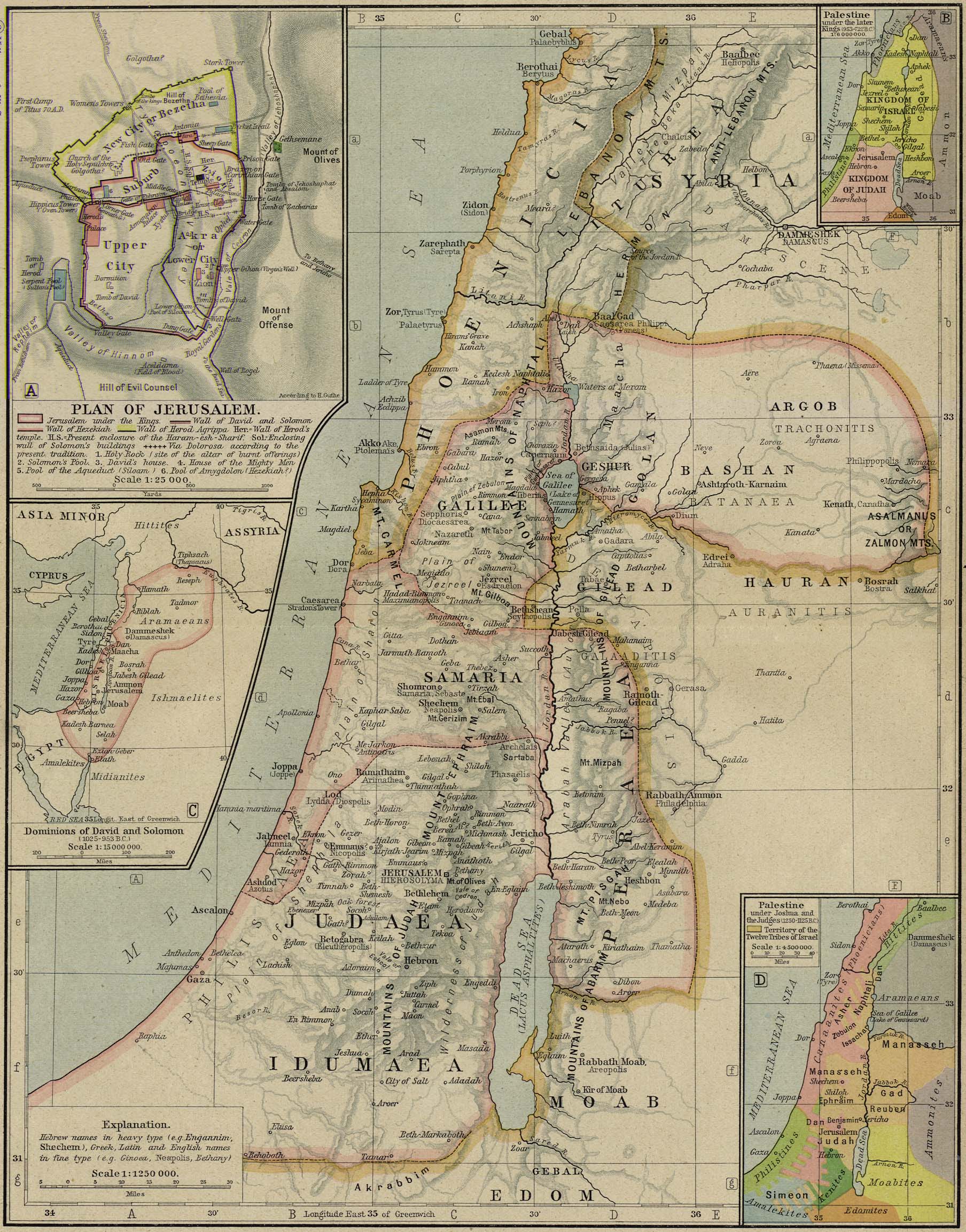
- Located: the site is known
- Proposed: a river identified with one Naaman named
- The route, in the order the text gives
- 1Jerusalem, Saul asked the high priest for letters to the synagogues of Damascus Acts 9:1 to 2
- 2Damascus, The light from heaven flashed around Saul as he drew near the city Acts 9:3
- 3Dan, Abram's pursuit of the kings passed Dan on its way north of Damascus Genesis 14:14
- 4?The Barada, The Abanah of Naaman's complaint 2 Kings 5:12
- 5?The Awaj, The Pharpar of Naaman's complaint 2 Kings 5:12
Base map: Reference map of ancient Palestine, Rand McNally reference map (1926), public domain. Places with a place page stand at its coordinates and the others at the point cited for each, set on the plate by Jerusalem and Damascus, as the plate prints them.
Five places; the line joins the two ends of Saul's road, and Acts gives no way between them.
Damascus Through Time
The city appears in the records of Egypt, Israel, Assyria and Rome, and in the call of Saul.
Damascus outlasted the kingdom of Aram and stood as a Roman city in the days of the apostles.
- The fifteenth century BCThutmose III of Egypt lists the city as tjmsqw
- About 1350 BCThe Amarna letters name the city Dimasqu, ruled by Biryawaza
- The reign of DavidDavid puts garrisons in Aram of Damascus2 Samuel 8:6
- The reign of SolomonRezon gathers raiders, settles in Damascus and rules there1 Kings 11:24
- 853 BCHadadezer of Damascus leads the coalition that fights Assyria at Qarqar
- The days of ElishaNaaman, the commander of the king of Aram, is cleansed in the Jordan2 Kings 5:14
- About 732 BCAssyria takes the city in the days of Ahaz2 Kings 16:9
- 64 BCPompey annexes western Syria, and Rome redesigns the city on two main streets
- The days of the apostlesSaul is led blind into Damascus and is baptized thereActs 9:8 to 18
- After Saul's return from ArabiaThe governor under King Aretas guards the city, and Saul escapes in a basket2 Corinthians 11:32 to 33
Ten events in order; the rows from Scripture carry their references.
About 732 BC, 64 BC, The days of the apostles, After Saul's return from Arabia
The Head of Aram
The Aramean kingdom of Damascus began in the late twelfth century BC.
The kings Ben-hadad and Hazael of Damascus appear often in the books of Kings, and Assyrian records sometimes called the kingdom the house of Hazael.
For the head of Aram is Damascus, and the head of Damascus is Rezin. Within sixty-five years Ephraim will be shattered as a people.In Isaiah's day the whole kingdom could be named by its capital and its king.
So the king of Assyria responded to him, marched up to Damascus, and captured it. He took its people to Kir as captives and put Rezin to death. Then King Ahaz went to Damascus to meet Tiglath-pileser king of Assyria. On seeing the altar in Damascus, King Ahaz sent Uriah the priest a model of the altar and complete plans for its construction.Judah's king copied the altar of the city whose fall he had paid Assyria to bring about.
The Rivers and the Street
Two things a reader of Scripture can still find at Damascus are its river and its long straight street.
The Barada flows out of the spring of Ain al-Fijah in the Anti-Lebanon and divides into seven branches that water the Ghouta oasis. Its Greek name, Chrysorrhoas, means streaming with gold.
The rivers Naaman preferred to the Jordan2 Kings 5:12
Are not the Abanah and Pharpar, the rivers of Damascus, better than all the waters of Israel? Could I not have washed in them and been cleansed?” So he turned and went away in a rage.Naaman's anger shows how the rivers of his city were prized.
Adam Clarke, in his Commentary of 1832, wrote that the rivers no longer carried these names and that no one knew which streams they were. OpenBible now identifies the Abanah with the Barada and the Pharpar with the Awaj.
The street called StraightActs 9:11
Straight Street is the old main street of Damascus, running east to west through the walled city for about 1,500 metres. Its eastern end reaches the Roman gate Bab Sharqi, the one gate of the Roman wall that still stands.
The Road and the Years After
Barnes wrote on the place of the light, and Paul's own letter adds a stay in Arabia.
Albert Barnes, in his Notes on Acts 9:3, writes that the place of the light on the road is not known and that all we know is that it was near Damascus.
nor did I go up to Jerusalem to the apostles who came before me, but I went into Arabia and later returned to Damascus.Paul sets out his movements to show that he received his gospel by revelation from Jesus Christ.
Where It Points
Damascus sent armies against Israel, and God showed mercy to two men tied to the city.
Then Naaman and all his attendants went back to the man of God, stood before him, and declared, “Now I know for sure that there is no God in all the earth except in Israel. So please accept a gift from your servant.”Jesus pointed to this cleansing at Nazareth as mercy shown to a man outside Israel.
“Go!” said the Lord. “This man is My chosen instrument to carry My name before the Gentiles and their kings, and before the people of Israel.The Lord's word to Ananias names the work the persecutor was chosen for.
Saul promptly began to proclaim Jesus in the synagogues, declaring, “He is the Son of God.”Saul's first preaching was in the synagogues of the city where he had come to make arrests.
The Voices
Three teachers on Abram's heir, the call of Saul and the judgment of Damascus, from Ambrose to Albert Barnes.
died 397 · Ambrose of Milan
On Abraham
Abram asked God for an heir
The quotation1 quotation
“Let us also consider what recompense he requests from the Lord. He does not ask for riches, as would a greedy person, nor for a long life in this world, as would one who fears death, nor for power. Rather he asks for an heir worthy of his work. ‘What will you give me?’—he says—‘I am about to depart without children.’ And then he says, ‘Because you have not given me posterity, a slave born in my house will be my heir.’ Let everyone learn therefore not to despise marriage.”
Ambrose of Milan · On Abraham · on Genesis 15:2 to 3Patristic
1509 to 1564 · John Calvin
Commentaries
God reclaimed a man who ran against Christ
The quotation1 quotation
“In craving epistles of the high priest, he ran headlong against Christ willingly; and now he is enforced to obey whether he will or no. This is surely the most excellent mercy of God, in that that man is reclaimed unto salvation contrary to the purpose of his mind, whom so great a heat carried headlong into destruction.”
John Calvin · Commentaries · on Acts 9:3Reformed
1798 to 1870 · Albert Barnes
Notes, Explanatory and Practical, on the Old and New Testaments (1832-1869)
Judgment began with Israel's enemies
The quotation1 quotation
“The order of God’s threatenings seems to have been addressed to gain the hearing of the people. The punishment is first denounced upon their enemies, and that, for their sins, directly or indirectly, against themselves, and God in them. Then, as to those enemies themselves, the order is not of place or time, but of their relation to God’s people.”
Albert Barnes · Notes, Explanatory and Practical, on the Old and New Testaments (1832-1869) · on Amos 1:3Evangelical
Books to Read Next
One of these three works can be read free online.
Antiquities of the Jews, Book 1, chapter 7
Flavius Josephus, translated by William Whiston · about AD 93
Josephus quotes Nicolaus of Damascus, who wrote that Abram reigned at Damascus before he went on to Canaan.
Read at Project GutenbergPaul's Early Period: Chronology, Mission Strategy, Theology
Rainer Riesner · 1998
Riesner weighs the evidence for who ruled Damascus when Paul escaped over the wall.
In print: find it wherever books are sold.
Paul Between Damascus and Antioch: The Unknown Years
Martin Hengel · 1997
Hengel studies the years after Paul's call that Acts tells in a few verses.
In print: find it wherever books are sold.
The City of the Call
The prophets judged Damascus for its cruelty to Gilead.
The reader is called to the mercy that reached Saul while he was still breathing threats against the disciples.
Sources
Scripture is the Berean Standard Bible.
- Strong's Hebrew dictionary, h1834.
- OpenBible.info, Bible Geocoding Data, ancient.jsonl, CC BY.
- Flavius Josephus, Antiquities of the Jews 1.7.2, translated by William Whiston, public domain.
- Adam Clarke, Commentary on the Bible, 1832, on 2 Kings 5:12.
- Albert Barnes, Notes, Explanatory and Practical, on the New Testament, on Acts 9:3.
- Ambrose of Milan, On Abraham, 397, on Genesis 15:2 to 3.
- John Calvin, Commentaries, 1554, on Acts 9:3.
- Albert Barnes, Notes, Explanatory and Practical, on the Old Testament, on Amos 1:3.
- Rainer Riesner, Paul's Early Period: Chronology, Mission Strategy, Theology (Eerdmans, 1998)
- Martin Hengel, Paul Between Damascus and Antioch: The Unknown Years (Westminster John Knox, 1997)
- Rand McNally atlas reference map, 1926, public domain.
Keep Studying
Read it4