
Genesis 1:26 to 27 and 9:6 · Doctrine · Featured Study
The Sanctity of Human Life
The doctrine rests on the image of God in Genesis 1 and 9 and on the texts that speak of a person before birth.
After the flood God said He would demand an accounting from anyone who takes a human life.
- First taught
- Genesis 1:26 to 27
- Fullest statement
- Genesis 9:5 to 6
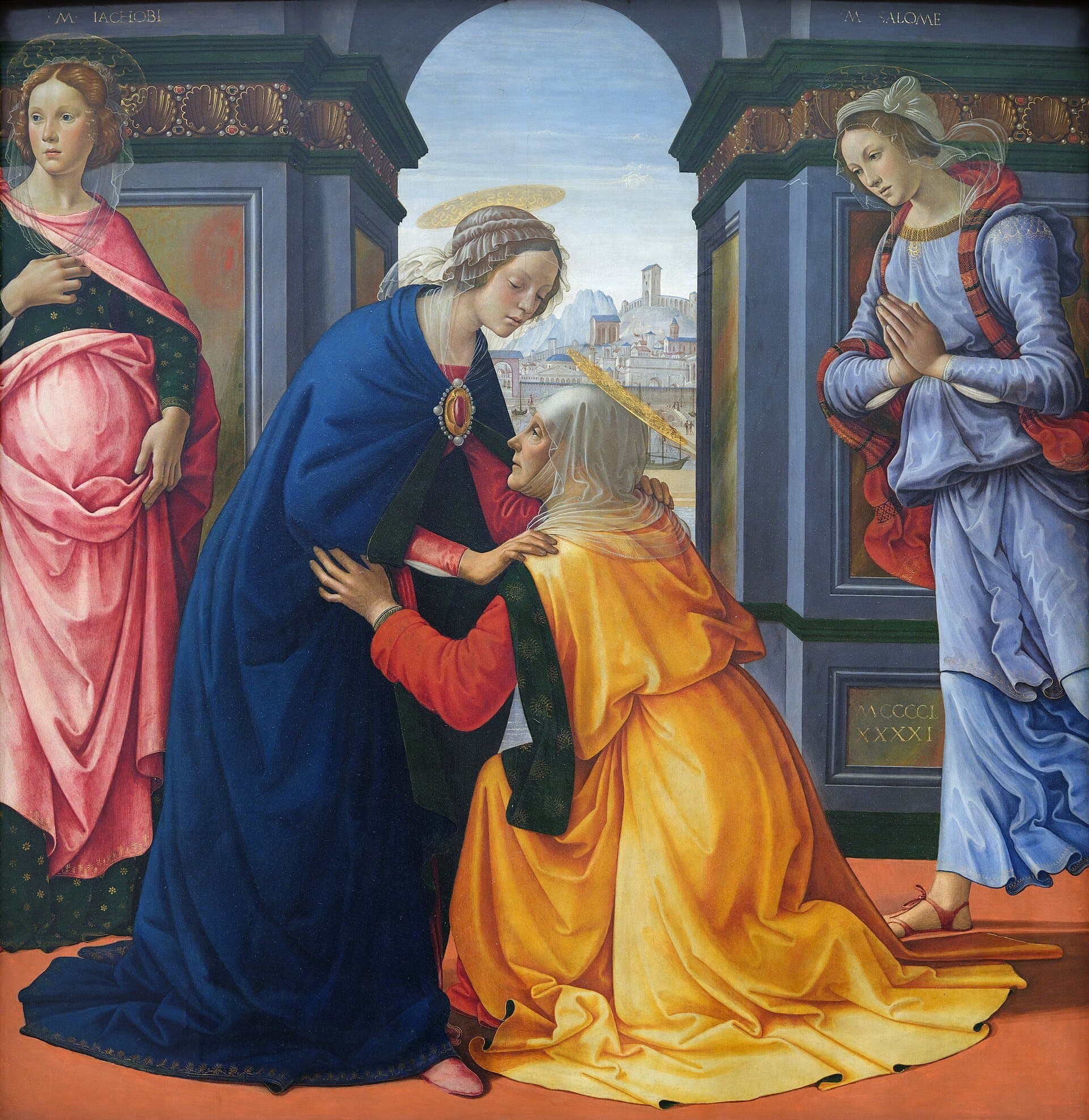
Domenico Ghirlandaio, The Visitation with Mary Jacobi and Mary Salome, 1491, Louvre, INV 297. Public domain by date (the painter died in 1494), via Wikimedia Commons, File:La_Visitation_avec_Marie-Jacobie_et_Marie-Salom%C3%A9_-_Domenico_Ghirlandaio_-_Mus%C3%A9e_du_Louvre_Peintures_INV_297_%3B_MR_240.jpg.
THE ARTWORKGhirlandaio painted the meeting of Mary and Elizabeth that Luke 1:39 to 45 records, with Mary Jacobi and Mary Salome standing beside them. Luke says the baby in Elizabeth's womb leaped at Mary's greeting, and the painter shows Elizabeth kneeling to Mary under an arch at the centre of the panel.
Summary
Scripture grounds the worth of every human life in the image of God.
- Genesis 1:27 says God created man in His own image, male and female.
- Genesis 9:6 bases the penalty for shedding human blood on that image.
- Psalm 139:13 and Jeremiah 1:5 speak of God forming and knowing a person in the womb.
- The Didache and the Epistle of Barnabas forbid the killing of a child by abortion and after birth.
- Calvin, Rashi and the Septuagint read the law of Exodus 21:22 to 25 in three different ways.
In the Image of God
Genesis 1 names the image of God at creation, and Genesis 9 names it again after the flood.
Then God said, “Let Us make man in Our image, after Our likeness, to rule over the fish of the sea and the birds of the air, over the livestock, and over all the earth itself and every creature that crawls upon it.” So God created man in His own image; in the image of God He created him; male and female He created them.The verses root the worth of every person in the counsel and the work of God.
And surely I will require the life of any man or beast by whose hand your lifeblood is shed. I will demand an accounting from anyone who takes the life of his fellow man: Whoever sheds the blood of man, by man his blood will be shed; for in His own image God has made mankind.God spoke these words to Noah and his sons, from whom the whole earth was populated, so the law binds every people descended from them.
The Hebrew word for image is tselem, a representative figure, and the word for likeness is demut, a resemblance or model.
Genesis 5:3 says Adam had a son in his own likeness, after his own image, so the likeness passes from father to son.
The order of the words in Genesis 9:6shaphak, dam, adam
The first half of Genesis 9:6 runs in Hebrew as sheds, blood, man, then by man, his blood, will be shed. The words of the first line return in reverse order in the second, so the sentence on the killer mirrors his deed.
Calvin and Jamieson, Fausset and Brown on the image after the fallOn Genesis 9:6
John Calvin answered the reader who says the image has been blotted out. He wrote that a remnant of it remains, so that man still has no small dignity, and that God keeps in view the end for which He made man.
Jamieson, Fausset and Brown wrote that the image was injured by the fall but not lost. For that reason they set a high value on the life of every man, even the poorest and humblest.
The Image Across the Canon
Genesis 5 and four passages of Paul's letters carry the image beyond the first chapters of the Bible.
| Text | Its words | What it adds |
|---|---|---|
| Genesis 5:1 | He made him in His own likeness | The likeness stands at the head of the line of Adam |
| 1 Corinthians 11:7 | he is the image and glory of God | Paul applies the image to a man at worship |
| 2 Corinthians 4:4 | Christ, who is the image of God | The light of the gospel shows His glory |
| Colossians 1:15 | The Son is the image of the invisible God | The image of the God no one sees is a person, the Son |
| Colossians 3:10 | being renewed in knowledge in the image of its Creator | The believer's new self is renewed in the image |
From the Blood of Abel to the Child in the Womb
Genesis 4, Exodus 20, Matthew 5, Psalm 139, Jeremiah 1 and Luke 1 carry the worth of a life from the first murder back to the womb.
The first death by a human hand comes one chapter after the fall, when Cain kills his brother in the field.
“What have you done?” replied the LORD. “The voice of your brother’s blood cries out to Me from the ground. Now you are cursed and banished from the ground, which has opened its mouth to receive your brother’s blood from your hand.The verses show that God hears a life taken in secret and holds the killer to account.
You shall not murder.The sixth commandment uses ratsach, the verb for the killing of a human being and above all for murder.
You have heard that it was said to the ancients, ‘Do not murder’ and ‘Anyone who murders will be subject to judgment.’ But I tell you that anyone who is angry with his brother will be subject to judgment. Again, anyone who says to his brother, ‘Raca,’ will be subject to the Sanhedrin. But anyone who says, ‘You fool!’ will be subject to the fire of hell.Jesus carries the commandment from the hand that kills to the anger that leads to it.
The Psalms, the Prophets and the Gospels speak of a person in the womb as one whom God already knows.
For You formed my inmost being; You knit me together in my mother’s womb. I praise You, for I am fearfully and wonderfully made. Marvelous are Your works, and I know this very well. My frame was not hidden from You when I was made in secret, when I was woven together in the depths of the earth. Your eyes saw my unformed body; all my days were written in Your book and ordained for me before one of them came to be.David speaks of himself as the one God formed, so his life before birth and after it is one life.
“Before I formed you in the womb I knew you, and before you were born I set you apart and appointed you as a prophet to the nations.”God's knowledge and calling of Jeremiah come before his birth.
When Elizabeth heard Mary’s greeting, the baby leaped in her womb, and Elizabeth was filled with the Holy Spirit. In a loud voice she exclaimed, “Blessed are you among women, and blessed is the fruit of your womb! And why am I so honored, that the mother of my Lord should come to me? For as soon as the sound of your greeting reached my ears, the baby in my womb leaped for joy.Luke calls the unborn John a baby with the word he uses for the newborn Jesus in Luke 2:12, and Elizabeth calls the unborn Jesus her Lord.
What the Text Says and What Is Said of It
Two questions readers bring to the law that guards human life, each answered from the verse that bears on it.
DOES THE SIXTH COMMANDMENT FORBID EVERY TAKING OF LIFE?
The same law of Moses names a death penalty for the one who strikes and kills a man.
DOES EXODUS 21:22 SETTLE WHEN LIFE BEGINS?
The Hebrew says her children come out, and readers differ on whether the harm that follows is the mother's or the child's.
The Early Church and the Exposure of Children
Christian texts from the Didache to the letters of Basil of Caesarea forbade the killing of children before and after birth in a world that exposed them.
| Text | Its words | Translator |
|---|---|---|
| The Didache, chapter 2 | you shall not murder a child by abortion nor kill that which is begotten | M. B. Riddle |
| The Epistle of Barnabas, chapter 19 | You shall not slay the child by procuring abortion; nor, again, shall you destroy it after it is born | Alexander Roberts and James Donaldson |
| Tertullian, Apology, chapter 9 | To hinder a birth is merely a speedier man-killing | S. Thelwall |
| Lactantius, Divine Institutes, book 6, chapter 20 | It is therefore as wicked to expose as it is to kill | William Fletcher |
| Basil of Caesarea, Letter 188, canon 2 | The woman who purposely destroys her unborn child is guilty of murder | Blomfield Jackson |
Tertullian and Lactantius on the exposure of childrenTheir charges against the Roman practice
Tertullian wrote to the Romans that they exposed their own children, to be taken up by any passer-by who pitied them. He charged them with putting their offspring to death by drowning or by exposure to cold, hunger and dogs.
Lactantius wrote that God breathes souls into newborn children for life, and that a parent too poor to raise children should abstain from marriage rather than mar the work of God.
Basil on the danger to the motherLetter 188, canon 2
Basil added that the canon protects the woman as well as the child, since in most cases women who made such attempts died.
What the Text Leaves Unsaid
Scripture leaves three things unsaid about the beginning of a life and the law that guards it.
Scripture speaks of God forming a person in the womb, and it names no moment at which the soul is given to the body.
No verse names the deliberate ending of a pregnancy as an act of its own, and the Didache sets it under the commandment against murder.
Exodus 21:22 to 25 speaks of a woman struck while men are fighting, and it gives no law for a blow aimed at the child.
Why Every Human Life Is Guarded
Calvin and James draw a duty toward every person from the image, and Paul names its end in the Son.
John Calvin wrote on Genesis 9:6 that God sees His own gifts in every person and counts Himself violated in them. No one, he said, can injure a brother without wounding God himself.
With the tongue we bless our Lord and Father, and with it we curse men, who have been made in God’s likeness. Out of the same mouth come blessing and cursing. My brothers, this should not be!James applies the ground of Genesis 9:6 to the tongue as well as to the hand.
For those God foreknew, He also predestined to be conformed to the image of His Son, so that He would be the firstborn among many brothers.The worth the image gives every life finds its end in Christ, whose likeness God's people are shaped to bear.
How Human Life Has Been Taught
Five teachers from the third century to the nineteenth on the image, the blood of Abel, the child in the womb and the life God guards in Genesis 9:5.
OrigenThird century
Origen reads Genesis 4:10 as a word for the persecuted church.
“We also know that what was said of Abel, when he was slain by the wicked murderer Cain, is suitable for all whose blood has been shed wickedly. Let us suppose that the verse ‘The voice of your brother's blood is crying to me from the ground’ is said as well for each of the martyrs, the voice of whose blood cries to God from the ground.”
Origen of Alexandria · Exhortation to Martyrdom 50 · on Genesis 4:10Patristic
Gregory of NyssaFourth century
Gregory separates the image God made from the misery that sin has brought into view.
“We must, then, examine the words carefully: for we find, if we do so, that that which was made ‘in the image’ is one thing, and that which is now manifested in wretchedness is another.”
Gregory of Nyssa · On the Making of Man 16 · on Genesis 1:27Patristic
Ambrose of MilanFourth century
Ambrose marks what the unborn John perceived at Mary's greeting.
“But soon the blessed fruits of Mary's coming and our Lord's presence are made evident. For it follows, And it came to pass, that when Elisabeth heard the salutation of Mary, the babe leaped in her womb. Mark the distinction and propriety of each word. Elisabeth first heard the word, but John first experienced the grace. She heard by the order of nature, he leaped by reason of the mystery. She perceived the coming of Mary, he the coming of the Lord.”
Ambrose of Milan · Catena Aurea by Aquinas · on Luke 1:41Patristic
Matthew HenryEighteenth century
Henry draws from Genesis 9:5 a duty to guard one's own life as well as another's.
“Our lives are not so our own as that we may quit them at our own pleasure, but they are God's and we must resign them at his pleasure; if we in any way hasten our own deaths, we are accountable to God for it.”
Matthew Henry · Commentary on the Whole Bible · on Genesis 9:5Puritan
Charles SpurgeonNineteenth century
Spurgeon describes the first killing as Cain must have met it.
“The first shedding of human blood was a very terrible experiment. Whether Cain's murderous blow was premeditated or not, the sight of a bleeding human corpse must have been a terrible novelty to him. He had not been hardened by reading details of warfare, or listening to tales of murder. Killing and slaying were new terrors to mankind, and he who was the ringleader in such violence must have been filled with mingled astonishment at the result of his blow, and apprehension as to its consequences.”
Charles Spurgeon · The Metropolitan Tabernacle Pulpit, Sermon No. 708: “The Blood Of Abel And The Blood Of Jesus” (lightly modernized text, CCEL edition) · on Genesis 4:10
Where Readers Differ
Readers differ on the harm of Exodus 21:23, on the sword of Genesis 9:6 and on the moment the soul is given.
Exodus 21:22 to 25 is read of a child born early and of a miscarriageJohn Calvin, Commentaries on the Four Last Books of Moses; Rashi on Exodus; Adam Clarke, Commentary on the Bible · Reformed, Rabbinic and Methodist commentary
Calvin held that the harm of verse 23 covers the child as well as the mother, because the foetus in the womb is already a human being. The Berean text renders verse 22 in the same way, with a child born prematurely.
Rashi takes the further mischief of verse 23 to be harm done to the woman. Adam Clarke reads verse 22 of a blow by which the fruit of the womb might be destroyed, and he says its punishment was left to the husband.
Calvin rejected the reading that confines the harm of verse 23 to the mother. He held it a great absurdity if ending the life of the foetus were not a capital crime. He added that no father should sell the life of his child for a set sum.
Genesis 9:6 is read as the magistrate's warrant and as a bar to every capital chargeJohn Calvin, Commentaries on Genesis; Adam Clarke, Commentary on the Bible; Lactantius, Divine Institutes; John Wesley, Explanatory Notes · Reformed, Methodist and early Latin writers
Calvin wrote that the punishments the laws ordain and the judges carry out rest on this sentence of God, who arms the magistrate so that human blood is not shed with impunity. Clarke held that the one guilty of murder should die, and that no other offence should cost a man his life.
Lactantius wrote that a just man may not accuse anyone of a capital charge, since it makes no difference whether a man is put to death by word or by the sword.
John Wesley answered in his note on Exodus 20:13 that the commandment does not forbid necessary defence or the magistrate's putting of offenders to death.
The fathers differ on when the soul is givenTertullian, A Treatise on the Soul; Gregory of Nyssa, On the Making of Man; the Septuagint; Augustine, Enchiridion; Basil of Caesarea, Letter 188 · Early Greek and Latin writers
Tertullian held that soul and body are conceived and formed together, with no moment between them. Gregory of Nyssa wrote that our constitution begins neither as a soul without a body nor as a body without a soul.
The Septuagint sets a fine where the child is born imperfectly formed and life for life where it is perfectly formed. Augustine thought most readers would judge that unformed abortions perish like seeds that never bore fruit, and he doubted that anyone could resolve when an infant begins to live in the womb.
Basil of Caesarea set the question aside in his canon on the unborn, where the Church makes no enquiry into whether the child was formed or unformed.
Books to Read Next
Five works on the image of God, the unborn and the law of Exodus 21, each free to read online.
Commentaries on the First Book of Moses Called Genesis, translated by John King
John Calvin · 1847
Calvin first published this commentary in 1554, and his notes on Genesis 9:6 stand in the first volume.
Read at the Christian Classics Ethereal LibraryThe Didache, translated by M. B. Riddle
Anonymous · 1886
The translation stands in the Ante-Nicene Fathers, volume 7.
Read at New AdventA Treatise on the Soul, translated by Peter Holmes
Tertullian · 1885
Tertullian treats the conception and the forming of the embryo in chapters 25, 27 and 37.
Read at New AdventLetter 188, To Amphilochius, concerning the Canons, translated by Blomfield Jackson
Basil of Caesarea · 1895
Basil's first canonical letter sets out the Church's discipline for the killing of the unborn in its second canon.
Read at New AdventThe Septuagint Version of the Old Testament, with an English translation
Lancelot Charles Lee Brenton · 1879
Brenton's volume gives the Greek text with his English translation beside it.
Read at the Internet ArchiveThe Word Made Flesh
The Word became flesh and made His dwelling among us, so the life God guards in Genesis 9 is the life His Son took on.
Those who belong to Him are called to guard that life in every person they meet.