
Matthew 27, Mark 15, Luke 23, John 19 · Story · Featured Study
The Crucifixion
The day Jesus died on a Roman cross at Golgotha, told from Matthew, Mark, Luke and John.
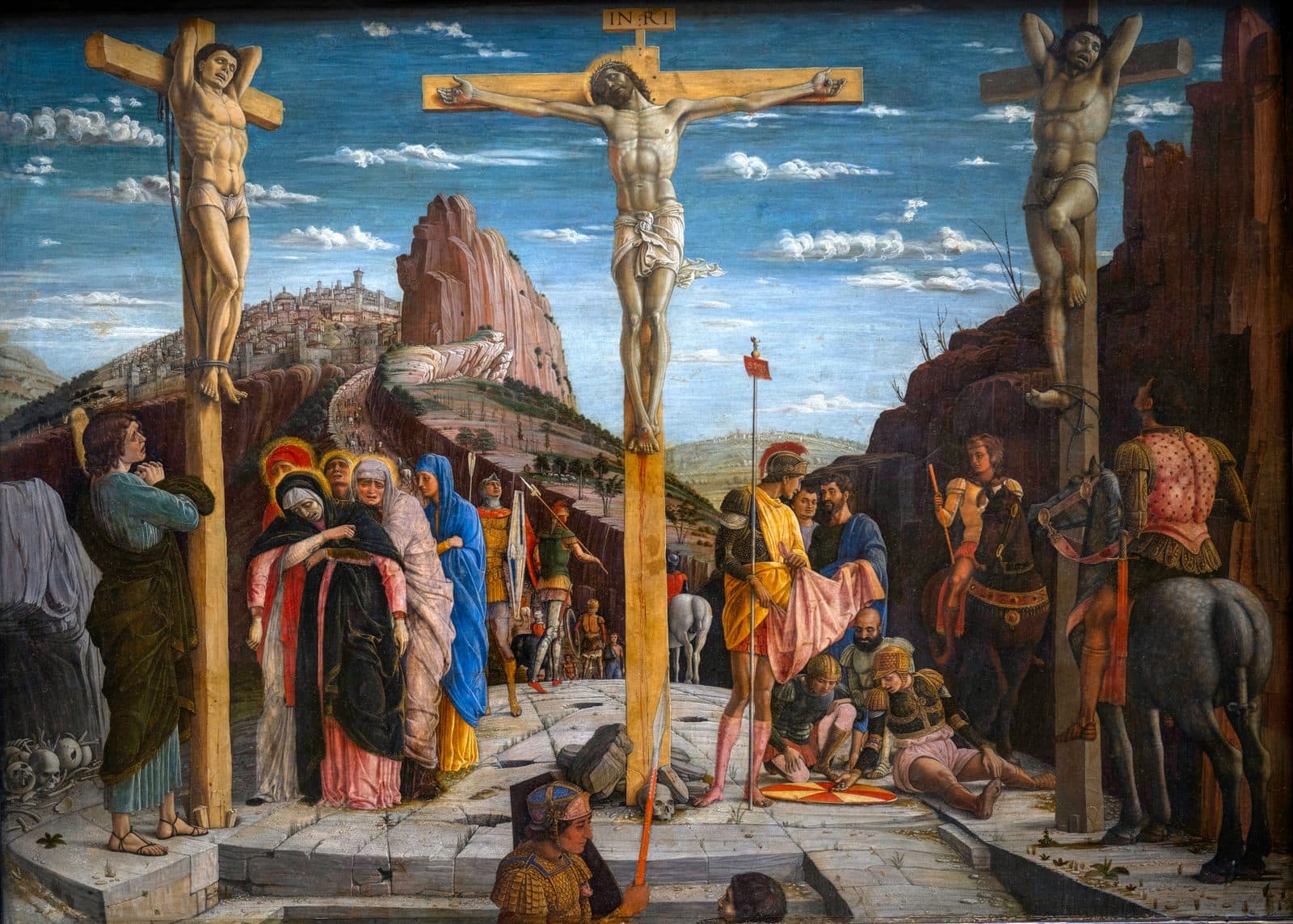
Andrea Mantegna, Crucifixion, between 1456 and 1459, predella of the San Zeno altarpiece, Louvre INV 368. Public domain, via Wikimedia Commons.
THE ARTWORKMantegna set the soldiers' dice and the fainting mother under one cross. John's Gospel places the casting of lots and the women at the cross in consecutive verses.
Rome kept the cross for slaves, and the Gospels say the Son of God died on one.
Summary
Roman soldiers crucified Jesus at Golgotha on the order of Pontius Pilate, between two condemned men, on the day before a Sabbath of Passover week.
- Mark counts the hours: crucified at the third hour, darkness from the sixth to the ninth, death after a loud cry.
- Pilate wrote the charge in Hebrew, Latin and Greek, and refused the chief priests' request to change it.
- Mark's third hour and John's sixth hour have four readings, each with its holders, since Augustine.
Led Out to the Place of the Skull
Mark 15:20-27 and John 19:16-18
After the soldiers had mocked Jesus in the Praetorium, they put His own clothes back on Him and led Him out to crucify Him.
On the road Jesus turned to the women of Jerusalem who were weeping for Him, and told them to weep for themselves and for their children.
Now Simon of Cyrene, the father of Alexander and Rufus, was passing by on his way in from the country, and the soldiers forced him to carry the cross of Jesus. They brought Jesus to a place called Golgotha, which means The Place of the Skull.Simon of Cyrene carries the cross to Golgotha.
Carrying His own cross, He went out to The Place of the Skull, which in Hebrew is called Golgotha. There they crucified Him, and with Him two others, one on each side, with Jesus in the middle.John gives the Hebrew name and the three crosses.
Seven Sayings from the Cross
Luke records three sayings, John three, and Matthew and Mark one
- He asks the Father to forgive those crucifying HimLuke 23:34
- He promises a dying criminal Paradise that dayLuke 23:43
- He gives His mother and the disciple He loved to each otherJohn 19:26-27
- He asks God why He has forsaken HimMark 15:34
- He says that He is thirstyJohn 19:28
- He says that it is finishedJohn 19:30
- He commits His spirit into the Father's handsLuke 23:46
A sequence of the seven sayings in the order the Gospels place them, each with the verse that records it.
From the Third Hour to the Ninth
The day as Mark counts it, with what the other Gospels add
The soldiers divided His garments among them. Passers-by, the chief priests and the scribes mocked Him and told Him to come down from the cross.
Luke adds that one of the criminals rebuked the other and asked Jesus to remember him. John adds that His mother stood near the cross with Mary Magdalene, other women and the disciple whom He loved.
When He cried out at the ninth hour, some who stood nearby thought He was calling Elijah, and one ran to fill a sponge with sour wine.
He let out a loud cry and breathed His last. The women who had followed Him from Galilee watched from a distance.
From the sixth hour until the ninth hour darkness came over all the land.Three hours of darkness, from midday.
And the veil of the temple was torn in two from top to bottom. When the centurion standing there in front of Jesus saw how He had breathed His last, he said, “Truly this man was the Son of God!”The torn veil and the centurion's words.
My God, My God
The cry of the ninth hour and how it is read
The cry is the first line of Psalm 22. In the Hebrew of the psalm the verb is azab, which the lexicon renders to loosen or relinquish.
The words are a prayer, and He addresses God as My God.
My God, my God, why have You forsaken me? Why are You so far from saving me, so far from my words of groaning?The psalm's title names David.
At the ninth hour, Jesus cried out in a loud voice, “Eloi, Eloi, lema sabachthani?” which means, “My God, My God, why have You forsaken Me?”Mark gives the cry in Aramaic before he translates it.
The judgment borne, the faith kept
Calvin, in his Harmony of the Evangelists, holds that Christ took the judgment of God in the place of sinners. He adds that faith still held firm in His heart while He felt forsaken. Spurgeon preached the cry as anguish no one can measure.
I do not think that the records of time, or even of eternity, contain a sentence more full of anguish. Here the wormwood, the gall and all the other bitterness are outdone. Here you may look as into a vast abyss—and though you strain your eyes and gaze till sight fails you, yet you perceive no bottom—it is measureless, unfathomable, inconceivable. This anguish of the Savior on your behalf and mine is no more to be measured and weighed than the sin which needed it, or the love which endured it. We will adore where we cannot comprehend.
Charles Spurgeon · The Metropolitan Tabernacle Pulpit, Sermon No. 2133: “"My God, My God, Why Have You Forsaken Me?"” (lightly modernized text, CCEL edition) · on Matthew 27:46
Trust and desolation together
Wesley reads trust in God and a terrible sense of the wrath due to sin in the one cry.
My God, my God, why hast thou forsaken me? - Our Lord hereby at once expresses his trust in God, and a most distressing sense of his letting loose the powers of darkness upon him, withdrawing the comfortable discoveries of his presence, and filling his soul with a terrible sense of the wrath due to the sins which he was bearing.
John Wesley · Explanatory Notes upon the New Testament · on Matthew 27:46Evangelical
The first line of a psalm that ends in glory
Jamieson, Fausset and Brown read the cry as the opening of a psalm that moves from suffering to glory.
They are the opening words of a Psalm (Ps 22:1) full of the last "sufferings of Christ and the following glories" (1Pe 1:11). "FATHER," was the cry in the first prayer which He uttered on the cross, for matters had not then come to the worst. "Father" was the cry of His last prayer, for matters had then passed their worst.
Jamieson, Fausset & Brown · Commentary Critical and Explanatory on the Whole Bible · on John 19:25-27Reformed
A Death Rome Kept for Slaves
What the Roman writers and Josephus record of the cross
Cicero, prosecuting the governor Verres in 70 BC, called crucifixion the most miserable and most painful punishment, fit for slaves alone. To crucify a Roman citizen, he told the court, was a crime too great for any name.
Josephus records crosses at Jerusalem itself. During the Roman siege the soldiers of Titus scourged the captives and crucified them before the city wall, up to five hundred on some days.
Tacitus records that Christus suffered the extreme penalty under Tiberius at the hands of the procurator Pontius Pilatus. He calls the Christian faith a mischievous superstition, yet he names both the death and the governor.
The Greek word for the cross is stauros, which the lexicon defines as a stake set upright, and so a pole or a cross used for execution.
Taken Down Before the Sabbath
Deuteronomy 21:22-23 and John 19:31-37
Josephus records that the Jews of his day took down the crucified and buried them before sunset.
The soldiers found Jesus already dead and did not break His legs. One of them pierced His side with a spear, and blood and water flowed out.
If a man has committed a sin worthy of death, and he is executed, and you hang his body on a tree, you must not leave the body on the tree overnight, but you must be sure to bury him that day, because anyone who is hung on a tree is under God’s curse. You must not defile the land that the LORD your God is giving you as an inheritance.The law that a hanged body is buried the same day.
It was the day of Preparation, and the next day was a High Sabbath. In order that the bodies would not remain on the cross during the Sabbath, the Jews asked Pilate to have the legs broken and the bodies removed.The request to Pilate before the High Sabbath.
What the Text Leaves Unsaid
Where the four accounts are silent
The Gospels give the cross no shape beyond a charge set above His head. No Gospel describes the nailing, and the nail marks are first named by Thomas after the resurrection.
No Gospel names the year or a medical cause of death. The text says the soldiers crucified Him on Pilate's sentence, after the chief priests, the rulers and the crowd demanded it.
It Is Finished
John 19:28-37 and Galatians 3:13
John writes that Jesus knew everything had now been accomplished, and that His last word was It is finished. The Greek verb is teleo, which the lexicon defines as to end, complete, execute, conclude or discharge a debt.
John marks Scripture fulfilled four times at the cross, in John 19:24, John 19:28, John 19:36 and John 19:37.
Now these things happened so that the Scripture would be fulfilled: “Not one of His bones will be broken.” And, as another Scripture says: “They will look on the One they have pierced.”Two Scriptures John says the spear and the unbroken legs fulfilled.
Christ redeemed us from the curse of the law by becoming a curse for us. For it is written: “Cursed is everyone who is hung on a tree.”Paul reads the curse of Deuteronomy 21:23 on the hanged man as the curse Christ bore for His people.
Three Voices on the Cross
Calvin, Ryle and Spurgeon, earliest first
Calvin, on John's Gospel, reads the crown of thorns as Pilate's mark of shame on a man called a king.
And the soldiers, platting a crown of thorns. This was unquestionably done by the authority of Pilate, in order to affix a mark of infamy on the Son of God, for having made himself a king; and that in order to satisfy the rage of the Jews, as if he had been convinced that the accusations which they brought against Christ were well founded.
John Calvin · Commentaries · on John 19:2Reformed
Ryle writes on the points of the passion that John alone records.
This part of John's narrative of Christ's passion, contains points of deep interest, which are silently passed over by Matthew, Mark, and Luke. The reason of this silence we are not told. Suffice it for us to remember that, both in what they recorded and in what they did not record, all four Evangelists wrote by inspiration of God. Let us mark, for one thing, in these verses, the frequent fulfillments of prophetic Scripture throughout every part of Christ's crucifixion. Three different predictions are specially mentioned, in Exodus, Psalms, and Zechariah, which received their accomplishment at the cross.
J.C. Ryle · Expository Thoughts on the Gospels: John (lightly modernized text, Grace Gems edition) · on John 19:28-37Reformed Evangelical
Spurgeon preached on the first saying, the prayer for those who were crucifying Him.
WHAT tenderness we have here; what self-forgetfulness; what almighty love! Jesus did not say to those who crucified Him, "Be gone!" One such word and they would have all fled. When they came to take Him in the garden, they went backward and fell to the ground when He spoke but a short sentence! And now that He is on the Cross, a single syllable would have made the whole company fall to the ground, or flee away in fright. Jesus says not a word in His own defense.
Charles Spurgeon · The Metropolitan Tabernacle Pulpit, Sermon No. 2263: “Christ's Plea for Ignorant Sinners” (lightly modernized text, CCEL edition) · on Luke 23:34
The Third Hour and the Sixth
Mark 15:25 and John 19:14, four readings with their holders
Mark and John name different hours on the day of the crucifixion.
Augustine grants that the plain reading of Mark, the nailing at the third hour, could be held if John had not named the sixth. Four readings answer the difference.
It was the third hour when they crucified Him.Mark's hour.
It was the day of Preparation for the Passover, about the sixth hour. And Pilate said to the Jews, “Here is your King!”John's hour.
The hour of the shout
Augustine reads Mark's third hour as the hour the crowd cried out for the crucifixion, and the nailing as after about the sixth.
On Pilate's judgment and condemnation before the tribunal, they took the Lord Jesus Christ, about the sixth hour, and led Him away. "And He, bearing His cross, went forth into the place that is called Calvary, but in Hebrew, Golgotha; where they crucified Him." What else, then, is the meaning of the evangelist Mark saying, "And it was the third hour, and they crucified Him," but this, that the Lord was crucified at the third hour by the tongues of the Jews, at the sixth hour by the hands of the soldiers? That we may understand that the fifth hour was now completed, and there was some beginning made of the sixth, when Pilate took his seat before the tribunal, which is expressed by John as "about the sixth hour;" and when He was led forth, and nailed to the tree with the two robbers, and the events recorded were enacted beside His cross, the completion of the sixth hour was fully reached, being the hour from which, on to the ninth, the sun was obscured, and the darkness took place, we have it jointly attested on the authority of the three evangelists, Matthew, Mark, and Luke. But as the Jews attempted to transfer the crime of slaying Christ from themselves to the Romans, that is to say, to Pilate and his soldiers, therefore Mark suppresses the hour at which Christ was crucified by the soldiers, and which then began to enter upon the sixth, and remembers rather to give an express place to the third hour, at which they are understood to have cried out before Pilate, "Crucify, crucify him," that it not only may be seen that the former crucified Jesus, namely, the soldiers who hung Him on the tree at the sixth hour, but the Jews also, who at the third hour cried out to have Him crucified.
Augustine of Hippo · Tractates on John 117 · on John 19:14Patristic
The objection: Mark writes that they crucified Him at that hour, and says nothing of a shout.
Two ways of counting the hours
Matthew Henry reads John's sixth hour by Roman reckoning, six in the morning, and Mark's third by Jewish reckoning, about nine.
He was brought before Pilate about the sixth hour ( John xix. 14 ), according to the Roman way of reckoning, which John uses, with which ours at this day agrees, that is at six o'clock in the morning; and then, at the third hour, according to the Jews' way of reckoning, that is, about nine of the clock in the morning, or soon after, they nailed him to the cross.
Matthew Henry · Commentary on the Whole Bible · on Mark 15:25Puritan
Quarters of the day, or a copyist's error
Adam Clarke gives two answers, the quarters of the day and a copyist's error in John 19:14.
The third hour - It has been before observed, that the Jews divided their night into four watches, of three hours each. They also divided the day into four general parts. The first began at sunrise. The second three hours after. The third at mid-day. The fourth three hours after, and continued till sunset. Christ having been nailed to the cross a little after mid-day, Joh 19:14-16, Joh 19:17, and having expired about three o’clock, Mar 15:33, the whole business of the crucifixion was finished within the space of this third division of the day, which Mark calls here the third hour. Commentators and critics have found it very difficult to reconcile this third hour of Mark, with the sixth hour of John, Joh 19:14. It is supposed that the true reading, in Joh 19:14, should be τριτη, the third, instead of ἑκτη the sixth; a mistake which might have readily taken place in ancient times, when the character γ gamma, which was put for τριτη, three, might have been mistaken for Ϛ episema, or sigma tau, which signifies six. And τριτη, the third, instead of ἑκτη, the sixth, is the reading of some very eminent MSS. in the place in question, Joh 19:14. See Bengel, Newcome, Macknight, Lightfoot, Rosenmuller, etc., on this perplexing point.
Adam Clarke · Commentary on the Bible · on Mark 15:25Evangelical
Books on the Crucifixion
The Harmony of the Gospels
Augustine of Hippo · about 400
Book 3 works through the four accounts of the passion and the points where they differ.
Read Book 3, chapter 13 at New AdventCommentary on a Harmony of the Evangelists, volume 3
John Calvin · 1555
Calvin reads the three Gospels of the passion as one account, verse by verse.
Read it at the Christian Classics Ethereal LibraryThe Wars of the Jews
Flavius Josephus, translated by William Whiston · 1737
Josephus records the crucifixions at the siege of Jerusalem in his history of the war.
Read it at Project GutenbergChrist Crucified
The cross was a death of shame under Rome and a death under the curse in the law of Moses. The Gospels say that Jesus, the King of the Jews, died there and committed His spirit to the Father.
John says the one who saw the blood and water testified, so that you also may believe. The text asks the reader to believe in the One who was pierced.
Keep studying
Read it4
Studies7
Symbols1