
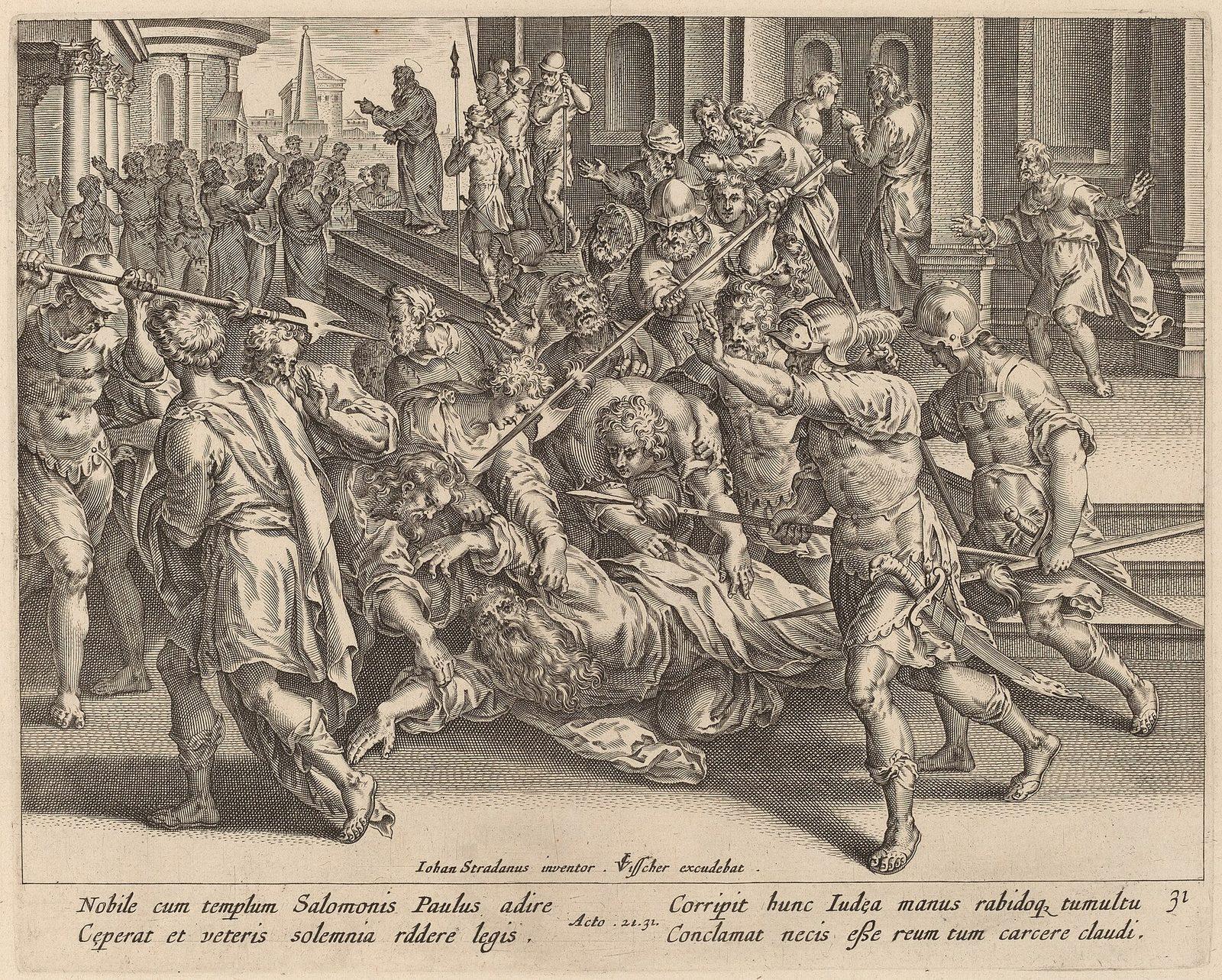
Philip Galle after Jan van der Straet, The Arrest of Saint Paul. CC0.
Acts 16 and 22 · Subject · Featured Study
Paul's Roman Citizenship
Paul held Roman citizenship from birth, a right many in the provinces had to buy.
“I paid a high price for my citizenship,” said the commander. “But I was born a citizen,” Paul replied.
- Books
- Acts, Philippians
- Hold in memory
- Acts 22:28, Philippians 3:20
Cicero wrote of a Roman beaten in the forum of Messana who could only cry out that he was a citizen of Rome.
Summary
The law of Rome kept a citizen from being scourged. A citizen could also ask to be tried by the emperor. Paul's claim to these rights changed how Roman officials treated him. In the end it carried his case to Caesar at Rome.
- Philippi, where Paul was beaten, was a Roman colony and the leading city of its district.
- Suetonius says Claudius put to death men who falsely claimed to be citizens.
- Pliny later sent Christians who were Roman citizens to Rome for trial.
Three Times Paul Named His Rights
Three verses give Paul's own words about his rights.
Each time Paul spoke, the officials had to stop and change course.
But Paul said to the officers, “They beat us publicly without a trial and threw us into prison, even though we are Roman citizens. And now do they want to send us away secretly? Absolutely not! Let them come themselves and escort us out!”Paul makes the magistrates' own law the ground of his complaint.
But as they stretched him out to strap him down, Paul said to the centurion standing there, “Is it lawful for you to flog a Roman citizen without a trial?”Paul's question here stops the flogging before it starts.
If, however, I am guilty of anything worthy of death, I do not refuse to die. But if there is no truth to their accusations against me, no one has the right to hand me over to them. I appeal to Caesar!”Before Festus Paul uses the citizen's right to have his case heard by the emperor.
From the Barracks to Rome
Six links, each a step in Acts where the citizenship changed what happened next.
Paul's citizenship stopped a flogging, put the commander on his side and opened the road to Caesar.
- What happened
- The commander orders Paul flogged and questioned
- What happened
- The commander sees he has put a Roman citizen in chains
- What happened
- The commander writes to Felix that he rescued a Roman citizen
- What happened
- Festus takes counsel and grants the appeal
- What happened
- Agrippa says Paul could have been released but for the appeal
6Rome
- What happened
- Paul lives in Rome with a soldier to guard him
The links run from Acts 22 to Acts 28.
Philippi, the Barracks and the Appeal
Three scenes in which the citizenship turns Paul's story.
At Philippi the magistrates had Paul and Silas stripped, beaten with rods and jailed. The next morning they sent word to let them go, and Paul refused to leave in secret.
The magistrates came in person, led the two men out and asked them to leave the city.
So the officers relayed this message to the magistrates, who were alarmed to hear that Paul and Silas were Roman citizens.Luke names the citizenship as the reason for the magistrates' fear.
At Jerusalem a centurion heard Paul's question and warned the commander.
The commander went to Paul and asked, “Tell me, are you a Roman citizen?” “Yes,” he answered.The commander checks the claim himself before the flogging goes any further.
At Caesarea Festus, wishing to please the Jews, asked Paul to go up to Jerusalem for trial.
Paul replied, “I am standing before the judgment seat of Caesar, where I ought to be tried. I have done nothing wrong to the Jews, as you yourself know very well.Paul names Caesar's court as the right place for his trial.
What the Citizenship Gave
Old laws against beating a citizen, and a right that could be bought.
Livy, the Roman historian, tells of two old laws. The Valerian law forbade the scourging of a citizen who had appealed, but it set no penalty. The Porcian law set the severest penalties on anyone who killed or scourged a Roman citizen.
Dio Cassius says that under Claudius the price fell so low that people joked a man could become a citizen for some bits of broken glass.
W. M. Ramsay held that Paul's citizenship marks his family as one of distinction and some wealth.
A Citizenship in Heaven
The church at Philippi had watched Paul claim his Roman rights.
To that church Paul later wrote of a citizenship of another kind.
But our citizenship is in heaven, and we eagerly await a Savior from there, the Lord Jesus Christ,Paul uses the language of the city for the church's true home.
Where Readers Differ
One question of Paul's citizenship, with the writers who answer it.
Why did Paul not speak before the beating at Philippi?2 paragraphs
John Calvin thought Paul may have claimed his right and not been heard in the uproar. W. M. Ramsay, in 1896, asked what chance a protest had in such a scene, and judged that it may have been made and not heard.
John Chrysostom read the later claim as a refusal to be released like a condemned man. He added that it protected the jailer, and Calvin held that it eased the brethren after Paul left.
Books to Read Next
Two works, each free to read online.
St. Paul the Traveller and the Roman Citizen
W. M. Ramsay · 1896
Ramsay weighs the scene at Philippi and asks why Paul's protest went unheard.
Free at the Internet ArchiveThe Life and Epistles of Saint Paul
W. J. Conybeare and J. S. Howson · 1869 edition
Their notes name the two Roman laws broken at Philippi.
Free at the Internet ArchiveSources
Scripture is the Berean Standard Bible.
- The Holy Bible, Berean Standard Bible (read 2026)
- Livy, History of Rome 10.9.5 to 6, translated by Canon Roberts (Dutton, 1912)
- Cicero, Against Verres 2.5.162, translated by C. D. Yonge, with the Latin text.
- Dio Cassius, Roman History 60.17.5 to 7, translated by Earnest Cary, Loeb (1924)
- Suetonius, Claudius 25.3, translated by J. C. Rolfe, Loeb (1914)
- Pliny the Younger, Letters 10.96 (Melmoth's Letter XCVII), revised by F. C. T. Bosanquet (London, 1905)
- W. J. Conybeare and J. S. Howson, The Life and Epistles of Saint Paul, People's Edition (Cincinnati, 1869)
- John Calvin, Commentary upon the Acts of the Apostles, volume 2, translated by Christopher Fetherstone, on Acts 16:37.
- W. M. Ramsay, St. Paul the Traveller and the Roman Citizen (New York and London: Putnam, 1896)
- John Chrysostom, Homily 36 on Acts, Nicene and Post-Nicene Fathers, first series, volume 11.
Keep Studying
Read it1
Studies9
People and groups8