
Judges 11:29 to 40 · Debate · Featured Study
Jephthah's vow
Josephus, Augustine, the rabbis, Radak and Keil and Delitzsch read the keeping of Jephthah's vow in Judges 11 in two ways.
Jephthah vowed that whatever came out of his door to meet him would belong to the LORD, and his only child came out.
- The question
- Did Jephthah put his daughter to death to keep his vow, or did he give her to the LORD for life?
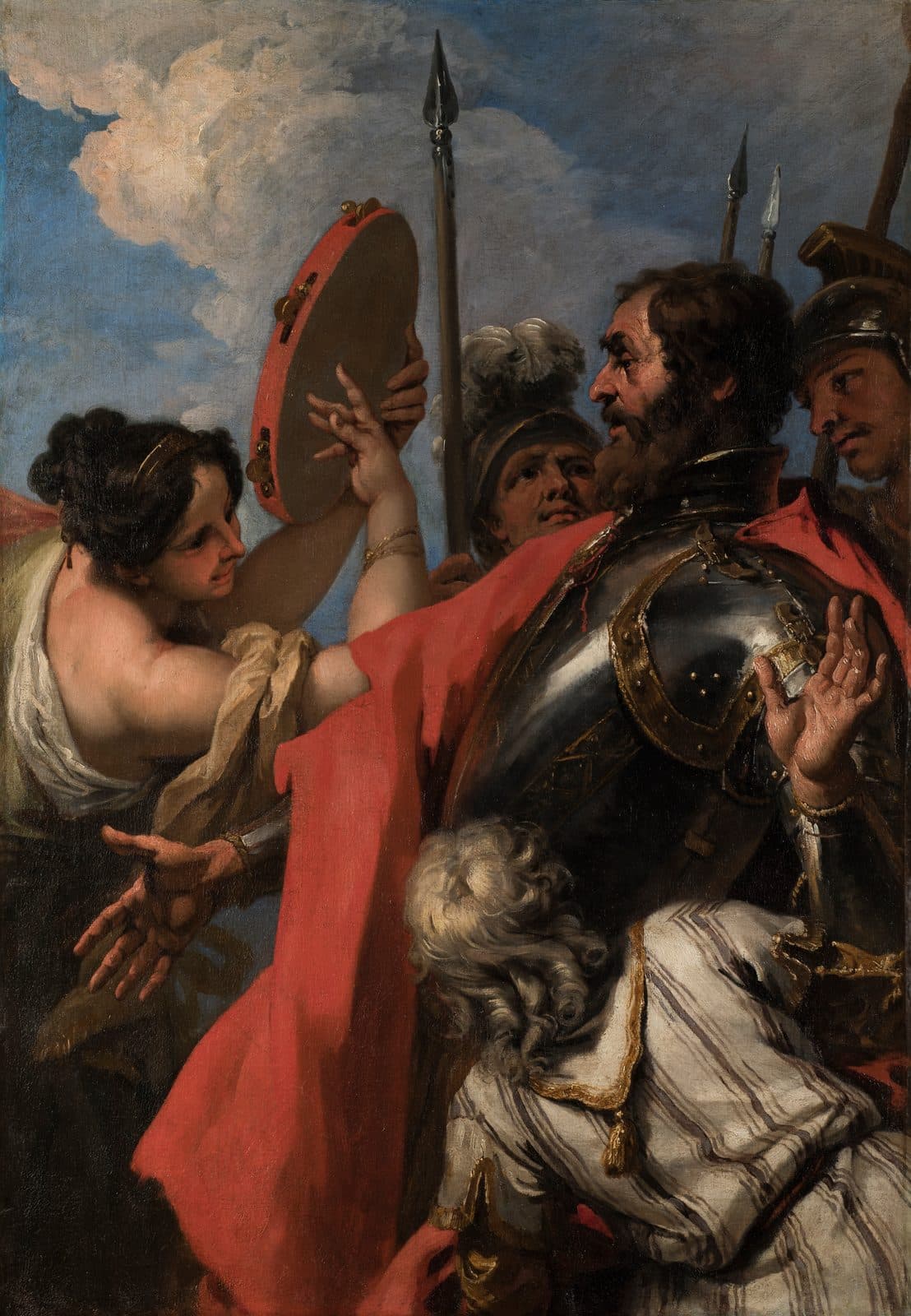
Sebastiano Ricci, Jephthah and His Daughter, about 1710, Memphis Brooks Museum of Art, Kress Collection. Published before 1930 and in the public domain. Wikimedia Commons, File:Ricci - Jephthah and His Daughter, c. 1710, K1704, Memphis Brooks Museum of Art.jpg.
THE ARTWORKRicci painted the moment the daughter comes out with her tambourine and her father recoils, and he left the outcome of the vow unpainted.
Summary
Judges 11:39 says that Jephthah did to his daughter as he had vowed, and readers since Josephus have divided over what he did.
- Josephus, the rabbis of the midrash, Ambrose and Albert Barnes hold that she was offered as a burnt offering, as verse 31 says.
- David Kimhi, Adam Clarke, John Gill and Keil and Delitzsch hold that she was given to the LORD for life and never married, as they read verses 37 to 39.
- Both readings hold that the law forbids the burning of sons and daughters in Deuteronomy 12:31, and that Hebrews 11 names Jephthah among those who acted through faith.
The Texts Every Side Reads
Four passages of Judges 11 carry the weight of the question, from the vow to the yearly custom.
Jephthah made this vow to the LORD: “If indeed You will deliver the Ammonites into my hand, then whatever comes out the door of my house to greet me on my triumphant return from the Ammonites will belong to the LORD, and I will offer it up as a burnt offering.”This is the vow itself, and the debate turns on what the words whatever comes out and a burnt offering meant as Jephthah spoke them.
And when Jephthah returned home to Mizpah, there was his daughter coming out to meet him with tambourines and dancing! She was his only child; he had no son or daughter besides her. As soon as Jephthah saw her, he tore his clothes and said, “No! Not my daughter! You have brought me to my knees! You have brought great misery upon me, for I have given my word to the LORD and cannot take it back.”His only child was the first to meet him, and his grief shows that he held his word to the LORD to bind him.
“My father,” she replied, “you have given your word to the LORD. Do to me as you have said, for the LORD has avenged you of your enemies, the Ammonites.” She also said to her father, “Let me do this one thing: Let me wander for two months through the mountains with my friends and mourn my virginity.”Her answer accepts the vow, and her wish to mourn her virginity is the detail the second reading rests on.
After two months, she returned to her father, and he did to her as he had vowed. And she had never had relations with a man. So it has become a custom in Israel that each year the young women of Israel go out for four days to lament the daughter of Jephthah the Gileadite.The verse joins the keeping of the vow to her never having had relations with a man, and each reading takes the two clauses together in its own way.
Two Answers to Seven Questions
The two readings divide on seven questions of the text and the law.
| The question | She died as a burnt offering | She was given to the LORD unmarried |
|---|---|---|
| What did the vow promise? | A burnt offering of whoever came out first, since only a person could be expected to come out to meet him (Barnes). | A burnt offering if it was fit for the altar, or a holy thing of the LORD if it was not (Kimhi). |
| What could come out of the door of a house that kept animals? | The rabbis ask what he would have done had a dog or a cat come out. | A person, who could be given to the LORD without the altar (Keil and Delitzsch). |
| What did she mourn in Judges 11:37 to 38? | Her youth, before her death (Josephus). | Her virginity itself, with a life ahead of her unmarried (Keil and Delitzsch). |
| What do the two clauses of Judges 11:39 mean? | He offered her as he had vowed, and she died a virgin (Josephus). | He kept the vow in her never knowing a man (Keil and Delitzsch). |
| What did the custom of Judges 11:40 keep? | Four days a year of lament, as the Berean text renders it. | Four days a year of comforting her (Clarke; Gill) or of praising her (Keil and Delitzsch). |
| Did the law allow what he did? | It did not: the offering was against the law (Josephus), and the high priest could have released the vow (Tanhuma). | It did: a person vowed to the LORD was His, and women served at the Tent of Meeting (Keil and Delitzsch). |
| What does Hebrews 11 imply? | God approves a faith that is halting and imperfect (Calvin). | His place among the faithful makes her death unlikely (Jamieson, Fausset and Brown). |
Each Reading Stated
The first reading rests on the burnt offering of verse 31, and the second on the virginity of verses 37 to 39.
She was offered as a burnt offeringJosephus; the rabbis; Augustine; Albert Barnes
Josephus, in his Antiquities of the Jews, wrote that Jephthah vowed to sacrifice whatever living creature first met him. When the two months were over, he wrote, Jephthah sacrificed his daughter as a burnt offering, an offering that the law did not allow and that God did not accept.
The rabbis of Genesis Rabbah 60:3 count Jephthah among four men who asked of God in an unfitting way, and they hold that God answered him in kind. The Midrash Tanhuma blames his ignorance of the law of vows. It holds that he and the high priest Phinehas were each too proud to go to the other, so that both were liable for her blood.
Augustine, in the City of God, asked whether Jephthah killed his daughter at the command of God.
Albert Barnes, in his Notes on Judges 11:31, held that only one of the household could be expected to come out of the door, so that the words could mean only a human sacrifice. On verse 35 he weighed what Jephthah should have done once the vow was made.
“Jephthah was right in not being deterred from keeping his vow by the loss and sorrow to himself (compare the marginal references), just as Abraham was right in not withholding his son, his only son, from God, when commanded to offer him up as a burnt-offering. But Jephthah was wholly wrong in that conception of the character of God which led to his making the rash vow. And he would have done right not to slay his child, though the guilt of making and of breaking such a vow would have remained.”
Albert Barnes · Notes, Explanatory and Practical, on the Old and New Testaments (1832-1869) · on Judges 11:35Evangelical
She was given to the LORD for lifeDavid Kimhi; Keil and Delitzsch; William Whiston
David Kimhi, called Radak, read the joining letter of verse 31 as or, after his father, and he noted that verse 39 does not say that Jephthah offered her.
Whoever strikes his father or mother must surely be put to death.Kimhi cites this law because its joining letter must mean or, since a son who strikes either parent is guilty.
Keil and Delitzsch, in their Biblical Commentary on Joshua, Judges and Ruth, held that the joining letter never means or and that the second clause defines the first more closely. They held all the same that Jephthah gave his daughter to the LORD as a spiritual burnt offering in lifelong virginity. The law forbade human sacrifice, the Spirit of the LORD had come upon him, and verse 39 joins the vow to her never knowing a man.
William Whiston, in a note to his translation of Josephus, held that Jephthah more probably dedicated his only child to perpetual virginity.
The site's tradition is Wesleyan-Pentecostal. John Wesley, from whom its Wesleyan stream comes, read her grief on verse 37 as grief at dying childless. On verse 40 he answered Matthew Henry's case against the second reading with a question about the killing of an only child. The site gives no verdict between the two readings.
What the Words Can Bear
Four phrases of Judges 11:31 to 40 carry the debate, and each can be read in more than one way.
Whatever comes out the doorJudges 11:31
Augustine, in his Questions on Judges, held that sheep do not come out to meet a general returning from war, so Jephthah had a person in mind. Keil and Delitzsch, who quote him, add that a man who meant an animal would have vowed the best of his flocks.
The word olahJudges 11:31
The word olah means a whole burnt offering, the offering that goes up entire in the flame of the altar, in the lexicon of Brown, Driver and Briggs. Keil and Delitzsch held that the word does not carry the idea of burning, as the English burnt offering does, but of going up on the altar, a complete surrender to the LORD.
Mourn my virginityJudges 11:37 to 38
Kimhi and Keil and Delitzsch ask why a girl about to die would mourn her virginity, and why she would spend two of her last months away from her father. Adam Clarke, on verse 36, wrote that a woman with no children was held in deep disgrace among the Hebrews, and that she set this aside because her father was safe and her country delivered.
To lament the daughter of JephthahJudges 11:40
Brown, Driver and Briggs give the verb as to celebrate in modern readers and as to mourn in the ancient versions, and they give it the sense of recounting in Judges 5:11. Adam Clarke held that it means to talk with her and comfort her, and John Gill gives that sense from Kimhi and Ben Melech. Keil and Delitzsch, after Rabbi Tanchum, read it as to praise.
The Story and the Law Behind the Vow
Judges 11:1 to 12:7 tells the story around the vow, and the law of Moses had already set rules for vows and against the sacrifice of children.
Jephthah rose from exile to judge, and his vow came between his call and his victory.
- Driven outHis brothers drove him out, and he settled in Tob.Judges 11:2 to 3
- Called backGilead made him leader, and he repeated his terms at Mizpah.Judges 11:11
- The messageHe sent messengers to the Ammonite king before the war.Judges 11:15 to 27
- The vowThe Spirit came upon him, and he vowed to the LORD.Judges 11:30
- The victoryHe devastated twenty cities from Aroer to Abel-keramim.Judges 11:33
- The meetingHis daughter came out to meet him at Mizpah.Judges 11:34
- The fordsGilead held the fords of the Jordan against Ephraim.Judges 12:5 to 6
- Six yearsHe judged Israel six years and was buried in Gilead.Judges 12:7
A sequence of eight acts from Tob to Gilead, each with its verse.
Jephthah's wars were fought in Gilead and Ammon, east of the Jordan, and at its fords.
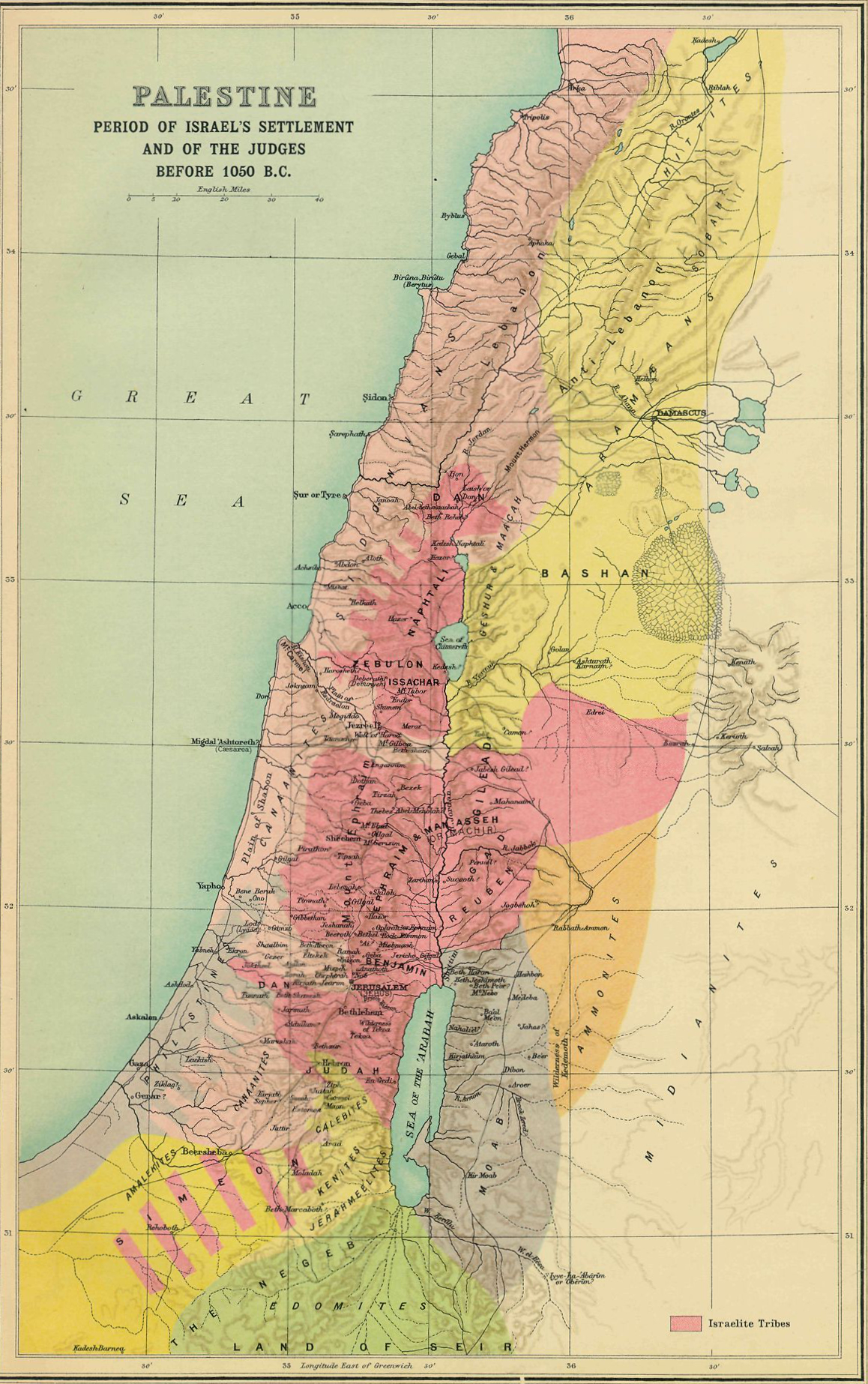
- 1The land of Tob, Jephthah lived there in exile.
- 2Mizpah of Gilead, He set out from there and came home to it.
- 3Ammon, He crossed over to fight the Ammonites.
- 4Aroer, Minnith and Abel-keramim, The bounds of the twenty cities he took.
- 5Zaphon, Ephraim came there to challenge him.
- 6The fords of the Jordan, Gilead killed the fugitives of Ephraim there.
Not placed: The land of Tob (1), Mizpah of Gilead (2), Aroer, Minnith and Abel-keramim (4), Zaphon (5).
Base map: Israel's settlement and the period of the Judges, George Adam Smith, Atlas of the Historical Geography of the Holy Land (1915), public domain. Each place stands at its place page's coordinates, set on the plate by Jerusalem and Damascus, as the plate prints them.
Two places are marked on the plate, Ammon and the Jordan River, and the key names four more places of Judges 11 and 12 that are not marked.
Jephthah and the elders of GileadJudges 11:1 to 11
Jephthah was the son of a prostitute, and the sons of Gilead's wife drove him out with no inheritance.
But Jephthah asked them, “If you take me back to fight the Ammonites and the LORD gives them to me, will I really be your leader?”Jephthah asked for the leadership before he would fight, and Albert Barnes held that he made his own rise the condition of saving his country.
The message to the king of AmmonJudges 11:12 to 28
The king of the Ammonites claimed the land from the Arnon to the Jabbok. Jephthah answered from the history of the wilderness: Israel had gone around Edom and Moab and had taken the land from Sihon king of the Amorites.
I have not sinned against you, but you have done me wrong by waging war against me. May the LORD, the Judge, decide today between the Israelites and the Ammonites.”Jephthah closed his message by leaving the dispute to the LORD, the Judge, before any battle was fought.
The vow before the battleJudges 11:29 to 30
Albert Barnes held that the coming of the Spirit of the LORD set Jephthah apart for his office as judge, as it had set apart Gideon and Samson.
“Returning to the camp at Mizpeh, he then began his march against the enemy. There he made his celebrated vow, in accordance with an ancient custom for generals at the outbreak of a war, or on the eve of a battle, to promise the god of their worship a costly oblation, or dedication of some valuable booty, in the event of victory.”
Jamieson, Fausset & Brown · Commentary Critical and Explanatory on the Whole Bible · on Judges 11:30Reformed
Ephraim and the word ShibbolethJudges 12:1 to 6
The men of Ephraim threatened to burn Jephthah's house down because he had fought without them, as they had contended with Gideon in Judges 8:1.
they told him, “Please say Shibboleth.” If he said, “Sibboleth,” because he could not pronounce it correctly, they seized him and killed him at the fords of the Jordan. So at that time 42,000 Ephraimites were killed.The verse closes the account of Jephthah's wars, which turned from Ammon to Israel's own tribe of Ephraim.
The law of vowsLeviticus 27:2 to 4; Numbers 30:2; 1 Samuel 1:11
The Hebrew word for a vow is neder. Brown, Driver and Briggs list among its uses a vow of personal service to the LORD, and they give Hannah's consecration of her son as their example.
“Speak to the Israelites and say to them, ‘When someone makes a special vow to the LORD involving the value of persons, if the valuation concerns a male from twenty to sixty years of age, then your valuation shall be fifty shekels of silver, according to the sanctuary shekel. Or if it is a female, then your valuation shall be thirty shekels.The law set a price in silver for a person vowed to the LORD, and readers on both sides ask why Jephthah paid none for his daughter.
If a man makes a vow to the LORD or swears an oath to obligate himself by a pledge, he must not break his word; he must do everything he has promised.The law binds a man who vows to the LORD to do everything he has promised, which is the word Jephthah believed he could not take back.
And she made a vow, pleading, “O LORD of Hosts, if only You will look upon the affliction of Your maidservant and remember me, not forgetting Your maidservant but giving her a son, then I will dedicate him to the LORD all the days of his life, and no razor shall ever come over his head.”Hannah vowed to dedicate her son to the LORD all the days of his life, a vow of a person kept by a life of service.
The law against the sacrifice of childrenLeviticus 18:21; Deuteronomy 12:31; 2 Kings 3:27
You must not give any of your children to be sacrificed to Molech, for you must not profane the name of your God. I am the LORD.Keil and Delitzsch set this law against the reading that Jephthah offered his daughter, since it stood in Israel before his day.
You must not worship the LORD your God in this way, because they practice for their gods every abomination which the LORD hates. They even burn their sons and daughters in the fire as sacrifices to their gods.Both readings must account for this law, and the reading that she lived takes it as the reason she was never offered.
So he took his firstborn son, who was to succeed him, and offered him as a burnt offering on the city wall. And there was great fury against the Israelites, so they withdrew and returned to their own land.Keil and Delitzsch cite this siege to show how Israel regarded a human sacrifice in the days of the kings.
Keil and Delitzsch held that human sacrifice was unknown in Israel in the early times and came to Jerusalem only with Ahaz and Manasseh.
How the Question Was Read
Eight marks trace the question from Josephus to Keil and Delitzsch.
- First centuryJosephus, Antiquities 5.7.10: she is sacrificed.
- Fourth centuryAmbrose of Milan, On the Duties of the Clergy 1.50.255.
- Fifth centuryAugustine, The City of God 1.21; Questions on Judges 49.
- Rabbinic midrashThe rabbis, Genesis Rabbah 60:3; Tanhuma, Bechukotai 5.
- About 1075 to 1105Rashi, Rashi on Judges: a law forbade any repeat of such a vow.
- About 1185 to 1235Radak, Radak on Judges, written in Provence.
- Nineteenth centuryAdam Clarke, Commentary on the Bible: she is not sacrificed.
- 1875 printingKeil and Delitzsch, Joshua, Judges, Ruth: a spiritual burnt offering.
A timeline of eight marks, each row naming the writer and the work that answered the question.
What Judges 11 Leaves Unsaid
The account stops at the keeping of the vow and leaves its manner untold.
The text does not say how Jephthah kept the vow, where he kept it, or whether a priest took part. It does not say whether he thought of his daughter when he vowed, and Keil and Delitzsch held that this cannot be determined. It records no word of God about the vow, and it names no price of redemption paid or refused.
What Both Readings Hold
Both readings share four teachings about the vow, the victory, the daughter and the law.
THE VOW WAS HIS OWN
Both readings hold that Jephthah made the vow to the LORD of his own accord, as his own words of verse 35 say.
THE LORD GAVE THE VICTORY
Both readings hold that the LORD delivered the Ammonites into his hand.
HER OWN ANSWER
Both readings honour the daughter's answer that her father should do to her as he had said, since the LORD had avenged him of his enemies.
THE LAW FORBIDS CHILD SACRIFICE
Both readings hold the law that no one in Israel may sacrifice his son or daughter in the fire.
The Teachers on the Daughter
Two teachers of the early church speak to the daughter's tears and to her father's promise.
The daughter's tearsJudges 11:37 to 38
“And whereas he [Jovinianus] prefers the fidelity of the father Jephthah to the tears of the virgin daughter, that corroborates our point. For we are not commending virgins of the world so much as those who are virgins for Christ's sake.”
Jerome · Against Jovinianus 1.23 · on Judges 11:30 to 31Patristic
A promise wrong to keepJudges 11:39
“It is also sometimes contrary to duty to fulfill a promise or to keep an oath. As was the case with Herod, who swore that whatever was asked he would give to the daughter of Herodias, and so allowed the death of John, that he might not break his word. And what shall I say of Jephthah, who offered up his daughter in sacrifice, she having been the first to meet him as he returned home victorious; whereby he fulfilled the vow which he had made that he would offer to God whatever should meet him first.”
Ambrose of Milan · On the Duties of the Clergy 1.50.255 · on Judges 11:39 to 40Patristic
The Two Readings Weighed
Each reading faces the objections that the other presses hardest.
| Reading and its tradition | Held by | Representative work |
|---|---|---|
| She died as a burnt offering: Second Temple Judaism, the rabbis, the Latin fathers and Protestant commentators | Josephus; the rabbis of the midrash; Rashi; Ambrose; Augustine; Albert Barnes; Matthew Henry | Josephus, Antiquities 5.7.10; Genesis Rabbah 60:3; Barnes, Notes on Judges |
| She was given to the LORD unmarried: medieval Jewish commentary and Protestant commentators | David Kimhi and his father; William Whiston; Adam Clarke; John Gill; Keil and Delitzsch | Radak on Judges; Keil and Delitzsch, Joshua, Judges, Ruth |
The objection to the reading that she died
The objection rests on Deuteronomy 12:31, which names the burning of sons and daughters as an abomination the LORD hates. It also rests on Leviticus 27:1 to 8, under which Whiston held that a daughter vowed for a sacrifice ought to have been redeemed. Keil and Delitzsch added that the last clause of verse 39 tells nothing if she died.
The objection to the reading that she lived
The objection rests on verse 31, which names a burnt offering, and on Matthew Henry's words, as Wesley quotes them, that no law of the Old Testament makes a single life a part of religion. Albert Barnes added that Jephthah's Syrian birth and long years in a Syrian city, where such rites were probably common, account for the vow.
Read the Great Books
These four works state the two readings in the words of their own holders, from Josephus to Keil and Delitzsch.
Antiquities of the Jews
Flavius Josephus, translated by William Whiston · first century
The story of Jephthah in book 5, chapter 7, is told from his call by the elders of Gilead to his war with Ephraim.
READ IT FREE →The City of God
Augustine · fifth century
Its first book weighs the cases in which a man may be put to death without the guilt of murder, and chapter 21 names Jephthah among them.
READ IT FREE →Radak on Judges
David Kimhi · about 1185 to 1235
Sefaria prints his notes on Judges in Hebrew, with an English translation of his note on the vow.
READ IT FREE →Biblical Commentary on Joshua, Judges, Ruth
C. F. Keil and F. Delitzsch · 1875 printing
Their pages on the vow and its keeping set out the readings with their holders and argue for the dedication.
READ IT FREE →The God Who Keeps His Word
Hebrews 11 names Jephthah's faith, and Hebrews 10 names the one sacrifice God has accepted.
And what more shall I say? Time will not allow me to tell of Gideon, Barak, Samson, Jephthah, David, Samuel, and the prophets, who through faith conquered kingdoms, administered justice, and gained what was promised; who shut the mouths of lions, quenched the raging fire, and escaped the edge of the sword; who gained strength from weakness, became mighty in battle, and put foreign armies to flight.Hebrews names Jephthah among those who through faith gained strength from weakness, and it says nothing of his vow.
Jephthah gave his word to the LORD and believed he could not take it back. Under the new covenant the people of God bring no costly vow to win His help, because the work that makes them holy is already finished in Christ. So the chapter asks the reader to speak to God with care and to trust the God who has kept His own word in Christ.
because by a single offering He has made perfect for all time those who are being sanctified.Keep studying
Read it2
Studies7
Places3
Doctrines7
Peoples and groups2