
Exodus 20:5 to 6 and 34:6 to 7 · Debate · Featured Study
Generational Curses
Three readings of Exodus 20:5 and 34:7, each with its holders, its texts and the problem it has to answer.
Christians still ask whether a family can carry its fathers' sins, and the question begins with the second commandment.
- The question
- Does Exodus 20:5 to 6 and 34:6 to 7 teach a curse passed by descent that a believer must break, punishment on children who keep their fathers' sins, or consequences that fall on a household?
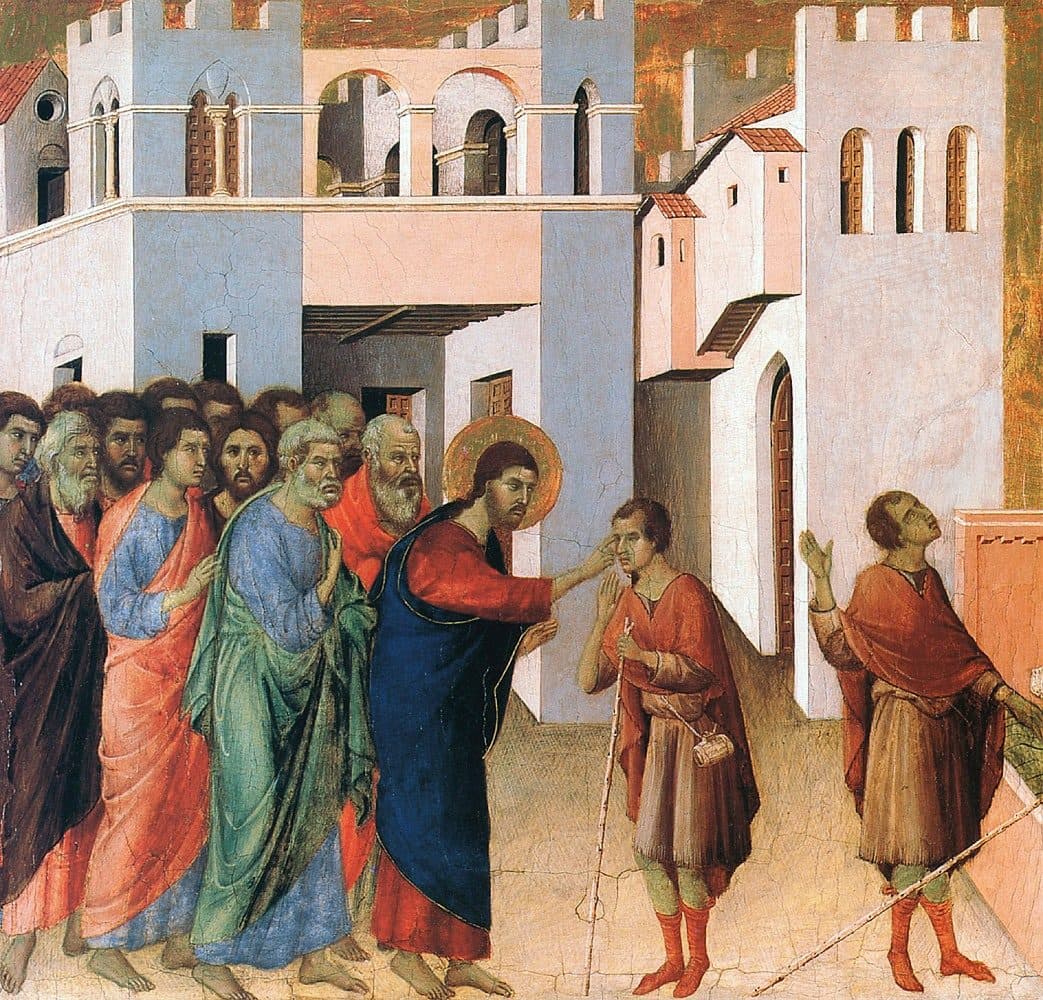
Duccio di Buoninsegna, Jesus Opens the Eyes of a Man Born Blind, 1307 to 1311. Public domain.
THE ARTWORKDuccio painted Jesus touching the eyes of the man born blind of John 9 and, at the right, the same man seeing after he has washed, the man whose parents the disciples asked about.
Summary
Jews and Christians have read the warning that the LORD visits the fathers' iniquity on their children in three ways.
- Derek Prince and the deliverance teachers after him read it as a curse that passes down a family line until a believer renounces it in Christ.
- Targum Onkelos, Rashi, the Talmud and John Calvin read it as punishment on children who hold to their fathers' sins.
- Keil and Delitzsch and Matthew Henry read it as judgment that falls on a household and a people in the effects of a father's sin.
- Ezekiel 18 and Deuteronomy 24:16 state that each person dies for his own sin, and every reading must account for them.
The Texts Both Sides Read
Six passages from the Law, the Prophets and Paul set the terms of the question.
You shall not bow down to them or worship them; for I, the LORD your God, am a jealous God, visiting the iniquity of the fathers on their children to the third and fourth generations of those who hate Me, but showing loving devotion to a thousand generations of those who love Me and keep My commandments.This is the warning of the second commandment, and every reading turns on the words those who hate Me and the thousand generations after them.
maintaining loving devotion to a thousand generations, forgiving iniquity, transgression, and sin. Yet He will by no means leave the guilty unpunished; He will visit the iniquity of the fathers on their children and grandchildren to the third and fourth generations.”The LORD proclaims this form of the warning in His own name, on the mountain where Moses brought the second tablets.
Fathers shall not be put to death for their children, nor children for their fathers; each is to die for his own sin.Moses gave this law in the same book that repeats the commandment against idols at Deuteronomy 5:9.
The soul who sins is the one who will die. A son will not bear the iniquity of his father, and a father will not bear the iniquity of his son. The righteousness of the righteous man will fall upon him, and the wickedness of the wicked man will fall upon him.Ezekiel states this rule in verse 4 and states it again here, at the end of his three cases of father and son.
“In those days, it will no longer be said: ‘The fathers have eaten sour grapes, and the teeth of the children are set on edge.’ Instead, each will die for his own iniquity. If anyone eats the sour grapes, his own teeth will be set on edge.Jeremiah sets the end of the proverb in the days of the new covenant he announces in the next verse.
Christ redeemed us from the curse of the law by becoming a curse for us. For it is written: “Cursed is everyone who is hung on a tree.”Three verses earlier Paul names the curse he means, the curse on everyone who does not continue to do everything written in the Book of the Law.
What Passes Down, Why and How It Ends
The readings differ on what passes down to the children of Exodus 20:5 and on how it ends.
| The question | A curse by descent | Punishment of imitators | Consequences on the household |
|---|---|---|---|
| What passes down to the children? | A curse on the descendants (Derek Prince; John Eckhardt). | The penalty of the sins the children repeat (Targum Onkelos; Rashi; John Calvin). | The judgment a father's sin brings on his family and his people (Keil and Delitzsch; Matthew Henry). |
| How does it end? | By repentance, renunciation and specific prayer in the authority of the cross (Prince; Eckhardt; Rob Reimer). | When the children leave their fathers' deeds (Berakhot 7a; Rashi). | God restrains His judgments when the sinner listens, and forgives those who love Him (Keil and Delitzsch). |
- The question
- What passes down to the children?
- A curse by descent
- A curse on the descendants (Derek Prince; John Eckhardt).
- Punishment of imitators
- The penalty of the sins the children repeat (Targum Onkelos; Rashi; John Calvin).
- Consequences on the household
- The judgment a father's sin brings on his family and his people (Keil and Delitzsch; Matthew Henry).
- The question
- How does it end?
- A curse by descent
- By repentance, renunciation and specific prayer in the authority of the cross (Prince; Eckhardt; Rob Reimer).
- Punishment of imitators
- When the children leave their fathers' deeds (Berakhot 7a; Rashi).
- Consequences on the household
- God restrains His judgments when the sinner listens, and forgives those who love Him (Keil and Delitzsch).
The Three Readings
Each reading is set out at its strongest, with its holders and the work where each holder teaches it.
A curse carried by descent
This reading belongs to the Pentecostal and charismatic deliverance ministries and to the Christian and Missionary Alliance renewal stream. It holds that curses pass through a family line from ancestral idolatry, unrighteousness, occult involvement and broken covenants. Derek Prince teaches it in Blessing or Curse: You Can Choose, published in 1990. John Eckhardt follows Prince and supplies the prayers in Prayers That Break Curses (2010). Robert Henderson sets the same teaching in the court of heaven, where a family's sin is legal ground for accusation until repentance and prayer settle it, in Unlocking Destinies From the Courts of Heaven (2016). Rob Reimer teaches the breaking of family sin patterns as the third principle of his Soul Care. The reading gives the believer something to do with the words visiting the iniquity, and it grounds that work in the cross.
Punishment of the children who imitate their fathers
This reading belongs to the rabbinic tradition and to the evangelical commentators, and it takes the words of those who hate Me as the key to the verse. Targum Onkelos, the Aramaic translation of the Torah, adds to Exodus 20:5 that the visiting falls on rebellious children when they complete the sinning after their fathers. Rashi explains those words the same way: the children are punished when they hold to the evil deeds of their ancestors. The Talmud in Berakhot 7a sets Exodus 34:7 against Deuteronomy 24:16 and resolves the two by the same rule. John Calvin, in his Harmony of the Law, says that God punishes the children justly as imitators of their fathers. Adam Clarke's Commentary says the clause necessarily implies that the children walk in the steps of their fathers. The reading's strength is that it keeps Exodus 20:5 and Ezekiel 18:20 within one law.
Consequences that fall on a household
This reading belongs to the Puritans and to the German commentators of the nineteenth century. Keil and Delitzsch, in their Biblical Commentary on the Pentateuch, call the human race a living organism in which the curse of sin and the punishment of wickedness pass from parents to children. They deny that this is a fate, since a righteous and gracious God governs the world. Matthew Henry reads the visiting as judgments that bring the total ruin of families and cast children out of the covenant with their idolatrous parents. The reading's strength is the history it accounts for, from Achan's household in Joshua 7 to Saul's sons in 2 Samuel 21.
What the Texts Say
Four matters in the texts are disputed between the readings, from the second commandment to the confessions of the exile.
Of those who hate Me1 table
Only the two forms of the warning inside the commandments name those who hate Him. Rashi carries the words of Exodus 20:5 over to Exodus 34:7, so that the shorter form means what the longer says. He also counts the measure of reward as five hundred times the measure of punishment. Keil and Delitzsch count the third generation as great-grandchildren and the fourth as the generation after them.
| The text | The iniquity of the fathers | The loving devotion |
|---|---|---|
| Exodus 20:5 to 6 | on their children to the third and fourth generations of those who hate Me | to a thousand generations of those who love Me and keep My commandments |
| Exodus 34:6 to 7 | on their children and grandchildren to the third and fourth generations | to a thousand generations, forgiving iniquity, transgression, and sin |
| Numbers 14:18 | upon their children to the third and fourth generation | abounding in loving devotion, forgiving iniquity and transgression |
| Deuteronomy 5:9 to 10 | on their children to the third and fourth generations of those who hate Me | to a thousand generations of those who love Me and keep My commandments |
| Jeremiah 32:18 | into the laps of their children after them | to thousands |
- The text
- Exodus 20:5 to 6
- The iniquity of the fathers
- on their children to the third and fourth generations of those who hate Me
- The loving devotion
- to a thousand generations of those who love Me and keep My commandments
- The text
- Exodus 34:6 to 7
- The iniquity of the fathers
- on their children and grandchildren to the third and fourth generations
- The loving devotion
- to a thousand generations, forgiving iniquity, transgression, and sin
- The text
- Numbers 14:18
- The iniquity of the fathers
- upon their children to the third and fourth generation
- The loving devotion
- abounding in loving devotion, forgiving iniquity and transgression
- The text
- Deuteronomy 5:9 to 10
- The iniquity of the fathers
- on their children to the third and fourth generations of those who hate Me
- The loving devotion
- to a thousand generations of those who love Me and keep My commandments
- The text
- Jeremiah 32:18
- The iniquity of the fathers
- into the laps of their children after them
- The loving devotion
- to thousands
The proverb of the sour grapes2 passages, 1 quotation
Jeremiah and Ezekiel both quote a proverb of their day, that the fathers ate sour grapes and the children's teeth were set on edge. Calvin reads Ezekiel as answering a people who called themselves innocent, since none of those under judgment was free of crime.
Our fathers sinned and are no more, but we bear their punishment.The survivors of Jerusalem's fall say they bear their fathers' punishment, which is the complaint the proverb carries.
He withholds his hand from harming the poor and takes no interest or usury. He keeps My ordinances and follows My statutes. Such a man will not die for his father’s iniquity. He will surely live.This is Ezekiel's answer to the proverb, given as a verdict on one man.
“Thus far that is right which is implied in this proverbial saying, That those who are guilty of wilful sin eat sour grapes; they do that which they will feel from, sooner or later. The grapes may look well enough in the temptation, but they will be bitter as bitterness itself in the reflection. They will set the sinner's teeth on edge.”
Matthew Henry · Commentary on the Whole Bible · on Ezekiel 18:30 to 32Puritan
The households that fell with a father2 passages
Joshua 7 and 2 Samuel 21 tell how a man's children suffered for what he did. John Wesley's notes on Deuteronomy 24:16 count Achan's case among those the LORD Himself commanded.
Then Joshua, together with all Israel, took Achan son of Zerah, the silver, the cloak, the bar of gold, his sons and daughters, his oxen and donkeys and sheep, his tent, and everything else he owned, and brought them to the Valley of Achor. “Why have you brought this trouble upon us?” said Joshua. “Today the LORD will bring trouble upon you!” And all Israel stoned him to death. Then they stoned the others and burned their bodies.Every reading has to account for this sentence on a whole household.
During the reign of David there was a famine for three successive years, and David sought the face of the LORD. And the LORD said, “It is because of the blood shed by Saul and his family, because he killed the Gibeonites.”The LORD gives the cause of the trouble, and the cause is the act of a king already dead.
Confessing the iniquity of the fathers2 passages
Nehemiah 9:2 records the returned exiles standing to confess their sins and the iniquities of their fathers.
Those of you who survive in the lands of your enemies will waste away in their iniquity and will decay in the sins of their fathers. But if they will confess their iniquity and that of their fathers in the unfaithfulness that they practiced against Me, by which they have also walked in hostility toward Me—This is the remedy the law sets before the exiles, in the chapter of the covenant's blessings and curses.
O Lord, in keeping with all Your righteous acts, I pray that Your anger and wrath may turn away from Your city Jerusalem, Your holy mountain; for because of our sins and the iniquities of our fathers, Jerusalem and Your people are a reproach to all around us.Daniel's prayer is one such confession, made in the exile.
God's Judgment and Israel's Courts
Deuteronomy 24:16 governed the courts of Israel.
John Wesley's notes on the verse set the LORD's visiting apart from a judge's sentence: God may visit the fathers' sins on the children, and He does not allow men to do so.
Yet he did not put the sons of the murderers to death, but acted according to what is written in the Book of the Law of Moses, where the LORD commanded: “Fathers must not be put to death for their children, and children must not be put to death for their fathers; each is to die for his own sin.”The writer of Kings quotes the law here as the reason for Amaziah's mercy.
“Accordingly, we find Amaziah sparing the children, even when the fathers were put to death for killing the king, 2 Kings xiv. It was in an extraordinary case, and no doubt by special direction from heaven, that Saul's sons were put to death for his offence, and they died rather as sacrifices than as malefactors, 2 Sam. xxi.”
Matthew Henry · Commentary on the Whole Bible · on Deuteronomy 24:16Puritan
How the Question Came Down
Ten dated marks trace the three readings from the first century to the twenty-first.
From Onkelos to Rashifour marks, about AD 80 to 1105
| When | Reading | The work |
|---|---|---|
| About AD 80 to 120 | Punishment | Targum Onkelos. |
| AD 420 | Punishment | Jerome, Commentary on Ezekiel. |
| About AD 450 to 550 | Punishment | The Babylonian Talmud, tractate Berakhot. |
| 1075 to 1105 | Punishment | Rashi, commentary on Exodus, written in France. |
- When
- About AD 80 to 120
- Reading
- Punishment
- The work
- Targum Onkelos.
- When
- AD 420
- Reading
- Punishment
- The work
- Jerome, Commentary on Ezekiel.
- When
- About AD 450 to 550
- Reading
- Punishment
- The work
- The Babylonian Talmud, tractate Berakhot.
- When
- 1075 to 1105
- Reading
- Punishment
- The work
- Rashi, commentary on Exodus, written in France.
From Matthew Henry to Robert Hendersonsix marks, 1710 to 2016
| When | Reading | The work |
|---|---|---|
| 1710 | Consequences | Matthew Henry, Commentary on the Whole Bible. |
| 1765 | Punishment | John Wesley, Explanatory Notes upon the Old Testament. |
| 1832 | Punishment | Adam Clarke, Commentary on the Bible. |
| 1990 | Curse by descent | Derek Prince, Blessing or Curse: You Can Choose. |
| 2010 | Curse by descent | John Eckhardt, Prayers That Break Curses. |
| 2016 | Curse by descent | Robert Henderson, Unlocking Destinies From the Courts of Heaven. |
- When
- 1710
- Reading
- Consequences
- The work
- Matthew Henry, Commentary on the Whole Bible.
- When
- 1765
- Reading
- Punishment
- The work
- John Wesley, Explanatory Notes upon the Old Testament.
- When
- 1832
- Reading
- Punishment
- The work
- Adam Clarke, Commentary on the Bible.
- When
- 1990
- Reading
- Curse by descent
- The work
- Derek Prince, Blessing or Curse: You Can Choose.
- When
- 2010
- Reading
- Curse by descent
- The work
- John Eckhardt, Prayers That Break Curses.
- When
- 2016
- Reading
- Curse by descent
- The work
- Robert Henderson, Unlocking Destinies From the Courts of Heaven.
What the Text Leaves Unsaid
Much that the three readings dispute lies outside the words of Exodus 20:5.
Exodus 20:5 does not use the word curse, and it does not say what form the visiting of iniquity takes in the children's lives. Keil and Delitzsch note that the verse says nothing of whether or how the fathers themselves are punished. It names the third and fourth generations and gives no reason for stopping at the fourth.
Where the Texts Point
Four texts carry the warning of Exodus 20:5 through to the redemption in Christ.
THE SON WHO TURNS LIVES
Ezekiel's third case is a grandson who watches his father's wrongdoing and chooses otherwise, the case any reading of a family's sin has to meet.
THE BLESSING OF ABRAHAM
Christ redeemed us so that the blessing promised to Abraham would come to the Gentiles in Christ Jesus.
REDEEMED FROM WHAT WAS INHERITED
Peter tells believers that they were redeemed from the empty way of life inherited from their forefathers.
IN CHRIST JESUS
There is now no condemnation for those who are in Christ Jesus.
How the Commentators Read It
Four commentators, from the fifth century to the nineteenth, read the warning and the proverb.
Jerome on the charge of cruelty and the sinner who turnsAD 420, the Latin church
“Heretics, who do not accept the Old Testament, often say in this place against the Creator: How good and just is the God of the Law and the Prophets, who, by remaining quiet and silent about the sins of the fathers, renders punishment to those who have not sinned; rather, what cruelty is in Him that He extends His anger even to the third and fourth generation! To whom shall we respond, and in this the clemency of God the Creator is demonstrated.”
Jerome · Commentary on Ezekiel · on Ezekiel 18:1 to 2Patristic
“In a way only, saith he, the sins of the fathers are not transmitted to the children, neither doth the wicked son any longer burden the righteous father; nor are others punished for the sins of others, so that he, who before was wicked and a sinner, if he afterwards do penance, and turn to better things, and blot out his former sins, be not judged by the old sins: but let him be received into my flock, by the renewal of virtue.”
Jerome · Commentary on Ezekiel · on Ezekiel 18:21Patristic
Matthew Henry on grace and the family line1710, the Puritans
“Let those good parents that have wicked children not look upon their case as singular; it is a case put here; and by it we see that grace does not run in the blood, nor always attend the means of grace.”
Matthew Henry · Commentary on the Whole Bible · on Ezekiel 18:11Puritan
“Wicked Ahaz begets a good Hezekiah, who sees all his father's sins which he has done, and though he will not, like Ham, proclaim his father's shame, or make the worst of it, yet he loathes it, and blushes at it, and thinks the worse of sin because it was the reproach and ruin of his own father.”
Matthew Henry · Commentary on the Whole Bible · on Ezekiel 18:14Puritan
Albert Barnes on the father's merit and the father's guilt1832 to 1869, evangelical
“The last verse of Ezek. 17 gives occasion for a declaration of the principle upon which God’s providential dispensations proceed, namely, that every individual shall be equitably dealt with - a principle that precludes the children from either presuming on the father’s merits or despairing on account of the father’s guilt. This chapter is an enlargement of Jer 31:29, and sets forth fully the doctrine of individual responsibility.”
Albert Barnes · Notes, Explanatory and Practical, on the Old and New Testaments (1832-1869) · on Ezekiel 18:1Evangelical
Jamieson, Fausset & Brown on the mercy proclaimed1871, Reformed
“Being about to republish His law--the sin of the Israelites being forgiven and the deed of pardon about to be signed and sealed by renewing the terms of the former covenant--it was the most fitting time to proclaim the extent of the divine mercy which was to be displayed, not in the case of Israel only, but of all who offend.”
Jamieson, Fausset & Brown · Commentary Critical and Explanatory on the Whole Bible · on Exodus 34:6Reformed
The Three Readings Weighed
Each reading meets texts or words of Scripture that its own holders have to answer.
The curse by descent and Ezekiel 18
This reading has to answer Ezekiel 18:20 and Deuteronomy 24:16, and it has to say why a believer who is a new creation in Christ still carries a curse from his fathers. Prince answers that a curse which still shows itself in a believer's life calls for deliverance ministry, beyond a declaration of what the believer has in Christ.
Punishment of imitators and the shorter form
This reading has to answer the shorter form of the warning and the households of Achan and Saul. Calvin grants that God's judgments are a great depth, and that what passes understanding in them is to be received with sobriety and reverence.
Consequences and the word visit
This reading has to answer the word visit itself, which Calvin reads as taking note of a sin in order to punish it. Keil and Delitzsch themselves gloss visits as punishes.
Read the Great Books
Seven works hold the three readings, and four of them are free to read.
Commentaries on the Four Last Books of Moses Arranged in the Form of a Harmony, volume 2
John Calvin, translated by Charles William Bingham · 1563; English 1852 to 1855
Calvin sets the laws of Moses under the commandments they serve, and his comment on the second commandment answers Ezekiel 18.
Read it at the Christian Classics Ethereal LibraryCommentary on the Whole Bible, volume 1
Matthew Henry · 1710
Henry's first volume covers Genesis to Deuteronomy, and its comments on Exodus 20 and Deuteronomy 24 both take up the question.
Read it at the Christian Classics Ethereal LibraryBiblical Commentary on the Old Testament: The Pentateuch, volume 2
C. F. Keil and F. Delitzsch, translated by James Martin · 1887 printing
Their comment on Exodus 20:5 to 6 explains the Hebrew word by word and cites Onkelos beside it.
Read it at the Internet ArchiveRashi on Exodus
Rashi, translated by M. Rosenbaum and A. M. Silbermann · 1929 to 1934
Rashi's note on Exodus 34:7 gives the rabbinic reading in a few lines and names its sources in the Talmud.
Read it at SefariaBlessing or Curse: You Can Choose
Derek Prince · 1990
Prince sets out how curses come on a family line and how a believer is released from them through the cross.
In print: find it wherever books are sold.
Prayers That Break Curses
John Eckhardt · 2010
Eckhardt's book gives prayers for breaking curses, opening from the believer's redemption from the curse.
In print: find it wherever books are sold.
Unlocking Destinies From the Courts of Heaven
Robert Henderson · 2016
Henderson treats the dissolving of curses as a matter of legal standing in the court of heaven.
In print: find it wherever books are sold.
That the Works of God Would Be Displayed
The disciples' question in John 9 is the question of Exodus 20:5 put to Jesus.
and His disciples asked Him, “Rabbi, who sinned, this man or his parents, that he was born blind?” Jesus answered, “Neither this man nor his parents sinned, but this happened so that the works of God would be displayed in him.Jesus' answer turns from the cause of the suffering to what God does next, and the healing follows in the verses after it.
The text asks the reader to be among those who love the LORD and keep His commandments. In Christ, who became a curse for us, it asks the reader to trust the redemption He bought with His own blood.
Keep studying
Studies4
Symbols1
Doctrines14