
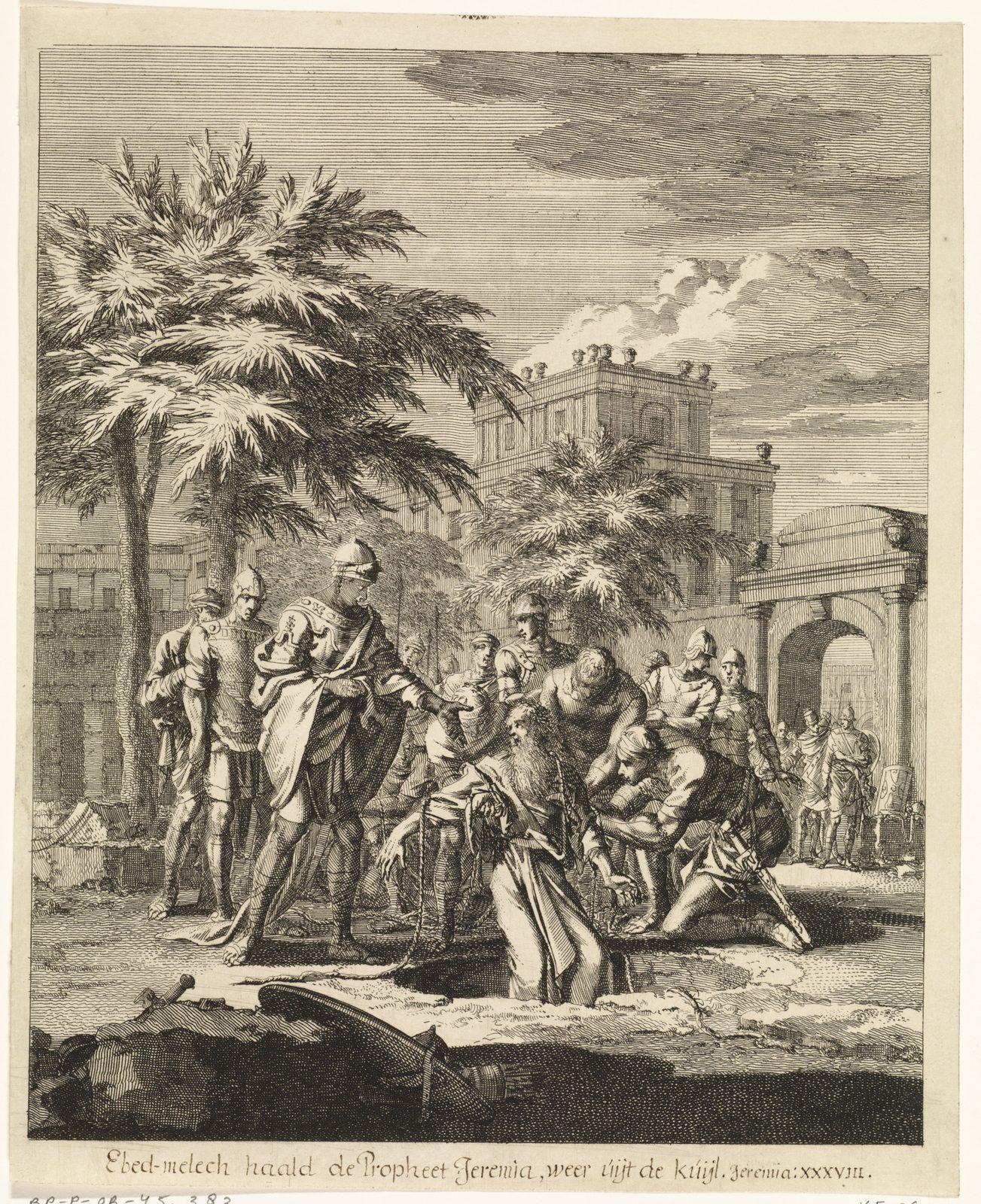
Jan Luyken, Jeremiah Drawn Out of the Pit, 1708. Public domain.
Lamentations 3 · Passage · Featured Study
The Man of Lamentations 3
A single speaker carries the third poem of Lamentations from complaint to prayer.
Lamentations 3 is the only one of the book's five poems that opens with the word I.
I am the man who has seen affliction under the rod of God’s wrath.
- Book
- Lamentations
- Hold in memory
- Lamentations 3:57
Summary
The man who speaks Lamentations 3 never gives his name, and his identity has been read in three ways.
- One reading hears Jeremiah, whom his enemies lowered into a cistern.
- A second hears the people of Judah speaking as one man.
- A third, kept in the church's Holy Week prayers, hears Christ.
I Am the Man
The man names himself with the Hebrew word geber.
The Hebrew of the poem's first verse opens 'ani haggever, I am the man. Geber means a man in his strength, a valiant man.
In Lamentations the word stands only in this poem, in its first verse and at Lamentations 3:27, Lamentations 3:35 and Lamentations 3:39.
It is good for a man to bear the yoke while he is still young.Here the poem turns the word into a lesson for any young man.
Why should any mortal man complain, in view of his sins?Here the word closes the poem's teaching on complaint.
Who Speaks, Verse by Verse
The poem moves between I, he and we.
The poem speaks as I for 43 of its 66 verses and as we for 8.
| Verses | Count | The voice | What it says |
|---|---|---|---|
| 1 to 18 | 18 | I, the man | God has driven him into darkness and broken him. |
| 19 to 24 | 6 | I, the man | He remembers and turns to hope in the LORD. |
| 25 to 39 | 15 | He, any man | It is good to wait, to bear the yoke and to sit in silence. |
| 40 to 47 | 8 | We, the people | Let us examine our ways, for You have not forgiven. |
| 48 to 66 | 19 | I, the man | He weeps, recalls the pit and asks the LORD to judge his cause. |
Three Readings of the Man
Each reading names its holders and the verses it leans on.
Jeremiah himselfJohn Gill; Jamieson, Fausset and Brown
John Gill, in his Exposition of the Old Testament, reads the man as the prophet, reproached and ill used by his own people. Jamieson, Fausset and Brown point to Jeremiah's own affliction in the dungeon of Malchiah.
They dropped me alive into a pit and cast stones upon me. The waters flowed over my head, and I thought I was going to die.This reading sets these verses beside Jeremiah 38.
So they took Jeremiah and dropped him into the cistern of Malchiah, the king’s son, which was in the courtyard of the guard. They lowered Jeremiah with ropes into the cistern, which had no water but only mud, and Jeremiah sank down into the mud.This is the cistern the reading has in mind.
The nation in one voiceThe Pulpit Commentary; Ball, in the Cambridge Bible
The Pulpit Commentary hears a believer whose fate is bound up with the nation's, or perhaps the nation personified. The Cambridge Bible reports that Ball took the community as the speaker, from the likeness of the other poems.
You have made us scum and refuse among the nations.This reading points to the we of the poem.
A figure of ChristJohn Gill's report; Jamieson, Fausset and Brown; the Good Friday office
John Gill reports that some took the man as a type of Christ throughout the poem, a figure that points ahead to Him. Jamieson, Fausset and Brown call the sufferings of the prophet and of the besieged city types of Christ's.
The Roman Breviary, the book of the church's daily prayer, read Lamentations 3:1 to 9 at Matins, the night office, on Good Friday.
What the Poem Leaves Unsaid
The poem gives no place and no date for the man's suffering.
The poem never names Jerusalem or Zion, though Lamentations 3:48 weeps over the daughter of my people.
Keil and Delitzsch say that nothing certain can be inferred from the poem about the person who complains.
Heard from the Pit
In Lamentations 3:55 to 58 the man says that the LORD heard his cry.
I called on Your name, O LORD, out of the depths of the Pit. You heard my plea: “Do not ignore my cry for relief.”This is the prayer that the next verses answer.
You drew near when I called on You; You said, “Do not be afraid.” You defend my cause, O Lord; You redeem my life.This is the LORD's reply as the man reports it.
Ellicott wrote that the lament has become the true inheritance of all mourners.
Voices on the Man
John Calvin read the man's complaint as a word to the whole nation.
John Calvin (1509 to 1564)
“Jeremiah, then, does not here plead his own private cause, but shews to his own nation what remedy there was for them in such a state of despair, even to have an immediate recourse to God, and on the one hand to consider their sins, and on the other to look to the mercy of God, so that they might entertain hope, and exercise themselves in prayer.”
John Calvin · Commentaries · on Lamentations 3:1Reformed
The Readings Weighed
Each reading meets an objection in the older commentaries.
The objection to the Jeremiah reading1 paragraph
Keil and Delitzsch reply that the sufferings are such as many godly people of that time went through.
The objection to the nation reading1 paragraph
Ellicott hears in this lament a more intense personality, the grief of one man.
The objection to the Christ reading1 paragraph
Adam Clarke, in his Commentary on the Bible, judged that applying the poem to Christ's passion has no foundation.
Books to Read Next
One older commentary weighs the man verse by verse.
Biblical Commentary on the Old Testament: Lamentations
Carl Friedrich Keil · 1857 to 1878
Keil reads each verse of the poem from the Hebrew.
Read it free at BibleHubCompassion at the Centre
At the centre of the poem the man teaches what he has learned.
For the Lord will not cast us off forever. Even if He causes grief, He will show compassion according to His abundant loving devotion. For He does not willingly afflict or grieve the sons of men.The man teaches it after eighteen verses of complaint and before he prays from the pit.
Sources
Scripture is the Berean Standard Bible.
- The Hebrew text of Lamentations 3, word by word, with Strong's numbers.
- Strong's lexicon entry h1397, geber, STEP Bible TBESH (Tyndale House, CC BY 4.0)
- John Gill, Exposition of the Old Testament (1746 to 1763), on Lamentations 3.
- Jamieson, Fausset and Brown, Commentary Critical and Explanatory on the Whole Bible (1871), on Lamentations 3:1.
- The Pulpit Commentary, on Lamentations 3; public domain.
- The Cambridge Bible for Schools and Colleges, on Lamentations 3; public domain.
- Carl Friedrich Keil and Franz Delitzsch, Biblical Commentary on the Old Testament (1857 to 1878), on Lamentations 3; public domain.
- Ellicott's Commentary for English Readers, on Lamentations 3:1; public domain.
- Adam Clarke, Commentary on the Bible (1832), on Lamentations 3:1.
- The Roman Breviary, Matins of Good Friday and Holy Saturday, from the source files of the Divinum Officium project.
- John Calvin, Commentaries (1554), on Lamentations 3:1.
Keep Studying
Subjects1
People and groups2
Places1
Symbols1