
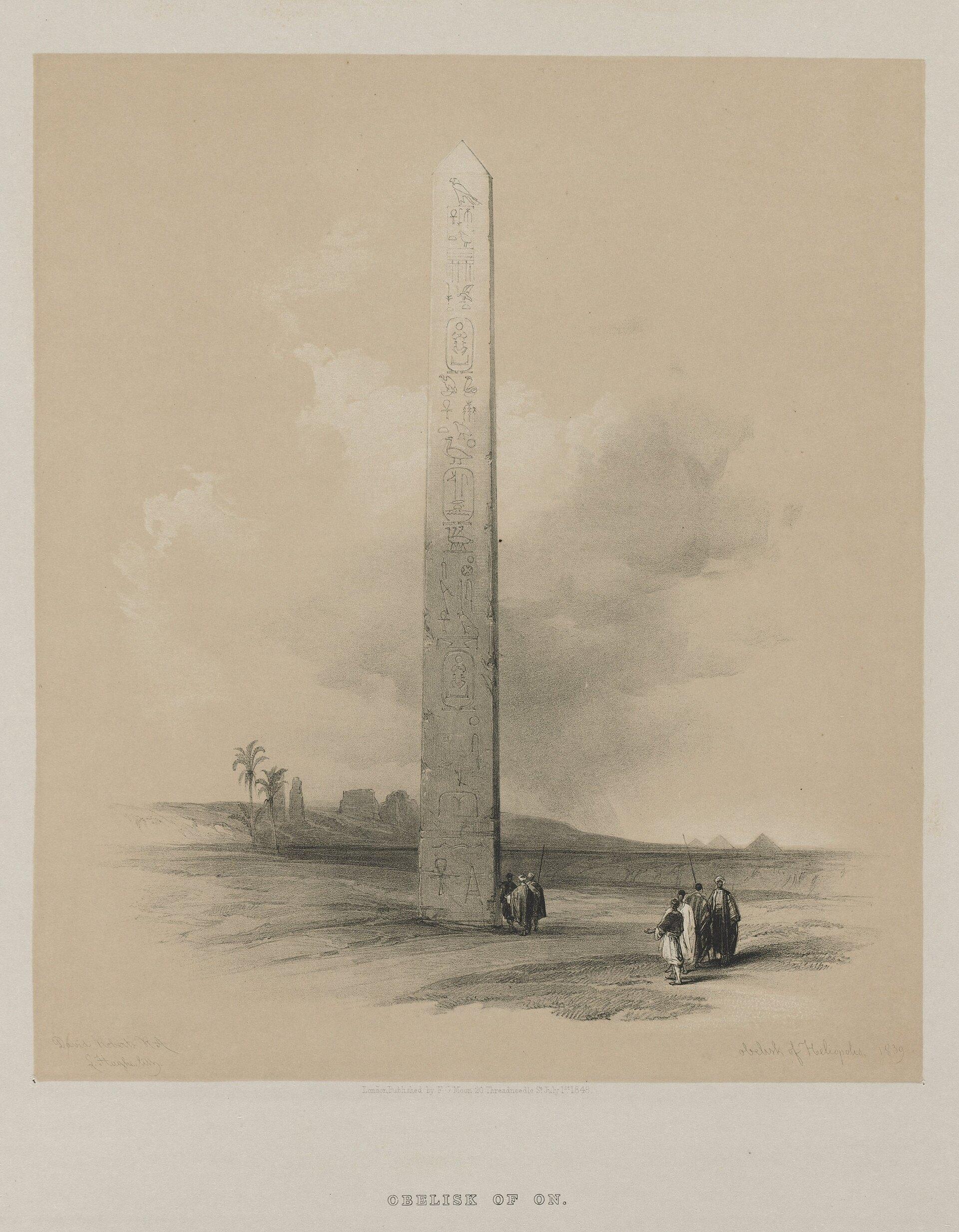
Louis Haghe after David Roberts, Obelisk of Heliopolis, 1848. Public domain.
Isaiah 19 · Passage · Featured Study
Egypt and Assyria at the Altar of the LORD
The prophet foretells a day when Egypt will worship the LORD.
The chapter that opens with the LORD riding to Egypt in judgment ends with Him calling Egypt My people.
The LORD of Hosts will bless them, saying, “Blessed be Egypt My people, Assyria My handiwork, and Israel My inheritance.”
The LORD of Hosts will bless them, saying, “Blessed be Egypt My people, Assyria My handiwork, and Israel My inheritance.”
- The passage
- Isaiah 19:16 to 25, Jeremiah 44:1
- Books
- Isaiah, Jeremiah
- Hold in memory
- Isaiah 19:25, Isaiah 19:21
Summary
Egypt learns to fear the LORD, five of its cities swear by His name, an altar stands in its land, and a highway joins it to Assyria. The last promise joins Israel to the two empires.
- The Hebrew copies differ over the name of one city in the chapter.
- Jews later worshipped at their own temples on Egyptian soil.
- Commentators read the highway as kept, begun or still to come.
Blessed Be Egypt My People
The last verses give the LORD's own names for three nations.
In that day there will be a highway from Egypt to Assyria. The Assyrians will go to Egypt, and the Egyptians to Assyria. The Egyptians and Assyrians will worship together.The road between the old enemies carries worshippers.
The Septuagint, the Greek translation of the Old Testament, reads the blessing of Isaiah 19:25 differently, as my people that is in Egypt, and that is among the Assyrians.
Six Times In That Day
Keil and Delitzsch counted the phrase as a signpost six times in these ten verses.
The promises carry Egypt step by step from terror to worship.
- FearEgypt trembles under the LORD's raised handIsaiah 19:16
- Five citiesFive Egyptian cities take up the speech and the oath of Israel's GodIsaiah 19:18
- Altar and pillarAn altar stands in the centre of Egypt and a pillar at its borderIsaiah 19:19
- KnowledgeEgypt knows the LORD and brings Him sacrifices and vowsIsaiah 19:21
- HighwayA road links Egypt and Assyria in shared worshipIsaiah 19:23
- Three partnersIsrael becomes the third partner with Egypt and AssyriaIsaiah 19:24
Six promises in the order of the chapter, each with its verse.
An Altar in Egypt and a Pillar at Its Border
The chapter places the worship of the LORD inside the land of Israel's old bondage.
In that day there will be an altar to the LORD in the center of the land of Egypt, and a pillar to the LORD near her border. It will be a sign and a witness to the LORD of Hosts in the land of Egypt. When they cry out to the LORD because of their oppressors, He will send them a savior and defender to rescue them.The sign stands in the land that once enslaved Israel.
And the LORD will strike Egypt with a plague; He will strike them but heal them. They will turn to the LORD, and He will hear their prayers and heal them.Judgment here serves a later mercy.
Albert Barnes read the altar as a memorial that marked a place of worship.
The Jews of Egypt and the Temple of Onias
Jewish settlers lived in Egypt from Jeremiah's day onward.
This is the word that came to Jeremiah concerning all the Jews living in the land of Egypt—in Migdol, Tahpanhes, and Memphis—and in the land of Pathros:Pathros, the last name, is Upper Egypt, where Elephantine lay.
A Jewish colony lived on the island of Elephantine, at Aswan in Upper Egypt. Its Aramaic papyri record a temple to YHW there and tell of its destruction in 410 BC.
Josephus tells of Onias, son of a high priest, who fled to King Ptolemy Philometor and asked leave to build a temple in Egypt. In his letter to the king Onias wrote that the prophet Isaiah foretold an altar in Egypt to the Lord God.
Josephus adds that Ptolemy gave him a place in the district of Heliopolis. Onias built a temple there, and Lupus, the governor of Alexandria, later shut it on Caesar's orders.
John Calvin judged that Onias perverted the passage.
The City of the Sun or the City of Destruction
The copies and versions give the city different names.
In that day five cities in the land of Egypt will speak the language of Canaan and swear allegiance to the LORD of Hosts. One of them will be called the City of the Sun.The Berean text follows the reading City of the Sun.
The Masoretic Text, the Hebrew text handed down by the Masoretic scribes, reads City of Destruction, and the Isaiah scroll from the Dead Sea Scrolls known as 1QIsaa reads City of the Sun. The two Hebrew words differ by one letter. The commentary of the Center for Online Judaic Studies takes City of the Sun to mean Heliopolis.
Ellicott thought the Greek city of Asedek, the city of righteousness, was probably tied to the temple Onias built.
The ancient witnesses name the city in four ways.
| Witness | The name it gives |
|---|---|
| The Masoretic Text | City of Destruction |
| The Dead Sea scrolls 1QIsaa and 4QIsaa | City of the Sun |
| The Greek Septuagint | City of Asedek |
| The Latin Vulgate | City of the Sun |
| The Targum, the Aramaic paraphrase | Beth-Shemesh, which is to be destroyed |
| Symmachus's Greek, as a note to Josephus reports | City of the Sun |
Voices on Egypt's Turning
Matthew Henry read the chapter through the later church of Egypt.
Matthew Henry (1662 to 1714)
Commentary on the Whole Bible
Henry looked to the history of the church in Egypt.
“We know not of any event in which this prophecy can be thought to have its full accomplishment short of the conversion of Egypt to the faith of Christ, by the preaching (as is supposed) of Mark the Evangelist, and the founding of many Christian churches there, which flourished for many ages.”
on Isaiah 19:17Puritan
When Is the Highway Built?
Readers divide over when the highway and the blessing are kept.
Kept in the gospelJohn Calvin; John Gill
Calvin referred the promise to the reign of Christ. We do not read, he wrote, that the Egyptians were on friendly terms with the Assyrians until after they had known Christ. Gill said the verse chiefly refers to Gospel times.
The objection: Isaiah 19:23 speaks of the lands of Egypt and Assyria themselves.
Begun in the Jewish communities after AlexanderVitringa, as Barnes reports; the Pulpit Commentary
Barnes reports that Vitringa applied the prophecy to the times after Alexander the Great. The Pulpit Commentary, after Kay, sees an initial stage in the Jewish communities of Egypt and Mesopotamia in that age.
The objection: Isaiah 19:21 has the Egyptians themselves acknowledge the LORD.
Still to comeEllicott
Ellicott wrote that, like other bright ideals of the future, the prophecy yet waits for its complete fulfilment. He saw the nearest approach to it, perhaps, in the Persian empire under Cyrus.
The objection: the Pulpit Commentary finds the fuller keeping after Pentecost, when the gospel was preached in Egypt and in Mesopotamia.
A Blessing Upon the Earth
I will bless those who bless you and curse those who curse you; and all the families of the earth will be blessed through you.”Isaiah 19:24 takes up this promise to Abraham.
Matthew Henry saw that blessing in the Christian church, made up of Jews and Gentiles.
Sources
Scripture is the Berean Standard Bible.
- Keil and Delitzsch, Commentary on the Old Testament; Ellicott's Commentary for English Readers; the Pulpit Commentary; Albert Barnes, Notes on the Bible; John Gill, Exposition of the Old Testament; each on Isaiah 19:18, Isaiah 19:23 and Isaiah 19:25.
- John Calvin, Commentary on Isaiah, volume 2, on Isaiah 19, in the Calvin Translation Society's English.
- Flavius Josephus, Antiquities of the Jews 13.3.1 to 3 and The Jewish War 7.10.2 to 4, in William Whiston's translation.
- Tziporah Levine, commentary on the Great Isaiah Scroll, Isaiah 13 to 27, the Center for Online Judaic Studies; Lancelot Brenton, The Septuagint with Apocrypha, Greek and English; the Targum of Jonathan on Isaiah 19 in the London Chaldee Paraphrase of 1871.
- A. E. Cowley, Aramaic Papyri of the Fifth Century B.C. (Oxford, 1923); Emil G. Kraeling, the Brooklyn Museum papyri (1953)
- Matthew Henry, Commentary on the Whole Bible (1710), on Isaiah 19:17 and Isaiah 19:24 to 25; Albert Barnes, Notes on the Bible, on Isaiah 19:20.
Keep Studying
Subjects1
Places1
Doctrines1