
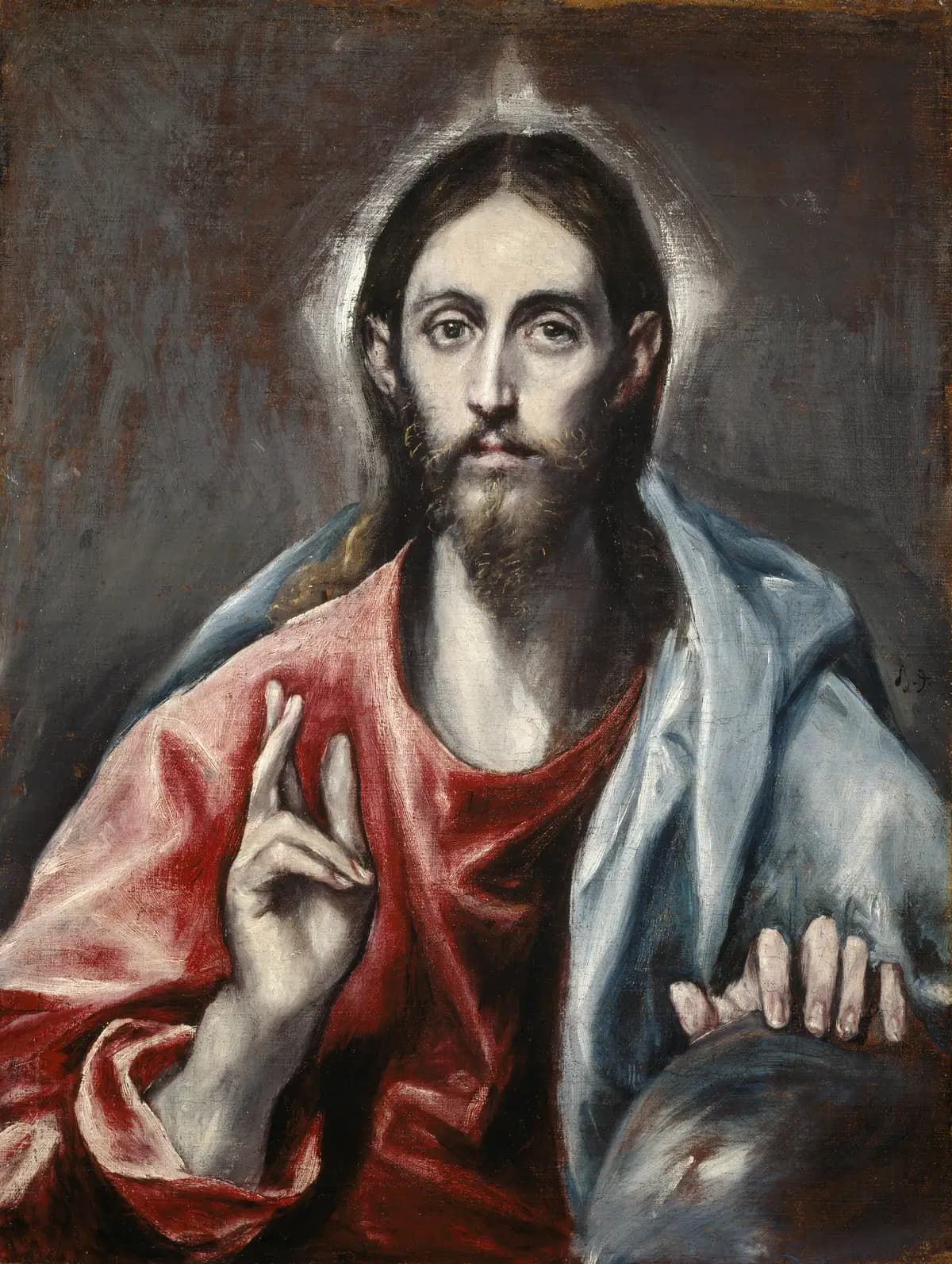
Christ Blessing ('The Saviour of the World'), El Greco, 1600, Scottish National Gallery. Public domain.
New Testament · Book 51 of 66
Colossians
Colossians is Paul's letter to the church at Colossae, teaching that Christ is over all creation and head of the church. He warns them against empty philosophy and sets out how the new life in Christ is lived.
Colossians is Paul's letter to the church at Colossae, teaching that Christ is over all creation and head of the church. He warns them against empty philosophy and sets out how the new life in Christ is lived.
What is Colossians about?
Paul wrote Colossians in chains to a church he had never visited, planted at Colossae by Epaphras. Someone was offering the church more than Christ: rules about food and days, the worship of angels and visions. Paul answers with who the Son is, the maker of all things and the head of the church, in whom all the fullness of God dwells. The church is complete in him, forgiven at the cross and raised with him, so it puts off the old life and puts on the new, at home and at work. The mystery he preaches is “Christ in you, the hope of glory” (1:27).
All 4 chapters
Every chapter of the book, in one grid. Each cell opens that chapter.
- The Son above allChapter 1
- Complete in himChapter 2
- The new selfChapter 3
- Fellow workersChapter 4
The colour is the movement of the letter the chapter stands in, one movement to a chapter, and every cell opens that chapter's Study level.
Who wrote it, where, when, for whom, and why?
The letter opens in the names of Paul, an apostle of Christ Jesus by the will of God, and Timothy (1:1). Paul names himself again as a servant of the gospel (1:23) and signs the last greeting in his own hand (4:18). Five of the fellow workers who greet the church in 4:10 to 14 greet Philemon too (Philemon 1:23 to 24).
This greeting is in my own hand—Paul. Remember my chains. Grace be with you.
Colossians 4:18, Berean Standard Bible.
Paul writes in chains (4:3 and 18), with Aristarchus his fellow prisoner beside him (4:10). Paul asks the church to pray for a door for the word, the mystery of Christ for which he is in chains (4:3). Acts records Paul held in Herod's Praetorium at Caesarea (Acts 23:35) and then in Rome with a soldier to guard him (Acts 28:16), with Aristarchus sailing with him (Acts 27:2).
Paul writes after Epaphras has come from Colossae with news of the church (1:7 to 8), while Onesimus is with him (4:9) and Mark is expected to travel (4:10). Tychicus carries this letter (4:7 to 8), and Ephesians names Tychicus as its bearer too (Ephesians 6:21 to 22).
The letter is written to the saints and faithful brothers in Christ at Colossae (1:2), a church that learned the gospel from Epaphras (1:7) and that Paul struggles for, with the church at Laodicea (2:1). Paul greets the church at Laodicea and Nympha's house church, and asks that the letter be read there too (4:15 to 16).
For I want you to know how much I am struggling for you and for those at Laodicea, and for all who have not met me face to face,
Colossians 2:1, Berean Standard Bible.
Paul writes so that no one will deceive the church by smooth rhetoric (2:4) or take it captive through philosophy and empty deception (2:8). He warns against being judged by food and Sabbaths (2:16) and against the worship of angels (2:18), and he tells the church it is complete in Christ (2:10).
Colossae stands with Laodicea and Hierapolis, the three cities Epaphras works hard for (4:13). The letter names Greek and Jew, circumcised and uncircumcised, barbarian, Scythian, slave and free in one church (3:11), and households of wives, children and slaves under masters (3:18 to 4:1).
Sources. Colossians 1:1 to 2, 1:7 to 8, 1:23, 2:1, 2:4, 2:8, 2:10, 2:16, 2:18, 3:11, 3:18 to 4:1, 4:3, 4:7 to 10, 4:13 to 16 and 4:18; Philemon 1:23 to 24; Ephesians 6:21 to 22; Acts 23:35, 27:2 and 28:16. Every verse is read in the Berean Standard Bible.
How is Colossians arranged, and what is it for?
The four movements the letter falls into, one to a chapter, then what it teaches and what it was written to do.
- The Son above allChapter 1, 29 verses, the turn at 1:18
The thanksgiving and the prayer, the hymn of the Son over all creation, and the mystery made known.
- Complete in himChapter 2, 23 verses, the turn at 2:9
The warning against empty deception, the fullness of Deity in Christ, the cross, and the rules that are a shadow.
- The new selfChapter 3, 25 verses, the turn at 3:3
Raised with Christ, the old self put off and the new put on, and the household in the Lord.
- Fellow workersChapter 4, 18 verses, the turn at 4:2
Masters, prayer and gracious speech, then the ten names of 4:7 to 17.
The theme
Colossians teaches that Christ is over all things and that the believer has everything in him. The Son is the image of the invisible God, the maker of all things and the head of the church, and all the fullness of the Deity dwells in him in bodily form. At the cross God forgave the believer's trespasses, cancelled the debt against him and disarmed the powers. So the believer is complete in Christ (2:10), and rules about food and days are a shadow of the things to come, whose body belongs to Christ (2:17). The believer has died and been raised with him, and lives a new life in the church and the household.
The purpose
Paul wrote to a church he had never visited, planted by Epaphras, to thank God for its faith and to guard it against a teaching that offered more than Christ. He set out who Christ is, told the church it was complete in him, and showed what life raised with Christ looks like at home and at work. He sent the letter with Tychicus and Onesimus, asked that it be read at Laodicea as well, and asked the church to pray for him in his chains.
The hymn of the Son: first in creation, first in the new creation
Panel 1, 1:15 to 17
First in creation
“the firstborn over all creation”
- 15The Son is the image of the invisible God, the firstborn over all creation.
- 16For in Him all things were created, things in heaven and on earth, visible and invisible, whether thrones or dominions or rulers or authorities. All things were created through Him and for Him.
- 17He is before all things, and in Him all things hold together.
Panel 2, 1:18 to 20
First in the new creation
“firstborn from among the dead”
- 18And He is the head of the body, the church; He is the beginning and firstborn from among the dead, so that in all things He may have preeminence.
- 19For God was pleased to have all His fullness dwell in Him,
- 20and through Him to reconcile to Himself all things, whether things on earth or things in heaven, by making peace through the blood of His cross.
In Him
The sphere in which all things were made.
Through Him
The one by whom they were made.
For Him
The one they were made for.
The Son above all, Colossians 1
What the text says in these 29 verses, and the pages they open on.
Paul and Timothy greet the saints at Colossae (1:1 to 2). Paul thanks God for the faith and love the church learned from Epaphras, and he prays that they will be filled with the knowledge of God's will and walk worthy of the Lord (1:3 to 12). God has rescued them from the dominion of darkness into the kingdom of his Son (1:13). The Son is the image of the invisible God: all things were created in him, through him and for him, and in him all things hold together (1:15 to 17). He is the head of the church and the firstborn from among the dead, and through him God reconciled all things by the blood of his cross (1:18 to 20). The Colossians, once hostile, are reconciled if they continue in the faith (1:21 to 23). Paul rejoices in his sufferings for the church and proclaims the mystery hidden for ages, Christ in you (1:24 to 29).
And He is the head of the body, the church; He is the beginning and firstborn from among the dead, so that in all things He may have preeminence.
- Study
Colossians 1the prayer, the hymn of the Son, and the mystery made knownShow the summary and 6 pagesShow summary, 6 pagesHide the summary
Paul and Timothy greet the saints at Colosse, giving thanks for their faith and love, and praying that they may be filled with the knowledge of his will. God has delivered us from the power of darkness, and translated us into the kingdom of his dear Son. Christ is the image of the invisible God, the firstborn of every creature; by him were all things created; and he is before all things, and by him all things consist. He is the head of the body, the church; in him all fulness should dwell. Calvin reads the hymn as the Christ-supremacy charter.
On this chapter (6)
- The supremacy of Christ
The Son over all things.
- The firstborn
The firstborn through Scripture.
- Is 1:15 to 20 an older hymn, and what does firstborn over all creation mean?
Answered under Where do readers disagree, lower on this page, with each reading and who holds it.
- What does filling up what is lacking in regard to Christ's afflictions in 1:24 mean?
Answered under Where do readers disagree, lower on this page, with each reading and who holds it.
- Did Paul write Colossians, and what do its vocabulary and style show?
Answered under Where do readers disagree, lower on this page, with each reading and who holds it.
- Colossians 1:15
The verse on its own page, with the commentators on it by era.
- The supremacy of Christ
The hymn of the Son is drawn as two panels, first in creation and first in the new creation, under The book as a whole.
The prayer for the church, in 7 requests
1. Filled with knowledge
“fill you with the knowledge of His will in all spiritual wisdom and understanding” (1:9)
2. A worthy walk
“walk in a manner worthy of the Lord” (1:10)
3. Fruit
“bearing fruit in every good work”
4. Growth
“growing in the knowledge of God”
5. Strength
“being strengthened with all power according to His glorious might” (1:11)
6. Endurance
“full endurance and patience”
7. Thanks
“giving thanks to the Father” (1:12)
Characters (3)
Who the text names. A name with a page carries its door.
Themes (6)
What these chapters raise, each on its own page where one stands.
- The supremacy of Christ
In all things he has preeminence (1:18).
- The firstborn
Firstborn over all creation and from among the dead (1:15, 1:18).
- The deity of Christ
The image of the invisible God (1:15).
- Reconciliation
All things reconciled by the blood of his cross (1:20).
Show the next 2
- The mystery which is Christ in you
Hidden for ages and now revealed to his saints (1:26 to 27).
- Prayer and thanksgiving
Paul's prayer for knowledge of God's will (1:9 to 12).
Where these chapters take up the Old Testament (1)each marked as a quotation or an allusion, with the evidence
- Probable allusionGenesis 1:26 to 27 at 1:15. The Son is the image of the invisible God. Genesis says God made man in his own image; Colossians calls the Son the image of the invisible God. The store holds the pair as two cross-reference rows, 1:26 and 1:27.
Beside it: Ephesians 1:15 to 23, the same thanksgiving and prayer and Christ the head over all things for the church; Philemon 1:4 to 7, Paul's thanks for Philemon's faith and love.
Complete in him, Colossians 2
What the text says in these 23 verses, and the pages they open on.
Paul tells the church how hard he struggles for them and for Laodicea, that they may know Christ, in whom all the treasures of wisdom and knowledge are hidden (2:1 to 3). As they received Christ Jesus as Lord, so they are to walk in him, rooted and built up (2:6 to 7). No one is to take them captive through philosophy and empty deception (2:8), because the whole fullness of the Deity dwells in Christ, and they are complete in him (2:9 to 10). In him they were circumcised without hands, buried with him in baptism and raised with him; God forgave their trespasses, cancelled the debt against them, nailed it to the cross, and disarmed the powers (2:11 to 15). So no one is to judge them by food, feasts or Sabbaths, which are a shadow of what was to come (2:16 to 17). Rules such as do not handle, do not taste, do not touch have an appearance of wisdom and are of no value against the flesh (2:20 to 23).
For in Christ all the fullness of the Deity dwells in bodily form.
- Study
Colossians 2the empty deception, the cross, and the shadow and the bodyShow the summary and 5 pagesShow summary, 5 pagesHide the summary
Paul's great conflict for them that they might have full assurance of understanding. Beware lest any man spoil you through philosophy and vain deceit, after the rudiments of the world, and not after Christ. In him dwells all the fulness of the Godhead bodily; you are complete in him. Buried with him in baptism; raised with him by faith. The handwriting of ordinances was blotted out, nailed to his cross. Let no man therefore judge you in meat, or in drink. Henry reads the chapter as the counter to a first-rank Christological heresy.
On this chapter (5)
- The shadow
The Law's days and the body that casts the shadow.
- Circumcision of the heart
The circumcision performed by Christ.
- What was the teaching at Colossae that the letter answers, and what do 2:8, 2:16 to 18 and 2:20 to 23 show of it?
Answered under Where do readers disagree, lower on this page, with each reading and who holds it.
- What are the spiritual forces of the world in 2:8 and 2:20?
Answered under Where do readers disagree, lower on this page, with each reading and who holds it.
- Colossians 2:9
The verse on its own page, with the commentators on it by era.
- The shadow
What was done in Christ, and what is shadow
Done in Christ (8)
- 1. Circumcised“In Him you were also circumcised” (2:11)
- 2. Buried“buried with Him in baptism” (2:12)
- 3. Raised“you were raised with Him through your faith”
- 4. Made alive“God made you alive with Christ” (2:13)
- 5. Forgiven“He forgave us all our trespasses”
- 6. The debt cancelled“having canceled the debt ascribed to us” (2:14)
- 7. Nailed to the cross“nailing it to the cross”
- 8. The powers disarmed“having disarmed the powers and authorities” (2:15)
Shadow (6)
“These are a shadow of the things to come, but the body that casts it belongs to Christ” (2:17)
- Food and drink“what you eat or drink” (2:16)
- The calendar“a feast, a New Moon, or a Sabbath”
- Angels“false humility and the worship of angels” (2:18)
- Visions“speculation about what he has seen”
- Regulations“Do not handle, do not taste, do not touch” (2:21)
- Harsh treatment“their harsh treatment of the body” (2:23)
“they are of no value against the indulgence of the flesh” (2:23)
Characters (3)
Who the text names. A name with a page carries its door.
- Paul
Struggles for the Colossians and for those at Laodicea (2:1).
- The one who would take them captive
Through philosophy and empty deception (2:8).
- The one who delights in false humility
And the worship of angels, puffed up by his unspiritual mind (2:18).
Places (2)
Where the chapters stand.
Themes (5)
What these chapters raise, each on its own page where one stands.
- The fullness
All the fullness of the Deity in bodily form (2:9).
- The shadow and the substance
Food, feasts and Sabbaths a shadow; the body belongs to Christ (2:17).
- Circumcision of the heart
A circumcision performed by Christ, in the putting off of the sinful nature (2:11).
- Water baptism
Buried with him in baptism and raised with him (2:12).
Show the next 1
- Sabbath rest
No one is to judge them with regard to a Sabbath (2:16).
Where these chapters take up the Old Testament (2)each marked as a quotation or an allusion, with the evidence
- Probable allusionProverbs 2:4 at 2:3. All the treasures of wisdom and knowledge hidden in Christ. Proverbs tells the son to search for wisdom as for hidden treasure; Colossians says the treasures of wisdom and knowledge are hidden in Christ. The store holds the pair as one cross-reference row.
- Probable allusionDeuteronomy 30:6 at 2:11. A circumcision performed by Christ, in the putting off of the sinful nature (2:11). Moses promises that the LORD will circumcise the hearts of his people; Colossians says the believer was circumcised by Christ in the putting off of the sinful nature. The store holds the pair as one cross-reference row.
Beside it: Ephesians 2:1 to 16, the dead made alive with Christ and the hostility put to death on the cross; Philemon 1:1 to 2, the same Paul and Timothy writing to the church that meets at Philemon's house, with Archippus greeted.
The new self, Colossians 3
What the text says in these 25 verses, and the pages they open on.
Since they have been raised with Christ, the Colossians are to set their minds on things above, where Christ is seated at the right hand of God (3:1 to 2). They have died, and their life is hidden with Christ in God, and when he appears they will appear with him in glory (3:3 to 4). So they are to put to death sexual immorality, impurity and greed, and to put aside anger, malice, slander and lies, since they have taken off the old self and put on the new, renewed in the image of its Creator (3:5 to 10). In the new self there is no Greek or Jew, slave or free, but Christ is all (3:11). They are to clothe themselves with compassion, kindness, humility, gentleness and patience, to forgive as the Lord forgave them, and over all these to put on love (3:12 to 14). The peace of Christ is to rule their hearts and the word of Christ to dwell in them richly (3:15 to 17). Wives and husbands, children and fathers, and slaves are each told how to live in the Lord (3:18 to 25).
For you died, and your life is now hidden with Christ in God.
- Study
Colossians 3the things above, the old self and the new, and the householdShow the summary and 3 pagesShow summary, 3 pagesHide the summary
If you then are risen with Christ, seek those things which are above, where Christ sits on the right hand of God. Set your affection on things above. Mortify therefore your members which are upon the earth: fornication, uncleanness, inordinate affection, evil concupiscence, covetousness, which is idolatry. Put off the old man; put on the new. Let the word of Christ dwell in you richly. Whatever you do in word or deed, do all in the name of the Lord Jesus. Household rules. Wives, husbands, children, fathers, servants, masters. Calvin reads the chapter as risen-life ethics.
On this chapter (3)
- In Christ
The life hidden with Christ in God.
- Marriage and the household
Wives, husbands, children and fathers.
- Colossians 3:10
The verse on its own page, with the commentators on it by era.
- In Christ
What is put off, and what is put on
Put off, 3:5
“Put to death, therefore, the components of your earthly nature”
- sexual immorality
- impurity
- lust
- evil desires
- greed, which is idolatry
Put off, 3:8
“But now you must put aside all such things as these”
- anger
- rage
- malice
- slander
- filthy language
Characters (4)
Who the text names. A name with a page carries its door.
- Christ
Seated at the right hand of God, and the believer's life (3:1, 3:4).
- Wives and husbands
Told to submit and to love (3:18 to 19).
- Children and fathers
Told to obey and not to provoke (3:20 to 21).
- Slaves
Told to work for the Lord and not for men (3:22 to 25).
Places (1)
Where the chapters stand.
- The things above
Where Christ is seated at the right hand of God (3:1).
Themes (5)
What these chapters raise, each on its own page where one stands.
- The old self and the new
Taken off and put on, renewed in the image of its Creator (3:9 to 10).
- In Christ
Your life is now hidden with Christ in God (3:3).
- Forgiveness
Forgive as the Lord forgave you (3:13).
- The household
Wives, husbands, children and fathers in the Lord (3:18 to 21).
Show the next 1
- The Bible and slavery
Slaves and masters under one Master (3:22 to 4:1).
Where these chapters take up the Old Testament (2)each marked as a quotation or an allusion, with the evidence
- Probable allusionPsalm 110:1 at 3:1. Christ seated at the right hand of God. The psalm has the LORD tell David's Lord to sit at his right hand; Colossians places the risen Christ there. The store holds the pair as one cross-reference row.
- Probable allusionGenesis 1:26 to 27 at 3:10. The new self renewed in the image of its Creator. Genesis says man was made in God's image; Colossians says the new self is renewed in the image of its Creator. The store holds the pair as a cross-reference row to 1:26 and one to 1:26 to 27.
Beside it: Ephesians 4:22 to 5:20 and 5:21 to 6:9, the old self and the new and the household told again; Philemon 1:15 to 16, a slave received back as a beloved brother.
Fellow workers, Colossians 4
What the text says in these 18 verses, and the pages they open on.
Masters are to treat their slaves justly, since they too have a Master in heaven (4:1). The church is to devote itself to prayer, watchful and thankful, and to pray that God will open a door for the word, for which Paul is in chains (4:2 to 4). They are to act wisely toward outsiders and let their speech be gracious, seasoned with salt (4:5 to 6). Tychicus will bring Paul's news, and Onesimus, one of their own, comes with him (4:7 to 9). Aristarchus, Mark and Jesus called Justus send greetings, and so do Epaphras, who wrestles in prayer for them, and Luke and Demas (4:10 to 14). Paul greets Nympha and the church in her house, asks that this letter be read at Laodicea and the letter from Laodicea at Colossae, and tells Archippus to complete his ministry (4:15 to 17). He signs the greeting in his own hand and asks them to remember his chains (4:18).
Devote yourselves to prayer, being watchful and thankful,
- Study
Colossians 4prayer and gracious speech, the couriers, and the greetingsShow the summary and 4 pagesShow summary, 4 pagesHide the summary
Masters, give to your servants that which is just and equal. Continue in prayer; watch in the same with thanksgiving. Pray for us. That a door of utterance be opened. Walk in wisdom toward them that are without; let your speech be alway with grace, seasoned with salt. Tychicus and Onesimus will bring news. Greetings from Aristarchus, Mark, Jesus called Justus, Epaphras, Luke, Demas. The Epistle to be read also in the church of the Laodiceans. Remember my bonds. Grace be with you. Henry reads the chapter as the apostolic farewell to a Lycian valley church.
On this chapter (4)
- The church
The church that meets in a house.
- From where was Colossians written: Rome, Ephesus or Caesarea?
Answered under Where do readers disagree, lower on this page, with each reading and who holds it.
- What was the letter from Laodicea of 4:16?
Answered under Where do readers disagree, lower on this page, with each reading and who holds it.
- Colossians 4:16
The verse on its own page, with the commentators on it by era.
- The church
The 10 names of the close
Named in Colossians and Philemon (7)
Colossians: “our faithful and beloved brother, who is one of you” (4:9)
Philemon: “my child Onesimus, whose father I became while I was in chains” (Philemon 1:10)
Aristarchus
Colossians: “My fellow prisoner Aristarchus sends you greetings” (4:10)
Philemon: “Aristarchus” (Philemon 1:24)
Colossians: “Mark the cousin of Barnabas” (4:10)
Philemon: “Mark”
Colossians: “He is always wrestling in prayer for you” (4:12)
Philemon: “Epaphras, my fellow prisoner in Christ Jesus” (Philemon 1:23)
Colossians: “Luke, the beloved physician” (4:14)
Philemon: “Luke, my fellow workers”
Colossians: “and Demas send you greetings” (4:14)
Philemon: “Demas”
Colossians: “See to it that you complete the ministry you have received in the Lord” (4:17)
Philemon: “to Archippus our fellow soldier” (Philemon 1:2)
Named in Colossians (3)
Colossians: “He is a beloved brother, a faithful minister, and a fellow servant in the Lord” (4:7)
Jesus called Justus
Colossians: “Jesus, who is called Justus, also sends greetings” (4:11)
Nympha
Colossians: “Nympha and the church that meets at her house” (4:15)
Characters (10)
Who the text names. A name with a page carries its door.
- Tychicus
A beloved brother who carries Paul's news (4:7).
- Onesimus
A faithful and beloved brother, one of their own (4:9).
- Aristarchus
Paul's fellow prisoner (4:10).
- Mark
The cousin of Barnabas, to be welcomed (4:10).
Show the next 6
- Jesus called Justus
One of the only Jews among Paul's fellow workers (4:11).
- Epaphras
Always wrestling in prayer for them (4:12).
- Luke
The beloved physician (4:14).
- Demas
Sends greetings with Luke (4:14).
- Nympha
The church meets at her house (4:15).
- Archippus
Told to complete the ministry he received in the Lord (4:17).
Places (5)
Where the chapters stand.
- Laodicea
The church that is to read this letter and send its own (4:16).
- Hierapolis
The third city Epaphras works hard for (4:13).
- Rome
One reading of where Paul was held in chains (4:3, 4:18).
- Ephesus
A second reading of the place of the chains.
Show the next 1
- Caesarea
A third place Paul was held under guard, in Acts.
Themes (3)
What these chapters raise, each on its own page where one stands.
- Prayer
Devote yourselves to prayer, watchful and thankful (4:2).
- The church
The church that meets at Nympha's house (4:15).
- Love one another
The greetings of the fellow workers (4:10 to 15).
Where these chapters take up the Old Testament (0)each marked as a quotation or an allusion, with the evidence
This chapter quotes no Old Testament passage.
Beside it: Ephesians 6:18 to 22, prayer for Paul in chains and Tychicus sent with news; Philemon 1:10 and 1:23 to 24, Onesimus and the same five fellow workers.
- Author
- Paul, with Timothy (1:1)
- Date
- c. AD 60–62, from Roman imprisonment
- Audience
- The church at Colossae, carried by Tychicus and Onesimus
Where do readers disagree?
One list: the readings with their holders, and what the evidence does not settle.
What was the teaching at Colossae that the letter answers, and what do 2:8, 2:16 to 18 and 2:20 to 23 show of it?
The Shadow→- Jewish observance pressed on Gentile believers. Held by Adam Clarke, Commentary on the Bible, on 2:20, and by John Chrysostom, Homilies on Colossians, homily 6, on 2:8.
- Jewish practice with visions and a mystic strain. Held by J. B. Lightfoot, Saint Paul's Epistles to the Colossians and to Philemon (1875).
- A local blend of Jewish practice and the religion of Phrygia. Held by F. F. Bruce, The Epistles to the Colossians, to Philemon, and to the Ephesians (1984), and by Douglas J. Moo, The Letters to the Colossians and to Philemon (2008).
What the evidence does not settle: Every account is built from Paul's answers to the teaching: he calls it philosophy and empty deception based on human tradition (2:8), and he names its food, feasts, angels and visions (2:16 to 18).
The argument in full
Jewish observance pressed on Gentile believers. The letter names circumcision (2:11), food and drink, feasts, New Moons and Sabbaths (2:16), the calendar of the Law, which Paul calls a shadow of what was to come (2:17).
Jewish practice with visions and a mystic strain. The Law's calendar stands beside false humility, the worship of angels and claims from visions (2:18), and rules of abstinence (2:21), a blend Lightfoot compares to the Essenes.
A local blend of Jewish practice and the religion of Phrygia. The teaching mixes the Law's days with angels, visions and harsh treatment of the body (2:18 and 23), and Paul answers each part with the fullness of Christ (2:9 to 10).
Did Paul write Colossians, and what do its vocabulary and style show?
- Paul wrote it, with Timothy. Held by F. F. Bruce, The Epistles to the Colossians, to Philemon, and to the Ephesians (1984), by N. T. Wright, Colossians and Philemon, Tyndale New Testament Commentaries (1986), and by Douglas J. Moo, The Letters to the Colossians and to Philemon (2008).
- A student of Paul wrote in his name. Held by Eduard Lohse, Colossians and Philemon, Hermeneia (1971), and by Walter Bujard, Stilistische Untersuchungen zum Kolosserbrief (1973).
What the evidence does not settle: How far a secretary, a co-sender and a new subject can change a writer's style; the letter ends with a greeting in Paul's own hand (4:18).
The argument in full
Paul wrote it, with Timothy. The letter names Paul at 1:1, 1:23 and 4:18, and its names of fellow workers match Philemon, which both readings hold to be Paul's; the words that stand out answer the teaching Paul opposes.
A student of Paul wrote in his name. The sentences run longer than in Romans and Galatians, the small words that join clauses are used differently, and many of its words appear in this letter alone among Paul's letters.
From where was Colossians written: Rome, Ephesus or Caesarea?
- From Rome. Held by Adam Clarke, Commentary on the Bible, on 4:9, and by Albert Barnes, Notes, Explanatory and Practical, on the Old and New Testaments, on 4:10.
- From Ephesus. Held by George S. Duncan, St. Paul's Ephesian Ministry (1929).
- From Caesarea. Held by Bo Reicke, 'Caesarea, Rome, and the Captivity Epistles', in Apostolic History and the Gospel (1970).
What the evidence does not settle: The letter places Paul in chains (4:3 and 18) with Aristarchus his fellow prisoner (4:10); Acts records him held two years at Caesarea (Acts 24:27) and two years at Rome (Acts 28:30), and each fits the names of 4:10 to 14.
The argument in full
From Rome. Aristarchus, Paul's fellow prisoner at 4:10, sailed with him to Rome (Acts 27:2), and Acts ends with Paul two years in Rome, free to receive visitors (Acts 28:30).
From Ephesus. Colossae lies a few days' walk from Ephesus, and the letter assumes that Epaphras and Onesimus had reached Paul and that Mark might soon travel to the church (1:7 to 8, 4:9 to 10).
From Caesarea. Acts records Paul held two years at Caesarea with his friends allowed to care for him (Acts 24:23 and 27).
Is 1:15 to 20 an older hymn, and what does firstborn over all creation mean?
The Firstborn→- Firstborn names rank over creation, the Nicene answer. Held by Athanasius of Alexandria in his Discourses Against the Arians, 2.63, and by Ambrosiaster in his Commentary on Colossians, on 1:16.
- Firstborn of the new creation. Held by Gregory of Nyssa in his Against Eunomius, book 4, and by Severian of Gabala in his Commentary on Colossians, on 1:18.
- An older hymn Paul takes up. Held by Eduard Lohse in his Colossians and Philemon, Hermeneia.
- A poem Paul could have written himself. Held by N. T. Wright, Colossians and Philemon, Tyndale New Testament Commentaries (1986).
What the evidence does not settle: Whether Paul wrote the lines or quoted them; every reading named here holds that the Son is before all things and that all things were created through him (1:16 to 17).
The argument in full
Firstborn names rank over creation, the Nicene answer. Arius read the word as making the Son the first thing God made. Athanasius answers that the Son is called firstborn because in him the creation came to be (1:16), and the one through whom all things were made is before all things (1:17).
Firstborn of the new creation. The word stands twice in the hymn, over all creation (1:15) and from among the dead (1:18), so the Son is first of the creation that was made and of the one made new.
An older hymn Paul takes up. The passage falls into two balanced parts with matching phrases, firstborn and all things, and uses words that appear in this passage alone among Paul's letters.
A poem Paul could have written himself. The two parts answer each other as creation and new creation, and the passage carries the letter's own words: image (3:10), fullness (2:9), head and body (2:19).
What are the spiritual forces of the world in 2:8 and 2:20?
- The first lessons of religion, the Law's rites. Held by Adam Clarke, Commentary on the Bible, on 2:20, who calls them the alphabet out of which the whole science of Christianity was composed.
- The sun and moon that mark the days. Held by John Chrysostom in his Homilies on Colossians, homily 6, on 2:8.
- Spirit powers behind the world. Held by Ambrosiaster in his Commentary on Colossians, on 2:8, who renders the phrase the elemental spirits of the world.
What the evidence does not settle: The Greek word can mean letters, first principles, the physical elements or spirits, and the letter uses it twice, at 2:8 and 2:20, both times of the world; the Berean text renders it spiritual forces.
The argument in full
The first lessons of religion, the Law's rites. The Greek word names the letters of the alphabet and the first elements of a subject, and the rules Paul names are the Law's food and days (2:16).
The sun and moon that mark the days. The warning leads into the feasts, New Moons and Sabbaths (2:16), which are kept by the sun and the moon.
Spirit powers behind the world. The letter speaks of rulers and authorities made through Christ (1:16) and disarmed at the cross (2:15), and of the worship of angels (2:18).
What does filling up what is lacking in regard to Christ's afflictions in 1:24 mean?
- The sufferings of Christ's body, the church. Held by Augustine of Hippo in his Tractates on the Gospel of John, tractate 108, and by John Wesley in his Explanatory Notes upon the New Testament, on 1:24.
- A share of suffering in the same cause. Held by Albert Barnes, Notes, Explanatory and Practical, on the Old and New Testaments, on 1:24, and by Matthew Henry, Commentary on the Whole Bible, on 1:24.
- A measure of affliction appointed before the end. Held by Eduard Lohse in his Colossians and Philemon, Hermeneia.
What the evidence does not settle: Whose afflictions are meant, since the letter says reconciliation was made by the blood of the cross (1:20) and Paul still speaks of what is lacking.
The argument in full
The sufferings of Christ's body, the church. The verse says Paul suffers for the sake of his body, which is the church (1:24), and the risen Christ asked Saul why he was persecuting him (Acts 9:4).
A share of suffering in the same cause. Paul suffers in the cause Christ suffered for, the gospel to the Gentiles, and the letter says the debt was already cancelled at the cross (2:14).
A measure of affliction appointed before the end. Jewish writings of the time looked for a set measure of suffering before the age to come, and Paul takes up a share of it in his own flesh for the church.
What was the letter from Laodicea of 4:16?
- A letter of Paul to Laodicea, now lost. Held by Thomas Aquinas in his Commentary on Colossians, on 4:16, who sets it beside the letter to Corinth that 1 Corinthians 5:9 names.
- The letter we call Ephesians. Held as a possibility by Matthew Henry, Commentary on the Whole Bible, on 4:16, who says some think it was the epistle to the Ephesians.
- A letter written from Laodicea. Held by John Gill in his Exposition of the New Testament, on 4:16, following the Syriac version, and reported by John Chrysostom in his Homilies on Colossians, homily 12.
What the evidence does not settle: Which letter Paul means by the letter from Laodicea (4:16); John Gill notes that the later Latin letter under that name is a collection of phrases from Paul's other letters.
The argument in full
A letter of Paul to Laodicea, now lost. Paul tells the church to read the letter from Laodicea, which reads most naturally as a letter he had sent there.
The letter we call Ephesians. Tychicus carries both letters (4:7, Ephesians 6:21), and Ephesians closes with peace to the brothers as a whole (Ephesians 6:23), where Colossians greets its people by name (4:15).
A letter written from Laodicea. The verse says from Laodicea, so it may be a letter the Laodiceans wrote, to Paul or to the church.
The Text and the Spade
- The mound of Colossae at Honazoccupation from the Bronze Age; the site identified in the nineteenth century
The city Paul wrote to has been located, on a mound beside the Lycus a short distance from the modern town of Honaz, and it has been surveyed rather than systematically excavated. Surface survey has recovered pottery across a long span, and the theatre and the line of the settlement can be traced. Colossae is the one city addressed by an undisputed letter of Paul that has had no major published excavation, which is worth saying plainly and worth revisiting, since survey and excavation work in the valley continues.
- Laodicea and Hierapolis, the two neighbours named at 4:13excavated from 1957 at Hierapolis and from 2003 at Laodicea
The two cities Paul names in the same breath as Colossae have been dug extensively. Laodicea has produced a street plan, two theatres, a stadium, an aqueduct system and one of the earliest church buildings in Asia Minor; Hierapolis has produced its necropolis, its theatre and its hot springs. The bearing on this letter is indirect and useful, since the excavated neighbours show what the Lycus valley was like in the first century while the addressee city stays under its mound.
- The Jewish population of Phrygiathe resettlement in the late 3rd century BC; Cicero's speech delivered 59 BC
Josephus records that Antiochus III moved two thousand Jewish families from Mesopotamia and Babylonia into Lydia and Phrygia to steady the region (Antiquities 12). Cicero, defending Flaccus in 59 BC, mentions temple money confiscated at Laodicea that had been collected from the Jewish communities of the district, and the quantity implies a sizable population. That is the documented background to the Jewish elements in the teaching Paul answers at 2:11 and 2:16.
- The Council of Laodicea, canon 354th century, in the same valley
A regional council held at Laodicea forbade Christians to leave the church of God and invoke angels. It is three centuries later than the letter and cannot describe the situation at Colossae in the first century. What it does show is that the practice Paul warns against at 2:18 had a long life in this particular region, which is why it belongs here as later regional evidence and never as proof of what the Colossian teachers held.
The pages Colossians opens on
Studies73
- The Supremacy of Christ
- The Firstborn
- The Deity of Christ
- The Incarnation
- Christ Our Wisdom
- Reconciliation
Show the next 6 titles
Show the next 6 titles
- Marriage and the Household
- The Bible and Slavery
- Diligence
- Put Off, Put On
- The Teaching Paul Answered at Colossae
- The Seven Churches of Revelation
Show the next 6 titles
- Angelology
- Creation and Evolution
- Darkness
- The Words Erek Appayim and Makrothymia
- Blessed Are the Peacemakers
- The Words Shalom and Eirene
Show the next 6 titles
- The Word Hypomone
- Territorial Spirits
- The Church
- The Gap Reading at Genesis 1:2
- The Image of God
- The Peace Offering
Show the next 6 titles
- The Younger Set Before the Elder
- The Watchers' Secrets
- Demonology
- The Fall Feasts
- The Hebrew Feasts
- Gilgal
Show the next 6 titles
- How the Cross Saves: The Views of the Atonement
- Infant Baptism and Believers' Baptism
- Jesus
- Be Kind to One Another
- Satan
- Satan Across the Testaments
Show the next 6 titles
- Spiritual Warfare
- The Appointed Times Read as a Calendar of Prophecy
- The Christian Year
- Sunday and the Sabbath
- The Sabbath in Jewish Practice
- The sign of circumcision
Show the next 6 titles
- Words of Knowledge & Wisdom
- You Shall Not Covet
- Corrie ten Boom and the Guard
- Forgiveness and Health
- Joseph Forgives His Brothers
- Gratitude
Show the next 6 titles
- Gratitude, Anxiety and the Brain
- The Hebrew and Greek Words for Humility
- Kindness
- Patience
- Patience and the Impulse
- Stephen, the First Martyr: Acts 6-7
Show the next 6 titles
People and groups10
Words8
Books beside it6
Sources for this page
The movements, the chapter entries, the figures and the Context are read off the text of Colossians, with Philemon, Ephesians 6 and Acts for the setting. The works behind the readings under Where do readers disagree are Athanasius of Alexandria, Discourses Against the Arians (about 360); Gregory of Nyssa, Against Eunomius (about 382); Ambrosiaster, Commentary on Colossians (about 380); John Chrysostom, Homilies on Colossians (about 400); Severian of Gabala, Commentary on Colossians (about 400); Augustine of Hippo, Tractates on the Gospel of John (about 420); Thomas Aquinas, Commentary on Colossians (about 1270); Matthew Henry, Commentary on the Whole Bible (1710); John Gill, Exposition of the New Testament (1746 to 1748); John Wesley, Explanatory Notes upon the New Testament (1755); Adam Clarke, Commentary on the Bible (1832); Albert Barnes, Notes, Explanatory and Practical, on the Old and New Testaments, 1832 to 1869; J. B. Lightfoot, Saint Paul's Epistles to the Colossians and to Philemon (1875); George S. Duncan, St. Paul's Ephesian Ministry (1929); Bo Reicke, Caesarea, Rome, and the Captivity Epistles (1970); Eduard Lohse, Colossians and Philemon (1971); Walter Bujard, Stilistische Untersuchungen zum Kolosserbrief (1973); F. F. Bruce, The Epistles to the Colossians, to Philemon, and to the Ephesians (1984); N. T. Wright, Colossians and Philemon (1986); and Douglas J. Moo, The Letters to the Colossians and to Philemon (2008). Every verse quoted on this page is the Berean Standard Bible, read from the store.