
Genesis 2:8 to 17 · Doctrine · Featured Study
Trees: Eden, Cross, New Jerusalem
The tree of life stands in the garden of Genesis 2 and again in the city of Revelation 22, and the apostles call the cross a tree.
Scripture also teaches by an ark of gopher wood, the oaks of Mamre, a burning bush, a cedar of Lebanon and a shoot from the stump of Jesse.
- First taught
- Genesis 2:9 “Out of the ground the LORD God gave…”
- Fullest statement
- Revelation 22:1 to 3 “Then the angel showed me a river of…”
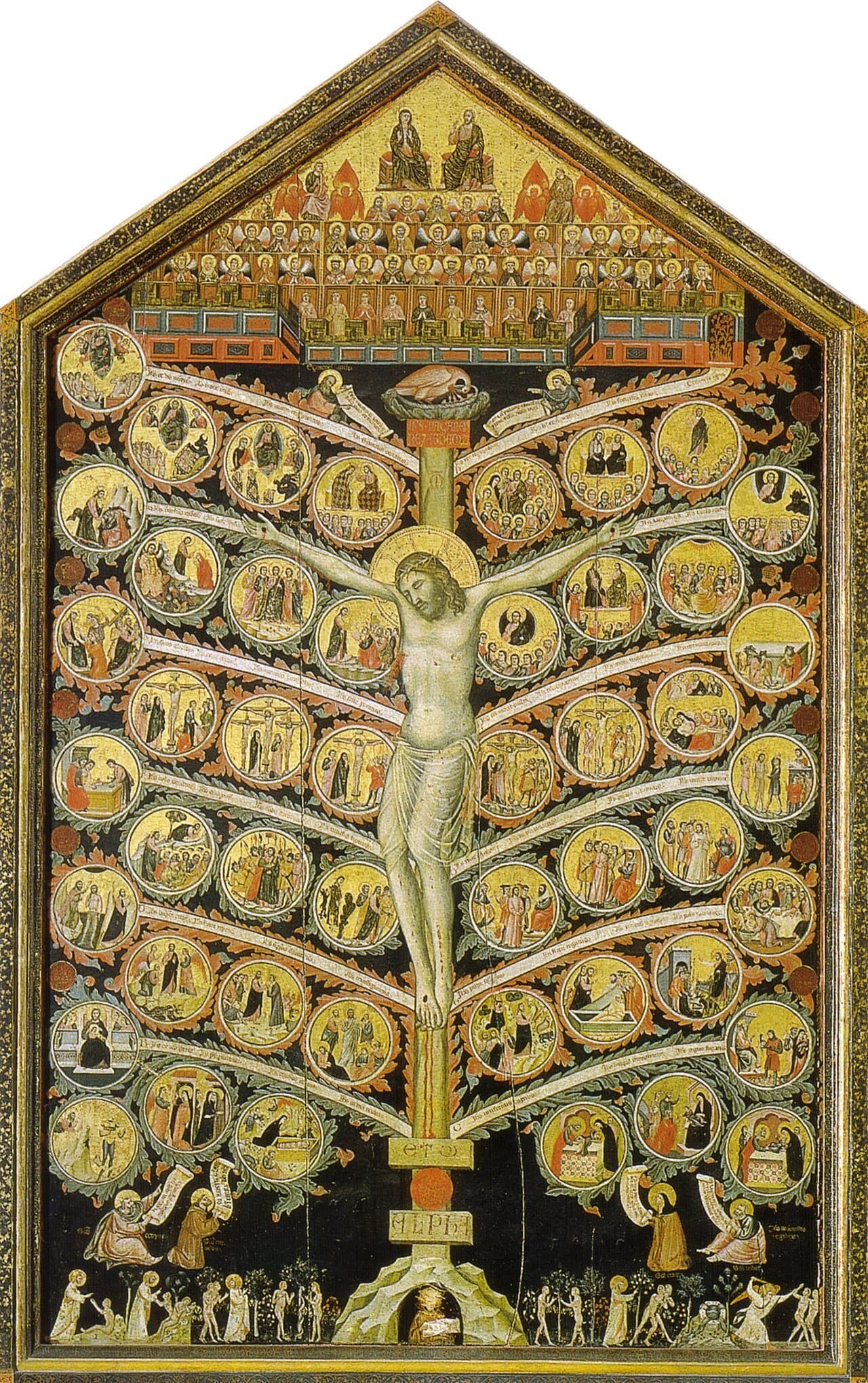
Pacino di Bonaguida, The Tree of Life, 1305 to 1310. Public domain.
Summary
Scripture's teaching on the trees turns on the expulsion from Eden and on the curse the law lays on a hanged man.
- Genesis 3:22 to 24 names the tree of life as the reason the LORD drove the man out of the garden.
- Deuteronomy 21:23 puts anyone hung on a tree under God's curse, and Galatians 3:13 says Christ became that curse for us.
- Peter's preaching in Acts and his first letter call the cross a tree, with the Greek word xylon.
Two Trees in the Middle of the Garden
Genesis 2 gives every tree of the garden for food but one, and Genesis 3 closes the way to the tree of life.
Out of the ground the LORD God gave growth to every tree that is pleasing to the eye and good for food. And in the middle of the garden were the tree of life and the tree of the knowledge of good and evil.This verse places both trees in the middle of the garden, so the first choice stood at its centre.
And the LORD God commanded him, “You may eat freely from every tree of the garden, but you must not eat from the tree of the knowledge of good and evil; for in the day that you eat of it, you will surely die.”God forbids one tree and gives the rest, so the tree of life was among the trees Adam could eat from.
Matthew Henry, in his Commentary on the Whole Bible (1706), read the grant of every tree as an assurance of life upon obedience. He noted that when the grant is recalled after the fall, the tree of life is the one tree named as withheld.
Then the LORD God said, “Behold, the man has become like one of Us, knowing good and evil. And now, lest he reach out his hand and take also from the tree of life, and eat, and live forever...” Therefore the LORD God banished him from the Garden of Eden to work the ground from which he had been taken. So He drove out the man and stationed cherubim on the east side of the Garden of Eden, along with a whirling sword of flame to guard the way to the tree of life.The LORD's reason for driving the man out names the tree of life, so the loss of Eden is the loss of the way to that tree.
Rashi and Tertullian explain the bar on the tree of lifeGenesis 3:22; Rashi; Tertullian
Rashi explains the bar of Genesis 3:22 by saying that a man who lived forever would lead people to say that he too is a god. Tertullian found mercy in the words and now, which set a limit on the time of the sentence.
“Inserting thus the particle of present time, ‘And now,’ He shows that He had made for a time, and at present, a prolongation of man's life. Therefore He did not actually curse Adam and Eve, for they were candidates for restoration, and they had been relieved by confession.”
Tertullian · Against Marcion Book II · on Revelation 22:14Patristic
The tree of life is barred at the fall and opened at the endGenesis 2:9 to Revelation 22:14
A table of four trees, each with its texts and what those texts say of it.
| Tree | Texts | What the texts say of it |
|---|---|---|
| The tree of life in Eden | Genesis 2:9 | Its way was barred at the fall |
| The tree of the knowledge of good and evil | Genesis 2:17 | The test that the first man and woman failed |
| The cross, called a tree | Acts 5:30; Galatians 3:13 | The curse was borne and the way restored |
| The tree of life in the city | Revelation 22:2; Revelation 22:14 | It stands on either side of the river |
Eight Stations from Eden to the City
Eight stations of tree, wood, bush and shoot run in canon order from the two trees of Eden to the tree of life in the city, and the cross stands seventh.
A chain of eight stations in canon order, each with its text, its tree and the Hebrew or Greek word it turns on.
1Eden
- Text
- Genesis 2:9
- What stands there
- The two trees in the middle of the garden
- The word
- ets, tree or wood
2Noah
- Text
- Genesis 6:14
- What stands there
- The gopher wood of the ark
- The word
- gopher, a building wood
- Text
- Genesis 18:1
- What stands there
- The oaks of Mamre
- The word
- elon, an oak or terebinth
- Text
- Exodus 3:2
- What stands there
- The burning bush
- The word
- seneh, a bramble
- Text
- Psalm 92:12
- What stands there
- The cedar of Lebanon
- The word
- erez, a cedar
- Text
- Isaiah 11:1
- What stands there
- A shoot and a Branch from the line of Jesse
- The word
- choter, a shoot; netser, a branch
- Text
- Galatians 3:13
- What stands there
- The tree that bore the curse
- The word
- xylon, wood or tree
- Text
- Revelation 22:2
- What stands there
- The tree of life by the river
- The word
- xylon zoes, the tree of life
The cross, The city
The guarded tree of Eden and the gopher wood of the arkGenesis 2:9, Genesis 3:24 and Genesis 6:14
In Eden the tree of life and the tree of the knowledge of good and evil stand together, and after the fall cherubim guard the way (Genesis 3:24).
Noah's ark is the pitch-sealed vessel of salvation through water. The word gopher stands only here and its tree is uncertain, though Strong's lexicon suggests the cypress; tebah, the ark, names only Noah's ark and the basket of the infant Moses. The first use of kaphar, to cover, which elsewhere means to atone, is the pitching of the ark, and 1 Peter 3:20 to 21 sets the ark beside baptism.
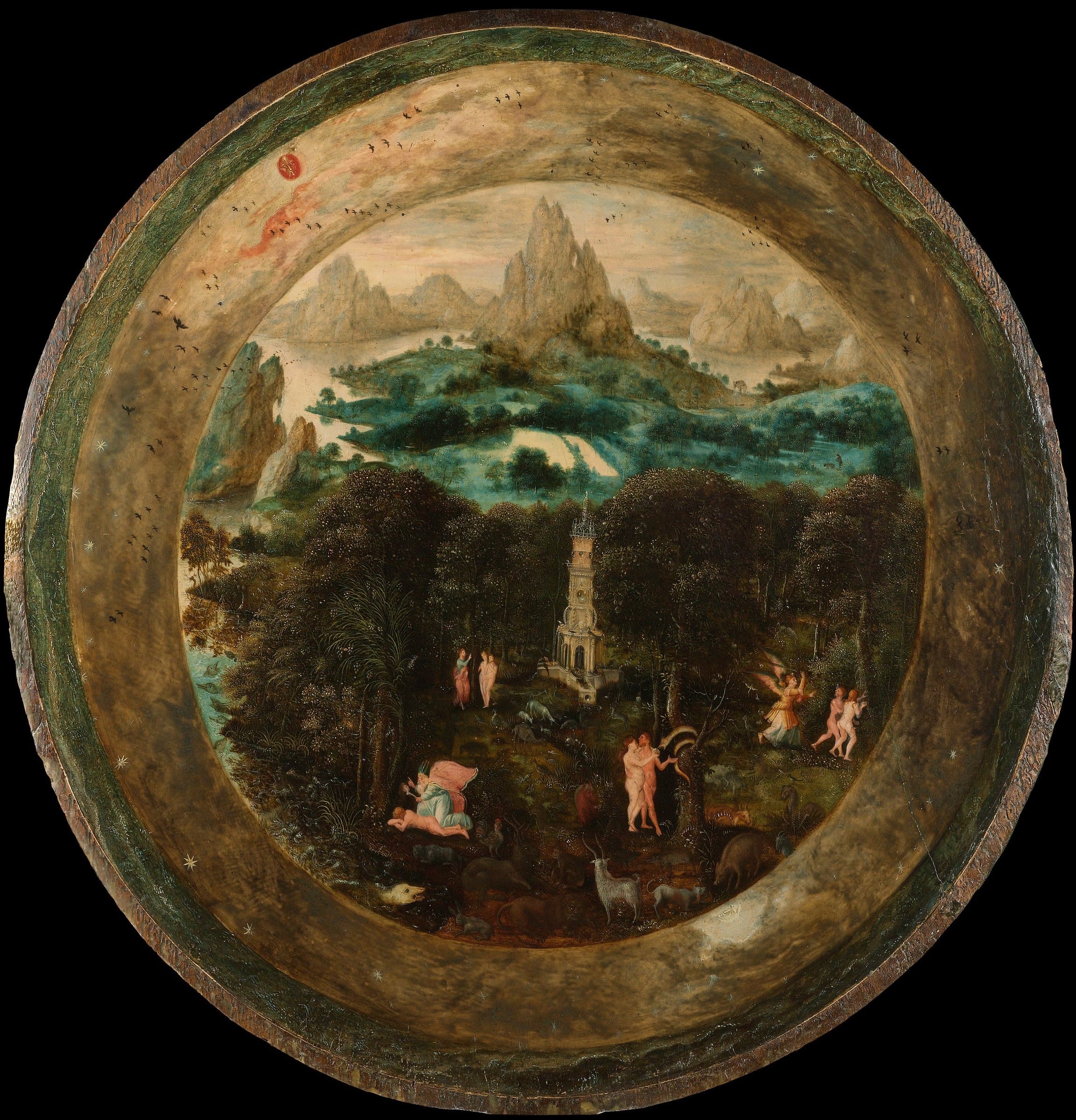
Herri met de Bles, Paradise, oil on panel, about 1545, Rijksmuseum SK-A-780, public domain by date.
Herri met de Bles painted the whole garden in one round panel, from the making of Eve to the angel who drives Adam and Eve out, with a fountain at its centre.
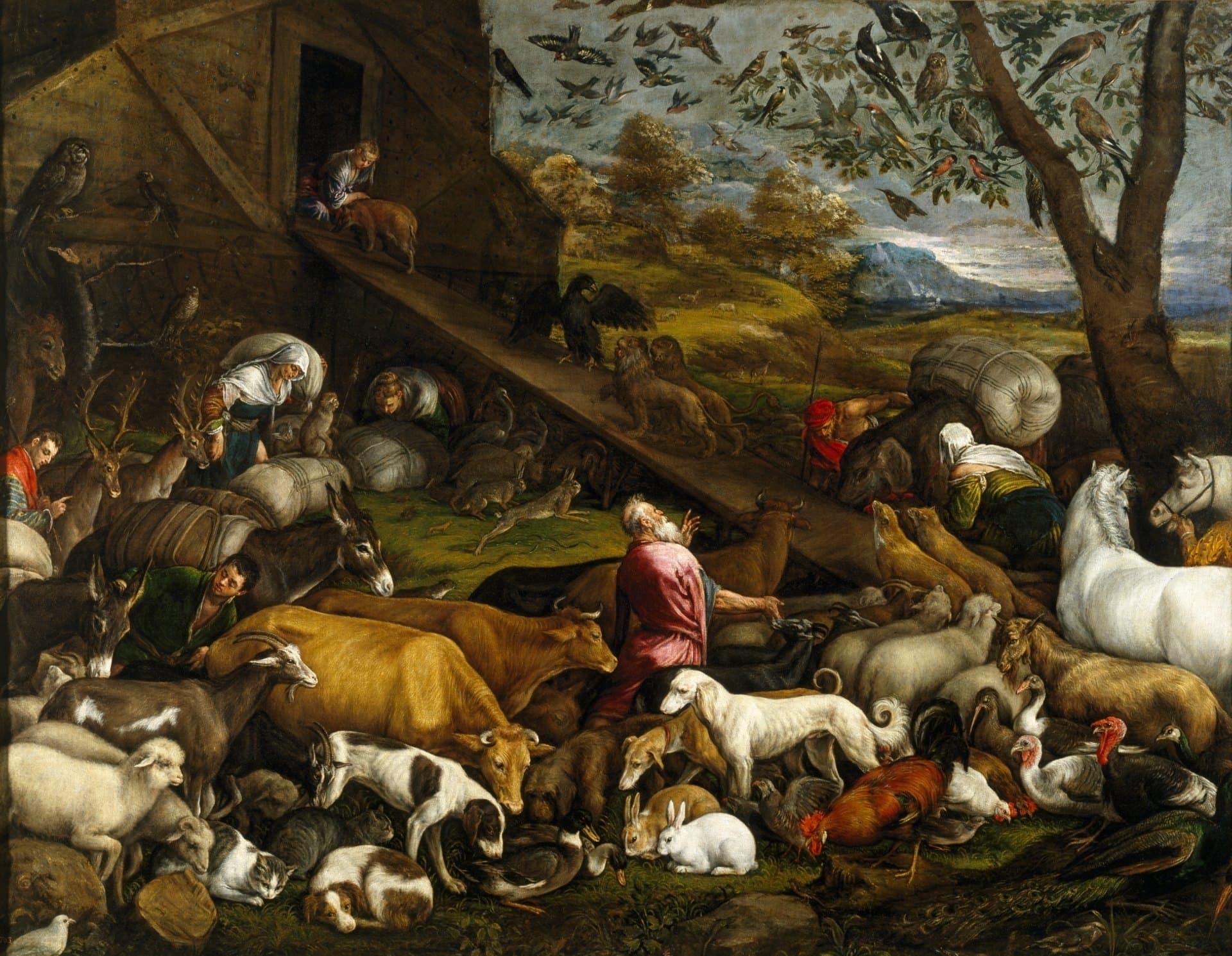
Jacopo Bassano, The Animals Entering Noah's Ark, oil on canvas, about 1570, public domain by date.
Bassano painted the wooden ark with its ramp as Noah's household loads the animals before the flood.
Mamre and Horeb: God appears by a treeGenesis 18:1 and Exodus 3:2
The LORD appeared to Abraham by the Oaks of Mamre, and Jacob's words at Peniel, I have seen God face to face (Genesis 32:30), tell of a like meeting. The word elon may mean an oak or a terebinth, and translators differ.
At Horeb Moses saw the bush ablaze with fire, but it was not consumed. The word seneh stands only in Exodus 3 and in Moses' blessing of Joseph (Deuteronomy 33:16), and it may sound a play on the name Sinai. Stephen tells the scene again in Acts 7:30 to 35.
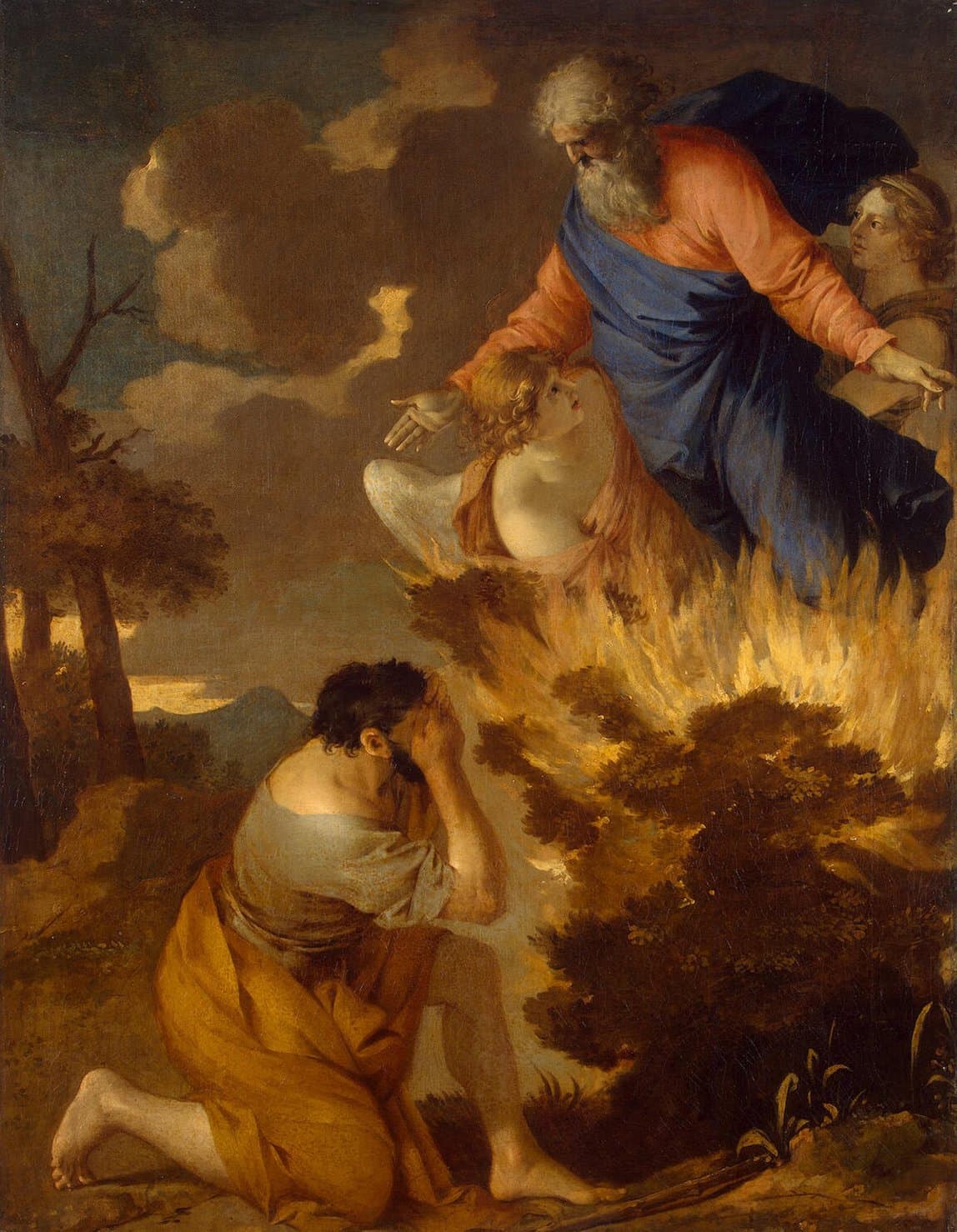
Sébastien Bourdon, The Burning Bush, oil on canvas, seventeenth century, public domain by date.
Bourdon painted Moses hiding his face as God speaks from above the burning bush.
The cedar and the shoot of JessePsalm 92:12; Ezekiel 17 and 31; Isaiah 11:1
The righteous will grow like a cedar in Lebanon (Psalm 92:12). Ezekiel sets the tender sprig the LORD plants, which becomes a majestic cedar (Ezekiel 17:22 to 24), against Assyria, the felled cedar of Ezekiel 31, so the proud are brought down and the lowly raised.
Rashi, following the Targum, reads the sprig of Ezekiel 17:22 as the King Messiah. Read within the chapter, the sprig answers the top of the cedar carried to Babylon in Ezekiel 17:3 to 4, so it also promises the restoration of David's line after the exile.
Isaiah 11:1 promises a shoot from the stump of Jesse and a Branch from his roots. The word choter, a shoot, stands only twice in the Hebrew Bible, and netser means a sprout or descendant. Paul quotes Isaiah 11:10 in Romans 15:12, Jesus calls Himself the Root and the Offspring of David in Revelation 22:16, and the Targum reads Isaiah 11:1 of the Messiah.
The river trees of Ezekiel 47 and Revelation 22Ezekiel 47:12 and Revelation 22:2
Along both banks of the river, fruit trees of all kinds will grow. Their leaves will not wither, and their fruit will not fail. Each month they will bear fruit, because the water from the sanctuary flows to them. Their fruit will be used for food and their leaves for healing.”Ezekiel saw this river in exile, flowing out from the temple.
down the middle of the main street of the city. On either side of the river stood a tree of life, bearing twelve kinds of fruit and yielding a fresh crop for each month. And the leaves of the tree are for the healing of the nations.John's river flows from the throne of God and of the Lamb.
G. K. Beale and D. A. Carson, Commentary on the New Testament Use of the Old Testament (2007), trace Revelation 22:2 to Ezekiel 47:12. The river of the city also recalls the river that watered Eden (Genesis 2:10).
Eight texts on the vine and the oliveGenesis 49:11 to Revelation 14:18
A table of eight texts on the vine and the olive in canon order, each with what it adds.
| Text | What it adds |
|---|---|
| Genesis 49:11 | The vine of Judah's royal blessing |
| Psalm 80:8 | A vine brought out of Egypt |
| Isaiah 5:7 | The vineyard of the LORD is the house of Israel |
| Isaiah 27:2 | The fruitful vineyard restored |
| Ezekiel 17:5 | The vine of David's house planted and then uprooted |
| John 15:1 | Jesus says I am the true vine |
| Romans 11:17 | A wild olive shoot grafted in by grace |
| Revelation 14:18 | The clusters of the vine of the earth gathered for judgment |
Romans 11:17, Revelation 14:18
Fig, olive, cedar and almondFour trees and what each pictures
A table of four trees, each with its texts and what it pictures.
| Tree | Texts | What it pictures |
|---|---|---|
| Fig | Genesis 3:7; Matthew 21:18 to 22; John 1:48; Micah 4:4 | The first coverings, the barren tree cursed, Nathanael seen under the fig tree, and the peace of each man under his own fig tree |
| Olive | Psalm 52:8 | An olive tree flourishing in the house of God |
| Cedar | 1 Kings 5 to 7 | The wood of Solomon's temple |
| Almond | Numbers 17:8; Exodus 25:33 to 34; Jeremiah 1:11 to 12 | Aaron's staff that budded, the blossoms of the lampstand, and God watching over His word |
Jeremiah 1:11 to 12 turns on a pun: the almond is shaqed, and the LORD says He is shoqed, watching over His word.
The Cross Called a Tree
Deuteronomy 21 gives the law of the hanged man, Paul and Peter apply its word for tree to the cross, and Revelation opens the tree of life again.
If a man has committed a sin worthy of death, and he is executed, and you hang his body on a tree, you must not leave the body on the tree overnight, but you must be sure to bury him that day, because anyone who is hung on a tree is under God’s curse. You must not defile the land that the LORD your God is giving you as an inheritance.Paul's argument in Galatians 3:13 depends on the last clause of this law.
Christ redeemed us from the curse of the law by becoming a curse for us. For it is written: “Cursed is everyone who is hung on a tree.”This verse is the bridge by which the word tree passes from the law of Moses into the preaching of the cross.
The apostles' preaching in Acts uses xylon, wood or tree, for the cross (Acts 5:30, Acts 10:39 and Acts 13:29), where the common word is stauros, a stake or cross. Luke records the word in three sermons, two by Peter and one by Paul.
He Himself bore our sins in His body on the tree, so that we might die to sin and live to righteousness. “By His stripes you are healed.”Peter uses xylon for the cross as he did in his preaching, and he joins healing to the tree as Revelation 22:2 does.
He who has an ear, let him hear what the Spirit says to the churches. To the one who overcomes, I will grant the right to eat from the tree of life in the Paradise of God.Christ speaks this promise to the church in Ephesus, so the tree barred in Genesis 3:24 is offered again before the vision of the city.
Blessed are those who wash their robes, so that they may have the right to the tree of life and may enter the city by its gates.This is the last blessing of the Bible, and it makes cleansing the ground of the right to the tree.
Doré engraved the cross on a darkened hillThe Crucifixion, 1866
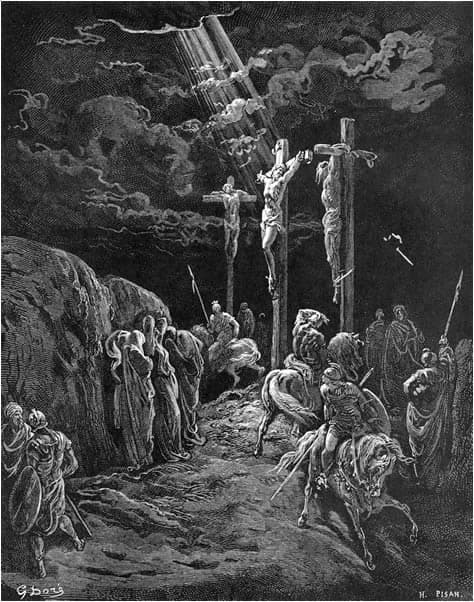
Gustave Doré, The Crucifixion, wood engraving, 1866, public domain by date.
Doré let a single shaft of light fall on Christ among the three crosses.
In Revelation 22 the tree of life is many treesRevelation 22:2; Jamieson, Fausset and Brown; John Wesley
The tree stands on either side of the river and yields a fresh crop each month, so the loss of Eden is answered by abundance and constancy. Jamieson, Fausset and Brown hold that there are several trees of one kind, all called the tree of life. John Wesley, in his Explanatory Notes upon the New Testament (1755), says the same: not one tree only, but many.
The right to the tree of life is a gift of graceJamieson, Fausset and Brown, on Revelation 22:14
The older manuscripts of Revelation 22:14 read wash their robes, the reading the Berean text follows, where later copies read do His commandments. Jamieson, Fausset and Brown take the right to the tree as given by grace on either reading.
“This reading takes away the pretext for the notion of salvation by works. But even English Version reading is quite compatible with salvation by grace; for God's first and grand Gospel ‘commandment’ is to believe on Jesus. Thus our ‘right’ to (Greek, ‘privilege’ or ‘lawful authority over’) the tree of life is due not to our doings, but to what He has done for us.”
Jamieson, Fausset & Brown · Commentary Critical and Explanatory on the Whole Bible · on Revelation 22:14Reformed
1 Peter 2:24, Revelation 2:7, Revelation 22:14
What the Text Says of the Trees
Readers ask whether the threat of Genesis 2:17 came true, what xylon means and how grafting works.
DID ADAM AND EVE DIE ON THE DAY THEY ATE?
Genesis 2:17 warns of death in the day of eating, and Genesis 5:5 says Adam lived 930 years and then died.
IS XYLON ONLY THE WORD FOR A WOODEN STAKE?
Strong's lexicon gives xylon as timber, a stick, a club or a tree, so the word reaches beyond a stake.
DID PAUL HAVE GRAFTING BACKWARDS?
Paul says the wild branch was grafted in contrary to nature, so he knew the grafting reversed the usual practice.
Ambrose on the double death of Genesis 2:17On Paradise
Ambrose asks why the command doubles its verb in you will surely die.
“What is the difference between saying 'ye shall die' and 'ye shall die the death'? We ought to point out that there is nothing superfluous in the command of God. Here is my solution. Since life and death are contradictory ideas, in unaffected language we say 'we live in life' and 'die in death.'”
Ambrose of Milan · On Paradise · on Genesis 2:17Patristic
Roman farmers grafted wild shoots into cultivated olivesColumella, On Agriculture 5.9
Columella, writing on farming in the first century AD, tells the grower to bore an olive that bears no fruit and set a green slip of wild olive in the hole to make it fertile. A. G. Baxter and J. A. Ziesler, Paul and Arboriculture, Journal for the Study of the New Testament 24 (1985), and Philip F. Esler, Ancient Oleiculture and Ethnic Differentiation, Journal for the Study of the New Testament 26.1 (2003), read Paul's words against that practice. The reversal Paul names is the point of his figure, since the Gentile branch is joined by grace to a root it did not grow.
One Hebrew Noun for Tree, Wood and Gallows
Paul's reading of the cross rests on one word for tree in Hebrew and one in Greek.
The Hebrew ets names the living tree of life and also the wood of the gallows. Its entry in Strong's Hebrew dictionary gives a tree, wood, sticks, timber and the gallows. The life of the tree of life is chayyim, from chay (H2416), alive. The Greek Old Testament renders ets as xylon at Genesis 2:9 and at Deuteronomy 21:22 to 23, and Revelation 22:2 uses xylon as well.
That shared word lets Paul apply the curse of the law to the cross in Galatians 3:13. The tree of Eden, the tree of the curse and the tree that heals are one noun across the two languages.
Xylon is the least used of the four words, and it is the word the apostles use for the cross and for the tree of life.
The four counts as a table
| Word | Uses in the Bible | What it names | Verse |
|---|---|---|---|
| ets (H6086) | 328 | a tree or wood, the word for both trees of the garden | Genesis 2:9 |
| stauros (G4716) | 27 | an upright stake, the cross that Simon of Cyrene carried | Matthew 27:32 |
| dendron (G1186) | 25 | a living tree, cut down when it bears no good fruit | Matthew 3:10 |
| xylon (G3586) | 20 | wood or a tree, the word of the tree of life in the city | Revelation 22:2 |
Four words for tree, wood and cross, each counted across the Bible, with one verse where it stands.
In Jewish law a body was hung on a tree after deathAlbert Barnes, on Deuteronomy 21:22
Barnes lists the four Jewish methods of execution and places the hanging of Deuteronomy 21 after death, as a mark of the curse.
“There were four methods of execution in use among the ancient Jews; stoning (Exo 17:4; Deu 13:10, etc.), burning Lev 20:14; Lev 21:9, the sword Exo 32:27, and strangulation. The latter, though not named in Scripture, is regarded by the rabbis as the most common, and the proper one to be adopted when no other is expressly enjoined by the Law. Suspension, whether from cross, stake, or gallows, was not used as a mode of taking life, but was sometimes added after death as an enhancement of punishment.”
Albert Barnes · Notes, Explanatory and Practical, on the Old and New Testaments (1832-1869) · on Deuteronomy 21:22Evangelical
What the Text Leaves Unsaid
Genesis gives the trees their names and their place, and leaves three things unsaid.
Genesis does not name the fruit of either tree, and the apple of later art has no source in the text.
Genesis does not say how long the man and the woman lived in the garden before the fall.
Genesis 18 does not name the three visitors at Mamre beyond calling one of them the LORD.
The Tree That Kills and the Tree That Saves
Irenaeus reads the cross against the disobedience in Eden, and Athanasius explains why the death of Christ had to be a cross.
Irenaeus: the obedience on the tree undoes the disobedience at the treeAgainst Heresies 5.19.1
Irenaeus, bishop of Lyon, set Mary's obedience beside Eve's disobedience as he set the cross beside the tree of Eden.
“That the Lord then was manifestly coming to His own things, and was sustaining them by means of that creation which is supported by Himself, and was making a recapitulation of that disobedience which had occurred in connection with a tree, through the obedience which was [exhibited by Himself when He hung] upon a tree, [the effects] also of that deception being done away with, by which that virgin Eve, who was already espoused to a man, was unhappily misled,-was happily announced, through means of the truth [spoken] by the angel to the Virgin Mary, who was [also espoused] to a man.”
Irenaeus · Against Heresies 5.19.1 · on Genesis 3:6Patristic
Athanasius: the death set for a curse is the crossOn the Incarnation 25
Athanasius ties the manner of Christ's death to the curse of Deuteronomy 21:23.
“If any of our own people also inquire, not from love of debate but from love of learning, why he suffered death in no other way except on the cross, let him also be told that no other way than this was good for us and that it was well that the Lord suffered this for our sakes. For if he himself came to bear the curse laid upon us, how else could he have ‘become a curse’ unless he received the death set for a curse? And that is the cross.”
Athanasius of Alexandria · On the Incarnation of the Word 25 · on Deuteronomy 21:23Patristic
How the Trees Have Been Taught
Six teachers from the third century to the twentieth speak on the garden, the cross and the tree of life, with six further witnesses and works beside them.
died 253 · Origen of Alexandria
HOMILIES ON LEVITICUS 16:4.3
Origen
The quotation1 quotation, 1 paragraph
Origen takes Proverbs 3:18, where wisdom is a tree of life, as a key to the other trees of Scripture.
“I turn to the most wise Solomon as a witness when he said about wisdom, ‘The tree of life is for all who embrace it.’ Therefore, if ‘wisdom is the tree of life,’ without a doubt, there is another tree of prudence, another of knowledge and another of justice. For logically it is not said that only wisdom, of all the virtues, was worthy to be called ‘the tree of life’ but that the other virtues by no means received names of a similar sort. Therefore, ‘the trees of the field will give their fruit.’”
Origen of Alexandria · Homilies on Leviticus 16:4.3 · on Proverbs 3:18Patristic
296 to 373 · Athanasius of Alexandria
On the Incarnation of the Word 3.4
Athanasius
The quotation1 quotation, 1 paragraph
Athanasius reads the garden itself as a safeguard of the grace given to Adam.
“Knowing once more how the will of man could sway to either side, in anticipation God secured the grace given them by a command and by the place where he put them. For he brought them into his own garden and gave them a law so that, if they kept the grace and remained good, they might still keep the life in paradise without sorrow or pain or care, besides having the promise of incorruption in heaven.”
Athanasius of Alexandria · On the Incarnation of the Word 3.4 · on Genesis 2:16 to 17Patristic
died 614 · Andreas of Caesarea
COMMENTARY ON THE APOCALYPSE 22:2
The quotation1 quotation, 1 paragraph
Andreas reads the river and its twelve fruits as the unceasing work of those planted beside it.
“This river waters the saints who are planted alongside it. They are here figuratively called the ‘tree of life’ by virtue of their participation and imitation of him who is the Tree of Life. Moreover, they give forth ‘twelve fruits,’ that is, they unceasingly yield …”
Andreas of Caesarea · Commentary on the Apocalypse 22:2 · on Revelation 22:2Patristic
1703 to 1791 · John Wesley
Explanatory Notes upon the Old Testament
The quotation1 quotation, 1 paragraph
Wesley measures the expulsion of Genesis 3:24 by the judgment it could have been.
“He might justly have chased him out of the world, Job xviii, 18, but he only chased him out of the garden: he might justly have cast him down to hell, as the angels that sinned were, when they were shut out from the heavenly paradise, 2 Pet. ii, 4, but man was only sent to till the ground out of which he was taken. He was only sent to a place of toil, not to a place of torment.”
John Wesley · Explanatory Notes upon the Old Testament · on Genesis 3:24Evangelical
1915 to 2003 · Derek Prince
Redeemed from the Curse (devotional)
The quotation1 quotation, 1 paragraph
Prince ties the curse of Galatians 3:13 to the visible act of the hanging.
“In order to redeem us from the curse of the law, Christ became a curse for us. This was demonstrated visibly when He hung on the cross.”
Derek Prince · Redeemed from the Curse (devotional) · on Galatians 3:13Pentecostal-Charismatic
1926 to 2020 · J.I. Packer
What Did the Cross Achieve? The Logic of Penal Substitution
The quotation1 quotation, 1 paragraph
Packer defines the curse that Christ bore on the tree.
“The curse is the divine condemnation of sin which leads to death. To this curse we lay exposed; but Christ on his cross identified himself with the doom impending on sinners that, through his act, the curse passes away and we go free.”
J.I. Packer · What Did the Cross Achieve? The Logic of Penal Substitution · on Galatians 3:13Reformed Anglican
Edwards, Henry and Genesis Rabbah on the treesThree older witnesses and three modern works
A table of three older witnesses, each with the work and the reading it gives.
| Witness | Work | The reading |
|---|---|---|
| Jonathan Edwards | Images of Divine Things, before 1758 | The fire in the unconsumed bush pictures the incarnation, a figural reading the New Testament does not give |
| Matthew Henry | Commentary on the Whole Bible, on Galatians 3:13 | Christ was made a curse for us to redeem us from the curse of the law |
| Genesis Rabbah 15:6 | The classical midrash on Genesis | The tree of life spreads over all the living, a walk of five hundred years across |
A table of three modern works, each with its year and the point it supports.
| Work | Year | The point |
|---|---|---|
| Andrew Streett, The Vine and the Son of Man | 2014 | The vine of the Old Testament stands behind John 15 |
| Charles Talbert, Reading John | 1994 | Israel's vineyard as the setting of the true vine |
| G. K. Beale, A New Testament Biblical Theology | 2011 | The new creation as the end of the story begun in Eden |
Andreas of Caesarea, John Wesley, Derek Prince, J.I. Packer
Where Readers Differ
Readers differ on the tree of life, on the olive of Romans 11, on the thousand years and on the visitors at Mamre.
The tree of life was a real tree and a sacramentAugustine, The City of God 13.20 · Latin theology
Augustine held that Adam and Eve ate from a real tree of life, which kept their bodies from age, and he called it their sacrament. It was to them, he wrote, what the wisdom of God is to the soul. The objection is Calvin's: the tree could not give the life that belongs to God alone, so its power lay in what it signified.
The tree of life was a symbol and pledge of life in ChristJohn Calvin, Commentary on Genesis, on 2:9 · Reformed
Calvin called the tree a symbol and memorial of the life Adam had received from God, a visible testimony, and he accepted the reading of Augustine and Eucherius that it was a figure of Christ. The objection is Augustine's, from Genesis 3:22: the LORD bars the tree lest the man eat and live forever, so its fruit could sustain life.
The tree of life in the city is the saintsAndreas of Caesarea, Commentary on the Apocalypse, on 22:2 · Greek commentary
Andreas held that the name is given to the saints figuratively. The objection is Adam Clarke's, in his Commentary on the Bible. He calls them trees that yield fruit by which life is preserved, so they give life to the city and are distinct from its people.
Romans 11:26 promises a future turning of national IsraelJohn F. Walvoord, The Millennial Kingdom (1959) · Dispensational
This reading holds that the root of the olive remains Israel's (Romans 11:18) and that the natural branches are not cast off forever. All Israel will be saved then points to a national restoration still to come. Calvin records that many in his day read the verse of the Jewish people. The objection is Calvin's own: Paul calls the church the Israel of God in Galatians 6:16.
The church is the whole Israel of God in Romans 11:26John Calvin, Commentaries on Romans, on 11:26 · Reformed
Calvin extended all Israel to the whole people of God, Jews and Gentiles gathered into one olive tree, while giving the Jews the first place as the firstborn. The objection is Romans 11:24 to 25, which speaks of the natural branches grafted back into their own olive tree after the full number of the Gentiles has come in.
The thousand years and the final paradise come in two stagesJustin Martyr, Dialogue with Trypho 80 to 81; Jamieson, Fausset and Brown, on Revelation 22:2 · Premillennial
Justin Martyr wrote in the second century that he held, with other Christians of his day, to a resurrection of the dead and a thousand years in Jerusalem, rebuilt as Ezekiel and Isaiah declare. Jamieson, Fausset and Brown read Ezekiel 47 as the millennial type of the final paradise, a first stage in which death is limited, followed by the eternal state. The objection is Augustine's reading of the thousand years as figurative.
Revelation 20 to 22 is one vision of the age to comeAugustine, The City of God 20.7 · Amillennial
Augustine took the thousand years as the present age of the church, figuratively named, and read Revelation 20 to 22 as one vision of the eternal state. This reading and the reading of two stages both affirm the tree of life, and they differ on the time it belongs to. The objection is Revelation 20:4 to 6, which orders a first resurrection before the thousand years, and the reading leaves Ezekiel 40 to 48 without a time of its own.
The LORD who spoke with Abraham was God the SonJustin Martyr, Dialogue with Trypho 56 · Early apologetics
Justin read the one Abraham addressed as Lord as God, sent with the two angels by the Father who remains unseen. The objection is Augustine's: God may appear through what is subject to Him without being seen as He is.
All three visitors were created angelsAugustine, The City of God 16.29 · Latin theology
Augustine held that the three were angels, though some think one of them was Christ. The objection is Justin's: Genesis 18 calls the one who speaks with Abraham the LORD.
Books to Read Next
Five older works on the garden, the cross and the tree of life are free to read online.
Commentaries on the First Book of Moses Called Genesis, translated by John King
John Calvin · 1847
Calvin explains the two trees of Genesis 2:9 and the bar of Genesis 3:22.
Read at the Christian Classics Ethereal LibraryCommentary on the Whole Bible, volume 1
Matthew Henry · 1706
The first volume covers Genesis to Deuteronomy, verse by verse.
Read at the Christian Classics Ethereal LibraryThe City of God, translated by Marcus Dods
Augustine · 1887
Augustine writes on the tree of life in book 13 and on the angels at Mamre in book 16, and the translation stands in the Nicene and Post-Nicene Fathers, First Series, volume 2.
Read at New AdventDialogue with Trypho, translated by Marcus Dods and George Reith
Justin Martyr · 1885
Justin argues in chapter 56 that God appeared to Abraham and in chapters 80 to 81 for a thousand years in Jerusalem, in the Ante-Nicene Fathers, volume 1.
Read at New AdventThe Life and Times of Jesus the Messiah
Alfred Edersheim · 1883
Edersheim shows that Isaiah 11:1 was applied to the Messiah and that netser, the Branch, lies behind the name Nazarene.
Read at the Christian Classics Ethereal LibraryThe Way to the Tree of Life Is Open
The life lost in Eden is given again through Christ, by faith in Him.
The reader is asked to be among those who wash their robes (Revelation 22:14).
Bible Codes and the Text of Genesis
Equidistant letter sequences in Genesis were tested in a statistics journal in 1994 and failed replication in the same journal in 1999.
Four kinds of pattern claimTiers A to D
A table of four tiers of pattern claim, each with what it is, its examples and how it is weighed.
| Tier | What it is | Examples | How it is weighed |
|---|---|---|---|
| A | Patterns the author made, which a reader can see | The alphabetic acrostics of Psalm 119 and Psalm 145; the number of the beast as a name (666 and 616) | Verifiable by any reader with no statistics |
| B | Claims tested in a reviewed journal and refuted | The Torah codes (1994, 1999, 2002); the Yeshua codes of Rambsel and Jeffrey, answered by Thomas and Ingermanson | Refuted in print; the Torah codes are the one pattern claim that received a scientific hearing |
| C | Numeric systems never reviewed | Ivan Panin's Bible numerics, built on sevens | Never tested in a reviewed journal |
| D | Claims never tested at all | The gospel in the stars; theomatics | Contested, and supported by tradition alone |
An equidistant letter sequence is read at a fixed skipHow a grid is made
A long text is written as one stream of letters with no spaces or vowel points. A reader picks a starting letter and a fixed skip, takes that letter and then every letter that many places on, and if the letters spell a word, the word is an equidistant letter sequence. Laid out in rows as wide as the skip, the sequence falls into a straight column, which is why the results are drawn as grids.
In any long text short words appear at some skip by chance, so a control text is required, such as the same search run on Moby Dick or on a Hebrew War and Peace. At a fixed skip the letters tav, vav, resh and he spell torah.
The famous rabbis result was refuted in 1999Witztum, Rips and Rosenberg (1994); McKay, Bar-Natan, Bar-Hillel and Kalai (1999)
Doron Witztum, Eliyahu Rips and Yoav Rosenberg published their study in Statistical Science 9 (1994), pages 429 to 438. They reported that the names of 32 famous rabbis lie closer to the Hebrew dates of their birth or death, as letter sequences in Genesis, than chance allows. The figure usually quoted is 1 in 60,000. The editor, Robert Kass, offered the paper as a challenging puzzle, since his referees were baffled.
Brendan McKay, Dror Bar-Natan, Maya Bar-Hillel and Gil Kalai replied in Statistical Science 14, number 2 (1999), pages 150 to 173. They showed that the rabbis' names left wide room for choice and that the choices made leaned toward the result. With a small part of the same freedom they built a list of names that scored as well in a Hebrew translation of War and Peace. Every test they ran with data prepared by an independent expert found nothing above chance.
A committee formed at the Hebrew University in 1997 ran two fresh replications of a related experiment on the rabbis' cities, with data compiled by experts it chose. Yisrael Aumann, Hillel Furstenberg, Eliyahu Rips and Dror Bar-Natan sat on it. The experiments were completed in 2002, and neither found any sign of codes. A claim of this kind is weighed by its statistics.
Weissmandl's torah at fifty letters is an observationMichael Dov Weissmandl, died 1957
Every fiftieth letter from the first tav of Genesis spells torah, and a like sequence stands near the start of Exodus. The observation was published after Weissmandl's death, with earlier forms claimed in Rabbeinu Bachya and in Chabad's The Purim Code.
Finding a four-letter word at some skip is trivial in any long text, as McKay and his colleagues (1999) showed, so the observation is real history and proves nothing. The sequence stands in the public domain Leningrad Codex as well.
The Yeshua codes of Isaiah 53 were refuted by a believing investigatorRambsel and Jeffrey (1996); Thomas (1997); Ingermanson (1999)
Yacov Rambsel, Yeshua: The Hebrew Factor (1996), and Grant R. Jeffrey, The Signature of God (1996), claimed that Yeshua and related words cluster as letter sequences through Isaiah 53 and other messianic passages.
The four letters of Yeshua stand at some skip throughout any long Hebrew text, and contrary and blasphemous strings appear by the same method. David E. Thomas answered the claim in Skeptical Inquirer 21, number 6 (1997). Randall Ingermanson, a Christian physicist, tested it, found no signal and published the result in 1999 as Who Wrote the Bible Code?
Drosnin's predictions did not occurMichael Drosnin, The Bible Code (1997), Brendan McKay, Assassinations Foretold in Moby Dick (1997), and Jeffrey H. Tigay, The Bible Codes: A Textual Perspective (1999)
Michael Drosnin claimed in The Bible Code (1997) that the Torah encoded the assassination of Yitzhak Rabin, reading the name across a phrase of Deuteronomy 4:42. Jeffrey H. Tigay, The Bible Codes: A Textual Perspective (1999), records that Drosnin read an atomic war after Rabin's death into the same grid and later settled for the bus bombings of 1996 as its fulfilment. McKay reports on his Torah Codes page that the leading codes researchers have disowned him.
Drosnin challenged his critics in Newsweek on 9 June 1997 to find such a message in Moby Dick. McKay answered with Assassinations Foretold in Moby Dick, grids of the same kind for Indira Gandhi, Leon Trotsky, Martin Luther King, John F. Kennedy, Abraham Lincoln and Yitzhak Rabin, and on further pages for Princess Diana and for Drosnin himself.
The gospel in the genealogy of Genesis 5 rests on disputed meaningsChuck Missler, Cosmic Codes (1999)
Chuck Missler, Cosmic Codes (1999), read the meanings of the names from Adam to Noah in order as a sentence of redemption. It is an interpretive reading, so it is weighed by the tests of an echo in Richard B. Hays, Echoes of Scripture in the Letters of Paul (1989), which do not apply to a statistical claim. Three of those tests are availability, volume and the history of interpretation. The names are available, the volume is low because one meaning must be chosen for each disputed name, and the history of the reading is modern, from the nineteenth and twentieth centuries.
The disputed meanings weaken it, since Methuselah is not securely his death shall bring, and Mahalalel and Jared are disputed in the standard Hebrew lexicons. It stands as a devotional observation and falls short of a proof of design.
The edition of the Hebrew text decides every sequenceKoren (1962), the Leningrad Codex and Jeffrey H. Tigay, The Bible Codes: A Textual Perspective (1999)
The 1994 study used the Koren edition, published in Jerusalem in 1962. Jeffrey H. Tigay counts 304,805 letters in the Torah of the Koren edition and some 45 more in the Leningrad Codex, finished in 1009, and most such differences are spellings that leave the sense unchanged.
Yemenite Torah scrolls differ from Koren in the spelling of nine words. Tigay reckons that each Dead Sea manuscript of the Torah, if it were complete, would differ from the Masoretic text by hundreds of letters. One letter added or lost shifts every later position and breaks every sequence that spans it, and the Talmud grants in Kiddushin 30a that the sages were not expert in full and short spellings. Witztum settled the question of the text by asking Rabbi Shlomo Fisher, who answered that they could fully rely on their text. The reply of McKay and his colleagues (1999) puts the main fault in the loose definition of the data.
Koren's letter stream differs from the Leningrad text, so the 1994 searches cannot be repeated on the open text. Menachem Cohen of Bar-Ilan University set out the differences in Genesis between Koren and the great manuscripts in a letter published on Brendan McKay's Torah Codes pages. The Leningrad Codex is published at tanach.us as a Unicode text that may be copied without restriction.
Ivan Panin's numerics were never reviewedIvan Panin, Bible Numerics, early twentieth century · Tier C
Ivan Panin counted patterns of seven, such as Genesis 1:1 in seven Hebrew words and twenty-eight letters, and they are often cited in popular code books. McKay and his colleagues (1999) set Panin's work among the claims of hidden messages whose statistics a modest effort shows to be invalid, so it stands below the one claim that had a scientific hearing.
Sources
Scripture is the Berean Standard Bible.
- Strong's lexicon entries.
- The Hebrew text tagged word by word with Strong's numbers.
- Matthew Henry, Commentary on the Whole Bible, volume 1, on Genesis 2:16 to 17.
- John Calvin, Commentaries on the First Book of Moses Called Genesis, translated by John King, 1847, on Genesis 2:9.
- John Calvin, Commentaries on the Epistle of Paul to the Romans, on Romans 11:26.
- Rashi on Ezekiel 17:22, The Judaica Press complete Tanach with Rashi, translated by A. J. Rosenberg, CC-BY.
- Rashi on Genesis 3:22, Pentateuch with Rashi's commentary by M. Rosenbaum and A. M. Silbermann, 1929 to 1934, public domain.
- Augustine, The City of God, book 13, chapters 20 and 21, translated by Marcus Dods.
- Augustine, The City of God, book 16, chapter 29, translated by Marcus Dods.
- Augustine, The City of God, book 20, chapter 7, translated by Marcus Dods.
- Justin Martyr, Dialogue with Trypho, chapter 56, translated by Marcus Dods and George Reith.
- Justin Martyr, Dialogue with Trypho, chapters 80 and 81, translated by Marcus Dods and George Reith.
- John F. Walvoord, The Millennial Kingdom, 1959.
- G. K. Beale and D. A. Carson, eds., Commentary on the New Testament Use of the Old Testament, 2007.
- Andreas of Caesarea, Commentary on the Apocalypse, on Revelation 22:2.
- Albert Barnes, Notes, Explanatory and Practical, on Deuteronomy 21:22.
- Jamieson, Fausset and Brown, Commentary Critical and Explanatory on the Whole Bible, 1871, on Revelation 22:2.
- Jamieson, Fausset and Brown, Commentary Critical and Explanatory on the Whole Bible, 1871, on Revelation 22:14.
- John Wesley, Explanatory Notes upon the New Testament, 1755, on Revelation 22:2.
- Adam Clarke, Commentary on the Bible, on Revelation 22:2.
- Genesis Rabbah 15:6, The Sefaria Midrash Rabbah, 2022, CC-BY.
- Alfred Edersheim, The Life and Times of Jesus the Messiah, 1883, book 2, chapter 9.
- Richard B. Hays, Echoes of Scripture in the Letters of Paul, 1989.
- Brendan McKay, Dror Bar-Natan, Maya Bar-Hillel and Gil Kalai, Solving the Bible Code Puzzle, Statistical Science 14, number 2 (1999), pages 150 to 173, the authors' preprint of June 1999.
- Brendan McKay, Assassinations Foretold in Moby Dick, 1997, with the Torah Codes page and The Demise of Drosnin.
- Brendan McKay and others, The rise and fall of the Gans experiment, on the Hebrew University committee formed in 1997.
- Jeffrey H. Tigay, The Bible Codes: A Textual Perspective, University of Pennsylvania, 13 October 1999.
- Menachem Cohen, Bar-Ilan University, letter on the versions of Genesis against the Koren Tanach, English version.
- Columella, Of Husbandry, in Twelve Books, English translation, London, 1745, book 5, chapter 9.
- The Unicode/XML Leningrad Codex, a fork of the Westminster Leningrad Codex 4.20.
Keep Studying
Studies10
Places7
Symbols8
Doctrines10