
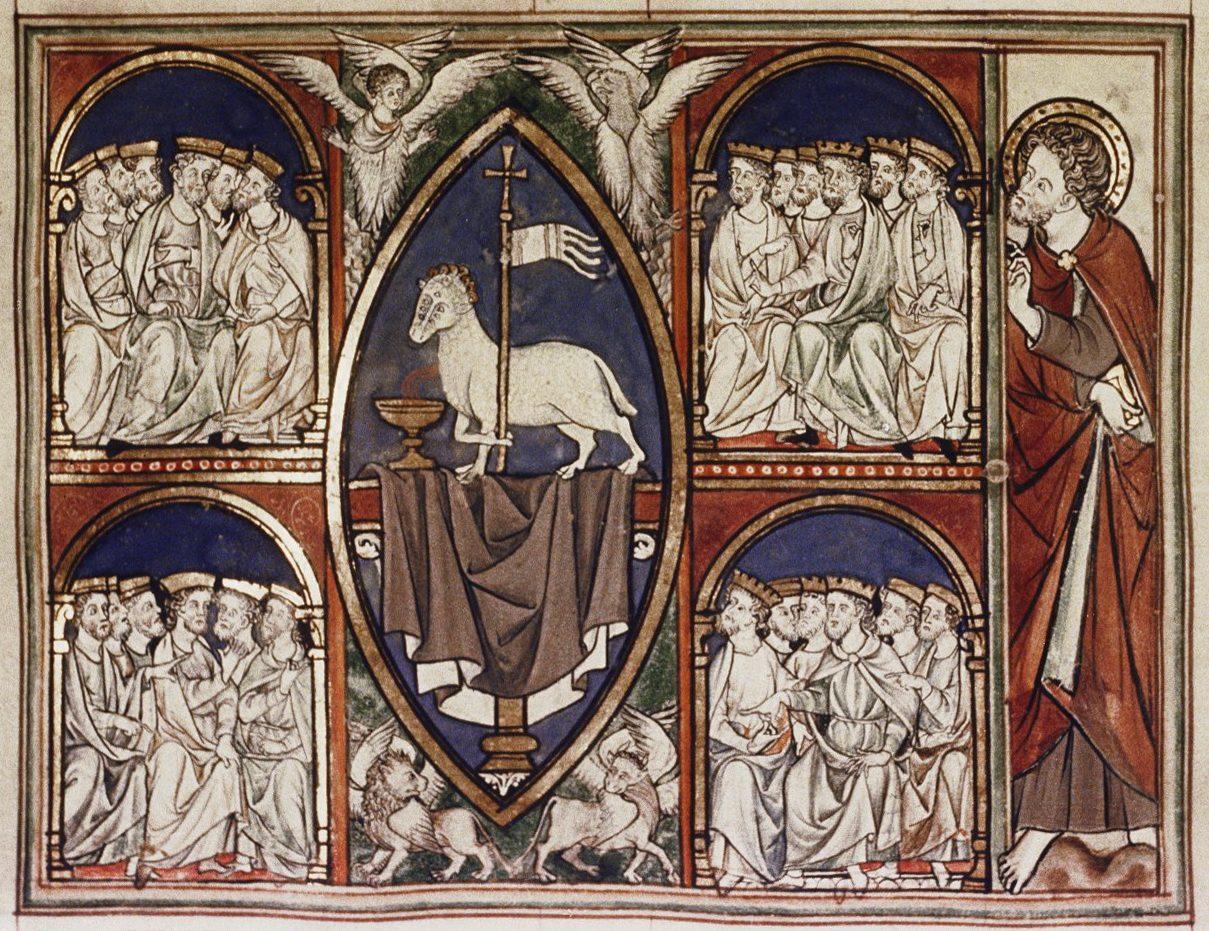
Unknown English illuminator, The Lamb Enthroned, about 1265. Public domain.
Zechariah 3:9, Zechariah 4:10 and Revelation 5:6 · Passage · Featured Study
The Seven Eyes of Zechariah 3:9 and Zechariah 4:10
Two visions of Zechariah and one vision of John share the number seven.
For who has despised the day of small things? But these seven eyes of the LORD, which scan the whole earth, will rejoice when they see the plumb line in the hand of Zerubbabel.”
- The passage
- Zechariah 3:8 to 10, Zechariah 4:1 to 10, Revelation 5:6
- Books
- Zechariah, Revelation
- When
- the twenty-fourth day of the eleventh month, in the second year of Darius
- Hold in memory
- Zechariah 4:10
The commentator Keil read the seven eyes of the stone, of the LORD and of the Lamb as one Spirit shining sevenfold.
Summary
Zechariah 3:9 and Zechariah 4:10 speak of seven eyes, and the angel calls them the eyes of the LORD. Readers have asked what the stone that bears them stands for.
- Zechariah saw the stone in a vision dated to the second year of Darius.
- Bonaventure set the eyes of the Lamb beside the stone of Zechariah.
- John Calvin read the number seven as a sign of perfection.
The Stone Before Joshua
The stone belongs to the vision of the high priest in Zechariah 3.
See the stone I have set before Joshua; on that one stone are seven eyes. Behold, I will engrave on it an inscription, declares the LORD of Hosts, and I will remove the iniquity of this land in a single day.The verse joins the eyes to a promise of cleansing for the whole land.
The Eyes of the LORD in Four Texts
Chronicles speaks of the eyes of the LORD, and Revelation of the eyes of the Lamb.
The eyes of the LORD go through the whole earth, and in Zechariah 3:9 they rest on one stone.
| Text | Whose eyes | Where they are |
|---|---|---|
| Zechariah 3:9 names the stone before Joshua | Seven eyes | On one stone |
| Zechariah 4:10 closes the vision of the lampstand | The seven eyes of the LORD | Over the whole earth |
| 2 Chronicles 16:9 speaks of hearts devoted to Him | The eyes of the LORD | Over all the earth |
| Revelation 5:6 shows the Lamb before the throne | The seven eyes of the Lamb | Sent into all the earth |
Seven as Perfection
John Calvin read the number of the eyes in both verses of Zechariah.
On Zechariah 4:10, Calvin wrote that God has no need of seven eyes, and that the number seven in Scripture signifies perfection. On Zechariah 3:9 he set aside as childish the reading that makes the eyes seven graces of the Spirit.
The Lampstand and Its Seven Lamps
Zechariah 4 opens with a gold lampstand, and the eyes of the LORD come at its end.
“What do you see?” he asked. “I see a solid gold lampstand,” I replied, “with a bowl at the top and seven lamps on it, with seven spouts to the lamps.What the Verses Leave Unsaid
The verse of the stone leaves the words of its inscription and the day of cleansing unstated.
The LORD promises to engrave the stone, and the verse does not give the words He will cut.
It names no date for the single day on which the LORD will remove the land's iniquity.
The Lamb with Seven Eyes
Revelation gives the eyes to the Lamb who was slain.
Then I saw a Lamb who appeared to have been slain, standing in the center of the throne, encircled by the four living creatures and the elders. The Lamb had seven horns and seven eyes, which represent the seven Spirits of God sent out into all the earth.John carries Zechariah's image into the vision of the throne.
From the throne came flashes of lightning, and rumblings, and peals of thunder. Before the throne burned seven torches of fire. These are the seven Spirits of God.This earlier verse pictures the seven Spirits as torches, so John uses two pictures for the one Spirit.
The same line runs through a medieval reading of the days of creation.
“These are the ‘seven eyes’ of the Lamb, and the ‘seven facets’ of the stone mentioned by Zachary, and the seven days that followed upon the first light. These Centers are the ‘seven golden lamp-stands,’ and Christ ‘in the midst of the seven lamp-stands,’ which …”
Bonaventure · Collations on the Hexaemeron, Collation 1 · on Zechariah 3:9Patristic
What Is the Stone with Seven Eyes?
Readers have taken the stone in two ways, each with its holders and an objection.
Christ, the living StoneJohn Wesley, Explanatory Notes upon the Old Testament (1765); E. B. Pusey, The Minor Prophets with a Commentary (1907 reprint)
Wesley held that the seven eyes, placed to look many ways, made the stone a more exact emblem of Christ and of his perfect knowledge and wisdom. Pusey pictured Christ as the living Stone who sees all things.
The objection: C. F. Keil held that the eyes are turned toward the stone and guard it, which leaves the stone without eyes of its own.
The foundation stone of the templeRashi, as E. B. Pusey reports him on Zechariah 3:9
Rashi, the medieval Jewish commentator, took it for the stone laid at the founding of the temple.
The objection: Pusey answered that the foundation had been laid long before, while the verse speaks of what God will still do.
By My Spirit
So he said to me, “This is the word of the LORD to Zerubbabel: Not by might nor by power, but by My Spirit, says the LORD of Hosts.The word to Zerubbabel stands in the same vision as the seven eyes that rejoice at his work.
Sources
Scripture is the Berean Standard Bible.
- John Wesley, Explanatory Notes upon the Old Testament (1765), on Zechariah 3:9.
- Bonaventure, Collations on the Hexaemeron, Collation 1.
- E. B. Pusey, The Minor Prophets with a Commentary, vol. viii, Zechariah (Nisbet, 1907 reprint), on Zechariah 3:9; public domain.
- C. F. Keil, Biblical Commentary on the Old Testament: The Twelve Minor Prophets, vol. 2 (T. and T. Clark, 1878), on Zechariah 3:9, pp. 260 to 261; public domain.
- John Calvin, Commentaries on the Twelve Minor Prophets, vol. 5, translated by John Owen for the Calvin Translation Society, on Zechariah 3:9 and 4:10; public domain.
Keep Studying
Read it4
Studies1
Doctrines2
People and groups3
Symbols1
Go further4