
Joshua 7 · Person · Featured Study
Achan
Joshua 7 is the one chapter that tells Achan's story, from the theft at Jericho to his death.
Achan is the man of Judah whose hidden plunder Joshua 7 names as the reason Israel fled before the men of Ai.
- Died
- in the Valley of Achor, after the fall of Jericho
- Family
- father: Carmi; grandfather: Zabdi; ancestor: Zerah; ancestor: Judah; children: his sons and daughters
- Places
- Gilgal, Jericho, Ai
- First named
- Joshua 7:1
- Last named
- 1 Chronicles 2:7
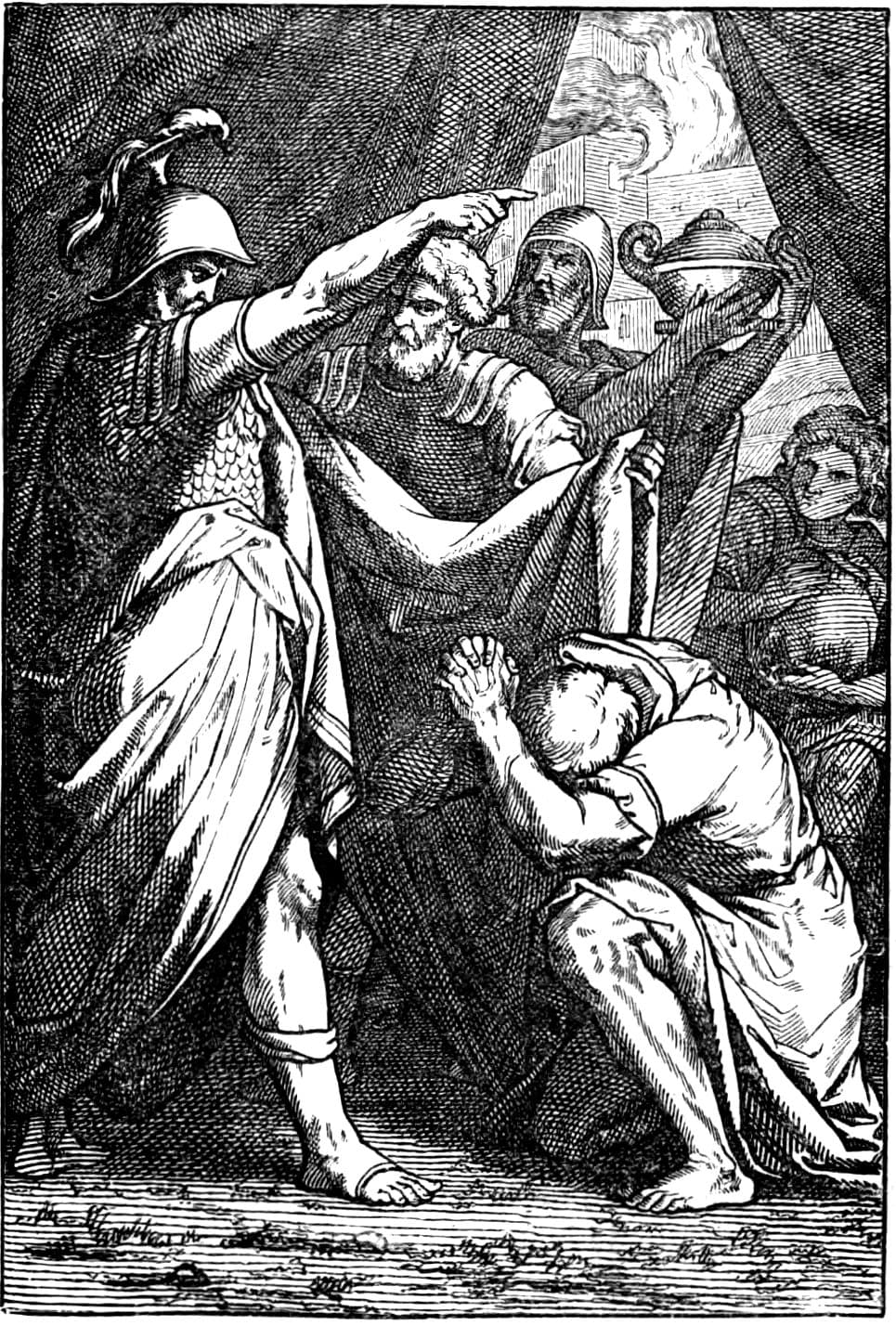
Charles Foster, engraving of Joshua and Achan, Story of the Bible in Pictures, Hartford, 1873. Public domain (PD-1923), Wikimedia Commons file Achan,_tell_me_what_thou_hast_done.jpg.
THE ARTWORKFoster drew the moment of Joshua 7:19 to 23, when the goods taken from Jericho are brought out of the tent and Achan kneels with his head bowed. The engraving stands here because the cloak and the vessel held up in it are the plunder the chapter turns on.
Summary
Achan took a cloak, silver and gold from the plunder of Jericho that God had claimed for Himself, and he hid them in the ground inside his tent.
- The LORD told Joshua that Israel had sinned and could not stand against its enemies until the devoted things were removed.
- The tribe that the LORD selected came forward clan by clan, family by family and man by man, until Achan was selected, and he confessed.
- All Israel stoned him in the Valley of Achor and heaped a large pile of rocks over him.
- Hosea 2:15 takes up the same valley again in a promise to Israel.
Where Achan Stands in Scripture
Joshua 7:1 opens the account, and two later verses look back on him.
The Israelites, however, acted unfaithfully regarding the things devoted to destruction. Achan son of Carmi, the son of Zabdi, the son of Zerah, of the tribe of Judah, took some of what was set apart. So the anger of the LORD burned against the Israelites.The verse names his line back to Judah and charges his act to all the Israelites before the battle at Ai is told.
Was not Achan son of Zerah unfaithful regarding what was set apart for destruction, bringing wrath upon the whole congregation of Israel? Yet it was not only Achan who perished because of his sin!’”Phinehas and the ten chiefs of Israel recall him as a warning to the tribes east of the Jordan.
The son of Carmi: Achar, who brought trouble upon Israel by violating the ban on devoted things.The Chronicler keeps him in the genealogy of Judah under the spelling Achar.
Joshua 6 to 8, Turn by Turn
The turns run from the ban on Jericho to the plunder Israel was allowed to keep at Ai.
- Jericho and everything in it are devoted to the LORDthe seventh day at JerichoJoshua 6:17
- Achan takes some of what was set apartthe text names no dayJoshua 7:1
- Joshua sends men from Jericho to spy out Aiafter JerichoJoshua 7:2
- About three thousand men go up and fleethe gate of AiJoshua 7:4
- About thirty-six fall, and the people's hearts meltthe slopes below AiJoshua 7:5
- Joshua and the elders lie facedown before the arkuntil eveningJoshua 7:6
- The LORD tells Joshua that Israel has sinnedbefore the arkJoshua 7:10 to 11
- Judah, the Zerahites, Zabdi and Achan are selectedearly the next morningJoshua 7:16 to 18
- Achan confesses, and the goods are found in his tentthe campJoshua 7:20 to 22
- Achan is stoned and a pile of rocks is heaped over himthe Valley of AchorJoshua 7:25 to 26
- Israel takes the cattle and plunder of Ai as the LORD commandedAiJoshua 8:27
The timeline draws eleven turns in the order Joshua 6 to 8 tells them, each with its verse.
What Happened Between Jericho and Ai
Joshua 7 runs from the theft to the stoning in the Valley of Achor.
Joshua learns of the theft only when the LORD speaks to him in Joshua 7:10 to 11.
The ban on JerichoJoshua 6:17 to 24
But keep away from the things devoted to destruction, lest you yourself be set apart for destruction. If you take any of these, you will set apart the camp of Israel for destruction and bring disaster upon it. For all the silver and gold and all the articles of bronze and iron are holy to the LORD; they must go into His treasury.”Joshua gave this warning to all the people before the city fell, so no one could take the goods unaware of the ban.
Then the Israelites burned up the city and everything in it. However, they put the silver and gold and articles of bronze and iron into the treasury of the LORD’s house.The verse shows the ban kept by everyone else at Jericho, which sets Achan's theft apart as one man's act.
The defeat at AiJoshua 7:2 to 5
On returning to Joshua, they reported, “There is no need to send all the people; two or three thousand men are enough to go up and attack Ai. Since the people of Ai are so few, you need not wear out all our people there.”The advice measured the task by the size of the town, while the cause of the defeat lay in the camp.
And the men of Ai struck down about thirty-six of them, chasing them from the gate as far as the quarries and striking them down on the slopes. So the hearts of the people melted and became like water.Israel's hearts now melt as the hearts of the Canaanites melted in Joshua 2:11 and Joshua 5:1.
Albert Barnes, in his Notes on the Old Testament, reads the small number of dead as a sign that the men fled early, probably without real fighting.
Joshua's lament and the LORD's answerJoshua 7:6 to 15
“O, Lord GOD,” Joshua said, “why did You ever bring this people across the Jordan to deliver us into the hand of the Amorites to be destroyed? If only we had been content to stay on the other side of the Jordan!Joshua asks why God brought the people across the Jordan at all, which shows he did not yet know the cause.
Israel has sinned; they have transgressed My covenant that I commanded them, and they have taken some of what was devoted to destruction. Indeed, they have stolen and lied, and they have put these things with their own possessions. This is why the Israelites cannot stand against their enemies. They will turn their backs and run from their enemies, because they themselves have been set apart for destruction. I will no longer be with you unless you remove from among you whatever is devoted to destruction.The LORD names the cause as theft and lying in the camp, and He makes His presence with Israel depend on its removal.
The one who is caught with the things devoted to destruction must be burned, along with all that belongs to him, because he has transgressed the covenant of the LORD and committed an outrage in Israel.’”The sentence of burning covers the guilty man and all that belongs to him, and the question of his household turns on these words.
The selection and the confessionJoshua 7:16 to 23
So Joshua said to Achan, “My son, give glory to the LORD, the God of Israel, and make a confession to Him. I urge you to tell me what you have done; do not hide it from me.”The appeal comes after the selection and before the sentence, so Achan is given room to speak.
“It is true,” Achan replied, “I have sinned against the LORD, the God of Israel. This is what I did: When I saw among the spoils a beautiful cloak from Shinar, two hundred shekels of silver, and a bar of gold weighing fifty shekels, I coveted them and took them. They are hidden in the ground inside my tent, with the silver underneath.”Achan's own words trace the sin from what he saw to what he coveted, took and buried.
So Joshua sent messengers who ran to the tent, and there it all was, hidden in his tent, with the silver underneath. They took the things from inside the tent, brought them to Joshua and all the Israelites, and spread them out before the LORD.The goods were found where Achan said, so his confession was proved before all Israel.
The stoning and the pile of rocksJoshua 7:24 to 26
Then Joshua, together with all Israel, took Achan son of Zerah, the silver, the cloak, the bar of gold, his sons and daughters, his oxen and donkeys and sheep, his tent, and everything else he owned, and brought them to the Valley of Achor. “Why have you brought this trouble upon us?” said Joshua. “Today the LORD will bring trouble upon you!” And all Israel stoned him to death. Then they stoned the others and burned their bodies.Joshua's words make the sentence answer the harm done to all Israel, and the whole people carry it out.
And they heaped over Achan a large pile of rocks that remains to this day. So the LORD turned from His burning anger. Therefore that place is called the Valley of Achor to this day.The pile of rocks and the LORD's turning from His anger close the account of the sin at Jericho.
What Achan Took
Achan's own words in Joshua 7:21 are the inventory of the theft.
Achan hid two hundred shekels of silver and a bar of gold of fifty shekels.
The 2 shekels as a table
| What he took | Shekels | Where it was hidden | Verse |
|---|---|---|---|
| Silver | 200 | underneath the other goods | Joshua 7:21 |
| A bar of gold | 50 | in the ground inside his tent | Joshua 7:21 |
The bar row draws the two weights Joshua 7:21 gives, in shekels; the verse gives no weight for the cloak.
Albert Barnes, in his Notes on the Old Testament, takes the cloak from Shinar for a long robe of the kind kings wore on state occasions. He notes that the Assyrians were famous in early times for dyed and richly embroidered robes.
His kingdom began in Babylon, Erech, Accad, and Calneh, in the land of Shinar.The verse sets Babylon in the land of Shinar, so the cloak came from the plain of Babylon.
The word for a devoted thingHebrew cherem, Strong's H2764
Joshua 6 and 7 use the Hebrew noun cherem, Strong's H2764, which Strong's lexicon defines as usually a doomed object. Albert Barnes, on Joshua 6:17, explains that Jericho, the first Canaanite city taken, was devoted to God as first-fruits, and its goods that could not be destroyed went into the treasury of the sanctuary.
Nothing devoted to destruction shall cling to your hands, so that the LORD will turn from His fierce anger, grant you mercy, show you compassion, and multiply you as He swore to your fathers,The law of devoted things promises that the LORD will turn from His fierce anger when nothing devoted clings to Israel's hands, and Joshua 7:26 records that He turned from His burning anger.
How the sin grewJohn Wesley on Joshua 7:21
John Wesley, in his Explanatory Notes upon the Old Testament, traces the sin in the order of Achan's words. It began at his eye, the gazing inflamed his desire, the desire made him take the goods, and having taken them he resolved to keep them and hid them in his tent.
Josephus on the garment and the burialAntiquities of the Jews 5.1.10 to 14
Flavius Josephus, in his Antiquities of the Jews, says the man found a royal garment woven entirely of gold. In his telling the man thought it hard to give to God, who needed nothing, what he had found at his own risk. So he dug a deep ditch in his tent and hid the goods there.
Josephus adds that after the lot found him he was put to death and buried at night in a disgraceful manner. William Whiston, his translator of 1737, notes that words have dropped out of Josephus's copies. The text should read a piece of gold of fifty shekels and one of silver of two hundred, as Joshua 7:21 has them.
Achan's Line and the Four Rounds of Selection
The selection of Joshua 7:16 to 18 came down his line from Judah, and it passed over only his father Carmi.
Generation 1
- Judahson of Jacob and Leah and head of the tribe; round one, tribe by tribe, selects the tribe of Judah (Joshua 7:16)
Generation 2
Generation 3
- Zabdinamed as Achan's grandfather in Joshua 7:1 and Joshua 7:18; round three, family by family, selects the family of Zabdi (Joshua 7:17)
Generation 4
- CarmiAchan's father, named in Joshua 7:18 and 1 Chronicles 2:7; the selection passes from Zabdi's family to its men, so no round falls on him
Generation 5
- Achanround four, man by man, selects Achan son of Carmi (Joshua 7:18), and he confesses when Joshua urges him in Joshua 7:19
Generation 6
- His sons and daughtersbrought with him, his cattle and his tent to the Valley of Achor (Joshua 7:24); Scripture gives none of their names
The tree draws six generations from Judah to Achan's children, with the round of selection beside each name it fell on.
The Places of Joshua 7
Five places stand in the account, from the camp at Gilgal to the valley of the stoning.
- Located: the site is known
- Proposed: one candidate among several
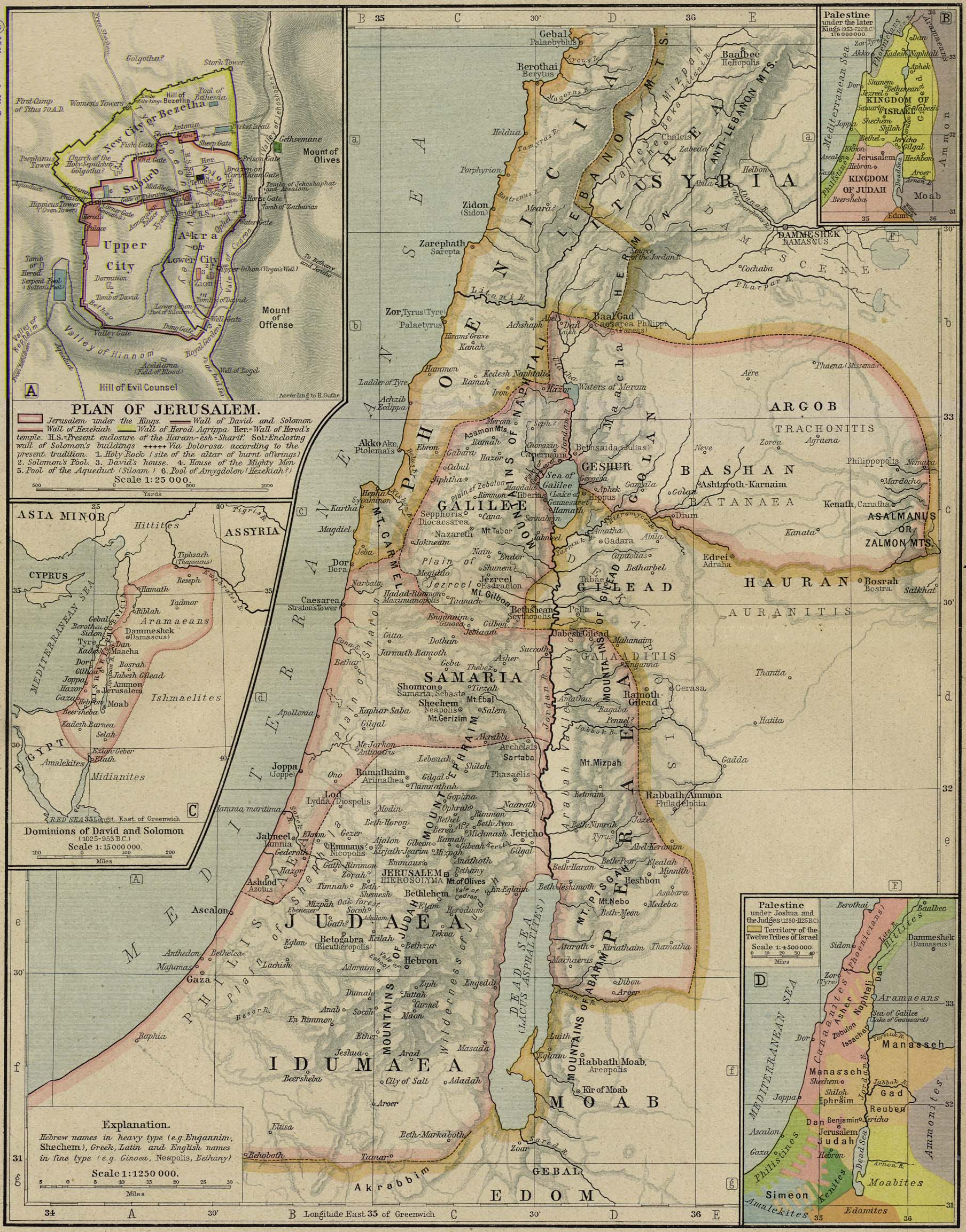
about 50 km (31 miles)
- 1Gilgal, Israel's camp on the plains of Jericho after the crossing of the Jordan. Joshua 5:10
- 2Jericho, The city whose plunder Achan took and hid. Joshua 7:1
- 3Bethel, Ai lay near Beth-aven, to the east of Bethel. Joshua 7:2
- 4Ai, About thirty-six Israelites fell on the slopes below its gate. Joshua 7:5
- 5The Valley of Achor, Where Achan was buried. Joshua 7:26
Not placed: The Valley of Achor (5).
Base map: Reference map of ancient Palestine, Rand McNally reference map (1926), public domain. Each place stands at its place page's coordinates, set on the plate by Jerusalem and Damascus, as the plate prints them.
Four places are marked on the plate, and the key also names the Valley of Achor, whose site is not fixed.
Questions Joshua 7 Raises
Readers ask five questions of the chapter, and the commentators answer each.
Why was all Israel charged with one man's sin?Albert Barnes, Origen, John Calvin
The chapter charges the whole people in Joshua 7:1 and again in Joshua 7:11, though the selection finds one man. Albert Barnes, in his Notes on the Old Testament, calls the trespass the act of one man imputed to all Israel, who also shared its penalty.
Origen, preaching on Joshua about 253, asks how so small a theft could defile the whole people.
“But also we should not let it be passed over without comment that by one sinner wrath comes upon all the people.…But let us also see what sort of sin this person did. He stole, it says, ‘a tongue of gold’ and placed it in his own tent. I do not think so great a force of sin was in that theft of a little gold that it defiled the innumerable church of the Lord. But let us see if a deeper understanding does not reveal the enormity and severity of the sin.”
Origen of Alexandria · Homilies on Joshua 7.6-7 · on Joshua 7:1Patristic
John Calvin finds the same oneness of the people in the promise of Joshua 8:1.
“The first place, however, is due to the promise, Fear not, for I have delivered it into thy hands: for although it is verbally directed to Joshua, it belongs in common to the whole people, as it was most necessary that all to a man should be freed from anxiety and furnished with new confidence.”
John Calvin · Commentaries · on Joshua 8:1Reformed
How was the choice made?Rashi, Adam Clarke, John Gill
In the morning you must present yourselves tribe by tribe. The tribe that the LORD selects shall come forward clan by clan, and the clan that the LORD selects shall come forward family by family, and the family that the LORD selects shall come forward man by man.The verse leaves the means of choosing to the LORD and names no stone or lot by which it was read.
Rashi, in his commentary on Joshua, says Joshua brought the tribes before the high priest's breastplate, which bore their names, and the stone of Judah faded. Adam Clarke reports the same Jewish view and links it with the Urim and Thummim, while John Gill allows either the dimmed stone or a lot cast on the tribe.
Why did Achan wait to confess?Matthew Henry, Rashi, Adam Clarke
Matthew Henry marks how near the selection came before Achan spoke.
“It was strange that Achan, being conscious to himself of guilt, when he saw the lot come nearer and nearer to him, had not either the wit to make an escape or the grace to make a confession; but his heart was hardened through the deceitfulness of sin, and it proved to be to his own destruction.”
Matthew Henry · Commentary on the Whole Bible · on Joshua 7:18Puritan
Rashi records a reading in which Achan first disputed the casting of lots. He then confessed when he saw the men of Judah gathering to defend him, judging it better that he alone should die than many thousands.
Adam Clarke calls the words of Joshua 7:20 an honest and hearty confession, and he hopes that Achan escaped perdition.
Was his name Achan or Achar?Adam Clarke, Albert Barnes, Josephus
Joshua writes Achan, Strong's H5912, and 1 Chronicles 2:7 writes Achar, Strong's H5917. The second form sounds like akar, to trouble, Strong's H5916, the verb Joshua speaks in Joshua 7:25.
Adam Clarke notes that the verse plays on Achar and calls the place the Valley of Achor, and that some have taken Achar for his proper name, as some manuscripts and ancient versions read. Albert Barnes holds that Achan became Achar in Chronicles to bring the name nearer the word for troubler. Josephus also writes Achar.
Why could Israel keep the plunder of Ai?Joshua 8:2 and Joshua 8:27; Adam Clarke
And you shall do to Ai and its king as you did to Jericho and its king, except that you may carry off their plunder and livestock for yourselves. Set up an ambush behind the city.”The LORD allows Israel to carry off the plunder and livestock of Ai, which the ban on Jericho had forbidden.
Israel took for themselves only the cattle and plunder of that city, as the LORD had commanded Joshua.The verse closes the account of Ai with Israel keeping its spoil in the open, where Achan had buried his.
Adam Clarke, on Joshua 8:27, explains that Jericho's goods were consigned to destruction, while the cattle and spoil of Ai were expressly given to the conquerors by the order of God.
What the Text Leaves Unsaid
Scripture leaves three things about Achan untold.
Joshua 7 does not say when Achan took the goods or how old he was.
Joshua 7:1 names his grandfather Zabdi, where 1 Chronicles 2:6 lists a Zimri among the sons of Zerah, and Scripture does not say whether the two names belong to one man.
The Valley of Achor, a Gateway of Hope
The valley of the stoning returns in the promises of Isaiah 65 and Hosea 2.
There I will give back her vineyards and make the Valley of Achor into a gateway of hope. There she will respond as she did in the days of her youth, as in the day she came up out of Egypt.God's tender words to Israel in Hosea 2:14 lead to this verse, where the valley of Achan's judgment becomes the opening of her return.
Matthew Henry draws from the valley's name a lesson on sorrow for sin.
“Or, if the allusion be to the name, it intimates that trouble for sin, if it be sincere, opens a door of hope; for that sin which truly troubles us shall not ruin us. The valley of Achor was a very fruitful pleasant valley, some think the same with the valley of Engedi, famous for vineyards, Cant. i.”
Matthew Henry · Commentary on the Whole Bible · on Hosea 2:15Puritan
The valley on the border of JudahJoshua 15:7
Then the border went up to Debir from the Valley of Achor, turning north to Gilgal, which faces the Ascent of Adummim south of the ravine. It continued along the waters of En-shemesh and came out at En-rogel.The valley served as a landmark on the border of Judah, so it was a place people could still find.
The valley in Isaiah's promiseIsaiah 65:10
Sharon will become a pasture for flocks, and the Valley of Achor a resting place for herds, for My people who seek Me.Isaiah turns the place of judgment into pasture, the reverse of its first use in Joshua 7, and he too speaks to Israel.
Voices on Joshua 7
Achan's story has served Christian teachers as a warning since the fourth century.
Ambrose of Milan finds the love of money in Achan, and Matthew Henry finds the pattern of confession in Joshua's charge to him.
“But human habits have so long applied themselves to this admiration of money that no one is thought worthy of honor unless he is rich. This is no new habit. No, this vice (and that makes the matter worse) grew long years ago in human hearts. When the city of Jericho fell at the sound of the priests' trumpets and Joshua the son of Nun gained the victory, he knew that the valor of the people was weakened through love of money and desire for gold.”
Ambrose of Milan · On the Duties of the Clergy 2.26.129 · on Joshua 7:20 to 21Patristic
“Note, In confessing sin, as we take shame to ourselves, so we give glory to God as righteous God, owning him justly displeased with us, and as a good God, who will not improve our confessions as evidences against us, but is faithful and just to forgive when we are brought to own that he would be faithful and just if he should punish.”
Matthew Henry · Commentary on the Whole Bible · on Joshua 7:19Puritan
Why Were His Sons and Daughters Taken?
Joshua 7:24 names them, and readers divide over whether they shared the sin.
Fathers shall not be put to death for their children, nor children for their fathers; each is to die for his own sin.The law forbids putting children to death for a father's sin, so every reading of Joshua 7:24 to 25 has to answer it.
They knew of the hiding place and shared the guiltJohn Wesley, Explanatory Notes upon the Old Testament, 1765
John Wesley answers the objection that some of the children were infants.
“If it be pretended that some of them were infants; the text doth not say so, but only calls them sons and daughters. And considering that Achan was an old man, as is most probable, because he was the fifth person from Judah, it seems most likely, that the children were grown up, and so capable of knowing, and concealing, or discovering this fact.”
John Wesley · Explanatory Notes upon the Old Testament · on Joshua 7:24Evangelical
The text records nothing the children did or knew.
They were brought to see the judgmentAdam Clarke, Commentary on the Bible, 1832
Adam Clarke, in his Commentary on the Bible, holds that Achan's cattle and goods were brought to the valley to be consumed. His sons and daughters, Clarke says, were probably brought to witness the judgment on their father.
Joshua 7:25 says they stoned the others after Achan, and Joshua 22:20 says that Achan was not the only one who perished because of his sin.
God gave His own order in this caseMatthew Henry, Commentary on the Whole Bible, 1710
Matthew Henry answers Deuteronomy 24:16 by saying that God gave that law to bind judges and did not bind Himself by it, and that in this case He had given an express order.
The order he appeals to in Joshua 7:15 does not name the children.
Books to Read Next
Five works from the first century to the eighteenth read Joshua 7 closely.
Antiquities of the Jews
Flavius Josephus, translated by William Whiston · 1737
Josephus retells the theft, the lot and the burial in the first chapter of his fifth book.
Read it free at Project GutenbergHomilies on Joshua
Origen of Alexandria · about 253
The homilies read Joshua as a book about the church, and the seventh turns on Achan.
On the Duties of the Clergy
Ambrose of Milan · 397
Ambrose sets Achan among his examples of the love of money.
Commentary on the Whole Bible
Matthew Henry · 1710
Henry follows Joshua 7 verse by verse, from the defeat at Ai to the pile of rocks.
Explanatory Notes upon the Old Testament
John Wesley · 1765
Wesley's notes on Joshua 7 are brief and take up the household of Achan.
Give Glory to the LORD
In Joshua 7:19 Joshua calls Achan his son and urges him to give glory to the LORD and make a confession to Him. Acts 5:1 to 11 tells how Ananias and Sapphira kept back part of the price of their land and lied to the Holy Spirit, and great fear came over the whole church.
Jamieson, Fausset & Brown, on Acts 5:11, set that judgment beside Achan's, each at the start of a new course for God's people. John writes in 1 John 1:9 that if we confess our sins, He is faithful and just to forgive us. In 1 John 1:7 he writes that the blood of Jesus His Son cleanses us from all sin.
Joshua 7 asks the reader to bring what is hidden before God and confess it.
Keep studying
Peoples and groups1