
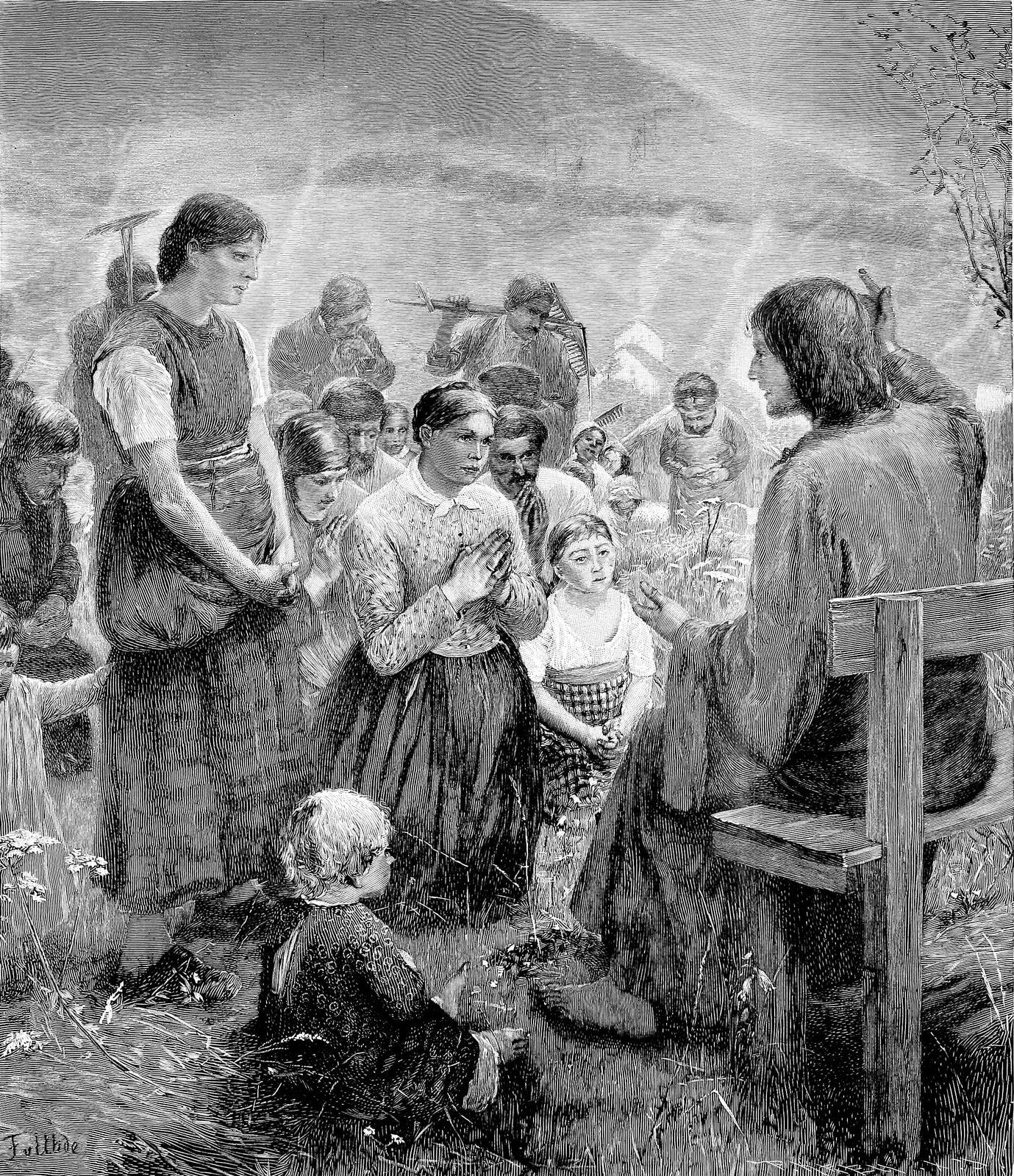
Fritz von Uhde, Die Bergpredigt, 1887. Public domain.
Luke 6:17 to 49 · Passage · Featured Study
The Sermon on the Plain
The sermon in Luke 6 asks the disciples to love their enemies and to show mercy.
Jesus looked up at His disciples and called the poor blessed.
Be merciful, just as your Father is merciful.
- The passage
- Luke 6:17 to 49
- Book
- Luke
Summary
The Sermon on the Plain is the teaching Jesus gave in Luke 6:20 to 49, on the day He chose the twelve apostles. It runs from blessings and woes to a parable of two builders.
- The commands include the rule of doing to others as you would have them do to you (Luke 6:31).
- Its commands rest on the kindness of the Most High to the ungrateful and wicked (Luke 6:35).
- Readers differ over whether Luke and Matthew report one sermon or two.
Down to a Level Place
The setting of the sermon gives it its name.
Then Jesus came down with them and stood on a level place. A large crowd of His disciples was there, along with a great number of people from all over Judea, Jerusalem, and the seacoast of Tyre and Sidon.This verse sets the scene for all that follows.
Power was coming from Jesus and healing them all, so the whole crowd was trying to touch Him (Luke 6:19).
Four Blessings and Four Woes
The sermon opens with four blessings and four woes.
The poor, the hungry, the weeping and the hated are blessed, and their opposites hear woe.
| Pair | Blessed are | Woe to |
|---|---|---|
| First | you who are poor | you who are rich |
| Second | you who hunger now | you who are well fed now |
| Third | you who weep now | you who laugh now |
| Fourth | when people hate you | when all men speak well of you |
Matthew's blessings name the poor in spirit and those who hunger and thirst for righteousness (Matthew 5:3 and Matthew 5:6). Luke's name the poor and those who hunger now. Jamieson, Fausset and Brown linked Luke's form to James, who calls the poor of this world rich in faith (James 2:5).
Bede explained why the woes stand here. On the mountain, he wrote, the Lord gave only blessings to the perfect, and on the plain He added woes for hearers who had to be turned by fear.
Love Your Enemies
Jesus asks for a love that expects nothing in return.
But to those of you who will listen, I say: Love your enemies, do good to those who hate you, bless those who curse you, pray for those who mistreat you.These two verses give the commands that the rest of the section explains.
Jesus then asked what credit there is in loving those who love you, since even sinners do the same (Luke 6:32). John Wesley noted that returning love for love does not, in this saying, even deserve thanks.
The Blind Guide and the Good Tree
A short parable and the sayings after it warn the disciples about teachers and about the heart.
Jesus asked whether a blind man can lead a blind man (Luke 6:39). He warned against the speck in a brother's eye and the beam in one's own.
The good man brings good things out of the good treasure of his heart, and the evil man brings evil things out of the evil treasure of his heart. For out of the overflow of the heart, the mouth speaks.This saying gives the reason a tree is known by its fruit.
The Measure Pressed Down
A picture from the grain market closes the commands on mercy.
Jesus told His hearers not to judge or condemn, and to forgive (Luke 6:37).
Give, and it will be given to you. A good measure, pressed down, shaken together, and running over will be poured into your lap. For with the measure you use, it will be measured back to you.”The verse holds the sermon's promise to those who give.
Theophylact explained the picture from the way meal is measured when no one wants to spare it.
One Sermon or Two?
Luke's sermon opens and closes like Matthew's, but Matthew sets it on a mountain and Luke on a level place.
One sermon, given on the mountain's level groundAugustine of Hippo, The Harmony of the Gospels, Book 2, chapter 19
Augustine noted that both sermons begin with the poor and end with the builders on rock and sand. He proposed that Jesus first stood with the disciples alone on a higher part of the mountain. Then He came down to level ground on its side, which could hold the crowds, and gave the same sermon there.
The objection: Luke places the choosing of the Twelve before the sermon, while Matthew does not name the Twelve until chapter 10.
One sermon, the same in substanceAdam Clarke, Commentary on the Bible (1832), on Luke 6:17; John Gill, Exposition of the New Testament (1746 to 1748)
Adam Clarke took Luke's sermon to be the same in substance as Matthew's. He saw no conflict between Matthew's Jesus seated on the mountain and Luke's Jesus standing on the plain to heal before He spoke. John Gill took the plain to be a lower, level part of the mountain itself.
The objection: Luke has four woes that Matthew's sermon lacks, and Luke's sermon runs to 30 verses where Matthew's fills three chapters.
The same lesson taught on another dayJ. C. Ryle, Expository Thoughts on the Gospels: Luke (1858), on Luke 6:20 to 26
J. C. Ryle held that the occasions of the two sermons were entirely different. He saw nothing unusual in Jesus repeating the same lesson in almost the same words.
The objection: the two sermons begin and end alike and stand at the same point in Jesus' early ministry, just before He enters Capernaum and heals a centurion's servant (Matthew 8:5 and Luke 7:1).
The Two Builders
The sermon ends with a parable about hearing and doing.
Jesus asked why His hearers called Him Lord but did not do what He said (Luke 6:46). John Calvin read the question as a general reproof to all who claim to be disciples.
He is like a man building a house, who dug down deep and laid his foundation on the rock. When the flood came, the torrent crashed against that house but could not shake it, because it was well built.The verse gives Luke's picture of the hearer who obeys.
In Matthew the foolish man builds on sand (Matthew 7:26). Luke's second builder skips the digging altogether (Luke 6:49).
Sources
Scripture is the Berean Standard Bible.
- Bede (735), on Luke 6:26, in Thomas Aquinas, Catena Aurea (1264)
- Robert Jamieson, A. R. Fausset and David Brown, Commentary Critical and Explanatory on the Whole Bible (1871), on Luke 6:20.
- Augustine of Hippo, The Harmony of the Gospels, Book 2, chapter 19, in Thomas Aquinas, Catena Aurea (1264), on Luke 6:17 to 20.
- Adam Clarke, Commentary on the Bible (1832), on Luke 6:17.
- John Gill, Exposition of the New Testament (1746 to 1748), on Luke 6:17.
- J. C. Ryle, Expository Thoughts on the Gospels: Luke (1858), on Luke 6:20 to 26.
- John Wesley, Explanatory Notes upon the New Testament (1755), on Luke 6:32.
- Theophylact of Ohrid (1107), on Luke 6:37 to 38, in Thomas Aquinas, Catena Aurea (1264)
- John Calvin, Commentaries (1554), on Luke 6:46.
Keep Studying
People and groups1
Subjects1
Doctrines2
Go further9
Values1