
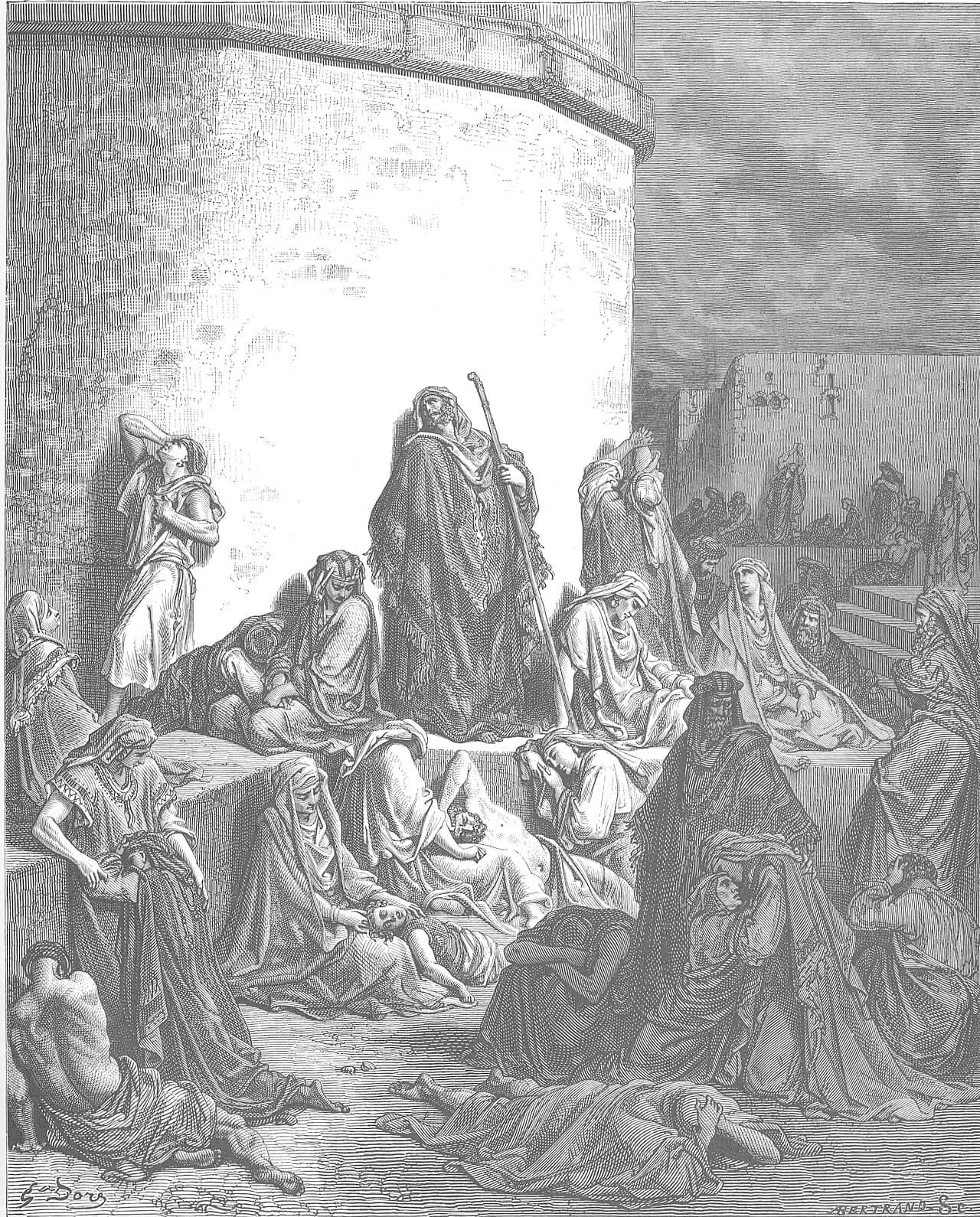
People Mourn over the Destruction of Jerusalem, Gustave Doré, 1866. Public domain.
Old Testament · Book 25 of 66
Lamentations
Lamentations is five poems of grief over the fall of Jerusalem to Babylon. The first four follow the order of the Hebrew alphabet, and the third holds the promise that the LORD's mercies are new every morning.
Lamentations is five poems of grief over the fall of Jerusalem to Babylon. The first four follow the order of the Hebrew alphabet, and the third holds the promise that the LORD's mercies are new every morning.
What is Lamentations about?
Five poems mourn Jerusalem after the army of Babylon has burned the city and the temple. The first shows the city as a widow with no one to comfort her. The second says the Lord Himself has acted as her enemy. In the third a man who has seen affliction remembers the LORD's loving devotion, and at the centre of the book he says His mercies are “new every morning” (3:23). The fourth looks back on the siege and the capture of the king, and the fifth is the survivors' prayer. Four poems follow the Hebrew alphabet, and the book teaches its readers to bring grief, confession and hope to God.
All 5 chapters
Every chapter of the book, in one grid. Each cell opens that chapter.
- The city aloneLamentations 1
- The LORD as enemyLamentations 2
- The man who has seen afflictionLamentations 3
- The gold grown dimLamentations 4
- Remember, O LORDLamentations 5
The colour is the poem, one to a chapter, from the slate of the empty city to the violet of the last prayer, and every cell opens that chapter's Study level.
Who wrote it, where, when, for whom, and why?
The book names no writer. Its voices are the poet who watches the city (1:1 to 11), the city herself speaking as a woman (1:12 to 22), a man who says he has seen affliction (3:1), and the whole people speaking as we (5:1 to 22). Outside the book, 2 Chronicles says that Jeremiah lamented over King Josiah and that laments were written in the Book of Laments (2 Chronicles 35:25).
I am the man who has seen affliction under the rod of God’s wrath.
Lamentations 3:1, Berean Standard Bible.
The poems stand in Jerusalem after its fall: the deserted gates and the roads to Zion that mourn (1:4), the sanctuary the nations have entered (1:10), the streets where children faint (2:11 and 12), the walls and ramparts (2:8), and Mount Zion lying desolate, patrolled by foxes (5:18). Edom, in the land of Uz, is named as the neighbour who rejoiced (4:21 and 22).
The book gives no year. It speaks after the city and the temple have fallen: the gates sunk into the ground, the king and princes exiled and no vision from the LORD (2:9), the famine of the siege (4:9 and 10), and the LORD's anointed captured (4:20). The history books date that fall to the eleventh year of King Zedekiah, when the army of Babylon burned the house of the LORD and broke down the walls (2 Kings 25:2 and 8 to 10).
The poems speak to the Daughter of Zion and for her (2:13, 4:22), and the last one is the prayer of those who survived in the ruined land, orphans and widows who buy their own water and wood and bear the punishment of their fathers (5:3, 5:4, 5:7).
The book calls its hearers to pour out their hearts like water in the presence of the Lord (2:19), to examine their ways and turn back to the LORD (3:40), and to ask Him to remember them (5:1). It owns the fall as the LORD's righteous act against a city that rebelled (1:18), and it holds to His loving devotion and faithfulness in the middle of the ruin (3:22 and 23).
Let us examine and test our ways, and turn back to the LORD.
Lamentations 3:40, Berean Standard Bible.
Sources. Lamentations 1:1 to 22, 1:4, 1:10, 1:18, 2:8, 2:9, 2:11 and 12, 2:13, 2:19, 3:1, 3:22 and 23, 3:40, 4:9 and 10, 4:20, 4:21 and 22, 5:1, 5:3, 5:4, 5:7 and 5:18; 2 Kings 25:2 and 8 to 10; 2 Chronicles 35:25. Every verse is read in the Berean Standard Bible.
How is Lamentations arranged, and what is it for?
The five poems, each one chapter, then what the book teaches and what it was written to do.
- The city aloneChapter 1. One verse to each letter, ayin before pe
Jerusalem sits as a widow with no one to comfort her, and then speaks for herself.
The turn, 1:12. The city stops the passer-by and asks whether any sorrow is like hers.
- The LORD as enemyChapter 2. One verse to each letter, pe before ayin
The Lord has thrown down His own city and sanctuary, and the children faint in the streets.
The turn, 2:5. The poem names the Lord Himself as the enemy who has swallowed Israel.
- The man who has seen afflictionChapter 3. Three verses to each letter, pe before ayin
One man tells of the rod, remembers, and finds hope in the LORD's mercies at the centre of the book.
The turn, 3:22 and 23. Out of the pit the man calls to mind the LORD's loving devotion and mercies new every morning.
- The gold grown dimChapter 4. One verse to each letter, pe before ayin
The siege remembered: the precious made worthless, the tender made cruel, the king taken.
The turn, 4:20. The LORD's anointed, the breath of the people's life, is captured.
- Remember, O LORDChapter 5. As many verses as letters, in no alphabetic order
The survivors pray together, list their losses, and ask the LORD to restore them.
The turn, 5:21. The prayer asks the LORD to restore His people to Himself and renew their days.
The theme
The city God chose has fallen, and the book says without softening that the LORD did it for her sin. It gives the grief its full voice, down to the children fainting in the streets. At its centre it holds a hope that does not deny any of that: the LORD's loving devotion keeps His people from being consumed, and He does not afflict willingly. Judgment owned and mercy trusted stand in the same poems.
The purpose
Lamentations was written to give the survivors words to mourn with before God. Its poems confess the sin that brought the fall, call the people back to the LORD, and end in a prayer that He will restore them. Its ordered form lets a community mourn together, and it is still read aloud on the ninth of Av and in Holy Week.
Grief given a shape, from aleph to tav
The ayin and pe rows, where poems 2, 3 and 4 set pe first. The hinge, 3:22 to 33.
The city alone, Lamentations 1
One verse to each letter, ayin before pe, and the pages the poem opens on.
The first poem opens on the city as a widow who was once great among the nations. She weeps in the night, her lovers and friends have betrayed her, Judah has gone into exile, the roads to Zion mourn and the gates stand deserted. The poet says the LORD brought this grief because of her many transgressions (1:5). Halfway through the city takes up her own voice. She calls to everyone who passes by to look and see whether any sorrow is like hers, confesses that the LORD is righteous and that she rebelled (1:18). Five times the poem says there is no one to comfort her.
Is this nothing to you, all you who pass by? Look around and see! Is there any sorrow like mine, which was inflicted on me, which the LORD made me suffer on the day of His fierce anger?
- Study
Lamentations 1the widow city, and her cry to all who pass byShow the summary and 3 pagesShow summary, 3 pagesHide the summary
The first of five poems over the fallen city, and an alphabetic acrostic, twenty-two stanzas, one for each letter of the Hebrew alphabet, grief ordered from aleph to tav. 'How lonely lies the city, once so full of people!' She that was great among the nations is become a widow, a forced laborer; she weeps sore in the night and her tears are on her cheeks, with none to comfort her among all her lovers. Judah's roads mourn because none come to the feasts. Halfway through, the city herself speaks and appeals to passers-by: 'Is this nothing to you, all you who pass by?' (1:12), and then confesses, 'The LORD is righteous, for I have rebelled against His command' (1:18).
On this chapter (3)
- Zion and Jerusalem
The city and the hill the poems mourn.
- The exile and return
How Judah went into exile and came back.
- Verse 1:12 on its own page
The verse with the commentators on it by era.
- Zion and Jerusalem
The limping line of the lament
How lonely lies the city, once so full of people!
Lamentations 1:1, the long line and then the short
I am the man who has seen affliction under the rod of God’s wrath.
Lamentations 3:1, the long line and then the short
Characters (3)
Who the poem names. A name with a page carries its door.
- The Daughter of Zion
The city spoken of as a woman, once a princess and now a widow (1:1, 1:6).
- Her lovers and friends
The allies who betrayed her and became her enemies (1:2, 1:19).
- The enemy
The foes who enter the sanctuary and gloat over the city (1:10, 2:16).
Places (3)
Where the poem stands.
- Jerusalem
The fallen city the five poems mourn (1:7, 1:8).
- The gates
All her gates are deserted (1:4).
- The sanctuary
The nations have entered it (1:10).
Themes (3)
What the poem raises, each on its own page.
- Grief with no comforter
The refrain of the first poem (1:2, 1:9, 1:16, 1:17, 1:21).
- The exile
Judah gone into exile under affliction (1:3).
- The day of the LORD's anger
The day the city fell, named in each of the first two poems (1:12, 2:22).
No New Testament passage quotes or names this chapter.
Where the New Testament uses these chapters (1)each marked as a quotation or an allusion, with the evidence
- Later Christian readingThe city's cry to all who pass by, Lamentations 1:12 at Handel, Messiah, part two. The words of 1:12 are sung of Christ's sorrow on the way to the cross. Held by George Frideric Handel and Charles Jennens, Messiah (1741).
The LORD as enemy, Lamentations 2
One verse to each letter, pe before ayin, and the pages the poem opens on.
The second poem names who has done this. The Lord has covered the Daughter of Zion with the cloud of His anger, swallowed up the dwellings of Jacob, cut off Israel's strength, bent His bow like an enemy, laid waste His own tabernacle and rejected His altar. The walls, the gates, the king and the law are gone (2:9), and the poet's eyes fail from weeping because children and infants faint in the streets and ask their mothers for grain and wine (2:11 and 12). The poet calls on Zion to cry out to the Lord in the night for her children, and the poem ends with the city's own question to the LORD: whom has He ever treated like this (2:20).
The Lord is like an enemy; He has swallowed up Israel. He has swallowed up all her palaces and destroyed her strongholds. He has multiplied mourning and lamentation for the Daughter of Judah.
- Study
Lamentations 2the Lord's anger against His own houseShow the summary and 3 pagesShow summary, 3 pagesHide the summary
The second acrostic, and the hardest to read, because the destroyer is named. The Lord has covered the daughter of Zion with a cloud in his anger, swallowed up her habitations, broken down her strongholds, and bent his bow like an adversary: 'The Lord is like an enemy; He has swallowed up Israel.' The festival is forgotten, king and priest despised, the altar cast off. Elders sit on the ground in silence with dust on their heads; virgins hang down their heads. The prophets find no vision from Jehovah, seeing false burdens instead. Worst is the street scene: children and sucklings swooning, asking their mothers, Where is grain and wine? The call is to pour out the heart like water before the face of the Lord.
On this chapter (3)
- The day of the LORD
The day of His anger, from the prophets to Revelation.
- Why is the order of ayin and pe reversed in chapters 2 to 4?
Answered under Where do readers disagree, lower on this page, with each reading and who holds it.
- Verse 2:5 on its own page
The verse with the commentators on it by era.
- The day of the LORD
What the Lord has done, verse by verse
- 2:1
has cast the glory of Israel from heaven to earth
- 2:2
has swallowed up all the dwellings of Jacob
- 2:3
has cut off every horn of Israel
- 2:4
has bent His bow like an enemy
- 2:5
has swallowed up Israel
- 2:6
has laid waste His tabernacle like a garden booth
- 2:7
has rejected His altar
- 2:8
stretched out a measuring line
- 2:9
has destroyed and shattered their bars
Characters (3)
Who the poem names. A name with a page carries its door.
- The elders
They sit on the ground in silence with dust on their heads (2:10, 5:12).
- The children
They faint in the streets and cry out to their mothers (2:11 and 12).
- The young women
They bow their heads to the ground (2:10).
Places (3)
Where the poem stands.
- The temple
His tabernacle laid waste, His altar rejected (2:6 and 7).
- The streets
Where the children faint (2:11, 2:19).
- Jerusalem
The fallen city the five poems mourn (1:7, 1:8).
Themes (2)
What the poem raises, each on its own page.
- The day of the LORD's anger
The day the city fell, named in each of the first two poems (1:12, 2:22).
- Prayer in the night
Pour out your heart like water before the Lord (2:19).
No New Testament passage quotes or names this chapter.
Where the New Testament uses these chapters (1)each marked as a quotation or an allusion, with the evidence
- Later Christian readingJerusalem under judgment, Lamentations 2 at Luke 19:41 to 44. Jesus weeps over the same city as He approaches it and foretells its fall, and the church has read His tears beside the poet's. Held by Matthew Henry, Commentary on the Whole Bible (1706), on Luke 19.
The man who has seen affliction, Lamentations 3
Three verses to each letter, pe before ayin, and the pages the poem opens on.
The third poem is the longest, three verses for each letter, and it is spoken by one man. He says he has seen affliction under the rod of God's wrath: driven into darkness, walled in, his prayer shut out, until his hope has perished (3:18). Then he calls something to mind and has hope. The LORD's loving devotion keeps His people from being consumed, His mercies are new every morning, and He is good to those who wait for Him. The Lord will not cast off forever, and He does not willingly afflict (3:31 to 33). He calls the people to turn back to the LORD, and the poem ends with his cry from the pit.
Because of the loving devotion of the LORD we are not consumed, for His mercies never fail. They are new every morning; great is Your faithfulness!
- Study
Lamentations 3the rod, the mercies, and the call to returnShow the summary and 5 pagesShow summary, 5 pagesHide the summary
The center panel and the most intricate: a triple acrostic of sixty-six verses, three to each letter. 'I am the man who has seen affliction under the rod of God’s wrath', led into darkness, walled about, his prayer shut out, his teeth broken with gravel stones. Then, at the exact middle of the book, the turn: 'Yet I call this to mind, and therefore I have hope: Because of the loving devotion of the LORD we are not consumed, for His mercies never fail. They are new every morning; great is Your faithfulness!' (3:21-23). '“The LORD is my portion,” says my soul, “therefore I will hope in Him.”' It is good that a man should hope and quietly wait; for he does not afflict willingly, nor grieve the children of men.
On this chapter (5)
- Great is Thy faithfulness
The mercies of 3:22 to 24 and the hymn they gave the church.
- The question of suffering
Why the righteous suffer, from Job to the cross.
- Who is the man of chapter 3: Jeremiah, the city, or an everyman?
Answered under Where do readers disagree, lower on this page, with each reading and who holds it.
- Is the book's theology retribution alone, or does 3:33 answer it?
Answered under Where do readers disagree, lower on this page, with each reading and who holds it.
- Verse 3:22 on its own page
The verse with the commentators on it by era.
- Great is Thy faithfulness
The centre of the book
Remember my affliction and wandering, the wormwood and the gall. Surely my soul remembers and is humbled within me. Yet I call this to mind, and therefore I have hope:
Lamentations 3:19-21, Berean Standard Bible
“The LORD is my portion,” says my soul, “therefore I will hope in Him.” The LORD is good to those who wait for Him, to the soul who seeks Him. It is good to wait quietly for the salvation of the LORD. It is good for a man to bear the yoke while he is still young. Let him sit alone in silence, for God has disciplined him. Let him bury his face in the dust—perhaps there is still hope. Let him offer his cheek to the one who would strike him; let him be filled with reproach. For the Lord will not cast us off forever. Even if He causes grief, He will show compassion according to His abundant loving devotion. For He does not willingly afflict or grieve the sons of men.
Lamentations 3:24-33, Berean Standard Bible
Characters (3)
Who the poem names. A name with a page carries its door.
- The man
He has seen affliction under the rod of God's wrath (3:1).
- Jeremiah
The prophet whom a long tradition hears in this chapter (Jeremiah 38:6).
- His enemies
They hunted him like a bird and mock him in song (3:52, 3:63).
Places (1)
Where the poem stands.
- The pit
Where the man is dropped alive and calls on the LORD (3:53 to 55).
Themes (3)
What the poem raises, each on its own page.
- Mercy new every morning
The LORD's loving devotion and faithfulness (3:22 and 23).
- The rod
Affliction under God's hand (3:1).
- Return
Examine and test our ways, and turn back to the LORD (3:40).
No New Testament passage quotes or names this chapter.
Where the New Testament uses these chapters (2)each marked as a quotation or an allusion, with the evidence
- Later Christian readingThe man who has seen affliction, Lamentations 3 at The Tenebrae office of Holy Week. The church reads Lamentations in the last three days of Holy Week and hears the man of chapter 3 as a figure of Christ's suffering. Held by the Roman Breviary (1568), in the office of Tenebrae.
- Later Christian readingMercies new every morning, Lamentations 3:22 and 23 at Great Is Thy Faithfulness. The hymn takes its refrain from 3:23 and sings the LORD's faithfulness morning by morning. Held by Thomas O. Chisholm, Great Is Thy Faithfulness (1923).
The gold grown dim, Lamentations 4
One verse to each letter, pe before ayin, and the pages the poem opens on.
The fourth poem looks back on the siege. The gold has grown dim, the precious sons of Zion are counted as jars of clay, infants thirst, and those brought up in crimson lie in ash heaps. The famine was worse than the sword, and compassionate women cooked their own children (4:10). The poet lays it to the sins of the prophets and priests (4:13). The people watched from their towers for a nation that could not save them, their pursuers were swifter than eagles, and the LORD's anointed, under whose shadow they had hoped to live, was captured (4:20). The poem ends with two words: Edom will drink the same cup, and the Daughter of Zion's punishment is complete (4:22).
The LORD’s anointed, the breath of our life, was captured in their pits. We had said of him, “Under his shadow we will live among the nations.”
- Study
Lamentations 4the siege, and the anointed one takenShow the summary and 2 pagesShow summary, 2 pagesHide the summary
The fourth acrostic, starker, contrasting before and after. The gold is become dim; the precious sons of Zion, once worth their weight in fine gold, are esteemed as earthen pitchers. Nursing animals feed their young, but the daughter of my people has become cruel; infants ask bread and no man breaks it to them; those raised in scarlet embrace dunghills. The Nazirites, purer than snow and whiter than milk, are now blacker than a coal. Compassionate women boiled their own children. The city fell because of the sins of her prophets and priests. 'The LORD’s anointed, the breath of our life, was captured in their pits' (4:20). Edom is told to rejoice while she can, the cup will pass to her.
On this chapter (2)
- The Davidic covenant
The promise to David's house, and the king taken at 4:20.
- Verse 4:20 on its own page
The verse with the commentators on it by era.
- The Davidic covenant
What the siege turned upside down
- Gold to clayWas
once worth their weight in pure gold
Nowesteemed as jars of clay
4:2 - The tender to the cruelWas
The hands of compassionate women
Nowhave cooked their own children
4:10 - The king to the pitWas
Under his shadow we will live among the nations
Nowwas captured in their pits
4:20
Characters (2)
Who the poem names. A name with a page carries its door.
- The LORD's anointed
The king of Judah, captured in their pits (4:20).
- The priests and prophets
They shed the blood of the righteous (4:13).
Places (2)
Where the poem stands.
Themes (2)
What the poem raises, each on its own page.
- The anointed king
The house of David at its fall (4:20).
- The end of punishment
He will not prolong your exile (4:22).
No New Testament passage quotes or names this chapter.
Where the New Testament uses these chapters (1)each marked as a quotation or an allusion, with the evidence
- Later Christian readingThe LORD's anointed, Lamentations 4:20 at Irenaeus on the anointed as Christ. Irenaeus reads the anointed of 4:20, the breath of the people's life, as Christ, under whose shadow the nations live. Held by Irenaeus of Lyons, Demonstration of the Apostolic Preaching (c. 180), chapter 71.
Remember, O LORD, Lamentations 5
As many verses as letters, in no alphabetic order, and the pages the poem opens on.
The last poem is a prayer spoken by the whole people. It asks the LORD to remember and look. Their inheritance has gone to strangers, they are orphans and widows, they buy their own water and wood, slaves rule over them, and they get their bread at the risk of their lives. The crown has fallen from their head, and they confess that they have sinned (5:16). Mount Zion lies desolate, patrolled by foxes. Then the prayer lifts its eyes: the LORD reigns forever. It asks why He has forgotten them, asks Him to restore them to Himself so they may return, and ends on the fear that He has utterly rejected them (5:22).
Restore us to Yourself, O LORD, so we may return; renew our days as of old,
- Study
Lamentations 5the survivors' prayerShow the summary and 3 pagesShow summary, 3 pagesHide the summary
The closing prayer breaks the pattern: still twenty-two verses, but no acrostic: the alphabet abandoned, as if grief will no longer hold its shape. 'Remember, O LORD, what has happened to us. Look and see our disgrace!' Their inheritance is turned over to strangers, their houses to aliens; they are orphans and fatherless; they buy their own water and wood; servants rule over them; their skin is black like an oven because of the burning heat of famine. 'The crown has fallen from our head. Woe to us, for we have sinned!' Yet the throne stands ('You, O LORD, reign forever') and the plea is 'Restore us to Yourself, O LORD, so we may return; renew our days as of old, unless You have utterly rejected us and remain angry with us beyond measure.'
On this chapter (3)
- Repentance
Turning back to God, the prayer of 5:21.
- Why does chapter 5 have no acrostic?
Answered under Where do readers disagree, lower on this page, with each reading and who holds it.
- Verse 5:21 on its own page
The verse with the commentators on it by era.
- Repentance
How the book ends
You, O LORD, reign forever; Your throne endures from generation to generation.
Why have You forgotten us forever? Why have You forsaken us for so long?
Restore us to Yourself, O LORD, so we may return; renew our days as of old,
unless You have utterly rejected us and remain angry with us beyond measure.
Characters (2)
Who the poem names. A name with a page carries its door.
- The survivors
We: the orphans and widows left in the land (5:3).
- The elders
They sit on the ground in silence with dust on their heads (2:10, 5:12).
Places (2)
Where the poem stands.
- Mount Zion
Desolate and patrolled by foxes (5:18).
- Egypt and Assyria
The powers they submitted to for bread (5:6).
No New Testament passage quotes or names this chapter.
Where the New Testament uses these chapters (1)each marked as a quotation or an allusion, with the evidence
- Later Christian readingRestore us to Yourself, Lamentations 5:21 at Calvin on the prayer to be turned. Calvin reads the prayer as a confession that the people cannot turn back to God unless He first turns them. Held by John Calvin, Commentaries on the Book of the Prophet Jeremiah and the Lamentations (1563).
- Author
- Traditionally Jeremiah (cf. 2 Chron 35:25); the book itself is anonymous
- Date
- Shortly after Jerusalem's fall, c. 586 BC
- Audience
- Judean survivors and exiles grieving the city they could not save
Where do readers disagree?
One list: the readings with their holders, and what the evidence does not settle.
Did Jeremiah write Lamentations, and what does 2 Chronicles 35:25 say?
The weeping prophet→- Jeremiah wrote it. Held by the Babylonian Talmud, tractate Bava Batra 15a (c. 500), and Carl Friedrich Keil, The Lamentations of Jeremiah, in Biblical Commentary on the Old Testament (1872).
- The writer is not named. Held by Delbert R. Hillers, Lamentations, Anchor Bible (1972), and Iain W. Provan, Lamentations, New Century Bible Commentary (1991).
- The Chronicler names another lament. Held by Flavius Josephus in his Antiquities of the Jews (c. 93).
What the evidence does not settle: Whether the Book of Laments the Chronicler names held any of these five poems, since no copy of that book survives.
The argument in full
Jeremiah wrote it. The Talmud names Jeremiah as the writer of his book, Kings and Lamentations. The Greek Old Testament opens the book with a line saying that Jeremiah sat weeping and lamented over Jerusalem. The poems speak as an eyewitness of the siege, and Jeremiah was in the city when it fell.
The writer is not named. The Hebrew book carries no title naming a writer. The poets looked for help from a nation that could not save (4:17) and spoke warmly of the captured king (4:20), where Jeremiah warned against trusting Egypt and against Zedekiah.
The Chronicler names another lament. Josephus writes in his tenth book that Jeremiah composed a lament for Josiah that was still extant in his day. The Chronicler speaks of a lament for Josiah, who died at Megiddo, written in the Book of Laments. Lamentations mourns the fall of the city a generation later, so the verse shows Jeremiah as a writer of laments without naming this book.
Why does chapter 5 have no acrostic?
The acrostics of Scripture→- The prayer keeps the count and leaves the order. Held by Adele Berlin, Lamentations: A Commentary, Old Testament Library (2002).
- A different kind of poem. Held by Claus Westermann, Lamentations: Issues and Interpretation (1994).
- The form gives way under the grief. Held by F. W. Dobbs-Allsopp, Lamentations, Interpretation (2002).
What the evidence does not settle: Whether the loss of the acrostic was meant as a sign, since the text gives no reason and each reading infers one from the form.
The argument in full
The prayer keeps the count and leaves the order. Chapter 5 has twenty-two verses, the number of the letters, so the poet kept the alphabet's measure while the lines no longer begin with its letters.
A different kind of poem. Chapter 5 is the people's lament, a prayer spoken to God as we, of the kind found in Psalms 44, 74 and 79, and that form did not take the alphabet.
The form gives way under the grief. The letters order the grief of chapters 1 to 4, and in the last poem the order falls away as the people speak straight to God and the book ends without resolution.
Why is the order of ayin and pe reversed in chapters 2 to 4?
- An older order of the alphabet. Held by Aaron Demsky, A Proto-Canaanite Abecedary Dating from the Period of the Judges, Tel Aviv 4 (1977).
- Their mouths spoke what their eyes had not seen. Held by Rashi in his Commentary on Lamentations (c. 1100), on 2:16, after the Babylonian Talmud, tractate Sanhedrin 104b.
What the evidence does not settle: Why chapter 1 alone keeps the standard order, and whether the four poems had one poet, since the order is the only difference of form between them.
The argument in full
An older order of the alphabet. The alphabet written on the ostracon found at Izbet Sartah sets pe before ayin, so both orders were in use in ancient Israel and the poets could follow either.
Their mouths spoke what their eyes had not seen. Pe is the letter of the mouth and ayin of the eye, and the Talmud reads the order as a rebuke to the spies, who spoke with their mouths what they had not seen with their eyes.
Who is the man of chapter 3: Jeremiah, the city, or an everyman?
The question of suffering→- Jeremiah speaks of his own sufferings. Held by Matthew Henry, Commentary on the Whole Bible (1706).
- Any sufferer who has learned to hope. Held by Delbert R. Hillers, Lamentations, Anchor Bible (1972).
- The people spoken as one man. Held by Iain W. Provan, Lamentations, New Century Bible Commentary (1991), who weighs this reading with the others.
What the evidence does not settle: Whether the poet meant one man at all, since the poem moves between I and we and names no one.
The argument in full
Jeremiah speaks of his own sufferings. The man is mocked by his own people (3:14) and thrown alive into a pit (3:53), as Jeremiah was lowered into the cistern (Jeremiah 38:6).
Any sufferer who has learned to hope. The man is an everyman, and his path from complaint to hope is the pattern the people are called to follow when the poem turns to we (3:40 to 47).
The people spoken as one man. The man's I passes into the people's we within the poem, so he stands for the nation that has seen affliction under the rod.
Is the book's theology retribution alone, or does 3:33 answer it?
Great is Thy faithfulness→- The fall is the covenant's punishment for sin. Held by Bertil Albrektson, Studies in the Text and Theology of the Book of Lamentations (1963).
- God afflicts, but not from His heart. Held by John Calvin, Commentaries on the Book of the Prophet Jeremiah and the Lamentations (1563).
- The protest is left standing. Held by Tod Linafelt, Surviving Lamentations (2000).
What the evidence does not settle: Whether the last verse ends in doubt or in a plea, since the Hebrew of 5:22 can be read either way and translations differ.
The argument in full
The fall is the covenant's punishment for sin. The poems own the fall as the LORD's righteous act for Jerusalem's sin (1:5, 1:18, 4:13), and this answers the faith that Zion could not fall.
God afflicts, but not from His heart. The LORD does not willingly afflict (3:33), so the punishment is real and just while His compassion is the deeper thing (3:31 and 32).
The protest is left standing. The city's complaint and the last verse (5:22) are given as much room as the hope of chapter 3, and the book does not let the centre silence the survivors' grief.
The pages Lamentations opens on
Studies31
- The Acrostics
- Great Is Thy Faithfulness
- The Weeping Prophet
- The Day of the LORD
- The Exile and Return
- Zion and Jerusalem
Show the next 6 titles
- The Question of Suffering
- Repentance
- The Davidic Covenant
- Praying the Hard Psalms
- The Major Prophets
- Faithfulness
Show the next 6 titles
People and groups4
Words8
Sources for this page
The painting in the band is People Mourn over the Destruction of Jerusalem, Gustave Doré, 1866. Public domain. The movements, the chapter entries, the figures and the Context are read off the text of Lamentations, and the letters of the acrostic off the first Hebrew word of every verse as the store holds it. The works behind the readings under Where do readers disagree and the figures are Flavius Josephus, Antiquities of the Jews (c. 93); the Babylonian Talmud, tractates Bava Batra and Sanhedrin (c. 500); Rashi, Commentary on Lamentations (c. 1100); John Calvin, Commentaries on the Book of the Prophet Jeremiah and the Lamentations (1563); the Roman Breviary (1568); Matthew Henry, Commentary on the Whole Bible (1706); George Frideric Handel and Charles Jennens, Messiah (1741); Carl Friedrich Keil, The Lamentations of Jeremiah, in Biblical Commentary on the Old Testament (1872); Karl Budde, Das hebräische Klagelied (1882); Thomas O. Chisholm, Great Is Thy Faithfulness (1923); Bertil Albrektson, Studies in the Text and Theology of the Book of Lamentations (1963); Delbert R. Hillers, Lamentations, Anchor Bible (1972); Aaron Demsky, A Proto-Canaanite Abecedary Dating from the Period of the Judges (1977); Iain W. Provan, Lamentations (1991); Claus Westermann, Lamentations: Issues and Interpretation (1994); Tod Linafelt, Surviving Lamentations (2000); Adele Berlin, Lamentations: A Commentary (2002); and F. W. Dobbs-Allsopp, Lamentations (2002). Every verse quoted on this page is the Berean Standard Bible, read from the store.