
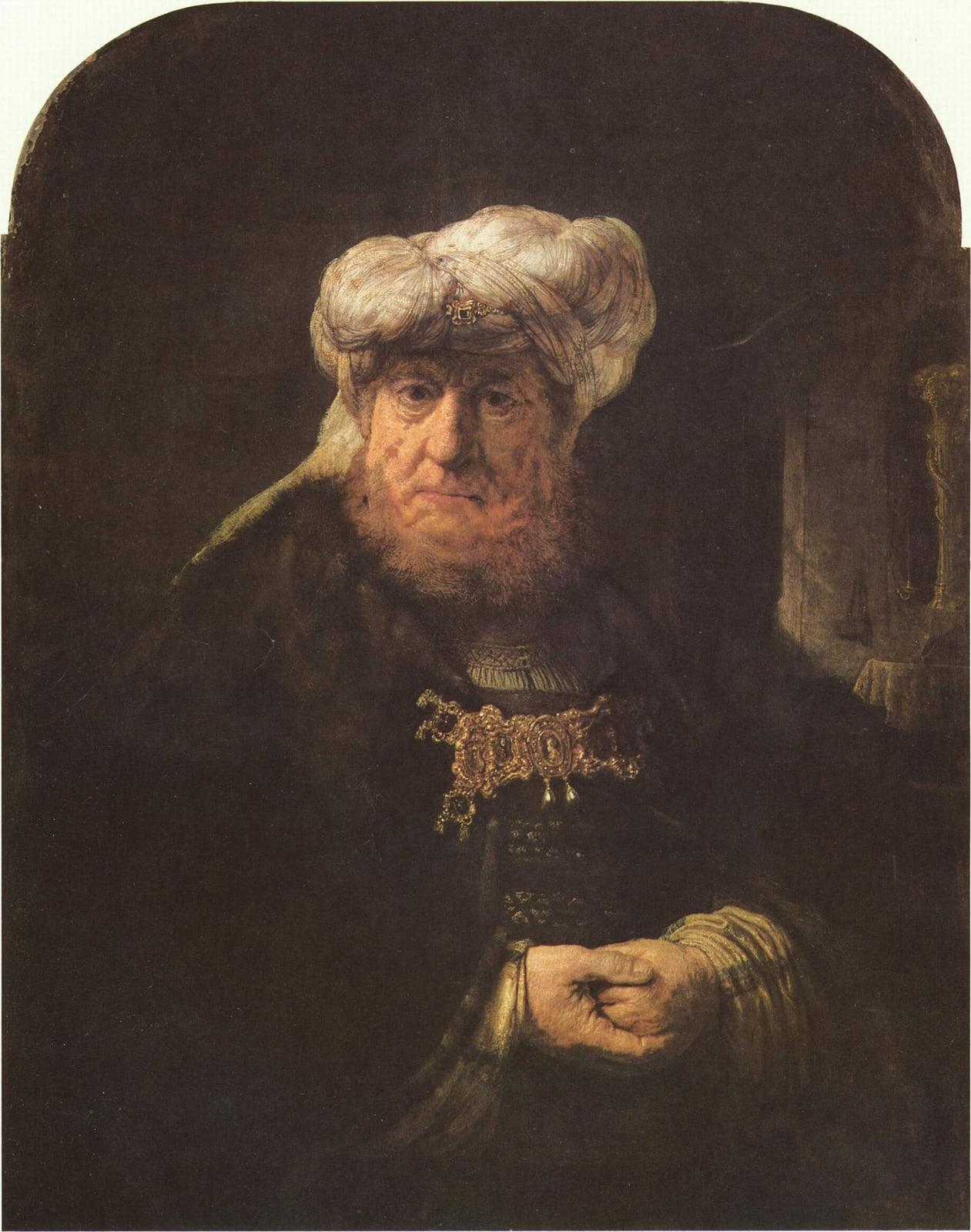
Rembrandt, Man in Oriental Costume, about 1639. Public domain.
Amos 1:1 and Zechariah 14:5 · Story · Featured Study
The Earthquake in the Days of Uzziah
Amos dated his words two years before an earthquake, and Zechariah recalled the people fleeing from it.
The ground shook in the reign of a king who was a leper until the day he died.
These are the words of Amos, who was among the sheepherders of Tekoa—what he saw concerning Israel two years before the earthquake, in the days when Uzziah was king of Judah and Jeroboam son of Jehoash was king of Israel.
- Who
- Amos, Uzziah, Zechariah
- When
- two years after Amos saw his words, in the reigns of Uzziah of Judah and Jeroboam son of Jehoash of Israel, by Amos 1:1
Summary
Scripture places the quake only by the reigns of Uzziah and Jeroboam. Josephus, Eusebius and three modern scholars have each tried to place it more closely.
- The Hebrew word for the quake is ra'ash, a shaking.
- Uzziah reigned fifty-two years in Jerusalem.
- Amos writes the earthquake, with the article, as of an event his hearers knew.
The Date in Amos 1
Amos names his town, his trade and his kings in his first verse.
From Jeroboam's Reign to Zechariah
Kings and Chronicles give the reigns, and Amos and Isaiah date their words by them.
The earthquake falls among six events told in Kings, Chronicles, Amos, Isaiah and Zechariah.
- Jeroboam becomes kingJeroboam son of Jehoash, in Samaria2 Kings 14:23
- Uzziah becomes kingUzziah, also called Azariah, in Jerusalem2 Kings 15:1
- Amos sees his wordsAmos, among the sheepherders of TekoaAmos 1:1
- The incense in the templeUzziah and the priests2 Chronicles 26:19
- Isaiah's callIsaiah, in the templeIsaiah 6:1
- The flight rememberedZechariah, speaking to JerusalemZechariah 14:5
Each step with its verse.
The Flight in Zechariah 14
Zechariah pictures the day of the LORD with the flight from the old earthquake.
On that day His feet will stand on the Mount of Olives, east of Jerusalem, and the Mount of Olives will be split in two from east to west, forming a great valley, with half the mountain moving to the north and half to the south. You will flee by My mountain valley, for it will extend to Azal. You will flee as you fled from the earthquake in the days of Uzziah king of Judah. Then the LORD my God will come, and all the holy ones with Him.Zechariah received his word in the second year of Darius (Zechariah 1:1), after the return from Babylon.
Albert Barnes reads Azal as the name of a place. Adam Clarke counts the place unknown and, if it is one, most probably near Jerusalem.
The Shaking in Amos and Isaiah
Amos 8 and 9 and Isaiah 6 speak of the land and the temple shaking.
I saw the Lord standing beside the altar, and He said: “Strike the tops of the pillars so that the thresholds shake. Topple them on the heads of all the people, and I will kill the rest with the sword. None of those who flee will get away; none of the fugitives will escape.Of the shakings in Amos, this one falls on a sanctuary.
Will not the land quake for this, and all its dwellers mourn? All of it will swell like the Nile; it will surge and then subside like the Nile in Egypt.This is a second place in Amos where the ground answers the people's sin.
Adam Clarke, on Amos 8:8, reported the view that an earthquake is meant. He allowed that commotions among the people may be meant instead. Albert Barnes saw in the verse the heaving of an earthquake.
At the sound of their voices the doorposts and thresholds shook, and the temple was filled with smoke.Isaiah dates his vision by the death of the king of Amos 1:1.
Josephus and the Temple
Chronicles tells of Uzziah's sin in the temple, and Josephus, in Antiquities of the Jews 9.10.4, adds an earthquake to it.
But when Uzziah grew powerful, his arrogance led to his own destruction. He was unfaithful to the LORD his God, for he entered the temple of the LORD to burn incense on the altar of incense. Then Azariah the priest, along with eighty brave priests of the LORD, went in after him. They took their stand against King Uzziah and said, “Uzziah, you have no right to offer incense to the LORD. Only the priests, the descendants of Aaron, are consecrated to burn incense. Leave the sanctuary, for you have acted unfaithfully; you will not receive honor from the LORD God.” Uzziah, with a censer in his hand to offer incense, was enraged. But while he raged against the priests in their presence in the house of the LORD before the altar of incense, leprosy broke out on his forehead.Chronicles alone tells of the incense in the temple; 2 Kings 15:5 gives only the leprosy.
Eusebius quotes Josephus on the earthquakeEusebius of Caesarea, Proof of the Gospel 6.18
“Uzziah is described as at first having been righteous, and then it is related that he was lifted up in mind and dared to offer sacrifice to God himself, and his face became leprous in consequence. But Josephus carefully studied the additional comments of the expounders as well, and a Hebrew of the Hebrews as he was, hear his description of the events of those times. He tells: ‘Though the priests urged Uzziah to go out of the temple and not to break the law of God, he angrily threatened them with death unless they held their peace. And meanwhile an earthquake shook the earth, and a bright light shone through a breach in the temple and struck the king's face, so that at once it became leprous. And before the city at the place called Eroga, the western half of the Mount was split asunder and rolling four stadia stopped at the eastern mountain, so as to block up the royal approach and gardens.’ This I take from the work of Josephus on Jewish antiquities. And I found in the beginning of the prophet Amos the statement that he began to prophecy ‘in the days of Uzziah, king of Judah, two years before the earthquake.’ What earthquake he does not clearly say. But I think the same prophet further on suggests this earthquake when he says, ‘I saw the Lord standing on the altar. And he said, Strike the altar, and the doors shall be shaken, and strike the heads of all, and the remnant I will slay with the sword.’Here I understand a prediction of the earthquake, and of the destruction of the ancient solemnities of the Jewish race and of the worship practiced by them in Jerusalem, the ruin that should overtake them after the coming of our Savior, when, since they rejected the Christ of God, the true High Priest, leprosy infected their souls, as in the days of Uzziah, when the Lord himself standing on the altar gave leave to him that struck, saying, ‘Strike the altar.’”
Eusebius of Caesarea · Proof of the Gospel 6.18 · on 2 Chronicles 26:16 to 19Patristic
The Evidence in the Ground
Excavators and geologists have looked for the quake in the ruins of eighth century BC towns.
Steven Austin, Gordon Franz and Eric Frost proposed a quake of magnitude 7.8 or more about 750 BC, as reported by the Institute for Creation Research's summary of their paper. The same summary names earthquake debris at six sites: Hazor, Deir Alla, Gezer, Lachish, Tell Judeideh and En Haseva.
Jefferson Williams's catalogue of Dead Sea earthquakes reports tilted walls that Yigael Yadin found at Hazor. The catalogue places them in Stratum VI, a layer it dates to the eighth century BC. The same catalogue reports the caution of Nicholas Ambraseys, in 2009, that the archaeological reports give little technical support for their claims.
The Voices
Three commentators from the sixteenth century to the nineteenth explain the shaking, the vision and the mountain.
John Calvin (1509 to 1564)
John Calvin reported how most interpreters of his day read the vision of Amos 9:1.
“Let us now see the design of the vision. The greater part of interpreters think that the destruction of the kingdom and of the priesthood is predicted here, at the time when Zedekiah was taken and led ignominiously into exile, and when his children were killed, and when afterwards the temple was erased and the city demolished.”
John Calvin · Commentaries · on Amos 9:1Reformed
Matthew Henry (1662 to 1714)
Matthew Henry read the shaking of Isaiah 6:4 as a warning to the people.
“This violent concussion of the temple was an indication of God's wrath and displeasure against the people for their sins; it was an earnest of the destruction of it and the city by the Babylonians first, and afterwards by the Romans; and it was designed to strike an awe upon us.”
Matthew Henry · Commentary on the Whole Bible · on Isaiah 6:4Puritan
Jamieson, Fausset & Brown (1802 to 1910)
Jamieson, Fausset and Brown tied the Mount of Olives of Zechariah 14:4 to the Gospels.
“He shall probably ‘come from the east’ (Mt 24:27). He so made His triumphal entry into the city from the Mount of Olives from the east (Mt 21:1-10). This was the scene of His agony: so it shall be the scene of His glory.”
Jamieson, Fausset & Brown · Commentary Critical and Explanatory on the Whole Bible · on Zechariah 14:4Reformed
How the Earthquake Has Been Read
Three readings of the earthquake stand among the fathers and the commentators.
One earthquake in Amos and ZechariahJohn Wesley; Adam Clarke
A tumult among the peopleAdam Clarke
Clarke left open that the Hebrew ha-ra'ash in Amos 1:1 might mean a popular tumult rather than a shaking of the ground.
Amos 9:1 foretells the quake, or a later fallEusebius of Caesarea; Adam Clarke
Clarke placed the vision's altar, perhaps, at Dan or Beersheba, and read it as the ruin of those temples.
Books to Read Next
An ancient history and an older commentary tell the earthquake and its text.
Antiquities of the Jews, translated by William Whiston
Flavius Josephus · Whiston's translation, 1737
Whiston's English keeps the book, chapter and section numbers of the Antiquities.
Read it free at the University of ChicagoNotes, Explanatory and Practical
Albert Barnes · 1832 to 1869
Barnes explains Azal and the valley of Zechariah 14:5.
Read it free at BibleHubThe LORD Roars from Zion
Amos 1:2 and Joel 3:16 give the same line about the LORD's voice.
The LORD will roar from Zion and raise His voice from Jerusalem; heaven and earth will tremble. But the LORD will be a refuge for His people, a stronghold for the people of Israel.The verse stands here for its last words, which Amos 1:2 does not have.
He said: “The LORD roars from Zion and raises His voice from Jerusalem; the pastures of the shepherds mourn, and the summit of Carmel withers.”Sources
Scripture is the Berean Standard Bible.
- The Hebrew text of Amos 1:1 and Zechariah 14:5, word by word, with Strong's numbers.
- John Wesley, Explanatory Notes upon the Old Testament (1765), on Amos 1:1.
- Adam Clarke, Commentary on the Bible (1832), on Amos 1:1, Amos 8:8, Amos 9:1 and Zechariah 14:5.
- Albert Barnes, Notes, Explanatory and Practical, on Amos 8:8 and Zechariah 14:5.
- Matthew Henry, Commentary on the Whole Bible (1710), on Isaiah 6:4.
- John Calvin, Commentaries (1554), on Amos 9:1.
- Jamieson, Fausset and Brown, Commentary Critical and Explanatory on the Whole Bible (1871), on Zechariah 14:4.
- Eusebius of Caesarea, Proof of the Gospel 6.18 (about 339), quoting Josephus.
- Flavius Josephus, Antiquities of the Jews 9.10.4, translated by William Whiston (1737)
- The Institute for Creation Research's summary of Steven A. Austin, Gordon W. Franz and Eric G. Frost, Amos's Earthquake: An Extraordinary Middle East Seismic Event of 750 B.C., International Geology Review 42, no. 7 (2000): 657 to 671; the paper itself was not opened.
- Jefferson Williams, Earthquake Catalog of the Dead Sea, the pages on Amos's earthquake and on Hazor Stratum VI, reporting Yadin's Hazor volumes and Ambraseys, Earthquakes in the Mediterranean and Middle East (Cambridge, 2009)
Keep Studying
Read it5
Studies1
People and groups6
Places1
Subjects1