
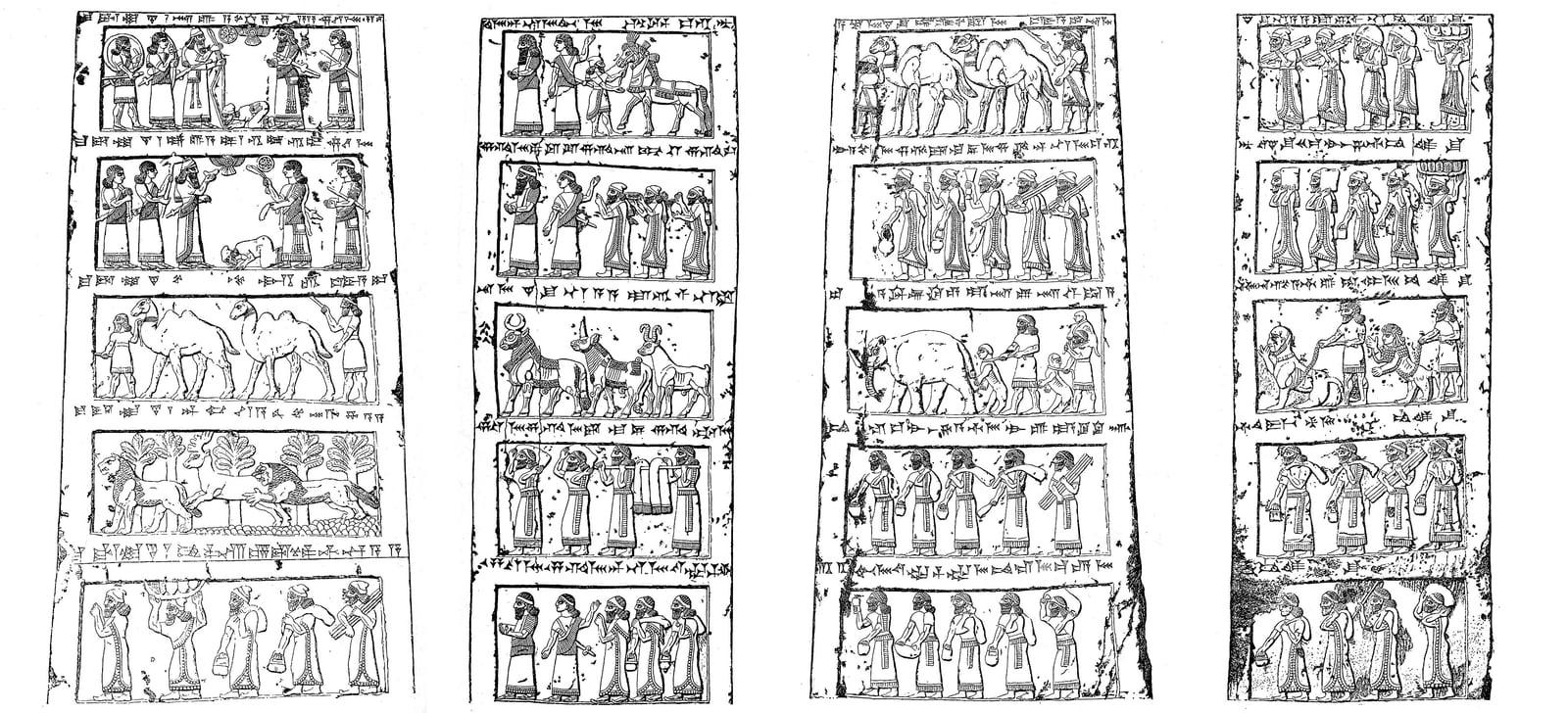
The Black Obelisk of Shalmaneser III, drawn for Friedrich Delitzsch, 1906. Public domain.
2 Kings 9 and 10 · Person · Featured Study
Jehu
A coup that began at Jezreel ended the house of Ahab and set a new dynasty on Israel's throne.
Nevertheless, the LORD said to Jehu, “Because you have done well in carrying out what is right in My sight and have done to the house of Ahab all that was in My heart, four generations of your sons will sit on the throne of Israel.”
- The name means
- Jehovah is he, in Easton's Bible Dictionary
- Family
- grandfather: Nimshi; father: Jehoshaphat; son: Jehoahaz; grandson: Jehoash; great-grandson: Jeroboam
- Places
- Ramoth-gilead, Jezreel, Megiddo, Samaria, Bethel, Dan
- First named
- 1 Kings 19:16 “You are also to anoint Jehu son of…”
- Last named
- Hosea 1:4 “…Jezreel upon the house of Jehu, and I…”
He drove like a madman, and the watchman knew him by it.
Summary
Jehu son of Jehoshaphat commanded Israel's army at Ramoth-gilead when a young prophet sent by Elisha poured oil on his head. He killed King Joram of Israel and King Ahaziah of Judah, and Jezebel was thrown from a window at Jezreel on his word. He reigned twenty-eight years in Samaria and kept the golden calves at Bethel and Dan.
- Jezebel called him Zimri from her window.
- Albert Barnes counts his house the longest to hold Israel's throne.
- Hosea named his first son Jezreel for the blood Jehu shed.
- Hazael of Aram took Gilead from Israel in his days.
Where Jehu Stands in Scripture
The LORD named him to Elijah at Horeb, and Elisha sent a prophet to anoint him.
Strong's dictionary counts five men named Jehu. This one is the son of Jehoshaphat and the grandson of Nimshi, and his rise and reign fill 2 Kings 9 and 10.
You are also to anoint Jehu son of Nimshi as king over Israel and Elisha son of Shaphat from Abel-meholah to succeed you as prophet.Hazael, Jehu and Elisha were named in one charge, and each would carry out the LORD's judgment on Israel.
Another Jehu, the son of Hanani, was a prophet who spoke against King Baasha in 1 Kings 16.
His Reign, Turn by Turn
His rise runs from the camp at Ramoth-gilead to the temple of Baal in Samaria.
Eleven of the twelve turns are told in 2 Kings 9 and 10.
- Named to Elijah for anointingHoreb1 Kings 19:16
- Anointed by a young prophet in an inner roomRamoth-gilead2 Kings 9:6
- Proclaimed king on the bare stepsRamoth-gilead2 Kings 9:13
- Shoots Joram between the shouldersNaboth's plot at Jezreel2 Kings 9:24
- Has Ahaziah of Judah shotthe Ascent of Gur, near Ibleam2 Kings 9:27
- Orders the queen mother's deathJezreel2 Kings 9:33
- Receives the heads of Ahab's seventy sonsthe gate of Jezreel2 Kings 10:7 to 8
- Kills forty-two relatives of AhaziahBeth-eked of the Shepherds2 Kings 10:14
- Turns a feigned sacrifice into a slaughterSamaria2 Kings 10:25
- Promised four generations on the throneSamaria2 Kings 10:30
- Loses the land east of the Jordan to HazaelGilead and Bashan2 Kings 10:32 to 33
- Dies and is buriedSamaria2 Kings 10:35 to 36
Turns 2 to 9 follow one another on the road from Ramoth-gilead to Samaria.
Receives the heads of Ahab's seventy sons, Kills forty-two relatives of Ahaziah, Turns a feigned sacrifice into a slaughter, Promised four generations on the throne, Loses the land east of the Jordan to Hazael, Dies and is buried
From Ramoth-gilead to Samaria
Four turns of his rise, from the flask of oil to the gate of Samaria.
Jehu's rise begins in an army camp east of the Jordan and ends with Ahab's house destroyed in two cities.
The flask of oil2 Kings 9:1 to 13; Matthew Henry
Elisha sent one of the sons of the prophets to Ramoth-gilead with a flask of oil and told him to run once it was poured.
And you are to strike down the house of your master Ahab, so that I may avenge the blood of My servants the prophets and the blood of all the servants of the LORD shed by the hand of Jezebel.First Kings 18:4 records what this charge avenges.
Matthew Henry weighs the reason the charge gives.
“That they were idolaters was bad enough, and merited all that was brought upon them; yet that is not mentioned here, but the controversy God has with them is for their being persecutors, not so much their throwing down God's altars as their slaying his prophets with the sword.”
Matthew Henry · Commentary on the Whole Bible · on 2 Kings 9:7Puritan
The ride to Jezreel2 Kings 9:14 to 26; Albert Barnes and John Wesley
Joram lay at Jezreel recovering from wounds taken against Hazael. Jehu drove there and kept the two riders the king sent out to meet him.
Again the watchman reported, “He reached them, but he is not coming back. And the charioteer is driving like Jehu son of Nimshi—he is driving like a madman!”Albert Barnes reads the verb as leading a company, and notes that some versions and Josephus give the opposite sense, that he drove quietly.
When Joram saw Jehu, he asked, “Have you come in peace, Jehu?” “How can there be peace,” he replied, “as long as the idolatry and witchcraft of your mother Jezebel abound?”Jehu answered the king's question about peace by naming his mother.
“He mentions not Joram's, but his mother's sins; because they were more notorious and infamous: and because they were the principal cause why God inflicted, and he was come to execute these judgments. The way of sin can never be the way of peace.”
John Wesley · Explanatory Notes upon the Old Testament · on 2 Kings 9:22Evangelical
The plot of Naboth2 Kings 9:24 to 37
Jehu had Joram's body thrown onto the plot of Naboth, recalling the word he had heard while riding behind Ahab. Jezebel was thrown from her window at his order, and the dogs left only her skull, her feet and the palms of her hands.
So they went back and told Jehu, who replied, “This is the word of the LORD, which He spoke through His servant Elijah the Tishbite: ‘On the plot of ground at Jezreel the dogs will devour the flesh of Jezebel.First Kings 21:23 records the word Jehu recalls.
The heads at the gate2 Kings 10:1 to 17
Jehu wrote twice to the rulers of Samaria, and the second letter asked for the heads of Ahab's seventy sons. He set them in two heaps at the gate of Jezreel and spoke to the people in the morning.
Know, then, that not a word the LORD has spoken against the house of Ahab will fail, for the LORD has done what He promised through His servant Elijah.”The page on the Rechabites follows the house of Jehonadab son of Rechab to Jeremiah's day.
The Sentence on Ahab's House
Elijah spoke the sentence on Ahab's house after Naboth's death.
The young prophet's charge at Ramoth-gilead repeats the words Elijah spoke to Ahab in Naboth's vineyard. Both name the houses of Jeroboam and Baasha as the pattern.
This is what the LORD says: ‘I will bring calamity on you and consume your descendants; I will cut off from Ahab every male in Israel, both slave and free. I will make your house like that of Jeroboam son of Nebat and like that of Baasha son of Ahijah, because you have provoked My anger and caused Israel to sin.’Another page teaches how Jehu destroyed the servants of Baal in their own temple.
The House of Jehu
His circle runs from his grandfather Nimshi to his great-great-grandson Zechariah.
Jehu stood between the house he ended and the four generations of his sons.
His fathers
- NimshiHis grandfather, whose name he was known by
- JehoshaphatHis father
The prophets who named him
His own day
- JehuThe king himself
- Joram of IsraelAhab's son, the king he shot
- Ahaziah of JudahKing of Judah, come to visit Joram
His sons on the throne
Second Kings 15:12 counts Zechariah the fourth generation and the end of the promise.
The Places of His Life
Six places mark his reign, from Ramoth-gilead to Dan.
His rise ran from the camp in Gilead to Jezreel and on to Samaria.
| Place | What Scripture tells of it | Verse |
|---|---|---|
| Ramoth-gilead | The army camp where he was anointed and proclaimed. | 2 Kings 9:4 |
| Jezreel | The royal city where Joram and Jezebel died. | 2 Kings 9:30 |
| Megiddo | Where Ahaziah of Judah died of his wound. | 2 Kings 9:27 |
| Samaria | The capital where he was buried. | 2 Kings 10:35 |
| Bethel | Where a golden calf stood that he left in place. | 2 Kings 10:29 |
| Dan | Where the other golden calf stood. | 2 Kings 10:29 |
Questions His Life Raises
Two questions are answered from the text and its commentators.
Was he the son of Nimshi?2 Kings 9:2 and 2 Kings 9:20; Albert Barnes
When you arrive, look for Jehu son of Jehoshaphat, the son of Nimshi. Go in, get him away from his companions, and take him to an inner room.Albert Barnes, in his Notes on 1 Kings 19:16, calls Jehu the grandson of Nimshi. He suggests that Jehu went by his grandfather's name because his father had died and Nimshi had raised him.
Where did Ahaziah of Judah die?2 Kings 9:27 and 2 Chronicles 22:9; C. F. Keil
Second Kings has Ahaziah shot near Ibleam and dying at Megiddo. Second Chronicles tells it another way.
Then Jehu looked for Ahaziah, and Jehu’s soldiers captured him while he was hiding in Samaria. So Ahaziah was brought to Jehu and put to death. They buried him, for they said, “He is the grandson of Jehoshaphat, who sought the LORD with all his heart.” So no one was left from the house of Ahaziah with the strength to rule the kingdom.C. F. Keil, in The Books of the Kings, judges that the brevity of the two accounts leaves no certain way to join them. He allows that Ahaziah may have fled to Samaria, been overtaken and brought back to Jehu, and been wounded near Ibleam before he fled on to Megiddo.
What the Text Leaves Unsaid
The text leaves two things about him untold.
After the anointing, 2 Kings 9 and 10 record no further word between Jehu and Elisha.
The text gives twenty-eight years to his reign and tells only of its first days and of Hazael's wars.
Zeal Without the Whole Heart
The narrator sets the LORD's reward between two verses that fault Jehu for the calves.
Jehu spoke of his own zeal for the LORD on the road to Samaria. The narrator praises what he did to Ahab's house and judges how he walked after it.
Yet Jehu was not careful to follow the instruction of the LORD, the God of Israel, with all his heart. He did not turn away from the sins that Jeroboam had caused Israel to commit.The phrase with all his heart is the measure the law sets in Deuteronomy 6:5.
Voices on Jehu
Matthew Henry and Albert Barnes wrote on the plot of Naboth and the limit of his reform.
Matthew Henry (1662 to 1714)
Commentary on the Whole Bible
Matthew Henry saw the judgment fall on the very ground Ahab had taken from Naboth.
“For this the house of Ahab must be reckoned with; and that very piece of ground which he, with so much pride and pleasure, had made himself master of at the expense of the guilt of innocent blood, now became the theatre on which his son's dead body lay exposed a spectacle to the world. Thus the Lord is known by the judgment which he executeth.”
on 2 Kings 9:25 to 26Puritan
Albert Barnes (1798 to 1870)
Notes, Explanatory and Practical, on the Old and New Testaments (1832-1869)
Albert Barnes held that the worship of the LORD without images lay beyond Jehu.
“To abolish the calf-worship was a thought which had probably never occurred to Jehu. He had religious feeling enough, and patriotism enough, to detest the utterly debasing Astarte worship; but the pure worship of Yahweh was altogether beyond and above him.”
on 2 Kings 10:29Evangelical
Rewarded in Kings, Judged in Hosea?
Second Kings 10:30 rewards Jehu for what he did at Jezreel, and Hosea 1:4 brings that bloodshed on his house.
Then the LORD said to Hosea, “Name him Jezreel, for soon I will bring the bloodshed of Jezreel upon the house of Jehu, and I will put an end to the kingdom of Israel.Hosea prophesied in the days of Jehu's great-grandson Jeroboam, by Hosea 1:1.
The deed was right and the heart was wrongMatthew Henry and C. F. Keil
“But how comes the same action to be both rewarded and punished? Very justly; the matter of it was good; it was the execution of a righteous sentence passed upon the house of Ahab, and, as such, it was rewarded; but Jehu did it not in a right manner; he aimed at his own advancement, not at the glory of God, and mingled his own resentments with the execution of God's justice.”
Matthew Henry · Commentary on the Whole Bible · on Hosea 1:4Puritan
C. F. Keil, in his commentary on Hosea, holds the same. An act God praised could not be blood-guilt in itself, and he cites Calvin that the massacre was a crime on Jehu's part and righteous vengeance on God's.
The objection is Hitzig's, as Keil reports him: the guilt lies in deeds Jehu added to his charge.
He went beyond his chargeHitzig, as C. F. Keil reports him
Hitzig, as Keil reports him, finds the blood of Jezreel in what Jehu added to his charge. He killed Ahaziah of Judah and his brothers as well as Joram and Jezebel, and he ordered the slaughter of 2 Kings 10:11.
The objection is Keil's: the historical account does not blame those deaths, since Judah's royal house had been drawn into the sin of Ahab's house by marriage.
Books to Read Next
Both works are in the public domain, and each has a free copy to read.
The Books of the Kings
C. F. Keil, translated by James Martin · 1872
Keil weighs Jehu's motives and the two accounts of Ahaziah's death in his notes on 2 Kings 9 and 10.
Read at the Internet ArchiveThe Twelve Minor Prophets, volume 1
C. F. Keil · 1878
Keil sets Hosea 1:4 beside 2 Kings 10:30 and answers Hitzig in his notes on Hosea 1.
Read at the Internet ArchiveWith All the Heart
Jehu's reform stopped at Bethel and Dan.
Jesus declared, “‘Love the Lord your God with all your heart and with all your soul and with all your mind.’Matthew 22:38 calls this the first and greatest commandment.
Sources
Scripture is the Berean Standard Bible.
- James Strong, Exhaustive Concordance of the Bible (1890), Hebrew dictionary, entry 3058, and the verses that carry them.
- M. G. Easton, Illustrated Bible Dictionary (1897), entry Jehu.
- C. F. Keil, The Books of the Kings, translated by James Martin, T. and T. Clark, 1872, pp. 343 to 344 and 354 to 355.
- Records of the Past, vol. V, Assyrian Texts, the Black Obelisk translated by A. H. Sayce, pp. 27 and 41.
- C. F. Keil, The Twelve Minor Prophets, volume 1, translated by James Martin, T. and T. Clark, printing of 1878, pp. 39 to 41.
- Matthew Henry, Commentary on the Whole Bible (1710), on 2 Kings 9:7, 9:25 to 26 and Hosea 1:4.
- John Wesley, Explanatory Notes upon the Old Testament (1765), on 2 Kings 9:22.
- Albert Barnes, Notes, Explanatory and Practical, on the Old and New Testaments (1832 to 1869), on 1 Kings 19:16, 2 Kings 9:20, 10:29 and 10:30.
Keep Studying
Read it4
Studies6
People and groups10
Subjects1