
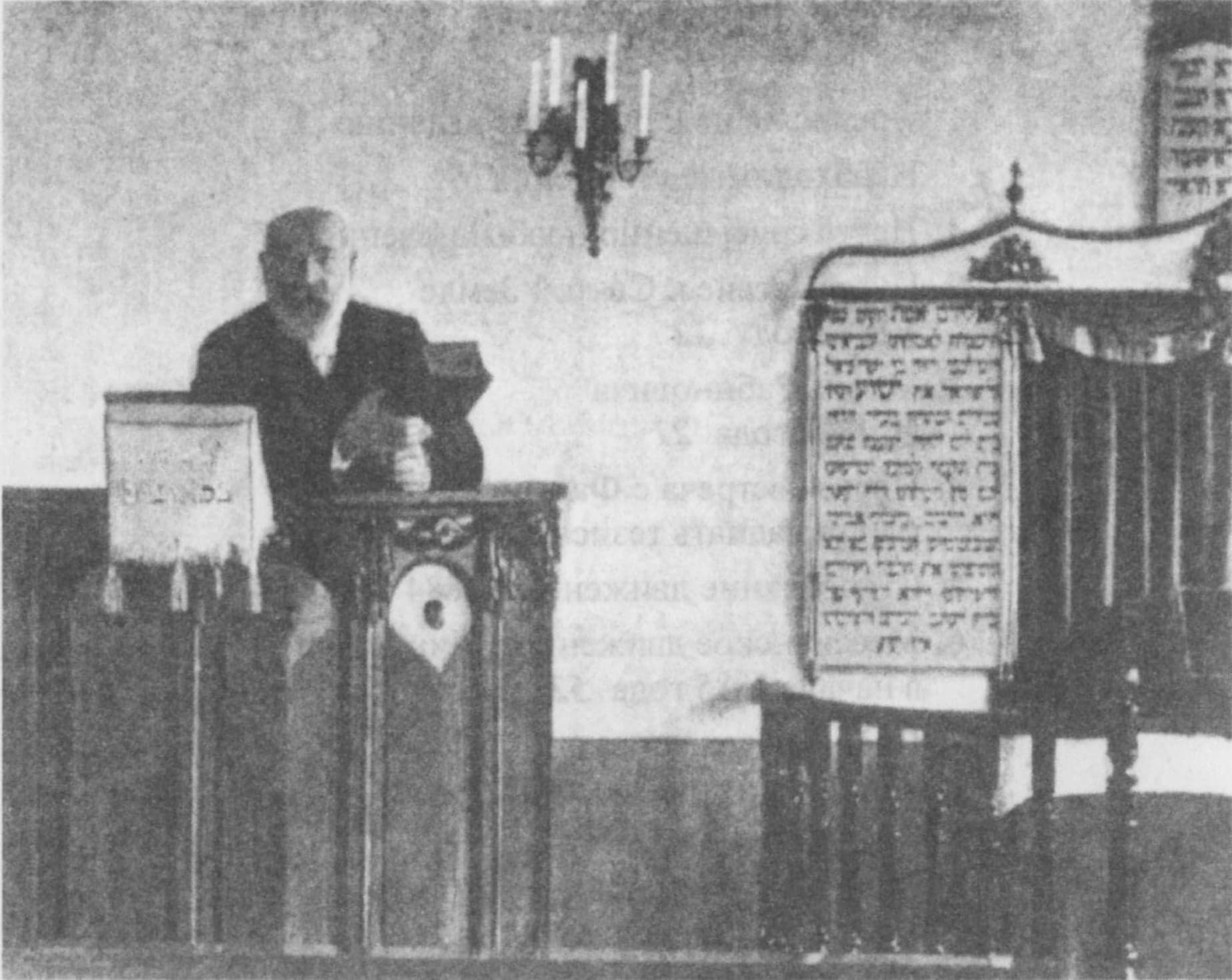
Joseph Rabinowitz preaching in the Somerville Memorial Hall, 1884. Public domain.
1813 to today · The churches · Featured Study
The Messianic Jewish Congregations
From the Hebrew Christians of London in 1813 to the Union of 1979 and Israel's fellowships today.
On 22 March 1885 Joseph Rabinowitz was baptized, a Jew who had preached the gospel to his own people in South Russia since 1883.
In the same way, at the present time there is a remnant chosen by grace.
- Began
- 1813 in London, as Gidney records it; the Union of 1979 (probable)
- Bodies
- The Union of Messianic Jewish Congregations, The Messianic Jewish Alliance of America, The International Alliance of Messianic Congregations and Synagogues
On 22 March 1885 Joseph Rabinowitz was baptized, a Jew who had preached the gospel to his own people in South Russia since 1883.
Summary
These congregations gather Jewish believers who confess Jesus as Messiah and keep their Jewish identity. They meet in congregations of their own in North America and in Israel.
- Their alliances in America date from 1915, and their union of congregations from 1979.
- The Union and the Alliance confess one God as Father, Son and Holy Spirit.
- Reform rabbis, and most American Jews in Pew's survey, reject the claim that such a believer is still a Jew.
- More of Israel's fellowships meet in Russian than in Hebrew.
- The Caspari Center's release of 2022 says the movement in Israel more than tripled in twenty years.
The Texts They Stand On
The texts come from Romans 11, Romans 9, Romans 1 and Acts 21.
The movement reads Romans for Israel's place after the Messiah came, and Acts 21 for Jewish believers who kept the law.
Paul an Israelite
I ask then, did God reject His people? Certainly not! I am an Israelite myself, a descendant of Abraham, from the tribe of Benjamin.
The movement's claim that a Jew who believes remains a Jew stands on this verse.
Romans 11:1BSB
the people of Israel. Theirs is the adoption as sons; theirs the divine glory and the covenants; theirs the giving of the law, the temple worship, and the promises. Theirs are the patriarchs, and from them proceeds the human descent of Christ, who is God over all, forever worthy of praise! Amen.
The Union of Messianic Jewish Congregations cites these verses for what belongs to Israel.
First to the Jew
I am not ashamed of the gospel, because it is the power of God for salvation to everyone who believes, first to the Jew, then to the Greek.
It is the ground of mission to the Jewish people, from the London Society of 1809 to Jews for Jesus.
Romans 1:16BSB
When they heard this, they glorified God. Then they said to Paul, “You see, brother, how many thousands of Jews have believed, and all of them are zealous for the law.
Mark John Levy set it at the head of his paper of 1931, and the Union cites it on the law.
Acts 21:20BSB
Romans 1:16, Acts 21:20
The Messianic Branch of the Family of Churches
From the London Society of 1809 to the congregational bodies of 1979 to 1986.
The line runs from Hebrew Christians in a mission society to congregations of their own.
1809 to 1813
- The London Society
- The Children of Abraham
1882 to 1885
- The Hebrew Christian Prayer Union
- The Israelites of the New Covenant
1915 to 1925
- The Hebrew Christian Alliance of America
- The International Hebrew Christian Alliance
1973 to 1975
- Jews for Jesus
- The Messianic Jewish Alliance of America
1979 to 1986
- The Union of Messianic Jewish Congregations
- The International Alliance of Messianic Congregations and Synagogues
Each year is the record's own, from Gidney, Levy, Rausch and the bodies' own pages.
The other families of the churches stand together with the dates on which each began.
How the Congregations Began: London, South Russia and New York
A mission society, a convert's movement and an alliance's secretary each left a record.
W. T. Gidney wrote the London Society's history for the Society in 1908. He records that its committee took that name on 15 February 1809, and that “The first exclusively Hebrew Christian Association was formed in the Jews' Chapel” in September 1813, with forty-one members.
On 5 February 1837 a regular Hebrew service began at Palestine Place. Gidney writes that there “Hebrew Christians joined with Gentile Christians in worshipping the Redeemer of Israel in the language of their forefathers.”
in the hope that I may provoke my own people to jealousy and save some of them.Gidney names it as the text of the sermon preached at that first service.
Gidney writes that Rabinowitz's followers “were known as ‘Israelites of the New Covenant.’ They were guided by Twelve Articles of Faith.”
Mark John Levy, the Alliance's first General Secretary, wrote in 1931 that its first conference “was held at the end of another seven years in New York (1915).”
Who tells this story, and with what interest1 paragraph
Gidney wrote for the mission society he records, and Levy for the Alliance he served, sixteen years after its first conference.
The Truth They Keep: a Jew Who Believes Remains a Jew
The movement's claim, and the Jewish bodies' answer at its full weight.
Levy argued in 1931 for the believer's right to keep “the God-given national customs of Israel.”
The Messianic Jewish Alliance of America defines Messianic Jews as “lineally Jewish people.”
The Central Conference of American Rabbis, the body of Reform rabbis, answered in 1985 that “any movement that professes such belief cannot be considered a part of Judaism and cannot legitimately represent itself as such.”
Pew's survey of 3,475 American Jews, taken from 20 February to 13 June 2013, found that 60 percent say a person cannot be Jewish if he believes Jesus was the Messiah. A minority of 34 percent said he can.
MannaFest condemns the teaching that the church has replaced Israel, and holds that God has a plan for Israel and that Judaism is fulfilled in Christ.
Regarding the gospel, they are enemies on your account; but regarding election, they are loved on account of the patriarchs. For God’s gifts and His call are irrevocable.The Union cites these verses under its heading The Jewish People, for Israel's calling.
How Romans 11:5 has been taught2 paragraphs
John Chrysostom preached on Romans in the fourth century. In his eighteenth homily, in the Oxford translation, he read Paul's two words, election and grace. He wrote, “Observe that each word maintains its own rank, shewing at once God's grace, and the obedient temper of them that receive salvation. For by saying election, he shewed the approval of them, but by saying grace, he shewed the gift of God.”
John Calvin, in John Owen's translation of 1849, wrote that Paul “calls God's people a remnant, that is, in comparison with the vast number in whom impiety prevailed.”
Their Own Statements of Faith
The Union's definition of 2005, the Alliance's creed and the mission's statement.
The Union of Messianic Jewish Congregations affirmed its definition by delegate vote on 20 July 2005. It calls Messianic Judaism “a movement of Jewish congregations and groups committed to Yeshua the Messiah.”
Their Jewish life and identity, it says, are “rooted in Torah, expressed in tradition, and renewed and applied in the context of the New Covenant.”
The Union confesses that “There is one God, who has revealed Himself as Father, Son, and Holy Spirit.”
The Alliance confesses that “The Son is God (Deity), and is worshiped as God, having existed eternally.”
Jews for Jesus says of traditional Jewish literature, “We regard it as in no way binding upon life or faith.”
The Torah, and the “One Law” teaching for Gentiles4 paragraphs
The Union holds that “The Torah is God's gift to Israel,” and that it does not have the same role for Messianic communities from the nations.
TorahResource, the ministry of Tim Hegg, holds that the Torah “is applicable to all who are in Yeshua, regardless of their ethnicity,” a position it calls “One Law.”
The International Alliance of Messianic Congregations and Synagogues answered in 2014 that “One Law” theology is “a form of replacement theology.”
It added that the Gentile church is not called to live by the same Jewish expression of faith.
The Congregations Today
Three counts in Israel, each with its counter, its method and what it counted.
Israel's Messianic fellowships held 2,178 people of Jewish descent in 1999 and 15,323 believers in 2020.
| Year | The count | Method | Counter |
|---|---|---|---|
| 1999 | 81 congregations and 2,178 people of Jewish descent | A survey of the congregations, as Serner reports it | The Caspari Center |
| 2019 | 145 bodies and 10,352 people, 7,782 of them with at least one Jewish grandparent | Interviews with leaders and an online survey, preliminary | David Serner |
| 2020 | 15,323 believers | Answers from 273 of the 280 fellowship leaders located | Serner and Goldberg, for the Caspari Center |
In the United States, Hillary Kaell reports estimates of weekly attendance from 30,000 to 2,000,000, “with most hovering at about 150,000 to 300,000,” and says they may or may not include Gentiles.
Where the Congregations Spread
London, Boston, Pennsylvania and Israel.
Levy persuaded Dr. Niles to call Hebrew Christian conferences at Boston in 1901 and 1908, and he dates the first international conference to London in 1925.
The Union says leaders of 19 North American congregations met in Pennsylvania in 1979 to form it, and that 79 congregations had joined by 1998.
The Caspari Center's count of 2020 found fellowships in Israel meeting in six languages: 136 in Russian, 83 in Hebrew, 30 in Amharic, 16 in English, 6 in Spanish and 2 in Romanian.
Banished after 1915, Taken Up in 1975
The Alliance rejected Messianic Judaism, then renamed itself by it.
The church historian David A. Rausch reports from the Alliance's Quarterly that after the first conference of 1915 its conference acted to banish Messianic Judaism. The Alliance put itself on record “to be absolutely free from it, now and forever.”
Rausch writes that the Alliance “was forced by popular vote nearly 60 years later, in 1975, to change its name to the Messianic Jewish Alliance of America.”
Kaell says the debate “pitted an older generation against the influx of converts who now called themselves Messianic Jews.”
She adds, “In the end, the younger wing won the day, supported by many of the older guard.”
A Jewish believer's critique, and the answer2 paragraphs
Baruch Maoz, a Jewish Christian pastor in Israel, wrote Judaism Is Not Jewish (2003). In his reply to a review he warned of adherents “who question the deity of Christ, or who are inclined toward a form of legalism that replaces grace with works.”
Richard Harvey, a Messianic Jew, answered that “Judaism” and “Jewishness” “share the same etymology.”
Books to Read Next
The History of the London Society for Promoting Christianity amongst the Jews, from 1809 to 1908
W. T. Gidney · 1908
Gidney records the Hebrew Christians of London and Rabinowitz's movement.
Free at the Internet ArchiveHebrew Christianity and Jewish Nationalism
Mark John Levy · 1931
The Alliance's first secretary argues for Israel's customs in his own words.
Free at the Internet ArchiveCommentaries on the Epistle of Paul the Apostle to the Romans
John Calvin, translated by John Owen · 1849
Calvin reads the remnant of Romans 11:5 as kept by grace.
Free at the Internet ArchiveWhat the Congregations Hand On
Worship in Hebrew runs through the record, from the first Hebrew service at Palestine Place in 1837 to the Hebrew-speaking fellowships of Israel.
The Union holds that the Messianic Jewish community and the Christian Church together constitute the ekklesia, “the one Body of Messiah.”
Sources
Scripture is the Berean Standard Bible.
- The Holy Bible, Berean Standard Bible (read 2026)
- W. T. Gidney, The History of the London Society for Promoting Christianity amongst the Jews, from 1809 to 1908 (London, 1908), First Period, chapter I; pages 42 to 43, 161, 424 and 542.
- Mark John Levy, Hebrew Christianity and Jewish Nationalism, a paper for the seventeenth annual conference of the Hebrew Christian Alliance of America, Erie, 4 to 8 May 1931, pages 1, 2 and 6 to 9.
- David A. Rausch, The Messianic Jewish Congregational Movement, Christian Century (September 15 to 22, page 926; the year not printed, its latest event 1981)
- Hillary Kaell, Messianic Judaism (United States), World Religions and Spirituality Project, 24 February 2019.
- The Messianic Jewish Alliance of America, Statement of Faith and About Us (undated; read 2026)
- Jews for Jesus, About and Statement of Faith (undated; read 2026)
- The Union of Messianic Jewish Congregations, Our History, Vision (Defining Messianic Judaism, affirmed 20 July 2005) and FAQs.
- Central Conference of American Rabbis, Deceptive Proselytization of Jews, adopted at the 96th Annual Convention, 1985.
- Pew Research Center, A Portrait of Jewish Americans, 1 October 2013, the overview and chapter 3.
- Caspari Center, The Caspari Center Survey Released, 7 February 2022, on Serner and Goldberg, Jesus-Believing Israelis: Exploring Messianic Fellowships (Caspari Center, 2021)
- David Serner, Den messianske bevægelse i Israel, Norsk Tidsskrift for Misjonsvitenskap 73, no. 3 to 4 (2019)
- TorahResource, One Law (page dated 29 June 2025 in its metadata)
- IAMCS Steering Committee, One Law, Two Sticks: A Critical Look at the Hebrew Roots Movement (15 January 2014)
- Richard Harvey, a review of Baruch Maoz, Judaism Is Not Jewish (Mentor and Christian Witness to Israel, 2003), with Maoz's reply, Banner of Truth, 26 November 2003.
- John Chrysostom, Homilies on Romans, Homily XVIII, in A Library of Fathers of the Holy Catholic Church, volume VII (Oxford: John Henry Parker; the scan dated 1877), page 330.
- John Calvin, Commentaries on the Epistle of Paul the Apostle to the Romans, translated by John Owen (Edinburgh: Calvin Translation Society, 1849), on 11:5, pages 413 to 414.