
Genesis 25 to Hebrews 12 · Subject · Featured Study
The Birthright
The right of the firstborn in Genesis, the blessing told apart from it, and the warning Hebrews draws from Esau.
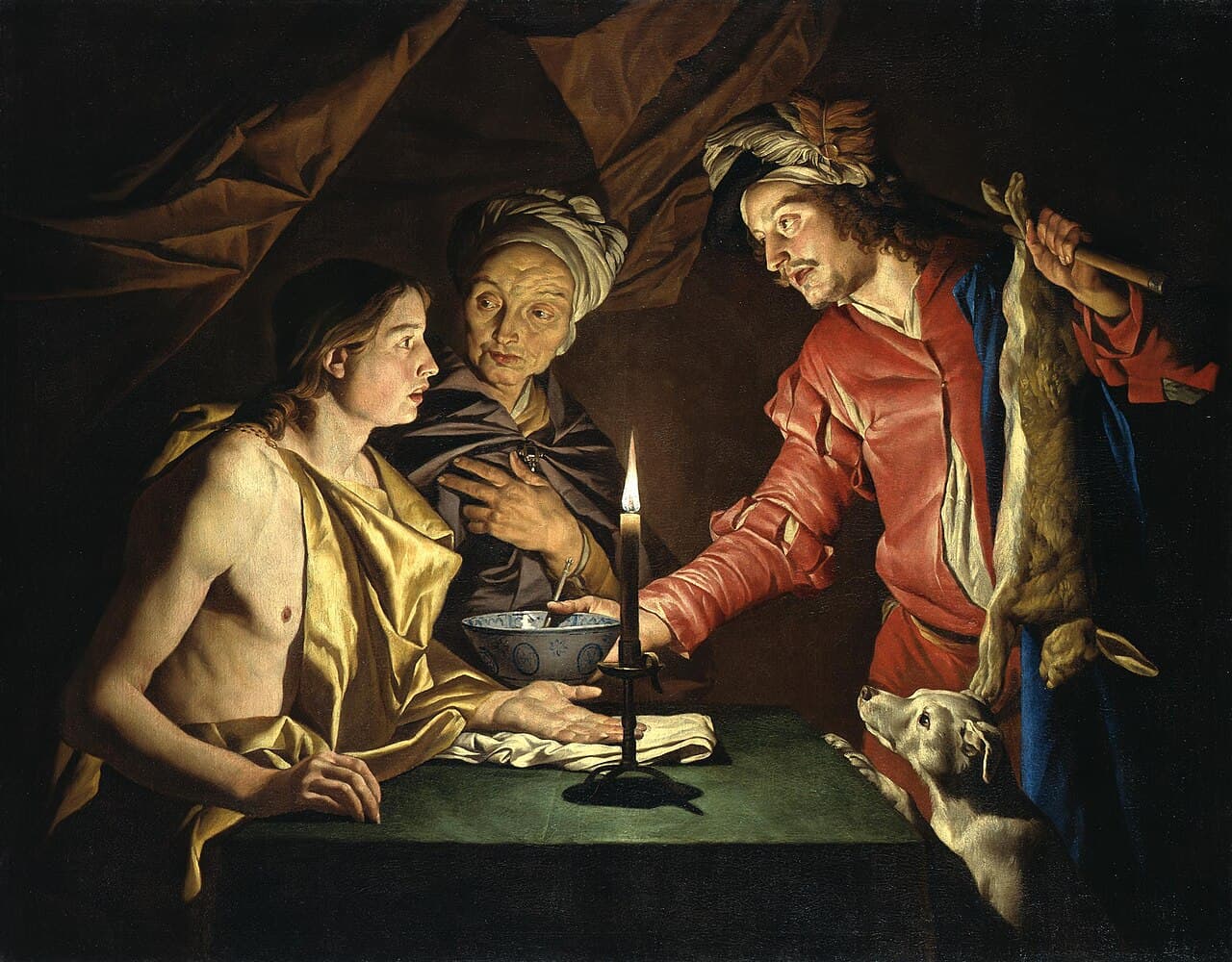
Matthias Stom, Esau Selling His Birthright to Jacob, between 1642 and 1645, Gemäldegalerie, Berlin. Public domain by date, painted before 1930.
THE ARTWORKStom painted Esau come in from the hunt with a hare over his shoulder, reaching across the table for the bowl of stew. Jacob sits by the candle with his hand flat on the cloth, and an old woman leans in behind him to watch the bargain.
Esau said that Jacob had taken two things from him, his birthright and his blessing.
Summary
The birthright was the firstborn son's place in his father's house, and Genesis tells how it passed from Esau to Jacob and from Reuben to the sons of Joseph.
- Esau sold it to Jacob under oath for bread and lentil stew.
- Jacob took Isaac's blessing by deceit, and it made him master of his brothers.
- The law of Deuteronomy gives the firstborn a double portion of all his father has.
- Reuben lost the birthright for defiling his father's bed, and Chronicles gives it to the sons of Joseph while the ruler comes from Judah.
- Hebrews calls Esau godless for selling his birthright for a single meal.
The Sale and the Blessing
Genesis 25 and 27 tell how Esau lost the birthright and then the blessing.
Rebekah carried twins who struggled with each other inside her, and she went to inquire of the LORD.
and He declared to her: “Two nations are in your womb, and two peoples from within you will be separated; one people will be stronger than the other, and the older will serve the younger.”The order of the two brothers is set before either is born, and the rest of the account turns on it.
One day, while Jacob was cooking some stew, Esau came in from the field and was famished. He said to Jacob, “Let me eat some of that red stew, for I am famished.” (That is why he was also called Edom.) “First sell me your birthright,” Jacob replied. “Look,” said Esau, “I am about to die, so what good is a birthright to me?” “Swear to me first,” Jacob said. So Esau swore to Jacob and sold him the birthright. Then Jacob gave some bread and lentil stew to Esau, who ate and drank and then got up and went away. Thus Esau despised his birthright.Later Isaac, old and unable to see, sent Esau to hunt game so that he might bless him before he died. Rebekah put Esau's finest clothes on Jacob, and Isaac blessed the younger son.
Isaac began to tremble violently and said, “Who was it, then, who hunted the game and brought it to me? Before you came in, I ate it all and blessed him—and indeed, he will be blessed!”The Younger Before the Elder
Genesis sets a younger son before an elder in six pairs of brothers.
| The elder | The younger | What the text records | Verse |
|---|---|---|---|
| Cain | Abel, and Seth after him | The LORD regards Abel's offering, and Seth is born in Abel's place | Genesis 4:25 |
| Ishmael | Isaac | Abraham's offspring will be reckoned through Isaac | Genesis 21:12 |
| Esau | Jacob | Esau swears the birthright to Jacob | Genesis 25:33 |
| Zerah | Perez | Zerah's hand comes out first, and Perez breaks out ahead of him | Genesis 38:28 to 30 |
| Reuben | Joseph | Reuben's birthright is given to the sons of Joseph | 1 Chronicles 5:1 |
| Manasseh | Ephraim | Jacob crosses his hands and sets his right hand on Ephraim | Genesis 48:14 |
From Reuben to the Sons of Joseph
Genesis and 1 Chronicles follow the birthright of Jacob's firstborn to Joseph, and the rule to Judah.
Reuben was Jacob's firstborn, the son of Leah.
Reuben, you are my firstborn, my might, and the beginning of my strength, excelling in honor, excelling in power. Uncontrolled as the waters, you will no longer excel, because you went up to your father’s bed, onto my couch, and defiled it.Jacob answers the act of Genesis 35:22 only on his deathbed, and the first son's place goes elsewhere.
And now your two sons born to you in Egypt before I came to you here shall be reckoned as mine; Ephraim and Manasseh shall be mine, just as Reuben and Simeon are mine.By counting Joseph's two sons as his own, Jacob gives Joseph the firstborn's double share.
Radak, David Kimhi, in his commentary on Genesis, reads Jacob's words to Joseph at Genesis 48:21 to 22 as that extra share, which Joseph's sons would inherit when the land was divided among the tribes.
These were the sons of Reuben the firstborn of Israel. Though he was the firstborn, his birthright was given to the sons of Joseph son of Israel, because Reuben defiled his father’s bed. So he is not reckoned according to birthright. And though Judah prevailed over his brothers and a ruler came from him, the birthright belonged to Joseph.Genesis 48:13 to 20, the crossed hands1 passage, 1 quotation
And Joseph took both of them—with Ephraim in his right hand toward Israel’s left hand, and Manasseh in his left hand toward Israel’s right hand—and brought them close to him. But Israel stretched out his right hand and put it on the head of Ephraim, the younger; and crossing his hands, he put his left on Manasseh’s head, although Manasseh was the firstborn. Then he blessed Joseph and said: “May the God before whom my fathers Abraham and Isaac walked, the God who has been my shepherd all my life to this day, the angel who has redeemed me from all harm—may He bless these boys. And may they be called by my name and the names of my fathers Abraham and Isaac, and may they grow into a multitude upon the earth.” When Joseph saw that his father had placed his right hand on Ephraim’s head, he was displeased and took his father’s hand to move it from Ephraim’s head to Manasseh’s. “Not so, my father!” Joseph said. “This one is the firstborn; put your right hand on his head.” But his father refused. “I know, my son, I know!” he said. “He too shall become a people, and he too shall be great; nevertheless, his younger brother shall be greater than he, and his offspring shall become a multitude of nations.” So that day Jacob blessed them and said: “By you shall Israel pronounce this blessing: ‘May God make you like Ephraim and Manasseh.’” So he put Ephraim before Manasseh.The younger grandson receives the greater blessing, as Jacob had over Esau.
Matthew Henry draws a rule about grace from Jacob's refusal.
“Grace observes not the order of nature, nor does God prefer those whom we think fittest to be preferred, but as it pleases him.”
Matthew Henry · Commentary on the Whole Bible · on Genesis 48:17 to 18Puritan
Genesis 49:8 to 10, the rule given to Judah1 passage
Judah, your brothers shall praise you. Your hand shall be on the necks of your enemies; your father’s sons shall bow down to you. Judah is a young lion—my son, you return from the prey. Like a lion he crouches and lies down; like a lioness, who dares to rouse him? The scepter will not depart from Judah, nor the staff from between his feet, until Shiloh comes and the allegiance of the nations is his.Jacob speaks these words over Judah, Leah's fourth son, at the same deathbed where he passes over Reuben.
The Blessing of Jacob and Shiloh and the Scepter treat this saying in full.
Birthright and Blessing Told Apart
The birthright and the blessing passed by different means and carried different things.
Adam Clarke, on Genesis 27:35, holds the blessing to be a different thing from the birthright.
What each one carried1 table, 3 rows
| Question | The birthright | The blessing | Verse |
|---|---|---|---|
| How it passed | Sold by Esau to Jacob under oath | Spoken by Isaac over Jacob before his death | Genesis 27:4 |
| What it carried | A double portion of all the father had | Dew, grain and new wine, and rule over his brothers | Deuteronomy 21:17 |
| What Esau was left | Nothing he could reclaim | A home away from the dew of heaven, the sword, and service to his brother | Genesis 27:39 to 40 |
The two blessings read toward Christ2 quotations
Matthew Henry reads the blessing of Jacob as carrying the promise of the Messiah.
“It must amount to an entail of the promise of the Messiah, and of the church; this was, in the patriarchal dialect, the blessing: something spiritual, doubtless, is included in it. First, That from him should come the Messiah, who should have a sovereign dominion on earth. It was that top-branch of his family which people should serve and nations bow down to.”
Matthew Henry · Commentary on the Whole Bible · on Genesis 27:29Puritan
John Wesley finds nothing of that promise in what was left to Esau.
“But the great difference is, that there is nothing in Esau's blessing that points at Christ, nothing that brings either him or his into the church, and without that the fatness of the earth, and the plunder of the field, will stand him in little stead. Thus Isaac by faith blessed them both, according as their lot should be.”
John Wesley · Explanatory Notes upon the Old Testament · on Genesis 27:39Evangelical
The Firstborn's Right in Law and Custom
The law of Moses fixed the firstborn's share, and Genesis already seats and marries by birth order.
Albert Barnes, on Deuteronomy 21:15, holds that Moses recognized the rights of the firstborn and did not originate them. In his reading a father could still set them aside for just cause.
If a man has two wives, one beloved and the other unloved, and both bear him sons, but the unloved wife has the firstborn son, when that man assigns his inheritance to his sons he must not appoint the son of the beloved wife as the firstborn over the son of the unloved wife. Instead, he must acknowledge the firstborn, the son of his unloved wife, by giving him a double portion of all that he has. For that son is the firstfruits of his father’s strength; the right of the firstborn belongs to him.Birth order at a table and at a wedding2 passages
They were seated before Joseph in order by age, from the firstborn to the youngest, and the men looked at one another in astonishment.The Hebrew seats the firstborn according to his birthright, the word of Genesis 25.
Laban replied, “It is not our custom here to give the younger daughter in marriage before the older.Laban answers Jacob, the younger son who took the elder's place, with the custom of his country.
The tablets of NuziCyrus Gordon; Kenneth Kitchen; Thomas Thompson; John Van Seters
Tablets from Nuzi of the fifteenth century BC grant a double portion to a natural firstborn son, and an earlier tablet from Mari (ANET 545) grants the double share to an adopted heir. Kenneth A. Kitchen sets out both in On the Reliability of the Old Testament (2003).
Cyrus Gordon, in Biblical Customs and the Nuzu Tablets (Biblical Archaeologist 3, 1940), set the sale of a birthright in the tablets of Nuzi beside the sale of Genesis 25. His comparison supported the traditional date of the patriarchs in the second millennium BC, and Kitchen still holds that date.
Thomas L. Thompson, in The Historicity of the Patriarchal Narratives (1974), and John Van Seters, in Abraham in History and Tradition (1975), answered that such parallels are not peculiar to that age.
Their answer on Nuzi is the majority reading, and Kitchen grants that they disposed of the Nuzi hypotheses of Gordon. He keeps the parallels that began in the Old Babylonian period and holds that the Nuzi links of themselves fix no date.
State of the question as of 2003, the year of Kitchen's survey: the double portion at Nuzi and at Mari is settled, and the date of the customs of Genesis is contested.
The Hebrew and Greek Words
Five words carry the subject from Genesis to Hebrews.
BEKHOR (HEBREW, H1060)
The firstborn, used of Reuben, of Manasseh and of Israel as the LORD's son.
BEKHORAH (HEBREW, H1062)
The birthright, a word that stands in nine verses from Genesis 25:31 to 1 Chronicles 5:2.
BERAKHAH (HEBREW, H1293)
The blessing, which Esau sets beside the birthright, and the two nouns share their consonants in a changed order.
PROTOTOKIA (GREEK, G4415)
The birthright, a word the New Testament uses only here.
PROTOTOKOS (GREEK, G4416)
The firstborn, the title Paul gives the Son and the name of the congregation in Hebrews 12:23.
What the Text Leaves Unsaid
Genesis leaves three questions about the birthright open.
Why the Elder Is Set Aside
Paul reads the word to Rebekah as God's choice, and the New Testament names Christ the firstborn.
Paul takes up the word spoken to Rebekah in Romans 9, in an argument that Jacob Have I Loved follows in full.
Not only that, but Rebecca’s children were conceived by one man, our father Isaac. Yet before the twins were born or had done anything good or bad, in order that God’s plan of election might stand, not by works but by Him who calls, she was told, “The older will serve the younger.”For those God foreknew, He also predestined to be conformed to the image of His Son, so that He would be the firstborn among many brothers.The title passes from the sons of the patriarchs to the Son of God, who shares His rank with those He saves.
Cyril of Alexandria read the lordship in Isaac's blessing in the light of the Son's place among His brothers.
“Afterward the power of blessing is transferred again to the Immanuel himself. ‘And let nations serve you, and princes bow down to you, and be lord of your brother.’ The Immanuel was called ‘the firstborn’ when he became so with reference to us, ‘among many brothers.’ But for this reason we must not forget that he is God and the Lord of the universe. We worship him as God, and he has reigned as God over those who are called from the brothers through grace.”
Cyril of Alexandria · Glaphyra on Genesis, 3.173B-C · on Genesis 27:29Patristic
Voices on Esau and Jacob
Ephrem the Syrian, Ambrose of Milan and Matthew Henry comment on the sale and the deceit, earliest first.
Ephrem the Syrian, in his Commentary on Genesis, says Jacob saw that Esau despised the right of the firstborn. Jacob took it from him trusting in God, who had said that the elder would serve the younger.
Ambrose of Milan draws a warning for parents from Isaac's love for Esau and Rebekah's love for Jacob.
“However, even parents should not be excused for abandoning us, because they have preferred a younger son to an older one. At the same time, care must be taken that no one, while following their example, has an unfair judgment between their children; so that they think one should be loved, the other should be disregarded. For from this fraternal hatred is aroused, and a crime of parricide is made from the despicable gain of money. The same measure of piety should nourish offspring.”
Ambrose of Milan · On Jacob and the Blessed Life, Book 2, Chapter II, Section 5 · on Genesis 25:28Patristic
Matthew Henry weighs how far the word given before the twins' birth lessens the fault of Rebekah and Jacob.
“That which in some small degree extenuates the crime of Rebekah and Jacob is that the fraud was intended, not so much to hasten the fulfilling, as to prevent the thwarting, of the oracle of God: the blessing was just going to be put upon the wrong head, and they thought it was time to bestir themselves.”
Matthew Henry · Commentary on the Whole Bible · on Genesis 27:23Puritan
What the Birthright Carried, and What Esau Sought
Readers divide over how far the birthright reached and over whose repentance Hebrews 12:17 means.
See to it that no one is sexually immoral, or is godless like Esau, who for a single meal sold his birthright. For you know that afterward, when he wanted to inherit the blessing, he was rejected. He could find no ground for repentance, though he sought the blessing with tears.A household priesthood with the double shareAdam Clarke; Jamieson, Fausset & Brown
Adam Clarke, on Genesis 25:31, records that what the birthright was has divided commentators ancient and modern. He lists four rights generally supposed to belong to it: authority over the family, a double portion, the father's blessing and the priesthood before Aaron.
Jamieson, Fausset & Brown name the family priesthood as the chief of these rights. Clarke reports that the ancient Targums read the honor of Genesis 49:3 as the priesthood and the power as the kingdom.
“Behold, I have taken the Levites from among the children of Israel in place of every firstborn Israelite from the womb. The Levites belong to Me, for all the firstborn are Mine. On the day I struck down every firstborn in the land of Egypt, I consecrated to Myself all the firstborn in Israel, both man and beast. They are Mine; I am the LORD.”This is the verse the reading of a household priesthood rests on.
The objection: 1 Chronicles 5:1 to 2 names no priesthood among the rights that passed from Reuben.
The double share, with the rule passing apartAlbert Barnes; John Wesley
The objection: Hebrews calls Esau godless for the sale, and Clarke ties that word to the spiritual advantages Esau gave up with the birthright.
The change sought was in Isaac's mindAdam Clarke; Albert Barnes
Adam Clarke, on Hebrews 12:17, takes metanoia here as a change of mind or purpose and refers it to Isaac, whom Esau could not persuade with his tears to reverse the blessing. Clarke adds that nothing in the verse concerns the eternal state of either brother.
Albert Barnes also has Esau beseech his father to reverse the sentence. He says the blessing Esau sought was the one Isaac had pronounced, since Esau knew the birthright could not be regained.
The objection: Jamieson, Fausset & Brown call the rendering of the verse as no place for changing his father's mind a forced one.
Esau's grief fell short of repentanceJohn Chrysostom; Theodoret of Cyrus; Jamieson, Fausset & Brown
John Chrysostom, in his thirty-first homily on Hebrews, says Esau's grief was not repentance, as Cain's grief was not, and the murder proved it. Theodoret of Cyrus says Esau wept and did not repent, and envied his brother instead.
Jamieson, Fausset & Brown read the verse as aimed at those who cast away grace and then seek escape from the penalty of their sin. Matthew Henry joins both readings: such men cannot repent aright, and God will not repent of His sentence.
The objection: Genesis 27:34 to 38 records Esau's cry and tears as pleas to his father for a blessing.
Books on the Birthright
Four early works treat the sale, the blessing or Esau's tears at length.
On the Blessings of Isaac and Jacob
Hippolytus of Rome · late second or early third century
Hippolytus reads Isaac's blessing of the younger son as a figure of Christ and of the Gentiles' share in the promise.
Commentary on Genesis
Ephrem the Syrian · fourth century
Ephrem's commentary treats both the sale and Esau's cry at the blessing.
On Jacob and the Blessed Life
Ambrose of Milan · fourth century
In the second book Ambrose holds that Isaac set the wise son over the foolish one, so that Esau might amend his ways under rule.
Homilies on Hebrews, Homily 31
John Chrysostom · late fourth or early fifth century
Chrysostom preached this homily on Hebrews 12, and it holds his reading of the warning drawn from Esau.
The Congregation of the Firstborn
Hebrews 12 follows the warning drawn from Esau with the people its readers have joined.
Instead, you have come to Mount Zion, to the city of the living God, the heavenly Jerusalem. You have come to myriads of angels in joyful assembly, to the congregation of the firstborn, enrolled in heaven. You have come to God the Judge of all, to the spirits of the righteous made perfect, to Jesus the mediator of a new covenant, and to the sprinkled blood that speaks a better word than the blood of Abel.The readers stand among the firstborn by grace, the rank Esau sold for one meal.
The text asks the reader to see that no one falls short of the grace of God, and to value what God gives above the appetite of a moment.
Keep studying
Studies6
Places1
Peoples and groups3