
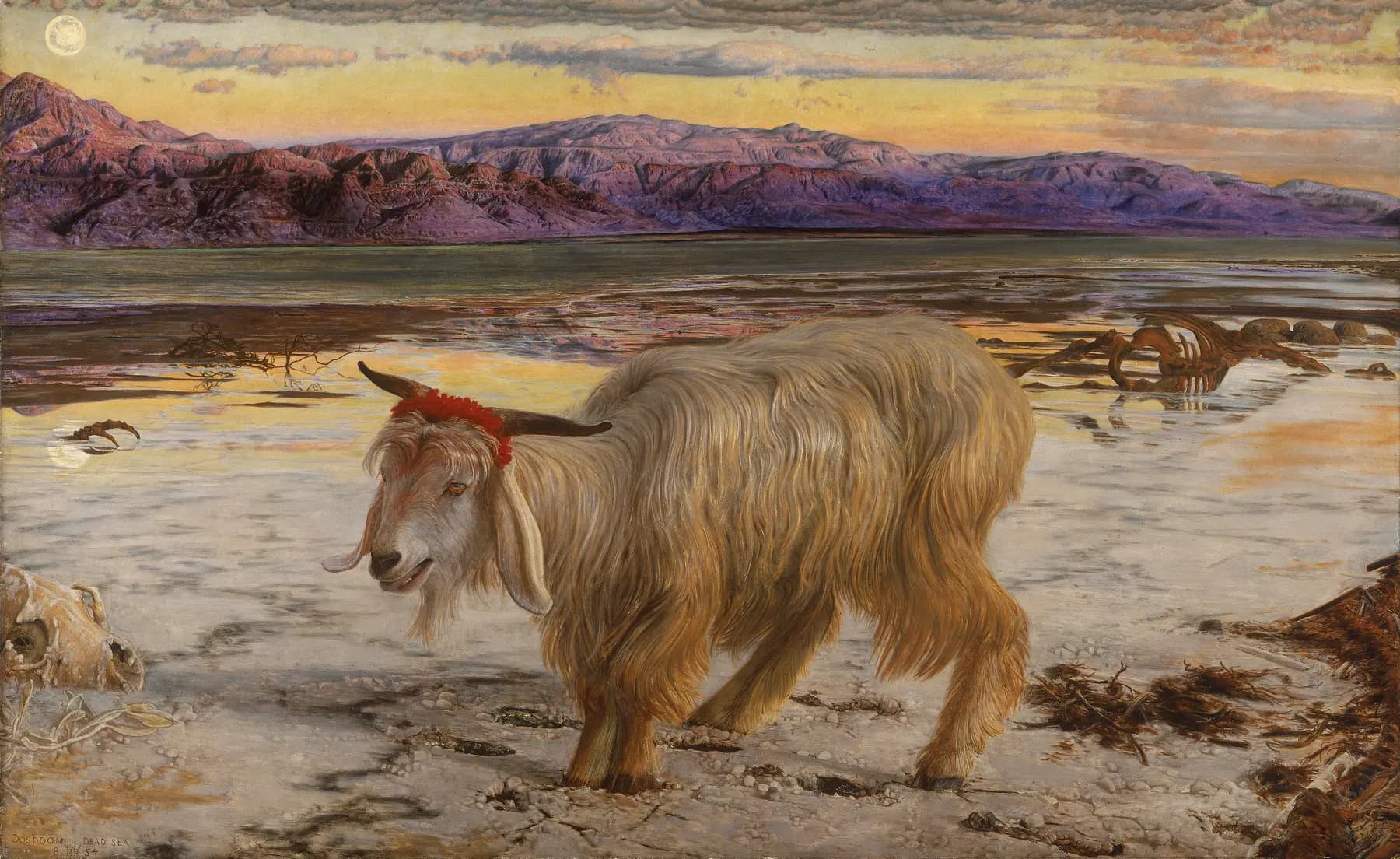
The Scapegoat, William Holman Hunt, 1854. Public domain.
Old Testament · Book 3 of 66
Leviticus
Leviticus gives the laws God spoke to Moses at Sinai for the offerings, the priesthood and purity. At its centre stands the Day of Atonement, when the high priest made atonement once a year for the whole people.
Leviticus gives the laws God spoke to Moses at Sinai for the offerings, the priesthood and purity. At its centre stands the Day of Atonement, when the high priest made atonement once a year for the whole people.
What is Leviticus about?
Leviticus is what the LORD says to Moses from the Tent of Meeting in the month after the tabernacle is raised at Sinai. It opens with five offerings by which a worshipper comes near. Aaron and his sons are then ordained as priests. The laws of clean and unclean follow, for food, birth, skin and the body. At its centre stands the Day of Atonement, when the high priest goes behind the veil once a year for the whole people. It ends with a holy life for the people, the priests, the calendar and the land, and gives its reason in God's own words: “be holy, because I am holy” (11:44).
All 27 chapters
Every chapter of the book, in one grid. Each cell opens that chapter.
- OfferingsLeviticus 1 to 7
- PriestsLeviticus 8 to 10
- Clean and uncleanLeviticus 11 to 15
- The Day of AtonementLeviticus 16
- Holy livingLeviticus 17 to 27
The colour is the movement of the book the chapter stands in, and every cell opens that chapter's Study level.
Who wrote it, where, when, for whom, and why?
Leviticus opens with the LORD calling to Moses and speaking to him from the Tent of Meeting (1:1), and it says the same of its laws three more times: after the offerings (7:37 and 38), after the blessings and curses (26:46), and in its last verse. Nehemiah's generation found written in the Law which the LORD had commanded through Moses that Israel was to live in booths at the feast of the seventh month (Nehemiah 8:14), the law of Leviticus 23:42. Luke calls the purification after childbirth the Law of Moses (Luke 2:22), and Hebrews reads the high priest's entry behind the veil as the law of the first covenant (Hebrews 9:1 to 10).
These are the commandments that the LORD gave to Moses for the Israelites on Mount Sinai.
Leviticus 27:34, Berean Standard Bible.
The whole book is spoken at one place, the Tent of Meeting in the camp at Mount Sinai (7:38 and 27:34). Israel does not move in Leviticus. The only journeys are those of a healed person coming back into the camp (14:8) and of the live goat led out into the wilderness (16:21 and 22).
The tabernacle is set up on the first day of the first month of the second year after Israel left Egypt (Exodus 40:17), and the LORD speaks again in the Tent of Meeting on the first day of the second month (Numbers 1:1). Leviticus stands between the two, within one month by the text's own count. The ordination of the priests takes seven days (8:33), and their service begins on the eighth (9:1).
Most of the book is spoken to the Israelites (1:2), and parts of it to Aaron and his sons (6:9). Any Israelite may bring an offering, the priests keep the law of each one, and the chapters on holy living are spoken to the whole congregation (19:2).
The book gives its reason in God's words: the people are to be holy because he is holy (11:44 and 45, 19:2), set apart from the nations to be his own (20:26), with his dwelling among them and himself walking among them as their God (26:11 and 12).
Leviticus stands in a camp in the wilderness around one tent. Behind the people is Egypt and ahead is Canaan, and the book forbids the practices of both (18:3). It names the goat demons some had sacrificed to (17:7) and Molech, to whom children were given (18:21). It looks toward a land the LORD is giving, where the first sheaf will be brought, the land will keep its Sabbath and the Jubilee will be proclaimed (23:10, 25:2 and 25:10).
Sources. Leviticus 1:1, 1:2, 6:9, 7:37 and 38, 8:33, 9:1, 11:44 and 45, 14:8, 16:21 and 22, 17:7, 18:3, 18:21, 19:2, 20:26, 23:10, 23:42, 25:2, 25:10, 26:11 and 12, 26:46 and 27:34; Exodus 40:17; Numbers 1:1; Nehemiah 8:14; Luke 2:22; Hebrews 9:1 to 10. Every verse is read in the Berean Standard Bible.
How is Leviticus arranged, and what is it for?
The five movements the book falls into, then what it teaches and what it was given to do.
- OfferingsLeviticus 1 to 7, 172 verses, the way in
Five offerings an Israelite may bring to the altar, and the priests' law for each.
- PriestsLeviticus 8 to 10, 80 verses, the way in
Aaron and his sons ordained, the first service, and the fire that kills two of them.
- Clean and uncleanLeviticus 11 to 15, 204 verses, the way in
Food, birth, skin, houses and the body, and how an unclean person is made clean.
- The Day of AtonementLeviticus 16, 34 verses, the centre
One day a year when the high priest goes behind the veil and the whole camp is cleansed.
- Holy livingLeviticus 17 to 27, 369 verses, the way out
A holy people, holy priests, holy times and a holy land, then blessing, curse and vows.
The theme
The holy God who has come to live in the middle of Israel's camp tells a people how to live near him. They come near by the blood of an offering brought through a priest, and they stay near by keeping the clean apart from the unclean and the holy apart from the common. Once a year the whole camp and the sanctuary are cleansed together, and from that day the holiness of the tent reaches the family, the neighbour, the calendar and the land.
The purpose
Leviticus was given so that Israel could live with the LORD in its midst and not die of his nearness, and so that it would be holy as he is holy. It gives the priests the law of the altar and gives every household the law of its table, its body and its year. It leaves Israel at Sinai with the tent served and the camp cleansed, which is where Numbers takes up the census and the march.
The book runs in to one day and out again
The stations (8)
- 1OfferingsLeviticus 1 to 7How a worshipper comes to the altar.
- 2PriestsLeviticus 8 to 10Who stands at the altar for the people.
- 3Clean and uncleanLeviticus 11 to 15What keeps a person from the tent, and the way back.
- 4The Day of AtonementLeviticus 16The sanctuary and the whole camp cleansed once a year.
- 5A holy peopleLeviticus 17 to 20Blood, the family, the neighbour and the nations.
- 6Holy priestsLeviticus 21 to 22The priests and the gifts held to a higher rule.
- 7Holy timesLeviticus 23 to 25The feasts, the lamp and the bread, the Sabbath year and the Jubilee.
- 8Blessing and vowsLeviticus 26 to 27The covenant's blessing and curse, and what is vowed to the LORD.
Offerings, Leviticus 1 to 7
What the text says in these 7 chapters, and the pages they open on.
The LORD calls to Moses from the tent his glory has just filled, and the first thing he gives is the way a worshipper may come near. Five offerings follow. The burnt offering is given whole to the altar, the grain offering is a gift of flour and oil, and the peace offering is a meal shared by the altar, the priests and the worshipper. The sin offering and the guilt offering answer a wrong once it is known, and the guilt offering adds repayment and a fifth more. Chapters 6 and 7 give the same offerings again as the priests' law, saying who eats what and where, and the section closes by naming them all as the LORD's command to Moses (7:37 to 38).
He is to lay his hand on the head of the burnt offering, so it can be accepted on his behalf to make atonement for him.
- Study
Leviticus 1the burnt offering, burned wholeShow the summary and 3 pagesShow summary, 3 pagesHide the summary
The burnt offering. The first of the five sacrifices and the most foundational. A bullock of the herd (or a sheep or goat or, for the poor, a turtledove or young pigeon), a male without blemish, offered at the door of the tabernacle. The offerer lays his hand on the head. Identification and transfer. Blood sprinkled round about the altar; the animal flayed, cut in pieces, and burned whole. ‘a pleasing aroma to the LORD.’ Calvin reads the chapter as a picture of total consecration; Henry, as the gospel preached before the cross. Everything of the offering goes up in flame. Nothing for the worshipper, all for God.
On this chapter (3)
- The sacrificial system
The offerings of Israel, what each was for, and how the New Testament reads them.
- The living sacrifice
Paul's call to offer the body as a living sacrifice.
- Leviticus 1:4
The verse on its own page, with the commentators on it by era.
- The sacrificial system
- Study
Leviticus 2the grain offering of flour, oil and frankincenseShow the summary and 2 pagesShow summary, 2 pagesHide the summary
The meat (grain) offering. Fine flour mixed with oil, frankincense upon it; or a meat offering baked in the oven, in the pan, or in the frying pan. Each of fine flour and oil, unleavened. No leaven and no honey burned on the altar; every meat offering seasoned with salt: ‘the salt of the covenant of your God’. The priest takes a handful as a memorial portion and burns it; the rest is for Aaron and his sons. Most holy. The chapter introduces the grain-offering vocabulary that the New Testament reaches for when it speaks of a pure and unmixed life offered up to God.
On this chapter (2)
- The sacrificial system
The offerings of Israel, what each was for, and how the New Testament reads them.
- Leviticus 2:2
The verse on its own page, with the commentators on it by era.
- The sacrificial system
- Study
Leviticus 3the peace offering, the meal the worshipper sharesShow the summary and 2 pagesShow summary, 2 pagesHide the summary
The peace offering. A fellowship sacrifice eaten with the LORD. Bullock or sheep or goat, male or female, without blemish. The fat, the kidneys, the caul above the liver are burned on the altar; the flesh is eaten in fellowship the same day (or the next). Unlike the burnt offering, the worshipper shares in the meal. This is the sacrifice of thanksgiving, vow, or freewill (ch. 7). JFB emphasises the communion dimension: God, priest, and people all partake. Paul's language of ‘fellowship’ and ‘communion’ in 1 Corinthians 10 reaches into the peace-offering category of the Old Testament altar.
On this chapter (2)
- The sacrificial system
The offerings of Israel, what each was for, and how the New Testament reads them.
- Leviticus 3:1
The verse on its own page, with the commentators on it by era.
- The sacrificial system
- Study
Leviticus 4the sin offering, by the rank of the one who sinnedShow the summary and 3 pagesShow summary, 3 pagesHide the summary
The sin offering. For sins done unwittingly. The anointed priest, the whole congregation, a ruler, a common person. The gradation of required victims matches the gradation of responsibility. For the priest or congregation, a bullock, with blood carried into the holy place and sprinkled before the veil and put on the horns of the incense altar; the body burned outside the camp. For the ruler, a male kid; for the common person, a female kid or a lamb, with blood only on the horns of the brazen altar. Hebrews 13:11–12 draws on ‘outside the camp’ for its Christology. Sins not foreseen require atonement; there is no sin small enough to leave unconfessed.
On this chapter (3)
- The sacrificial system
The offerings of Israel, what each was for, and how the New Testament reads them.
- The blood
The blood of the covenant, from the altar to the cross.
- Leviticus 4:3
The verse on its own page, with the commentators on it by era.
- The sacrificial system
- Study
Leviticus 5the guilt offering, with repayment and a fifthShow the summary and 2 pagesShow summary, 2 pagesHide the summary
The trespass offering continues the sin-offering law. A witness who refuses to testify; one who touches an unclean thing or a dead body; one who swears rashly. Each brings a trespass offering, with a graduated scale of victims down to two turtledoves or two young pigeons, and for the very poor a tenth part of an ephah of fine flour (without oil or frankincense, as befits a sin offering). Restitution for sanctuary trespass adds a fifth and pays in a ram without blemish. The chapter's care is pastoral: no Israelite, rich or poor, is beyond the reach of atonement.
On this chapter (2)
- The sacrificial system
The offerings of Israel, what each was for, and how the New Testament reads them.
- Leviticus 5:16
The verse on its own page, with the commentators on it by era.
- The sacrificial system
- Study
Leviticus 6the priests' law: the fire that never goes outShow the summary and 3 pagesShow summary, 3 pagesHide the summary
The law of the offerings for the priests. The burnt offering burns on the altar all night until morning; the fire is never put out. The meat offering. A handful burned, the rest eaten by the priests in the court. Aaron's own daily meat offering at his anointing and after: half in the morning, half at even, wholly burnt. The sin offering: where it is killed, there eaten by the priests; the blood sprinkled on a garment must be washed in the holy place; the earthen vessel that boiled its flesh broken, the brass vessel scoured. Holy vocation requires holy care.
On this chapter (3)
- The sacrificial system
The offerings of Israel, what each was for, and how the New Testament reads them.
- The priest
The priest who stands between God and the people.
- Leviticus 6:9
The verse on its own page, with the commentators on it by era.
- The sacrificial system
- Study
Leviticus 7the priests' portions and the summary at 7:37Show the summary and 2 pagesShow summary, 2 pagesHide the summary
The law of the trespass and peace offerings. Both most holy; both with their priestly portions. The right shoulder (heave offering) and the breast (wave offering) for Aaron and his sons. The peace offering must be eaten the day it is offered (if thanksgiving) or by the second day (if vow or freewill); after that, unclean. No fat eaten; no blood eaten: ‘whosoever eateth it shall be cut off from his people’. The chapter closes the five-offering opening of the book with a summary of the whole: ‘the law of the burnt offering, of the meat offering, of the sin offering, of the trespass offering, of the consecrations, of the sacrifice of the peace offerings’.
On this chapter (2)
- The sacrificial system
The offerings of Israel, what each was for, and how the New Testament reads them.
- Leviticus 7:37
The verse on its own page, with the commentators on it by era.
- The sacrificial system
Five offerings in the book's order, from the gift given whole to the debt repaid
- 1Burnt offering
- Brought
- A male without blemish from the herd or the flock, or birds (1:3, 1:14).
- The blood
- Sprinkled on all sides of the altar (1:5).
- Burned
- The whole animal is burned (1:9).
- Who eats
- No one.
- 2Grain offering
- Brought
- Fine flour with oil and frankincense, without yeast (2:1, 2:11).
- The blood
- No blood.
- Burned
- A handful burned as the memorial portion (2:2).
- Who eats
- Aaron and his sons eat the rest (2:3).
- 3Peace offering
- Brought
- A male or female without blemish (3:1).
- The blood
- Sprinkled on all sides of the altar (3:2).
- Burned
- The fat is burned (3:3 to 5).
- Who eats
- The priests take the breast and the right thigh (7:31 to 32); the worshipper eats the rest (7:15).
- 4Sin offering
- Brought
- A bull, a goat or a lamb, by the rank of the one who sinned (4:3, 4:23, 4:28, 4:32).
- The blood
- Put on the horns of the altar and poured at its base (4:7, 4:30).
- Burned
- The fat is burned (4:8 to 10).
- Who eats
- The priest eats it in the courtyard (6:26), unless its blood was brought into the tent (6:30).
- 5Guilt offering
- Brought
- A ram without blemish, with restitution and a fifth added (5:15 to 16).
- The blood
- Sprinkled on all sides of the altar (7:2).
- Burned
- The fat is burned (7:3 to 5).
- Who eats
- The male priests eat it in a holy place (7:6).
Characters (3)
Who the text names. A name with a page carries its door.
- Moses
Hears the LORD from the Tent of Meeting and gives his words to Aaron and the people.
- Aaron's sons, the priests
They sprinkle the blood, keep the fire and eat the most holy portions.
- The worshipper
Any Israelite who brings an animal, lays a hand on it and slaughters it at the tent.
Places (2)
Where the chapters stand.
- The Tent of Meeting
The tent the LORD speaks from at 1:1, and the one place the book never leaves.
- Sinai
The mountain where the whole book is given (7:38, 26:46, 27:34).
Themes (3)
What these chapters raise, each on its own page.
- The sacrificial system
The offerings of Israel and what each was for.
- The blood
Why the blood makes atonement, from the altar to the cross.
- The living sacrifice
Paul's call to offer the body to God.
Where the New Testament uses these chapters (2)each marked as a quotation or an allusion, with the evidence
- Probable allusionThe pleasing aroma, Leviticus 1:9 at Ephesians 5:2. Paul says that Christ gave himself up for us as a fragrant sacrificial offering to God, the language Leviticus uses of the burnt offering on the altar. Held by Paul.
- Probable allusionThe sin offering, Leviticus 4:3 to 35 at Romans 8:3. Paul says that God sent his Son as an offering for sin. The Greek Old Testament uses the same phrase for the sin offering of Leviticus 4 and 5. Held by Paul, read against the Greek Old Testament.
Priests, Leviticus 8 to 10
What the text says in these 3 chapters, and the pages they open on.
Moses washes Aaron and his sons, dresses them, anoints them and fills their hands, and for seven days they stay at the entrance to the tent (8:33). On the eighth day Aaron offers first for himself and then for the people, and fire comes out from the presence of the LORD and consumes the offering while the people shout and fall on their faces (9:24). The same day Aaron's sons Nadab and Abihu offer unauthorized fire, and fire from the LORD consumes them (10:1 to 2). The priests are then charged to distinguish between the holy and the common and between the clean and the unclean (10:10), which is the work of the chapters that follow.
Fire came out from the presence of the LORD and consumed the burnt offering and the fat portions on the altar. And when all the people saw it, they shouted for joy and fell facedown.
- Study
Leviticus 8Aaron and his sons ordained over seven daysShow the summary and 4 pagesShow summary, 4 pagesHide the summary
Aaron and his sons consecrated. Moses brings them to the door of the tabernacle; washes them with water; clothes Aaron with the coat, girdle, robe, ephod, breastplate (with Urim and Thummim), and mitre with the holy crown; anoints the tabernacle, its furnishings, Aaron, and his sons. Then the bullock of the sin offering; the ram of the burnt offering; the ram of consecration. Blood on the right ear, right thumb, right great toe of Aaron and each son. Seven days at the door of the tabernacle, day and night. ‘So Aaron and his sons did all things which the LORD commanded by the hand of Moses.’ The seven-day pattern foreshadows all later high-priestly pattern.
On this chapter (4)
- The priest
The priest who stands between God and the people.
- The high priestly line
Aaron's line from Sinai to the last high priests.
- A royal priesthood
The priesthood of the whole people of God.
- Leviticus 8:12
The verse on its own page, with the commentators on it by era.
- The priest
- Study
Leviticus 9the eighth day, and the glory appearing to the peopleShow the summary and 2 pagesShow summary, 2 pagesHide the summary
The eighth day. The first service. Aaron offers his own sin offering (a calf) and burnt offering (a ram) first; then for the people a kid for a sin offering, a calf and a lamb for burnt offerings, a bullock and a ram for peace offerings, and a meat offering. The glory of the LORD appears to all the people; fire comes out from before the LORD and consumes the burnt offering. The people shout and fall on their faces. The chapter is the book's joyful centre before the tragedy of chapter 10. Worship inaugurated with fire that descends from God, not fire that rises from man.
On this chapter (2)
- The priest
The priest who stands between God and the people.
- Leviticus 9:24
The verse on its own page, with the commentators on it by era.
- The priest
- Study
Leviticus 10Nadab and Abihu, and the charge to distinguishShow the summary and 3 pagesShow summary, 3 pagesHide the summary
Nadab and Abihu offer strange fire before the LORD ‘which he commanded them not’. Fire goes out from the LORD and devours them; they die before the LORD. Moses: ‘this is it that the LORD spake, saying, I will be sanctified in them that come nigh me’. Aaron holds his peace. The bodies are carried out. Aaron and his remaining sons are forbidden to mourn; the people mourn for them. Strong drink forbidden for priests on duty. Moses is angry at Eleazar and Ithamar for not eating the sin offering; Aaron answers wisely. The chapter's warning is stern: the holy God accepts only the worship he commands.
On this chapter (3)
- The priest
The priest who stands between God and the people.
- Why did Nadab and Abihu die?
Answered under Where do readers disagree, lower on this page, with each reading and who holds it.
- Leviticus 10:10
The verse on its own page, with the commentators on it by era.
- The priest
Characters (3)
Who the text names. A name with a page carries its door.
- Aaron
Moses' brother, ordained the first high priest, the one who goes behind the veil once a year.
- Nadab and Abihu
Aaron's eldest sons, consumed by fire for offering unauthorized fire.
- Eleazar and Ithamar
Aaron's surviving sons, told not to mourn in the way of the people (10:6).
Places (1)
Where the chapters stand.
- The altar
Where the fire from the LORD falls on the eighth day.
Themes (3)
What these chapters raise, each on its own page.
- The priest
The one who stands between God and the people.
- The high priestly line
Aaron's line through the centuries.
- A royal priesthood
The priesthood of the whole people of God.
Where the New Testament uses these chapters (1)each marked as a quotation or an allusion, with the evidence
- Probable allusionFirst for his own sins, Leviticus 9:7 at Hebrews 7:27. Hebrews says that Christ does not need to offer first for his own sins and then for the people's, the order Moses gives Aaron at the altar on the eighth day. Held by The writer to the Hebrews.
Clean and unclean, Leviticus 11 to 15
What the text says in these 5 chapters, and the pages they open on.
Chapter 11 sorts the animals Israel may eat from those it may not, on land, in the water, in the air and along the ground. Chapter 12 gives the days of purification after childbirth, and chapters 13 and 14 give the priest's examination of a skin disease, the rite that restores a healed person, and the law of a mould in a house. Chapter 15 covers discharges of the body. Uncleanness here is a state that bars a person from the holy things until it is ended by water, by time and by offering, and the reason given is the tabernacle standing among the people (15:31).
For I am the LORD, who brought you up out of the land of Egypt so that I would be your God; therefore be holy, because I am holy.
- Study
Leviticus 11the animals that may be eaten and those that may notShow the summary and 3 pagesShow summary, 3 pagesHide the summary
Clean and unclean animals. Of beasts. The cloven-hoofed cud-chewer. Of fish. Fins and scales. Of birds. A list of the forbidden. Of flying things that go on all four. Those with legs above their feet to leap withal. The carcasses of unclean creatures defile; the rules for vessels and water and wells. ‘For I am the LORD your God; consecrate yourselves, therefore, and be holy, because I am holy.’ The chapter's discipline is pedagogical: holiness is practised in the ordinary. What enters the mouth, what is touched. Acts 10 lifts the dietary distinction; the holiness principle it carried remains.
On this chapter (3)
- What are the food laws for?
Answered under Where do readers disagree, lower on this page, with each reading and who holds it.
- Which of these laws bind the church?
Answered under Where do readers disagree, lower on this page, with each reading and who holds it.
- Leviticus 11:45
The verse on its own page, with the commentators on it by era.
- What are the food laws for?
- Study
Leviticus 12purification after childbirthShow the summary and 1 pageShow summary, 1 pageHide the summary
Purification after childbirth. A woman who bears a man-child is unclean seven days, her separation thirty-three days; a maid-child, fourteen and sixty-six days. At the end, she brings a lamb of the first year for a burnt offering and a young pigeon or turtledove for a sin offering; if she cannot afford a lamb, two turtledoves or two young pigeons. Atonement is made and she is clean. Luke 2:22–24 records Mary's offering of the two birds. The poor woman's offering. At Jesus' presentation. The chapter normalises the ordinary events of human life into the regime of holiness.
On this chapter (1)
- Leviticus 12:8
The verse on its own page, with the commentators on it by era.
- Leviticus 12:8
- Study
Leviticus 13the priest examines a skin diseaseShow the summary and 2 pagesShow summary, 2 pagesHide the summary
Identification of leprosy. The priest is the examiner. House-by-house, garment-by-garment, body-by-body. White hair, deep-lying skin, raw flesh in the rising: uncleanness. The leper rends his clothes, covers his upper lip, cries ‘unclean, unclean’, and dwells alone outside the camp. Clothes and skins with the plague are burned. The chapter's 59 verses set a careful case law for a disease the ancient world could neither cure nor easily name. Henry reads it as the figure of sin; Gill notes the priestly function of diagnosis before cleansing. A disease that separates is met with ceremony and discipline.
On this chapter (2)
- Naaman the leper
The Syrian commander healed in the Jordan.
- Leviticus 13:46
The verse on its own page, with the commentators on it by era.
- Naaman the leper
- Study
Leviticus 14the healed person restored, and the mould in a houseShow the summary and 1 pageShow summary, 1 pageHide the summary
The law of cleansing a leper. The priest goes outside the camp; two living clean birds, cedar wood, scarlet, hyssop. One bird killed over running water; the living bird dipped in its blood with the cedar and scarlet and hyssop, then set free. The cleansed man washes his clothes, shaves off all his hair, bathes, and is re-admitted to the camp (but not yet to his tent). On the eighth day, sin, trespass, and burnt offerings; blood and oil on right ear, thumb, and great toe. The priestly pattern applied to the restored. The same law for mildew in a house. Jesus' healings of lepers (Mark 1:44) send them to this chapter's priest.
On this chapter (1)
- Leviticus 14:4
The verse on its own page, with the commentators on it by era.
- Leviticus 14:4
- Study
Leviticus 15discharges of the body, and the reason at 15:31Show the summary and 1 pageShow summary, 1 pageHide the summary
Laws of bodily discharges. An issue of the flesh. Men and women both. Renders unclean. Time-limited uncleanness for menstruation; extended uncleanness for chronic issue. Washing, time, and a sin offering and burnt offering after seven days of clean. ‘You must keep the children of Israel separate from their uncleanness, so that they do not die by defiling My tabernacle, which is among them.’ The chapter takes the body's normal functions into the regime of holiness. Mark 5:25–34. The woman with the issue of blood. Reads Jesus' healing against this chapter's twelve years of ritual exclusion.
On this chapter (1)
- Leviticus 15:31
The verse on its own page, with the commentators on it by era.
- Leviticus 15:31
Three states and the four ways between them
Holy
What belongs to God: the sanctuary, the priests on duty, the most holy portions.
Where: The court, the Holy Place and the Most Holy Place
Clean
The ordinary state of a person or thing, free to come to the tent.
Where: The camp
Unclean
Barred from the holy things until cleansed, by water, by time and by offering.
Where: Outside the camp, for skin disease (13:46)
The ground they stand on, from the innermost outward
The Most Holy Place
The high priest alone, once a year (16:2, 16:34)
Holy
The Holy Place
Outside the veil, where Aaron tends the lamps (24:3)
Holy
The court
The altar, where the offering is brought (1:3) and the priests eat their portion (6:16)
Holy
The camp
Where the clean live around the tent
Clean
Outside the camp
Where one with a skin disease lives alone (13:46)
Unclean
Characters (1)
Who the text names. A name with a page carries its door.
- The priest
Examines the skin, declares clean or unclean, and goes outside the camp to the healed.
Places (2)
Where the chapters stand.
- The camp
Where the clean live around the tent.
- Outside the camp
Where a person with a skin disease lives alone until healed (13:46).
Themes (2)
What these chapters raise, each on its own page.
- Naaman the leper
A skin disease healed in the Jordan.
- The law fulfilled
What Jesus said he came to do with the law.
Where the New Testament uses these chapters (3)each marked as a quotation or an allusion, with the evidence
- Probable allusionThe food laws, Leviticus 11:1 to 47 at Mark 7:19; Acts 10:14 to 15. Mark adds that Jesus declared all foods clean, and Peter answers the vision that he has never eaten anything impure or unclean, the categories of Leviticus 11. Held by Mark, and Peter as Luke records him.
- Explicit quotationThe poor mother's offering, Leviticus 12:8 at Luke 2:22 to 24. Luke says that Mary and Joseph offered the sacrifice specified in the Law, a pair of turtledoves or two young pigeons, the offering Leviticus allows a mother who cannot afford a lamb. Held by Luke.
- Explicit quotationThe cleansed man shown to the priest, Leviticus 14:2 to 32 at Mark 1:44. Jesus tells the man he has healed to show himself to the priest and present the offering Moses prescribed for his cleansing. Held by Jesus, as Mark records him.
The Day of Atonement, Leviticus 16
What the text says in this one chapter, and the pages it opens on.
The chapter opens after the death of Aaron's two sons, with the warning that Aaron may not enter behind the veil whenever he chooses (16:1 to 2). Once a year, on the tenth day of the seventh month, he bathes, puts on plain linen and offers a bull for himself. Two goats are chosen by lot. The blood of the bull and of the LORD's goat is sprinkled on the mercy seat behind the veil, and the altar is cleansed with it. Aaron then lays both hands on the live goat, confesses over it all the sins of Israel and sends it into the wilderness. The day ends with the people cleansed from all their sins before the LORD (16:30).
The goat will carry on itself all their iniquities into a solitary place, and the man will release it into the wilderness.
- Study
Leviticus 16the high priest behind the veil and the two goatsShow the summary and 6 pagesShow summary, 6 pagesHide the summary
The Day of Atonement. The book's centre. Aaron must not come at all times into the holy place within the veil, lest he die; for the LORD appears in the cloud upon the mercy seat. Once a year he enters. First a bullock for his own sin, then two goats for the sin of the people. One goat slain as the sin offering; the blood sprinkled on and before the mercy seat. The second goat is the scapegoat. Azazel. Sent away by the hand of a fit man into the wilderness: ‘The goat will carry on itself all their iniquities into a solitary place’. Fine linen garments; the camp cleansed. Hebrews 9–10 reads the whole chapter as the shadow whose substance is Christ entering once into the holy place.
On this chapter (6)
- The Day of Atonement
The one day a year behind the veil, and Hebrews on it.
- The mercy seat
The lid of the ark, where the blood was sprinkled.
- The veil
The veil before the Most Holy Place.
- 1 Enoch
The book that names Azazel among the fallen watchers.
- What is Azazel?
Answered under Where do readers disagree, lower on this page, with each reading and who holds it.
- Leviticus 16:30
The verse on its own page, with the commentators on it by era.
- The Day of Atonement
The high priest's path on the one day, in seven stations
- The goat for the LORD
- The scapegoat
- 1Washed and dressed in linen
He bathes and puts on the plain linen tunic, sash and turban.
- 2The bull for himself
A sin offering for himself and his household comes first.
- 3Two goats and the lot
Lots fall on two goats, one for the LORD and one as the scapegoat.
- 4Incense and blood behind the veil
The cloud of incense covers the mercy seat, and the blood of the bull and of the LORD's goat is sprinkled on it.
- 5The altar cleansed
Blood of both animals goes on the horns of the altar.
- 6The live goat sent away
Both hands on its head, the sins confessed, and the goat released into the wilderness.
- 7Burned outside the camp
The remains of the bull and the goat are burned outside the camp.
Characters (2)
Who the text names. A name with a page carries its door.
- Aaron on the day
Bathes, puts on linen and goes behind the veil with the blood, once a year (16:4, 16:34).
- The man appointed
Leads the live goat into the wilderness and bathes before he returns (16:21, 16:26).
Places (2)
Where the chapters stand.
- The Most Holy Place
Behind the veil, where the mercy seat stands over the ark.
- The wilderness
Where the live goat carries the sins into a solitary place (16:22).
Themes (3)
What these chapters raise, each on its own page.
- The Day of Atonement
The day, and Hebrews on it.
- The mercy seat
Where the blood was sprinkled.
- The veil
The curtain before the ark.
Where the New Testament uses these chapters (2)each marked as a quotation or an allusion, with the evidence
- Explicit quotationOnce a year behind the veil, Leviticus 16:2 to 34 at Hebrews 9:7, 9:25. Hebrews names the rite of the day: only the high priest entered the second room, once a year and never without blood, and it reads Christ's entry into heaven against it. Held by The writer to the Hebrews.
- Explicit quotationBurned outside the camp, Leviticus 16:27 at Hebrews 13:11 to 12. Hebrews says that the bodies of the animals whose blood the high priest brings in are burned outside the camp, and that Jesus suffered outside the city gate. Held by The writer to the Hebrews.
Holy living, Leviticus 17 to 27
What the text says in these 11 chapters, and the pages they open on.
From chapter 17 the book turns to the life of the whole people. The blood belongs at the altar because the life is in it (17:11). The family and the body are kept from the practices of Egypt and Canaan (18:3), and chapter 19 sets love of the neighbour beside honest measures, wages paid before morning and the gleanings left for the poor. The priests and the gifts are held to a stricter rule (21 and 22). Chapter 23 sets the appointed times of the year, and chapter 25 gives the land a Sabbath every seventh year and the Jubilee in the fiftieth. The covenant closes with blessing and curse and the promise that God will not reject his people in exile (26:44), and a last chapter on vows and tithes.
Do not seek revenge or bear a grudge against any of your people, but love your neighbor as yourself. I am the LORD.
- Study
Leviticus 17the blood belongs at the altarShow the summary and 3 pagesShow summary, 3 pagesHide the summary
The blood of atonement. All sacrifices must be brought to the door of the tabernacle; no more altars in the field. Any Israelite or stranger who eats blood is cut off. ‘For the life of the flesh is in the blood: and I have given it to you upon the altar to make an atonement for your souls: for it is the blood that maketh an atonement for the soul.’ The verse is the book's theological anchor. Blood is not food; blood is life; life carries guilt and pays guilt. Hebrews 9:22 (‘without the shedding of blood there is no forgiveness’) rests here. The chapter bridges the sacrificial system (1–16) and the holiness code (17–26) that follows.
On this chapter (3)
- The blood
The blood of the covenant, from the altar to the cross.
- The sacrificial system
The offerings of Israel, what each was for, and how the New Testament reads them.
- Leviticus 17:11
The verse on its own page, with the commentators on it by era.
- The blood
- Study
Leviticus 18the practices of Egypt and Canaan forbiddenShow the summary and 1 pageShow summary, 1 pageHide the summary
Sexual ethics under the holiness code. The introduction sets the context: do not after the doings of Egypt where you dwelt, nor after the doings of Canaan whither I bring you. Prohibitions of incest in careful concentric rings; adultery; Molech. The fire-child offering to a god of death; homosexual acts; bestiality. ‘For all these abominations have the men of the land done … and the land is defiled; therefore do I visit the iniquity thereof upon it, and the land itself vomiteth out her inhabitants.’ The chapter warns that moral defilement pollutes land as truly as blood does. Gill: moral holiness is a matter of the land's endurance, not merely the household's honor.
On this chapter (1)
- Leviticus 18:5
The verse on its own page, with the commentators on it by era.
- Leviticus 18:5
- Study
Leviticus 19be holy, and love your neighbour as yourselfShow the summary and 2 pagesShow summary, 2 pagesHide the summary
The holiness code proper. ‘Be holy because I, the LORD your God, am holy.’ The chapter weaves together cultic, social, and moral commands as one fabric. Reverence for father and mother, Sabbath, no idols, peace offerings eaten within two days, gleanings left for the poor and the stranger, no stealing, no lying, no swearing falsely, no withholding wages, no mocking of the deaf or tripping of the blind, no respect of persons in judgment, no hatred of brother, no grudge, no vengeance: ‘love your neighbor as yourself. I am the LORD.’ (19:18). Jesus cites this verse as the second great commandment (Matt 22:39).
On this chapter (2)
- Love one another
The command to love, from Leviticus 19 to the upper room.
- Leviticus 19:18
The verse on its own page, with the commentators on it by era.
- Love one another
- Study
Leviticus 20the penalties, and set apart from the nationsShow the summary and 1 pageShow summary, 1 pageHide the summary
Penalties for the holiness-code violations of chapter 18. Molech; familiar spirits and wizards; cursing father or mother; adultery; incest; bestiality; homosexual acts. The penalties range from death to childlessness to being cut off from the people. ‘Consecrate yourselves, therefore, and be holy, because I am the LORD your God. And you shall keep My statutes and practice them. I am the LORD who sanctifies you.’ The chapter is the courtroom for chapter 18's catechism. Henry: Scripture does not publish the moral code without publishing its sanction. The land that vomited out the Canaanites will not indulge the same abominations in Israel.
On this chapter (1)
- Leviticus 20:26
The verse on its own page, with the commentators on it by era.
- Leviticus 20:26
- Study
Leviticus 21the priests held to a stricter ruleShow the summary and 2 pagesShow summary, 2 pagesHide the summary
Holiness of priests. Priests are not to be defiled for the dead except for the closest kin; not to mar their heads or beards; not to marry a harlot or a profane or divorced woman. The high priest, with higher consecration, must marry a virgin of his own people and not go in to any dead, not even father or mother. Physical blemishes (blind, lame, disfigured, crippled) disqualify from priestly service at the altar, though the priest still eats of the holy bread. The chapter insists that mediators represent the perfection of the holy God they serve. Hebrews 7:26 applies the chapter's logic to the great High Priest.
On this chapter (2)
- The priest
The priest who stands between God and the people.
- Leviticus 21:8
The verse on its own page, with the commentators on it by era.
- The priest
- Study
Leviticus 22the holy gifts and who may eat themShow the summary and 2 pagesShow summary, 2 pagesHide the summary
Priestly handling of the holy things. Priests with any uncleanness must not eat of the holy things on pain of being cut off. No stranger may eat of them; a slave born in the house or bought with money may; a daughter married to a stranger may not (returning widowed without children, she may). Sacrificial animals must be without blemish. No blind, broken, maimed, wen-afflicted, scurvy, or scabbed; no animal under eight days old; no mother and young slain the same day. ‘You must not profane My holy name. I must be acknowledged as holy among the Israelites. I am the LORD who sanctifies you … I am the LORD.’
On this chapter (2)
- The priest
The priest who stands between God and the people.
- Leviticus 22:32
The verse on its own page, with the commentators on it by era.
- The priest
- Study
Leviticus 23the Sabbath and the seven appointed timesShow the summary and 7 pagesShow summary, 7 pagesHide the summary
The seven appointed feasts. Sabbath weekly; Passover on the fourteenth day of the first month; Unleavened Bread seven days; the wave sheaf of Firstfruits the morrow after the sabbath of Passover week; Pentecost (Weeks) seven weeks after; Trumpets on the first of the seventh month; Atonement on the tenth; Tabernacles seven days from the fifteenth, with the eighth-day holy convocation. ‘These are my feasts.’ The calendar teaches Israel's year to rehearse the story of redemption. Acts 2 is Pentecost; the Firstfruits morrow-after-sabbath pattern is claimed for resurrection in 1 Cor 15:20. The feasts are a rehearsal the gospel will repay.
On this chapter (7)
- The Hebrew feasts
The appointed times of Israel's year, read in order.
- Firstfruits
The first sheaf of the harvest, and Christ the firstfruits.
- Unleavened bread
The week of bread without yeast after the Passover.
- Trumpets
The day of trumpet blasts in the seventh month.
- Tabernacles
The feast of booths at the harvest's end.
- The Day of Atonement
The one day a year behind the veil, and Hebrews on it.
Show the next 1
- Leviticus 23:2
The verse on its own page, with the commentators on it by era.
- The Hebrew feasts
- Study
Leviticus 24the lamp, the bread, and the blasphemer's caseShow the summary and 1 pageShow summary, 1 pageHide the summary
The lampstand, the shewbread, and the blasphemer. Pure oil olive beaten for the light. Aaron to order it before the LORD continually. Twelve cakes of fine flour on the pure table, set in two rows of six, with frankincense on each row; a memorial burned, the bread itself for Aaron and his sons. Then the son of an Israelite woman and an Egyptian blasphemes the Name; he is put in ward until the LORD's mind is made known; the LORD orders him stoned outside the camp, with every one who heard laying his hand on the head. The lex talionis is restated: life for life, eye for eye. Applied to stranger and native alike.
On this chapter (1)
- Leviticus 24:16
The verse on its own page, with the commentators on it by era.
- Leviticus 24:16
- Study
Leviticus 25the Sabbath year and the JubileeShow the summary and 4 pagesShow summary, 4 pagesHide the summary
The Sabbatical year and the Jubilee. Every seventh year the land rests. Sown and reaped not; what it yields of itself is common food. Every fiftieth year, on the tenth day of the seventh month (the Day of Atonement), a trumpet sounds, liberty is proclaimed throughout the land. Slaves returned to their families, land returned to its original clans. ‘The land must not be sold permanently, because it is Mine, and you are but foreigners and residents with Me.’ Economic liberty anchored in theological ownership. Jesus in Luke 4 quotes Isa 61, reading the acceptable year of the LORD in the pattern of the Jubilee.
On this chapter (4)
- The Jubilee
The fiftieth year of liberty and return.
- Sabbath rest
The seventh day from creation to the rest that remains.
- Was the Jubilee ever kept?
Answered under Where do readers disagree, lower on this page, with each reading and who holds it.
- Leviticus 25:10
The verse on its own page, with the commentators on it by era.
- The Jubilee
- Study
Leviticus 26blessing and curse, and a covenant kept in exileShow the summary and 1 pageShow summary, 1 pageHide the summary
Blessings and curses. If you walk in my statutes and keep my commandments, rain in due season, the land yielding her increase, peace, the sword not through your land, fruitfulness, and my tabernacle among you. If not. Terror, consumption, fever; enemies eating your increase; the heavens iron and the earth brass; wild beasts, the sword, pestilence, famine. The curses escalate sevenfold for persistent refusal, ending in exile and a scattered people. And yet: ‘if they shall confess their iniquity … then will I remember my covenant with Jacob, and also my covenant with Isaac, and also my covenant with Abraham’. The chapter is the prophets' quarry for centuries.
On this chapter (1)
- Leviticus 26:12
The verse on its own page, with the commentators on it by era.
- Leviticus 26:12
- Study
Leviticus 27vows, valuations and the titheShow the summary and 1 pageShow summary, 1 pageHide the summary
Vows and dedications. The book's appendix. A person vowed to the LORD is redeemed by a graduated valuation (age and sex). A beast may be changed only with a penalty. A house vowed to the LORD is valued and redeemed with a fifth added. Land vowed is valued by the years to the Jubilee. The firstborn of clean beasts is already the LORD's and cannot be vowed. Devoted things (cherem) are most holy; a man devoted cannot be redeemed but must die. The tithe of the land belongs to the LORD; redeemed by adding a fifth. ‘These are the commandments, which the LORD commanded Moses for the children of Israel in mount Sinai.’ The book ends where it began. At the mount.
On this chapter (1)
- Leviticus 27:30
The verse on its own page, with the commentators on it by era.
- Leviticus 27:30
The year of seven feasts inside the fifty years of the Jubilee
The appointed times (7)
Characters (2)
Who the text names. A name with a page carries its door.
- The son of Shelomith
The son of an Israelite mother and an Egyptian father, stoned for blaspheming the Name (24:10 to 23).
- The foreigner
The stranger living among Israel, to be loved as oneself (19:34).
Places (2)
Where the chapters stand.
- Egypt
The land Israel came out of, whose practices it must leave behind (18:3).
- Canaan
The land ahead, which the LORD says will vomit out a defiled people (18:25, 18:28).
Themes (6)
What these chapters raise, each on its own page.
- The Hebrew feasts
The appointed times of chapter 23.
- The Jubilee
The fiftieth year of liberty.
- Firstfruits
The first sheaf, and Christ the firstfruits.
- Sabbath rest
The seventh day and the seventh year.
Show the next 2
- Love one another
The command to love the neighbour.
- The fear of the LORD
Fear your God, the reason Leviticus 19 gives again and again.
Where the New Testament uses these chapters (7)each marked as a quotation or an allusion, with the evidence
- Probable allusionThe blood that makes atonement, Leviticus 17:11 at Hebrews 9:22. Hebrews says that according to the law nearly everything is purified with blood, and without the shedding of blood there is no forgiveness. Held by The writer to the Hebrews.
- Explicit quotationThe man who does these things, Leviticus 18:5 at Romans 10:5; Galatians 3:12. Paul quotes the verse twice, naming Moses as its writer in Romans: the man who does these things will live by them. Held by Paul.
- Explicit quotationLove your neighbour as yourself, Leviticus 19:18 at Matthew 22:39; Romans 13:9; Galatians 5:14; James 2:8. Jesus names it the second commandment, like the first. Paul says the whole law is summed up in it, and James calls it the royal law. Held by Jesus as Matthew records him, Paul, and James.
- Explicit quotationBe holy, because I am holy, Leviticus 11:44 to 45; 19:2 at 1 Peter 1:16. Peter quotes the command with the formula for it is written and gives it to the church. Held by Peter.
- Probable allusionThe sheaf of firstfruits, Leviticus 23:10 to 11 at 1 Corinthians 15:20. Paul calls the risen Christ the firstfruits of those who have fallen asleep, the name of the sheaf brought to the priest at the start of the harvest. Held by Paul.
- Explicit quotationEye for eye, Leviticus 24:20 at Matthew 5:38. Jesus quotes the rule as what was said. It stands also at Exodus 21:24 and Deuteronomy 19:21, so the quotation is not of Leviticus alone. Held by Jesus, as Matthew records him.
- Explicit quotationI will walk among you, Leviticus 26:11 to 12 at 2 Corinthians 6:16. Paul quotes the promise that God will dwell with his people and walk among them, joining it to the same promise in the prophets. Held by Paul.
- Author
- Moses, receives these laws at Sinai; the repeated formula is ‘the LORD spake unto Moses, saying’
- Date
- Composed during Israel's year at Sinai (15th–13th century BC)
- Audience
- The priesthood primarily; the laity through the priests
Where do readers disagree?
One list: the readings with their holders, and what the evidence does not settle.
Who wrote Leviticus, and when?
- Moses, at Sinai. Held by Matthew Henry, who reads 1:1 as Moses writing down what he heard from the mercy seat, and by the Talmud, which names Moses as the writer of his book (Bava Batra 14b to 15a).
- A priestly source written after Moses. Held by Julius Wellhausen, Prolegomena to the History of Israel (1878), and the documentary hypothesis after him.
- A priestly source older than the exile. Held by Jacob Milgrom, Leviticus 1 to 16 (1991), and Israel Knohl, The Sanctuary of Silence (1995).
What the evidence does not settle: Whether the formula the LORD spoke to Moses marks the origin of each law or the unit it heads, and how far the linguistic dating can be pressed; the critical school is itself divided on the date of the priestly writing.
The argument in full
Moses, at Sinai. The book says more than thirty times that the LORD spoke to Moses, and it closes by calling itself the commandments the LORD gave Moses on Mount Sinai (27:34). The New Testament calls its laws what Moses prescribed (Mark 1:44).
A priestly source written after Moses. The book's ritual language and its concern for one sanctuary and one priesthood are read as the work of a priestly school, dated by Wellhausen to the exile or after.
A priestly source older than the exile. The language of the priestly laws is older than the Hebrew of the exile, and parts of it are older than Deuteronomy, so even a source reading need not date the book late.
What is Azazel?
The Day of Atonement, argued in full→- A place in the wilderness. Held by the Mishnah (Yoma 6:6) and by Rashi in his Commentary on the Torah, on 16:8.
- A being of the wilderness. Held by Albert Barnes in his Notes on the Old Testament, who reads Azazel as the name of an evil personal being set against the LORD; 1 Enoch 8:1 and 10:4 to 8 names Azazel as a leader of the fallen watchers, bound in the desert.
- The goat that goes away. Held by the Greek Old Testament, which renders it the one sent away, and by William Tyndale, who coined the English word scapegoat (1530).
What the evidence does not settle: The word stands only in Leviticus 16 and nowhere else in the Hebrew Bible, so no other use decides it; each reading keeps the point of the rite, which is that the sins are carried away (16:22).
The argument in full
A place in the wilderness. The goat is led to a rugged cliff in the wilderness, and the word names the place it is sent to.
A being of the wilderness. The lot is cast for the LORD and for Azazel (16:8), so the word is read as a name set beside the LORD's.
The goat that goes away. The word is read as a description of what happens to the goat, and the Berean Standard Bible prints scapegoat.
What are the food laws for?
- Health. Held in part by Moses Maimonides, The Guide for the Perplexed (1190), III.48.
- A lesson in order and wholeness. Held by Mary Douglas, Purity and Danger (1966).
- A boundary between Israel and the nations. Held by John Calvin, on 11:1 to 8, and grounded in 20:24 to 26.
What the evidence does not settle: The chapter gives the LORD's holiness as its reason (11:44 and 45) and names no medical reason, so what the list meant beyond that is an inference from the list.
The argument in full
Health. Some of the forbidden animals carried disease, and the laws kept Israel from harm.
A lesson in order and wholeness. The clean animals are those that fit the kind of their habitat, and the unclean are those that cross its lines, so the table teaches the holiness of an ordered world.
A boundary between Israel and the nations. The LORD sets Israel apart from the nations and tells it therefore to distinguish clean animals from unclean, so the table marks a separated people.
The New Testament ends the food laws for the church without saying what they were for: Mark adds that Jesus declared all foods clean (Mark 7:19), and Peter's vision tells him not to call impure what God has made clean (Acts 10:15).
Why did Nadab and Abihu die?
- Fire from the wrong source. Held by John Wesley, who reads the fire as taken from a common fire and not from the altar.
- Wine. Held by Matthew Henry, on 10:1 and 2, and by Leviticus Rabbah 12:1.
- An office that was not theirs. Held by Robert Jamieson, A. R. Fausset and David Brown, who read the fault as taking up the incense service unbidden.
What the evidence does not settle: What made the fire unauthorized, since the text says only that the LORD had not commanded it.
The argument in full
Fire from the wrong source. The fire on the altar came from the LORD (9:24) and was never to go out (6:13), and they offered fire the LORD had not commanded (10:1).
Wine. The command that follows forbids the priests wine when they enter the tent (10:9), and it is read as naming the cause.
An office that was not theirs. The warning at 16:1 and 2 that Aaron may not enter behind the veil whenever he chooses recalls their death as they approached the presence of the LORD.
Was the Jubilee ever kept?
The Jubilee→- Left unkept. Held by John Wesley, on 2 Chronicles 36:21.
- Kept in part, and read forward. Held by Robert Jamieson, A. R. Fausset and David Brown, on Isaiah 61:1 and 2.
What the evidence does not settle: Whether silence in the historical books means the year was never kept, since they record few of the feasts either.
The argument in full
Left unkept. Chronicles says the land lay desolate to make up its Sabbaths (2 Chronicles 36:21), which he reads as the seventh years Israel ploughed through, and the historical books record no Jubilee proclaimed.
Kept in part, and read forward. Zedekiah's people released their slaves and then took them back (Jeremiah 34:8 to 17), and Isaiah's year of the LORD's favour is read as the Jubilee's liberty, which Jesus reads at Nazareth (Luke 4:18 and 19).
Which of these laws bind the church?
- The moral law abides; the ceremonial and civil laws are fulfilled. Held by Thomas Aquinas, Summa Theologiae I-II, question 99, and by the Westminster Confession of Faith, chapter 19 (1646).
- The ban on blood still binds. Held by John Wesley, on Acts 15:29.
- The ban on blood was for a time. Held by Matthew Henry, on Acts 15:20.
What the evidence does not settle: Where the line falls in a given law, since the New Testament repeats some laws of Leviticus (Matthew 22:39; 1 Peter 1:16), sets others aside (Mark 7:19; Hebrews 10:1 to 14) and keeps a few for the Gentile churches (Acts 15:28 and 29).
The argument in full
The moral law abides; the ceremonial and civil laws are fulfilled. The law is read in three kinds: the moral law, such as love of the neighbour, still binds, and the offerings, the priesthood and the food laws are fulfilled in Christ.
The ban on blood still binds. The ban was given to Noah (Genesis 9:4), renewed at 17:10 to 14, and kept for the Gentile churches at Acts 15:29, and nothing in the New Testament repeals it.
The ban on blood was for a time. The council asked the Gentile churches to keep from blood so as not to offend the Jews among them, and the rule was not meant to be kept always.
The pages Leviticus opens on
Studies138
- The Sacrificial System
- The Day of Atonement
- The Priest
- The High Priestly Line
- A Royal Priesthood
- The Blood
Show the next 6 titles
Show the next 6 titles
Show the next 6 titles
- The Fear of the LORD
- Melchizedek
- 1 Enoch
- Clean and Unclean
- Cut Off from Among His People
- Ezekiel, the Study Guide
Show the next 6 titles
- The Fall Feasts
- Gleaning and the corner of the field
- Be Holy, Because I Am Holy
- Molech and Topheth
- Restitution and the Added Fifth
- The Appointed Times Read as a Calendar of Prophecy
Show the next 6 titles
- The blood rule after the cross
- The Christian Year
- The Covenant of Salt
- The Grain Offering
- The Hebrew Calendar
- The Ordination of the Priests
Show the next 6 titles
- The Peace Offering
- The Red Heifer
- The Scapegoat and the Word Azazel
- The Three Forbidden Mixtures
- Tsara'at: the affliction of Leviticus 13 and 14
- Vows in Israel
Show the next 6 titles
- Weights, Measures, and Money in Scripture
- The Great High Priest: Aaronic Type
- The Tabernacle
- The Scarlet Thread
- Creation to New Creation
- The Altar
Show the next 6 titles
- The Burnt Offering
- The Ordeal of the Suspected Wife
- Enter His Gates with Thanksgiving
- The Words Nasa, Salach and Aphiemi
- The Elders of Israel
- The Horn
Show the next 6 titles
- The Sin Offering and the Guilt Offering
- Fire
- The Words Todah, Yadah and Eucharisteo
- Aaron
- Prophet, Priest and King: The Threefold Office of Christ
- The Bronze Laver
Show the next 6 titles
- The Urim and Thummim and Inquiring of the LORD
- Nadab and Abihu: the unauthorized fire
- The Ascension: Acts 1:1-11 · Luke 24:50-53
- The Priestly Blessing
- The Words Qadosh and Hagios
- Incense and the Censers
Show the next 6 titles
- The Nazirite Vow
- The Second Passover
- Locusts in Scripture
- Brit milah: circumcision on the eighth day
- The Dove
- The Ten Lepers
Show the next 6 titles
- Outside the Camp
- The Tassels and the Blue Cord
- Azazel and the Scapegoat
- Overcome Evil with Good
- The Anchor of the Soul
- How the Cross Saves: The Views of the Atonement
Show the next 6 titles
- The lot in Israel
- Demonology
- The Holiness Code
- Jephthah's vow
- Rachel and Leah
- The Body and Sexual Ethics in Scripture
Show the next 6 titles
- The Canaanite Conquest
- The wife and sister scenes
- Hospitality in Israel and the Early Church
- The Words Philoxenia and Ger
- How Scripture Shapes Christian Ethics
- How to Study the Bible
Show the next 6 titles
- A Costly Oath Kept
- Just Weights
- The Words Mishpat and Tsedaqah
- Ruth's Kindness to Naomi
- Made Holy
- Saul at Endor: 1 Samuel 28
Show the next 6 titles
- The Golden Rule
- The Greatest Commandment
- The Harvest
- The Silver Cup and Joseph's Claim to Divine
- Unequally Yoked
- Work and Vocation
Show the next 6 titles
- The Death Penalty in the Law of Moses
- Mourning and Burial in Israel
- The Words Tom and Tamim
- A Day in the Life
- Pentecost
- The Jewish Day and the Watches of the Night
Show the next 6 titles
- The Passover and the First Month
- The Rapture: the Blessed Hope and the Four Timings
- The Sabbath in Jewish Practice
- The Sevens of Scripture
- The Ten Commandments
- The Three Pilgrim Feasts
Show the next 6 titles
- The Trumpet & the Shofar
- Water
- An Eye for an Eye in the Law of Moses
- The Deity of Christ
- The Lampstand
- The Mixed Multitude and the Foreigner
Show the next 6 titles
Words6
Sources for this page
The painting in the band is The Scapegoat, William Holman Hunt, 1854. Public domain. The movements, the chapter entries, the graphics and the Context are read off the text of Leviticus. The works behind the readings under Where do readers disagree are the Mishnah, tractate Yoma; the Babylonian Talmud, tractate Bava Batra; Leviticus Rabbah; Rashi, Commentary on the Torah; 1 Enoch; Moses Maimonides, The Guide for the Perplexed (1190); Thomas Aquinas, Summa Theologiae (1274); William Tyndale, The Pentateuch (1530); John Calvin, Commentaries on the Four Last Books of Moses (1563); Matthew Henry, Commentary on the Whole Bible (1706); John Wesley, Explanatory Notes upon the New Testament (1755) and upon the Old Testament (1765); Robert Jamieson, A. R. Fausset and David Brown, Commentary Critical and Explanatory on the Whole Bible (1871); Albert Barnes, Notes on the Old Testament, 1832 to 1869; the Westminster Confession of Faith (1646); Julius Wellhausen, Prolegomena to the History of Israel (1878); Mary Douglas, Purity and Danger (1966); Jacob Milgrom, Leviticus 1 to 16 (1991); and Israel Knohl, The Sanctuary of Silence (1995). Every verse quoted on this page is the Berean Standard Bible, read from the store.