
Exodus 17 to Joshua 24 · Person · Featured Study
Joshua son of Nun
Joshua's life in four books, with the readings of his name and of the Commander near Jericho.
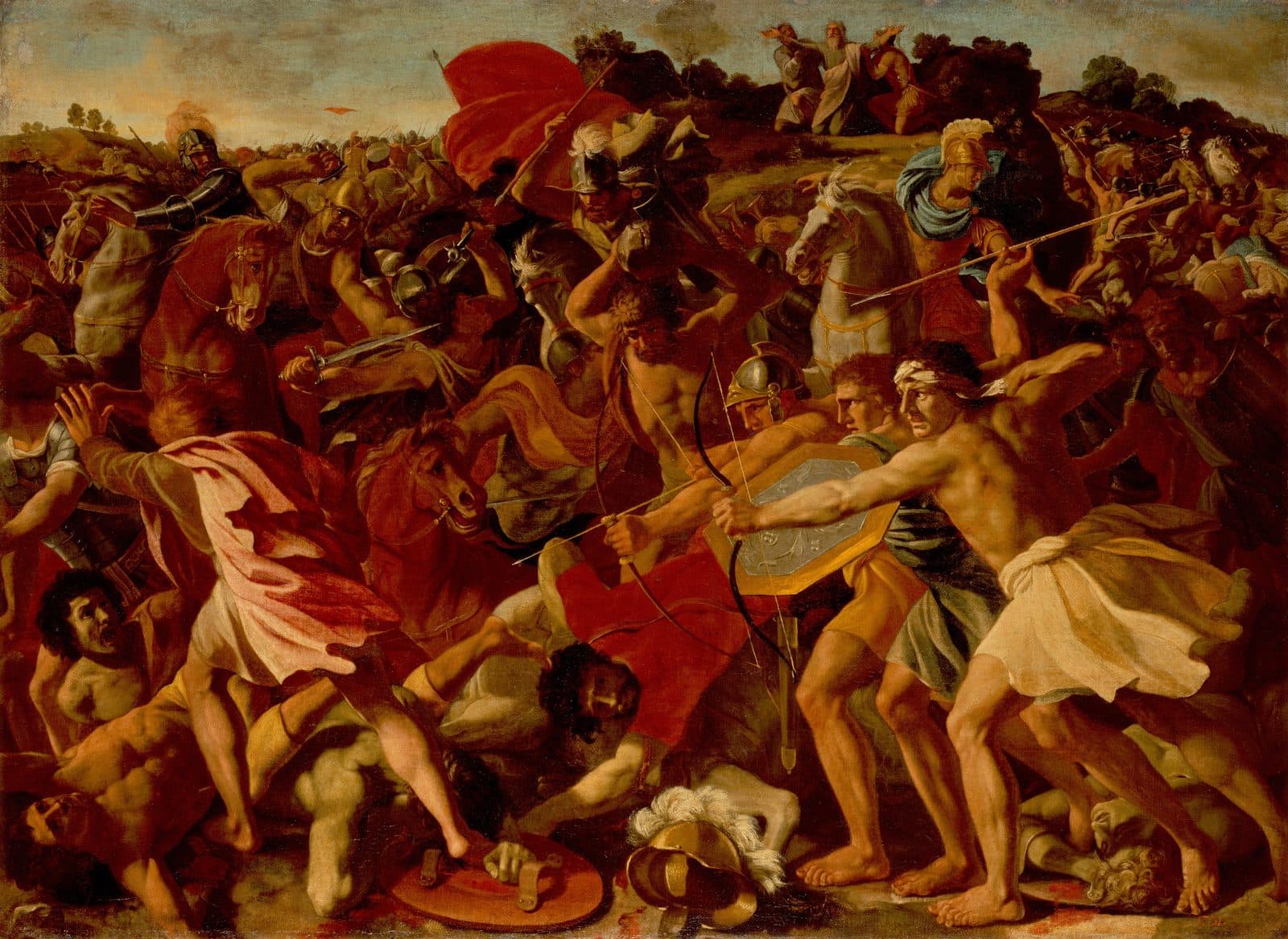
Nicolas Poussin, The Victory of Joshua over the Amalekites, 1624 to 1625, State Hermitage Museum. Public domain, via Wikimedia Commons.
THE ARTWORKPoussin painted the battle with Amalek: Joshua's men fight below while Aaron and Hur hold up Moses' hands on the hill.
Joshua took his own share of the land after every tribe had received its portion, and the town he asked for was one he had to rebuild.
Summary
Joshua son of Nun, of the tribe of Ephraim, served Moses from his youth and then led Israel across the Jordan into Canaan.
- He commanded Israel's first battle, against Amalek at Rephidim.
- He and Caleb were the two spies who urged Israel to go in, and the only men of their generation who lived to enter.
- Moses laid his hands on him, and after Moses died the LORD sent him over the Jordan.
- He took Jericho, divided the land among the tribes and renewed the covenant at Shechem.
- He died at 110 and was buried at Timnath-serah, in the hill country of Ephraim.
Where Joshua Stands in Scripture
From Exodus 17 to Acts 7
So Moses said to Joshua, “Choose some of our men and go out to fight the Amalekites. Tomorrow I will stand on the hilltop with the staff of God in my hand.” Joshua did as Moses had instructed him and fought against the Amalekites, while Moses, Aaron, and Hur went up to the top of the hill.Joshua enters Scripture as a soldier under orders.
The New Testament names him twice, in Stephen's speech and in Hebrews.
And our fathers who received it brought it in with Joshua when they dispossessed the nations God drove out before them. It remained until the time of David,Stephen counts Joshua in the history of the tabernacle.
The Life, Turn by Turn
Twenty-one turns from Rephidim to Timnath-serah, each with its verse
- Fights AmalekRephidim, Exodus 17:13
- Goes up the mountain with MosesSinai, Exodus 24:13
- Stays in the tentthe tent outside the camp, Exodus 33:11
- Asks Moses to stop Eldad and Medadthe camp, Numbers 11:28
- Renamed and sent to spyWilderness of Paran, Numbers 13:16
- Urges Israel to go inKadesh, Numbers 14:6 to 9
- Commissioned before Eleazarbefore the congregation, Numbers 27:22 to 23
- Commissioned by the LORDthe Tent of Meeting, Deuteronomy 31:23
- Told to cross the Jordanafter Moses' death, Joshua 1:2
- Crosses the river in floodopposite Jericho, Joshua 3:16
- Circumcises the men and keeps the PassoverGilgal, Joshua 5:10
- Meets the Commander of the LORD's armynear Jericho, Joshua 5:14
- Takes JerichoJericho, Joshua 6:20
- Repulsed, then takes AiAi, Joshua 8:28
- Writes and reads the lawMount Ebal, Joshua 8:32
- Makes a treaty without asking the LORDGilgal, Joshua 9:15
- The sun stands stillGibeon and Aijalon, Joshua 10:13
- Casts lots for the landShiloh, Joshua 18:10
- Receives his inheritanceTimnath-serah, Joshua 19:50
- Makes a covenant for the peopleShechem, Joshua 24:25
- Dies at 110buried at Timnath-serah, Joshua 24:30
A timeline of the turns in the order Exodus, Numbers, Deuteronomy and Joshua tell them; Joshua and Judges give his age only at his death.
From Attendant to Leader
Exodus 24 to Judges 2
Joshua's life falls into two halves. In the first he serves at Moses' side through the wilderness years; in the second he leads Israel into the land and divides it among the tribes.
The book that bears his name gives the credit to the LORD who fought for Israel, to the priests who carried the ark, and to the promise made to the fathers.
The attendant at Sinai and the tentExodus 32 and 33; Numbers 11
Coming down the mountain with Moses, Joshua heard the shouting of the golden calf and took it for the sound of war.
Thus the LORD would speak to Moses face to face, as a man speaks to his friend. Then Moses would return to the camp, but his young assistant Joshua son of Nun would not leave the tent.Scripture gives one glimpse of Joshua alone in these years, and it places him at the tent.
Joshua son of Nun, the attendant to Moses since youth, spoke up and said, “Moses, my lord, stop them!” But Moses replied, “Are you jealous on my account? I wish that all the LORD’s people were prophets and that the LORD would place His Spirit on them!”The young Joshua guards Moses' honour, and Moses teaches him that the Spirit belongs to more than his master.
The twelve spiesNumbers 13 and 14
Moses sent one leader from each tribe to spy out Canaan, and from Ephraim he sent Hoshea son of Nun. Ten came back saying the people of the land were too strong, and only Joshua and Caleb stood against them.
and said to the whole congregation of Israel, “The land we passed through and explored is an exceedingly good land. If the LORD delights in us, He will bring us into this land, a land flowing with milk and honey, and He will give it to us. Only do not rebel against the LORD, and do not be afraid of the people of the land, for they will be like bread for us. Their protection has been removed, and the LORD is with us. Do not be afraid of them!”Their report rests the whole venture on the LORD's delight in Israel.
The congregation threatened to stone them, and the ten who brought the bad report died by a plague before the LORD.
Surely none of you will enter the land in which I swore to settle you, except Caleb son of Jephunneh and Joshua son of Nun.The oath keeps Joshua forty years in the wilderness beside the people who refused.
The handoverNumbers 27; Deuteronomy 31
And the LORD replied to Moses, “Take Joshua son of Nun, a man with the Spirit in him, and lay your hands on him. Have him stand before Eleazar the priest and the whole congregation, and commission him in their sight. Confer on him some of your authority, so that the whole congregation of Israel will obey him. He shall stand before Eleazar the priest, who will seek counsel for him before the LORD by the judgment of the Urim. At his command, he and all the Israelites with him—the entire congregation—will go out and come in.”Joshua's authority comes from the LORD's choosing, which is why Israel follows him after Moses dies.
Moses charged him before all Israel to be strong and courageous, and the LORD gave the same charge at the Tent of Meeting. The charge is given to him six times across Deuteronomy 31 and Joshua 1: once by Moses, four times by the LORD and once by the people.
The commission and the riverJoshua 1, 3 and 4
Above all, be strong and very courageous. Be careful to observe all the law that My servant Moses commanded you. Do not turn from it to the right or to the left, so that you may prosper wherever you go. This Book of the Law must not depart from your mouth; meditate on it day and night, so that you may be careful to do everything written in it. For then you will prosper and succeed in all you do.The LORD ties Joshua's success to the Book of the Law, so his courage is measured by his obedience.
The priests carried the ark into the Jordan at harvest time, when the river overflows its banks, and the water stood still upstream. John Wesley reads it as the barley harvest, because Israel kept the Passover soon after the crossing.
On that day the LORD exalted Joshua in the sight of all Israel, and they revered him all the days of his life, just as they had revered Moses.The crossing fulfils the promise of Joshua 3:7 that the LORD would exalt him before Israel.
GilgalJoshua 5:2 to 12
Inside Canaan and before any battle, the LORD told Joshua to circumcise the men born in the wilderness. Israel kept the Passover at Gilgal, ate the produce of the land, and the manna stopped the next day.
Then the LORD said to Joshua, “Today I have rolled away the reproach of Egypt from you.” So that place has been called Gilgal to this day.The place takes its name from this word of the LORD, and Gilgal stays Israel's camp through the war.
The Commander and the fall of JerichoJoshua 5:13 to 6:27
Now when Joshua was near Jericho, he looked up and saw a man standing in front of him with a drawn sword in His hand. Joshua approached Him and asked, “Are You for us or for our enemies?” “Neither,” He replied. “I have now come as Commander of the LORD’s army.” Then Joshua fell facedown in reverence and asked Him, “What does my Lord have to say to His servant?” The Commander of the LORD’s army replied, “Take off your sandals, for the place where you are standing is holy.” And Joshua did so.The Commander repeats the command Moses heard at the burning bush, so Joshua stands where Moses stood.
And the LORD said to Joshua, “Behold, I have delivered Jericho into your hand, along with its king and its mighty men of valor. March around the city with all the men of war, circling the city one time. Do this for six days. Have seven priests carry seven rams’ horns in front of the ark. Then on the seventh day, march around the city seven times, while the priests blow the horns. And when there is a long blast of the ram’s horn and you hear its sound, have all the people give a mighty shout. Then the wall of the city will collapse and all your people will charge straight into the city.”The LORD gives the plan before any weapon is raised.
So when the rams’ horns sounded, the people shouted. When they heard the blast of the horn, the people gave a great shout, and the wall collapsed. Then all the people charged straight into the city and captured it.The walls fall at the signal the LORD named in Joshua 6:5.
Joshua then laid a curse on any man who would rebuild Jericho, and 1 Kings records it falling on Hiel of Bethel in Ahab's days.
Ai and AchanJoshua 7 and 8
About three thousand men went up against Ai on the scouts' advice, fled, and lost about thirty-six of their number. Joshua tore his clothes and asked the LORD why He had brought the people across the Jordan.
But the LORD said to Joshua, “Stand up! Why have you fallen on your face? Israel has sinned; they have transgressed My covenant that I commanded them, and they have taken some of what was devoted to destruction. Indeed, they have stolen and lied, and they have put these things with their own possessions.The LORD puts the cause of the defeat inside the camp.
Joshua called Achan "My son" as he urged him to confess. At the second attack an ambush took the city, and Joshua held out his battle lance until all who lived in Ai were destroyed.
The law read at Mount EbalJoshua 8:30 to 35
Joshua built an altar of uncut stones on Mount Ebal, as the Law of Moses commanded, and wrote a copy of the law on stones.
Afterward, Joshua read aloud all the words of the law—the blessings and the curses—according to all that is written in the Book of the Law. There was not a word of all that Moses had commanded that Joshua failed to read before the whole assembly of Israel, including the women, the little ones, and the foreigners who lived among them.The reading fulfils the command Moses gave in Deuteronomy 27, before Israel crossed the Jordan.
Gibeon and the long dayJoshua 9 and 10
Envoys from Gibeon came with worn sacks and cracked wineskins and claimed to live in a distant land.
Then the men of Israel sampled their provisions, but did not seek the counsel of the LORD. And Joshua made a treaty of peace with them to let them live, and the leaders of the congregation swore an oath to them.The whole treaty turns on the one clause about the LORD's counsel.
When five Amorite kings attacked Gibeon, Joshua marched all night from Gilgal to defend the people who had deceived him.
On the day that the LORD gave the Amorites over to the Israelites, Joshua spoke to the LORD in the presence of Israel: “O sun, stand still over Gibeon, O moon, over the Valley of Aijalon.” So the sun stood still and the moon stopped until the nation took vengeance upon its enemies. Is this not written in the Book of Jashar? “So the sun stopped in the middle of the sky and delayed going down about a full day.”Joshua commands the sun in the LORD's hearing, and the account names the Book of Jashar as its source.
The land dividedJoshua 11, 14 and 18
At that time Joshua proceeded to eliminate the Anakim from the hill country of Hebron, Debir, and Anab, and from all the hill country of Judah and of Israel. Joshua devoted them to destruction, along with their cities. No Anakim were left in the land of the Israelites; only in Gaza, Gath, and Ashdod did any survive.The Anakim who frightened the ten spies are cut off by one of the two who said Israel could go in.
Gath is the city Goliath comes from in 1 Samuel, and the page on David and Goliath follows that line.
Now therefore give me this hill country that the LORD promised me on that day, for you yourself heard then that the Anakim were there, with great and fortified cities. Perhaps with the LORD’s help I will drive them out, as the LORD has spoken.” Then Joshua blessed Caleb son of Jephunneh and gave him Hebron as his inheritance.Caleb's faith at Kadesh is still his faith in old age, and Joshua honours it with Hebron.
So Joshua said to the Israelites, “How long will you put off entering and possessing the land that the LORD, the God of your fathers, has given you?Joshua rebukes seven tribes for delay, which shows the land still waiting on Israel's own faith.
Shechem and the endJoshua 23 and 24; Judges 2
Joshua gathered the tribes at Shechem and began the covenant with the reminder that Terah, Abraham's father, had served other gods beyond the Euphrates.
But Joshua said to the people, “You are not able to serve the LORD, for He is a holy God; He is a jealous God; He will not forgive your rebellion or your sins.Joshua tests the people's ready promise against the holiness of the God they promise to serve.
John Calvin reads the warning as Joshua showing the people their own stubbornness, so that they would learn to change.
Israel had served the LORD throughout the days of Joshua and of the elders who outlived him and who had experienced all the works that the LORD had done for Israel.Joshua's influence outlives him by one generation, through the elders who had seen the LORD's works.
After that whole generation had also been gathered to their fathers, another generation rose up who did not know the LORD or the works that He had done for Israel.Judges begins its cycle of sin and rescue from this verse.
Adam Clarke reports that the Greek Septuagint adds a line at his burial: the flint knives with which he circumcised Israel at Gilgal were laid in his tomb.
What the Text Sets Beside the Retelling
Six details retellings often drop
CALEB'S GENERATION
Caleb, who spied out the land with him, was eighty-five when the land was divided, and the two belonged to one generation.
HORNS ON EVERY DAY
The priests blew rams' horns on all seven days; the people alone kept silent until the day of the shout.
A SWORN PROMISE KEPT
Rahab's household lived because two spies had sworn an oath to her, and Joshua sent the same two men to bring them out.
LAND STILL TO TAKE
The book that says Joshua took the whole land also records the LORD telling him that very much of it remained to be possessed.
THE LORD LISTENED TO A MAN
Scripture calls the long day unique because on it the LORD listened to the voice of a man.
BY THE HORNET
At Shechem the LORD says He drove out the two Amorite kings by the hornet He sent, and the victory owed nothing to Israel's sword or bow.
The World Behind the Story
The date, the Urim, and Joshua in the Jewish writings
The year of the conquest is disputed, and the book page on Joshua sets out the early and the late dates with their holders.
Joshua was to seek the LORD's counsel through Eleazar the priest by the judgment of the Urim, which Exodus places in the high priest's breastpiece. The Law never says how the Urim gave an answer.
Joshua in the ApocryphaSirach 46; 1 Maccabees 2
The Wisdom of Ben Sira praises him as Moses' successor, made great according to his name for the saving of God's elect, and asks whether one day was not as long as two.
1 Maccabees sums up his life in one line on the lips of the dying Mattathias: for fulfilling the word he was made a judge in Israel.
Joshua in the Mishnah and the TalmudAvot 1:1; Bava Batra 14b and 15a; Megillah 14b
The Mishnah opens its chain of teachers with Moses receiving the Torah at Sinai and handing it to Joshua, and Joshua to the elders.
The Talmud holds that Joshua wrote his own book, and that Eleazar and then Phinehas completed it after his death.
It also records a tradition that Rahab became a proselyte and married Joshua, and that he had daughters and no sons.
The Family of Joshua
Five generations of Ephraim, from Ladan to Joshua
Generation 1
- LadanGreat-great-grandfather, 1 Chronicles 7:26
Generation 2
- AmmihudGreat-grandfather, 1 Chronicles 7:26
Generation 3
- ElishamaGrandfather. Numbers names an Elishama son of Ammihud as the leader of Ephraim in the wilderness; neither book says the two are one man, 1 Chronicles 7:26
Generation 4
- NunFather, 1 Chronicles 7:27
Generation 5
- JoshuaSon of Nun, 1 Chronicles 7:27
A family tree from 1 Chronicles 7, with the verse for each generation.
The Places of His Life
Twelve places, from the battlefield at Rephidim to his grave
- Proposed: one candidate among several
- Placed: the point stands for an area, or is rounded
- Located: the gazetteer fixes one site
about 200 km (124 miles)
- 1Rephidim, Amalek attacked Israel there. Exodus 17:8
- 2Sinai, He went up the mountain of God with Moses. Exodus 24:13
- 3Kadesh, The spies brought their report back to the congregation. Numbers 13:26
- 4Jordan River, The water backed up as far as the city of Adam. Joshua 3:16
- 5Gilgal, Twelve stones from the river were set up there. Joshua 4:20
- 6Jericho, The city was tightly shut up because of the Israelites. Joshua 6:1
- 7Ai, Joshua left it a permanent heap of ruins. Joshua 8:28
- 8Mount Ebal, Half of Israel stood in front of it, and half in front of Mount Gerizim. Joshua 8:33
- 9Gibeon, It was a great city, like one of the royal cities. Joshua 10:2
- 10Shiloh, The congregation set up the Tent of Meeting there. Joshua 18:1
- 11Shechem, He assembled all the tribes for his last charge. Joshua 24:1
- 12Timnath-serah, It lies in the hill country of Ephraim, north of Mount Gaash. Joshua 24:30
Not located: Rephidim, Gibeon, Timnath-serah.
The coastline is simplified; each place stands at its place page's coordinates.
A map of the places in the order Scripture reaches them, with a door where the site has a place page.
Questions the Life Raises
Four questions, with the readers who answer them
Why does Exodus call him Joshua before Moses renamed him?Adam Clarke
Exodus 17 already uses the name Joshua, and the renaming comes later, in Numbers 13. Adam Clarke reports the view that Joshua received the new name after the victory over Amalek.
How long did the war last, and how long did he lead?Joshua 14; Josephus; Jamieson, Fausset and Brown
Josephus says the fifth year was past when the land was cleared, and that Joshua led Israel for twenty-five years after Moses died. Jamieson, Fausset and Brown report that Lightfoot computed seventeen years after the entry into Canaan.
Josephus wrote from the same Scripture, so his figures are his own reckoning from it. Scripture gives no length for his leadership.
What happened on the long day?Adam Clarke; Albert Barnes
Adam Clarke, in 1832, reads the day as a real miracle, asked in prayer so that the fleeing armies could not regroup. Albert Barnes, in his Notes, holds that the lines from the Book of Jashar are poetry set into the narrative. The book page on Joshua sets out the wider range of readings.
Was Israel right to keep the oath to Gibeon?Ambrose of Milan; John Wesley
The leaders had sworn by the LORD, so they let the Gibeonites live and made them woodcutters and water carriers.
During the reign of David there was a famine for three successive years, and David sought the face of the LORD. And the LORD said, “It is because of the blood shed by Saul and his family, because he killed the Gibeonites.”The famine proves that the oath of Joshua 9 still bound Israel generations later.
Ambrose of Milan, in the fourth century, explains why Joshua believed the envoys. John Wesley, in 1765, draws from the failure a rule for every reader.
“And he, being as yet ignorant of localities and not knowing anything of the inhabitants, did not see through their deceit, nor did he enquire of God but readily believed them. So sacred was one's promised word held in those days that no one would believe that others could try to deceive. Who could find fault with the saints in this, namely, that they should consider others to have the same feelings as themselves and suppose no one would lie because truth was their own companion?”
Ambrose of Milan · On the Duties of the Clergy 3.10.67-68 · on Joshua 9:14 to 15Patristic
“For though it is probable, if God had been consulted, he would have consented to the sparing of the Gibeonites; yet it should have been done with more caution, and an obligation upon them to embrace the true religion. In every business of importance, we should stay to take God along with us, and by the word and prayer consult him.”
John Wesley · Explanatory Notes upon the Old Testament · on Joshua 9:14Evangelical
What the Text Leaves Unsaid
Two silences: his household and his successor
The Name Joshua and the Name Jesus
The name in Numbers, Matthew and Hebrews
These were the names of the men Moses sent to spy out the land; and Moses gave to Hoshea son of Nun the name Joshua.Hoshea becomes Joshua on the eve of Israel's first mission into Canaan.
The new name means the LORD saves. Matthew Henry, in 1710, hears a prayer answered: Hoshea asks God to save, and Joshua promises that He will. Rashi, the Jewish commentator of Troyes in France, writing between 1075 and 1105, hears Moses praying over the spy: may God save you from the counsel of the spies.
In Greek the name is Iesous, which is why the King James Version prints Jesus for Joshua at Acts 7:45 and Hebrews 4:8. It is the name the angel tells Joseph to give Mary's son.
She will give birth to a Son, and you are to give Him the name Jesus, because He will save His people from their sins.”The angel's reason for the name matches its meaning.
Joshua's rest was real, for not one of the LORD's good promises to Israel failed.
For if Joshua had given them rest, God would not have spoken later about another day. There remains, then, a Sabbath rest for the people of God.Hebrews reasons from the later "Today" of Psalm 95 that a greater rest than Joshua's remains.
Voices on Joshua
One commentator in his own words
Henry reads Israel's faithfulness under Joshua as a lesson for the church.
“While Joshua lived, religion was kept up among them under his care and influence; but soon after he and his contemporaries died it went to decay, so much oftentimes does one head hold up: how well is it for the gospel church that Christ, our Joshua, is still with it, by his Spirit, and will be always, even unto the end of the world!”
Matthew Henry · Commentary on the Whole Bible · on Joshua 24:31Puritan
Who Was the Commander of the LORD's Army?
Two identifications, each with its holders
The figure near Jericho gives a title and no name.
The Son of God before the incarnationJustin Martyr; Origen; John Calvin; John Wesley
Justin Martyr, in his Dialogue with Trypho, counts the Captain who appeared to Joshua among the titles of the Word. Origen, in his Homilies on Joshua, holds that Joshua would not have worshiped had he not recognized God. John Calvin, in his commentary on Joshua of 1563 to 1564, receives the ancient reading and warns that Christ did not then become incarnate. John Wesley gives three grounds: the figure accepts worship, makes the place holy, and is called Lord.
The objection: Scripture names princes among the angels, Michael among them.
The angel MichaelRashi
Rashi reads the officer of the LORD's host as the angel Michael.
But first I will tell you what is inscribed in the Book of Truth. Yet no one has the courage to support me against these, except Michael your prince.Rashi's reading rests on this verse, where Michael stands as Israel's prince in battle.
The objection is the first of Wesley's grounds, which the Christian readers rest on Revelation 22:8 to 9.
Books to Read Next
Four works, three of them free to read
Antiquities of the Jews, Book 5
Flavius Josephus, translated by William Whiston · about AD 93
Josephus retells the history of the Jews in twenty books, from the creation to his own century.
READ IT FREE AT PROJECT GUTENBERG →Homilies on Joshua
Origen · third century
Origen reads the fall of Jericho as a figure of the end of the world, when Jesus overthrows it with trumpets.
Commentary on Joshua
John Calvin, translated by Henry Beveridge · 1564
Calvin dictated it in his last months.
READ IT FREE AT CCEL →Commentary on the Whole Bible, Volume 2
Matthew Henry · 1710
Henry gave his second volume to the books from Joshua to Esther, verse by verse.
READ IT FREE AT CCEL →As for Me and My House
But if it is unpleasing in your sight to serve the LORD, then choose for yourselves this day whom you will serve, whether the gods your fathers served beyond the Euphrates, or the gods of the Amorites in whose land you are living. As for me and my house, we will serve the LORD!”Joshua binds his whole household before he asks the tribes to choose.
Joshua brought Israel into a land they had not earned, and Jesus, who bears his name, brings His people to God. Hebrews urges every reader to make every effort to enter God's rest.
Keep studying
Studies12
Places12
Doctrines7
Peoples and groups1