
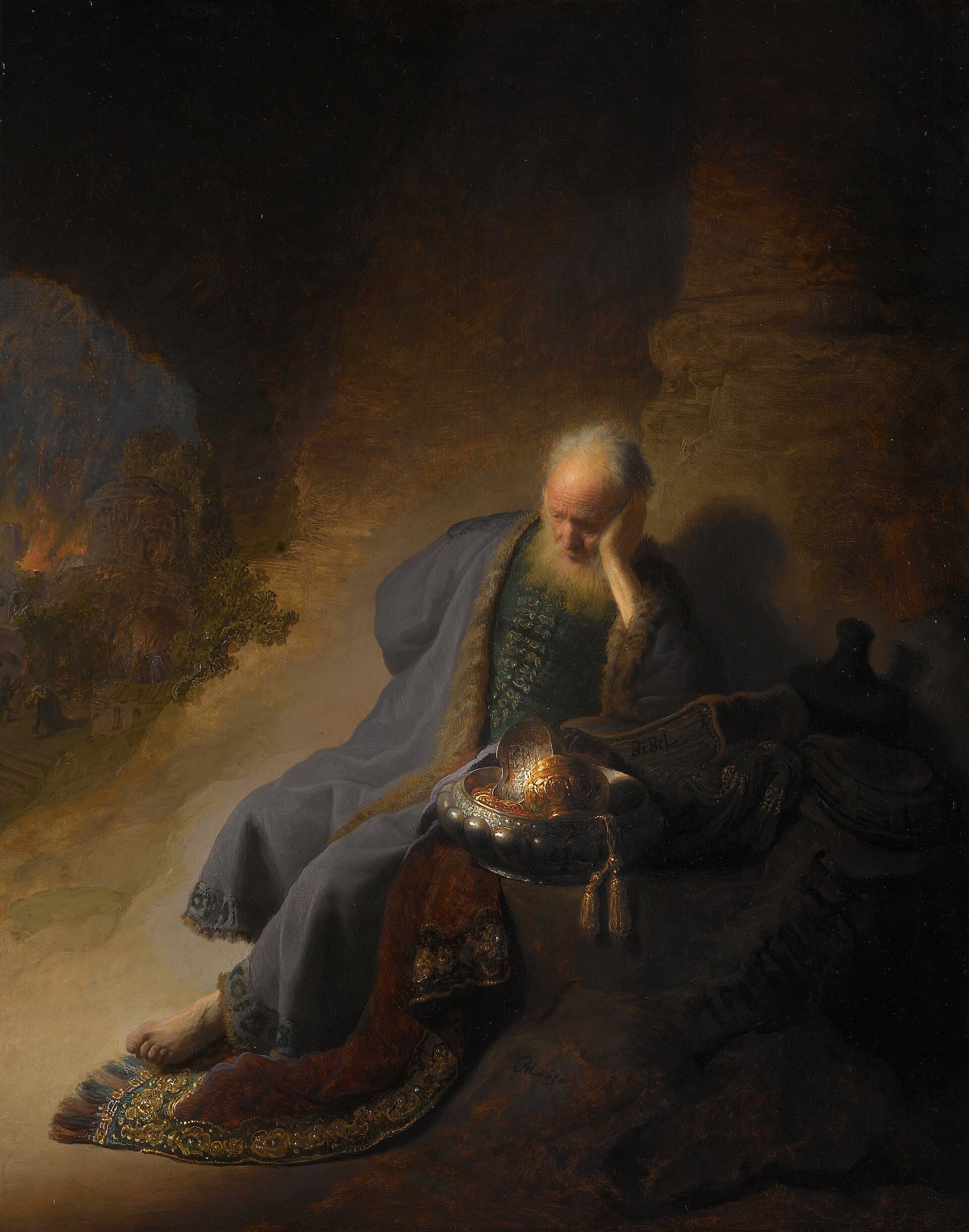
Jeremiah Lamenting the Destruction of Jerusalem, Rembrandt, 1630. Public domain.
Old Testament · Book 24 of 66
Jeremiah
Jeremiah records the prophet's warnings to Judah from the reign of Josiah to the fall of Jerusalem to Babylon. He suffers for his message, and he foretells a new covenant God will make with his people.
Jeremiah records the prophet's warnings to Judah from the reign of Josiah to the fall of Jerusalem to Babylon. He suffers for his message, and he foretells a new covenant God will make with his people.
What is Jeremiah about?
Jeremiah preached for forty years to a nation that would not hear, watched Jerusalem burn exactly as he had said it would, and wept the whole way down. He is the prophet of a dying kingdom — and precisely into that ruin God spoke the deepest promise in the Old Testament: a new covenant, not carved on stone but written in their hearts, with sins forgiven and remembered no more. The writer of Hebrews quotes the whole oracle. Jesus took it on His own lips over a cup.
All 52 chapters
Every chapter of the book, in one grid. Each cell opens that chapter.
- The call and the chargeJeremiah 1 to 10
- The temple and the potterJeremiah 11 to 20
- The letters and the new covenantJeremiah 21 to 33
- The fall of the cityJeremiah 34 to 45
- The nations and the endJeremiah 46 to 52
The colour is the movement of the book the chapter stands in, and every cell opens that chapter's Study level.
Who wrote it, where, when, for whom, and why?
The book calls itself the words of Jeremiah son of Hilkiah, one of the priests in Anathoth (1:1), and closes his words at 51:64. Chapter 36 tells how it was written: Jeremiah dictated, and Baruch son of Neriah wrote on a scroll all the words the LORD had spoken to him. When the king burned that scroll, Baruch wrote them again with many similar words added (36:32). Daniel read the number of the years in the books of Jeremiah (Daniel 9:2), and Matthew names him as the prophet behind two of his quotations (Matthew 2:17, 27:9).
So Jeremiah called Baruch son of Neriah, and at the dictation of Jeremiah, Baruch wrote on a scroll all the words that the LORD had spoken to Jeremiah.
Jeremiah 36:4, Berean Standard Bible.
Most of the book is spoken in Jerusalem, at the temple gate (7:2), in the courtyard of the guard (32:2) and at the palace of the king (22:1). It moves out to Anathoth and the Euphrates (13:4), then after the fall to Mizpah (40:6) and at last to Tahpanhes in Egypt (43:7), where Jeremiah's last words to Judah are spoken (44:1).
The word comes in the thirteenth year of Josiah and goes on through Jehoiakim to the fifth month of the eleventh year of Zedekiah, when Jerusalem went into exile (1:2 and 3). The book dates its words by those kings, and it does not set them in the order of their years: chapter 25 is dated to the fourth year of Jehoiakim and chapter 32 to the tenth year of Zedekiah, and chapter 36 goes back to Jehoiakim again. Its last date is the thirty-seventh year of Jehoiachin's exile (52:31).
Jeremiah is appointed a prophet to the nations (1:5), and his words go to the kings of Judah, its priests and prophets and the people of the land (1:18). A letter goes to the exiles in Babylon (29:1), and a last word to the Jews living in Egypt (44:1).
The book gives its reason in the LORD's words: Jeremiah is sent to uproot and tear down, to destroy and overthrow, to build and plant (1:10). The scroll is written so that Judah may hear of the disaster and turn from its wicked way, and the LORD may forgive (36:3). The words of hope are written in a book for the days when the LORD restores his people (30:2 and 3).
Perhaps when the people of Judah hear about all the calamity I plan to bring upon them, each of them will turn from his wicked way. Then I will forgive their iniquity and their sin.”
Jeremiah 36:3, Berean Standard Bible.
Judah stands between Egypt and Babylon. Pharaoh Neco is defeated at Carchemish in the fourth year of Jehoiakim (46:2), the first year of Nebuchadnezzar (25:1), and Judah's kings turn between the two powers. Nebuchadnezzar takes Jeconiah to Babylon (24:1), sets Zedekiah on the throne (37:1), and burns the city in his nineteenth year (52:12 and 13).
Sources. Jeremiah 1:1, 1:2 and 3, 1:5, 1:10, 1:18, 7:2, 13:4, 22:1, 24:1, 25:1, 29:1, 30:2 and 3, 32:1 and 2, 36:1, 36:3, 36:4, 36:32, 37:1, 40:6, 43:7, 44:1, 46:2, 51:64, 52:12 and 13, 52:31; Daniel 9:2; Matthew 2:17, 27:9. Every verse is read in the Berean Standard Bible.
How is Jeremiah arranged, and what is it for?
The five movements the book falls into, then what it teaches and what it was written to do.
- The call and the chargeJeremiah 1 to 10, 280 verses, the turn at 1:10
The LORD calls a young priest of Anathoth and sends him to warn Judah of disaster from the north.
- The temple and the potterJeremiah 11 to 20, 214 verses, the turn at 18:6
The broken covenant, the acted signs, and the prophet's own complaints to God.
- The letters and the new covenantJeremiah 21 to 33, 361 verses, the turn at 31:31
The kings judged, the seventy years, the letter to the exiles and the promise of a new covenant.
- The fall of the cityJeremiah 34 to 45, 244 verses, the turn at 39:2
The scroll burned, the prophet in the cistern, Jerusalem taken, and the flight to Egypt.
- The nations and the endJeremiah 46 to 52, 265 verses, the turn at 51:64
The words against Egypt and the nations, the fall of Babylon, and the fall of Jerusalem told again.
The theme
The LORD watches over his word to perform it (1:12). He calls Judah back from other gods to himself, the fountain of living water, and warns for forty years of the judgment that comes from the north. When the people will not hear, the word comes true in the fall of Jerusalem. Inside that judgment the LORD promises to build and to plant again: the exiles will return after seventy years, a righteous Branch will rise for David, and a new covenant will be written on the heart.
The purpose
Jeremiah was written so that Judah would hear and turn from its wicked way (36:3), and then so that those who survived would know why the city fell and that the LORD had not finished with them. It keeps a prophet's words and his sufferings together, and it sets the nations under the same word as Judah. It leaves the reader with the people in exile and a king of David's line alive in Babylon (52:31 to 34), which is where Lamentations mourns and Ezekiel and Daniel take up the exile.
The reigns Jeremiah dates his words by, and the book's dated headings in the book's order
The call and the charge, Jeremiah 1 to 10
What the text says in these 10 chapters, and the pages they open on.
The word of the LORD comes to Jeremiah, of a priestly family at Anathoth, in the thirteenth year of Josiah. The LORD says he set him apart before he was born, puts his words in his mouth, and shows him an almond branch and a boiling pot tilting from the north. Jeremiah charges Judah with leaving the fountain of living water for broken cisterns and calls faithless Israel to return. At the temple gate he warns the people not to trust in the words the temple of the LORD, and he weeps for the slain of his people. The movement closes on the carved idols of the nations, set against the living God.
See, I have appointed you today over nations and kingdoms to uproot and tear down, to destroy and overthrow, to build and plant.”
- Study
Jeremiah 1The LORD calls Jeremiah before his birth, touches his mouth and shows him an almond branch and a boiling pot.Show the summary and 3 pagesShow summary, 3 pagesHide the summary
The call, dated to Josiah's thirteenth year: 'Before I formed you in the womb I knew you, and before you were born I set you apart and appointed you as a prophet to the nations' (1:5). Jeremiah protests that he is a child and cannot speak; Jehovah touches his mouth and puts his words there, setting him 'over nations and kingdoms to uproot and tear down … to build and plant.' Two sign-visions follow: a rod of an almond-tree ('I am watching over My word to accomplish it') and a boiling caldron tipping from the north. He is made a fortified city, an iron pillar, brazen walls.
On this chapter (3)
- The weeping prophet
Jeremiah's tears and complaints, read whole.
- Was Jeremiah's commission to the nations literal?
Answered under Where do readers disagree, lower on this page, with each reading and who holds it.
- Jeremiah 1:5
The verse on its own page, with the commentators on it by era.
- The weeping prophet
- Study
Jeremiah 2Israel has left the fountain of living water for cisterns that cannot hold water.Show the summary and 2 pagesShow summary, 2 pagesHide the summary
The indictment opens with a memory of courtship: 'I remember the devotion of your youth, your love as a bride, how you followed Me in the wilderness, in a land not sown' (2:2). Then the charge that defines the book: 'My people have committed two evils: They have forsaken Me, the fountain of living water, and they have dug their own cisterns … broken cisterns that cannot hold water' (2:13). Israel is a degenerate vine, a wild ass in her heat, a nation saying to a stock, You are my father. And owning as many gods as she has cities.
On this chapter (2)
- Covenant lawsuit
The LORD's case against a people who left him.
- Jeremiah 2:13
The verse on its own page, with the commentators on it by era.
- Covenant lawsuit
- Study
Jeremiah 3Faithless Israel and unfaithful Judah are called to return.Show the summary and 1 pageShow summary, 1 pageHide the summary
The law forbids a divorced wife's return, yet Jehovah calls: 'Return, O faithless Israel'. Faithless Judah is judged worse than backsliding Israel, having watched the north go into exile and learned nothing. Beyond the pleading stands promise: 'I will give you shepherds after My own heart, who will feed you with knowledge and understanding' (3:15). The ark will not be missed, for Jerusalem itself shall be called the throne of Jehovah, and all nations gathered to it: Judah and Israel walking together out of the north country into the land given to their fathers, a restoration of Israel as Israel still ahead.
On this chapter (1)
- Jeremiah 3:12
The verse on its own page, with the commentators on it by era.
- Jeremiah 3:12
- Study
Jeremiah 4A lion comes up from the north, and the prophet cries out at what he sees.Show the summary and 2 pagesShow summary, 2 pagesHide the summary
A summons to real repentance: 'Break up your unplowed ground, and do not sow among the thorns' (4:3); circumcise the foreskins of your heart. Then the alarm. Blow the trumpet, flee into the fortified cities, for evil comes from the north like a lion out of his thicket, like clouds, with chariots as the whirlwind. The chapter's astonishing center is an un-creation vision: 'I looked at the earth, and it was formless and void; I looked to the heavens, and they had no light' (4:23). Mountains trembling, no man left, the birds fled. Yet mercy holds the line: 'yet will I not make a full end.'
On this chapter (2)
- Circumcision of the heart
The call to circumcise the heart, from Moses to Paul.
- Jeremiah 4:6
The verse on its own page, with the commentators on it by era.
- Circumcision of the heart
- Study
Jeremiah 5Jerusalem is searched for one person who acts justly, and none is found.Show the summary and 1 pageShow summary, 1 pageHide the summary
Run through the streets of Jerusalem and see, Jehovah says, whether one man can be found that does justly and seeks truth: the city would be pardoned for his sake. The great men have broken the yoke as thoroughly as the poor. Therefore a lion out of the forest, a wolf of the evenings. God who set the sand as the bound of the sea, which it cannot pass, is defied by a people with a revolting heart. The chapter ends with the book's sharpest verdict on religious leadership: 'The prophets prophesy falsely, and the priests rule by their own authority. My people love it so' (5:30-31).
On this chapter (1)
- Jeremiah 5:1
The verse on its own page, with the commentators on it by era.
- Jeremiah 5:1
- Study
Jeremiah 6The enemy surrounds the city, and prophets and priests say peace where there is none.Show the summary and 1 pageShow summary, 1 pageHide the summary
Siege poetry: blow the trumpet in Tekoa, for evil looks forth from the north; hew down trees and cast up a mound against Jerusalem. The wound is treated with cosmetics: 'They dress the wound of My people with very little care, saying, ‘Peace, peace,’ when there is no peace at all' (6:14). And no one blushes. At the crossroads comes the invitation the nation refuses: 'Stand at the crossroads and look. Ask for the ancient paths: ‘Where is the good way?’ Then walk in it, and you will find rest for your souls. But they said, ‘We will not walk in it!’' (6:16). Jeremiah is set as an assayer; the smelting fails, and they are called refuse silver.
On this chapter (1)
- Jeremiah 6:14
The verse on its own page, with the commentators on it by era.
- Jeremiah 6:14
Jeremiah 7 to 10 (4 chapters)Opens the entries for the rest of this movement.
- Study
Jeremiah 7At the temple gate Jeremiah warns against trusting in the words the temple of the LORD.Show the summary and 2 pagesShow summary, 2 pagesHide the summary
The Temple Sermon, preached in the gate: 'Do not trust in deceptive words, chanting: ‘This is the temple of the LORD, the temple of the LORD, the temple of the LORD.’' (7:4). Amend your ways; do not steal, murder, commit adultery, swear falsely, burn incense to Baal, and then stand in this house and say, We are delivered. 'Has this house, which bears My Name, become a den of robbers in your sight?'. The line Jesus takes up when he cleanses the temple. Go see Shiloh. Cakes are baked for the queen of heaven; children burned in Topheth, a thing God says he never commanded, 'nor did it even enter My mind.'
On this chapter (2)
- The cleansing of the temple
Jesus in the temple and the den of robbers.
- Jeremiah 7:4
The verse on its own page, with the commentators on it by era.
- The cleansing of the temple
- Study
Jeremiah 8The harvest is past, and the prophet asks whether there is no balm in Gilead.Show the summary and 1 pageShow summary, 1 pageHide the summary
Bones dragged from the tombs and spread before the sun and moon they served. Judah holds fast deceit and refuses to return, while the stork, the turtle-dove, the swallow and the crane keep the times appointed them: 'but my people know not the ordinance of Jehovah.' The lying pen of the scribes has worked falsehood; peace, peace is proclaimed again over a mortal wound. Harvest ends without rescue: 'The harvest has passed, the summer has ended, but we have not been saved' (8:20). And then the prophet's own broken cry: 'Is there no balm in Gilead? is there no physician there? why then is not the health of the daughter of my people recovered?'
On this chapter (1)
- Jeremiah 8:22
The verse on its own page, with the commentators on it by era.
- Jeremiah 8:22
- Study
Jeremiah 9The prophet wishes his eyes were a fountain of tears, and the one boast is knowing the LORD.Show the summary and 2 pagesShow summary, 2 pagesHide the summary
The weeping prophet at full voice: 'Oh, that my head were a spring of water, and my eyes a fountain of tears! I would weep day and night over the slain daughter of my people' (9:1). And, in the same breath, a longing for a lodging-place in the wilderness away from a nation of adulterers. Their tongue is a bow bent for lies; brother supplants brother. Call for the mourning women, for death is come up into our windows. The chapter's summit is the true ground of boasting: 'Let not the wise man boast in his wisdom … let him who boasts boast in this, that he understands and knows Me' (9:23-24): Paul quotes it twice.
On this chapter (2)
- The weeping prophet
Jeremiah's tears and complaints, read whole.
- Jeremiah 9:24
The verse on its own page, with the commentators on it by era.
- The weeping prophet
- Study
Jeremiah 10The idols of the nations are carved wood; the LORD is the true God.Show the summary and 2 pagesShow summary, 2 pagesHide the summary
Idol-making as satire: a tree cut out of the forest, worked with the axe, decked with silver and gold, fastened with nails so it will not topple; the images are like a scarecrow in a cucumber field, unable to speak or walk, 'They must be carried because they cannot walk.' Against them stands the incomparable God ('the LORD is the true God; He is the living God and eternal King') whose wrath makes the earth tremble, who made the earth by his power and stretched out the heavens by his understanding. A single Aramaic verse (10:11) sentences the false gods to perish. Jeremiah closes praying, 'I know, O LORD, that a man’s way is not his own'.
On this chapter (2)
- Does Jeremiah 10:1 to 5 describe a Christmas tree?
Answered under Where do readers disagree, lower on this page, with each reading and who holds it.
- Jeremiah 10:10
The verse on its own page, with the commentators on it by era.
- Does Jeremiah 10:1 to 5 describe a Christmas tree?
The two visions of the call
An almond branch
And the word of the LORD came to me, asking, “Jeremiah, what do you see?” “I see a branch of an almond tree,” I replied. “You have observed correctly,” said the LORD, “for I am watching over My word to accomplish it.”
The almond is the tree that wakes first in the year, and its name sounds like the verb the LORD uses for watching over his word.
A boiling pot
Again the word of the LORD came to me, asking, “What do you see?” “I see a boiling pot,” I replied, “and it is tilting toward us from the north.” Then the LORD said to me, “Disaster from the north will be poured out on all who live in the land.
The pot tilts from the north, and the LORD says disaster will pour out from the north on all who live in the land.
Characters (3)
Who the text names. A name with a page carries its door.
Places (5)
Where the chapters stand.
- Anathoth
Jeremiah's home town in the land of Benjamin (1:1).
- Jerusalem
The city Jeremiah is sent to search for one just person (5:1).
- The temple
Where Jeremiah stands at the gate to preach (7:2).
- Topheth
The high place in the Valley of Ben-hinnom where children were burned (7:31).
Show the next 1
- Shiloh
The first sanctuary, laid waste, named as a warning to the temple (7:12).
Themes (5)
What these chapters raise, each on its own page where one stands.
- The weeping prophet
The prophet who wishes his eyes were a fountain of tears (9:1).
- Circumcision of the heart
Circumcise yourselves to the LORD (4:4), a call Paul takes up.
- The heart
The heart that has gone after other gods.
- Repentance
Return, faithless Israel (3:12).
Show the next 1
- The cleansing of the temple
Jesus names the den of robbers of 7:11.
Where the New Testament uses these chapters (2)each marked as a quotation or an allusion, with the evidence
- Explicit quotationA den of robbers, Jeremiah 7:11 at Matthew 21:13; Mark 11:17. In the temple courts Jesus says it is written, joins the house of prayer of Isaiah 56:7 to the den of robbers of Jeremiah 7:11, and says the temple has been made one. Held by Jesus, as Matthew and Mark record him.
- Explicit quotationLet him who boasts boast in the Lord, Jeremiah 9:23 and 24 at 1 Corinthians 1:31; 2 Corinthians 10:17. Paul introduces the words with as it is written. They give the sense of Jeremiah 9:23 and 24 in a shorter form. Held by Paul.
The temple and the potter, Jeremiah 11 to 20
What the text says in these 10 chapters, and the pages they open on.
Judah has broken the covenant, and the men of Anathoth plot against Jeremiah's life. He asks why the way of the wicked prospers. He buries a linen loincloth by the Euphrates and digs it up ruined, and in the drought the LORD forbids him to pray for the people. He is told not to marry. At the potter's house he sees a marred pot reworked, and the LORD says Israel is clay in his hand; then Jeremiah breaks a clay jar before the elders. Pashhur the priest puts him in the stocks, and Jeremiah cries that the word is a fire shut up in his bones.
“O house of Israel, declares the LORD, can I not treat you as this potter treats his clay? Just like clay in the potter’s hand, so are you in My hand, O house of Israel.
- Study
Jeremiah 11Judah has broken the covenant, and the men of Anathoth plot against Jeremiah.Show the summary and 1 pageShow summary, 1 pageHide the summary
Jeremiah is sent to preach 'the words of this covenant' in the cities of Judah and the streets of Jerusalem. Cursed be the man that heareth not, blessed the obedience that makes them his people. But a conspiracy is found: Judah has returned to the iniquities of the fathers, and Jerusalem's gods are as many as her streets. Do not pray for this people; their crying will not be heard in the time of their trouble. Then the plot comes home. The men of his own town Anathoth seek his life, and the prophet realizes it only when Jehovah shows him: 'I was like a gentle lamb led to slaughter' (11:19).
On this chapter (1)
- Jeremiah 11:10
The verse on its own page, with the commentators on it by era.
- Jeremiah 11:10
- Study
Jeremiah 12Jeremiah asks why the wicked prosper, and the LORD answers with a harder road ahead.Show the summary and 1 pageShow summary, 1 pageHide the summary
The first of Scripture's great honest complaints: 'Righteous are You, O LORD, when I plead before You. Yet about Your judgments I wish to contend with You: Why does the way of the wicked prosper?' (12:1). You have planted them, and they take root and bring forth fruit. God's answer refuses comfort and offers commission instead: 'If you have raced with men on foot and they have worn you out, how can you compete with horses?' His heritage has become to him a lion in the forest, a speckled bird set upon. Yet even the plucked-up neighbor nations are promised compassion if they learn to swear by his name.
On this chapter (1)
- Jeremiah 12:1
The verse on its own page, with the commentators on it by era.
- Jeremiah 12:1
- Study
Jeremiah 13A linen loincloth buried by the Euphrates is ruined, and so will Judah's pride be.Show the summary and 1 pageShow summary, 1 pageHide the summary
Two enacted parables. Jeremiah buys a linen girdle, wears it, hides it in a cleft of the rock by the Euphrates, and returns to find it marred and profitable for nothing. So will Jehovah mar the pride of Judah, who once clave to him as a girdle clings to the loins. Then the proverb of the jars: every jar filled with wine, and the inhabitants of Jerusalem made drunk and dashed one against another. Pride is warned before darkness falls and the flock is carried away. The chapter's unforgettable question exposes habit hardened into nature: 'Can the Ethiopian change his skin, or the leopard his spots? Neither are you able to do good … you who are accustomed to doing evil' (13:23).
On this chapter (1)
- Jeremiah 13:10
The verse on its own page, with the commentators on it by era.
- Jeremiah 13:10
- Study
Jeremiah 14In the drought the people plead, and the LORD forbids Jeremiah to pray for them.Show the summary and 1 pageShow summary, 1 pageHide the summary
A drought oracle: the gates languish, nobles send servants to empty cisterns, they return with vessels ashamed and cover their heads; the hind forsakes her calf, the wild asses pant on the bare heights. Jeremiah prays out of the drought: 'O Hope of Israel, its Savior in times of distress, why are You like a stranger in the land, like a traveler who stays but a night?' (14:8). The people's prophets promise assured peace in this place; Jehovah answers, 'I did not send them or appoint them or speak to them.' Judgment lands on prophets and hearers alike, and Jeremiah is again told not to intercede. Yet he ends still pleading, 'we put our hope in You, for You have done all these things.'
On this chapter (1)
- Jeremiah 14:11
The verse on its own page, with the commentators on it by era.
- Jeremiah 14:11
- Study
Jeremiah 15Even Moses and Samuel could not turn the LORD's heart, and Jeremiah curses his birth.Show the summary and 1 pageShow summary, 1 pageHide the summary
'Even if Moses and Samuel should stand before Me, My heart would not go out to this people' (15:1): the two great intercessors named, and the door still shut, because of what Manasseh did in Jerusalem. Then Jeremiah turns inward: 'Woe to me, my mother, that you have borne me, a man of strife and conflict', a man neither lending nor borrowing yet cursed by everyone. His joy and his wound are the same thing: 'Your words were found, and I ate them. Your words became my joy and my heart’s delight' (15:16). God answers with a condition and a promise: if you return, I will bring you again; I will make you a fortified brazen wall.
On this chapter (1)
- Jeremiah 15:1
The verse on its own page, with the commentators on it by era.
- Jeremiah 15:1
- Study
Jeremiah 16Jeremiah is told not to marry, mourn or feast, as a sign of what is coming.Show the summary and 1 pageShow summary, 1 pageHide the summary
The prophet's life becomes the sermon: he may not marry or father children, may not enter the house of mourning, may not sit in the house of feasting. Because the mourning and the marriage songs of Judah are both about to end. Then a startling reversal of Israel's founding confession: the day comes when men will no longer swear by the God who brought Israel out of Egypt, but by the God who brought them back 'from the land of the north.' Fishers and hunters will fetch them home, and the nations will come from the ends of the earth confessing that their fathers inherited nothing but lies.
On this chapter (1)
- Jeremiah 16:2
The verse on its own page, with the commentators on it by era.
- Jeremiah 16:2
Jeremiah 17 to 20 (4 chapters)Opens the entries for the rest of this movement.
- Study
Jeremiah 17Judah's sin is written with an iron pen, and the heart is deceitful above all things.Show the summary and 2 pagesShow summary, 2 pagesHide the summary
Judah's sin is engraved with a pen of iron and the point of a diamond on the tablet of the heart and the horns of the altars. Two men, two root systems: 'Cursed is the man that trusteth in man, and maketh flesh his arm' (a heath in the desert) and 'Blessed is the man that trusteth in Jehovah… he shall be as a tree planted by the waters,' unanxious in the year of drought (17:5-8). Between them stands the diagnosis: 'The heart is deceitful above all things, and it is exceedingly corrupt: who can know it?': answered at once by 'I, Jehovah, search the heart.' The chapter ends preaching sabbath at the city gates.
On this chapter (2)
- The heart
The heart in Scripture, from its deceit to its renewal.
- Jeremiah 17:9
The verse on its own page, with the commentators on it by era.
- The heart
- Study
Jeremiah 18At the potter's house the LORD says Israel is clay in his hand.Show the summary and 2 pagesShow summary, 2 pagesHide the summary
Down to the potter's house, where a marred vessel is simply made again as it seemed good to the potter: 'Just like clay in the potter’s hand, so are you in My hand, O house of Israel' (18:6). The lesson is not fatalism but responsiveness: if a nation I threatened turns from its evil, I repent of the evil; if a nation I promised to build does evil, I repent of the good. Judah answers, There is no hope; we will walk after our own devices. Does snow forsake Lebanon? Yet my people have forgotten me. The chapter closes with the plot ('let us denounce him') and the prophet's raw appeal for justice.
On this chapter (2)
- The potter and the clay
The LORD's right to shape and reshape a people.
- Jeremiah 18:6
The verse on its own page, with the commentators on it by era.
- The potter and the clay
- Study
Jeremiah 19Jeremiah breaks a clay jar in the Valley of Ben-hinnom before the elders.Show the summary and 2 pagesShow summary, 2 pagesHide the summary
Jeremiah buys a potter's earthen bottle and walks the elders and senior priests out to the valley of the son of Hinnom by the gate of potsherds, where children were burned to Baal. There he announces a disaster that will make the ears of all who hear it tingle, and Topheth's renaming to the valley of Slaughter, its dead buried there till there is no place left. Then he breaks the bottle before their eyes: even so will Jehovah break this people and this city, as one breaks a potter's vessel that cannot be made whole again. He returns to the temple court and repeats the sentence publicly: the act that provokes the arrest of chapter 20.
On this chapter (2)
- The potter and the clay
The LORD's right to shape and reshape a people.
- Jeremiah 19:11
The verse on its own page, with the commentators on it by era.
- The potter and the clay
- Study
Jeremiah 20Pashhur puts Jeremiah in the stocks, and the prophet says the word burns in his bones.Show the summary and 2 pagesShow summary, 2 pagesHide the summary
Pashhur the priest, chief officer of the temple, strikes Jeremiah and locks him in the stocks. Released, the prophet renames him Magor-missabib (Terror on every side) and sends him to Babylon to die. Then comes the most naked page in the prophets: 'You have deceived me, O LORD, and I was deceived. You have overcome me and prevailed.' He is a laughing-stock all the day; and when he resolves to quit, 'His message becomes a fire burning in my heart, shut up in my bones, and I become weary of holding it in, and I cannot prevail' (20:9). Praise breaks out. And the chapter still ends cursing the day of his birth.
On this chapter (2)
- The weeping prophet
Jeremiah's tears and complaints, read whole.
- Jeremiah 20:9
The verse on its own page, with the commentators on it by era.
- The weeping prophet
The 7 acted signs of the book, in the book's order
- Sign 1The linen loinclothJeremiah 13:1Worn, buried by the Euphrates and dug up ruined: Judah's pride spoiled.
- Sign 2The potter's houseJeremiah 18:2A marred pot reworked on the wheel: the LORD may reshape his people.
- Sign 3The broken jarJeremiah 19:1A clay jar smashed before the elders: a city broken past mending.
- Sign 4The yokeJeremiah 27:2Straps and bars on the prophet's neck: serve the king of Babylon and live.
- Sign 5The field at AnathothJeremiah 32:9A field bought in the siege for seventeen shekels: land will be bought again.
- Sign 6The stones at TahpanhesJeremiah 43:9Stones hidden at Pharaoh's door: Nebuchadnezzar will set his throne there.
- Sign 7The scroll in the riverJeremiah 51:63A scroll tied to a stone and thrown into the Euphrates: Babylon will sink.
Characters (4)
Who the text names. A name with a page carries its door.
- Jeremiah
Son of Hilkiah, a priest of Anathoth, called as a prophet to the nations (1:1, 1:5).
- The men of Anathoth
Jeremiah's own townsmen, who plot to kill him (11:21).
- Pashhur son of Immer
The priest who beats Jeremiah and puts him in the stocks (20:1 and 2).
- Moses and Samuel
The two intercessors the LORD says could not turn his heart now (15:1).
Places (3)
Where the chapters stand.
- The Euphrates
Where the loincloth is hidden in a crevice of the rock (13:4).
- The potter's house
Where Jeremiah watches the clay reworked on the wheel (18:2 and 3).
- The Valley of Ben-hinnom
Where the jar is broken, to be called the Valley of Slaughter (19:6).
Themes (4)
What these chapters raise, each on its own page where one stands.
- The potter and the clay
The LORD's right over the nations he shapes (18:6).
- The heart
The heart is deceitful above all things (17:9).
- Covenant lawsuit
The LORD brings his case against a people who broke the covenant (11:10).
- The weeping prophet
The complaints of a prophet who cannot keep silent (20:9).
Where the New Testament uses these chapters (1)each marked as a quotation or an allusion, with the evidence
- Probable allusionThe potter and the clay, Jeremiah 18:6 at Romans 9:21. Paul asks whether the potter has the right to make from the same lump of clay one vessel for special use and another for common use, the picture of Jeremiah 18 and of Isaiah 29:16 and 45:9. Held by Paul.
The letters and the new covenant, Jeremiah 21 to 33
What the text says in these 13 chapters, and the pages they open on.
Zedekiah sends to ask for a miracle, and the LORD says he himself will fight against Judah. The kings after Josiah are judged, and a righteous Branch is promised for David. Jeremiah says Judah will serve Babylon seventy years and makes the nations drink the cup of wrath. He is tried for his life and spared; he wears a yoke, and Hananiah breaks it and dies within the year. He writes to the exiles to seek the peace of Babylon. Then come the words of hope: the LORD will restore Israel and Judah and make a new covenant with them, and in the siege Jeremiah buys a field at Anathoth.
Behold, the days are coming, declares the LORD, when I will make a new covenant with the house of Israel and with the house of Judah.
- Study
Jeremiah 21Zedekiah asks for a miracle, and the LORD says he himself will fight against Judah.Show the summary and 1 pageShow summary, 1 pageHide the summary
Zedekiah, with the Babylonians already at the walls, sends Pashhur and Zephaniah the priest to ask whether Jehovah will deal with them according to his wondrous works and make the enemy withdraw. The answer inverts every holy-war memory: God himself will fight against the city 'with an outstretched hand and with a strong arm, even in anger, and in wrath.' To the people he offers a terrible mercy: 'Behold, I set before you the way of life and the way of death': he that stays dies by sword, famine, and pestilence; he that goes out to the Chaldeans lives, his life for a prey. To the house of David: execute justice in the morning, lest my fury go forth like fire.
On this chapter (1)
- Jeremiah 21:8
The verse on its own page, with the commentators on it by era.
- Jeremiah 21:8
- Study
Jeremiah 22The kings after Josiah are judged, and Coniah is written down as childless.Show the summary and 2 pagesShow summary, 2 pagesHide the summary
A charge delivered at the king's house: do justice, deliver the robbed, oppress not the sojourner, fatherless, or widow, and thrones will pass through these gates; refuse, and this house becomes a desolation. Then three kings in turn. Shallum, carried away, shall never see this land again. Jehoiakim, building his house by unrighteousness with cedar and vermilion, is measured against his father Josiah, who judged the cause of the poor and needy: 'Is this not what it means to know Me?', and is sentenced to the burial of an ass. Coniah is the signet ring plucked from God's hand: 'Enroll this man as childless … None of his descendants will prosper to sit on the throne of David' (22:30).
On this chapter (2)
- The curse on Jeconiah
Coniah written down as childless, and the line of Jesus.
- Jeremiah 22:30
The verse on its own page, with the commentators on it by era.
- The curse on Jeconiah
- Study
Jeremiah 23A righteous Branch for David is promised, and the false prophets are condemned.Show the summary and 3 pagesShow summary, 3 pagesHide the summary
Woe to the shepherds that scatter the flock: Jehovah will gather the remnant himself and set true shepherds over them. Then the Messianic promise the book turns on: 'Behold, the days are coming, declares the LORD, when I will raise up for David a righteous Branch, and He will reign wisely as King and will administer justice and righteousness in the land. In His days Judah will be saved, and Israel will dwell securely. And this is His name by which He will be called: The LORD Our Righteousness' (23:5-6): a reign still future and literal. The rest indicts the prophets who steal words: 'Is not My word like fire … and like a hammer that smashes a rock?'
On this chapter (3)
- The Branch and the King
The righteous Branch raised for David.
- The shepherd
The shepherds who scatter and the LORD who gathers.
- Jeremiah 23:5
The verse on its own page, with the commentators on it by era.
- The Branch and the King
- Study
Jeremiah 24Two baskets of figs show the exiles as good and those left in Jerusalem as bad.Show the summary and 1 pageShow summary, 1 pageHide the summary
After Jeconiah and the craftsmen were carried to Babylon, Jeremiah sees two baskets of figs set before the temple. One very good, like first-ripe figs, the other so bad they cannot be eaten. The reading upends the popular arithmetic that survival equals blessing. The good figs are the exiles God has sent to Chaldea for their good: 'I will set mine eyes upon them for good, and I will bring them again to this land… and I will give them a heart to know me, that I am Jehovah.' The bad figs are Zedekiah, his princes, the survivors in Jerusalem and those settled in Egypt. To be tossed among all the kingdoms of the earth for a reproach and a byword.
On this chapter (1)
- Jeremiah 24:7
The verse on its own page, with the commentators on it by era.
- Jeremiah 24:7
- Study
Jeremiah 25Judah will serve Babylon seventy years, and the nations must drink the cup of wrath.Show the summary and 3 pagesShow summary, 3 pagesHide the summary
In Jehoiakim's fourth year Jeremiah tallies twenty-three years of unheeded preaching ('you have not listened') and speaks the number that will shape Daniel's prayer and the exile's calendar: 'these nations will serve the king of Babylon for seventy years' (25:11), after which Babylon herself is called to account. Then the vision widens to the whole earth: the cup of the wine of wrath taken from Jehovah's hand and made to be drunk by nation after nation, Jerusalem first and Sheshach last. Jehovah roars from on high like one that treads the grapes; the slain shall be from one end of the earth to the other; and the shepherds of the flock are told to howl and wallow.
On this chapter (3)
- The seventy weeks
Daniel's reading of Jeremiah's seventy years.
- When do the seventy years begin and end?
Answered under Where do readers disagree, lower on this page, with each reading and who holds it.
- Jeremiah 25:11
The verse on its own page, with the commentators on it by era.
- The seventy weeks
- Study
Jeremiah 26After the temple sermon Jeremiah is tried for his life and spared.Show the summary and 1 pageShow summary, 1 pageHide the summary
The temple sermon told again, this time from the outside, as courtroom drama. Jeremiah stands in the court and is told to hold back not a word; when he finishes, priests, prophets, and all the people seize him: 'You must surely die!' The princes come up and sit in judgment at the new gate. Jeremiah's defense is simply his commission. Amend your ways, and Jehovah will repent of the evil; as for me, I am in your hand. The elders rescue him with precedent, recalling Micah of Moresheth, who said Zion should be plowed as a field, and Hezekiah, who repented rather than killed. The counter-example is chilling: Uriah, extradited from Egypt and executed. Ahikam's hand keeps Jeremiah alive.
On this chapter (1)
- Jeremiah 26:24
The verse on its own page, with the commentators on it by era.
- Jeremiah 26:24
Jeremiah 27 to 33 (7 chapters)Opens the entries for the rest of this movement.
- Study
Jeremiah 27Jeremiah wears a yoke and tells the kings to serve Babylon.Show the summary and 1 pageShow summary, 1 pageHide the summary
Jeremiah makes bonds and bars, wears the yoke on his own neck, and sends duplicates by envoy to the kings of Edom, Moab, Ammon, Tyre, and Sidon assembled in Jerusalem. The message is a policy the whole region will hate: the God who made the earth by his great power has given these lands into the hand of Nebuchadnezzar his servant; bring your neck under his yoke and live; listen to the diviners and dreamers who promise otherwise and you will perish. Zedekiah gets the same word, and the priests too: the temple vessels remaining will also go to Babylon, and stay there until the day Jehovah visits them and brings them back.
On this chapter (1)
- Jeremiah 27:12
The verse on its own page, with the commentators on it by era.
- Jeremiah 27:12
- Study
Jeremiah 28Hananiah breaks the yoke and promises a quick return, and dies within the year.Show the summary and 1 pageShow summary, 1 pageHide the summary
A prophet against a prophet, in public. Hananiah of Gibeon announces in the temple that within two full years Jehovah will break Babylon's yoke and bring back the vessels and Jeconiah. Jeremiah's reply is disarming ('Amen! … May the LORD do so!'), followed by the test: the prophet who prophesies peace is vindicated only when his word comes to pass. Hananiah then takes the bar from Jeremiah's neck and breaks it, and Jeremiah simply walks away. Later the word comes: you have broken bars of wood, but made in their stead bars of iron. Jeremiah tells him Jehovah never sent him, and that he will die this year, and in the seventh month Hananiah dies.
On this chapter (1)
- Jeremiah 28:16
The verse on its own page, with the commentators on it by era.
- Jeremiah 28:16
- Study
Jeremiah 29Jeremiah writes to the exiles to build houses in Babylon and seek its peace.Show the summary and 3 pagesShow summary, 3 pagesHide the summary
A letter to the exiles already in Babylon. Settle in: 'Build houses and settle down. Plant gardens' (take wives, multiply): 'Seek the prosperity of the city to which I have sent you as exiles. Pray to the LORD on its behalf' (29:5-7). The prophets among them promising a quick return are lying. After seventy years are accomplished for Babylon, God will visit them: 'For I know the plans I have for you, declares the LORD, plans to prosper you and not to harm you, to give you a future and a hope'. And 'You will seek Me and find Me when you search for Me with all your heart.' (29:11-13). Ahab, Zedekiah, and Shemaiah are named and sentenced.
On this chapter (3)
- The exile and the return
Seventy years in Babylon and the way home.
- When do the seventy years begin and end?
Answered under Where do readers disagree, lower on this page, with each reading and who holds it.
- Jeremiah 29:7
The verse on its own page, with the commentators on it by era.
- The exile and the return
- Study
Jeremiah 30The LORD will restore Israel and Judah after the time of Jacob's distress.Show the summary and 1 pageShow summary, 1 pageHide the summary
The Book of Consolation opens with a command to write all these words in a book, because the captivity of both Israel and Judah will be turned. First the terror: men holding their loins like a woman in travail: 'How awful that day will be! None will be like it! It is the time of Jacob’s distress, but he will be saved out of it' (30:7), a day read here as the tribulation still ahead of Israel. Then rescue: the yoke broken, 'they will serve the LORD their God and David their king, whom I will raise up for them.' The incurable wound is healed; the city rebuilt on its own heap; you shall be my people, and I will be your God.
On this chapter (1)
- Jeremiah 30:7
The verse on its own page, with the commentators on it by era.
- Jeremiah 30:7
- Study
Jeremiah 31Rachel weeps in Ramah, and the LORD promises a new covenant written on the heart.Show the summary and 4 pagesShow summary, 4 pagesHide the summary
'I have loved you with an everlasting love; therefore I have drawn you with loving devotion' (31:3). Vineyards planted again on the mountains of Samaria; watchmen crying, Let us go up to Zion; blind, lame, and the woman with child brought home by rivers of waters. 'A voice is heard in Ramah, mourning and great weeping, Rachel weeping for her children' (31:15): Matthew 2 quotes it over Bethlehem's infants. Then the new covenant: the law written in the inward parts, none teaching his neighbor, 'because they will all know Me, from the least of them to the greatest … will remember their sins no more' (31:31-34), quoted whole in Hebrews 8. Israel ceases to be a nation only when sun, moon, and sea depart.
On this chapter (4)
- The new covenant
The promise of 31:31 to 34 and its use in Hebrews.
- The Lord's Supper
The cup of the new covenant.
- What is the new covenant, and is it new in kind or in degree?
Answered under Where do readers disagree, lower on this page, with each reading and who holds it.
- Jeremiah 31:33
The verse on its own page, with the commentators on it by era.
- The new covenant
- Study
Jeremiah 32In the siege Jeremiah buys a field at Anathoth as a sign that land will be bought again.Show the summary and 1 pageShow summary, 1 pageHide the summary
Jerusalem is under siege and Jeremiah is shut in the court of the guard for preaching surrender, when his cousin Hanamel arrives to sell him a field at Anathoth. He weighs out seventeen shekels of silver, seals the deed before witnesses and gives the sealed and open copies to Baruch for an earthen vessel, to last many days: because 'Houses, fields, and vineyards will again be bought in this land.' Then he prays: 'You have made the heavens and the earth by Your great power … Nothing is too difficult for You!' (32:17). God answers the prayer with its own question ('Is anything too difficult for Me?') and promises an everlasting covenant, one heart and one way.
On this chapter (1)
- Jeremiah 32:15
The verse on its own page, with the commentators on it by era.
- Jeremiah 32:15
- Study
Jeremiah 33The LORD will restore the city and keep his covenant with David and with the Levites.Show the summary and 3 pagesShow summary, 3 pagesHide the summary
Still confined, Jeremiah receives the invitation the whole book has been earning: 'Call to Me, and I will answer and show you great and unsearchable things you do not know' (33:3). Siege-torn houses give way to health and cure and abundance of peace and truth. Into streets now desolate returns the voice of joy and gladness, the voice of bridegroom and bride, and of those bringing thanksgiving into the house of Jehovah. The Branch is promised again (in those days Judah shall be saved and Jerusalem dwell safely, called 'The LORD Our Righteousness' (33:16)) and secured by covenant with day and night: as surely as the ordinances of heaven hold, David and the Levites will not lack a man.
On this chapter (3)
- The Branch and the King
The righteous Branch raised for David.
- The Davidic covenant
The promise of a throne for David's line.
- Jeremiah 33:17
The verse on its own page, with the commentators on it by era.
- The Branch and the King
The covenant with the fathers and the new covenant, in the words of Jeremiah 31
Characters (8)
Who the text names. A name with a page carries its door.
- Jeremiah
Son of Hilkiah, a priest of Anathoth, called as a prophet to the nations (1:1, 1:5).
- Zedekiah
The last king of Judah, who sends to ask the LORD for a miracle (21:1 and 2).
- Jehoiakim
The king who kills the prophet Uriah (26:23).
- Jehoiachin
Called Coniah, written down as childless (22:24 to 30).
Show the next 4
- Nebuchadnezzar
King of Babylon, called the LORD's servant (25:9).
- Hananiah
The prophet who breaks the yoke and dies within the year (28:10, 28:17).
- Rachel
Weeping in Ramah for her children (31:15).
- Hanamel
Jeremiah's cousin, who sells him the field at Anathoth (32:9).
Places (4)
Where the chapters stand.
Themes (7)
What these chapters raise, each on its own page where one stands.
- The new covenant
A covenant written on the heart (31:31 to 34).
- The Branch and the King
A righteous Branch raised for David (23:5).
- The seventy years
Daniel reads the number in Jeremiah's words (Daniel 9:2).
- The curse on Jeconiah
No descendant of Coniah on David's throne (22:30).
Show the next 3
- The shepherd
Shepherds who scatter the flock, and the LORD who gathers it (23:1 to 4).
- The Davidic covenant
David will never lack a man on his throne (33:17).
- The Lord's Supper
Jesus names the cup the new covenant in his blood.
Where the New Testament uses these chapters (5)each marked as a quotation or an allusion, with the evidence
- Probable allusionThe cup of the wine of wrath, Jeremiah 25:15 at Revelation 14:10. Revelation says the worshipper of the beast will drink the wine of God's anger poured into the cup of his wrath, the cup the LORD gives Jeremiah to make the nations drink. Held by John, in Revelation.
- Explicit quotationRachel weeping for her children, Jeremiah 31:15 at Matthew 2:18. Matthew says the killing of the boys of Bethlehem fulfilled what was spoken through Jeremiah the prophet, and quotes the voice heard in Ramah. Held by Matthew.
- Explicit quotationThe new covenant, Jeremiah 31:31 to 34 at Hebrews 8:8 to 12; Hebrews 10:16 and 17. Hebrews quotes the whole promise, then says that by speaking of a new covenant God has made the first one obsolete (Hebrews 8:13), and quotes it again of the one offering of Christ. Held by The writer to the Hebrews.
- Probable allusionThe cup of the new covenant, Jeremiah 31:31 at Luke 22:20. At the supper Jesus takes the cup and says it is the new covenant in his blood, the only covenant the Old Testament calls new. Held by Jesus, as Luke records him.
- Explicit quotationThe potter's field, Jeremiah 32:6 to 15 at Matthew 27:9 and 10. Matthew names Jeremiah the prophet for the thirty pieces of silver given for the potter's field. The words follow Zechariah 11:12 and 13, and the potter and the bought field are Jeremiah's (18:2, 19:1, 32:9). Held by Matthew.
The fall of the city, Jeremiah 34 to 45
What the text says in these 12 chapters, and the pages they open on.
Zedekiah's people free their slaves and take them back, while the Rechabites keep their father's command. Baruch writes Jeremiah's words on a scroll, and Jehoiakim cuts it up and burns it; the scroll is written again. Under Zedekiah, Jeremiah is arrested and lowered into a muddy cistern, and Ebed-melech draws him out. In the eleventh year the wall is breached, Zedekiah's sons are killed at Riblah, and the city is burned. Jeremiah stays with Gedaliah at Mizpah until Ishmael kills the governor. The survivors refuse the word they asked for and take Jeremiah down to Egypt, where he gives a last word to Baruch.
And on the ninth day of the fourth month of Zedekiah’s eleventh year, the city was breached.
- Study
Jeremiah 34Zedekiah's people free their slaves and then take them back.Show the summary and 1 pageShow summary, 1 pageHide the summary
Two words to a doomed city. To Zedekiah: you will not escape, you will see the king of Babylon eye to eye and go to Babylon. Yet you shall die in peace, with the burnings of your fathers, and men shall lament you, saying, Ah lord. Then the covenant of liberty. Under siege pressure the people proclaim release for their Hebrew servants, cutting a calf in two and passing between its parts; when the pressure eases, they take them back into subjection. Jehovah's answer turns their own word against them: you have not proclaimed liberty, therefore 'I proclaim freedom for you' (to the sword, the pestilence, and the famine) and the men who walked between the calf's pieces become the sacrifice.
On this chapter (1)
- Jeremiah 34:17
The verse on its own page, with the commentators on it by era.
- Jeremiah 34:17
- Study
Jeremiah 35The Rechabites keep their father's command, and Judah will not keep God's.Show the summary and 1 pageShow summary, 1 pageHide the summary
Jeremiah brings the Rechabites into a chamber of the temple, sets pots full of wine and cups before them, and says, Drink. They refuse: Jonadab their father commanded them to drink no wine, build no house, sow no seed, plant no vineyard, but dwell in tents, and they have obeyed for generations, entering Jerusalem only to escape the Babylonian army. The contrast is the whole lesson. A dead ancestor's word has been kept without exception, while Jehovah has risen up early and sent his prophets, saying Return, and Judah has not inclined its ear. The house of Rechab receives its own promise: Jonadab shall not want a man to stand before Jehovah for ever.
On this chapter (1)
- Jeremiah 35:14
The verse on its own page, with the commentators on it by era.
- Jeremiah 35:14
- Study
Jeremiah 36Baruch writes the scroll, Jehoiakim burns it, and it is written again.Show the summary and 3 pagesShow summary, 3 pagesHide the summary
The scroll. Jeremiah, barred from the temple, dictates to Baruch every word spoken since Josiah's days, hoping Judah will hear and repent. Baruch reads it publicly on a fast day; Micaiah reports it; the princes hear it, grow afraid, and tell the two men to hide. Jehoiakim sits in the winter house with a brazier burning before him, and as Jehudi reads three or four leaves the king cuts them with a penknife and casts them into the fire until the whole roll is consumed: 'and they were not afraid, nor rent their garments.' Elnathan, Delaiah, and Gemariah plead in vain. So another roll is written with all the former words, and many like words added.
On this chapter (3)
- Baruch, the scribe who stayed
The scribe who wrote the scroll.
- Who wrote the book, and what was Baruch's part?
Answered under Where do readers disagree, lower on this page, with each reading and who holds it.
- Jeremiah 36:23
The verse on its own page, with the commentators on it by era.
- Baruch, the scribe who stayed
- Study
Jeremiah 37Jeremiah is arrested as a deserter and held in the courtyard of the guard.Show the summary and 1 pageShow summary, 1 pageHide the summary
Pharaoh's army marches out and the Chaldeans lift the siege; Jerusalem exhales. Jeremiah punctures it: the Egyptians will go home, the Chaldeans will return and burn this city, do not deceive yourselves. Leaving town to claim a portion in Benjamin, he is seized at the gate of Benjamin by Irijah, charged with defecting, beaten by the princes, and put in the dungeon cells of Jonathan's house for many days. Zedekiah sends for him secretly and asks, Is there any word from Jehovah? The answer is unchanged: you shall be delivered into the hand of the king of Babylon. Jeremiah pleads not to be sent back to die there, and is moved to the court of the guard with a daily loaf while bread lasts.
On this chapter (1)
- Jeremiah 37:17
The verse on its own page, with the commentators on it by era.
- Jeremiah 37:17
- Study
Jeremiah 38Jeremiah is lowered into a cistern, and Ebed-melech draws him out.Show the summary and 1 pageShow summary, 1 pageHide the summary
Shephatiah, Gedaliah, Jucal, and Pashhur demand the prophet's death for weakening the hands of the soldiers; the king says, He is in your hand: I am not he that can do anything against you. They lower Jeremiah by cords into Malchijah's cistern, where there is no water but mire, and he sinks in it. Ebed-melech the Ethiopian eunuch goes straight to Zedekiah at the gate of Benjamin and gets thirty men, then lets down old rags and worn-out garments for Jeremiah to put under his armholes beneath the cords. In secret conference the prophet begs the king: go forth to the princes of Babylon and live, and this city will not be burned. Zedekiah, afraid of the deserters, will not.
On this chapter (1)
- Jeremiah 38:6
The verse on its own page, with the commentators on it by era.
- Jeremiah 38:6
- Study
Jeremiah 39The city is breached, Zedekiah is taken, and Jeremiah is set free.Show the summary and 2 pagesShow summary, 2 pagesHide the summary
The eleventh year, the fourth month, the ninth day: the city is broken up, and Babylon's princes sit in the middle gate. Zedekiah flees by night through the king's garden toward the Arabah and is overtaken in the plains of Jericho. At Riblah his sons and the nobles of Judah are slain before him, then his eyes are put out and he is bound in fetters for Babylon. The palace and the houses are burned and the walls broken down; the poorest of the people are left vineyards and fields. Nebuzaradan is charged to look well to Jeremiah, who is committed to Gedaliah. And Ebed-melech receives his reward: 'Because you have trusted in Me, you will escape with your life like a spoil of war, declares the LORD.'
On this chapter (2)
- The exile and the return
Seventy years in Babylon and the way home.
- Jeremiah 39:2
The verse on its own page, with the commentators on it by era.
- The exile and the return
Jeremiah 40 to 45 (6 chapters)Opens the entries for the rest of this movement.
- Study
Jeremiah 40Jeremiah stays with Gedaliah, the governor at Mizpah.Show the summary and 1 pageShow summary, 1 pageHide the summary
Nebuzaradan finds Jeremiah bound among the captives at Ramah, releases him, and (with a Babylonian officer's summary of Judah's own theology, that this came because they sinned against Jehovah) gives him a free choice: come to Babylon and be looked after, or go anywhere you please. He returns to Gedaliah at Mizpah and dwells among the people left in the land. Scattered Judeans hear that a governor has been appointed and stream back from Moab, Ammon, and Edom, gathering wine and summer fruits in great abundance. Then the shadow: Johanan warns that Baalis king of Ammon has sent Ishmael to kill Gedaliah, and offers to kill him first. Gedaliah refuses to believe it.
On this chapter (1)
- Jeremiah 40:6
The verse on its own page, with the commentators on it by era.
- Jeremiah 40:6
- Study
Jeremiah 41Ishmael kills Gedaliah at a meal and flees to the Ammonites.Show the summary and 1 pageShow summary, 1 pageHide the summary
In the seventh month Ishmael son of Nethaniah, of the royal seed, eats bread with Gedaliah at Mizpah and murders him, with the Jews and the Chaldean soldiers there. The next day, before the news is out, eighty pilgrims from Shechem, Shiloh, and Samaria come toward the house of Jehovah with offerings and incense, beards shaven and clothes rent; Ishmael goes out weeping to meet them, brings them inside, and kills seventy, filling the cistern King Asa had made. He carries off the rest, including the king's daughters, toward Ammon. Johanan overtakes him at the great waters in Gibeon and recovers the captives; Ishmael escapes with eight men. The survivors camp at Geruth Chimham near Bethlehem, already looking toward Egypt.
On this chapter (1)
- Jeremiah 41:2
The verse on its own page, with the commentators on it by era.
- Jeremiah 41:2
- Study
Jeremiah 42The survivors ask Jeremiah for a word, and the word is do not go to Egypt.Show the summary and 2 pagesShow summary, 2 pagesHide the summary
The whole remnant, from the least to the greatest, asks Jeremiah to pray, swearing to obey whether the word is good or bad. Ten days pass before it comes, and it is exactly opposite to their plan: 'If you will indeed stay in this land, then I will build you up and not tear you down', do not fear the king of Babylon, 'for I am with you to save you and deliver you from him.' But if you say, We will go into Egypt, then the sword you fear shall overtake you there and the famine follow you, and you shall die. Jeremiah closes by naming what he already sees: 'you have deceived yourselves', you sent me to ask, and you will not obey.
On this chapter (2)
- The remnant
The survivors God keeps, from the prophets to Paul.
- Jeremiah 42:19
The verse on its own page, with the commentators on it by era.
- The remnant
- Study
Jeremiah 43They go to Egypt anyway, and Jeremiah buries stones at Tahpanhes.Show the summary and 1 pageShow summary, 1 pageHide the summary
Azariah, Johanan, and the proud men answer flatly, You speak falsely; Jehovah has not sent you: 'Baruch son of Neriah is inciting you against us'. They take the entire remnant, the men, women, children, king's daughters, and Jeremiah and Baruch with them, and go down into Egypt as far as Tahpanhes, the very journey God forbade. There Jeremiah performs one more sign in the sight of the men of Judah: he hides great stones in mortar in the brickwork at the entry of Pharaoh's palace, and announces that Nebuchadnezzar will set his throne on those stones and spread his royal pavilion over them, coming to Egypt with death, captivity, and sword, and burning the temples of Egypt's gods.
On this chapter (1)
- Jeremiah 43:9
The verse on its own page, with the commentators on it by era.
- Jeremiah 43:9
- Study
Jeremiah 44The Jews in Egypt vow to keep burning incense to the Queen of Heaven.Show the summary and 1 pageShow summary, 1 pageHide the summary
The last long oracle, spoken to the Jews settled at Migdol, Tahpanhes, Noph, and in Pathros. Look at Judah's ruins, Jeremiah says, they came from this same incense burned to other gods. Why commit so great an evil against your own souls, cutting off name and remnant? The reply is the most brazen speech in the book: the men know their wives burn incense to the queen of heaven and pour out drink-offerings, and they will keep the vows, 'for then had we plenty of victuals, and were well, and saw no evil.' Judgment falls on the whole colony, with a sign attached: Pharaoh Hophra will be given into the hand of his enemies as Zedekiah was.
On this chapter (1)
- Jeremiah 44:17
The verse on its own page, with the commentators on it by era.
- Jeremiah 44:17
- Study
Jeremiah 45The LORD tells Baruch not to seek great things for himself, and gives him his life.Show the summary and 2 pagesShow summary, 2 pagesHide the summary
A short private word, dated back to the year Baruch wrote the first scroll, and placed here like a postscript to a scribe's whole career. Baruch had said, Woe is me now, for Jehovah has added sorrow to my pain; I am weary with my groaning and find no rest. God answers first with his own grief (what I have built I am breaking down, what I have planted I am plucking up, this whole land) and then with a question that has steadied ambitious servants ever since: 'do you seek great things for yourself? Stop seeking!' Evil is coming upon all flesh; but in every place Baruch goes, his life will be given him for a prey.
On this chapter (2)
- Baruch, the scribe who stayed
The scribe who wrote the scroll.
- Jeremiah 45:5
The verse on its own page, with the commentators on it by era.
- Baruch, the scribe who stayed
The siege and the fall, on the dates the text gives
- The first dayThe siege beginstenth day, tenth month, ninth year of ZedekiahJeremiah 39:1, 52:4
- Month 18 of the siegeThe wall is breachedninth day, fourth month, eleventh year of ZedekiahJeremiah 39:2, 52:6 and 7
- Month 19 of the siegeThe temple is burnedtenth day, fifth month, nineteenth year of NebuchadnezzarJeremiah 52:12 and 13
- Month 21 of the siegeGedaliah is killedthe seventh monthJeremiah 41:1 and 2
Characters (8)
Who the text names. A name with a page carries its door.
- Jeremiah
Son of Hilkiah, a priest of Anathoth, called as a prophet to the nations (1:1, 1:5).
- Baruch
Son of Neriah, the scribe who writes the scroll at Jeremiah's dictation (36:4).
- Jehoiakim
Cuts the scroll with a knife and burns it (36:23).
- Zedekiah
Consults Jeremiah in secret and is taken at Jericho (38:14, 39:5).
Show the next 4
- Ebed-melech
The Cushite official who draws Jeremiah out of the cistern (38:7 to 13).
- The Rechabites
The family that keeps its father's command (35:6).
- Gedaliah
The governor Babylon sets over the land, killed at Mizpah (40:5, 41:2).
- Nebuchadnezzar
Takes the city and gives orders to keep Jeremiah safe (39:11 and 12).
Places (5)
Where the chapters stand.
- The courtyard of the guard
Where Jeremiah is held until the city falls (38:28).
- Mizpah
Where Gedaliah governs and is killed (40:6, 41:1).
- Riblah
Where Zedekiah's sons are killed before his eyes (39:6).
- Tahpanhes
The town in Egypt the survivors flee to (43:7).
Show the next 1
- Egypt
Where Jeremiah's last words to Judah are spoken (44:1).
Themes (3)
What these chapters raise, each on its own page where one stands.
- The remnant
The people left in the land, and the few who escape (42:2).
- The exile and the return
The city taken and its people carried away (39:9).
- The fear of the LORD
The Rechabites' faithfulness set beside Judah's (35:14).
Where the New Testament uses these chapters (0)No New Testament passage quotes or names these chapters.
The nations and the end, Jeremiah 46 to 52
What the text says in these 7 chapters, and the pages they open on.
The words against the nations begin with Egypt, defeated at Carchemish, and go on to the Philistines, Moab, Ammon, Edom, Damascus, Kedar and Hazor, and Elam; several end with a promise of restored fortunes. The longest is against Babylon: the city that broke the nations will fall, and Israel and Judah will come weeping to seek the LORD. Jeremiah sends the scroll of Babylon's disaster with Seraiah, to be read and sunk in the Euphrates, and there his words end. Chapter 52 tells the fall of Jerusalem again and closes on Jehoiachin released from prison in Babylon.
Then you are to say, ‘In the same way Babylon will sink and never rise again, because of the disaster I will bring upon her. And her people will grow weary.’” Here end the words of Jeremiah.
- Study
Jeremiah 46Egypt is defeated at Carchemish, and Jacob is told not to fear.Show the summary and 2 pagesShow summary, 2 pagesHide the summary
The oracles against the nations begin, and Egypt goes first. Carchemish by the river Euphrates: harness the horses, furbish the spears, put on the coats of mail. And then the rout, the mighty beaten down, fleeing apace without looking back, terror on every side. A second oracle announces Nebuchadnezzar's coming against Egypt herself: she rises like the Nile and boasts she will cover the earth, but her hired soldiers turn and flee together; Pharaoh is called a noise that has let the appointed time pass. Yet the chapter ends turning homeward: 'My servant Jacob, do not be afraid … for I am with you': a full end of the nations, but never a full end of Israel.
On this chapter (2)
- Why do the Hebrew and Greek texts of Jeremiah differ in length and order?
Answered under Where do readers disagree, lower on this page, with each reading and who holds it.
- Jeremiah 46:28
The verse on its own page, with the commentators on it by era.
- Why do the Hebrew and Greek texts of Jeremiah differ in length and order?
- Study
Jeremiah 47The Philistines will be cut off by waters rising from the north.Show the summary and 1 pageShow summary, 1 pageHide the summary
A brief, terrifying poem against the Philistines before Pharaoh smote Gaza. Waters rise out of the north and become an overflowing stream that covers the land and the city and its inhabitants; men cry, and every inhabitant howls. At the noise of stamping hoofs and rushing chariots and rumbling wheels, fathers do not look back for their children, so feeble are their hands: the day is come to destroy all the Philistines, and to cut off from Tyre and Sidon every helper that remains. Gaza is bald, Ashkelon brought to nothing. The chapter ends addressing the sword itself: how long till you are quiet? put yourself into your scabbard. Yet how can it rest when Jehovah has given it a charge?
On this chapter (1)
- Jeremiah 47:2
The verse on its own page, with the commentators on it by era.
- Jeremiah 47:2
- Study
Jeremiah 48Moab's pride will be broken, and its fortunes restored in the last days.Show the summary and 1 pageShow summary, 1 pageHide the summary
The longest of the nation oracles, and the most grieved. Nebo, Kiriathaim, Heshbon, Dibon, Aroer: town after Moabite town named and emptied; Chemosh goes into captivity with his priests and princes. The image at its center explains everything: 'Moab has been at ease from youth, settled like wine on its dregs; he has not been poured from vessel to vessel': never decanted, never disturbed, so his taste remained in him. Pride, arrogancy, and loftiness of heart are the charge. Along the way stands a line that has convicted many a preacher: 'Cursed is the one who is remiss in doing the work of the LORD'. Yet the sentence is not final: 'in the latter days I will restore Moab from captivity'.
On this chapter (1)
- Jeremiah 48:47
The verse on its own page, with the commentators on it by era.
- Jeremiah 48:47
- Study
Jeremiah 49Words against Ammon, Edom, Damascus, Kedar and Hazor, and Elam.Show the summary and 1 pageShow summary, 1 pageHide the summary
Five short oracles. Ammon, for occupying Gad's territory, sees Milcom go into captivity with his priests, yet afterward the captivity is turned. Edom, wise in Teman, is asked whether wisdom has vanished: 'The terror you cause and the pride of your heart have deceived you, O dwellers in the clefts of the rocks', grape-gatherers would leave gleanings, but Esau will be stripped bare, and like Sodom and Gomorrah no man shall dwell there. Damascus is feeble, Hamath and Arpad confounded, and fire kindled in the wall of Ben-hadad. Kedar and Hazor, a nation at ease without gates or bars, are plundered by Nebuchadnezzar. Elam's bow is broken and her throne set by Jehovah, but her captivity too is turned in the latter days.
On this chapter (1)
- Jeremiah 49:39
The verse on its own page, with the commentators on it by era.
- Jeremiah 49:39
- Study
Jeremiah 50Babylon will fall, and Israel and Judah will come weeping to seek the LORD.Show the summary and 2 pagesShow summary, 2 pagesHide the summary
Two chapters against Babylon begin: 'Babylon is captured; Bel is put to shame; Marduk is shattered'. A nation out of the north comes up against her, and none shall dwell there. In the same breath, Israel's homecoming: 'My people are lost sheep', their shepherds having turned them aside on the mountains. 'In those days and at that time, declares the LORD, the children of Israel and the children of Judah will come together', weeping as they go, asking the way to Zion, joining themselves to Jehovah 'in an everlasting covenant that will never be forgotten.' Their sin will be sought and not found. Flee out of the midst of Babylon: 'Their Redeemer is strong; the LORD of Hosts is His name.'
On this chapter (2)
- Babylon
The city and empire that took Jerusalem.
- Jeremiah 50:4
The verse on its own page, with the commentators on it by era.
- Babylon
- Study
Jeremiah 51Babylon is judged, and the scroll is sunk in the Euphrates.Show the summary and 3 pagesShow summary, 3 pagesHide the summary
The verdict lands. 'Babylon was a gold cup in the hand of the LORD, making the whole earth drunk' (51:7), imagery Revelation takes up over the last Babylon. Physicians are called and the patient refuses: 'We tried to heal Babylon, but she could not be healed. Abandon her!' The destroying mountain will be made a burnt mountain. Against her idols stands the God who made the earth by his power and established the world by his wisdom; the portion of Jacob is not like them. 'Come out of her, My people!' Finally Seraiah carries the written scroll to Babylon, reads it, ties a stone to it, and throws it into the Euphrates: thus shall Babylon sink, and not rise again.
On this chapter (3)
- Babylon
The city and empire that took Jerusalem.
- Babylon the Great
Revelation's Babylon, drawn from these chapters.
- Jeremiah 51:63
The verse on its own page, with the commentators on it by era.
- Babylon
Jeremiah 52 (1 chapter)Opens the entry for the last chapter of this movement.
- Study
Jeremiah 52The fall of Jerusalem is told again, and Jehoiachin is released in Babylon.Show the summary and 1 pageShow summary, 1 pageHide the summary
A historical appendix, largely parallel to 2 Kings 24-25. Zedekiah's rebellion, the siege from the ninth year to the eleventh, the famine so severe there was no bread for the people of the land, the breach, the flight to the Arabah, the capture near Jericho, the sons slain at Riblah, the eyes put out, prison in Babylon till death. Nebuzaradan burns the house of Jehovah and the king's house, and the bronze is inventoried down to the pillars and their capitals and ninety and six pomegranates. Three deportations total four thousand six hundred souls. And then the last paragraph lifts: Evil-merodach frees Jehoiachin, changes his prison garments, seats him above the other kings, and gives him bread continually all the days of his life.
On this chapter (1)
- Jeremiah 52:31
The verse on its own page, with the commentators on it by era.
- Jeremiah 52:31
The 9 nations of Jeremiah 46 to 51, in the text's order
- Egypt 46:1 to 28
- The Philistines 47:1 to 7
- Moab 48:1 to 47
- Ammon 49:1 to 6
- Edom 49:7 to 22
- Damascus 49:23 to 27
- Kedar and Hazor 49:28 to 33
- Elam 49:34 to 39
- Babylon 50:1 to 51:64
Characters (4)
Who the text names. A name with a page carries its door.
- Jeremiah
Son of Hilkiah, a priest of Anathoth, called as a prophet to the nations (1:1, 1:5).
- Pharaoh Neco
King of Egypt, defeated at Carchemish (46:2).
- Seraiah
The quartermaster who carries the scroll to Babylon and sinks it (51:59 to 64).
- Jehoiachin
Released from prison in Babylon in the thirty-seventh year of his exile (52:31).
Places (6)
Where the chapters stand.
Themes (3)
What these chapters raise, each on its own page where one stands.
- Babylon
The city that falls, in Jeremiah and in Revelation.
- Babylon the Great
Revelation's Babylon, drawn from Jeremiah 50 and 51.
- The Day of the LORD
A day of vengeance on the LORD's enemies (46:10).
Where the New Testament uses these chapters (2)each marked as a quotation or an allusion, with the evidence
- Probable allusionCome out of her, My people, Jeremiah 51:45 at Revelation 18:4. A voice from heaven calls God's people out of Babylon in the words of Jeremiah 51:45. Held by John, in Revelation.
- Probable allusionThe stone cast into the water, Jeremiah 51:63 and 64 at Revelation 18:21. An angel throws a great millstone into the sea and says Babylon will be cast down, as Seraiah throws the scroll tied to a stone into the Euphrates. Held by John, in Revelation.
- Author
- Jeremiah, son of Hilkiah, of the priestly family of Anathoth (1:1); Baruch the scribe assisted with dictation (36:4, 45:1)
- Date
- Ministry c. 627–580 BC; book compiled during and after the 586 BC exile
- Audience
- Judah in its final generation; exilic and post-exilic readers
Where do readers disagree?
One list: the readings with their holders, and what the evidence does not settle.
Why do the Hebrew and Greek texts of Jeremiah differ in length and order?
- The Greek keeps an earlier, shorter edition. Held by J. Gerald Janzen, Studies in the Text of Jeremiah (1973), and Emanuel Tov, "The Literary History of the Book of Jeremiah in the Light of Its Textual History", in Empirical Models for Biblical Criticism (1985).
- The Greek translator shortened the book. Held by Jack R. Lundbom, Jeremiah 1 to 20, Anchor Bible (1999).
What the evidence does not settle: How much of the difference is edition and how much is copying. The Greek also sets the words against the nations after 25:13, where the Hebrew has them at 46 to 51.
The argument in full
The Greek keeps an earlier, shorter edition. Hebrew fragments from Qumran share the shorter form of the Greek, so the Greek is read as the translation of a Hebrew edition older than the one the Masoretic text keeps.
The Greek translator shortened the book. Many of the missing words fall where a copyist's eye could skip between two like phrases, so the shorter text is read as loss in copying and the longer Hebrew as the better text.
Jerome, Commentary on Jeremiah, on 1:10, already notes a word of the Hebrew that is not found in the Septuagint. The Berean Standard Bible translates the Masoretic Hebrew, so its order and its length are the ones this page follows.
Who wrote the book, and what was Baruch's part?
Baruch, the scribe who stayed→- Jeremiah, through Baruch's pen. Held by Adam Clarke, on 36:4, who calls Baruch the scribe so useful to the prophet, and by the Babylonian Talmud, tractate Bava Batra 15a, which says Jeremiah wrote his book.
- Three kinds of material gathered later. Held by Sigmund Mowinckel, Zur Komposition des Buches Jeremia (1914).
- A book built by later communities. Held by Robert P. Carroll, Jeremiah, Old Testament Library (1986).
What the evidence does not settle: Which of the added words of 36:32 are which, and how far the prose of the book is Jeremiah's own speech written down by Baruch.
The argument in full
Jeremiah, through Baruch's pen. The book calls itself the words of Jeremiah (1:1, 51:64), and chapter 36 shows Jeremiah dictating and Baruch writing, the scroll burned and written again with many similar words added (36:32).
Three kinds of material gathered later. The poetry, the stories told about Jeremiah and the prose sermons are read as three sources, the second often tied to Baruch, the third to later editors.
A book built by later communities. The book is read as the work of the generations after the fall, who gave their own words to the prophet, so little of the man himself can be recovered.
When do the seventy years begin and end?
The seventy weeks, Daniel's reading of the seventy years→- From the fourth year of Jehoiakim. Held by Matthew Henry, on 25:12.
- From the exile of Jeconiah. Held by Robert Jamieson, A. R. Fausset and David Brown, on 29:10, and by John Wesley, on 25:12.
- The years of Babylon's rule. Held by Albert Barnes, on 29:10.
What the evidence does not settle: Whether the number is counted to the year or stands as a round span. Zechariah 1:12 speaks of seventy years of anger in the second year of Darius, and 2 Chronicles 36:21 reads them as the land's Sabbath rest.
The argument in full
From the fourth year of Jehoiakim. The word is dated to the fourth year of Jehoiakim, the first year of Nebuchadnezzar (25:1), when the nations began to serve Babylon, and the count ends with the first year of Cyrus (2 Chronicles 36:22).
From the exile of Jeconiah. The letter of chapter 29 is sent to those carried away with Jeconiah and promises them the end of the seventy years, so the count is taken from their exile.
The years of Babylon's rule. The text says Babylon's seventy years (29:10) and the punishment of the king of Babylon when they are complete (25:12), so the years are first the span of the empire and only then of the exile.
What is the new covenant, and is it new in kind or in degree?
The new covenant→- New in its spirit, which heals. Held by Augustine in On the Spirit and the Letter.
- New in manner, one in substance. Held by John Wesley, on 31:31 and 33.
- Made with Israel and Judah. Held by Robert Jamieson, A. R. Fausset and David Brown, on 31:31.
What the evidence does not settle: How the promise to Israel and Judah and the church's share in it stand together. The chapter goes on to tie Israel's place before the LORD to the fixed order of the sun and the stars (31:35 to 37).
The argument in full
New in its spirit, which heals. The old covenant is called old because the letter that commanded did not heal, and the new is called new for the newness of the spirit that heals, with the law written on the heart.
New in manner, one in substance. The covenant was made with Abraham and with Israel before; it is called new for the clearer way it is given and the grace that changes the heart.
Made with Israel and Judah. The text names the house of Israel and the house of Judah, and the Gentiles share it as branches grafted into Israel's stock (Romans 11:16 to 27).
Was Jeremiah's commission to the nations literal?
- Over the nations by the word he spoke. Held by Matthew Henry, on 1:5 and 1:10.
- Over the powers behind the nations. Held by Origen in his Homilies on Jeremiah, on 1:10.
What the evidence does not settle: How far the verbs of 1:10 are done in history and how far by the word alone. Chapters 46 to 51 carry the words against the nations, and 51:59 to 64 sends one of them to Babylon.
The argument in full
Over the nations by the word he spoke. Jeremiah is set over the kingdoms as a prophet and not as a prince: he sends yokes to the kings (27:2 and 3) and makes the nations drink the cup (25:15 to 17).
Over the powers behind the nations. Everyone who has received words from God is given them to root out kingdoms, and the kingdoms rooted out are the kingdoms of sin and of the adverse powers.
Does Jeremiah 10:1 to 5 describe a Christmas tree?
- A decorated tree of the nations, read as the Christmas tree. Held by Herbert W. Armstrong, The Plain Truth About Christmas (1952).
- An idol carved from a tree. Held by Jerome in his Commentary on Jeremiah, on 10:3, and by Adam Clarke, on 10:3 to 5.
What the evidence does not settle: Nothing in the chapter speaks of a feast or a season; the question is only whether the custom named is the carving of an idol or something wider.
The argument in full
A decorated tree of the nations, read as the Christmas tree. The customs of the peoples cut a tree from the forest, adorn it with silver and gold and fasten it so it will not totter (10:3 and 4), and the custom is read as the one kept at Christmas.
An idol carved from a tree. The tree is shaped with a chisel by a craftsman, and verse 5 calls the finished work their idols, which cannot speak and must be carried.
The Text and the Spade
- The Lachish Lettersexcavated 1935 and 1938 by James Leslie Starkey at Tell ed-Duweir; the ostraca date to c. 588 BC
Ink-written potsherds found in the burnt guardroom of the city gate, letters from a Judean officer at an outpost to his commander at Lachish during the last months before the fall. One of them reports that the signals of Azekah can no longer be seen, which matches the moment Jeremiah describes when Babylon was 'against Lachish and Azekah. For these were the only fortified cities remaining in Judah' (34:7). Another complains of words that weaken the hands of the people, the same charge the princes bring against Jeremiah, 'he is discouraging the warriors who remain in this city' (38:4). A third mentions a prophet. These are ordinary military correspondence from the exact weeks the book is describing, published by Harry Torczyner in Lachish I: The Lachish Letters (1938).
- The Babylonian Chronicle for the years 605 to 594 BC (British Museum, BM 21946)cuneiform tablet, copied in the Neo-Babylonian period
Nebuchadnezzar's own record of the campaign that took Jerusalem in the second Adar of his seventh year, which converts to March 597 BC, when he captured the city, seized its king, appointed a king of his own choice, and carried tribute to Babylon. That is the deportation Jeremiah preaches through and the change of kings behind Zedekiah's reign. Published by D. J. Wiseman in Chronicles of Chaldaean Kings (1956), it fixes the chronology of the book from outside it.
- The bullae of Jehucal son of Shelemiah and Gedaliah son of Pashhurexcavated in the City of David, Jerusalem, by Eilat Mazar in 2005 and 2008
Two clay seal impressions, each bearing a name and patronymic that Jeremiah 38:1 lists side by side among the officials who demanded his death: 'Gedaliah son of Pashhur, Jucal son of Shelemiah'. The same Jehucal appears at 37:3, sent by Zedekiah to ask Jeremiah to pray for the city. Both bullae came out of a controlled excavation with recorded stratigraphy in the same building, which is what makes them evidence rather than curiosities: two named opponents of the prophet, found in the ruins of the quarter where the story is set.
- The Babylonian ration tablets naming Jehoiachintablets from a storeroom near Nebuchadnezzar's palace in Babylon, dated around 592 BC
Administrative lists of oil and barley issued to captives and hostages in Babylon, including allotments to the king of the land of Judah and to his sons, named in the cuneiform in a form matching Jehoiachin. Published by Ernst Weidner in 1939, they confirm that the deported king was kept alive at the palace at royal expense, which is the situation the last paragraph of the book resolves when 'in the first year of the reign of Evil-merodach king of Babylon, he pardoned Jehoiachin king of Judah and released him from prison' (52:31).
- The Nebo-Sarsekim tablet (British Museum, BM 114789)cuneiform receipt from Sippar, dated to the tenth year of Nebuchadnezzar, 595 BC; identified by Michael Jursa in 2007
A small tablet recording a gift of gold to a temple by an official named Nabu-sharrussu-ukin, chief eunuch of Nebuchadnezzar. The ASV lists the Babylonian officers who sat in the middle gate of the captured city as 'Nergal-sharezer, Samgar-nebo, Sarsechim, Rab-saris' (39:3), and other translations divide the same consonants as Nebo-Sarsekim the Rab-saris, which is the title chief eunuch. The name and the office match, and the date is right for the same man. What the tablet establishes firmly is that an official of that name held that office under that king; the identification with the officer in Jeremiah 39 rests on that combination rather than on the tablet naming Jerusalem, which it does not.
- The burnt destruction layer in the City of Davidexcavated by Yigal Shiloh from 1978 to 1985; the destruction dates to 586 BC
A collapsed and burned quarter on the eastern slope, including a room where a scribal archive of clay seal impressions was fired hard by the flames that destroyed the building, and arrowheads of Babylonian type in the debris. The layer is the physical fact behind the book's last chapters, and it dates the fall of the city rather than merely illustrating it.
- The bullae naming Baruch son of Neriah, held on the antiquities marketsurfaced in the 1970s and again in the 1990s, with no excavation context
Two well-known seal impressions read 'belonging to Berekhyahu son of Neriyahu the scribe', which is Baruch's full name with the divine element and his title as it stands at 36:32. They are quoted constantly and they are not usable as evidence here, because neither came from a dig. Both were bought on the antiquities market, so nothing is known about where they lay, what they lay with, or who made them, and unprovenanced bullae of exactly this kind have been the subject of serious forgery questions. They are named here so a reader who has met them elsewhere knows why the case for Jeremiah's world is built on the Lachish letters, the City of David bullae, and the Babylonian tablets instead.
The pages Jeremiah opens on
Studies124
- The Weeping Prophet
- The New Covenant
- The Potter and the Clay
- The Branch and the King
- The Curse on Jeconiah
- The Seventy Weeks
Show the next 6 titles
- The Exile and the Return
- The Remnant
- Babylon
- Babylon the Great
- Circumcision of the Heart
- Covenant Lawsuit
Show the next 6 titles
- The Davidic Covenant
- The Lord's Supper
- Baruch, the Scribe Who Stayed
- The Major Prophets
- Habakkuk, the Study Guide
- Hosea, the Study Guide
Show the next 6 titles
- Huldah, the Prophetess Who Authenticated Scripture
- Micah, the Study Guide
- Obadiah, the Study Guide
- The Flight to Egypt: Matthew 2
- The Last Kings of Judah and the Fall of Jerusalem
- The Scroll & the Book
Show the next 6 titles
- The Seventy Years
- The Vine & the Vineyard
- The Yoke
- The Designer's Fingerprint
- Trees: Eden, Cross, New Jerusalem
- Mazzaroth
Show the next 6 titles
- The Genealogies of Christ
- The Genealogy of Jesus: Matthew's 3×14
- Names of God
- The Fulfillment Formula: Matthew's Ten Quotations
- Once for All: the Finished Sacrifice
- Creation to New Creation
Show the next 6 titles
- Hebrews: the Study Guide
- Covenants of Scripture
- The God Who Sings: Zephaniah 3:17
- The Burning Bush: the Name Revealed
- The Sanctity of Human Life
- Type-Scenes: the Stories Scripture Tells Twice
Show the next 6 titles
- Wordplay: the Puns of the Prophets
- Water
- The Ark of the Covenant
- The Harlot
- The Gap Reading at Genesis 1:2
- Abraham's Intercession for Sodom
Show the next 6 titles
- The stubborn and rebellious son
- Come Unto Me
- Gold, Silver, Bronze & Iron
- The Words Shalom and Eirene
- Afterlife Vocabulary
- Gehenna
Show the next 6 titles
- Molech and Topheth
- Obedience
- The Words Shama and Hypakoe
- Shiloh
- The Cleansing of the Temple: John 2 · Matthew 21
- The high places
Show the next 6 titles
- The Seven Days of a Jewish Wedding
- The Three Pilgrim Feasts
- Gilead
- The Words Mishpat and Tsedaqah
- The Qinah, the Rhythm of the Hebrew Lament
- The Brickfields of Egypt
Show the next 6 titles
- The Furnace & the Refiner's Fire
- The Euphrates
- The Intercession of Moses
- Trust in the LORD with All Your Heart
- The Sabbath in Jewish Practice
- The Tree
Show the next 6 titles
- How Prophecy Works
- When God relents, and the gracious and compassionate formula
- The Seal & the Signet
- Dreams in Scripture and in Egypt
- The Levite's concubine and the war on Benjamin
- The Night Visions of Zechariah
Show the next 6 titles
- The Shepherd
- True and false prophets
- Chaldea
- Gethsemane (The Garden Called the Oil Press)
- The prophet like Moses
- Cyrus, the LORD's anointed
Show the next 6 titles
- The Dated Messages of Haggai and Zechariah
- The Kingdom and Culture: Dominion, Transformation and Separation
- The Great Tribulation
- Covenant Theology and Dispensationalism
- Ephraim and Manasseh, the two tribes of Joseph
- Generational Curses
Show the next 6 titles
- Theological Words
- God Is Love
- The Words Agape, Philia, Chesed and Ahavah
- The Mosaic Covenant
- Pentecost
- Rachel and Leah
Show the next 6 titles
People and groups7
Show the next 1 title
Books beside it5
Sources for this page
The painting in the band is Jeremiah Lamenting the Destruction of Jerusalem, Rembrandt, 1630. Public domain. The movements, the chapter entries, the figures and the Context are read off the text of Jeremiah, and every count on the page is counted from the Berean text in the store. The works behind the readings under Where do readers disagree are the Babylonian Talmud, tractate Bava Batra; Origen, Homilies on Jeremiah; Augustine, On the Spirit and the Letter (412); Jerome, Commentary on Jeremiah; Matthew Henry, Commentary on the Whole Bible (1710); John Wesley, Explanatory Notes upon the Old Testament (1765); Adam Clarke, Commentary on the Bible (1832); Albert Barnes, Notes on the Old Testament (1832 to 1869); Robert Jamieson, A. R. Fausset and David Brown, Commentary Critical and Explanatory on the Whole Bible (1871); Sigmund Mowinckel, Zur Komposition des Buches Jeremia (1914); Herbert W. Armstrong, The Plain Truth About Christmas (1952); J. Gerald Janzen, Studies in the Text of Jeremiah (1973); Emanuel Tov, “The Literary History of the Book of Jeremiah in the Light of Its Textual History”, in Empirical Models for Biblical Criticism (1985); Robert P. Carroll, Jeremiah, Old Testament Library (1986); and Jack R. Lundbom, Jeremiah 1 to 20, Anchor Bible (1999). Every verse quoted on this page is the Berean Standard Bible, read from the store.