
Psalms 35, 69, 109 and 137
The Imprecatory Psalms
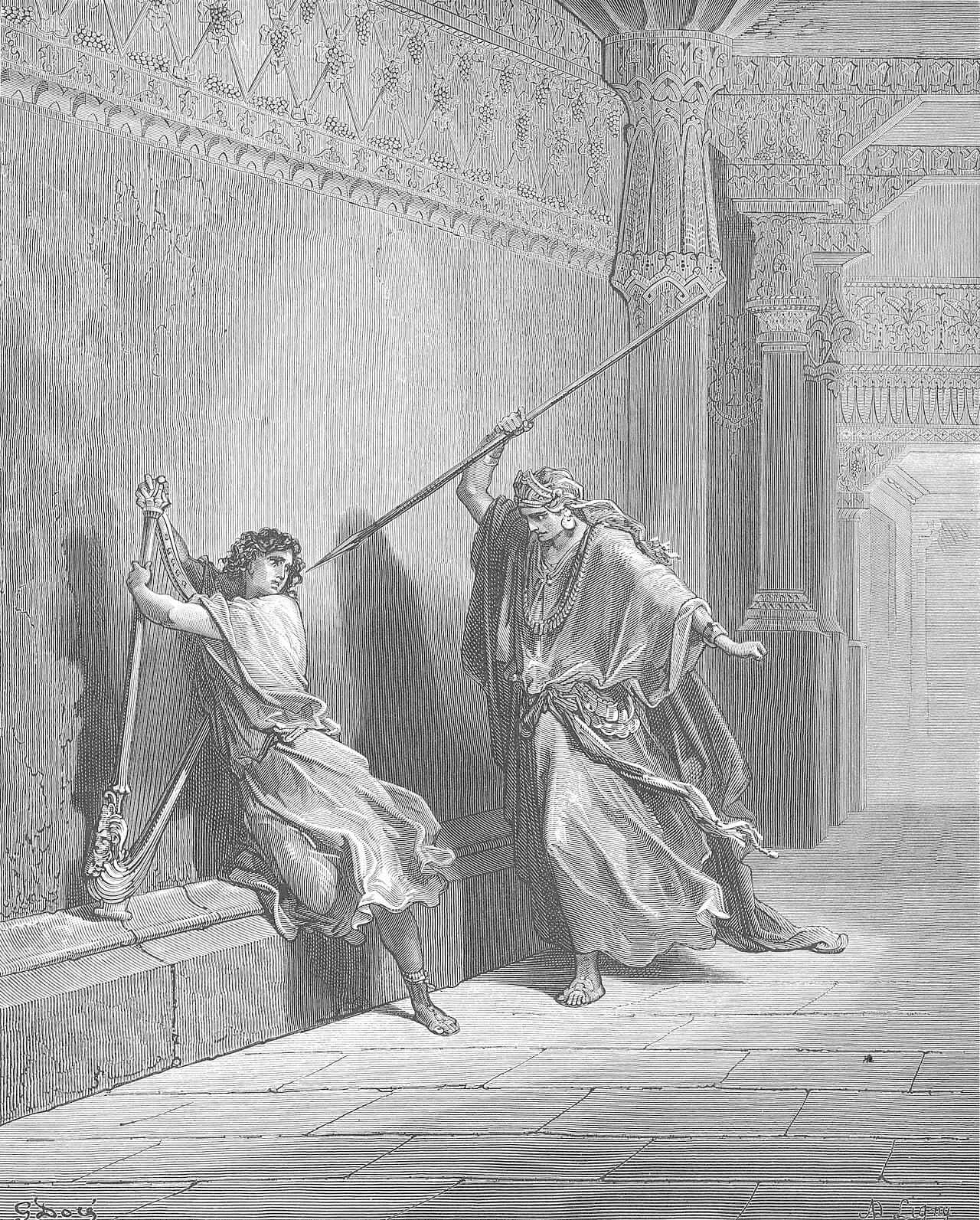
Gustave Doré, Saul Attempts to Kill David, from La Grande Bible de Tours, 1866. Public domain.
THE ARTWORKDoré draws the moment in 1 Samuel 19 when the king throws a spear at the man playing music for him. Three of these four psalms carry David's name in their headings, and all three speak from the position this plate shows. It is a man under attack from someone he had served, with no court to take the case to. The fourth psalm speaks from Babylon, where there was no court either.
Summary
Summary
A curse psalm asks God to act against an enemy. Four carry the weight of the group, the apostles quote two of them, and every request in them is addressed to God rather than carried out by the man praying.
- Psalms 35, 69, 109 and 137 stand on every list of the group that the research found.
- The New Testament quotes Psalms 69 and 109 five times, once applying an imprecation to Judas.
- In each psalm the verb of judgment belongs to God. The psalmist asks; he never says he will act.
- Romans 12:19 and Revelation 6:10 leave the appeal exactly where the psalms leave it.
What a Curse Psalm Is
an imprecation is a curse called down, and these psalms call it down on God
To imprecate is to call down a curse. An imprecatory psalm is one in which the psalmist asks God to bring disaster on an enemy, and names the disaster. The requests run from a lawsuit to a battlefield to a household left empty, and in Psalm 137 to the killing of children.
The ground under the request is the covenant. God had sworn to bless those who blessed Abraham's line and curse those who cursed it, and he had reserved vengeance to himself in the Song of Moses. A psalmist asking God to repay an enemy is asking God to do what God said he would do. The request is therefore addressed to a party who has already made a promise about it.
Vengeance is Mine; I will repay. In due time their foot will slip; for their day of disaster is near, and their doom is coming quickly.”The reservation the psalms appeal to, and the line Paul quotes in Romans 12:19.
Lists of the group vary from one reference work to another, and the research file records two that differ. Psalms 35, 69, 109 and 137 stand on every list it found, which is why they are the four here.
The Four Psalms and Their Occasions
4 psalms, each with its heading, its situation and its sharpest lines
The heading names David. The psalm speaks from a hunt: men are after the psalmist's life, the hostility has no cause he can name, and men he had treated as friends are among them. He asks God to take the case up as his own.
Contend with my opponents, O LORD; fight against those who fight against me.The first verb of the psalm is a legal one. The psalmist asks God to contend, which is what a party to a lawsuit does, and only then to fight. Verse 19 supplies the line the Gospel of John later puts in the mouth of Jesus.
The heading names David and sets the tune. The psalmist is in rising water, hated without cause, and the reproach he carries is reproach aimed at God. The psalm turns to imprecation at verse 22 and stays there for seven verses.
May their table become a snare; may it be a retribution and a trap. May their eyes be darkened so they cannot see, and their backs be bent forever.This is the psalm the New Testament quotes most often after Psalm 22 and Psalm 110. Three of its lines are applied to Jesus and two of them to his opponents, and the imprecation of verse 22 is among the two.
The heading names David and the choirmaster. The psalmist has been answered with hatred for love and accused by lying mouths, and he says that he gave himself to prayer. From verse 6 the psalm asks for judgment on one man, at length and in detail.
May his days be few; may another take his position.The prayer of verses 6 to 20 is the longest sustained imprecation in the Psalter. Peter reads verse 8 of Judas in Acts 1:20, which fixes at least one line of this psalm as prophecy in the apostles' own reading.
No heading stands over this psalm. It speaks from the exile, by the waterways of Babylon, where the captors asked their prisoners for the songs of Zion as entertainment. Matthew Henry reads the closing verses as written late in the captivity, with Babylon's own fall already in view.
O Daughter of Babylon, doomed to destruction, blessed is he who repays you as you have done to us. Blessed is he who seizes your infants and dashes them against the rocks.These are the hardest two verses in the book. They are printed here whole, because the one thing forbidden on this subject is quoting the psalm with its last line removed.
The Apostles' Own Use
5 places the New Testament quotes Psalm 69 or Psalm 109, each pair checked verse against verse
quotes Psalm 69:9
His disciples remembered that it is written: “Zeal for Your house will consume Me.”
The disciples remember the line after Jesus clears the temple. The psalm says the zeal has consumed the psalmist; John reports it of Jesus in the future tense.
But this is to fulfill what is written in their Law: ‘They hated Me without reason.’
Jesus says the world's hatred fulfils what is written in their Law. The words stand in both psalms, and both are psalms on this page.
“For it is written in the book of Psalms: ‘May his place be deserted; let there be no one to dwell in it,’ and, ‘May another take his position.’
Peter joins one line from each psalm and reads them of Judas: the deserted place from Psalm 69, and another taking his position from Psalm 109. This is an imprecation quoted as Scripture and acted on.
quotes Psalm 69:22-23
And David says: “May their table become a snare and a trap, a stumbling block and a retribution to them. May their eyes be darkened so they cannot see, and their backs be bent forever.”
Paul quotes the imprecation itself, names David as its author, and applies it to those in Israel who did not receive Christ. He then spends two chapters arguing that their fall is temporary.
quotes Psalm 69:9
For even Christ did not please Himself, but as it is written: “The insults of those who insult You have fallen on Me.”
The second half of the same verse John quoted, now put to Christ bearing insult rather than pleasing himself. Paul offers it to the strong as the pattern for bearing with the weak.
The weight of this section is Acts 1:20. Peter takes a line out of the longest imprecation in the Psalter and reads it as Scripture that had to be fulfilled. The eleven then fill the office it speaks of. Whatever else is true of these psalms, the apostles used one of them to make a decision.
How the Church Has Read Them
4 readings from the store's public-domain commentaries, each with the work named
The rest of the prayers here against his enemies were the expressions, not of passion, but of the Spirit of prophecy.
Matthew Henry· Commentary on the Whole Bible, on Psalm 109
The prophetic reading, which is the oldest of the four. On this account the psalmist is not stating a wish at all. He is being shown what will happen and saying it, and the proof offered is that Peter treats verse 8 as a thing written to be fulfilled.
not from a principle of malice and revenge, but in a holy zeal for God and against sin and with an eye to the enemies of Christ
Matthew Henry· Commentary on the Whole Bible, on Psalm 109:6
The zeal reading. The psalmist speaks against sin and against the enemies of God rather than out of personal injury. The heat of the psalm is measured against what it is heated about.
The pious Jews in Babylon, having afflicted themselves with the thoughts of the ruins of Jerusalem, here please themselves with the prospect of the ruin of her impenitent implacable enemies; but this not from a spirit of revenge, but from a holy zeal for the glory of God and the honour of his kingdom.
Matthew Henry· Commentary on the Whole Bible, on Psalm 137:8-9
The same reading applied to the hardest verses in the book. Henry states the difficulty in the same breath as the defence, which is the honest form of the argument.
In these words, which may be considered as an introduction to the psalm, David declares that he neither could find nor would desire any other than God to stand forward in vindication of the integrity of his heart.
John Calvin· Commentary on the Book of Psalms, on Psalm 109:1
Calvin's hinge. The psalm opens by handing the case to God, and everything asked for afterwards is asked of the judge rather than taken by the plaintiff. Calvin reads David here as a public person with a public office, not a private man with a grievance.
These four readings agree on the point that decides the question and differ on how much of the psalm it covers. The prophetic reading accounts for Acts 1:20 and leaves the rest of Psalm 109 to be explained. The zeal reading accounts for the whole psalm and has to carry the weight of Psalm 137:9. The research file records that fuller statements of the case by Augustine, Spurgeon, Lewis and Kidner could not be fetched from this session, and they are therefore not quoted here.
Where the Psalms Put the Matter
the grammar of the request, and the New Testament's own place for it
In every one of the four psalms the verb of judgment belongs to God. Psalm 35 asks the LORD to contend and to fight. Psalm 69 asks God to pour out his indignation. Psalm 109 asks that an accuser be appointed, and the appointing is God's act. Psalm 137 pronounces a blessing on whoever repays Babylon and names no agent and no date.
The psalmist asks. He does not say he will act, and in none of the four does he act. That is the whole distance between an imprecatory psalm and a threat, and it is the distance the New Testament keeps when it takes the same subject up.
Do not avenge yourselves, beloved, but leave room for God’s wrath. For it is written: “Vengeance is Mine; I will repay, says the Lord.”Paul forbids the Christian to avenge himself by quoting the same reservation the psalms appeal to.
And they cried out in a loud voice, “How long, O Lord, holy and true, until You avenge our blood and judge those who dwell upon the earth?”The martyrs under the altar ask God for what Psalm 109 asks God for, in heaven, after the cross.
Vengeance is Mine; I will repay. In due time their foot will slip; for their day of disaster is near, and their doom is coming quickly.”The promise both of them rest on, spoken in the Song of Moses before Israel entered the land.
Keep studying
On this page
People1
Places1
Doctrines1
Go further1