
1 Peter 4 · Subject · Featured Study
Suffering as a Christian
The name Christian in Acts and 1 Peter, and what the churches of Asia Minor faced from Nero to Pliny.
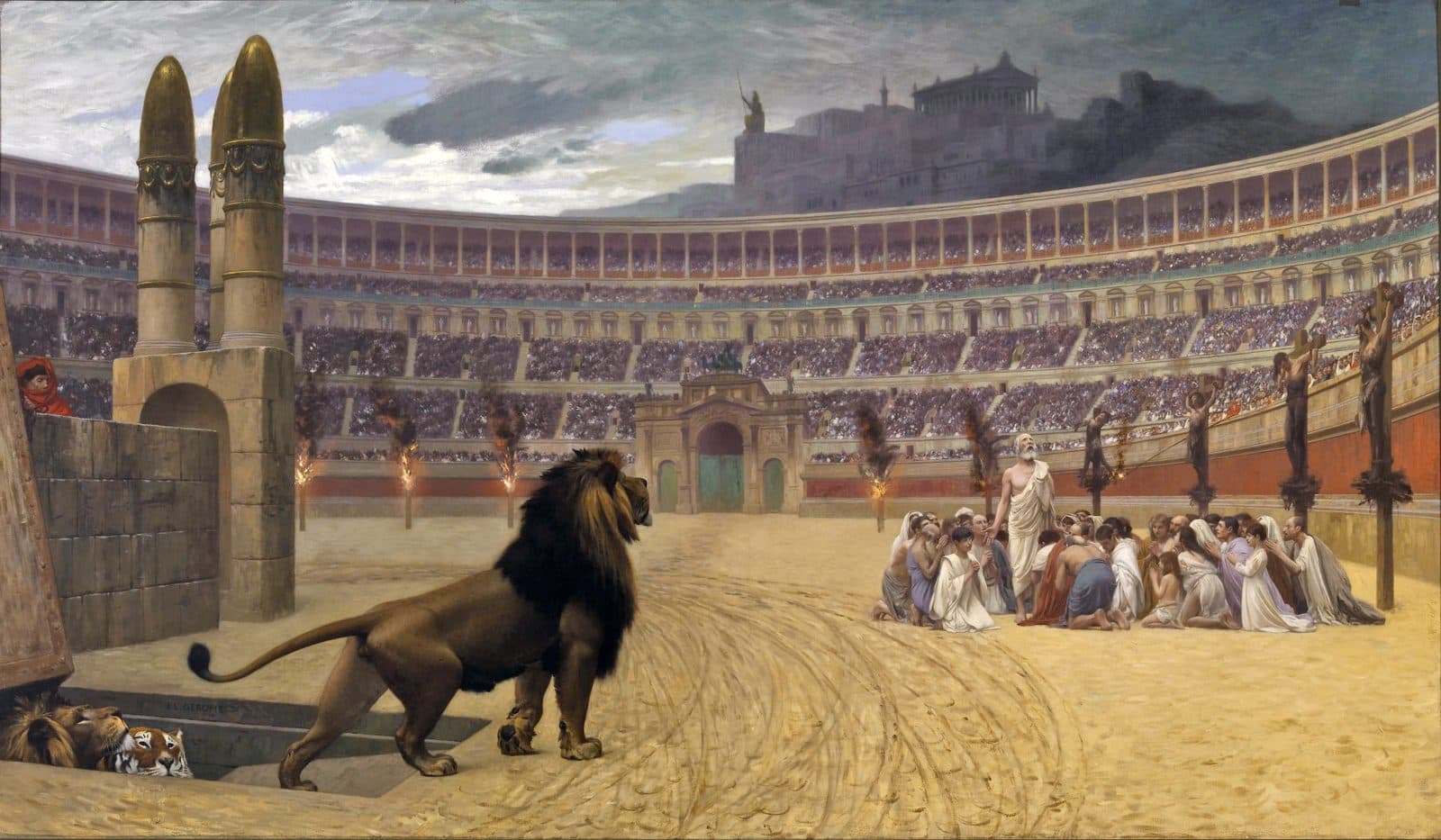
Jean-Léon Gérôme, The Christian Martyrs' Last Prayer, commissioned 1863 and delivered in 1883, Walters Art Museum, Baltimore. Public domain, via Wikimedia Commons.
THE ARTWORKGérôme set a band of Christians at prayer on the sand of a Roman arena, with an old man standing among them and a lion stepping out of the pit. Men are burning on crosses around the track. Gérôme painted the last moments of believers who would not give up the name.
Peter told the churches not to be surprised at the fiery trial, because to suffer for the name is to share in the sufferings of Christ.
Summary
Christian is a name for a follower of Christ, and Peter writes that one who suffers as a Christian is not to be ashamed.
- The name first appears in Acts 11, in the church at Antioch in Syria.
- Peter wrote to churches in five regions of Asia Minor whose neighbours spoke against them.
- Early in the second century the governor of Bithynia and Pontus put to death those who would not deny the name.
- Scholars differ on whether the letter speaks of court trials or of hostile neighbours.
The Name and the Fiery Trial
Five passages, from the naming at Antioch to Peter's charge to the churches.
Then Barnabas went to Tarsus to look for Saul, and when he found him, he brought him back to Antioch. So for a full year they met together with the church and taught large numbers of people. The disciples were first called Christians at Antioch.The name began in a church of Jews and Greeks, after believers from Cyprus and Cyrene had preached to both.
Then Agrippa said to Paul, “Can you persuade me in such a short time to become a Christian?”At Caesarea, King Agrippa answers Paul's defense with the same word.
Beloved, do not be surprised at the fiery trial that has come upon you, as though something strange were happening to you. But rejoice that you share in the sufferings of Christ, so that you may be overjoyed at the revelation of His glory.Everything Peter asks in the rest of the chapter rests on the reason for joy these two verses give.
If you are insulted for the name of Christ, you are blessed, because the Spirit of glory and of God rests on you. Indeed, none of you should suffer as a murderer or thief or wrongdoer, or even as a meddler. But if you suffer as a Christian, do not be ashamed, but glorify God that you bear that name.These verses set the terms for the whole subject: Peter praises suffering for the name, and a crime earns no such praise.
For it is time for judgment to begin with the family of God; and if it begins with us, what will the outcome be for those who disobey the gospel of God? And, “If it is hard for the righteous to be saved, what will become of the ungodly and the sinner?” So then, those who suffer according to God’s will should entrust their souls to their faithful Creator and continue to do good.The charge ends by setting the readers' trial within God's judgment and His care.
Peter's Commands to Those Who Suffer
The letter returns to suffering in all five of its chapters.
| Passage | What the readers suffer | What Peter asks |
|---|---|---|
| 1 Peter 1:6 to 7 | Grief in various trials | Rejoice, for the proven character of your faith is more precious than gold. |
| 1 Peter 2:12 | Slander as evildoers | Conduct yourselves with such honor that they may see your good deeds. |
| 1 Peter 2:19 to 21 | The pain of unjust suffering | Endure it, and follow in His footsteps, for Christ also suffered for you. |
| 1 Peter 3:14 to 17 | Suffering for what is right | Do not fear what they fear; be prepared to give a defense with gentleness and respect. |
| 1 Peter 4:1 to 4 | Abuse heaped on them for leaving the old life | Arm yourselves with the same resolve, and live for the will of God. |
| 1 Peter 5:8 to 10 | The devil prowling like a roaring lion, and the same kinds of suffering worldwide | Resist him, standing firm in your faith; God will restore you. |
- Passage
- 1 Peter 1:6 to 7
- What the readers suffer
- Grief in various trials
- What Peter asks
- Rejoice, for the proven character of your faith is more precious than gold.
- Passage
- 1 Peter 2:12
- What the readers suffer
- Slander as evildoers
- What Peter asks
- Conduct yourselves with such honor that they may see your good deeds.
- Passage
- 1 Peter 2:19 to 21
- What the readers suffer
- The pain of unjust suffering
- What Peter asks
- Endure it, and follow in His footsteps, for Christ also suffered for you.
- Passage
- 1 Peter 3:14 to 17
- What the readers suffer
- Suffering for what is right
- What Peter asks
- Do not fear what they fear; be prepared to give a defense with gentleness and respect.
- Passage
- 1 Peter 4:1 to 4
- What the readers suffer
- Abuse heaped on them for leaving the old life
- What Peter asks
- Arm yourselves with the same resolve, and live for the will of God.
- Passage
- 1 Peter 5:8 to 10
- What the readers suffer
- The devil prowling like a roaring lion, and the same kinds of suffering worldwide
- What Peter asks
- Resist him, standing firm in your faith; God will restore you.
For the Name or for a Crime
Calvin and Henry on 1 Peter 4:15 to 16, and Peter's word on judgment in 1 Peter 4:17 to 18.
John Calvin, in his commentary on the Catholic Epistles, says Peter regards not so much the name as the cause. Matthew Henry, in his Commentary on the Whole Bible, wrote that the cause makes the martyr.
Judgment beginning with the family of God1 Peter 4:17 to 18; Ezekiel 9:6; Proverbs 11:31
Adam Clarke sets Peter's words beside Ezekiel 9 and beside a saying of the Talmud, in Bava Kamma 60a, that the destroyer begins with the righteous. Rashi, the medieval Jewish commentator, records the rabbis' reading of Ezekiel 9:6 as from My sanctified ones.
Slaughter the old men, the young men and maidens, the women and children; but do not go near anyone who has the mark. Now begin at My sanctuary.” So they began with the elders who were before the temple.Here judgment begins at the sanctuary, the pattern Peter applies when he says judgment begins with the family of God.
If the righteous receive their due on earth, how much more the ungodly and the sinner!Peter's question in 1 Peter 4:18 follows this proverb as the Greek version renders it, as Matthew Henry notes.
The Churches of Asia Minor from Nero to Pliny
The provinces Peter wrote to, and what Roman and Christian writers record of the trials that followed.
1 Peter is addressed to believers scattered through Pontus, Galatia, Cappadocia, Asia and Bithynia.
In AD 64 Nero punished Christians at Rome, and Tacitus told the story in his Annals more than fifty years later.
In AD 112 Pliny the Younger, governor of Bithynia and Pontus, wrote to the emperor Trajan for advice. He had asked the accused three times whether they were Christians and had those who held firm led away to be punished.
In his reply, a rescript, Trajan ruled that Christians were not to be hunted out. Those accused and proved were to be punished, and anyone who denied the name and called on the gods was to be pardoned.
What Pliny foundPliny, Letters 10.96
Pliny released those who called on the gods, offered wine and incense before the emperor's statue and cursed Christ. A few told him they had left the faith more than twenty years before.
The accused said they met on a fixed day before dawn and prayed to Christ as divine. They bound themselves by oath to commit no theft, no adultery and no fraud.
Tertullian's answer to the rescriptTertullian, Apology 2
Writing about 197, Tertullian held that Trajan's ruling contradicted itself.
“It forbids them to be sought after as innocent, and it commands them to be punished as guilty.”
Tertullian · Apology, chapter 2 · on 1 Peter 4:16Early Church
Polycarp before the proconsulThe Martyrdom of Polycarp 10
In the account of his death, Polycarp, bishop of Smyrna, is pressed to swear by the fortune of Caesar. His answer to the proconsul uses the name Peter wrote of in 1 Peter 4:16.
The Words of Suffering in 1 Peter
Six Greek words that carry the letter's teaching on suffering.
CHRISTIANOS (GREEK, G5546)
A noun that names a Christian, and it stands three times in the New Testament, twice in Acts and once in 1 Peter.
PYROSIS (GREEK, G4451)
A noun for burning or smelting, used figuratively of a calamity that tests.
XENIZO (GREEK, G3579)
A verb for receiving a guest, and in the passive for finding something strange; Peter uses it of the neighbours at 1 Peter 4:4 and of the believers at 1 Peter 4:12.
KOINONEO (GREEK, G2841)
A verb that means to share with others.
PATHEMA (GREEK, G3804)
A noun for something undergone, a hardship or pain.
ONEIDIZO (GREEK, G3679)
A verb that means to defame, rail at or taunt.
What the Text Leaves Unsaid
Three questions, of the setting, the fire and the name, stay open in the text.
The letter names no particular emperor, no law against Christians and no death among its readers.
It does not say whether the fiery trial is fire in fact.
Acts does not say who first called the disciples Christians.
Is the fire literal? Two readingsJohn Wesley; James Macknight, quoted by Adam Clarke
“Wonder not at the burning which is among you - This is the literal meaning of the expression. It seems to include both martyrdom itself, which so frequently was by fire, and all the other sufferings joined with, or previous to, it; which is permitted by the wisdom of God for your trial.”
John Wesley · Explanatory Notes upon the New Testament · on 1 Peter 4:12Evangelical
James Macknight, whom Adam Clarke quotes on this verse, reads the burning as the fire that tries gold, the image of 1 Peter 1:7.
Where the name came fromActs 11:26 and Acts 26:28
John Wesley notes that the disciples had been called Nazarenes and Galileans before Antioch. Albert Barnes lists three views of who gave the new name: enemies in scorn, the disciples themselves, or God. He thinks scorn unlikely.
The verb in Acts 11:26 is chrematizo. It means divinely warned in Matthew 2:12, and simply called in Romans 7:3.
“The objection on which so much stress is laid, that the word ‘Christian’ was at that time only a term of contempt, has no force except on the other side; for taking it in that view, the sense is, ‘Thou wilt soon have me one of that despised sect.’”
Jamieson, Fausset & Brown · Commentary Critical and Explanatory on the Whole Bible · on Acts 26:28Reformed
Voices on Suffering for the Name, Earliest First
Three teachers, from Polycarp to Wesley.
“Let us then continually persevere in our hope, and the earnest of our righteousness, which is Jesus Christ, ‘who bore our sins in His own body on the tree,’ ‘who did no sin, neither was guile found in His mouth,’ but endured all things for us, that we might live in Him. Let us then be imitators of His patience; and if we suffer for His name's sake, let us glorify Him. For He has set us this example in Himself, and we have believed that such is the case.”
Polycarp of Smyrna · Epistle to the Philippians 8 · on 1 Peter 4:16Patristic
“In such case he asserts, Happy are you, the reason of which is, ‘Because you have the spirit of God with you, to fortify and comfort you; and the Spirit of God is also the Spirit of glory, that will carry you through all, bring you off gloriously, and prepare and seal you up for eternal glory.”
Matthew Henry · Commentary on the Whole Bible · on 1 Peter 4:14Puritan
“Commit to him their souls - (Whatever becomes of the body) as a sacred depositum. In well doing - Be this your care, to do and suffer well: He will take care of the rest. As unto a faithful Creator - In whose truth, love, and power, ye may safely trust.”
John Wesley · Explanatory Notes upon the New Testament · on 1 Peter 4:19Evangelical
What Did the Readers Face?
Three datings of the letter, from before AD 64 to the reign of Hadrian.
Trials for the name under a settled policy, about AD 75 to 80W. M. Ramsay, The Church in the Roman Empire before A.D. 170 (1893)
Ramsay held that in 1 Peter Christians suffer for the Name pure and simple, and that officials seek them out for trial. He dated the letter about 75 to 80, after Nero, when he believed the Flavian emperors had made this the fixed policy that Pliny later carried out.
Charles Bigg objected that no such Flavian procedure is attested. He noted that Peter's words for the name leave room for other charges, and that Pliny says he knew of no settled method.
The age of Trajan or HadrianH. J. Holtzmann, in Schenkel's Bibel-Lexikon, as Ramsay reports him
Holtzmann read 1 Peter 4:15 to 16 beside Pliny's letter and placed 1 Peter in the time of Trajan or Hadrian.
Ramsay replied that this rests on a false reading of Pliny's report, and that the letter looks forward to trials rather than back on them.
Slander and hostility before Nero's persecutionCharles Bigg, A Critical and Exegetical Commentary on the Epistles of St. Peter and St. Jude (1901)
Bigg held that the believers were spoken against as evildoers, as the apostles had been, and that suffering in Peter need not mean death. He dated the letter before the outbreak of Nero's persecution.
The objection is the one Bigg himself names: 1 Peter 4:15 to 16 sets the Christian beside the murderer, whom the courts put to death. Bigg answered that thieves were not put to death, yet stand in the same list.
Books to Read Next
Five works, each free to read online.
Letters, Book 10
Pliny the Younger · about 112
The tenth book holds Pliny's letters to Trajan from his province and the emperor's replies.
Read at Project GutenbergThe Apology
Tertullian · about 197
Tertullian addressed it to the rulers of the Roman Empire in defence of the Christians.
Read at New AdventCommentaries on the Catholic Epistles
John Calvin · 1551
Owen's translation holds Calvin's notes on 1 Peter, 2 Peter, James, Jude and 1 John.
Read at CCELThe Church in the Roman Empire before A.D. 170
W. M. Ramsay · 1893
Ramsay follows the church in the Roman provinces from Paul's travels to about AD 170.
Read at the Internet ArchiveA Critical and Exegetical Commentary on the Epistles of St. Peter and St. Jude
Charles Bigg · 1901
Bigg's introduction sets the date of 1 Peter against the Roman record of persecution.
Read at the Internet Archive