
Genesis 6:1 to 4 · Debate · Featured Study
The Dynastic-Ruler Reading of the Sons of God
The reading of Genesis 6:1 to 4 that identifies its sons of God with kings and nobles, with holders from the Targum to Meredith G. Kline, set beside the Watchers and Sethite readings.
In the laws of Moses the Hebrew word for God is also used of the judges of Israel, and an old Jewish reading of Genesis 6 starts from that use.
- The question
- Were the sons of God of Genesis 6:2 and 6:4 kings and nobles who took wives at will and founded houses of mighty men?
- The texts
- Genesis 6:2, Genesis 6:4, Exodus 21:6, Psalm 82:6, Job 1:6
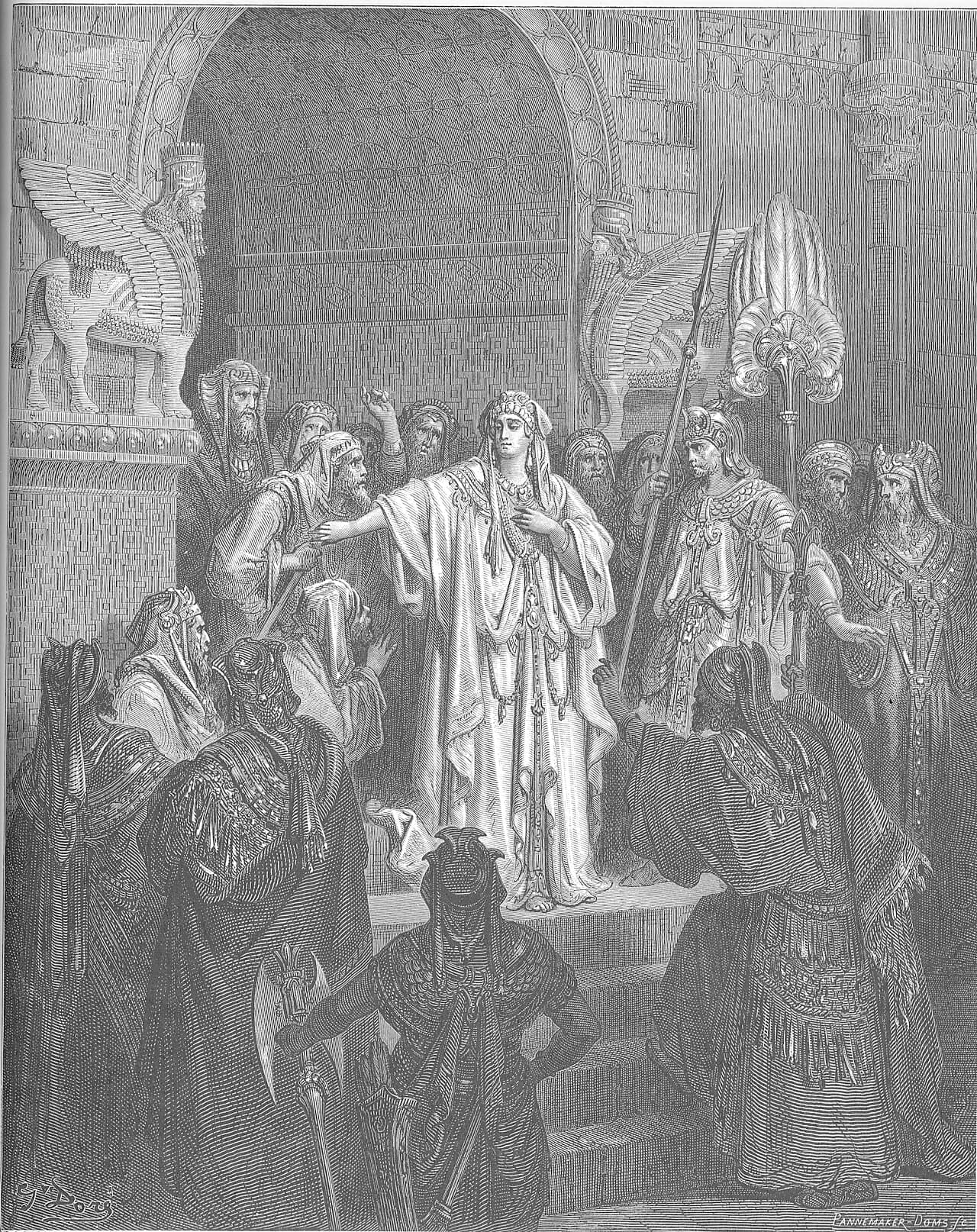
Gustave Doré, Queen Vashti Refuses to Obey the Command of Ahasuerus, La Grande Bible de Tours, 1866. Public domain.
THE ARTWORKDoré engraved Queen Vashti standing before the court of King Ahasuerus after she refused his summons (Esther 1:10 to 12).
Summary
The dynastic reading takes the sons of God as rulers who claimed divine sonship, married any woman they wished and fathered the mighty men of old.
- Targum Onqelos reads the phrase as the sons of the great ones, and Rashi reads it as the sons of princes and rulers.
- Meredith G. Kline gave the reading its modern form in 1962, from the royal titles of Israel's neighbours.
- The Watchers reading, the oldest of the three and the site's Wesleyan-Pentecostal tradition, takes the sons of God as angels.
- The Sethite reading, the majority reading of the Western church from the fifth century, takes them as the godly line of Seth.
The Verses Every Reading Answers
Five verses from Genesis, the Psalms, Job and Jude hold the evidence that the three readings weigh.
the sons of God saw that the daughters of men were beautiful, and they took as wives whomever they chose.Each of the three readings starts from this verse, and each gives the sons of God a different identity.
The Nephilim were on the earth in those days—and afterward as well—when the sons of God had relations with the daughters of men. And they bore them children who became the mighty men of old, men of renown.Verse 4 names the Nephilim and the children of the union, and every reading has to account for both.
I have said, ‘You are gods; you are all sons of the Most High.’The three readings differ over whether the gods addressed here are human judges or members of the heavenly assembly.
One day the sons of God came to present themselves before the LORD, and Satan also came with them.The Watchers reading takes this use of the phrase, for beings who present themselves before the LORD, as the key to Genesis 6.
And the angels who did not stay within their own domain but abandoned their proper dwelling—these He has kept in eternal chains under darkness, bound for judgment on that great day.The Watchers reading hears the sin of Genesis 6 behind the verse.
Three Readings and Their Holders
The dynastic, Watchers and Sethite readings each identify the sons of God, their sin and the mighty men in their own way.
| The question | The dynastic reading | The Watchers reading (the site's tradition) | The Sethite reading |
|---|---|---|---|
| Who the sons of God are | Rulers and nobles of the earth | Angels who left their proper dwelling | Men of the godly line of Seth |
| The sin | Rulers taking the women they wanted, as a king fills a harem | Heavenly beings crossing into marriage with women | The godly line marrying into the line of Cain |
| The mighty men of Genesis 6:4 | The founders of royal houses, men of renown | The offspring of the union | Violent men of the mixed generation |
| The Scripture it reads | Exodus 21:6 and 22:8; Psalm 82:1 and 82:6 | Job 1:6, 2:1 and 38:7; Jude 1:6 to 7; 2 Peter 2:4 | Genesis 4:25 to 26 and 5:1 to 3 |
| Its holders | Targum Onqelos; Symmachus; Genesis Rabbah 26:5; Rashi; Meredith G. Kline; John H. Walton | 1 Enoch; Josephus; Justin Martyr; Irenaeus; Clement of Alexandria; Tertullian; Michael S. Heiser; Chuck Missler; Gary Wayne | Julius Africanus; Ephrem the Syrian; John Chrysostom; Augustine; John Calvin |
| Its representative works | Rashi on Genesis 6:2; Meredith G. Kline, Divine Kingship and Genesis 6:1 to 4, Westminster Theological Journal 24, 1962 | 1 Enoch 6 to 16, the Book of the Watchers; Michael S. Heiser, The Ancient Near Eastern Context for Genesis 6:1 to 4, 2015 | Augustine, The City of God, Book 15, 426; John Calvin, Commentaries on Genesis, 1554 |
- The question
- Who the sons of God are
- The dynastic reading
- Rulers and nobles of the earth
- The Watchers reading (the site's tradition)
- Angels who left their proper dwelling
- The Sethite reading
- Men of the godly line of Seth
- The question
- The sin
- The dynastic reading
- Rulers taking the women they wanted, as a king fills a harem
- The Watchers reading (the site's tradition)
- Heavenly beings crossing into marriage with women
- The Sethite reading
- The godly line marrying into the line of Cain
- The question
- The mighty men of Genesis 6:4
- The dynastic reading
- The founders of royal houses, men of renown
- The Watchers reading (the site's tradition)
- The offspring of the union
- The Sethite reading
- Violent men of the mixed generation
- The question
- The Scripture it reads
- The dynastic reading
- Exodus 21:6 and 22:8; Psalm 82:1 and 82:6
- The Watchers reading (the site's tradition)
- Job 1:6, 2:1 and 38:7; Jude 1:6 to 7; 2 Peter 2:4
- The Sethite reading
- Genesis 4:25 to 26 and 5:1 to 3
- The question
- Its holders
- The dynastic reading
- Targum Onqelos; Symmachus; Genesis Rabbah 26:5; Rashi; Meredith G. Kline; John H. Walton
- The Watchers reading (the site's tradition)
- 1 Enoch; Josephus; Justin Martyr; Irenaeus; Clement of Alexandria; Tertullian; Michael S. Heiser; Chuck Missler; Gary Wayne
- The Sethite reading
- Julius Africanus; Ephrem the Syrian; John Chrysostom; Augustine; John Calvin
- The question
- Its representative works
- The dynastic reading
- Rashi on Genesis 6:2; Meredith G. Kline, Divine Kingship and Genesis 6:1 to 4, Westminster Theological Journal 24, 1962
- The Watchers reading (the site's tradition)
- 1 Enoch 6 to 16, the Book of the Watchers; Michael S. Heiser, The Ancient Near Eastern Context for Genesis 6:1 to 4, 2015
- The Sethite reading
- Augustine, The City of God, Book 15, 426; John Calvin, Commentaries on Genesis, 1554
The Case for Kings and Nobles
The dynastic reading rests on four lines of evidence from the Law, the Psalms, Genesis and the rabbinic commentary.
Elohim names the judges of IsraelExodus 21:6 and 22:8; Rashi
A servant who chooses to stay with his master is brought before the judges in Exodus 21:6. In that verse the Hebrew is el haelohim, literally to God, as Adam Clarke notes, and Rashi reads it as the court. On Genesis 6:2 Rashi says that the word elohim signifies authority wherever it occurs, and he cites Exodus 4:16 and 7:1, where Moses is to be like God to Aaron and to Pharaoh. The dynastic reading concludes that the sons of elohim can be the sons of rulers and judges.
If the thief is not found, the owner of the house must appear before the judges to determine whether he has taken his neighbor’s property.This second law sends a property dispute to the same officers, a second instance of the use.
Rulers called sons of the Most HighPsalm 82; Rashi; Matthew Henry
God presides in the divine assembly; He renders judgment among the gods:God stands in the divine assembly to judge its members, the gods whom the rest of the psalm addresses.
Psalm 82 charges the gods it addresses with judging unjustly and showing partiality to the wicked, and it tells them to defend the weak and the fatherless. Verse 7 says they will die like mortals and fall like rulers. Rashi reads the gods of verse 1 as judges, and on his reading, which the dynastic reading follows, the psalm gives the title sons of the Most High to men who hold power. Matthew Henry reads the psalm the same way.
“The power and honour of magistrates; they are the mighty. They are so in authority, for the public good (it is a great power that they are entrusted with), and they ought to be so in wisdom and courage. They are, in the Hebrew dialect, called gods; the same word is used for these subordinate governors that is used for the sovereign ruler of the world.”
Matthew Henry · Commentary on the Whole Bible · on Psalm 82:1Puritan
Taking whomever they choseGenesis 6:2; Genesis Rabbah 26:5
Rashi, after Genesis Rabbah 26:5, says that when a bride had been adorned for the marriage canopy, one of the lords would come and carry her off first. Meredith G. Kline reads Genesis 6:2 as kings who claimed divine sonship taking whatever women they wanted, a sin of tyranny and of many wives.
And Lamech married two women, one named Adah and the other Zillah.Lamech of Cain's line is the first man in Genesis to take two wives, two chapters before the sons of God take whomever they choose.
Cain's city, Lamech's song and Nimrod's kingdomGenesis 4:17 to 24; Genesis 10:8 to 10
And Cain had relations with his wife, and she conceived and gave birth to Enoch. Then Cain built a city and named it after his son Enoch.The first city Genesis names rises in the line of Cain, two chapters before the sons of God appear.
Then Lamech said to his wives: “Adah and Zillah, hear my voice; wives of Lamech, listen to my speech. For I have slain a man for wounding me, a young man for striking me. If Cain is avenged sevenfold, then Lamech seventy-sevenfold.”This song, the first boast of vengeance in Genesis, is sung in the line that built the city.
Genesis 6:4 calls the children of the sons of God the mighty men of old, and Genesis 10:8 uses the same word, gibbor, of Nimrod, who began to be a mighty one on the earth. His kingdom began in Babylon, and Radak says he first conquered Babylon and established himself as king there. The dynastic reading takes the mighty men of Genesis 6 as a dynasty of warrior kings of that kind.
The Case for Angels and for the Line of Seth
The Watchers reading and the Sethite reading each rest on their own texts and their own line of holders.
The Watchers readingfrom 1 Enoch to Michael S. Heiser
1 Enoch 6 to 16, the Book of the Watchers, tells of two hundred Watchers who descend on Mount Hermon under Semjaza and Azazel, take wives and father the giants. Josephus reports the Watchers reading as the common understanding of his day, and some Greek copies of Genesis read angels of God at verse 2. Justin Martyr held the reading in his Second Apology, and Irenaeus, in The Demonstration of the Apostolic Preaching, ties the giants of verse 4 to the union of angels with the daughters of men. In the modern era Michael S. Heiser argues for it from the setting of Genesis in the ancient Near East. Chuck Missler argues from 1 Enoch, Jubilees and the Septuagint in Alien Encounters (1997), and Gary Wayne traces it across the canon in The Genesis 6 Conspiracy (2014).
For if God did not spare the angels when they sinned, but cast them deep into hell, placing them in chains of darkness to be held for judgment;Peter sets the angels who sinned first in a run of judgments that goes on to the Flood, and the Watchers reading takes that order as Genesis 6.
The Sethite readingfrom Julius Africanus to John Calvin
And to Seth also a son was born, and he called him Enosh. At that time men began to call upon the name of the LORD.The Sethite reading starts from the line of Seth, where calling on the name of the LORD begins.
The Sethite reading takes the sons of God as the descendants of Seth and the daughters of men as the descendants of Cain. Julius Africanus held that Seth's line was called the sons of God for the righteous men and patriarchs born of it, down to the Saviour Himself. Augustine, in The City of God, Book 15, chapter 22, read the two names as the marks of the two cities, the city of God and the earthly city. Calvin, on Genesis 6:2 in 1554, called it base ingratitude in the posterity of Seth to mingle with the children of Cain, since they threw away the grace of God. John Chrysostom and Ephrem the Syrian held the reading in the churches of the East.
Kings Called Sons of the Gods
Meredith G. Kline and the dynastic reading's other holders set Genesis 6 beside two royal customs of the ancient world and one king's harem in Esther.
and let the king appoint commissioners in each province of his kingdom to assemble all the beautiful young women into the harem at the citadel of Susa. Let them be placed under the care of Hegai, the king’s eunuch in charge of the women, and let them be given beauty treatments.The search for a new queen gathers the young women of every province into one king's harem, the kind of taking the dynastic reading finds in Genesis 6:2.
| The custom | Where it is found |
|---|---|
| A king styled the son of his god | The royal titles of the ancient Near East, the pharaohs of Egypt among them |
| A king taking brides by right | The Epic of Gilgamesh, tablet 1, where Gilgamesh of Uruk takes the brides of his city |
- The custom
- A king styled the son of his god
- Where it is found
- The royal titles of the ancient Near East, the pharaohs of Egypt among them
- The custom
- A king taking brides by right
- Where it is found
- The Epic of Gilgamesh, tablet 1, where Gilgamesh of Uruk takes the brides of his city
What Genesis 6 Leaves Unsaid
Genesis 6:1 to 4 gives the sons of God a title and one deed, and every other fact about them comes from outside the passage.
The dynastic reading draws their identity from the courts of Israel, the Watchers reading from the heavenly court, and the Sethite reading from the genealogies of Genesis 4 and 5. The passage tells the taking of the women in one verb, and its readers judge whether force or marriage stands behind it.
The Commentators on the Sons of God
Five quotations on the sons of God of Genesis 6:2, from Clement of Alexandria about 215 to Michael S. Heiser in 2015.
Clement of Alexandria on the angels who sank into pleasuresThe Stromata, Book 5, about 215, the Watchers reading
“To which also we shall add, that the angels who had obtained the superior rank, having sunk into pleasures, told to the women the secrets which had come to their knowledge; while the rest of the angels concealed them, or rather, kept them against the coming of the Lord.”
Clement of Alexandria · The Stromata Book 5 · on Genesis 6:2Patristic
Tertullian on the angels who revoltedOn Prayer, chapter 22, about 220, the Watchers reading
“It is on account of the angels, he says, that the woman's head is to be covered, because the angels revolted from God on account of the daughters of men.”
Tertullian · On Prayer 22.5 · on 1 Corinthians 11:10Patristic
Julius Africanus on the copies of Genesis 6:2Fragment 2, about 240, on the copies that read angels
“When men multiplied on the earth, the angels of heaven came together with the daughters of men. In some copies I found ‘the sons of God.’”
Julius Africanus · Fragment 2 · on Genesis 6:1 to 4Patristic
Ephrem the Syrian on the sons of SethCommentary on Genesis, 373, the Sethite reading
“[Moses] called the sons of Seth ‘sons of God,’ those who, like the sons of Seth, had been called ‘the righteous people of God.’”
Ephrem the Syrian · Commentary on Genesis 6.3.1 · on Genesis 6:1 to 2Patristic
Michael S. Heiser on the setting of Genesis 6The Ancient Near Eastern Context for Genesis 6:1 to 4, 2015, the Watchers reading
“This article deals a death blow to any non-supernatural (or non-mythic as some prefer) interpretation in the sense that, if you care about interpreting the Bible in context, no human interpretation of the sons of God can work.”
Michael S. Heiser · "The Ancient Near Eastern Context for Genesis 6:1-4" (drmsh.com) · on Genesis 6:2Academic
The Three Readings Weighed
Each reading meets one chief objection, raised by the holders of another reading.
The objection to the dynastic reading
In The Pentateuch (1864), C. F. Keil, a holder of the Sethite reading, called the reading of the sons of God as princes unwarranted by the usage of the language and unscriptural. Rashi, the dynastic reading's chief rabbinic holder, himself derives the Nephilim of Numbers 13:33 from Shemchazai and Azael, who fell from heaven.
The objection to the Watchers reading
John Chrysostom, in Homily 22 on Genesis, argued that Scripture calls men sons of God and never calls angels by that name. He held that the bodiless nature of angels could not join with bodily creatures, and he cited the words of Jesus on marriage in the resurrection. The holders of the Sethite and dynastic readings add that the judgment of Genesis 6:3 falls on man, and that Genesis 6:5 gives the wickedness of man as the cause of the Flood.
In the resurrection, people will neither marry nor be given in marriage. Instead, they will be like the angels in heaven.The Watchers reading answers that Jesus speaks here of the angels in heaven, and that Genesis 6 tells of angels who sinned.
The objection to the Sethite reading
In A New Commentary on Genesis (1888), Franz Delitzsch, a holder of the Watchers reading, answered that the Old Testament never stretches the phrase sons of God to mean the godly line. Genesis 6:2 sets the sons of God beside the daughters of men, and it never names the daughters of Cain.
Read the Great Books
Four works by holders of the three readings, from the second century to the sixteenth, each free to read.
The Second Apology
Justin Martyr · about 165
Chapter 5 gives the second-century Christian form of the Watchers reading, in which the children of the fallen angels are the demons.
Read it on New AdventThe City of God, Book 15
Augustine of Hippo · 426
Augustine reads the events of Genesis from Cain and Abel to the Flood as the story of the two cities.
Read Book 15 on New AdventPentateuch with Rashi's Commentary
Rashi, translated by M. Rosenbaum and A. M. Silbermann · 1929 to 1934
Rashi's note on Genesis 6:2 gives the princes and rulers first and the princely angels second.
Read the note on SefariaCommentaries on the First Book of Moses Called Genesis
John Calvin, translated by John King · 1554
Calvin's commentary carried the Sethite reading into the Reformed churches.
Read it on CCELThe Son of God Who Came to Serve
Jesus answers His accusers from Psalm 82 and teaches His disciples the way of greatness.
The sons of God of Genesis 6 took whomever they chose, and the mighty men born to them were men of renown. The Gospels set beside them a different Son of God.
Jesus replied, “Is it not written in your Law: ‘I have said you are gods’?Jesus meets the charge of blasphemy with the psalm, which He calls the Law.
then what about the One whom the Father sanctified and sent into the world? How then can you accuse Me of blasphemy for stating that I am the Son of God?From the gods of the psalm Jesus argues to Himself, the One the Father sent.
For even the Son of Man did not come to be served, but to serve, and to give His life as a ransom for many.”Jesus gives His own coming as the pattern for disciples who want to be great among His people.
Keep studying
Studies7
Places1
Doctrines6