
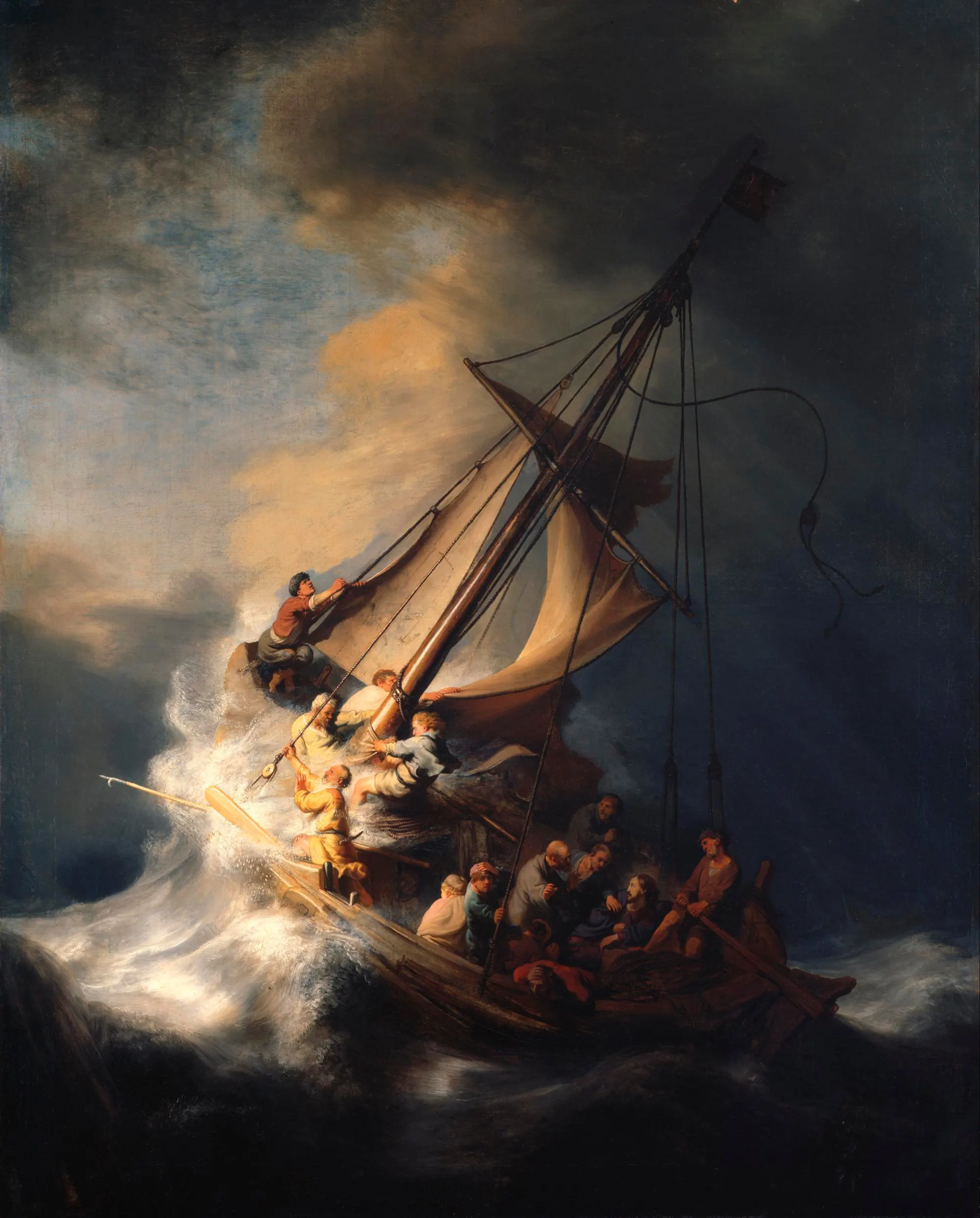
Christ in the Storm on the Sea of Galilee, Rembrandt, 1633, Isabella Stewart Gardner Museum. Public domain.
New Testament · Book 41 of 66
Mark
Mark is the shortest of the four Gospels and moves quickly through the ministry of Jesus. It gives much of its space to his last week in Jerusalem, his death on the cross and the empty tomb.
Mark is the shortest of the four Gospels and moves quickly through the ministry of Jesus. It gives much of its space to his last week in Jerusalem, his death on the cross and the empty tomb.
What is Mark about?
Mark tells the good news of Jesus Christ, the Son of God. John baptizes Jesus in the Jordan, and Jesus comes into Galilee announcing the kingdom of God. He heals, drives out spirits, calms the sea and teaches in parables, and all who see it ask who he is. At Caesarea Philippi Peter calls him the Christ, and Jesus walks toward Jerusalem, foretelling three times his death and rising. In Jerusalem he is arrested and crucified, and a Roman centurion calls him the Son of God. On the third day the tomb is empty. He came “to serve, and to give His life as a ransom for many” (10:45).
All 16 chapters
Every chapter of the book, in one grid. Each cell opens that chapter.
- The beginning of the gospelChapters 1 to 3
- Parables and powerChapters 4 to 6
- The way opened to the nations7:1 to 8:26
- The way to Jerusalem8:27 to 10:52
- The king in the templeChapters 11 to 13
- The passion and the empty tombChapters 14 to 16
The colour is the movement of the book the chapter stands in, and every cell opens that chapter's Study level. The way to Jerusalem begins at 8:27, inside chapter 8.
Who wrote it, where, when, for whom, and why?
The book opens with its own title for what follows (1:1). The New Testament names a John called Mark, whose mother's house in Jerusalem was a place of prayer (Acts 12:12). He left Paul and Barnabas in Pamphylia (Acts 13:13), later served with Paul again (Colossians 4:10; 2 Timothy 4:11), and is called my son by Peter (1 Peter 5:13). The early writers who link that Mark to this book stand under Where do readers disagree.
This is the beginning of the gospel of Jesus Christ, the Son of God.
Mark 1:1, Berean Standard Bible.
The story begins in the wilderness at the Jordan (1:4 and 5) and stays mostly in Galilee, around Capernaum and the sea (1:14, 1:21). It crosses to the Gentile regions of Tyre and the Decapolis (7:24, 7:31) and reaches Caesarea Philippi in the north (8:27). From there it goes through Judea beyond the Jordan and Jericho (10:1, 10:46) to Jerusalem, where the last week is spent between the temple and Bethany (11:11).
The events fall after John's arrest (1:14), while Herod rules in Galilee (6:14) and Pilate governs Judea (15:1). The last week is counted day by day: the entry, the next day (11:12), two days before the Passover (14:1), the first day of Unleavened Bread (14:12), the day of Preparation before the Sabbath (15:42), and very early on the first day of the week (16:2). The book does not state when it was written.
Mark writes for readers who need Jewish customs explained, telling them that the Pharisees and all the Jews do not eat until they wash their hands ceremonially (7:3). He translates the Aramaic words he keeps, Talitha koum (5:41), Ephphatha (7:34) and Eloi, Eloi, lema sabachthani (15:34), and he explains the Praetorium as the palace (15:16). Once he turns to the reader directly: let the reader understand (13:14).
The book names its subject in its first line (1:1), and it tells why Jesus came in his own words: not to be served but to serve, and to give his life as a ransom for many (10:45). It calls anyone who would come after him to take up his cross (8:34), and it ends with the message that he has risen and goes ahead into Galilee (16:6 and 7).
For even the Son of Man did not come to be served, but to serve, and to give His life as a ransom for many.”
Mark 10:45, Berean Standard Bible.
Mark's world is Roman Judea and Herod's Galilee: Caesar's denarius (12:16), Herod's banquet for his officials (6:21), the Praetorium and a centurion (15:39). Its Jewish world is the synagogue on the Sabbath, the Pharisees and their tradition, the Sadducees who deny the resurrection (12:18), the temple with its money changers (11:15), and the Sanhedrin (14:55).
Sources. Mark 1:1, 1:4 and 5, 1:14, 1:21, 5:41, 6:14, 6:21, 7:3, 7:24, 7:31, 7:34, 8:27, 8:34, 10:1, 10:45, 10:46, 11:11, 11:12, 11:15, 12:16, 12:18, 13:14, 14:1, 14:12, 14:55, 15:1, 15:16, 15:34, 15:39, 15:42 and 16:2 to 7; Acts 12:12, 13:13; Colossians 4:10; 2 Timothy 4:11; 1 Peter 5:13. Every verse is read in the Berean Standard Bible.
How is Mark arranged, and what is it for?
The six movements the book falls into, then what it teaches and what it was written to do.
- The beginning of the gospel1 to 3, 108 verses, the turn at 1:15
John, the baptism, the first disciples, and the first healings and disputes in Galilee.
- Parables and power4 to 6, 140 verses, the turn at 4:41
Parables by the sea, then power over storm, demons, sickness and death.
- The way opened to the nations7:1 to 8:26, 63 verses, the turn at 7:19
All foods clean, a Gentile woman's daughter healed, a second feeding, a blind man.
- The way to Jerusalem8:27 to 10:52, 114 verses, the turn at 8:29
Peter's confession, three foretellings of the cross, and the cost of following.
- The king in the temple11 to 13, 114 verses, the turn at 11:17
The entry, the temple cleared, four questions, and the discourse on the Mount of Olives.
- The passion and the empty tomb14 to 16, 139 verses, the turn at 15:39
The supper, Gethsemane, the trials, the cross, the burial and the empty tomb.
The theme
Mark announces the gospel of the Son of God and shows who he is by what he does and where he goes. He comes with authority over spirits, sickness, sin, the Sabbath and the sea, and those who see it keep asking who he is. Peter names him the Christ halfway through, and from there Jesus teaches that the Christ must suffer, die and rise, and that those who follow him take the same road. The book reaches its answer at the cross, where a Gentile soldier calls him the Son of God, and at the tomb, where the women hear that he has risen.
The purpose
Mark was written so that its readers would know the good news of Jesus as it began, and would follow him. It explains Jewish customs and translates Aramaic words, so it was written for readers outside Judea. It sets the cost of following beside the promise of the resurrection, and it ends with the women sent to tell the disciples and Peter that Jesus is going ahead of them into Galilee.
The way between two blind men, Mark 8:22 to 10:52
- At the head of the wayThe blind man of Bethsaida, 8:22 to 26
“I can see the people, but they look like trees walking around” (8:24)
- 1Caesarea Philippi
- He foretells the cross, 8:31
- “the Son of Man must suffer many things”
- They do not understand, 8:32 and 33
- “Peter took Him aside and began to rebuke Him”
- He teaches the way, 8:34 to 38
- “he must deny himself and take up his cross and follow Me”
- 2Through Galilee to Capernaum
- He foretells the cross, 9:31
- “The Son of Man will be delivered into the hands of men”
- They do not understand, 9:33 and 34
- “they had been arguing about which of them was the greatest”
- He teaches the way, 9:35 to 37
- “he must be the last of all and the servant of all”
- 3Going up to Jerusalem
- He foretells the cross, 10:33 and 34
- “the Son of Man will be delivered over to the chief priests and scribes”
- They do not understand, 10:35 to 41
- “Grant that one of us may sit at Your right hand”
- He teaches the way, 10:42 to 45
- “to serve, and to give His life as a ransom for many”
- At the foot of the wayBartimaeus at Jericho, 10:46 to 52
“followed Jesus along the road” (10:52)
The beginning of the gospel, Mark 1 to 3
What the text says in this movement, and the pages it opens on.
John the Baptist preaches in the wilderness, and Jesus is baptized in the Jordan: the heavens are torn open, the Spirit descends, and a voice calls him the beloved Son (1:10 and 11). After the wilderness he comes into Galilee proclaiming the gospel of God and calls four fishermen. One Sabbath in Capernaum shows his authority over spirits and sickness. He cleanses a leper, forgives a paralysed man, calls Levi and eats with sinners, and the Sabbath disputes lead the Pharisees to plot with the Herodians (3:6). He appoints twelve and names as his family whoever does the will of God (3:35).
“The time is fulfilled,” He said, “and the kingdom of God is near. Repent and believe in the gospel!”
- Study
Mark 1John, the baptism, the four fishermen and a Sabbath in CapernaumShow the summary and 6 pagesShow summary, 6 pagesHide the summary
Prologue. John the Baptist in the wilderness, clothed in camel's hair, preparing the way of the Lord (Isa 40). Jesus baptized; heavens rent, Spirit descending, Father's voice. Forty days with the wild beasts and angels. Calling of the first disciples; the Capernaum sabbath; demoniac healed; Peter's mother-in-law; early-morning prayer; leper cleansed.
On this chapter (6)
- The baptism of Jesus
The torn heavens, the Spirit and the voice.
- The kingdom is at hand
The time fulfilled, and the call to repent and believe.
- Why does 1:2 name Isaiah for a line from Malachi?
Answered under Where do readers disagree, lower on this page, with each reading and who holds it.
- Who wrote Mark, and what did Papias say of Peter's interpreter?
Answered under Where do readers disagree, lower on this page, with each reading and who holds it.
- What is the messianic secret, and who named it?
Answered under Where do readers disagree, lower on this page, with each reading and who holds it.
- Mark 1:15
The verse on its own page, with the commentators on it by era.
- The baptism of Jesus
- Study
Mark 2the paralysed man forgiven, Levi called, and the Lord of the SabbathShow the summary and 2 pagesShow summary, 2 pagesHide the summary
Paralytic lowered through the roof: 'Son, your sins are forgiven.' Call of Levi; dinner with publicans and sinners. The fasting question. New wine, new bottles. Two Sabbath controversies: grain fields ('the Son of Man is Lord even of the Sabbath') and the man with the withered hand. Mark's first summary of rising opposition.
On this chapter (2)
- His authority
The Son of Man's authority on earth to forgive sins.
- Mark 2:10
The verse on its own page, with the commentators on it by era.
- His authority
- Study
Mark 3the withered hand, the twelve appointed, and the true familyShow the summary and 2 pagesShow summary, 2 pagesHide the summary
The hand restored on the Sabbath; Herodians and Pharisees plot. Summary of the crowds by the sea. The Twelve appointed: 'that they should be with him, and that he might send them forth to preach.' Beelzebub accusation and the kingdom-divided answer. True family. Those who do the will of God.
On this chapter (2)
- The twelve disciples
The twelve appointed, and who they were.
- Mark 3:35
The verse on its own page, with the commentators on it by era.
- The twelve disciples
One Sabbath in Capernaum, and the morning after
- 1The synagogueMark 1:21, the Sabbath
- 2The unclean spiritMark 1:27, the Sabbath
- 3Simon's mother-in-lawMark 1:31, the Sabbath
- 4The evening crowdMark 1:32, the Sabbath
“That evening, after sunset, people brought to Jesus all who were sick and demon-possessed”
- 5The early prayerMark 1:35, the next morning
- 6The departureMark 1:38, the next morning
“Let us go on to the neighboring towns so I can preach there as well”
Characters (7)
Who the text names. A name with a page carries its door.
- Jesus
Baptized in the Jordan, then proclaims the gospel in Galilee.
- John the Baptist
The messenger in the wilderness who baptizes with water.
- Simon Peter
The first called, with his brother Andrew, from casting nets.
- James and John
The sons of Zebedee, called from mending nets.
Show the next 3
- Levi
The son of Alphaeus, called from the tax booth.
- The twelve
Appointed to be with him and to be sent out to preach.
- The scribes and Pharisees
Dispute his forgiving and his Sabbath, then plot his death.
Places (4)
Where the chapters stand.
- The Jordan
Where John baptizes and Jesus is baptized.
- The wilderness
Where John preaches and Jesus is tempted forty days.
- Capernaum
The first Sabbath, and the house with the opened roof.
- The Sea of Galilee
Where the first four are called and the crowds gather.
Themes (4)
What these chapters raise, each on its own page.
- The kingdom of God at hand
The time fulfilled and the call to repent and believe.
- The authority of Jesus
A new teaching with authority, over spirits, sickness and sin.
- The baptism of Jesus
The torn heavens, the Spirit and the voice.
- The messianic secret
Why Jesus silences the spirits who know him.
The Old Testament these chapters take up (1)each marked as a quotation or an allusion, with both texts
- Quotation
Mark opens with a written word under the name of Isaiah: the messenger sent ahead, and the voice in the wilderness.
As it is written in Isaiah the prophet: “Behold, I will send My messenger ahead of You, who will prepare Your way.” “A voice of one calling in the wilderness, ‘Prepare the way for the Lord, make straight paths for Him.’”
Mark 1:2–3 “Behold, I will send My messenger, who will prepare the way before Me. Then the Lord whom you seek will suddenly come to His temple—the Messenger of the covenant, in whom you delight—see, He is coming,” says the LORD of Hosts.
Malachi 3:1 A voice of one calling: “Prepare the way for the LORD in the wilderness; make a straight highway for our God in the desert.
Isaiah 40:3
In the other Gospels: Matthew 3 to 4, 8 to 10 and 12; Luke 3 to 6 and 8:19 to 21; John 1:19 to 42 tells John's witness and the first disciples in its own way.
Parables and power, Mark 4 to 6
What the text says in this movement, and the pages it opens on.
From a boat Jesus teaches in parables: the sower, the lamp, the growing seed and the mustard seed, with the secret of the kingdom given to those around him (4:11). That evening he rebukes the wind and the sea (4:39). Across the lake he frees a man from a legion of demons, and he raises Jairus's daughter after a woman is healed by touching his cloak. Nazareth takes offence at him (6:3). He sends out the twelve, Herod fears that John, whom he beheaded, has risen, and the movement ends with five thousand fed and Jesus walking on the sea.
Overwhelmed with fear, they asked one another, “Who is this, that even the wind and the sea obey Him?”
- Study
Mark 4the sower, the lamp, the growing seed, the mustard seed, and the stormShow the summary and 3 pagesShow summary, 3 pagesHide the summary
Parable of the sower, with the private interpretation. Lamp under a bushel. The seed growing secretly. Mark's unique parable. Mustard seed. Stilling of the storm: 'what manner of man is this, that even the wind and the sea obey him?' Mark's hinge between teaching and demonstrating kingdom authority.
On this chapter (3)
- The parables
What the parables are and why Jesus taught in them.
- Calming the storm
The wind and the sea obey him.
- Mark 4:41
The verse on its own page, with the commentators on it by era.
- The parables
- Study
Mark 5Legion, Jairus's daughter, and the woman who touched his cloakShow the summary and 2 pagesShow summary, 2 pagesHide the summary
Legion in the Gadarene tombs. The swine into the sea. The demoniac restored, sent to tell his friends in the Decapolis. Jairus's daughter raised; en route, the woman with the issue of blood touches the hem. 'Talitha cumi.' Two healings interleaved as Mark's signature narrative device.
On this chapter (2)
- Study
Mark 6Nazareth, the twelve sent, John's death, the five thousand and the seaShow the summary and 2 pagesShow summary, 2 pagesHide the summary
Nazareth rejection: 'a prophet is not without honour, but in his own country.' The Twelve sent out two by two. Herod's birthday feast; John the Baptist beheaded. Five thousand fed (five loaves, two fish, twelve baskets remain). Walking on the sea; Gennesaret's sick healed at the hem of his garment.
On this chapter (2)
- Feeding the five thousand
Five loaves, two fish and twelve baskets.
- Mark 6:34
The verse on its own page, with the commentators on it by era.
- Feeding the five thousand
The four parables by the sea, Mark 4
- 1The sower4:3
“A farmer went out to sow his seed”
The line, 4:14: “The farmer sows the word”
- 2The lamp4:21
“Does anyone bring in a lamp to put it under a basket or under a bed?”
The line, 4:22: “there is nothing hidden that will not be disclosed”
- 3The growing seed4:26
“The kingdom of God is like a man who scatters seed on the ground”
The line, 4:27: “the seed sprouts and grows, though he knows not how”
- 4The mustard seed4:30
“To what can we compare the kingdom of God?”
The line, 4:32: “it grows to be the largest of all garden plants”
Characters (4)
Who the text names. A name with a page carries its door.
- Jairus
A synagogue leader whose daughter Jesus raises.
- The woman who touched his cloak
Healed of twelve years of bleeding by her faith.
- Herod and Herodias
The king who beheads John at his wife's demand.
- John the Baptist
Beheaded in prison; Herod fears he has risen.
Places (3)
Where the chapters stand.
- The Sea of Galilee
The boat for a pulpit, the storm, and the walk on the water.
- Gerasa
Across the lake, where Legion is sent into the pigs.
- Nazareth
His hometown, where they take offence at him.
Themes (4)
What these chapters raise, each on its own page.
- The parables
What the parables are and how Jesus explains them.
- Calming the storm
The wind and the sea obey him.
- Feeding the five thousand
Five loaves, two fish and twelve baskets.
- Faith
The woman's faith and the disciples' fear.
The Old Testament these chapters take up (1)each marked as a quotation or an allusion, with both texts
- Quotation
Jesus gives the reason for the parables in the words of Isaiah's commission.
so that, ‘they may be ever seeing but never perceiving, and ever hearing but never understanding; otherwise they might turn and be forgiven.’”
Mark 4:12 And He replied: “Go and tell this people, ‘Be ever hearing, but never understanding; be ever seeing, but never perceiving.’ Make the hearts of this people calloused; deafen their ears and close their eyes. Otherwise they might see with their eyes, hear with their ears, understand with their hearts, and turn and be healed.”
Isaiah 6:9–10
In the other Gospels: Matthew 8 to 9, 13 and 14; Luke 8 and 9:1 to 17; John 6:1 to 21 tells the five thousand and the walk on the sea.
The way opened to the nations, Mark 7:1 to 8:26
What the text says in this movement, and the pages it opens on.
Pharisees and scribes from Jerusalem ask why his disciples eat with unwashed hands. Jesus answers with Isaiah and the command to honour father and mother, and says that nothing entering a man from outside defiles him, which Mark reads as all foods declared clean (7:19). In the region of Tyre a Syrophoenician woman wins healing for her daughter by her answer (7:29). In the Decapolis he opens a deaf man's ears and feeds four thousand. The disciples still do not understand (8:21), and at Bethsaida a blind man is healed in two stages (8:24 and 25).
because it does not enter his heart, but it goes into the stomach and then is eliminated.” (Thus all foods are clean.)
- Study
Mark 7the tradition of the elders, the Syrophoenician woman, and EphphathaShow the summary and 2 pagesShow summary, 2 pagesHide the summary
Tradition of the elders; Corban; that which defiles comes from within. The Syrophoenician woman's faith: 'the dogs under the table eat of the children's crumbs.' Deaf and dumb man of the Decapolis healed: 'Ephphatha, that is, Be opened.' Mark's unique account.
On this chapter (2)
- Tradition and the commandment
The command of God set aside for the tradition of men.
- Mark 7:19
The verse on its own page, with the commentators on it by era.
- Tradition and the commandment
- Study
Mark 8the four thousand, the leaven, the blind man of Bethsaida, and Peter's confessionShow the summary and 4 pagesShow summary, 4 pagesHide the summary
Four thousand fed (seven loaves, seven baskets). Sign denied. Leaven of the Pharisees and of Herod. Blind man of Bethsaida healed in stages. Mark's unique two-stage healing. Peter's confession at Caesarea Philippi: 'You are the Christ.' Narrative hinge. First passion prediction. Cross-bearing.
On this chapter (4)
- The passion predictions
The three foretellings of the cross.
- Take up your cross
The cost of following.
- What is the messianic secret, and who named it?
Answered under Where do readers disagree, lower on this page, with each reading and who holds it.
- Mark 8:29
The verse on its own page, with the commentators on it by era.
- The passion predictions
Two feedings, and the question in the boat
| In the story | The five thousand, 6:30 to 44 | The four thousand, 8:1 to 10 |
|---|---|---|
| The crowd | Like sheep without a shepherd 6:34 | With him three days, with nothing to eat 8:2 |
| The loaves | Five 6:38 | Seven 8:5 |
| The fish | Two 6:38 | A few small fish 8:7 |
| The baskets left | Twelve 6:43 | Seven 8:8 |
| Those fed | Five thousand men 6:44 | About four thousand 8:9 |
| The boat after | Ahead to Bethsaida 6:45 | To Dalmanutha 8:10 |
When I broke the five loaves for the five thousand, how many basketfuls of broken pieces did you collect?” “Twelve,” they answered. “And when I broke the seven loaves for the four thousand, how many basketfuls of broken pieces did you collect?” “Seven,” they said. Then He asked them, “Do you still not understand?”
Characters (4)
Who the text names. A name with a page carries its door.
- The Pharisees and scribes from Jerusalem
Charge the disciples with eating with unwashed hands.
- The Syrophoenician woman
A Greek who asks for her daughter and wins her request.
- The deaf man
Opened with Ephphatha in the Decapolis.
- The blind man of Bethsaida
Healed in two stages.
Places (3)
Where the chapters stand.
- Tyre and Sidon
The Gentile region where the woman finds him.
- The Decapolis
The ten cities where the deaf man is healed.
- Bethsaida
Where the blind man sees men like trees walking.
Themes (3)
What these chapters raise, each on its own page.
- Tradition and the commandment
The command of God set aside for the tradition of men.
- Bread
Two feedings, the leaven, and one loaf in the boat.
- Healing
The deaf, the dumb and the blind.
The Old Testament these chapters take up (2)each marked as a quotation or an allusion, with both texts
- Quotation
Jesus says Isaiah prophesied of these hypocrites: honoured with lips, the heart far away.
Jesus answered them, “Isaiah prophesied correctly about you hypocrites, as it is written: ‘These people honor Me with their lips, but their hearts are far from Me. They worship Me in vain; they teach as doctrine the precepts of men.’
Mark 7:6–7 Therefore the Lord said: “These people draw near to Me with their mouths and honor Me with their lips, but their hearts are far from Me. Their worship of Me is but rules taught by men.
Isaiah 29:13 - Quotation
Moses said to honour father and mother, the command the tradition of Corban set aside.
For Moses said, ‘Honor your father and your mother’ and ‘Anyone who curses his father or mother must be put to death.’
Mark 7:10 Honor your father and mother, so that your days may be long in the land that the LORD your God is giving you.
Exodus 20:12 Anyone who curses his father or mother must surely be put to death.
Exodus 21:17
In the other Gospels: Matthew 15:1 to 16:12; Luke carries none of Mark 6:45 to 8:26, and John none of this movement.
The way to Jerusalem, Mark 8:27 to 10:52
What the text says in this movement, and the pages it opens on.
Near Caesarea Philippi Peter answers that Jesus is the Christ (8:29), and from then on Jesus teaches plainly that the Son of Man must suffer, be killed and rise. He says it three times on the road, and each time the disciples fail to understand: Peter rebukes him, they argue over who is greatest, and James and John ask for the seats of honour. Each time he answers with the cost of following, up to the ransom of 10:45. Between these stand the transfiguration, the boy freed of a spirit, divorce, the children and the rich man. At Jericho blind Bartimaeus receives his sight and follows him on the road (10:52).
“But what about you?” Jesus asked. “Who do you say I am?” Peter answered, “You are the Christ.”
- Study
Mark 9the transfiguration, the boy with a spirit, and who is the greatestShow the summary and 2 pagesShow summary, 2 pagesHide the summary
Transfiguration. Moses, Elijah, the cloud. Descent and the demoniac boy: 'I do believe; help my unbelief!' Second passion prediction; incomprehension; argument about greatness. 'Whoever welcomes one of these little children in My name welcomes Me, and whoever welcomes Me welcomes not only Me, but the One who sent Me.' Millstone warning; the salt-and-peace conclusion.
On this chapter (2)
- The transfiguration
The glory seen on the mountain.
- Mark 9:35
The verse on its own page, with the commentators on it by era.
- The transfiguration
- Study
Mark 10divorce, the children, the rich man, the third foretelling, and BartimaeusShow the summary and 3 pagesShow summary, 3 pagesHide the summary
Divorce question: 'Therefore what God has joined together, let man not separate.' Children received. The rich young ruler. Third passion prediction. James and John ask for seats; Jesus answers with the cup and the baptism and the servant saying: 'the Son of Man did not come to be served, but to serve, and to give His life as a ransom for many.' Blind Bartimaeus at Jericho.
On this chapter (3)
- The ransom
The Son of Man who came to serve and to give his life.
- The rich young ruler
One thing lacking.
- Mark 10:45
The verse on its own page, with the commentators on it by era.
- The ransom
The way begins at 8:27; chapter 8's entry stands under The way opened to the nations, and the road is drawn as the way between two blind men.
Characters (5)
Who the text names. A name with a page carries its door.
- Simon Peter
Confesses Jesus as the Christ, then rebukes him.
- Elijah and Moses
Talk with Jesus on the mountain.
- The rich man
Kneels to ask about eternal life and goes away grieving.
- James and John
Ask to sit at his right and left in his glory.
Show the next 1
- Bartimaeus
The blind beggar at Jericho who follows him on the road.
Places (3)
Where the chapters stand.
- Caesarea Philippi
The villages where Peter confesses him.
- The high mountain
Where he is transfigured before three disciples.
- Jericho
The last stop before Jerusalem, where Bartimaeus sees.
Themes (8)
What these chapters raise, each on its own page.
- The passion predictions
The three foretellings on the road.
- Take up your cross
The cost of following, from 8:34.
- The transfiguration
The glory seen on the mountain.
- The ransom
The Son of Man who came to serve.
Show the next 4
- Receiving children
The kingdom received like a child.
- The rich young ruler
One thing lacking.
- Divorce
What God joined together.
- Jesus on discipleship
What following him costs.
The Old Testament these chapters take up (1)each marked as a quotation or an allusion, with both texts
- Quotation
Jesus answers the divorce question from the beginning of creation.
However, from the beginning of creation, ‘God made them male and female.’ ‘For this reason a man will leave his father and mother and be united to his wife, and the two will become one flesh.’ So they are no longer two, but one flesh.
Mark 10:6–8 So God created man in His own image; in the image of God He created him; male and female He created them.
Genesis 1:27 For this reason a man will leave his father and mother and be united to his wife, and they will become one flesh.
Genesis 2:24
In the other Gospels: Matthew 16:13 to 20:34; Luke 9:18 to 50 and 18:15 to 43; John 6:68 and 69 gives Peter's confession in other words.
The king in the temple, Mark 11 to 13
What the text says in this movement, and the pages it opens on.
Jesus rides into Jerusalem while the crowds cry Hosanna. The next day he curses a barren fig tree and drives the buyers and sellers from the temple (11:17). Four groups test him in the temple courts, on his authority, the tax to Caesar, the resurrection and the first commandment, and he puts his own question on David's son and David's Lord (12:35 to 37). He tells the parable of the tenants and praises a poor widow's two coins. On the Mount of Olives he foretells the fall of the temple and the coming of the Son of Man, and ends with one command: keep watch (13:37).
Then Jesus began to teach them, and He declared, “Is it not written: ‘My house will be called a house of prayer for all the nations’? But you have made it ‘a den of robbers.’”
- Study
Mark 11the entry, the fig tree, the temple cleared, and the question of authorityShow the summary and 2 pagesShow summary, 2 pagesHide the summary
Triumphal entry on the colt. Temple cleansed between the cursing and withering of the fig tree. Mark's 'sandwich' telling. Question of authority. The John-the-Baptist counter-question silences the chief priests and the scribes.
On this chapter (2)
- The cleansing of the temple
A house of prayer for all the nations.
- Mark 11:17
The verse on its own page, with the commentators on it by era.
- The cleansing of the temple
- Study
Mark 12the tenants, Caesar's coin, the resurrection, the first commandment, the widowShow the summary and 3 pagesShow summary, 3 pagesHide the summary
Parable of the wicked husbandmen: 'the stone which the builders rejected.' Tribute to Caesar. Sadducees on resurrection. The greatest commandment. Love God, love neighbor. David's son question. The widow's mite at the treasury: 'she of her want did cast in all that she had.'
On this chapter (3)
- The greatest commandment
Love of God and of the neighbour.
- Render to Caesar
The coin and the image.
- Mark 12:30
The verse on its own page, with the commentators on it by era.
- The greatest commandment
- Study
Mark 13the temple's fall foretold, and the Son of Man coming in the cloudsShow the summary and 3 pagesShow summary, 3 pagesHide the summary
Olivet Discourse. The temple's coming fall; birth pangs. False Christs, wars, persecutions, the gospel to all nations. Abomination of desolation; great tribulation; the elect gathered from the four winds. 'Of that day and that hour knoweth no man.' The fig-tree parable of nearness. Watch, watch, watch.
On this chapter (3)
- The abomination of desolation
The sign of 13:14 and its readings.
- What is the abomination of desolation of 13:14?
Answered under Where do readers disagree, lower on this page, with each reading and who holds it.
- Mark 13:26
The verse on its own page, with the commentators on it by era.
- The abomination of desolation
Four questions in the temple, and the one he asks
- 1The chief priests, scribes and elders
- They ask, 11:27 and 28
- “By what authority are You doing these things?”
- He answers, 11:29 to 33
- “Neither will I tell you by what authority I am doing these things”
- 2The Pharisees and Herodians
- They ask, 12:13 to 15
- “Is it lawful to pay taxes to Caesar or not?”
- He answers, 12:15 to 17
- “Give to Caesar what is Caesar’s, and to God what is God’s”
- 3The Sadducees
- They ask, 12:18 to 23
- “In the resurrection, then, whose wife will she be?”
- He answers, 12:24 to 27
- “He is not the God of the dead, but of the living”
- 4A scribe
- They ask, 12:28
- “Which commandment is the most important of all?”
- He answers, 12:29 to 31
- “Love your neighbor as yourself”
He asks, 12:35 to 37“How can the scribes say that the Christ is the Son of David?”
Characters (5)
Who the text names. A name with a page carries its door.
- The chief priests, scribes and elders
Ask by what authority he acts.
- The Pharisees and Herodians
Ask whether to pay taxes to Caesar.
- The Sadducees
Who say there is no resurrection.
- The scribe
Asks which commandment is first; not far from the kingdom.
Show the next 1
- The poor widow
Puts in two small coins, all she had to live on.
Places (4)
Where the chapters stand.
- Jerusalem
The city he enters on a colt.
- Bethany
Where he lodges during the week.
- The temple courts
Where he clears the tables and answers his questioners.
- The Mount of Olives
Where he sits opposite the temple and foretells its fall.
Themes (7)
What these chapters raise, each on its own page.
- The cleansing of the temple
A house of prayer for all the nations.
- Render to Caesar
The coin and the image.
- The resurrection and the Sadducees
The God of the living.
- The greatest commandment
Love of God and neighbour.
Show the next 3
- The widow's mite
Two small coins.
- The abomination of desolation
The sign of 13:14.
- The Son of Man
Coming in the clouds with great power and glory.
The Old Testament these chapters take up (7)each marked as a quotation or an allusion, with both texts
- Quotation
The crowds greet him with the pilgrims' psalm: Hosanna, blessed is he who comes.
The ones who went ahead and those who followed were shouting: “Hosanna!” “Blessed is He who comes in the name of the Lord!” “Blessed is the coming kingdom of our father David!” “Hosanna in the highest!”
Mark 11:9–10 O LORD, save us, we pray. We beseech You, O LORD, cause us to prosper! Blessed is he who comes in the name of the LORD. From the house of the LORD we bless you.
Psalm 118:25–26 - Quotation
Is it not written: Isaiah's house of prayer for all the nations, and Jeremiah's den of robbers.
Then Jesus began to teach them, and He declared, “Is it not written: ‘My house will be called a house of prayer for all the nations’? But you have made it ‘a den of robbers.’”
Mark 11:17 I will bring them to My holy mountain and make them joyful in My house of prayer. Their burnt offerings and sacrifices will be accepted on My altar, for My house will be called a house of prayer for all the nations.”
Isaiah 56:7 Has this house, which bears My Name, become a den of robbers in your sight? Yes, I too have seen it, declares the LORD.
Jeremiah 7:11 - Quotation
The parable of the tenants ends with the rejected stone made the cornerstone.
Have you never read this Scripture: ‘The stone the builders rejected has become the cornerstone. This is from the Lord, and it is marvelous in our eyes’?”
Mark 12:10–11 The stone the builders rejected has become the cornerstone. This is from the LORD, and it is marvelous in our eyes.
Psalm 118:22–23 - Quotation
Against the Sadducees, the God of Abraham, Isaac and Jacob from the book of Moses at the bush.
But concerning the dead rising, have you not read about the burning bush in the Book of Moses, how God told him, ‘I am the God of Abraham, the God of Isaac, and the God of Jacob’?
Mark 12:26 Then He said, “I am the God of your father, the God of Abraham, the God of Isaac, and the God of Jacob.” At this, Moses hid his face, for he was afraid to look at God.
Exodus 3:6 - Quotation
The first commandment is the Shema, and the second is love of the neighbour.
Jesus replied, “This is the most important: ‘Hear O Israel, the Lord our God, the Lord is One. Love the Lord your God with all your heart and with all your soul and with all your mind and with all your strength.’ The second is this: ‘Love your neighbor as yourself.’ No other commandment is greater than these.”
Mark 12:29–31 Hear, O Israel: The LORD our God, the LORD is One. And you shall love the LORD your God with all your heart and with all your soul and with all your strength.
Deuteronomy 6:4–5 Do not seek revenge or bear a grudge against any of your people, but love your neighbor as yourself. I am the LORD.
Leviticus 19:18 - Quotation
David, speaking by the Holy Spirit, calls the Christ his Lord.
Speaking by the Holy Spirit, David himself declared: ‘The Lord said to my Lord, “Sit at My right hand until I put Your enemies under Your feet.”’
Mark 12:36 The LORD said to my Lord: “Sit at My right hand until I make Your enemies a footstool for Your feet.”
Psalm 110:1 - Allusion
The Son of Man coming in the clouds takes up Daniel's night vision without naming it.
At that time they will see the Son of Man coming in the clouds with great power and glory.
Mark 13:26 In my vision in the night I continued to watch, and I saw One like the Son of Man coming with the clouds of heaven. He approached the Ancient of Days and was led into His presence.
Daniel 7:13
In the other Gospels: Matthew 21 to 25; Luke 19:28 to 21:38; John 2:13 to 22 and 12:12 to 19 tell the temple cleared and the entry.
The passion and the empty tomb, Mark 14 to 16
What the text says in this movement, and the pages it opens on.
A woman at Bethany anoints his head (14:3). At the supper he gives the bread and the cup as his body and the blood of the covenant (14:22 to 24), and in Gethsemane he prays that the cup be taken from him, yet not his will but the Father's (14:36). Judas betrays him, the disciples flee, and Peter denies him three times. Before the Sanhedrin he says that he is the Christ (14:62), and Pilate hands him over to be crucified. He dies at the ninth hour, the veil of the temple is torn, and the centurion calls him the Son of God (15:39). On the first day of the week the women find the tomb empty and hear that he has risen (16:6).
When the centurion standing there in front of Jesus saw how He had breathed His last, he said, “Truly this man was the Son of God!”
- Study
Mark 14the anointing, the supper, Gethsemane, the arrest, the trial and Peter's denialShow the summary and 3 pagesShow summary, 3 pagesHide the summary
Anointing at Bethany; Judas agrees to betray. Passover and the institution of the Supper. Gethsemane: 'Abba, Father … all things are possible for You. Take this cup from Me.' Judas's kiss; the young man fleeing naked (Mark's unique note). Trial before the high priest. Peter's three denials fulfill Jesus' word.
On this chapter (3)
- The Lord's Supper
The bread, the cup and the covenant.
- Gethsemane
Not what I will, but what you will.
- Mark 14:36
The verse on its own page, with the commentators on it by era.
- The Lord's Supper
- Study
Mark 15Pilate, the crucifixion, the torn veil, the centurion and the burialShow the summary and 2 pagesShow summary, 2 pagesHide the summary
Pilate; Barabbas released. Scourging, mockery, the way to Calvary. Simon of Cyrene. Crucifixion at the third hour; darkness from the sixth to the ninth; 'Eloi, Eloi, lama sabachthani'; the veil rent; the centurion's confession: 'truly this man was the Son of God.' Joseph of Arimathea and the tomb.
On this chapter (2)
- The veil
The veil of the temple torn in two.
- Mark 15:39
The verse on its own page, with the commentators on it by era.
- The veil
- Study
Mark 16the empty tomb, and the ending after 16:8Show the summary and 3 pagesShow summary, 3 pagesHide the summary
Resurrection morning; the women find the stone rolled away; the young man in white announces 'he is risen.' The shorter ending closes with fear and flight (16:8). The longer ending (16:9–20). Appearances to Mary Magdalene, to the two on the road, to the eleven; the Great Commission; ascension; signs following. See the textual-evidence panel on this chapter for manuscript and patristic data.
On this chapter (3)
- The ending of Mark
Where the book ends, and the witnesses.
- Where does Mark end, at 16:8 or with the longer ending?
Answered under Where do readers disagree, lower on this page, with each reading and who holds it.
- Mark 16:6
The verse on its own page, with the commentators on it by era.
- The ending of Mark
Mark's hours, from the Passover to the tomb
- 114:12The day of the Passover lamb
- 214:17The supper
- 314:72Peter's denial
- 415:1Handed to Pilate
- 515:25The crucifixion
- 615:33The darkness
“From the sixth hour until the ninth hour darkness came over all the land”
- 715:34The cry
- 815:42The burial
- 916:2The empty tomb
“Very early on the first day of the week, just after sunrise”
Characters (7)
Who the text names. A name with a page carries its door.
- The woman at Bethany
Anoints his head beforehand for burial.
- Judas Iscariot
One of the twelve, who betrays him with a kiss.
- Simon Peter
Denies him three times before the rooster crows twice.
- Pontius Pilate
Hands him over to be crucified.
Show the next 3
- The centurion
Calls him the Son of God when he dies.
- Joseph of Arimathea
A council member who buries him.
- The women at the tomb
Mary Magdalene, Mary the mother of James, and Salome.
Places (4)
Where the chapters stand.
- Bethany
The house of Simon the leper, where he is anointed.
- Gethsemane
Where he prays and is arrested.
- Golgotha
The Place of the Skull, where he is crucified.
- Jerusalem
The high priest's courtyard and the Praetorium.
Themes (6)
What these chapters raise, each on its own page.
- The Lord's Supper
The bread, the cup and the blood of the covenant.
- Gethsemane
Not what I will, but what you will.
- Peter's denial
Three times before the rooster crows twice.
- The veil
Torn in two from top to bottom.
Show the next 2
- The ending of Mark
Where the book ends, and the witnesses.
- Passover
The feast the supper keeps.
The Old Testament these chapters take up (2)each marked as a quotation or an allusion, with both texts
- Quotation
For it is written: the shepherd struck and the sheep scattered, said on the way to the Mount of Olives.
Then Jesus said to them, “You will all fall away, for it is written: ‘I will strike the Shepherd, and the sheep will be scattered.’
Mark 14:27 Awake, O sword, against My Shepherd, against the man who is My Companion, declares the LORD of Hosts. Strike the Shepherd, and the sheep will be scattered, and I will turn My hand against the little ones.
Zechariah 13:7 - Quotation
The cry at the ninth hour is the first line of Psalm 22, in Aramaic with its meaning given.
At the ninth hour, Jesus cried out in a loud voice, “Eloi, Eloi, lema sabachthani?” which means, “My God, My God, why have You forsaken Me?”
Mark 15:34 My God, my God, why have You forsaken me? Why are You so far from saving me, so far from my words of groaning?
Psalm 22:1
In the other Gospels: Matthew 26 to 28; Luke 22 to 24; John 12:1 to 8 and 13 to 20.
- Author
- John Mark, who travelled with Peter and is greeted at the close of Peter's own letter
- Date
- c. AD 50–65
- Audience
- Believers under pressure at Rome, most of them outside Jewish life
Where do readers disagree?
One list: the readings with their holders, and what the evidence does not settle.
Who wrote Mark, and what did Papias say of Peter's interpreter?
- Mark, Peter's interpreter, who wrote down what Peter taught. Held by Papias of Hierapolis, from the Elder, as Eusebius quotes him in the Ecclesiastical History, 3.39.15.
- Written after the death of Peter and Paul. Held by Irenaeus of Lyons in his Against Heresies, 3.1.1.
- Written at Rome in Peter's lifetime. Held by Clement of Alexandria, Hypotyposes, as Eusebius quotes him in the Ecclesiastical History, 6.14.6 and 7.
What the evidence does not settle: The name rests on the early writers and the titles of the manuscripts. They agree on Mark and on Peter, and they differ on whether he wrote before or after Peter's death, which is why the date is set by some before AD 70 and by others near it.
The argument in full
Mark, Peter's interpreter, who wrote down what Peter taught. Mark became Peter's interpreter and wrote down accurately, though not in order, what he remembered of the things the Lord said and did, since he had not followed the Lord himself but Peter.
Written after the death of Peter and Paul. After the departure of Peter and Paul, Mark, the disciple and interpreter of Peter, handed down in writing what Peter had preached.
Written at Rome in Peter's lifetime. Those who heard Peter preach at Rome asked Mark, who had long followed him, to write down what he said, and Peter neither forbade nor urged it.
Where does Mark end, at 16:8 or with the longer ending?
The ending of Mark, with the witnesses→- The longer ending, 16:9 to 20, belongs to the Gospel. Held by John William Burgon, The Last Twelve Verses of the Gospel According to S. Mark (1871).
- Mark ended at 16:8 on purpose. Held by R. H. Lightfoot, The Gospel Message of St. Mark (1950).
- The first ending was lost. Held by Bruce M. Metzger, The Text of the New Testament (1964).
What the evidence does not settle: The two oldest complete Greek Bibles, Codex Sinaiticus and Codex Vaticanus, of the fourth century by the letter forms, end at 16:8, and Eusebius says in To Marinus that the accurate copies end there; most later manuscripts carry 16:9 to 20. What does not change is the resurrection, which stands on 16:6 and on texts no one disputes (1 Corinthians 15:3 to 8; Luke 24:5 and 6).
The argument in full
The longer ending, 16:9 to 20, belongs to the Gospel. Nearly all the Greek manuscripts, the old versions and the lectionaries carry the twelve verses, and Irenaeus quotes 16:19 as written by Mark in Against Heresies, 3.10.5, before the end of the second century.
Mark ended at 16:8 on purpose. The women's fear and silence close a book that has shown fear and awe before the power of God throughout, and the promise of 16:7 points past the page.
The first ending was lost. A book of good news would not end on the women's fear, and 16:7 promises a meeting in Galilee that 16:1 to 8 never tells, so the last leaf of the first copy may have been lost and the endings supplied later.
The Berean text in the store carries 16:9 to 20, so the reader meets the verses on the chapter's page and the question here. The King James translators of 1611 printed the verses as the text of their day and wrote in their preface that the marginal readings are necessary where the copies differ.
The site does not rest its teaching on the gifts of the Spirit on 16:17 and 18. That teaching stands on texts no one disputes (Acts 2:4; 1 Corinthians 12:7 to 11), and the longer ending stands as a witness to what the early church expected.
Was Mark written first, and what is the Synoptic problem?
The Gospels→- Matthew first, and Mark as his follower. Held by Augustine of Hippo in The Harmony of the Gospels, 1.2.4.
- Matthew, then Luke, then Mark drawing on both. Held by Johann Jakob Griesbach, Commentatio qua Marci evangelium totum e Matthaei et Lucae commentariis decerptum esse monstratur (1789), and by William R. Farmer, The Synoptic Problem (1964).
- Mark first, used by Matthew and Luke. Held by Heinrich Julius Holtzmann, Die synoptischen Evangelien (1863), and by B. H. Streeter, The Four Gospels (1924).
What the evidence does not settle: No Gospel states which of the others its writer had read. The order is argued from the wording and the order of the shared passages, and the minor agreements of Matthew and Luke against Mark remain the strongest objection to Mark written first.
The argument in full
Matthew first, and Mark as his follower. Mark follows Matthew closely, as his attendant and abridger, which Augustine reads from the order the church received the Gospels in.
Matthew, then Luke, then Mark drawing on both. Where Matthew and Luke agree, Mark follows them; where they part, Mark follows one and then the other, which reads as a writer joining two books.
Mark first, used by Matthew and Luke. Almost all of Mark stands in Matthew or Luke, their order of events follows Mark's, and where they differ from Mark they rarely agree against him, which reads as two writers using one.
What is the messianic secret, and who named it?
The messianic secret→- A device of the evangelist. Held by William Wrede, Das Messiasgeheimnis in den Evangelien (1901), who gave the secret its name.
- Jesus' own secret. Held by Albert Schweitzer, The Quest of the Historical Jesus (1906), in his answer to Wrede.
- Silence until the cross and the resurrection. Held by John Calvin, Commentary on a Harmony of the Evangelists, on Matthew 16:20.
What the evidence does not settle: The commands are not all kept: the healed leper spreads the news (1:45), and Jesus himself tells the freed man of Gerasa to tell his family (5:19), so no one reading explains every case.
The argument in full
A device of the evangelist. The commands to keep silent (1:34, 1:44, 8:30, 9:9) were written into the story to explain why Jesus was not known as the Messiah until after the resurrection.
Jesus' own secret. The secrecy belongs to Jesus himself, who held his office as a hidden thing until the time he had set for it.
Silence until the cross and the resurrection. The full preaching of Christ waited for his death and resurrection, and 9:9 sets the limit: tell no one until the Son of Man has risen.
Why does 1:2 name Isaiah for a line from Malachi?
- Isaiah named as the chief of the two prophets. Held by Robert Jamieson, A. R. Fausset and David Brown, Commentary Critical and Explanatory on the Whole Bible (1871), on Mark 1:2.
- The text reads in the prophets. Held by Matthew Henry, Commentary on the Whole Bible (1706), on Mark 1:2, who reads the verse as the Received Text and the King James Version print it.
What the evidence does not settle: Which reading Mark wrote is a question of the manuscripts: the older copies read in Isaiah the prophet, and the later majority read in the prophets. Irenaeus, before the end of the second century, knows the received reading.
The argument in full
Isaiah named as the chief of the two prophets. The Malachi line is a later growth of the great prophecy of Isaiah 40:3, and the whole quotation takes its name from the first and greater of the two.
The text reads in the prophets. The received reading names the prophets, and Henry reads two prophecies, Isaiah the longest and Malachi the latest, joined in one purpose.
What is the abomination of desolation of 13:14?
The abomination of desolation→- The Roman armies at the siege of Jerusalem. Held by Robert Jamieson, A. R. Fausset and David Brown in their Commentary Critical and Explanatory on the Whole Bible, on Mark 13:14.
- Antichrist in the temple at the end. Held by Irenaeus of Lyons in his Against Heresies, 5.25.2.
- Antiochus the pattern, and a fulfilment beyond him. Held by Jerome in his Commentary on Daniel, on Daniel 11:31.
What the evidence does not settle: Mark's aside, let the reader understand, asks the reader to know Daniel, and the discourse joins the fall of the temple (13:2) with the coming of the Son of Man (13:26), so readers divide on which verses speak of the year 70 and which of the end.
The argument in full
The Roman armies at the siege of Jerusalem. Luke's parallel says Jerusalem surrounded by armies (Luke 21:20), so the sign is the Roman standards, the emblems of a pagan power, standing where they ought not.
Antichrist in the temple at the end. Daniel's abomination is the man of lawlessness who sits in the temple of God (2 Thessalonians 2:4), still to come before the Lord returns.
Antiochus the pattern, and a fulfilment beyond him. The altar Antiochus set up in the temple (1 Maccabees 1:54) fulfilled Daniel in part and stands as a type of the one still to come.
The Text and the Spade
- Capernaum: the synagogue foundations and the house beneath the octagonal churchexcavated from 1905, with the Franciscan campaigns from 1968
Mark's base of operations, where the first day of ministry in chapter 1 runs from the synagogue to Simon's house within a few verses. The white limestone synagogue standing today is later, and beneath it lie black basalt foundations of a first-century building. A short walk away a modest first-century house was enlarged into a public hall and then covered by a fifth-century octagonal church, the usual sign that early Christians marked a spot. Mark 1:29 puts Jesus in the house of Simon and Andrew that same day; that the excavated house is the one Mark means is a traditional identification, which the building itself cannot settle.
- The Galilee Boat, recovered near Ginosarfound 1986; radiocarbon and construction dating place it around the 1st century BC to 1st century AD
A wooden fishing boat about eight metres long, exposed when the lake fell in a drought. It is the physical scale of a vessel that would hold Jesus and the twelve, and it makes concrete the many crossings Mark reports, including the stern where Jesus sleeps through the squall at 4:38.
- Kursi, on the eastern shore of the lakeexcavated from 1970 after the site was exposed during road works
A large Byzantine monastery and church, with a chapel built against the hillside, marking the place early Christians identified with the healing of the demoniac in Mark 5. The location bears on the place-name question at 5:1, since the country of the Gerasenes takes its name from a city some way inland, and Kursi sits on the lake with a steep slope running down to the water. Whether this is the site cannot be proved. What the excavation establishes is that the early tradition placed the event at a spot where the terrain matches the account.
- The ossuary inscribed Alexander son of Simon, Kidron Valley, Jerusalemfound 1941 in a tomb of a Cyrenian Jewish family; published by Nahman Avigad in 1962
Mark alone identifies the man pressed into carrying the cross as 'the father of Alexander and Rufus' (15:21), which only helps a reader who knows the sons. A burial cave used by Jews from Cyrene, in Jerusalem, produced an ossuary, a stone box holding the bones of one person after the flesh had gone, naming an Alexander son of Simon. The names are common and the identification cannot be established, so it stands as a possibility rather than a proof. What it does establish is that a Cyrenian Jewish community with exactly these naming habits was living and burying its dead in first-century Jerusalem.
- The Pilate stone, Caesarea Maritimadiscovered 1961; the inscription cut in the AD 20s or 30s
A limestone block reused in the theatre at Caesarea, carrying a dedication that names Pontius Pilate and his office in Judaea. It confirms the governor of Mark 15 as a real official of the right rank in the right province at the right time.
The pages Mark opens on
Studies138
- The Kingdom Is at Hand
- His Authority
- The Messianic Secret
- The Passion Predictions
- Take Up Your Cross
- The Ransom
Show the next 6 titles
- The Son of Man
- The Transfiguration
- The Parables
- Calming the Storm
- Feeding the Five Thousand
- The Cleansing of the Temple
Show the next 6 titles
- The Abomination of Desolation
- The Lord's Supper
- Gethsemane
- Peter's Denial
- The Ending of Mark
- The Suffering Servant
Show the next 6 titles
- Mark: the Study Guide
- The Burning Bush: the Name Revealed
- Clean and Unclean
- Demonology
- The Essenes
- Why Four Gospels
Show the next 6 titles
- The Words Qadosh and Hagios
- Jesus
- Jesus on Discipleship
- Jesus on Prayer
- Jesus on the Kingdom
- John the Baptist
Show the next 6 titles
Show the next 6 titles
- Tsara'at: the affliction of Leviticus 13 and 14
- Forgiveness
- Jesus on Himself
- Lord of the Sabbath
- Sabbath Rest
- The Sabbath in Jewish Practice
Show the next 6 titles
- Blasphemy Against the Spirit
- Edom, the nation of Esau
- Mary of Nazareth
- The Humanity of Christ
- The Sects of Second Temple Judaism
- Jesus on Money and Possessions
Show the next 6 titles
- The Kingdom Parables
- Why Jesus Spoke in Parables
- Jesus Stills the Storm
- The Sea
- The Giants of 1 Enoch
- Faith
Show the next 6 titles
- The Words Enkrateia and the City Without Walls
- Little Faith and Great Faith
- James the Brother of the Lord
- Peter's Confession
- The Silent Years
- The Tassels and the Blue Cord
Show the next 6 titles
- Walking on Water: Matthew 14:22-33
- Work and Vocation
- Be Holy, Because I Am Holy
- Holiness and Legalism
- Jesus on the Scriptures
- Sidon
Show the next 6 titles
- Tradition and Commandment
- Vows in Israel
- Afterlife Vocabulary
- I Believe; Help My Unbelief
- Gehenna
- Hell and the Final State of the Lost
Show the next 6 titles
Show the next 6 titles
- The Least Is Greatest
- The seventy elders and the Spirit given to them
- The Deity of Christ
- Elders and Deacons
- Entering the Kingdom
- Barnabas, a Good Man
Show the next 6 titles
- The Words Tov and Agathosyne
- Why He Said He Came
- How the Cross Saves: The Views of the Atonement
- Infant Baptism and Believers' Baptism
- Marriage and the Household
- Marriage, Singleness, and Divorce: 1 Corinthians 7
Show the next 6 titles
- Mercy
- Molech and Topheth
- Money, Law and Power
- Phoebe: Servant, Patron, Letter-Carrier
- Redemption
- The Body and Sexual Ethics in Scripture
Show the next 6 titles
- The Dynastic-Ruler Reading of the Sons of God
- The Half Shekel and the Temple Tax
- The Questions Jesus Asked
- The Rich Young Ruler
- The Words Nasa, Salach and Aphiemi
- The Entry into Jerusalem
Show the next 6 titles
- 1 Enoch: The Book Jude Quotes
- The Torah
- Giving in Secret
- Render Unto Caesar
- The Greatest Commandment
- The Right Hand
Show the next 6 titles
- The Shema
- The Widow's Mites
- Weights, Measures, and Money in Scripture
- Who Wrote the Pentateuch
- The Bride & the Jewish Wedding
- The Jewish Day and the Watches of the Night
Show the next 6 titles
People and groups9
Places8
Show the next 2 titles
Words6
Sources for this page
The movements, the chapter entries, the figures and the Context are read off the text of Mark. The works behind the readings under Where do readers disagree are Papias of Hierapolis and Clement of Alexandria, Hypotyposes, as Eusebius of Caesarea quotes them in the Ecclesiastical History, with Eusebius, To Marinus; Irenaeus of Lyons, Against Heresies; Augustine of Hippo, The Harmony of the Gospels; Jerome, Commentary on Daniel (407); John Calvin, Commentary on a Harmony of the Evangelists (1555); Matthew Henry, Commentary on the Whole Bible (1706); Johann Jakob Griesbach, Commentatio (1789); Heinrich Julius Holtzmann, Die synoptischen Evangelien (1863); Robert Jamieson, A. R. Fausset and David Brown, Commentary Critical and Explanatory on the Whole Bible (1871); John William Burgon, The Last Twelve Verses of the Gospel According to S. Mark (1871); William Wrede, Das Messiasgeheimnis in den Evangelien (1901); Albert Schweitzer, The Quest of the Historical Jesus (1906); B. H. Streeter, The Four Gospels (1924); R. H. Lightfoot, The Gospel Message of St. Mark (1950); Bruce M. Metzger, The Text of the New Testament (1964); William R. Farmer, The Synoptic Problem (1964); and Ernest Best, Following Jesus: Discipleship in the Gospel of Mark (1981). Every verse quoted on this page is the Berean Standard Bible, read from the store.