
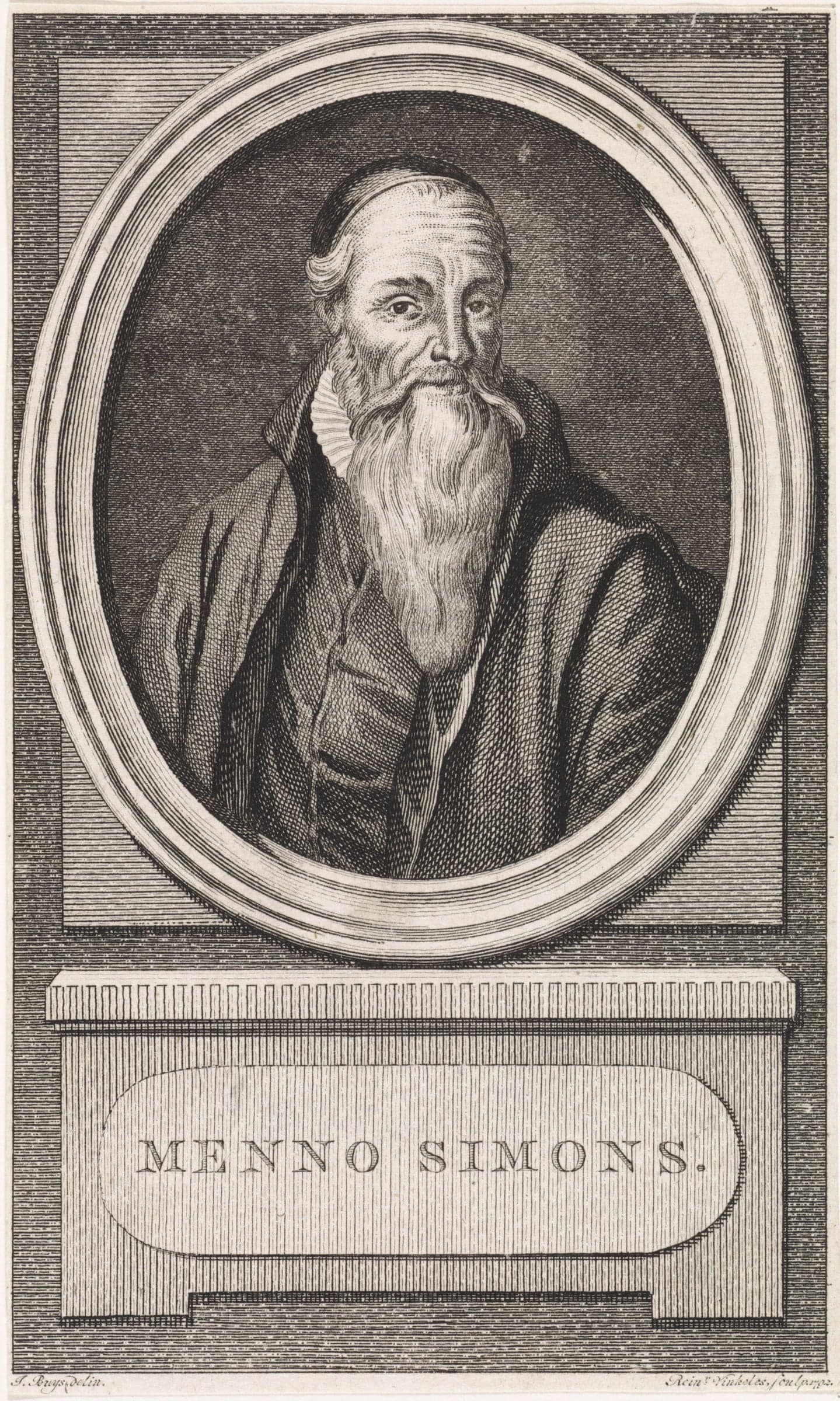
Anonymous engraving, Portrait of Menno Simons, 1792. Public domain.
Friesland and the Baltic coast, to 1561 · Person · Featured Study
Menno Simons
He left the priesthood in Friesland in 1536 and led the Dutch Anabaptists until he died in 1561.
Men who died for a cause he thought wrong shamed the priest who kept his office, and he gave up his parish to be hunted.
For no one can lay a foundation other than the one already laid, which is Jesus Christ.
For no one can lay a foundation other than the one already laid, which is Jesus Christ.
- Born
- 1496, by his own count of his years in 1524 (probable)
- Died
- January 1561 at Wüstenfelde in Holstein
- Family
- wife: Gertrude
- Places
- Witmarsum, Pingjum, Groningen, Wismar, Wüstenfelde
Summary
Menno Simons served as a priest in Friesland from 1524. His own reading led him to doubt the Mass and infant baptism, and he kept his office for years. The killing at the Old Cloister in 1535 ended that. He left the Roman church in January 1536, and Obbe Philips baptized and ordained him. An edict of the emperor hunted him until he died in 1561.
- His own account of his leaving stands in his reply of 1554 to Gellius Faber.
- He taught that the people of Christ carry no sword, against the men of Münster.
- His doctrine of the Incarnation and his rule of shunning the excommunicated were disputed in his lifetime.
The Verse on His Title Page
1 Corinthians 3:11 stands over his Foundation, and the command to Peter stands behind his teaching on the sword.
Funk's English edition of 1871 prints 1 Corinthians 3:11 on the title page of the Foundation. Menno returns to the verse in that book and writes that no other foundation can be laid to all eternity.
He says he once wished to live in comfort and without the cross. The question of this life is how such a priest became the shepherd of a hunted people. Most of what is known of his early years comes from his own pen, and he wrote it to answer an opponent.
“Put your sword back in its place,” Jesus said to him. “For all who draw the sword will die by the sword.Menno charged the men of the Old Cloister with drawing the sword that the Lord told Peter to put away.
The Life in Order
His own account gives the first steps, and an edict and the Frisian records give later ones.
He lived his last twenty-five years under threat of arrest.
- 1496He was born at Witmarsum in Friesland, by his own count of his yearsMenno, Renunciation; Horsch, page 18
- 1524He took a priest's office at Pingjum, in his twenty-eighth yearMenno, Renunciation; Horsch, page 18
- 20 March 1531Sikke Snyder was beheaded at Leeuwarden, and Menno began to search the Scriptures on baptismMenno, Renunciation; Horsch, page 22
- AfterwardHe returned to his birthplace for a better livingMenno, Renunciation; Horsch, page 24
- 5 April 1535The Old Cloister fellHorsch, page 26
- 30 January 1536He renounced the Roman churchHorsch, page 32
- Late 1536Obbe Philips ordained him in the province of GroningenHorsch, page 32
- 8 January 1539Tjard Reynders was executed for sheltering himMenno, in Horsch, page 53
- 7 December 1542Charles V published an edict against himThe edict, in Horsch, page 55
- February 1554He met Martin Micron twice at WismarHorsch, page 89
- After WismarHe made his last home under Ahlefeld's protectionHorsch, page 217
- January 1561He died at Wüstenfelde and was buried in his own gardenFunk, the life; Horsch, page 220
Each step of the life stands with its witness.
Late 1536, 8 January 1539, 7 December 1542, February 1554, After Wismar, January 1561
From the Parish to the Road
He tells the first half himself, and the edict and his friends' deaths tell the second.
Menno Simons was a Catholic priest in Friesland. He admitted he had barely opened a Bible when doubts about the Mass drove him to read one. He spent his first years at Pingjum, he says, in playing, drinking and frivolous diversions with the two other priests of the place.
Then a tailor named Sikke Snyder was beheaded at Leeuwarden for being rebaptized, and it sounded strange to Menno to hear of a second baptism. Searching Scripture, he could find no command to baptize infants either. He consulted Luther, then Bucer, then Bullinger, as he puts it, and found three different reasons for the practice.
He moved to Witmarsum as parish priest with a better income, and by his own account he went for gain and a name. He says he knew the truth on baptism and the Supper by then, and he kept his office.
Blood finally moved him. The violent takeover of Münster in 1535 had discredited the whole movement, and then a band of Anabaptists was cut down, his own brother among them by Horsch's account. They had fortified the Old Cloister near Bolsward, and troops stormed it on 5 April. He had argued against their error, and he saw that they gave their lives while he lived comfortably.
Menno concluded that the scattered, peaceable believers who remained had no shepherd, and he walked away from his parish to become one. He preached repentance from his own pulpit for about nine months before he left it. Obbe Philips baptized him, and toward the end of that year, at the request of a few believers who came to him, Obbe ordained him.
For twenty-five years he traveled the Low Countries and northern Germany with a price on his head. He baptized, wrote, and argued that Christ's people follow their Lord in suffering rather than in force. He married a woman of Witmarsum named Gertrude, probably in 1539. That January, Tjard Reynders of Kimswerd died on the wheel because he had taken Menno into his house.
At Wismar, a little before midwinter of 1553, his people helped a shipload of Reformed exiles from England out of the ice. He then argued with their leader Martin Micron for eleven hours in one sitting. An injury to his leg at Wismar never healed, and he signed some letters "The cripple, your brother."
A Holstein nobleman let the exiles settle on his estate at Wüstenfelde, and Menno spent his last years there. Those who gathered around his teaching were eventually called Mennonites, a name he did not choose. He died in his bed, which for an Anabaptist leader of his generation was rare.
The Emperor's Edict
Charles V named him in December 1542, and the edict set out what it would pay.
The edict went to the mayors and counsellors of Leeuwarden. It called him a former priest polluted with Anabaptism, who had come back in secret to preach at night and circulate books. It forbade anyone to give him shelter, food or drink, to speak with him, or to keep his books, on pain of life and property.
It offered one hundred golden Karolus gulden to whoever delivered him to the court in Friesland. It promised pardon to the captor for lesser crimes and for heresy, if he repented and came back to the church.
Menno answered it in his reply to Faber, who had reproved his people for preaching at night. He remembered the year as 1543, and the edict is dated 1542. He wrote that criminals and manslayers were promised pardon and freedom "if they would betray me and deliver me into the hands of the executioners."
In Their Own Words
Five sayings from the English of his works, on his leaving, his call, the sword and faith.
Menno Simons (1496 to 1561)
Renunciation of the Church of Rome (1554), Funk's English (1871), page 5
His prayer after the Old Cloister
“My heart trembled in my body. I prayed to God with sighs and tears, that he would give to me, a troubled sinner, the gift of his grace, and create a clean heart within me […]”
Anabaptist
About this saying1 paragraph
He looks back here on the months after the Old Cloister fell in April 1535.
Menno Simons
The Cross of Christ, Funk's English (1871), pages 182 to 183
Follow the rejected Christ
“They must, in all misery, ignominy and trouble, take upon themselves the pressing cross, and must follow the rejected, outcast, bleeding and crucified Christ”
Anabaptist
About this saying1 paragraph
This comes from his tract The Cross of Christ, written before he died in 1561, on what it costs to follow Him.
Menno Simons
The Reason why Menno Simon does not cease Teaching and Writing, on true evangelical faith
Faith that cannot lie still
“For true evangelical faith is of such a nature that it cannot lay dormant; but manifests itself in all righteousness and works of love; it dies unto flesh and blood; destroys all forbidden lusts and desires; cordially seeks, serves and fears God; clothes the naked; feeds the hungry […]”
Anabaptist
About this saying1 paragraph
He wrote the tract The Reason why Menno Simon does not cease Teaching and Writing before he died in 1561, and Funk's edition prints it with no year.
Who called him1 quotation, 1 paragraph
The same reply of 1554 answers the charge that he owed his ministry to the men of Münster.
Patience, silence and hope1 quotation, 1 paragraph
He wrote this in A Humble and Christian Defense, in his years in hiding between 1536 and 1561, against the charge that his people meant rebellion.
The People Around Him
The witnesses name those who died near him, those who worked beside him and those who argued against him.
A man who sheltered him could pay for it with his life.
| Person | Tie to Menno | The witness |
|---|---|---|
| Sikke Snyder | He was a tailor put to death for rebaptism, and his death raised Menno's first doubt. | Menno, Renunciation; Horsch, page 22 |
| Obbe Philips | He baptized and ordained Menno, and later left the brotherhood. | Horsch, pages 31, 32 and 61 |
| Dirk Philips | Obbe's brother worked beside Menno. | Horsch, page 61 |
| Tjard Reynders | He was executed in January 1539 for taking Menno into his house. | Menno, in Horsch, page 53 |
| Gertrude | She was his wife, of Witmarsum, and she died before him. | Horsch, pages 78 and 220 |
| Gellius Faber | He attacked Menno's call in print, and Menno's reply gives us his life. | Horsch, pages 17 and 32 |
| Martin Micron | He debated Menno at Wismar in February 1554. | Horsch, page 89 |
| Bartholomew von Ahlefeld | He gave Menno's people a refuge on his land. | Horsch, page 217 |
Martin Micron, Bartholomew von Ahlefeld
The Places of His Life
His life runs from two Frisian villages to the Baltic coast and Holstein.
He moved east along the coast as the edicts followed him.
| Place | What the witnesses say | The witness |
|---|---|---|
| Witmarsum | He was born there and served there as parish priest. | Menno, Renunciation |
| Pingjum | He calls it his father's village and began as a priest there. | Menno, Renunciation |
| Leeuwarden | Sikke Snyder died there, and the edict went to its magistrates. | Menno, Renunciation; Horsch, page 55 |
| The Old Cloister | It stood near Bolsward, and three hundred people held it until the storming. | Horsch, page 26 |
| Groningen | He was ordained in the province and probably married there. | Horsch, pages 32 and 78 |
| East Friesland | He reached it about the winter of 1543, where no new state church yet stood. | Horsch, page 78 |
| Wismar | His people helped the exiles there, and he met Micron there. | Horsch, pages 88 and 89 |
| Wüstenfelde | The name means "the desert field," and the Thirty Years' War left no trace of the village. | Horsch, pages 217 and 220 |
Wismar, Wüstenfelde
The Sword and the Church
He set the church of the cross against Münster on one side and against the charge of rebellion on the other.
He wrote that a rightly baptized person is baptized inwardly with Spirit and fire, and outwardly with water. Such a person, he wrote, knows of no weapons but patience, hope, quiet and God's word. He asked how a Christian can, by Scripture, retaliate, rebel, make war or burn cities.
That answered two opponents. The men of Münster took up the sword, and he preached against them while he was still a priest. Those who called his people rebels heard from him that their hands were clear of all rebellion.
Horsch records that the Mennonites held that the powers that be are ordained of God. He adds that Menno thought capital punishment even for criminals inconsistent with Christian principles.
How the Key Verse Was Taught
Chrysostom, John Wesley and the commentary of Jamieson, Fausset and Brown read the one foundation.
John Chrysostom (died 407)
Homilies on First Corinthians, Homily VIII, on 1 Corinthians 3:11
Chrysostom told his hearers to hold so close to Christ that no gap remained.
“Upon this then let us build, and as a foundation let us cleave to it, as a branch to a vine; and let there be no interval between us and Christ. For if there be any interval, immediately we perish.”
Patristic
John Wesley (1703 to 1791)
Explanatory Notes upon the New Testament, on 1 Corinthians 3:11
John Wesley said what this foundation can bear.
“Who, in his person and offices, is the firm, immovable Rock of Ages, every way sufficient to bear all the weight that God himself, or the sinner, when he believes, can lay upon him.”
Evangelical
Jamieson, Fausset & Brown (1802 to 1910)
Commentary Critical and Explanatory on the Whole Bible, on 1 Corinthians 3:11
Jamieson, Fausset and Brown gave the reason no other can be laid.
“A man can not lay any other, since the only one recognized by God has been already laid.”
Evangelical
What the Witnesses Leave Open
Readers differ on his birth, his brother, his death and two of his doctrines.
The year of his birththe older biographers; Funk; Horsch
Horsch says 1492 was commonly believed. Menno writes that he took his office in 1524 in his twenty-eighth year, so Funk and Horsch both reckon 1496.
His brother and MünsterKarel Vos; John Horsch
Horsch says Menno's brother died at the Old Cloister, and the account of his leaving that Menno wrote in 1554 names no brother. Karel Vos identified this brother with Peter Symonson, an elder of John of Leyden at Münster.
Horsch calls that a pure assumption. He argues that Menno's opponents would have used it against him, and that Menno could not have said of such a brother that he erred on one point only.
The day of his deathFunk; Horsch; the Martyrs Mirror
One old account gives Friday 13 January 1561, and Funk gives the same day. Horsch reads the date as probably 31 January. The Martyrs Mirror gives 13 January 1559, and Funk answers that Menno wrote a tract later that same month.
His doctrine of the IncarnationMenno Simons; Martin Micron; John Horsch; the Swiss Brethren
Menno taught that Christ did not take His human nature from a sinful child of Adam, and that God through the Spirit prepared His body. He and Micron argued it bitterly at Wismar on 15 February 1554.
Horsch defends the doctrine as reasonable and says Menno sometimes lost sight of his own rule that the Incarnation is to be believed and not comprehended. The Swiss Brethren discussed it at Strasburg in 1557 and declared it non-essential.
How far to shun the excommunicatedMenno Simons; the Swiss Brethren; the Hutterites; John Horsch
Horsch reports that the Swiss Brethren and the Hutterites agreed with Menno on excommunication and differed on avoiding those put out. He writes that the question led to a division in the last years of Menno's life.
Books to Read Next
The Complete Works of Menno Simon
John F. Funk and Brother · 1871
This is the English of his own writings, with a short life before them.
Read Funk's edition free at the Internet ArchiveMenno Simons: His Life, Labors, and Teachings
John Horsch · 1916
Horsch prints the edict and sets the dates against the Dutch records.
Read Horsch free at the Internet ArchiveWhat Menno Left
He left a shelf of books written on the run and churches that still carry the name his opponents gave them.
Sources
Scripture is the Berean Standard Bible.
- The Holy Bible, Berean Standard Bible (read 2026)
- Menno Simons, The Complete Works of Menno Simon, translated from the Dutch (Elkhart: John F. Funk and Brother, 1871)
- John Horsch, Menno Simons: His Life, Labors, and Teachings (Scottdale, 1916)
- John Chrysostom, Homilies on First Corinthians, Homily VIII, on 1 Corinthians 3:11.
- John Wesley, Explanatory Notes upon the New Testament, on 1 Corinthians 3:11.
- Jamieson, Fausset and Brown, Commentary Critical and Explanatory on the Whole Bible, on 1 Corinthians 3:11.
Keep Studying
People and groups5
Doctrines2
Church history3
Go further2