
1523 to today · The churches · Featured Study
The Reformed and Presbyterian Churches
The churches of the Swiss Reformation, of Heidelberg, of Scotland and of the Westminster Confession.
In January 1523, as Jackson counts them, six hundred priests and laymen met in the Town Hall of Zurich to debate 67 articles that Zwingli had printed.
- Began
- January 1523 at Zurich, as Jackson dates the first disputation (probable)
- Bodies
- The Uniting Reformed Church in Southern Africa, The Reformed Church in America
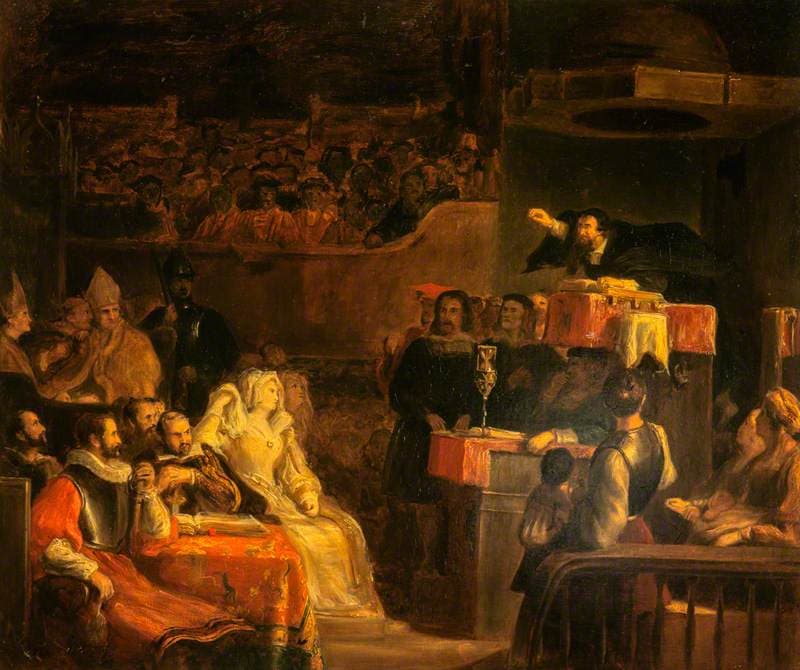
David Wilkie, The Preaching of John Knox, 1832. Public domain.
In Him we were also chosen as God’s own, having been predestined according to the plan of Him who works out everything by the counsel of His will,
Summary
The Reformed churches teach that God ordains all things by the counsel of His will and that Scripture holds the whole counsel of God. Their confessions run from Zurich to Westminster.
- Their confessions run from the Scots Confession of 1560 to Westminster in 1646.
- The Remonstrants and the Synod of Dort disputed election inside the family.
- A church of this family in southern Africa adopted the Belhar Confession in 1986.
The Texts the Reformed Churches Stand On
The texts come from 2 Timothy 3, Romans 11, John 3 and 2 Corinthians 5.
The Westminster Confession gives Ephesians 1:11 as the first proof of its chapter on God's eternal decree.
Proofs the confessions give
All Scripture is God-breathed and is useful for instruction, for conviction, for correction, and for training in righteousness, so that the man of God may be complete, fully equipped for every good work.
Westminster gives it first among the proofs of chapter I, section 6, on what Scripture holds.
O, the depth of the riches of the wisdom and knowledge of God! How unsearchable are His judgments, and untraceable His ways!
Westminster gives it second among the proofs of the same section on the decree.
Romans 11:33BSB
Whoever believes in the Son has eternal life. Whoever rejects the Son will not see life. Instead, the wrath of God remains on him.”
The Remonstrance of 1610 quotes it in its first article on election.
John 3:36BSB
All this is from God, who reconciled us to Himself through Christ and gave us the ministry of reconciliation: that God was reconciling the world to Himself in Christ, not counting men’s trespasses against them. And He has committed to us the message of reconciliation.
The Belhar Confession of 1986 cites 2 Corinthians 5:17 to 21 for the church's message of reconciliation.
The Reformed Branch of the Family of Churches
From Zurich in 1523 to Belhar in 1986.
The Reformed line runs from the Zurich disputation through Geneva and Heidelberg to Westminster and Belhar.
1523 to 1532
- The first disputation of the Zurich Reformation
- The Waldensians join at Chanforan
1546 to 1560
- Calvin's letters to Farel from Geneva
- The Scots Confession
1563 to 1610
- The Heidelberg Catechism
- The Remonstrance
1618 to 1646
- The Synod of Dort and its Canons
- The Westminster Confession, completed in December
1986 to 1994
- The Belhar Confession, adopted by the Mission Church
- The Uniting Reformed Church in Southern Africa
Jackson (1901), Bonnet (1858), Schaff (1877), Muston (1853) and the Reformed Church in America date the generations.
The other families of the churches stand together with the dates on which each began.
How the Reformed Churches Began at Zurich
A schoolmaster, a vicar general and a historian tell the debate of 1523.
Samuel Macauley Jackson's Selected Works of Huldreich Zwingli, published in 1901, records that the city council invited the bishops of Constance and the dioceses around it.
Jackson writes that the debate “is preserved to us by Erhart Hegenwald, a schoolmaster in Zurich.”
Hegenwald wrote it, Jackson adds, “from memory immediately after hearing it.” Zwingli edited that account and published it in Zurich, so it is the interested party's record.
John Faber, vicar general of the diocese of Constance, spoke for the Roman side. “Fabri also published his account of the debate,” Jackson notes, and in it, he adds, Faber “appeared to greater advantage than in Zwingli's account.”
The Truth They Recovered: God's Decree and Scripture's Rule
Two chapters of the Westminster Confession in Schaff's text of 1647.
Westminster grounds all things in God's counsel and finds that counsel set down in Scripture.
| Chapter and section | The words |
|---|---|
| III.1, Of God's Eternal Decree | God from all eternity did, by the most wise and holy counsel of his own will, freely and unchangeably ordain whatsoever comes to pass; yet so as thereby neither is God the author of sin, nor is violence offered to the will of the creatures, nor is the liberty or contingency of second causes taken away, but rather established. |
| I.6, Of the Holy Scripture | The whole counsel of God, concerning all things necessary for his own glory, man's salvation, faith, and life, is either expressly set down in Scripture, or by good and necessary consequence may be deduced from Scripture: unto which nothing at any time is to be added, whether by new revelations of the Spirit, or traditions of men. |
Chapter I, section 9, in the 1647 text, says the true sense of a Scripture “must be searched and known by other places that speak more clearly.”
Schaff's note on that word marks that the American edition reads “may.”
Their Confessions, From Heidelberg to Westminster
A catechism, a Scottish confession, the Remonstrance and the Assembly's Confession.
Heidelberg begins with comfort in Christ, and the Remonstrance sets election on faith that perseveres.
| The confession | Its words |
|---|---|
| The Heidelberg Catechism, 1563, Question 1 | What is thy only comfort in life and in death? That I, with body and soul, both in life and in death, am not my own, but belong to my faithful Saviour Jesus Christ |
| The Remonstrance, 1610, Article I | to save in Christ, for Christ's sake, and through Christ, those who, through the grace of the Holy Ghost, shall believe on this his Son Jesus, and shall persevere in this faith and obedience of faith, through this grace, even to the end |
Schaff's third volume also prints the Scots Confession, which his heading dates to 1560.
The Remonstrance answered the Reformed doctrine of election from inside the Reformed churches.
The Synod of Dort answered it in 1618 and 1619, and Schaff prints the Canons of the Synod.
Schaff records that the Assembly completed the Confession in its 752nd session, on 4 December 1646, and presented it to both Houses of Parliament.
It was first printed in December 1646 or January 1647 without the Scripture proofs.
The Reformed Churches Today
Two bodies, as the Reformed Church in America names them.
The Reformed Church in America prints the Belhar Confession among its creeds and confessions. It says Belhar is now one of the “standards of unity” of the Uniting Reformed Church in Southern Africa.
That church was formed in 1994, when the Dutch Reformed Mission Church and the Dutch Reformed Church in Africa united, the same page records.
Where the Reformed Churches Went
The language of each confession's first text, from Scotland to southern Africa.
The confessions were written in German, English, Dutch, Latin and Afrikaans before they reached English readers.
| Place | Year | The confession | Its first language |
|---|---|---|---|
| Scotland | 1560 | The Scots Confession | English, with Patrick Adamson's Latin translation |
| Heidelberg | 1563 | The Heidelberg Catechism | German, with Schaff's English beside it |
| The Netherlands | 1610 | The Remonstrance | Dutch, its official text from the first edition of 1612 |
| Dordrecht | 1619 | The Canons of Dort | Latin, officially published on 6 May 1619 |
| Southern Africa | 1986 | The Belhar Confession | Afrikaans, with an English translation |
Servetus at Geneva and the Confession of Belhar
Calvin's letters of 1546 and 1553, and a Reformed church's rejection of the doctrine behind apartheid.
Calvin wrote to Farel from Geneva on 13 February 1546, in the English of Jules Bonnet's edition of 1858, that Servetus had offered to come to the city.
He went on, “I am unwilling to pledge my word for his safety, for if he shall come, I shall never permit him to depart alive, provided my authority be of any avail.”
On 20 August 1553, after Servetus was arrested at Geneva, Calvin wrote to Farel again.
He said, “I hope that sentence of death will at least be passed upon him; but I desire that the severity of the punishment may be mitigated.”
The Belhar Confession was first drafted in 1982 by the Dutch Reformed Mission Church in South Africa, which adopted it in 1986, the Reformed Church in America records.
The English text is that of the Office of Theology and Worship of the Presbyterian Church (U.S.A.).
Its third article rejects any doctrine that “sanctions in the name of the gospel or of the will of God the forced separation of people on the grounds of race and color.”
Books to Read Next
The Creeds of Christendom, volume 3
Philip Schaff · 1877
Schaff prints the Reformed confessions in their own languages and in English, Westminster in its text of 1647.
Free at the Christian Classics Ethereal LibraryLetters of John Calvin, volume 2
Jules Bonnet, editor · 1858
It holds Calvin's letters to Farel on Servetus of 1546 and 1553.
Free at the Internet ArchiveSelected Works of Huldreich Zwingli
Samuel Macauley Jackson, editor · 1901
Jackson's volume gives Hegenwald's record of the debate of 1523 in English.
Free at the Internet ArchiveWhat the Reformed Churches Hand On
The Reformed churches hand on confessions that rest every question on the counsel of God written in Scripture, and they have used confessions to judge their own churches.
The line through this page
The verse whose work this page shows continuing, then 1 link to other pages, in order of date.
The verse whose work this page shows continuing.
1532
The Waldensians to The Reformed and Presbyterian Churches
Farel and Saulnier came from Switzerland.
This page
The Reformed and Presbyterian Churches
Sources
Scripture is the Berean Standard Bible.
- The Holy Bible, Berean Standard Bible (read 2026)
- Samuel Macauley Jackson, editor, Selected Works of Huldreich Zwingli (Philadelphia, 1901), the introduction to the First Zurich Disputation, pages 40 to 41.
- Jules Bonnet, editor, Letters of John Calvin, volume 2 (Philadelphia, 1858), letters CLIV and CCCXXII to Farel, pages 31 and 416.
- Philip Schaff, The Creeds of Christendom, volume 3 (1877): the Westminster Confession (1647 text) I.6, I.9 with note 892, III.1 with notes 978 and 870; the Heidelberg Catechism, Question 1; the Remonstrance, Article I; the Canons of Dort; the Scotch Confession of Faith.
- Philip Schaff, The Creeds of Christendom, volume 1 (1877), the history of the Westminster Confession.
- The Reformed Church in America, The Belhar Confession (1986), with its introduction.
- Alexis Muston, The Israel of the Alps, translated by W. Hazlitt (London: Ingram, Cooke, 1853), chapter VII.