
Exodus 30 · Symbol · Featured Study
Incense and the Censers
The incense of the tabernacle and the prayers it stands for, from Exodus 30 to Revelation 8.
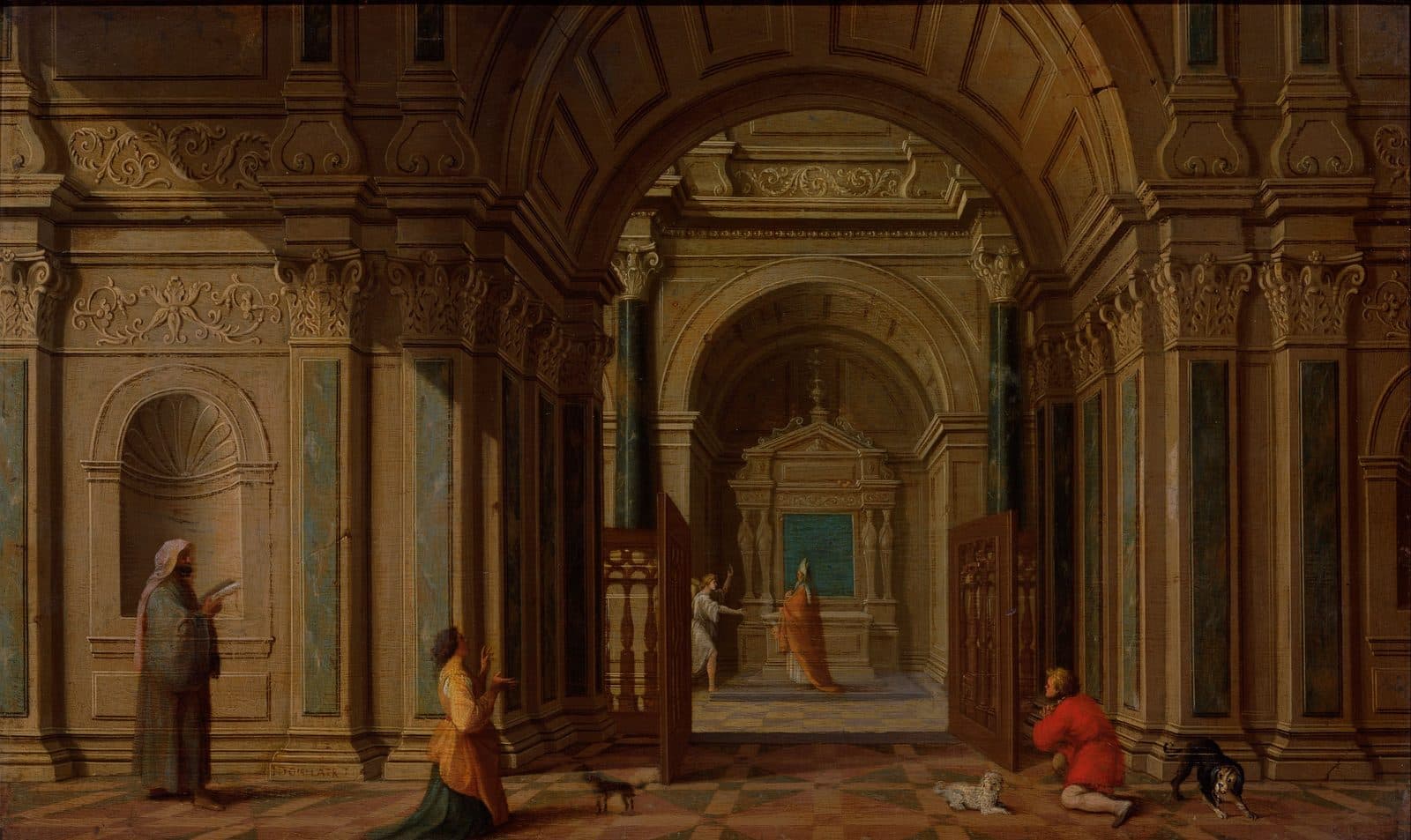
Nicolaes de Gijselaer, The Archangel Gabriel Appears to Zacharias, 1625. Rijksmuseum, Amsterdam. Public domain (CC0), via Wikimedia Commons.
THE ARTWORKNicolaes de Gijselaer painted Zechariah at the altar with the angel beside him and the people praying in the outer hall, as in Luke 1:10.
The smoke of the incense rose where God met with His people, and the firepans that carried its coals were deadly in the wrong hands.
Summary
Exodus 30 commands a small gold altar for incense and one blend of four spices that no one may copy for himself.
- Nadab and Abihu offered unauthorized fire, and Korah's 250 men and King Uzziah took up the incense that belonged to the descendants of Aaron, and each of them was struck.
- During the plague of Numbers 16, Aaron offered the incense and made atonement for the people.
- Psalm 141:2 asks that prayer be set before God like incense, and Revelation 5:8 calls the golden bowls of incense the prayers of the saints.
- Readers differ on what the unauthorized fire was and on whether Hebrews 9:4 names a censer or the altar.
The Altar of Incense
Exodus 30 sets the altar in front of the veil and the incense on it twice a day.
God gave the altar its measure in Exodus 30:2, a cubit square and two cubits high with horns of one piece, and Bezalel built it to that measure in Exodus 37:25.
Place the altar in front of the veil that is before the ark of the Testimony—before the mercy seat that is over the Testimony—where I will meet with you.This verse fixes the place of the altar inside the tent.
And Aaron is to burn fragrant incense on it every morning when he tends the lamps. When Aaron sets up the lamps at twilight, he must burn the incense perpetually before the LORD for the generations to come.The incense is burned at the two hours the lamps are tended, so that it burns before the LORD at all times.
The LORD also said to Moses, “Take fragrant spices—gum resin, onycha, galbanum, and pure frankincense—in equal measures, and make a fragrant blend of incense, the work of a perfumer, seasoned with salt, pure and holy.This is the one recipe Scripture gives for the incense.
You are never to use this formula to make incense for yourselves; you shall regard it as holy to the LORD. Anyone who makes something like it to enjoy its fragrance shall be cut off from his people.”The penalty for copying the blend kept its fragrance for the LORD's presence alone.
The yearly atonement on its hornsExodus 30:9 to 10
Exodus 30:9 forbids every other offering on this altar, whether unauthorized incense, a burnt offering, a grain offering or a drink offering.
Once a year Aaron shall make atonement on the horns of the altar. Throughout your generations he shall make atonement on it annually with the blood of the sin offering of atonement. The altar is most holy to the LORD.”John Calvin, in his commentary on the last four books of Moses, reads this yearly rite to mean that prayer has no sweet savour unless it is sprinkled with the blood of atonement.
The making and the first burningExodus 37 and 40
He also made the sacred anointing oil and the pure, fragrant incense, the work of a perfumer.Bezalel made the incense to the command of Exodus 30:35.
Moses placed the gold altar in the Tent of Meeting, in front of the veil, and he burned fragrant incense on it, just as the LORD had commanded him.This is the first burning of the incense, on the day the tabernacle was set up in Exodus 40:17.
The Incense in Seven Scenes
Priests, rebels, a king and an angel offer incense, and the outcome turns on who offers it.
| Passage | Who offers the incense | What follows |
|---|---|---|
| Leviticus 10:1 to 2 | Nadab and Abihu, sons of Aaron | Fire from the presence of the LORD consumes them. |
| Leviticus 16:12 to 13 | The high priest on the Day of Atonement | The cloud of incense covers the mercy seat, and he does not die. |
| Numbers 16:16 to 35 | Korah's 250 men | Fire from the LORD consumes the 250 men. |
| Numbers 16:46 to 48 | Aaron | He stands between the living and the dead, and the plague is halted. |
| 2 Chronicles 26:16 to 21 | King Uzziah | Leprosy breaks out on his forehead before the altar of incense. |
| Luke 1:8 to 11 | Zechariah the priest, chosen by lot | An angel of the Lord appears at the right side of the altar of incense. |
| Revelation 8:3 to 5 | An angel with a golden censer | The smoke rises with the prayers of the saints, and the censer is hurled to the earth. |
- Passage
- Leviticus 10:1 to 2
- Who offers the incense
- Nadab and Abihu, sons of Aaron
- What follows
- Fire from the presence of the LORD consumes them.
- Passage
- Leviticus 16:12 to 13
- Who offers the incense
- The high priest on the Day of Atonement
- What follows
- The cloud of incense covers the mercy seat, and he does not die.
- Passage
- Numbers 16:16 to 35
- Who offers the incense
- Korah's 250 men
- What follows
- Fire from the LORD consumes the 250 men.
- Passage
- Numbers 16:46 to 48
- Who offers the incense
- Aaron
- What follows
- He stands between the living and the dead, and the plague is halted.
- Passage
- 2 Chronicles 26:16 to 21
- Who offers the incense
- King Uzziah
- What follows
- Leprosy breaks out on his forehead before the altar of incense.
- Passage
- Luke 1:8 to 11
- Who offers the incense
- Zechariah the priest, chosen by lot
- What follows
- An angel of the Lord appears at the right side of the altar of incense.
- Passage
- Revelation 8:3 to 5
- Who offers the incense
- An angel with a golden censer
- What follows
- The smoke rises with the prayers of the saints, and the censer is hurled to the earth.
Nadab and AbihuLeviticus 10
Fire from the LORD had just consumed Aaron's first offerings in Leviticus 9:24, and Albert Barnes, in his Notes on Leviticus, observes that the same fire now destroyed his two eldest sons.
Then Moses said to Aaron, “This is what the LORD meant when He said: ‘To those who come near Me I will show My holiness, and in the sight of all the people I will reveal My glory.’” But Aaron remained silent.This verse gives the reason for the deaths of Nadab and Abihu.
The Day of AtonementLeviticus 16
On this one day of the year the incense went behind the veil into the Most Holy Place.
Then he must take a censer full of burning coals from the altar before the LORD, and two handfuls of finely ground fragrant incense, and take them inside the veil. He is to put the incense on the fire before the LORD, and the cloud of incense will cover the mercy seat above the Testimony, so that he will not die.The incense guards the high priest's life as he stands before the mercy seat.
Korah's censers and Aaron'sNumbers 16
Moses answered Korah's claim to the priesthood with a test of incense, saying that the man the LORD chooses will be the one who is holy.
As for the censers of those who sinned at the cost of their own lives, hammer them into sheets to overlay the altar, for these were presented before the LORD, and so have become holy. They will serve as a sign to the Israelites.” So Eleazar the priest took the bronze censers brought by those who had been burned up, and he had them hammered out to overlay the altar, just as the LORD commanded him through Moses. This was to be a reminder to the Israelites that no outsider who is not a descendant of Aaron should approach to offer incense before the LORD, lest he become like Korah and his followers.The bronze of the rebels' censers was beaten onto the altar as a sign of who may offer incense.
So Aaron took the censer as Moses had ordered and ran into the midst of the assembly. And seeing that the plague had begun among the people, he offered the incense and made atonement for the people. He stood between the living and the dead, and the plague was halted.The high priest goes out to the people instead of waiting at the altar, and the plague stops where he stands.
King Uzziah in the temple2 Chronicles 26
Uzziah was a king of Judah and no priest, and Azariah with eighty priests went into the temple after him.
They took their stand against King Uzziah and said, “Uzziah, you have no right to offer incense to the LORD. Only the priests, the descendants of Aaron, are consecrated to burn incense. Leave the sanctuary, for you have acted unfaithfully; you will not receive honor from the LORD God.”The priests' answer rests on the rule of Numbers 16:40.
From the Tent to the Throne
The Psalms, Luke and Revelation tie the incense to prayer, and Malachi carries it to the nations.
May my prayer be set before You like incense, my uplifted hands like the evening offering.David asks that his prayer be received as the incense and the evening offering were received.
he was chosen by lot, according to the custom of the priesthood, to enter the temple of the Lord and burn incense. And at the hour of the incense offering, the whole congregation was praying outside.Luke sets the priest's incense and the people's prayer in the same hour, the link the psalm had made.
When He had taken the scroll, the four living creatures and the twenty-four elders fell down before the Lamb. Each one had a harp, and they were holding golden bowls full of incense, which are the prayers of the saints.Here Scripture says what the incense in the golden bowls is.
Then another angel, who had a golden censer, came and stood at the altar. He was given much incense to offer, along with the prayers of all the saints, on the golden altar before the throne. And the smoke of the incense, together with the prayers of the saints, rose up before God from the hand of the angel.The golden altar of Exodus 30 now stands before the throne, and the prayers of all the saints rise from it.
In Revelation 8:6 the seven trumpets of judgment follow the prayers.
The incense of the nationsMalachi 1:11
For My name will be great among the nations, from where the sun rises to where it sets. In every place, incense and pure offerings will be presented in My name, because My name will be great among the nations,” says the LORD of Hosts.The prophet sees incense offered to God by the nations in every place, far from the one altar of Exodus 30.
Incense in Israel's World
Frankincense came from the trees of Arabia, and Egypt's perfumers made blends for its temples.
Albert Barnes, in his Notes on Luke 1:9, describes frankincense as a white resin taken chiefly in Arabia by cutting the bark of the tree so that the gum flows out. Exodus 30:35 calls Israel's blend the work of a perfumer.
“This incense was placed within the sanctuary, to be at hand when the priest required to burn on the altar. The art of compounding unguents and perfumes was well known in Egypt, where sweet-scented spices were extensively used not only in common life, but in the ritual of the temples.”
Jamieson, Fausset & Brown · Commentary Critical and Explanatory on the Whole Bible · on Exodus 30:34 to 38Reformed
The Four Spices and the Firepan
Exodus 30:34 names four spices, and Leviticus 10:1 names the firepan that carried the coals.
| Hebrew | Berean text | Sense in Strong's lexicon | Times in Scripture |
|---|---|---|---|
| נָטָף nataph | gum resin | a drop, and an aromatic gum, probably stacte | 2 |
| שְׁחֵלֶת shecheleth | onycha | a scale or shell, the aromatic mussel | 1 |
| חֶלְבְּנָה chelbenah | galbanum | an odorous gum | 1 |
| לְבֹנָה lebonah | frankincense | frankincense, named from its whiteness or the whiteness of its smoke | 21 |
- Hebrew
- נָטָף nataph
- Berean text
- gum resin
- Sense in Strong's lexicon
- a drop, and an aromatic gum, probably stacte
- Times in Scripture
- 2
- Hebrew
- שְׁחֵלֶת shecheleth
- Berean text
- onycha
- Sense in Strong's lexicon
- a scale or shell, the aromatic mussel
- Times in Scripture
- 1
- Hebrew
- חֶלְבְּנָה chelbenah
- Berean text
- galbanum
- Sense in Strong's lexicon
- an odorous gum
- Times in Scripture
- 1
- Hebrew
- לְבֹנָה lebonah
- Berean text
- frankincense
- Sense in Strong's lexicon
- frankincense, named from its whiteness or the whiteness of its smoke
- Times in Scripture
- 21
Adam Clarke, in his Commentary on the Bible, takes the gum resin as stacte, the gum that flows of itself from the tree that yields myrrh. He takes onycha as the outer crust of the murex shell.
Qetoret and machtahthe incense and the firepan
The incense is qetoret, which Strong's lexicon glosses as a fumigation, and the word stands 60 times. The firepan is machtah, a pan for live coals, which stands 22 times and which the King James renders censer, firepan and snuffdish. The golden censer of Revelation 8:3 is libanotos, a word for frankincense that came to name the censer that burned it.
What the Text Leaves Unsaid
Exodus names the incense and its spices and leaves two things unsaid.
Exodus 30 commands the incense and states no meaning for it. Exodus also gives no description of any of the four spices.
The Incense and Christ
John Wesley, in his Explanatory Notes upon the Old Testament, set the two altars of the tabernacle beside two works of Christ.
The bronze altar in the court stood for Christ dying on earth, and the golden altar in the sanctuary for Christ interceding in heaven.
“The incense burnt on this altar daily, signified both the prayers of saints, and the intercession of Christ, to which is owing the acceptableness of them.”
John Wesley · Explanatory Notes upon the Old Testament · on Exodus 37:25Evangelical
Voices on the Incense
Six readers from Ambrose to Spurgeon speak to the prayer of Psalm 141, the daily altar, the plague and the hour of incense.
Spurgeon and Jerome on Psalm 141Psalm 141:2
“Let my prayer be set forth before thee as incense. As incense is carefully prepared, kindled with holy fire, and devoutly presented unto God, so let my prayer be. We are not to look upon prayer as easy work requiring no thought.”
Charles Spurgeon · The Treasury of David, Vol. 7 · on Psalm 141:2
“Let my prayer be directed as incense in your sight. That is, let my prayer come straight to you, having no filth or faults or diabolical thoughts. Now incense is the prayers of the saints. And this we know from the Apocalypse, when the twenty-four elders held censers and said: 'These are the prayers of the saints.' The lifting up of my hands an evening sacrifice. The lifting up of the hands points to the Lord, and in the lifting up of the hands we behold the Creator.”
Jerome · Homily 51, on Psalm 140 · on Psalm 141:2Patristic
Matthew Henry on the daily altarExodus 30:7 to 8
“As by the offerings on the brazen altar satisfaction was made for what had been done displeasing to God, so, by the offering on this, what they did well was, as it were, recommended to the divine acceptance; for our two great concerns with God are to be acquitted from guilt and accepted as righteous in his sight.”
Matthew Henry · Commentary on the Whole Bible · on Exodus 30:7 to 8Puritan
Ambrose and Albert Barnes on Aaron in the plagueNumbers 16:47
“A man clearly worthy to be proposed that all should follow him was he, for when a terrible death on account of the rebels was spreading over the people, he offered himself between the dead and the living, that he might arrest death, and that no more should perish. A man truly of priestly mind and soul, who as a good shepherd with pious affection offered himself for the Lord's flock. And so he broke the sting of death, restrained its violence, refused it further course. Affection aided his deserts, for he offered himself for those who were resisting him.”
Ambrose of Milan · Epistle 63 · on Numbers 16:47Patristic
“A striking proof of the efficacy of that very Aaronic priesthood which the rebels had presumed to reject. The incense offering which had brought down destruction when presented by unauthorised hands, now in the hand of the true priest is the medium of instant salvation to the whole people. Aaron by his acceptable ministration and his personal self-devotion foreshadows emphatically in this transaction the perfect mediation and sacrifice of Himself made by Christ.”
Albert Barnes · Notes, Explanatory and Practical, on the Old and New Testaments (1832-1869) · on Numbers 16:47Evangelical
John Wesley on the hour of incenseLuke 1:10
“Perhaps one reason of ordaining incense might be, to intimate the acceptableness of the prayer that accompanied it; as well as to remind the worshippers of that sacrifice of a sweet-smelling savour, which was once to be offered to God for them, and of that incense, which is continually offered with the prayers of the saints, upon the golden altar that is before the throne, Rev. viii, 3, 4.”
John Wesley · Explanatory Notes upon the New Testament · on Luke 1:10Evangelical
Three Contested Questions
Readers differ on the unauthorized fire, on the gold object of Hebrews 9:4 and on the angel of Revelation 8:3.
The unauthorized fire of Leviticus 10:1Wesley, Barnes, Cyprian, Rashi
John Wesley, in his Explanatory Notes upon the Old Testament, takes the fault to be fire other than the altar's, which Leviticus 6:12 had forbidden by implication when it commanded the altar fire kept burning.
Albert Barnes, in his Notes on Leviticus, holds that the incense was probably lit at a time not commanded and calls it a self-willed act of worship. Cyprian, in On the Unity of the Church, set the two priests beside all who replace the teaching God gave with teaching of human authority.
Rashi, in his commentary on Leviticus 10:2, gives Rabbi Ishmael's reading that they entered the sanctuary drunk with wine, since the law against wine in Leviticus 10:9 follows their deaths. He also gives Rabbi Eliezer's reading that they gave rulings in the presence of Moses. Jamieson, Fausset and Brown, in their Commentary Critical and Explanatory, note on Leviticus 10:9 that many have held the reading of wine.
Each reading meets the same objection, because Leviticus 10:1 names the fire only as unauthorized and contrary to His command and does not say which command was broken.
Censer or altar in Hebrews 9:4Wesley; Jamieson, Fausset and Brown
The Greek word is thumiaterion, which the King James renders golden censer and the Berean text renders golden altar of incense.
Behind the second curtain was a room called the Most Holy Place, containing the golden altar of incense and the gold-covered ark of the covenant. Inside the ark were the gold jar of manna, Aaron’s staff that had budded, and the stone tablets of the covenant.Hebrews lists the gold object with the Most Holy Place, which is where the question begins.
John Wesley, in his Explanatory Notes upon the New Testament, reads it as the censer the high priest alone used once a year. The objection is that Strong's lexicon gives the altar of incense as the word's sense.
Jamieson, Fausset and Brown, in their Commentary Critical and Explanatory, read it as the altar and point to 1 Kings 6:22, which says the gold altar belonged to the inner sanctuary. The objection is that Exodus 30:6 and Exodus 40:26 set the altar in front of the veil.
The angel of Revelation 8:3Henry; Wesley; Jamieson, Fausset and Brown; Barnes
Matthew Henry, in his Commentary on the Whole Bible, reads the angel as Christ, who has His own incense, censer and altar for the prayers of His people. The objection is that Revelation 8:3 calls him another angel, after the seven angels who stand before God.
John Wesley, in his Explanatory Notes upon the New Testament, reads the incense here as the desires of all the angels, brought with the prayers of all the saints by this angel. Jamieson, Fausset and Brown, in their commentary on Revelation 8:3, hold that Christ alone is the Mediator and that the saints do not offer their prayers to the angel. The objection, in Henry's terms, is that the prayers of the saints need the intercession of Christ to be accepted.
Albert Barnes, in his Notes on Revelation, says the text does not name the angel. He lists readings that make him the angels in general, the ministry of the church, Michael or the Lord Jesus.
Books on the Incense
Three public domain commentaries read the incense passages verse by verse.
Explanatory Notes upon the Old Testament
John Wesley · 1765
He wrote short notes on Exodus 30, Leviticus 10 and Numbers 16.
READ HIS NOTES →Commentary on the Whole Bible
Matthew Henry · 1706
His notes run through Exodus 30, Numbers 16 and Revelation 8.
READ HIS COMMENTARY →Commentary Critical and Explanatory on the Whole Bible
Jamieson, Fausset and Brown · 1871
Their notes on Exodus 30 and Hebrews 9 treat the blend and the place of the altar.
READ THEIR COMMENTARY →He Always Lives to Intercede
Aaron stood between the living and the dead for one day, and he died on the mountain in Numbers 20:28.
Therefore He is able to save completely those who draw near to God through Him, since He always lives to intercede for them.Hebrews 7:23 to 24 says death ended the work of every other priest, and this verse gives a priest whose intercession has no end.
The text asks the reader to come to God by this priest and to pray.
Keep studying
Read it1
Places1
Symbols7