

Mariotto Albertinelli, The Sacrifice of Cain and Abel, 1510. Public domain.
Leviticus 2 · Doctrine · Featured Study
The Grain Offering
Leviticus 2 and Leviticus 6:14 to 23, the five forms of the offering, and the readings of Cain's offering and of Malachi's pure offering.
Cain's offering of the fruit of the soil and the grain offering of Leviticus 2 are called by one Hebrew word.
“When anyone brings a grain offering to the LORD, his offering must consist of fine flour. He is to pour olive oil on it, put frankincense on it, and bring it to Aaron’s sons the priests. The priest shall take a handful of the flour and oil, together with all the frankincense, and burn this as a memorial portion on the altar, an offering made by fire, a pleasing aroma to the LORD.
- First taught
- Genesis 4:3 “So in the course of time, Cain brought…”
- Fullest statement
- Leviticus 2:1 to 16 “When anyone brings a grain offering to…”
Cain's offering of the fruit of the soil and the grain offering of Leviticus 2 are called by one Hebrew word.
Summary
The grain offering, minchah in Hebrew, is the second of the five offerings of Leviticus 1 to 5. The worshipper brought fine flour with olive oil and frankincense, raw or baked, and the priest burned a handful of it on the altar as a memorial portion. The rest belonged to the priests as a most holy portion.
- No grain offering burned on the altar could be made with leaven or honey, and every one was seasoned with salt.
- The priest's own grain offering was burned completely and never eaten.
- Readers divide over why Cain's offering was not regarded, and over whether Malachi's pure offering foretells the church's offering.
A Gift of Fine Flour
The offering as the worshipper brings it and the priests receive it.
Minchah is the Hebrew word for a donation or a tribute, and Strong's concordance adds that as a sacrifice it is usually bloodless and voluntary. In Leviticus 2 it names an offering of grain, and the law sets out what the gift is made of, who takes the handful for the altar and who eats the rest. Genesis uses the same word for gifts of every kind, from the fruit of the soil to herds of goats.
“When anyone brings a grain offering to the LORD, his offering must consist of fine flour. He is to pour olive oil on it, put frankincense on it, and bring it to Aaron’s sons the priests. The priest shall take a handful of the flour and oil, together with all the frankincense, and burn this as a memorial portion on the altar, an offering made by fire, a pleasing aroma to the LORD.This is the raw form of the offering, the first of the five that Leviticus 2 sets out.
The remainder of the grain offering shall belong to Aaron and his sons; it is a most holy part of the offerings made by fire to the LORD.The priests eat what the altar does not burn, so the gift feeds those who serve God.
The remainder of the grain offering shall belong to Aaron and his sons; it is a most holy part of the offerings made by fire to the LORD.The priests eat what the altar does not burn, so the gift feeds those who serve God.
Minchah From Genesis to Philippians
The texts run from Genesis through the Law and the prophets to Paul.
Before Leviticus, minchah names a tribute of any kind, from fruit to herds.
- What it adds
- Cain brings some of the fruit of the soil as an offering to the LORD.
- What it adds
- Jacob sends herds ahead to appease his brother.
- What it adds
- Israel's sons carry balm, honey, spices, myrrh and nuts to the ruler of Egypt.
- What it adds
- Flour without oil or frankincense is burned as a sin offering.
- What it adds
- Barley flour without oil or frankincense is a reminder of iniquity.
- What it adds
- Each burnt offering and sacrifice brings a measure of flour mixed with oil.
- What it adds
- Pure offerings will be presented in the LORD's name in every place.
- What it adds
- Paul calls the gifts of the Philippians a fragrant offering and an acceptable sacrifice.
Each text in canon order, with what it adds.
Malachi's promise, Paul's thanks
The Five Forms of Leviticus 2
Raw flour, three kinds of baked bread and the firstfruits of new grain.
Four of the five forms are cooked by the worshipper before they are brought.
| Form | Ingredients | The priest burns |
|---|---|---|
| Raw flour | fine flour with olive oil poured on it and frankincense | a handful of the flour and oil with all the frankincense |
| Baked in an oven | unleavened cakes mixed with oil or unleavened wafers coated with oil | the memorial portion |
| On a griddle | unleavened bread of fine flour mixed with oil, crumbled, with oil poured on | the memorial portion |
| In a pan | fine flour with oil | the memorial portion |
| Firstfruits | crushed heads of new grain roasted on the fire, with oil and frankincense | the memorial portion with all its frankincense |
The priests' shareLeviticus 6:16 and Leviticus 6:23
Aaron and his sons are to eat the remainder. It must be eaten without leaven in a holy place; they are to eat it in the courtyard of the Tent of Meeting.This is the priests' own law for the share that Leviticus 2:3 gives them.
Every grain offering for a priest shall be burned completely; it is not to be eaten.”The law sets the priest's own offering apart from the people's.
The First Minchah
Genesis 4:2 to 5 in Mariotto Albertinelli's panel.
Abel kept sheep and Cain worked the soil, and in the course of time each brought the LORD a gift from his own work. The LORD looked with favor on Abel and his offering and had no regard for Cain and his.
Albertinelli shows the LORD's favor and His disregard as fire and smoke over one altar.
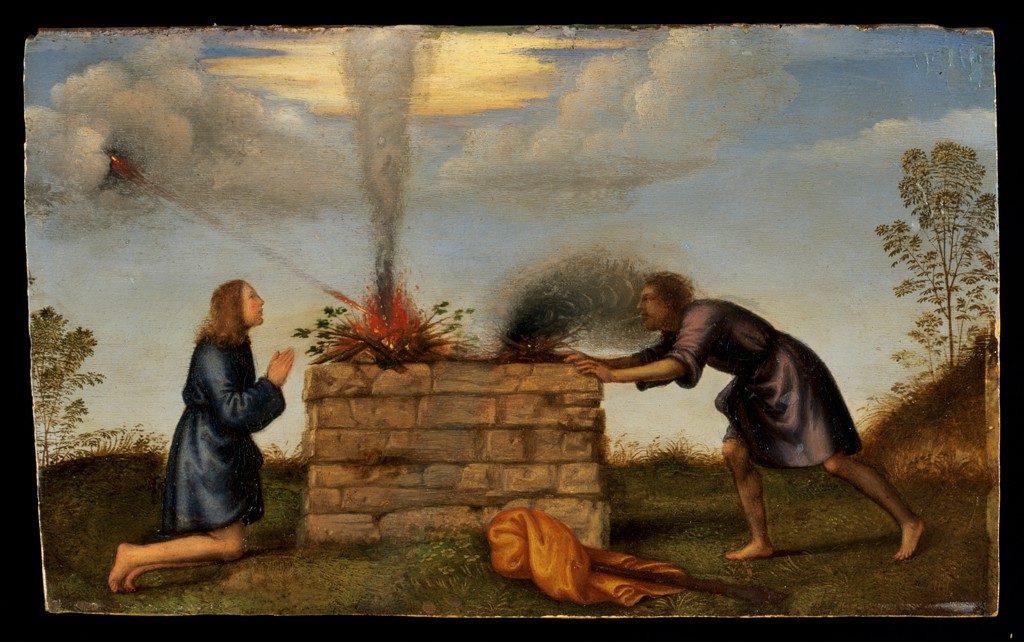
- AbelThe younger brother kneels in blue with his hands joined.Genesis 4:4
- The fire from the cloudsA thin ray of fire runs down from the clouds to Abel's side of the altar.Genesis 4:4
- CainThe elder brother in purple leans over the altar toward his fire.Genesis 4:3
- The smoke beaten downThe smoke of Cain's fire blows back over him.Genesis 4:5
- The altarThe painter gives the two brothers one altar of stone.Genesis 4:3
Mariotto Albertinelli, The Sacrifice of Cain and Abel, 1510. Public domain.
Five parts of the painting, each numbered where it stands, with the verse it answers to.
What the Law Leaves Unsaid
Leviticus 2 and Genesis 4 leave three questions open.
Leviticus 2 names no sin for which the grain offering is brought, and it never says that the offering makes atonement.
The law keeps honey off the altar in Leviticus 2:11 without giving a reason.
Genesis does not say how Cain knew that the LORD had no regard for his offering.
A Fragrant Offering
Hebrews 13 and Philippians 4, with Matthew Henry's note, give the altar's language to good works and gifts.
And do not neglect to do good and to share with others, for with such sacrifices God is pleased.The letter ends its teaching on sacrifice with the gifts believers give one another.
“He did accept it: It is an odour of a sweet smell, a sacrifice acceptable, well-pleasing to God. Not a sacrifice of atonement, for none makes atonement for sin but Christ; but a sacrifice of acknowledgment, and well-pleasing to God. It was more acceptable to God as it was the fruit of their grace than it was to Paul as it was the supply of his want.”
Matthew Henry · Commentary on the Whole Bible · on Philippians 4:18Puritan
Voices on the Grain Offering
Four teachers from the second century to the eighteenth, each with the work named.
died 202 · Irenaeus
“Inasmuch, then, as the Church offers with single-mindedness, her gift is justly reckoned a pure sacrifice with God. As Paul also says to the Philippians, ‘I am full, having received from Epaphroditus the things that were sent from you, the odour of a sweet smell, a sacrifice acceptable, pleasing to God.’ For it behoves us to make an oblation to God, and in all things to be found grateful to God our Maker, in a pure mind, and in faith without hypocrisy, in well-grounded hope, in fervent love, offering the first-fruits of His own created things.”
Irenaeus · Against Heresies Book IV · on Philippians 4:18Patristic
1509 to 1564 · John Calvin
“Moses afterwards commands, that whatever is consecrated to God should be delivered into the hand of the priest, as we have before seen that private persons were excluded from this honor so that Christ's peculiar dignity should remain to Him, i.e., that by Him alone access should be sought to God, and that all men might know that no worship pleases God except what He sanctifies.”
John Calvin · Commentaries · on Leviticus 2:1Reformed
1662 to 1714 · Matthew Henry
“That is not expected from green ears which one may justly look for from those that have been left to grow fully ripe. If those that are young do God's work as well as they can, they shall be accepted, though they cannot do it so well as those that are aged and experienced.”
Matthew Henry · Commentary on the Whole Bible · on Leviticus 2:14 to 16Puritan
1703 to 1791 · John Wesley
“In condescension to the poor, that they might not want an offering for God, and to shew that God would accept even the meanest services, when offered with a sincere mind.”
John Wesley · Explanatory Notes upon the Old Testament · on Leviticus 2:2Evangelical
Matthew Henry, John Wesley
Where Readers Divide
Two readings of Cain's offering and two of Malachi 1:11, each with its holders.
Cain's offering lacked blood and faithJohn Wesley; Adam Clarke
The objection: the law later accepts a bloodless grain offering as a pleasing aroma to the LORD, and Genesis gives both brothers' offerings the same name.
Cain's heart and the worth of his giftRashi; Radak; Origen
Rashi, on Genesis 4:3, takes the fruit of the soil to be the worst of the fruits, and Radak, on Genesis 4:5, says that Cain's intention had not been good and pure.
“In the case of Cain his wickedness did not begin when he killed his brother. For even before that God, who knows the heart, had no regard for Cain and his sacrifice. But his baseness was made evident when he killed Abel.”
Origen of Alexandria · On Prayer 29.18 · on Genesis 4:5Patristic
The objection: Genesis 4:3 to 5 does not grade the fruit Cain brought, and Rashi takes the worst fruits from the midrash Genesis Rabbah 22:5.
Malachi's pure offering is the church'sthe Didache; Irenaeus
“But every Lord's day do ye gather yourselves together, and break bread, and give thanksgiving after having confessed your transgressions, that your sacrifice may be pure. But let no one that is at variance with his fellow come together with you, until they be reconciled, that your sacrifice may not be profaned. For this is that which was spoken by the Lord: In every place and time offer to me a pure sacrifice; for I am a great King, saith the Lord, and my name is wonderful among the nations.”
Didache · The Didache, Chapter 14 · on Malachi 1:11 to 14Patristic
The objection: Malachi 1:11 joins the pure offerings to incense, which Revelation 5:8 names as the prayers of the saints.
Malachi's pure offering is prayer and worshipJamieson, Fausset and Brown
Jamieson, Fausset and Brown read the incense of Malachi 1:11 as prayer and the sacrifice as spiritual worship. They allow the fathers' reference to the Lord's Supper only in that sense, as a spiritual offering accepted through the Lamb slain once for all.
The objection: Malachi calls it minchah, the word of the grain offering, and the Didache reads it of the church's bread and thanksgiving.
Books to Read Next
Three works a student reads next, each free to read.
Commentary on the Whole Bible
Matthew Henry · 1708 to 1710
His notes on Leviticus 2 take each ingredient of the offering in turn.
Read his Leviticus notesExplanatory Notes upon the Old Testament
John Wesley · 1765
He wrote short notes on both Genesis 4 and Leviticus 2.
Read Wesley on GenesisCommentary on the Torah
Rashi · eleventh century
It reads Leviticus 2 phrase by phrase with the rabbis' rulings on the handful.
Read at SefariaGifts Brought to God
The grain offering was a gift from the field and the kitchen, brought to God and shared with the priests who served at His altar. Paul asks believers to give themselves to God in the same way.
Therefore I urge you, brothers, on account of God’s mercy, to offer your bodies as living sacrifices, holy and pleasing to God, which is your spiritual service of worship.Paul names the whole life of the believer as the offering God now asks for.
Sources
Scripture is the Berean Standard Bible.
- James Strong, Exhaustive Concordance of the Bible, 1890, entries H4503 and H234, with their definitions, occurrence counts and uses by verse.
- Rashi on Genesis 4:3 and Leviticus 2:1 to 2, Pentateuch with Rashi's commentary by M. Rosenbaum and A. M. Silbermann, 1929 to 1934 (public domain), via Sefaria.
- Radak on Genesis 4:5, translated by Eliyahu Munk, HaChut Hameshulash (CC-BY), via Sefaria.
- John Wesley, Explanatory Notes upon the Old Testament, on Genesis 4:4.
- Adam Clarke, Commentary on the Bible, on Genesis 4:5.
- Jamieson, Fausset and Brown, Commentary Critical and Explanatory, 1871, on Malachi 1:11.
- The Didache, chapter 14.
- Irenaeus, Against Heresies, Book 4.
- Origen, On Prayer 29.18.
- John Calvin, Commentaries, on Leviticus 2:1.
- Matthew Henry, Commentary on the Whole Bible, 1708 to 1710.
- John Wesley, Explanatory Notes upon the Old Testament, on Leviticus 2:2.