
Exodus 20:22 to 24:8 · The Laws Read at Sinai
The Book of the Covenant
Exodus 20:22 to 23:33 holds the laws the LORD gave Moses at Sinai, and Exodus 24 seals them as a covenant in blood.
Israel promised twice to keep these laws, once when Moses told them and again the next morning when he read them from a book.
- First taught
- Exodus 24:7
- Fullest statement
- Exodus 24:3 to 8
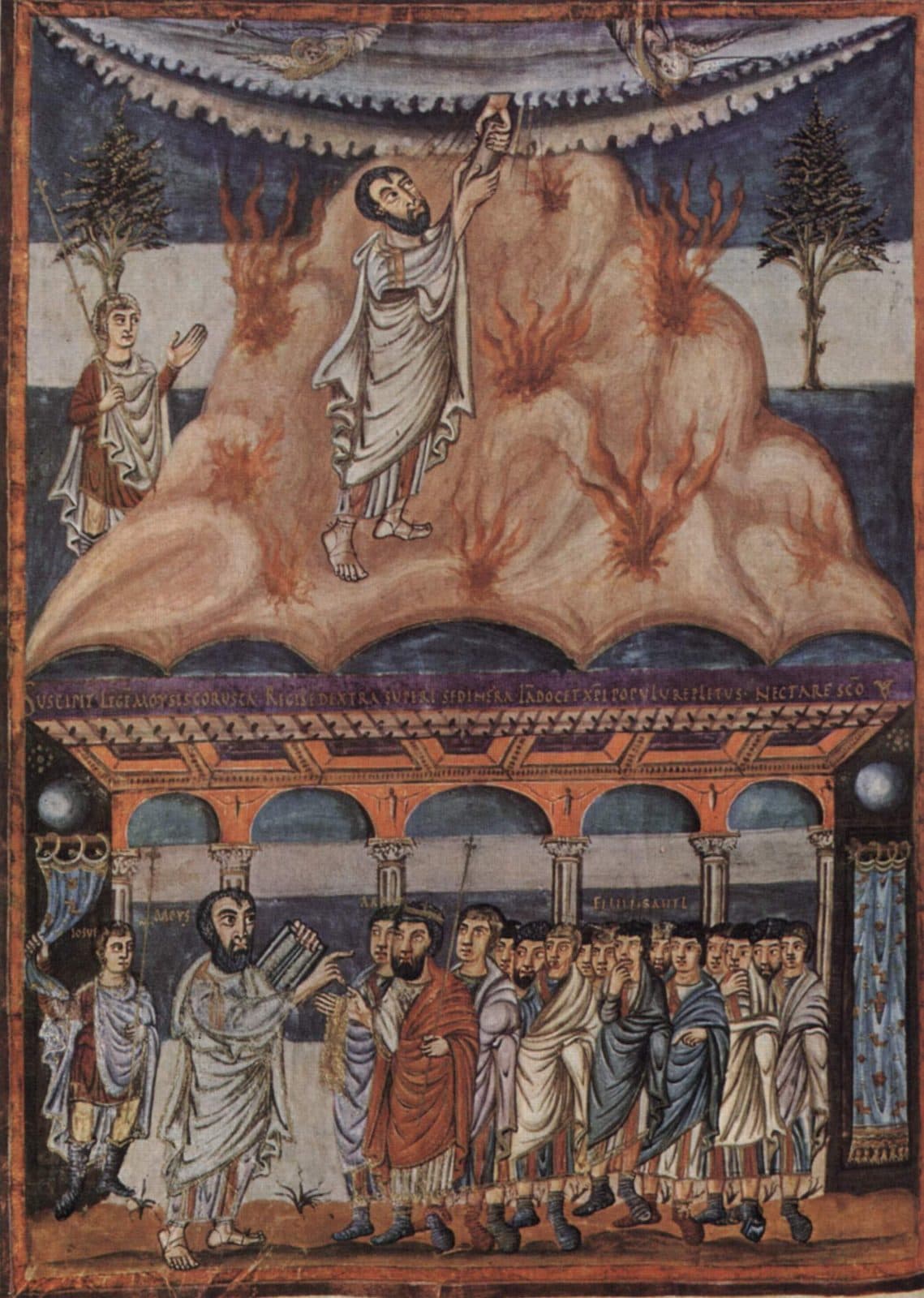
A Carolingian illuminator, Moses on Sinai and Moses before the Israelites, the Moutier-Grandval Bible, about 840, British Library, Add MS 10546. Public domain, via Wikimedia Commons.
THE ARTWORKThe illuminator painted two scenes on one page. Above, Moses receives the law on the mountain the LORD came down on in fire (Exodus 19:18). Below, he holds a book out to Aaron and the people, a scene that matches the reading of the Book of the Covenant in Exodus 24:7.
Summary
The Book of the Covenant is the name Exodus 24:7 gives to the laws the LORD spoke to Moses after the Ten Commandments.
- The ordinances deal with servants, injury, property, the poor, the courts, the sabbath year and the three feasts.
- Moses sprinkled half the blood of the offerings on the altar and the other half on the people.
- At the Last Supper Jesus called the cup His blood of the covenant.
- Readers divide over how the judicial laws bind after Christ.
The Covenant Sealed at Sinai
Exodus 24:3 to 8 tells how Israel accepted the LORD's laws and how Moses sealed the covenant with blood.
The LORD spoke these laws to Moses after the people had stood at a distance and Moses had approached the thick darkness where God was.
When Moses came and told the people all the words and ordinances of the LORD, they all responded with one voice: “All the words that the LORD has spoken, we will do.”The people's first answer comes on the day Moses tells them the words, before anything is written down.
And Moses wrote down all the words of the LORD. Early the next morning he got up and built an altar at the base of the mountain, along with twelve pillars for the twelve tribes of Israel. Then he sent out some young men of Israel, and they offered burnt offerings and sacrificed young bulls as peace offerings to the LORD.These verses fix the covenant's terms in writing before any blood is shed.
Moses took half of the blood and put it in bowls, and the other half he sprinkled on the altar. Then he took the Book of the Covenant and read it to the people, who replied, “All that the LORD has spoken we will do, and we will be obedient.”The book is read between the blood on the altar and the blood on the people, so the people hear the terms before the covenant is sealed on them.
So Moses took the blood, sprinkled it on the people, and said, “This is the blood of the covenant that the LORD has made with you in accordance with all these words.”Moses ties the blood to all these words, so the covenant rests on the book just read.
The rite ends with a meal on the mountain, where Moses, Aaron, Nadab, Abihu and seventy elders saw the God of Israel and ate and drank (Exodus 24:9 to 11).
The Laws in Their Order
Thirteen groups of laws run from the altar of Exodus 20:24 to the angel of Exodus 23:20.
| The laws | What they require | Verses |
|---|---|---|
| The altar | An altar of earth or of uncut stone, with no steps | Exodus 20:22 to 26 |
| The Hebrew servant | Release in the seventh year, or service for life by the servant's own choice | Exodus 21:1 to 11 |
| Death and injury | Death for murder, kidnapping and striking a parent, a place to flee for one who kills without intent, and payment for lost work and healing | Exodus 21:12 to 21 |
| Eye for eye | A fine when a pregnant woman is struck, and life for life, eye for eye, when serious injury results | Exodus 21:22 to 25 |
| The servant's eye, the ox and the pit | Freedom for a maimed servant, and liability for a goring ox or an open pit | Exodus 21:26 to 36 |
| Theft and restitution | Repayment fivefold, fourfold or double, and rules for goods held in trust | Exodus 22:1 to 15 |
| Seduction, sorcery and other gods | The bridal price paid, and death for sorcery, bestiality and sacrifice to other gods | Exodus 22:16 to 20 |
| The foreigner, the widow, the orphan and the poor | No oppression, no interest from the poor, and a pledged cloak returned by sunset | Exodus 22:21 to 27 |
| Reverence and the firstborn | No blasphemy against God or curse on the ruler, and the firstfruits and the firstborn given to God | Exodus 22:28 to 31 |
| Justice and the enemy's animal | No false report, no favoritism and no bribe, and help for an enemy's stray or fallen animal | Exodus 23:1 to 9 |
| The sabbath year and the sabbath | The land rested in the seventh year and work stopped on the seventh day | Exodus 23:10 to 13 |
| The three feasts | Unleavened Bread, Harvest and Ingathering, with every male before the Lord GOD | Exodus 23:14 to 19 |
| The angel sent ahead | Guidance into the land, which is taken little by little, and no covenant with its peoples | Exodus 23:20 to 33 |
- The laws
- The altar
- What they require
- An altar of earth or of uncut stone, with no steps
- Verses
- Exodus 20:22 to 26
- The laws
- The Hebrew servant
- What they require
- Release in the seventh year, or service for life by the servant's own choice
- Verses
- Exodus 21:1 to 11
- The laws
- Death and injury
- What they require
- Death for murder, kidnapping and striking a parent, a place to flee for one who kills without intent, and payment for lost work and healing
- Verses
- Exodus 21:12 to 21
- The laws
- Eye for eye
- What they require
- A fine when a pregnant woman is struck, and life for life, eye for eye, when serious injury results
- Verses
- Exodus 21:22 to 25
- What they require
- Freedom for a maimed servant, and liability for a goring ox or an open pit
- Verses
- Exodus 21:26 to 36
- The laws
- Theft and restitution
- What they require
- Repayment fivefold, fourfold or double, and rules for goods held in trust
- Verses
- Exodus 22:1 to 15
- What they require
- The bridal price paid, and death for sorcery, bestiality and sacrifice to other gods
- Verses
- Exodus 22:16 to 20
- What they require
- No oppression, no interest from the poor, and a pledged cloak returned by sunset
- Verses
- Exodus 22:21 to 27
- The laws
- Reverence and the firstborn
- What they require
- No blasphemy against God or curse on the ruler, and the firstfruits and the firstborn given to God
- Verses
- Exodus 22:28 to 31
- The laws
- Justice and the enemy's animal
- What they require
- No false report, no favoritism and no bribe, and help for an enemy's stray or fallen animal
- Verses
- Exodus 23:1 to 9
- The laws
- The sabbath year and the sabbath
- What they require
- The land rested in the seventh year and work stopped on the seventh day
- Verses
- Exodus 23:10 to 13
- The laws
- The three feasts
- What they require
- Unleavened Bread, Harvest and Ingathering, with every male before the Lord GOD
- Verses
- Exodus 23:14 to 19
- The laws
- The angel sent ahead
- What they require
- Guidance into the land, which is taken little by little, and no covenant with its peoples
- Verses
- Exodus 23:20 to 33
The Laws, Group by Group
Many of the ordinances are written as cases that begin with if, and the others as commands.
1. Exodus 20:22 to 26, the altar2 passages, 2 quotations
Then the LORD said to Moses, “This is what you are to tell the Israelites: ‘You have seen for yourselves that I have spoken to you from heaven. You are not to make any gods alongside Me; you are not to make for yourselves gods of silver or gold.The LORD opens the laws by recalling that Israel heard Him speak from heaven, and He forbids gods of silver or gold beside Him.
You are to make for Me an altar of earth, and sacrifice on it your burnt offerings and peace offerings, your sheep and goats and cattle. In every place where I cause My name to be remembered, I will come to you and bless you. Now if you make an altar of stones for Me, you must not build it with stones shaped by tools; for if you use a chisel on it, you will defile it. And you must not go up to My altar on steps, lest your nakedness be exposed on it.’The first law governs the place of worship before any law governs a neighbor.
John Wesley places these chapters in relation to the Ten Commandments.
“Moses being gone into the thick darkness where God was, God there spoke in his hearing only, all that follows from hence to the end of chap. 23, which is mostly an exposition of the ten commandments; and he was to transmit it to the people. The laws in these verses relate to God's worship.”
John Wesley · Explanatory Notes upon the Old Testament · on Exodus 20:22Evangelical
Matthew Henry draws a rule for later worship from the plain altar.
“This rule being prescribed before the establishment of the ceremonial law, which appointed altars much more costly, intimates that, after the period of that law, plainness should be accepted as the best ornament of the external services of religion, and that gospel-worship should not be performed with external pomp and gaiety.”
Matthew Henry · Commentary on the Whole Bible · on Exodus 20:24 to 25Puritan
2. Exodus 21:1 to 11, the Hebrew servant4 passages, 1 quotation
“These are the ordinances that you are to set before them: If you buy a Hebrew servant, he is to serve you for six years. But in the seventh year, he shall go free without paying anything.The ordinances open with the release of a Hebrew servant, the first case the judges would hear.
But if the servant declares, ‘I love my master and my wife and children; I do not want to go free,’ then his master is to bring him before the judges. And he shall take him to the door or doorpost and pierce his ear with an awl. Then he shall serve his master for life.The law lets the servant refuse his release, and it sets that choice before the judges.
If a fellow Hebrew, a man or a woman, is sold to you and serves you six years, then in the seventh year you must set him free. And when you release him, do not send him away empty-handed. You are to furnish him liberally from your flock, your threshing floor, and your winepress. You shall give to him as the LORD your God has blessed you.Deuteronomy repeats the seventh-year release and adds that the servant must not leave empty-handed.
“This is what the LORD, the God of Israel, says: I made a covenant with your forefathers when I brought them out of the land of Egypt, out of the house of slavery, saying: Every seventh year, each of you must free his Hebrew brother who has sold himself to you. He may serve you six years, but then you must let him go free. But your fathers did not listen or incline their ear.Jeremiah recalls the release as part of the covenant made when Israel left Egypt and says the fathers did not listen.
John Wesley explains the name the ordinances carry.
“The first verse is the general title of the laws contained in this and the two following chapters. Their government being purely a theocracy; that which in other states is to be settled by human prudence, was directed among them by a divine appointment. These laws are called judgments; because their magistrates were to give judgment according to them.”
John Wesley · Explanatory Notes upon the Old Testament · on Exodus 21:1Evangelical
3. Exodus 21:12 to 21, death and injury2 passages, 2 quotations
Whoever strikes and kills a man must surely be put to death. If, however, he did not lie in wait, but God allowed it to happen, then I will appoint for you a place where he may flee. But if a man schemes and acts willfully against his neighbor to kill him, you must take him away from My altar to be put to death.The law separates the killer who lay in wait from the one who did not, and it gives the second a place to flee.
Athanasius finds the law of Exodus 21:13 carried into a command of Christ.
“For there was a command under the law that cities of refuge should be appointed, in order that they who were sought after to be put to death might at least have some means of saving themselves. And when he who spoke to Moses, the Word of the Father, appeared in the end of the world, he also gave this commandment, saying, ‘But when they persecute you in this city, flee into another.’”
Athanasius of Alexandria · Defense of His Flight 11 · on Exodus 21:13Patristic
If a man strikes his manservant or maidservant with a rod, and the servant dies by his hand, he shall surely be punished. However, if the servant gets up after a day or two, the owner shall not be punished, since the servant is his property.The death of a servant at his master's hand is a crime the master must answer for.
Albert Barnes sets this law beside the laws of other ancient nations.
“The Jewish authorities appear to be right in referring this law, like those in Exo 21:26-27, Exo 21:32, to foreign slaves (see Lev 25:44-46). The protection here afforded to the life of a slave may seem to us but a slight one; but it is the very earliest trace of such protection in legislation, and it stands in strong and favorable contrast with the old laws of Greece, Rome, and other nations.”
Albert Barnes · Notes, Explanatory and Practical, on the Old and New Testaments (1832-1869) · on Exodus 21:20Evangelical
4. Exodus 21:22 to 25, eye for eye1 passage
If men who are fighting strike a pregnant woman and her child is born prematurely, but there is no further injury, he shall surely be fined as the woman’s husband demands and as the court allows. But if a serious injury results, then you must require a life for a life— eye for eye, tooth for tooth, hand for hand, foot for foot, burn for burn, wound for wound, and stripe for stripe.The penalty follows the harm done, a fine where there is no further injury and life for life where there is.
The readings of this law, from bodily retaliation to payment in money, are set out in An Eye for an Eye in the Law of Moses.
5. Exodus 21:26 to 36, the servant's eye, the ox and the pit3 passages
If a man strikes and blinds the eye of his manservant or maidservant, he must let the servant go free as compensation for the eye. And if he knocks out the tooth of his manservant or maidservant, he must let the servant go free as compensation for the tooth.A master who maims a servant must let the servant go free, which limits his power over the servant's body.
If an ox gores a man or woman to death, the ox must surely be stoned, and its meat must not be eaten. But the owner of the ox shall not be held responsible. But if the ox has a habit of goring, and its owner has been warned yet does not restrain it, and it kills a man or woman, then the ox must be stoned and its owner must also be put to death. If payment is demanded of him instead, he may redeem his life by paying the full amount demanded of him.The law weighs what the owner knew before his animal killed.
If a man opens or digs a pit and fails to cover it, and an ox or a donkey falls into it, the owner of the pit shall make restitution; he must pay its owner, and the dead animal will be his.The man who leaves a pit open pays for the loss it causes.
6. Exodus 22:1 to 15, theft and restitution1 passage, 1 quotation
“If a man steals an ox or a sheep and slaughters or sells it, he must repay five oxen for an ox and four sheep for a sheep. If a thief is caught breaking in and is beaten to death, no one shall be guilty of bloodshed. But if it happens after sunrise, there is guilt for his bloodshed. A thief must make full restitution; if he has nothing, he himself shall be sold for his theft. If what was stolen is actually found alive in his possession—whether ox or donkey or sheep—he must pay back double.The measure of repayment for theft depends on what became of the stolen animal.
Jamieson, Fausset & Brown give a reason for each measure.
“The penalty for the theft of a sheep which was slain or sold, was fourfold; for an ox fivefold, because of its greater utility in labor; but, should the stolen animal have been recovered alive, a double compensation was all that was required, because it was presumable he (the thief) was not a practised adept in dishonesty.”
Jamieson, Fausset & Brown · Commentary Critical and Explanatory on the Whole Bible · on Exodus 22:1 to 4Reformed
7. Exodus 22:16 to 20, seduction, sorcery and other gods2 passages
If a man seduces a virgin who is not pledged in marriage and sleeps with her, he must pay the full dowry for her to be his wife. If her father absolutely refuses to give her to him, the man still must pay an amount comparable to the bridal price of a virgin.The first case of this group protects a woman not yet pledged in marriage.
You must not allow a sorceress to live. Whoever lies with an animal must surely be put to death. If anyone sacrifices to any god other than the LORD alone, he must be set apart for destruction.The penalties rise to death or destruction for sorcery, for lying with an animal and for sacrifice to another god.
8. Exodus 22:21 to 27, the foreigner, the widow, the orphan and the poor2 passages, 1 quotation
You must not exploit or oppress a foreign resident, for you yourselves were foreigners in the land of Egypt. You must not mistreat any widow or orphan. If you do mistreat them, and they cry out to Me in distress, I will surely hear their cry. My anger will be kindled, and I will kill you with the sword; then your wives will become widows and your children will be fatherless.God names no judge for this wrong, and He promises to hear the cry and to punish the oppressor Himself.
If you lend money to one of My people among you who is poor, you must not act as a creditor to him; you are not to charge him interest. If you take your neighbor’s cloak as collateral, return it to him by sunset, because his cloak is the only covering he has for his body. What else will he sleep in? And if he cries out to Me, I will hear, for I am compassionate.The same care reaches the poor borrower, whose loan carries no interest and whose cloak comes back by sunset.
Clement of Alexandria reads the ban on interest as a call to give freely.
“There is a great deal about sharing and exchanging, but it is enough to say that the law forbids lending at interest to a brother. By brother it means not merely one born of the same parents but a member of the same tribe or one of the same faith, who shares in the same Logos. The law does not deem it right to collect interest on the capital. It seeks to enable free giving to those in need, with hands and minds wide open. God is the creator of this free gift.”
Clement of Alexandria · The Stromata Book 2 · on Exodus 22:25Patristic
9. Exodus 22:28 to 31, reverence and the firstborn2 passages, 1 quotation
You must not blaspheme God or curse the ruler of your people.Reverence for God and for the ruler stand together in one verse.
Matthew Henry follows this verse into the trial of Paul.
“Princes and magistrates are our fathers, whom the fifth commandment obliges us to honour and forbids us to revile. St. Paul applies this law to himself, and owns that he ought not to speak evil of the ruler of his people; no, not though the ruler was then his most unrighteous persecutor, Acts xxiii.”
Matthew Henry · Commentary on the Whole Bible · on Exodus 22:28Puritan
You must not hold back offerings from your granaries or vats. You are to give Me the firstborn of your sons. You shall do likewise with your cattle and your sheep. Let them stay with their mothers for seven days, but on the eighth day you are to give them to Me. You are to be My holy people. You must not eat the meat of a mauled animal found in the field; you are to throw it to the dogs.The firstfruits and the firstborn are given to God, and the ban on meat torn by animals stands under the call to be His holy people.
10. Exodus 23:1 to 9, justice and the enemy's animal2 passages, 2 quotations
If you encounter your enemy’s stray ox or donkey, you must return it to him. If you see the donkey of one who hates you fallen under its load, do not leave it there; you must help him with it.The duty to help reaches the animal of a man who hates you.
Clement of Alexandria draws from this law a lesson for the treatment of an enemy.
“The Lord tells us to relieve and lighten the burden of beasts of burden, even when they belong to our enemies. He is teaching us at a distance not to take pleasure in the misfortunes of others and not to laugh at our enemies. He wants to teach those who have exercised themselves in these disciplines to pray for their enemies.”
Clement of Alexandria · The Stromata Book 2 · on Exodus 23:5Patristic
Do not accept a bribe, for a bribe blinds those who see and twists the words of the righteous.This verse gives the reason behind the ban on bribes in the courts.
Matthew Henry extends the ban from the unjust verdict to the gift itself.
“They must not only not be swayed by a gift to give an unjust judgment, to condemn the innocent, or acquit the guilty, or adjudge a man's right from him, but they must not so much as take a gift, lest it should have a bad influence upon them, and overrule them, contrary to their intentions; for it has a strange tendency to blind those that otherwise would do well.”
Matthew Henry · Commentary on the Whole Bible · on Exodus 23:8Puritan
11. Exodus 23:10 to 13, the sabbath year and the sabbath2 passages, 1 quotation
For six years you are to sow your land and gather its produce, but in the seventh year you must let it rest and lie fallow, so that the poor among your people may eat from the field and the wild animals may consume what they leave. Do the same with your vineyard and olive grove. For six days you are to do your work, but on the seventh day you must cease, so that your ox and your donkey may rest and the son of your maidservant may be refreshed, as well as the foreign resident.These verses tie the holy times to the care of those who own nothing.
Albert Barnes comments on the purpose of the two rests.
“This is the first mention of the Sabbatical year; the law for it is given at length in Lev 25:2. Both the Sabbatical year and the weekly Sabbath are here spoken of exclusively in their relation to the poor, as bearing testimony to the equality of the people in their covenant with Yahweh.”
Albert Barnes · Notes, Explanatory and Practical, on the Old and New Testaments (1832-1869) · on Exodus 23:10Evangelical
Pay close attention to everything I have said to you. You must not invoke the names of other gods; they must not be heard on your lips.The laws of rest end with a charge to keep every word and to leave other gods unnamed.
12. Exodus 23:14 to 19, the three feasts1 passage, 1 quotation
Three times a year you are to celebrate a feast to Me. You are to keep the Feast of Unleavened Bread as I commanded you: At the appointed time in the month of Abib you are to eat unleavened bread for seven days, because that was the month you came out of Egypt. No one may appear before Me empty-handed. You are also to keep the Feast of Harvest with the firstfruits of the produce from what you sow in the field. And keep the Feast of Ingathering at the end of the year, when you gather your produce from the field. Three times a year all your males are to appear before the Lord GOD.The harvests of Israel's farms become appointed times of worship in these verses.
John Wesley sets the feasts in their seasons.
“The Passover, Pentecost, and feast of Tabernacles, in spring, summer, and autumn, were the three times appointed for their attendance; not in winter, because travelling was then uncomfortable; nor in the midst of their harvest.”
John Wesley · Explanatory Notes upon the Old Testament · on Exodus 23:14Evangelical
13. Exodus 23:20 to 33, the angel sent ahead2 passages
Behold, I am sending an angel before you to protect you along the way and to bring you to the place I have prepared. Pay attention to him and listen to his voice; do not defy him, for he will not forgive rebellion, since My Name is in him.The angel who guides Israel carries the LORD's Name, so to defy him is to defy the LORD.
Little by little I will drive them out ahead of you, until you become fruitful and possess the land. And I will establish your borders from the Red Sea to the Sea of the Philistines, and from the desert to the Euphrates. For I will deliver the inhabitants into your hand, and you will drive them out before you. You shall make no covenant with them or with their gods. They must not remain in your land, lest they cause you to sin against Me. For if you serve their gods, it will surely be a snare to you.”The laws end on the danger that the peoples of the land would draw Israel into serving their gods.
What Exodus Leaves Unsaid
Exodus 23 and 24 leave three questions open.
Exodus 24:7 names the Book of the Covenant without saying where it began or ended. Adam Clarke, in his Commentary on the Bible, takes the words Moses told the people as the Ten Commandments and the laws of Exodus 20 to 23. Rashi, in his commentary on Exodus and following the Mekhilta, takes the book as Genesis up to the giving of the Torah together with the laws given at Marah.
The text does not say who the angel of Exodus 23:20 is. Clarke reads him as the Lord Jesus Christ, the Angel of the Covenant, and John Wesley, in his Explanatory Notes upon the Old Testament, also calls him the angel of the covenant.
The text does not say how blood from the bowls reached the whole people. Rashi reads the verb of Exodus 24:8 as sprinkling on the people, and the Targum he cites reads that Moses poured the blood on the altar to atone for the people.
The Blood of the Covenant
Hebrews and the Gospels take up the words Moses spoke over the blood.
Hebrews 9 sets the rite of Exodus 24 beside the death of Christ.
That is why even the first covenant was not put into effect without blood. For when Moses had proclaimed every commandment of the law to all the people, he took the blood of calves and goats, along with water, scarlet wool, and hyssop, and sprinkled the scroll and all the people, saying, “This is the blood of the covenant, which God has commanded you to keep.”Hebrews tells the rite at Sinai with details that Exodus 24 leaves out.
According to the law, in fact, nearly everything must be purified with blood, and without the shedding of blood there is no forgiveness.The writer draws from the rite a rule for the whole of the law.
Then He took the cup, gave thanks, and gave it to them, saying, “Drink from it, all of you. This is My blood of the covenant, which is poured out for many for the forgiveness of sins.Matthew records that this blood is poured out for the forgiveness of sins, which Exodus 24:8 does not say of the blood at Sinai.
In the same way, after supper He took the cup, saying, “This cup is the new covenant in My blood, which is poured out for you.Luke records the cup as the new covenant in His blood, the promise of Jeremiah 31:31.
Matthew Henry sets the meal of the elders beside the Lord's table.
“They feasted upon the sacrifice, before God, in token of their cheerful consent to the covenant now made, their grateful acceptance of the benefits of it, and their communion with God, in pursuance of that covenant. Thus believers eat and drink with Christ at his table, Luke xxii.”
Matthew Henry · Commentary on the Whole Bible · on Exodus 24:11Puritan
Jeremiah 31:31 to 33, the law written on the heart1 passage
Behold, the days are coming, declares the LORD, when I will make a new covenant with the house of Israel and with the house of Judah. It will not be like the covenant I made with their fathers when I took them by the hand to lead them out of the land of Egypt—a covenant they broke, though I was a husband to them,” declares the LORD. “But this is the covenant I will make with the house of Israel after those days, declares the LORD. I will put My law in their minds and inscribe it on their hearts. And I will be their God, and they will be My people.Jeremiah promises a covenant unlike the one Israel broke after the LORD led them out of Egypt.
Hebrews 9:15, the mediator of a new covenant1 passage
Therefore Christ is the mediator of a new covenant, so that those who are called may receive the promised eternal inheritance, now that He has died to redeem them from the transgressions committed under the first covenant.This verse joins the death of Christ to the breaking of the covenant sealed at Sinai.
Voices on the Law at Sinai
Jerome and Gregory of Nazianzus read the servant's release and the people's distance from the mountain.
Jerome reads the seventh-year release as a figure of the believer's freedom.
“We read that every Hebrew keeps the same Passover, and that in the seventh year every prisoner is set free, and that at Jubilee, that is, the fiftieth year, every possession returns to its owner. All this refers not to the present but to the future. For being in bondage during the six days of this world, on the seventh day, the true and eternal sabbath, we shall be free. If we wish to be free, we will be free even while still in bondage in the world.”
Jerome · Against Jovinian 2.25 · on Exodus 21:2Patristic
Gregory of Nazianzus explains why Moses alone went near.
“For it is not everyone who may draw near to God but only one who, like Moses, can bear the glory of God. Moreover, before this, when the law was first given, the trumpet blasts, and lightnings, and thunders, and darkness, and the smoke of the whole mountain, and the terrible threats that if even a beast touched the mountain it should be stoned, and other like alarms kept back the rest of the people, for whom it was a great privilege, after careful purification, merely to hear the voice of God.”
Gregory of Nazianzus · ORATION 2.92 · on Exodus 24:2Patristic
How the Laws Bind After Christ
Three readings answer how the ordinances of Exodus 21 to 23 bind after Christ, and a fourth reads them as a record of ancient law.
The judicial laws expired, and their equity remains
Thomas Aquinas, in the Summa Theologiae (I-II, question 104), divides the law of Moses into moral, ceremonial and judicial precepts. He holds that the coming of Christ annulled the judicial precepts, so that they no longer bind. A ruler who ordered them kept would not sin, he says, unless he enforced them as binding by the Old Law.
John Calvin, in the Institutes of the Christian Religion (4.20.14 to 16), keeps the same division. He teaches that the Lord gave the judicial law to the Jewish nation alone, so that each nation may make its own laws as long as they rest on the equity of the moral law.
The Westminster Confession of Faith (19.4) says the judicial laws "expired together with the state of that people" and bind no one now "further than the general equity thereof may require". It cites Exodus 21 and 22 for the point.
The objection, which Calvin records in Institutes 4.20.16 in order to answer it, is that setting aside the law God gave through Moses for other laws insults that law.
The case laws still bind with their sanctions
Gary North, in Theonomy: An Informed Response (1991), describes theonomy as holding that the moral law of the Old Covenant binds in New Testament times and that its case laws bind with their civil sanctions. North dates the movement to 1973, when R. J. Rushdoony published The Institutes of Biblical Law and Greg L. Bahnsen submitted his thesis on the civil magistrate. Bahnsen's Theonomy in Christian Ethics followed in 1977.
The objection: Calvin had already called false the view that no commonwealth is rightly framed without the law of Moses (Institutes 4.20.14), and North records that the faculty of Westminster Seminary rejected the theonomic conclusion.
The whole Torah binds Israel as the oral law reads it
The rabbinic tradition holds the ordinances binding on Israel as the oral law interprets them. The Mishnah's tractate Avot opens with the chain of tradition from Moses at Sinai through Joshua, the elders and the prophets to the Men of the Great Assembly.
Rashi was the commentator of Troyes in France (1040 to 1105). In his commentary on Exodus he reads the word "and" that opens the Hebrew of Exodus 21:1 as joining these ordinances to the commandments given at Sinai. He explains their place directly after the altar law as a sign that the Sanhedrin was to sit near the Temple.
Tractate Bava Kamma opens with four primary categories of damage, the ox, the pit, the maveh and fire, which are the cases of Exodus 21:28 to 22:6. The Gemara takes the maveh either as the tooth of a grazing animal or as a person who causes damage.
The objection from the New Testament rests on Hebrews 8:13.
By speaking of a new covenant, He has made the first one obsolete; and what is obsolete and aging will soon disappear.Hebrews reads Jeremiah's promise of a new covenant as making the first covenant obsolete.
The code is Israel's oldest law collection
Stanley A. Cook, in The Laws of Moses and the Code of Hammurabi (1903), reads Exodus 21 to 23 as the oldest civil code in the Old Testament. He finds in it the law of an agricultural people whose wealth lay in cattle and produce, and he sets it beside the Babylonian code of Hammurabi.
The two codes rule on the same case of the goring ox. In C. H. W. Johns's translation (1903), law 251 of Hammurabi makes the owner of an ox known to gore pay half a mina of silver when it kills a man of gentle birth. Exodus 21:29 puts the warned owner to death, and Exodus 21:30 lets him redeem his life.
The objection is the text's own account, in which Moses wrote down all the words of the LORD at the foot of Sinai (Exodus 24:4).
The Obedience the Covenant Asks For
Exodus 24 joins hearing the LORD's words to doing them.
Hebrews 9 asks its readers to come to that service cleansed by the blood of Christ.
how much more will the blood of Christ, who through the eternal Spirit offered Himself unblemished to God, purify our consciences from works of death, so that we may serve the living God!The verse sets the blood of Christ above the blood of goats and bulls in the verse before it.
Keep studying
Read it1
Studies6
Doctrines15