
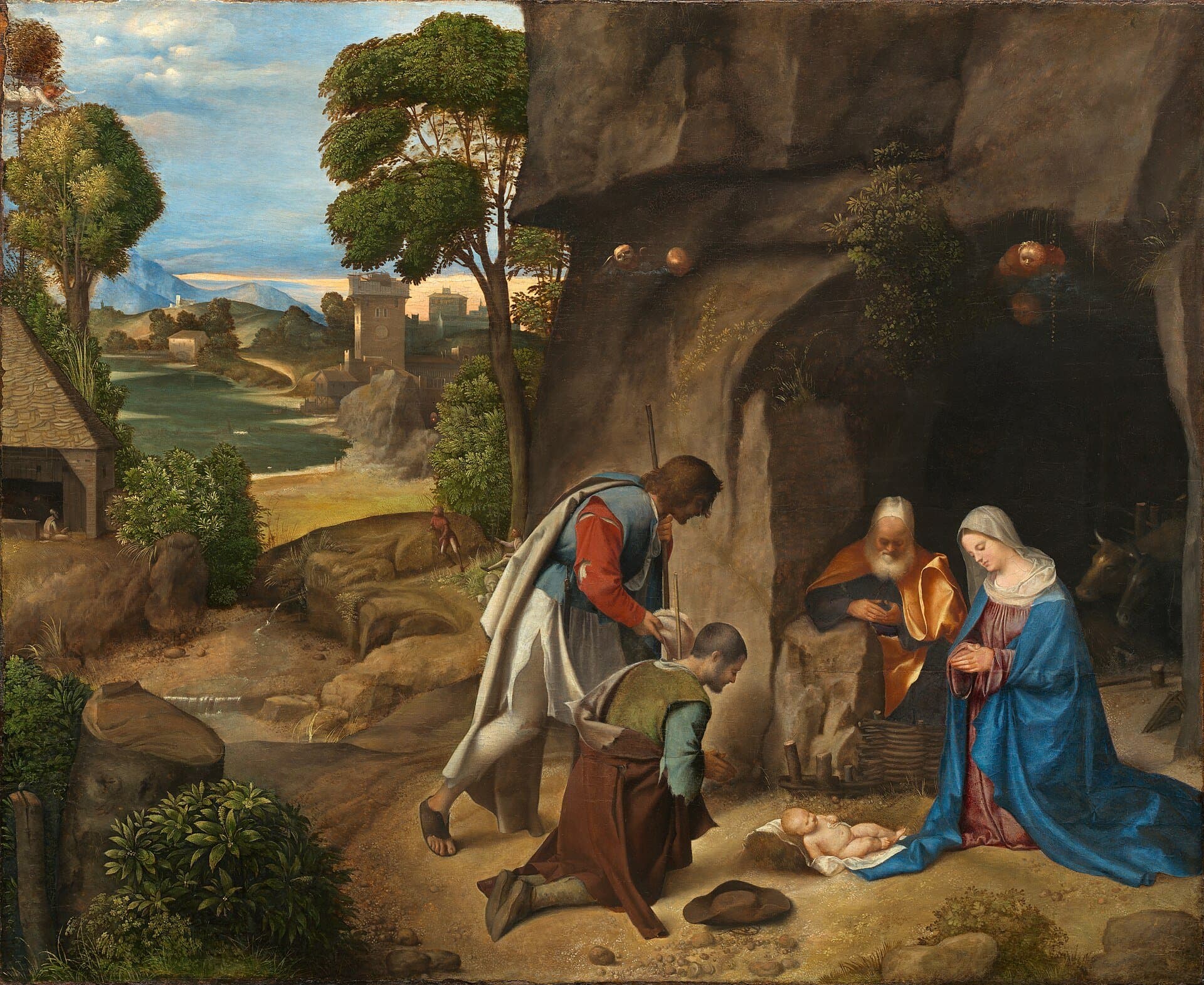
Giorgione, The Adoration of the Shepherds, 1505 to 1510. Public domain.
Genesis 3:15 to Revelation 22:16 · Doctrine · Featured Study
The Seed Promise
Genesis 3:15 promised a seed of the woman, and the line runs down the generations to the child of Bethlehem, whom Galatians 3:16 names Christ.
The Bible's longest prophecy is carried by one Hebrew word, zera, seed.
And I will put enmity between you and the woman, and between your seed and her seed. He will crush your head, and you will strike his heel.”
- First taught
- Genesis 3:15 “…the woman, and between your seed and her…”
- Fullest statement
- Galatians 3:16 “…to Abraham and to his seed. The Scripture…”
The Bible's longest prophecy is carried by one Hebrew word, zera, seed.
Summary
Each text after Genesis 3:15 narrows the line of the woman's seed until only one person fits it.
- Latin tradition calls Genesis 3:15 the protoevangelium, the first gospel.
- The line passes through Seth, Shem, Abraham, Isaac, Jacob, Judah and David.
- Paul's argument in Galatians 3:16 turns on the singular seed, and he names that seed Christ.
- Revelation 12 brings back the woman, the dragon and the male child, and Romans 16:20 puts the crushing under the church's feet.
Genesis 3:15 as the Protoevangelium
God speaks the promise to the serpent, inside the curse on it.
And I will put enmity between you and the woman, and between your seed and her seed. He will crush your head, and you will strike his heel.”The promise rests on the pronoun He, which gives the crushing of the serpent's head to one descendant of the woman.
The seed (Hebrew zera, זֶרַע) is grammatically singular. The descendant who crushes the serpent is born of a woman, an unusual construction in Hebrew genealogy, which typically runs through fathers.
The Hebrew verb and suffix behind the one who crushes are masculine singular, and the Septuagint renders the subject with the masculine pronoun autos against a neuter noun for seed. The ancient translators did not have to introduce that oddity, and they did. The King James Version's older rendering, it shall bruise thy head, flattens the point, and the American Standard Version of 1901 recovers it with he.
The seed (Hebrew zera, זֶרַע) is grammatically singular. The descendant who crushes the serpent is born of a woman, an unusual construction in Hebrew genealogy, which typically runs through fathers.
The Hebrew verb and suffix behind the one who crushes are masculine singular, and the Septuagint renders the subject with the masculine pronoun autos against a neuter noun for seed. The ancient translators did not have to introduce that oddity, and they did. The King James Version's older rendering, it shall bruise thy head, flattens the point, and the American Standard Version of 1901 recovers it with he.
The stroke Satan receives from Christ2 quotations
“Thus, fatal shall be the stroke which Satan shall receive from Christ, though it is probable he did not at first understand the nature and extent of his doom.”
Jamieson, Fausset & Brown · Commentary Critical and Explanatory on the Whole Bible · on Genesis 3:15Reformed
“He has therefore, in His work of recapitulation, summed up all things, both waging war against our enemy, and crushing him who had at the beginning led us away captives in Adam, and trampled upon his head, as thou canst perceive in Genesis that God said to the serpent, ‘And I will put enmity between thee and the woman, and between thy seed and her seed; He shall be on the watch for thy head, and thou on the watch for His heel.’”
Irenaeus · Against Heresies 5.21.1 · on Genesis 3:15Patristic
Four witnesses to the messianic reading1 paragraph
The case for the messianic reading of Genesis 3:15 is cumulative. Four witnesses read the text in the same direction, independently, across centuries. They are the singular masculine pronoun, the Septuagint's rendering before Christ, the later messianic paraphrase of the Targums and the New Testament's reuse of the verse in Romans 16:20 and Revelation 12.
The Narrowing Funnel: Ten Specifications
Ten texts from Genesis to Luke each name a line, a manner or a place.
A chain of ten texts in canon order, from Genesis 3:15 to Luke 1:31 to 33, each with the line it names.
- The line it names
- humanity, the broadest range
- The line it names
- one of Noah's three sons
- The line it names
- one descendant of Shem
- The line it names
- one of Abraham's sons, and Ishmael is set aside
- The line it names
- one of Isaac's sons, and Esau is set aside
- The line it names
- one of Jacob's twelve sons, who holds the scepter
- The line it names
- one of Judah's descendants
- The line it names
- the manner of the birth
- The line it names
- the town of the birth
10To Mary, in Nazareth, of the house of David
- The line it names
- the woman herself
Through David, Through a virgin, Born in Bethlehem, To Mary, in Nazareth, of the house of David
Each new revelation specifies the one before it and rules out vast portions of humanity, until the seed is identified down to a particular town and a particular woman. Each step agrees with the steps before it.
The order of the narrowing makes the case. A messianic figure might match one or two of these texts by accident, and all of them met by one person in the sequence Scripture gives them point to that person. Chuck Missler's verse-by-verse commentary on the Book of Genesis treats this narrowing as a signature case of the integrated design of Scripture, one message laid down across a thousand years of separate authors.
God blesses the nations through Abraham and sets Jacob over Esau2 verses
I will bless those who bless you and curse those who curse you; and all the families of the earth will be blessed through you.”Galatians 3:8 says that in this promise the Scripture foretold the gospel to Abraham.
and He declared to her: “Two nations are in your womb, and two peoples from within you will be separated; one people will be stronger than the other, and the older will serve the younger.”The oracle is given to Rebekah while the twins are in her womb, so the line passes to Jacob before either son is born.
The Line in Six Bands and Sixteen Stops
Six bands group the stops of the line, each band with its texts and the word it carries.
A table of six bands, each with the line it narrows to, its texts, the texts where it lands and the word it carries.
| Band | Narrows to | Texts | Where it lands | Word |
|---|---|---|---|---|
| I. Cosmos | all creation and all nations | Genesis 3:15 and Genesis 12:3 | Galatians 3:16 and Romans 16:20 | zera |
| II. One family | Shem, then Abraham | Genesis 9:26 and Genesis 22:18 | Acts 3:25 and Galatians 3:16 | zera |
| III. One tribe | Judah | Genesis 49:10 and Numbers 24:17 | Revelation 5:5 | shevet |
| IV. One house | David | 2 Samuel 7:12 and Psalm 89:3 to 45 | Luke 1:32 and Acts 2:30 | zera |
| V. One virgin and one town | the sign to David's house, one womb and one town | Isaiah 7:14, Isaiah 9:6, Isaiah 11:1 and Micah 5:2 | Matthew 1:23, Romans 15:12 and Matthew 2:6 | netzer |
| VI. One | the arrival | Matthew 1:1 and Revelation 22:16 | Galatians 3:16 and Luke 3:38 | sperma |
Sixteen stops in canon order1 table or figure
A table of sixteen stops in canon order, each with its band, the person or event it names and what narrows there.
| Stop | Band | Who | What narrows |
|---|---|---|---|
| 1 | Cosmos | Eve | The promise starts as wide as the human race, in her seed. |
| 2 | Cosmos | Seth | The first murder nearly ends the line in one generation, and Eve names the replacement son with the promise word on her lips. |
| 3 | Cosmos | Noah | The whole earth is judged and the line survives in a single household, as eight people carry it through the water. |
| 4 | One family | Shem | Of three sons the blessing is spoken over Shem alone, the first narrowing to a family. |
| 5 | One family | Abraham | Out of every nation one man is called, and the promise at once widens back out through him to all the families of the earth. |
| 6 | One family | Isaac | Two sons stand in the house, and the line is named through Isaac. |
| 7 | One family | In your offspring | After the offering of Isaac the wording sharpens to the singular Paul presses in Galatians 3:16. |
| 8 | One family | Jacob | Of two sons again the promise takes one, Jacob, and Esau is passed over. |
| 9 | One tribe | Judah | The scepter is pledged to exactly one of twelve tribes and held there until Shiloh comes. |
| 10 | One tribe | Balaam's star | A hired pagan seer uses Judah's word shevet for a scepter out of Israel and a star out of Jacob. |
| 11 | One house | David | One tribe narrows to one house, and that house is promised a throne forever. |
| 12 | One house | The throne cast down | Psalm 89 sings the covenant in verses 3 and 27 and casts the throne down in verses 38 to 45, and the prophets after it hope for a restored David. |
| 13 | One virgin and one town | The virgin's son | David's house narrows to one woman and one child, and the sign is given to the house as well as to the king. |
| 14 | One virgin and one town | The Branch, and one town | A shoot, netzer, rises out of a felled stump, and the town is small enough to name, Bethlehem Ephrathah. |
| 15 | One | The genealogies land | One sentence gathers the line as son of David and son of Abraham, and Paul says the singular was the point all along. |
| 16 | One | The capstone | Revelation 22:16 gathers the Branch of Isaiah 11:1 and the Star of Numbers 24:17 into one voice, the Root and the Offspring of David, the bright Morning Star. |
7, 8, 9, 10, 11, 12, 13, 14 and 2 more
After the line comes to one, it widens again through Him to all the families of the earth, and Revelation 12:17 names the rest of the woman's children.
And the dragon was enraged at the woman, and went to make war with the rest of her children, who keep the commandments of God and hold to the testimony of Jesus. And the dragon stood on the shore of the sea.This verse carries the enmity of Genesis 3:15 on to the church after the child is caught up to God.
Paul's Grammatical Argument in Galatians 3:16
Zera (זֶרַע) can refer to one descendant, a line of descendants or the whole of a man's offspring, and Hebrew marks no difference among the three.
The promises were spoken to Abraham and to his seed. The Scripture does not say, “and to seeds,” meaning many, but “and to your seed,” meaning One, who is Christ.The grammar of the promises to Abraham carries Paul's singular in advance.
The Septuagint's reading of Genesis 3:15 was in Jewish hands before Paul, so he extends an existing Jewish line of interpretation and does not invent one out of Greek grammar laid on a Hebrew word.
A single person, and that seed is Christ1 quotation, 1 paragraph
Matthew Henry, in his Commentary on the Whole Bible, calls Paul's reading a very surprising exposition. Readers would have thought the promise meant only the people of the Jews, but the apostle says the word is singular and points at a single person, Christ, so the covenant is still in force.
“This verse is parenthetical. The covenant of promise was not ‘spoken’ (so Greek for ‘made’) to Abraham alone, but ‘to Abraham and his seed’; to the latter especially; and this means Christ (and that which is inseparable from Him, the literal Israel, and the spiritual, His body, the Church).”
Jamieson, Fausset & Brown · Commentary Critical and Explanatory on the Whole Bible · on Galatians 3:16Reformed
Jewish Interpretive Traditions as Corroborating Witnesses
Aramaic paraphrases, scrolls from Qumran and the rabbis read these texts of the Messiah.
Targum Pseudo-Jonathan, one of the Aramaic paraphrases of the Hebrew Bible read in the synagogue, reads Genesis 3:15 of the Messiah. In J. W. Etheridge's translation of 1862, the sons of the woman keep the commandments of the law and smite the serpent on the head. Targum Onkelos reads the scepter oracle of Genesis 49:10 the same way, rendering until Shiloh comes as the coming of the Messiah, whose is the kingdom. That matters because Onkelos is the conservative Targum and keeps close to the Hebrew.
When the Targums were written down1 paragraph
The Targums survive in written form centuries after the New Testament, and the final redaction of Targum Pseudo-Jonathan is usually placed in the seventh or eighth century AD (Paul V. M. Flesher and Bruce Chilton, The Targums: A Critical Introduction, 2011). So they do not prove how the synagogue read these verses before Christ. They are reception, a record of how a later, independent tradition outside the church kept reading the same texts in the same direction. Independent agreement is real evidence, of a different kind from a manuscript of the first century.
Ancient Jewish reception, text by text1 table or figure
A table of four witnesses of ancient Jewish reception and Edersheim's catalogue of them, each with the texts it reads and its reading.
| Witness | Texts | Reading |
|---|---|---|
| Targum Onkelos, Etheridge translation (1862) | Genesis 49:10 | until the Messiah come, whose is the kingdom |
| Targum Pseudo-Jonathan, Etheridge translation (1862) | Genesis 3:15 and Numbers 24:17 | a remedy for the heel in the days of the King Meshiha; the Meshiha, the Power-sceptre of Israel |
| Targum Jonathan on the Prophets, Pauli, The Chaldee Paraphrase on the Prophet Isaiah (1871) | Isaiah 9:6 and Isaiah 11:1 | Isaiah 9:6 names the Messiah, and Isaiah 11:1 says the Messiah shall be anointed from Jesse |
| Alfred Edersheim, The Life and Times of Jesus the Messiah (1883), Appendix IX | 456 Old Testament passages, Micah 5:2 among them | the catalogue of passages the ancient synagogue applied to the Messiah; on Micah 5:2 it cites the Targum |
| The Dead Sea Scrolls 4Q252, 4Q174 Florilegium and 4Q175 Testimonia | Genesis 49:10, 2 Samuel 7 and Numbers 24:17 | the seed, scepter and star texts read of the Messiah before Christ, in the Second Temple period |
The Great Isaiah Scroll and the Tree of Jesse1 table or figure, 1 paragraph
The Great Isaiah Scroll from Qumran (1QIsaᵃ), dated to about 125 BC, is the oldest complete copy of Isaiah, and it carries Isaiah 7:14 and Isaiah 11:1 more than a century before Christ.
The Lambeth Bible of about 1140 draws the shoot from the stump of Jesse in Isaiah 11:1 as a family tree rising from the sleeping Jesse's body to Christ at its crown.
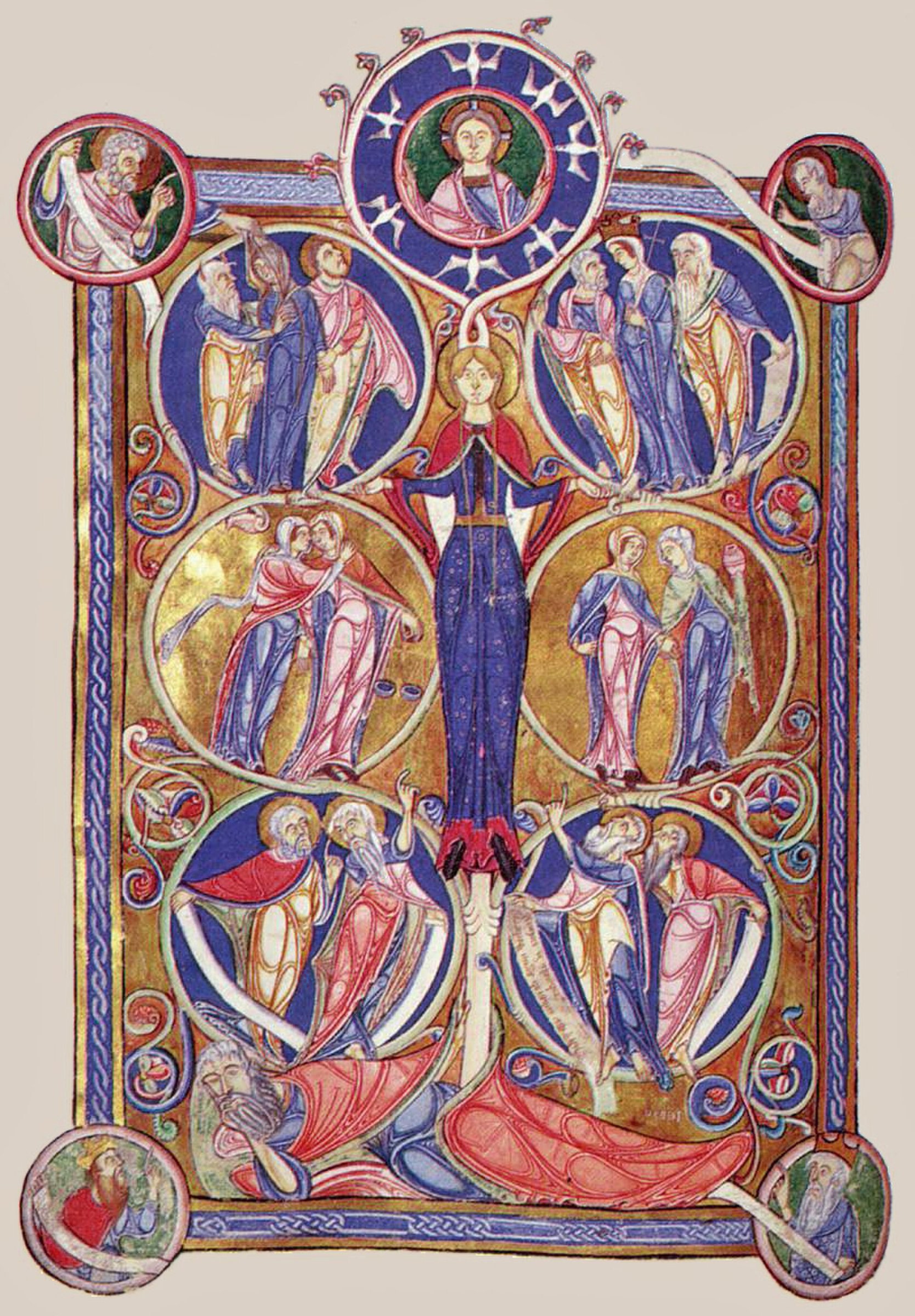
- Jesse asleep at the rootIsaiah 11:1
- The shoot rising from his bodyIsaiah 11:1
- The Virgin in the trunkIsaiah 7:14
- Christ at the crownRevelation 22:16
- The doves around ChristIsaiah 11:2
Illuminator of the Lambeth Bible, The Tree of Jesse, about 1140 to 1150, Lambeth Palace Library. Public domain by date; Wikimedia Commons file 12th-century painters - The Tree of Jesse - WGA15728.jpg.
Five parts of the page, each with the verse it draws.
What the Text Leaves Unsaid
Genesis is silent on three points of the promise.
Genesis 3 never names Satan. The serpent is named the devil and Satan in Revelation 12:9, at the other end of the canon.
Genesis 3:15 gives the woman's seed no name, no tribe and no date. Each of those comes later, one text at a time.
Genesis 49:10 does not explain the word Shiloh.
Revelation 12: the Enmity Fulfilled
The last book answers the curse of Eden element by element.
The Bible that opens with a promise ends with its fulfillment, and Genesis 3:15 and Revelation 12:5 stand as Scripture's most distant bookends.
A table of four elements of Revelation 12, each with its verse and the words of Genesis 3:15 it answers.
| Element | Revelation 12 | Genesis 3:15 |
|---|---|---|
| The woman, with a crown of twelve stars | Revelation 12:1 to 2 | the woman |
| The dragon | Revelation 12:3 to 4 | the serpent |
| The male child | Revelation 12:5 | the seed |
| The head crushed | Revelation 12:9, the dragon hurled down | He will crush your head |
The God of peace will soon crush Satan under your feet. The grace of our Lord Jesus Christ be with you.Paul uses the crushing of Genesis 3:15 for the victory God will soon give the church in Rome.
Revelation 12 and Romans 16:20 in three early and later commentaries3 quotations
“Care was taken of this child: it was caught up to God, and to his throne; that is, taken into his special, powerful, and immediate protection. The Christian religion has been from its infancy the special care of the great God and our Saviour Jesus Christ.”
Matthew Henry · Commentary on the Whole Bible · on Revelation 12:5Puritan
“‘And the God of peace shall crush Satan under your feet speedily.’ The question is asked in this passage what Satan he meant, who was to be crushed swiftly by God beneath the feet of those to whom he writes.”
Origen of Alexandria · Commentary on the Epistle to the Romans · on Romans 16:20Patristic
“The woman who ‘appeared in heaven … clothed with the sun’ and crowned with ‘twelve stars,’ having the moon for her footstool, and being with child, and travailing in birth, is certainly, according to the accurate interpretation, our mother, … a power by herself distinct from her children, whom the prophets, according to the aspect of their subjects, have called sometimes Jerusalem, sometimes a Bride, sometimes Mount Zion, and sometimes the Temple and Tabernacle of God.”
Methodius of Olympus · SYMPOSIUM 8.5-6 · on Revelation 12:1Patristic
Who Read the Line This Way
Irenaeus, Justin, Calvin, Luther and Matthew Henry comment on Genesis 3:15, and Rufinus and Basil comment on the scepter of Genesis 49:10.
died 379 · Basil of Caesarea
LETTER 236
The quotation1 quotation
“However, the tribe of Judah did not fail until he came for whom it was reserved, who did not himself sit upon a material throne, for the kingdom of Judea had now been transferred to Herod, the son of Antipater, the Ascalonite, and to his sons, who divided Judea into four provinces when Pilate was governor and Tiberius held the power over the whole Roman province. But his indestructible kingdom he calls the throne of David on which the Lord sat. He himself is ‘the expectation of nations,’ not of the least part of the world.”
Basil of Caesarea · LETTER 236 · on 2 Samuel 7:12 to 13Patristic
died 411 · Tyrannius Rufinus
THE BLESSINGS OF THE PATRIARCHS 1.7
The quotation1 quotation, 1 paragraph
Rufinus and Basil both date the end of Judah's rulers to Herod, and both read the coming of Christ at that point.
“This passage clearly refers to Judah. It appears that until the birth of Christ there was no lack of princes from the family of Judah or of heads from its sides, until Herod came, who according to the history written by Josephus was a foreigner and usurped the throne of Judea through his plots. As soon as this happened and a head from the sides of Judah was lacking, the one to whom the kingdom had been reserved immediately came.”
Tyrannius Rufinus · The Blessings of the Patriarchs 1.7 · on Genesis 49:10Patristic
Irenaeus of LyonsAgainst Heresies 3.23.7, 4.40.3 and 5.21.1 · Patristic
Irenaeus reads the woman's Seed as Christ in Against Heresies 3.23.7 and 4.40.3, where Christ undoes the serpent by recapitulation.
Justin MartyrDialogue with Trypho 100 and 103 · Patristic
John CalvinCommentary on Genesis, translated by John King for the Calvin Translation Society (1847) · Reformation
Calvin holds that the woman's Seed crushes the serpent's head where the God of peace crushes Satan under the feet of the church, in Romans 16:20. He calls the Latin reading that applies to the mother of Christ what is said of her seed a profane exposition.
Martin LutherCommentary on Genesis, volume 1 · Reformation
Luther reads Genesis 3:15 as the protoevangelium, the first promise of the woman's Seed against the serpent.
Matthew HenryCommentary on the Whole Bible, Genesis 3:15 (1706) · Puritan
Henry calls the promise of Genesis 3:15 the chief promise and the dawning of the gospel day.
Five Contested Stops
Readers have disputed the messianic reading at five texts of the line.
Genesis 3:15 is the headwater of the promiseIrenaeus, Luther, Matthew Henry; Targum Pseudo-Jonathan and Sotah 49b · Typological
Paul reads the promise of Christ in Galatians 3:16 and Romans 16:20. Irenaeus, Luther and Matthew Henry hold the reading, and ancient Jewish reception reads the verse of the Messiah in Targum Pseudo-Jonathan and Sotah 49b.
Rashi reads Genesis 3:15 on its plain sense, as an account of why humans and snakes are enemies, and he names no Messiah. The serpent, having no height, can bite the man only on the heel (Rashi on Genesis 3:15, in the translation of M. Rosenbaum and A. M. Silbermann, 1929 to 1934).
Isaiah 7:14 names a virginMatthew 1:23; the Septuagint, in H. B. Swete, The Old Testament in Greek (1900) · Fulfillment
Matthew 1:23 quotes the verse as fulfilled in the virgin birth. The Septuagint rendered the Hebrew almah (עַלְמָה) as parthenos (παρθένος), virgin, roughly two hundred years before Christ, so the reading is a Jewish one and was not fitted onto the text by Christians.
Rashi reads the young woman as the prophet's own wife, in the fourth year of Ahaz. The word almah means a young woman, and betulah is the precise word for a virgin. Isaiah 7:16 ties the sign to the days of Ahaz, since the child's infancy dates a near deliverance.
Genesis 49:10 holds the scepter in Judah until the MessiahTargum Onkelos, Targum Pseudo-Jonathan, the Jerusalem Targum, Sanhedrin 98b · Reception
The scepter (shevet, שֵׁבֶט) stays with Judah until Shiloh comes. Targum Onkelos, Pseudo-Jonathan, the Jerusalem Targum and Sanhedrin 98b read the verse of the Messiah, and Revelation 5:5 names Christ the Lion of the tribe of Judah.
Jamieson, Fausset and Brown call Shiloh an obscure word that is variously interpreted, and it is read as a place name, as he to whom it belongs, or as tribute. No New Testament writer quotes the verse, so the messianic reading rests on reception and has no apostolic citation.
Numbers 24:17 foretells the star of ChristTargum Pseudo-Jonathan on Numbers 24:17; 4Q175 Testimonia · Reception
Balaam's star out of Jacob and scepter out of Israel point to the star at Jesus' birth in Matthew 2:2 and to Jesus the Morning Star in Revelation 22:16.
Eusebius records in his Church History 4.6 that the rebel leader Bar Kokhba, whose name signifies a star, claimed to be a star come down from heaven in AD 132. The oracle was therefore applied to more than one man in Jewish hope.
The singular of Galatians 3:16 carries Paul's weightPaul; J. B. Lightfoot, Saint Paul's Epistle to the Galatians (1865); C. John Collins, A Syntactical Note (Genesis 3:15), Tyndale Bulletin 48.1 (1997) · Collective singular
The Greek sperma (σπέρμα) is singular as the Hebrew zera is, and on this reading the one offspring, Christ, gathers the whole line.
Calvin, in his Commentary on Genesis 3:15, asks who will concede that a collective noun is to be understood of one man only. He reads the seed as the woman's posterity, victorious under Christ its Head. Zera normally denotes many descendants, like the English word offspring, and J. B. Lightfoot reports critics who urged on that ground that Paul's argument rests on a grammatical error. Lightfoot answers that Paul lays the stress on a singular collective noun, which admits of plurality and at the same time carries the idea of unity. C. John Collins finds the same singular in Genesis 3:15, where the pronoun and the verbs follow the pattern Hebrew uses when zera names one individual.
Books to Read Next
Six works on the promise, three of them free to read online.
Against Heresies
Irenaeus of Lyons · about 180
The bishop of Lyons wrote it about 180, and it stands in English in the Ante-Nicene Fathers, volume 1.
Read it free at New AdventCommentaries on the First Book of Moses Called Genesis
John Calvin · 1554
Calvin wrote on Genesis chapter by chapter, from the creation to the death of Joseph.
Read it free at CCELThe Life and Times of Jesus the Messiah
Alfred Edersheim · 1883
Appendix IX lists the Old Testament passages the ancient synagogue applied to the Messiah.
Read it free at CCELEchoes of Scripture in the Letters of Paul
Richard B. Hays · 1989
Hays studies how Paul reads the Old Testament, the method behind his reading of the seed.
In print: find it wherever books are sold.
The Messianic Hope
Michael Rydelnik · 2010
Rydelnik argues that the Old Testament itself reads its promises of the Messiah forward.
In print: find it wherever books are sold.
The Targums: A Critical Introduction
Paul V. M. Flesher and Bruce Chilton · 2011
The authors date the Targums and set out how each one reads the Hebrew.
In print: find it wherever books are sold.
The Seed Who Crushed the Serpent
God kept the promise of Eden in His Son.
The text asks the reader to belong to that Seed by faith, since Galatians 3:29 makes everyone who belongs to Christ Abraham's seed and heirs according to the promise.
But when the time had fully come, God sent His Son, born of a woman, born under the law,This verse joins the Son of God to the promise of Genesis 3:15 through His mother.
Nine Hebrew and Greek Words of the Promise
Seven Hebrew words and two Greek words carry the promise down the line.
A table of nine words, each with its Strong's number, its sense, where it stands in the line and how often it occurs.
| Word | Number | Sense | Where it stands | Occurrences |
|---|---|---|---|---|
| zera, זֶרַע | H2233 | seed, offspring | the line's main word: Genesis 3:15, Genesis 22:18, 2 Samuel 7:12 and Psalm 89:4, and Paul's collective singular in Galatians 3:16; its first use, in Genesis 1:11, is of plants | 229 tagged occurrences |
| shevet, שֵׁבֶט | H7626 | scepter, tribe | the scepter of Genesis 49:10 and of Numbers 24:17 | 190 tagged occurrences |
| netzer, נֵצֶר | H5342 | branch, shoot | the Branch of Isaiah 11:1, the word the medieval Tree of Jesse drew from | 4 tagged occurrences |
| shuph, שׁוּף | H7779 | to bruise, to crush | the crushing verb of Genesis 3:15, used twice there; Romans 16:20 speaks of the same crushing of Satan | 4 occurrences: Genesis 3:15 twice, Job 9:17 and Psalm 139:11 |
| choter, חֹטֶר | H2415 | shoot, twig | the shoot from the stump of Jesse in Isaiah 11:1, beside netzer | 2 occurrences: Isaiah 11:1 and Proverbs 14:3 |
| yiqhah, יִקְּהַת | H3349 | obedience, gathering | the allegiance of the nations in Genesis 49:10, the keystone of the Shiloh oracle | 2 occurrences: Genesis 49:10 and Proverbs 30:17 |
| almah, עַלְמָה | H5959 | young woman | Isaiah 7:14, the contested word beside the Septuagint's parthenos | 7 tagged occurrences |
| sperma, σπέρμα | G4690 | seed | Galatians 3:16, the New Testament word that lands the line of H2233 | 43 tagged occurrences |
| parthenos, παρθένος | G3933 | virgin | Matthew 1:23, quoting the Septuagint of Isaiah 7:14 | 15 tagged occurrences |
almah, עַלְמָה, sperma, σπέρμα, parthenos, παρθένος
Sources
Scripture is the Berean Standard Bible.
- Irenaeus, Against Heresies, Ante-Nicene Fathers volume 1.
- Rashi on Genesis, in Pentateuch with Rashi's commentary, M. Rosenbaum and A. M. Silbermann (1929 to 1934)
- Rashi on Isaiah, in The Judaica Press Complete Tanach with Rashi, translated by A. J. Rosenberg.
- The Targum of Jonathan ben Uzziel, translated by J. W. Etheridge (London, 1862)
- Targum Onkelos on Genesis 49:10, in the Metsudah Chumash (2009)
- C. W. H. Pauli, The Chaldee Paraphrase on the Prophet Isaiah (1871)
- Alfred Edersheim, The Life and Times of Jesus the Messiah (1883), Appendix IX.
- Paul V. M. Flesher and Bruce Chilton, The Targums: A Critical Introduction (2011)
- H. B. Swete, The Old Testament in Greek (1900)
- Richard B. Hays, Echoes of Scripture in the Letters of Paul (1989)
- J. B. Lightfoot, Saint Paul's Epistle to the Galatians (first edition 1865; Andover: W. F. Draper, 1870), on Galatians 3:16, pages 255 to 256.
- Jack (C. John) Collins, A Syntactical Note (Genesis 3:15): Is the Woman's Seed Singular or Plural?, Tyndale Bulletin 48.1 (1997), pages 139 to 148.
- Chuck Missler, commentary on the Book of Genesis.
- The Dead Sea Scrolls 4Q252, 4Q174 and 4Q175.
- John Calvin, Commentaries on the First Book of Moses Called Genesis, translated by John King (1847)
- Eusebius, Church History, book 4, chapter 6, Nicene and Post-Nicene Fathers, second series, volume 1.
- Strong's Exhaustive Concordance and the Brown-Driver-Briggs lexicon, with the site's tagged Hebrew and Greek text data.
Keep Studying
Studies6
People and groups10
Places1
Words5
Doctrines12
Subjects3