

Exodus 7–12 · Featured Study
The Ten Plagues
Read quickly, the plagues look like escalating fury. Read closely, they are architecture: three triads of three, and in every triad the same warning pattern: announced at dawn by the water, announced in the palace, then struck with no warning at all. A tenth stands outside the pattern, because its answer is not another plague but a lamb. And running under all of it is Scripture's hardest sentence about a human heart, which this page sets out verse by verse rather than settling for you.
John Martin, The Seventh Plague of Egypt (1823) — Public domain, via Wikimedia Commons
Summary
This page charts the ten plagues as three repeating triads plus a tenth outside the pattern, grades the judgment-on-the-gods-of-Egypt reading by how firm the evidence is, and lays out all nineteen hardening statements in order.
- Each triad repeats the same warning pattern: a morning warning, a palace warning, then no warning at all
- The gods-of-Egypt mappings are graded firm, plausible, or inferred rather than presented as settled
- All nineteen statements about Pharaoh's hardened heart are listed in narrative order
- The Reformed and Wesleyan-Arminian readings of the hardening are both given at full strength
- The tenth plague stands outside the pattern because Passover, not another plague, answers it
Three Triads, and a Tenth
the warning pattern that repeats three times, exactly
Set the ten side by side and the design shows itself. Plagues 1, 4 and 7 open the same way: Moses is sent to intercept Pharaoh in the morning, at the water. Plagues 2, 5 and 8 open with “go in unto Pharaoh.” Plagues 3, 6 and 9 come with no warning whatsoever. Three times, in order, without exception.
First Triad
— the Nile and what rises out of it. Egypt's experts still keeping upThe Nile turned to blood
“Go to Pharaoh in the morning… Wait on the bank of the Nile to meet him” (7:15)
The first blow lands on the artery of Egyptian life and religion. The magicians duplicate it: which only doubles the ruin.
Frogs
“Go to Pharaoh and tell him” (8:1)
The magicians can produce frogs; they cannot remove them. Pharaoh has to ask Moses to pray, and grants a delay of one day.
Gnats from the dust
No audience, no demand: “Stretch out your staff and strike the dust of the earth” (8:16)
The turning point for Egypt's own experts. They try, they fail, and they tell Pharaoh: “This is the finger of God.” He does not listen.
Second Triad
— the land, the herds, the body: and Israel visibly set apartSwarms of flies
“Get up early in the morning… stand before him” (8:20)
The first explicit exemption: Goshen is set apart, “In this way you will know that I, the LORD, am in the land” (8:22).
Murrain on the livestock
“Go to Pharaoh and tell him” (9:1)
Egypt's herds die; Israel's do not lose one animal, and Pharaoh sends men to check, confirms it, and hardens anyway.
Boils on man and beast
No warning: ashes thrown toward heaven in Pharaoh's sight (9:8)
The magicians cannot even stand in Moses' presence. And here, for the first time in the narrative, it is the LORD who hardens Pharaoh's heart (9:12).
Third Triad
— sky, harvest, sun: the cosmos itself turned against the empireHail and fire
“Get up early in the morning, stand before Pharaoh” (9:13)
The first plague with an offer of shelter, and some of Pharaoh's officials “feared the word of the LORD” and brought their servants and livestock indoors (9:20). Judgment now sorts Egyptians too.
Locusts
“Go to Pharaoh” (10:1)
Pharaoh's own officials break: “Knowest thou not yet that Egypt is destroyed?” (10:7). He negotiates: the men may go, not the children, and refuses.
Darkness that may be felt
No warning: “Stretch out your hand toward heaven” (10:21)
Three days in which no Egyptian rises from his place, while “all the children of Israel had light in their dwellings.” The sun-god's own house goes dark.
The Tenth
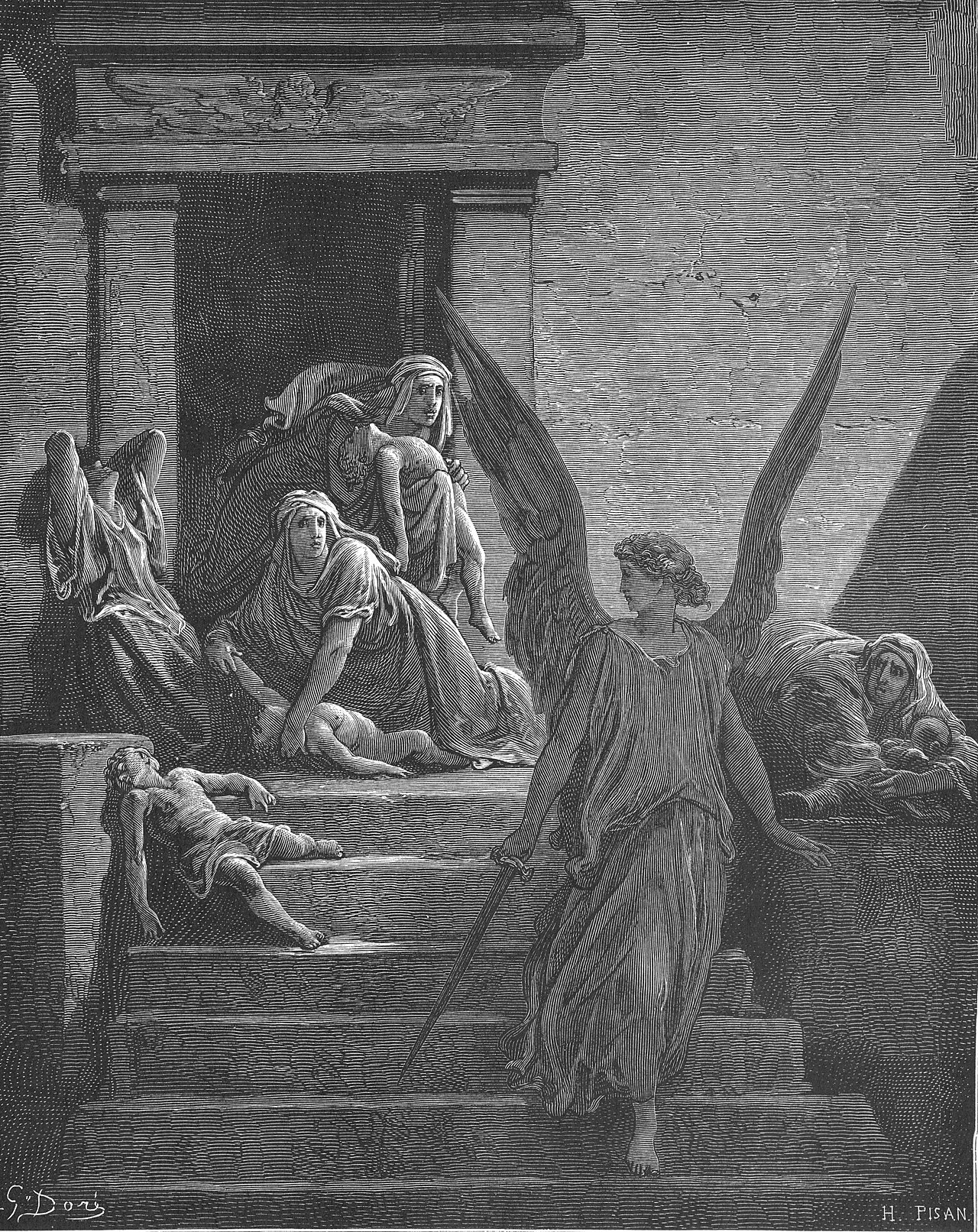
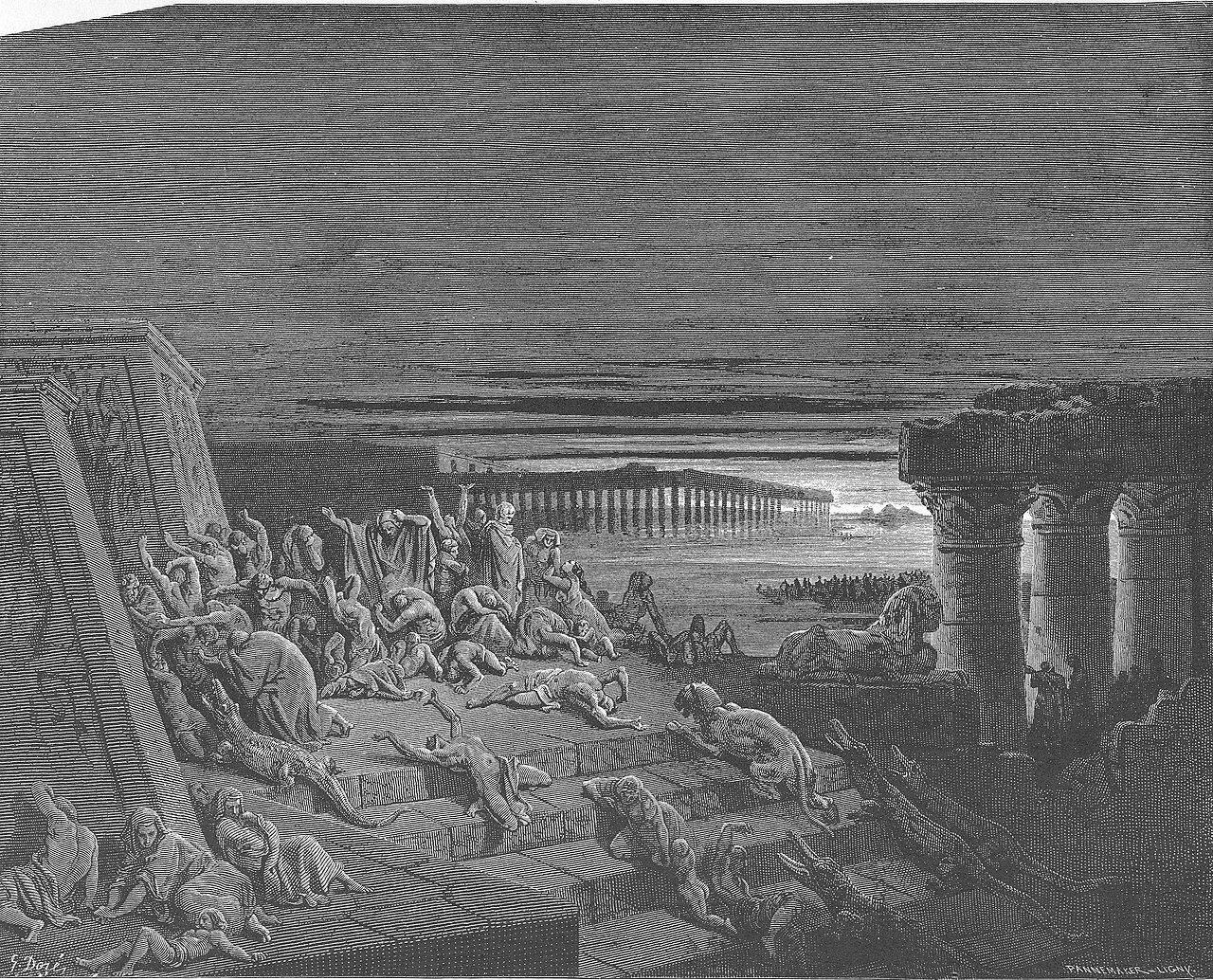
— outside the pattern, because Passover is its answerThe pattern matters because of what it rules out. A God who strikes in a fixed, three-times-repeated order, warning before nearly every blow and exempting Goshen by announcement, is not a God losing His temper. He is a God building a case, and the case is stated in the middle of it: “I will execute judgment against all the gods of Egypt. I am the LORD” (12:12).
Judgment on the Gods of Egypt
the reading is textual; the mappings are scholarship, graded, not smuggled
The polemic reading
Exodus itself supplies the frame: the tenth night executes judgment “against all the gods of Egypt” (12:12), and Numbers 33:4 says the same looking back. Each blow is read as striking a domain Egypt had deified: the river, the frog, the herd, the sun, and at last Pharaoh's own claim to divine sonship. Developed by John Currid (Ancient Egypt and the Old Testament) and, in the unseen-realm register, by Michael Heiser (The Unseen Realm)
The caution, at full strength
Scripture names the theme and never supplies a list. Every deity-per-plague chart in print is assembled by moderns out of Egyptological sources, and the pairings vary from author to author: which is exactly what you would expect of reconstruction rather than exegesis. Some are near-inescapable; several are a guess with a respectable footnote.
A note on the mapping: the polemic-against-the-gods reading is sound and textually anchored; the specific mappings are carried as illustration, with reconstruction labelled as reconstruction. The point Exodus insists on is not which god fell where, but that every power Egypt trusted was emptied in order, and the last one to fall was the man on the throne.
Pharaoh's Heart: the Whole Ledger
nineteen statements, in narrative order, coloured by who acts
This is the hardest question the plague cycle raises, and it is usually argued from three or four favourite verses. Below is every statement in the book, in the order the reader meets it. Two are announcements made before the story begins; the rest are the narrative itself. The sequence is the evidence, read it before reading the two traditions under it.
The two faded cells at the left are 4:21 and 7:3. The LORD telling Moses in advance what He will do, before Pharaoh has refused anything. Everything after them is narration.
What the sequence shows
- Before 9:12, the narrative never says the LORD hardened Pharaoh. It says Pharaoh hardened himself, or simply that his heart was hard: with no agent named at all.
- At 9:12: after the sixth plague, after the magicians have conceded, after Pharaoh has twice hardened himself in so many words: the agent changes, and from that point the LORD is named in almost every instance.
- Pharaoh hardens himself once more after the hinge (9:34), and the text pointedly says he “sinned yet more” in doing it.
- And the two verses that name the LORD first (4:21; 7:3) are not narration at all. They are God telling Moses in advance how this will end, foreknowledge stated as intention, which is precisely what the two traditions below disagree about.
The Hebrew uses three different verbs across these nineteen statements, to make strong, to make heavy, and to make hard. They are not interchangeable in flavour, and no English version keeps the distinction visible. Worth watching in the interlinear.
The Reformed reading
God declares the hardening before a single plague falls, acts to harden repeatedly, and states His purpose in 9:16: to display His power and publish His name in all the earth. Paul quotes exactly that verse and draws exactly that conclusion: “whom he will he hardeneth” (Rom 9:17–18). Pharaoh is a vessel in a sovereign purpose declared in advance (Calvin, Institutes; and his Harmony of the Law on these chapters).
The Wesleyan-Arminian reading
The ledger above is the argument: the divine hardening enters the narrative only after Pharaoh has repeatedly hardened himself against light he plainly received, including his own advisers' verdict that this was the finger of God. What God then does is confirm a will already set, the judicial giving-over of Romans 1. The foretelling of 4:21 is foreknowledge of a free refusal, not its cause (Wesley, Explanatory Notes upon the Old Testament).
Where the readings meet: both traditions read the same nineteen statements and affirm God's sovereignty in full; they differ on whether the hardening precedes or answers Pharaoh's own resistance: judicial confirmation of a will already set, on one reading, or a sovereign purpose declared from the start, on the other. This is an intramural line between traditions that both love this text: not a boundary of the faith.
The Refrains
the repeated sentences that mark the cycle's seams
“Let my people go, that they may serve me”
Exodus 7:16; 8:1, 20; 9:1, 13; 10:3
The demand never changes, and it is never for bare freedom. The Hebrew word for the slave-labour Israel does for Pharaoh is the word for the worship it will do for God. This is a transfer of ownership.
“You will know that I am the LORD”
Exodus 7:5, 17; 8:10, 22; 9:14, 29; 14:4, 18
The stated purpose of the whole cycle is knowledge. Pharaoh's, Egypt's, Israel's. The plagues are an argument, and the conclusion is a Name.
“I will put a division between my people and thy people”
Exodus 8:22–23; 9:4, 26; 10:23; 11:7
From the fourth plague on, the text keeps score of who is exempt. By the tenth, the dividing line has moved: it is no longer Goshen that saves, but blood.
The magicians' descending arc
Exodus 7:22; 8:7; 8:18–19; 9:11
They match the first two, fail at the third and name it “the finger of God,” and by the sixth cannot even stand in Moses' presence. Egypt's own religious establishment concedes before its king does.
Where the Tenth Plague Goes
the only door out of the pattern
Keep studying
Read it1
On this page
Places1
Symbols2
Doctrines2
Go further1