
Genesis 2:4 to 37:2 · Subject · Featured Study
The toledot formula of Genesis
Genesis carries eleven headings, and each one names the creation, a man or a family.
Account by account, the story moves from the garden in Eden to Jacob's household in Egypt.
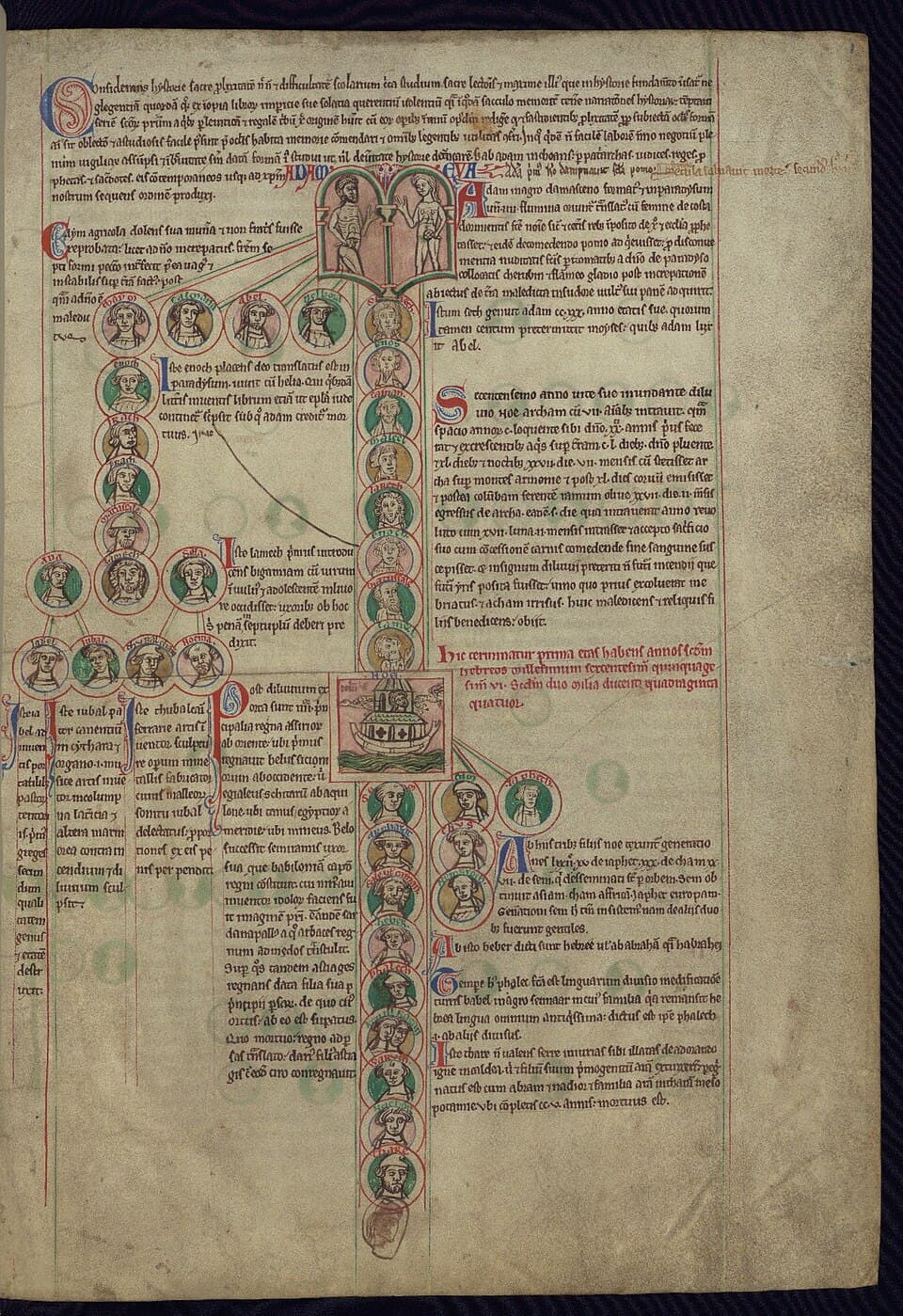
Peter of Poitiers, Compendium historiae in genealogia Christi, English manuscript, 13th century, MS W.796, fol. 1r. Photograph by The Digital Walters, CC BY-SA 3.0, via Wikimedia Commons.
THE ARTWORKAdam and Eve stand at the head of the page, and the roundels below follow the line of Seth down to Noah's ark, with Cain's line set apart on its own branch. Under the ark the line divides into the three sons of Noah.
Summary
Readers differ on whether a heading opens the account after it, closes the record before it, or marks one source.
- Esau is the one man named in two headings, at Genesis 36:1 and 36:9.
- Genesis tells Cain's line before Seth's, Ishmael's before Isaac's and Esau's before Jacob's.
- Paul names Christ as the one seed of the promise to Abraham.
Where the Headings Stand
The first heading stands at Genesis 2:4 and the last at Genesis 37:2, and the verse before each heading here ends a scene.
This is the account of the heavens and the earth when they were created, in the day that the LORD God made them.Genesis 2:3 ends the seventh day, and this verse follows it directly.
This is the book of the generations of Adam. In the day that God created man, He made him in His own likeness.Genesis 4:26 ends with men beginning to call upon the name of the LORD, and the list of Adam's line stands after this heading in Genesis 5.
This is the account of Jacob. When Joseph was seventeen years old, he was tending the flock with his brothers, the sons of his father’s wives Bilhah and Zilpah, and he brought their father a bad report about them.Genesis 37:1 has Jacob living in the land of Canaan, and this heading names him, though the chapters under it follow his son Joseph most closely.
The Eleven Headings
The part under each heading runs to the next heading or to the end of the book, from seven verses for Ishmael to fourteen chapters for Jacob.
| Verse | Hebrew | Whose account | From this heading to the next |
|---|---|---|---|
| Genesis 2:4 | תוֹלְד֧וֹת toledot | the heavens and the earth | Genesis 2:4 to 4:26 |
| Genesis 5:1 | סֵ֔פֶר תּוֹלְדֹ֖ת sefer toledot | Adam | Genesis 5:1 to 6:8 |
| Genesis 6:9 | תּוֹלְדֹ֣ת toledot | Noah | Genesis 6:9 to 9:29 |
| Genesis 10:1 | תּוֹלְדֹ֣ת toledot | Noah's sons Shem, Ham, and Japheth | Genesis 10:1 to 11:9 |
| Genesis 11:10 | תּוֹלְדֹ֣ת toledot | Shem | Genesis 11:10 to 26 |
| Genesis 11:27 | תּוֹלְדֹ֣ת toledot | Terah | Genesis 11:27 to 25:11 |
| Genesis 25:12 | תֹּלְדֹ֥ת toledot | Abraham's son Ishmael | Genesis 25:12 to 18 |
| Genesis 25:19 | תּוֹלְדֹ֥ת toledot | Abraham's son Isaac | Genesis 25:19 to 35:29 |
| Genesis 36:1 | תֹּלְד֥וֹת toledot | Esau (that is, Edom) | Genesis 36:1 to 8 |
| Genesis 36:9 | תֹּלְד֥וֹת toledot | Esau, the father of the Edomites, in the area of Mount Seir | Genesis 36:9 to 37:1 |
| Genesis 37:2 | תֹּלְד֣וֹת toledot | Jacob | Genesis 37:2 to 50:26 |
- Verse
- Genesis 2:4
- Hebrew
- תוֹלְד֧וֹת toledot
- Whose account
- the heavens and the earth
- From this heading to the next
- Genesis 2:4 to 4:26
- Verse
- Genesis 5:1
- Hebrew
- סֵ֔פֶר תּוֹלְדֹ֖ת sefer toledot
- Whose account
- Adam
- From this heading to the next
- Genesis 5:1 to 6:8
- Verse
- Genesis 6:9
- Hebrew
- תּוֹלְדֹ֣ת toledot
- Whose account
- Noah
- From this heading to the next
- Genesis 6:9 to 9:29
- Verse
- Genesis 10:1
- Hebrew
- תּוֹלְדֹ֣ת toledot
- Whose account
- Noah's sons Shem, Ham, and Japheth
- From this heading to the next
- Genesis 10:1 to 11:9
- Verse
- Genesis 11:10
- Hebrew
- תּוֹלְדֹ֣ת toledot
- Whose account
- Shem
- From this heading to the next
- Genesis 11:10 to 26
- Verse
- Genesis 11:27
- Hebrew
- תּוֹלְדֹ֣ת toledot
- Whose account
- Terah
- From this heading to the next
- Genesis 11:27 to 25:11
- Verse
- Genesis 25:12
- Hebrew
- תֹּלְדֹ֥ת toledot
- Whose account
- Abraham's son Ishmael
- From this heading to the next
- Genesis 25:12 to 18
- Verse
- Genesis 25:19
- Hebrew
- תּוֹלְדֹ֥ת toledot
- Whose account
- Abraham's son Isaac
- From this heading to the next
- Genesis 25:19 to 35:29
- Verse
- Genesis 36:1
- Hebrew
- תֹּלְד֥וֹת toledot
- Whose account
- Esau (that is, Edom)
- From this heading to the next
- Genesis 36:1 to 8
- Verse
- Genesis 36:9
- Hebrew
- תֹּלְד֥וֹת toledot
- Whose account
- Esau, the father of the Edomites, in the area of Mount Seir
- From this heading to the next
- Genesis 36:9 to 37:1
- Verse
- Genesis 37:2
- Hebrew
- תֹּלְד֣וֹת toledot
- Whose account
- Jacob
- From this heading to the next
- Genesis 37:2 to 50:26
The Word Toledot
One Hebrew noun stands in every heading of Genesis.
The Berean text renders the noun of the headings as account at ten of them and as generations at Genesis 5:1.
The headings use the noun in its plural form, written toledot (תּוֹלְדֹ֣ת) at Genesis 6:9, and its dictionary form is the singular toledah (תּוֹלְדָה). Counted by its Strong's number, H8435, in the STEP Bible's tagged Hebrew text, the word stands 39 times, 13 of them in Genesis, and eleven of those thirteen stand in a heading. The other two stand inside lists, at Genesis 10:32 and 25:13.
At Genesis 5:1 the heading adds sefer (סֵ֔פֶר), the word for a written record, which the Berean text renders book.
Rashi, Rabbi Shlomo Yitzchaki of Troyes in France (1040 to 1105), reads that heading in his commentary on Genesis as the record, or enumeration, of the generations of Adam.
The other Hebrew and Greek words of descent are defined on the page The Genealogies.
What the Text Leaves Unsaid
Two parts of Genesis stand without a heading of their own, and two questions about the headings stay open.
The creation account of Genesis 1:1 to 2:3 carries no heading of its own.
Abraham has no heading in his own name, and his whole story, from the call to his burial, stands inside the account of Terah.
The text gives no reason for the heading at Genesis 36:9, the second over Esau's line. Rashi, in his commentary on Genesis 36:9, reads the second as the generations born to Esau's sons after he went to Seir.
Genesis does not say who wrote the headings, or whether any of them stood in an older record.
The Branch First and the Line of Promise After
In Genesis 4, 25 and 36 the line of a brother outside the promise is told first and briefly.
Cain's descendants fill Genesis 4:17 to 24 and end with Lamech's boast of vengeance.
And Adam again had relations with his wife, and she gave birth to a son and named him Seth, saying, “God has granted me another seed in place of Abel, since Cain killed him.”Seth is born after Cain's line has been told, and the account of Adam in Genesis 5 follows the line through him.
Ishmael's account ends with his death at 137 years, at Genesis 25:17.
But God said to Abraham, “Do not be distressed about the boy and your maidservant. Listen to everything that Sarah tells you, for through Isaac your offspring will be reckoned.God's word at the sending away of Ishmael decides which son's line Genesis will follow.
Genesis 36 lists Esau's sons and chiefs, the sons of Seir the Horite and the kings who reigned in Edom, and the account of Jacob begins in the next chapter.
and He declared to her: “Two nations are in your womb, and two peoples from within you will be separated; one people will be stronger than the other, and the older will serve the younger.”The word to Rebekah before the twins' birth sets the younger son's line ahead of the older son's.
Rashi on the short accounts and the long onesRashi, on Genesis 37:1
Rashi, in his commentary on Genesis 37:1, notes that Scripture describes the settlements of Esau and his descendants briefly and those of Jacob at length.
Following Midrash Tanchuma, he likens Scripture to a man who sifts sand for a jewel that has fallen into it, and who keeps the jewel when he finds it and throws away the pebbles.
Why the branches are told at allRadak; Adam Clarke
Radak, David Kimhi of Provence (1160 to 1235), reads the account of Ishmael in his commentary on Genesis as a tribute to Abraham, whose firstborn Ishmael was.
As for Ishmael, I have heard you, and I will surely bless him; I will make him fruitful and multiply him greatly. He will become the father of twelve rulers, and I will make him into a great nation.Genesis 25:13 to 16 names the twelve princes this verse foretold, and Radak reads their list as the promise kept.
Adam Clarke, in his Commentary on the Bible, reads the account of Ishmael as showing how God kept His promises to both branches of Abraham's family.
Voices on the Headings
John Calvin and John Wesley comment on the accounts of Esau and of Shem.
John Calvin sets the splendour of Esau's line against the lasting kingdom of God.
“As, therefore, it has been before said of other profane nations, so now Esau is exalted as on a lofty theater. But since there is no permanent condition out of the kingdom of God, the splendor attributed to him is evanescent, and the whole of his pomp departs like the passing scene of the stage.”
John Calvin · Commentaries · on Genesis 36:1Reformed
John Wesley names three earlier words of Genesis that the account of Esau fulfils.
“To shew the performance of the promise to Abraham, that he should be the father of many nations, and of that answer which Rebekah had from the oracle she consulted, Two nations are in thy womb; and of the blessing of Isaac, Thy dwelling shall be the fatness of the earth.”
John Wesley · Explanatory Notes upon the Old Testament · on Genesis 36:1Evangelical
Wesley draws a lesson for his own readers from the bare names of the account of Shem.
“That nothing is left upon record concerning those of this line, but their names and ages; the Holy Ghost seeming to hasten thro' them to the story of Abraham. How little do we know of those that are gone before us in this world, even those that lived in the same places where we live! Or indeed of those who are our contemporaries, but in distant places.”
John Wesley · Explanatory Notes upon the Old Testament · on Genesis 11:10Evangelical
What the Formula Does
The holders of three readings of the formula run from Rashi in the eleventh century to R. K. Harrison in 1969.
The heading of Genesis 37:2 opens the account after itRashi; Adam Clarke
Adam Clarke takes the word at Genesis 37:2 in a general sense, as the history of the lives and actions of Jacob and his sons, because no list of descent follows it.
The objection is Clarke's own, for he allows that the words at Genesis 37:2 may refer back to the lists of descent in Genesis 36.
Each heading closes the record before itP. J. Wiseman; R. K. Harrison
P. J. Wiseman, in New Discoveries in Babylonia about Genesis (1936), compared the headings to the closing lines of Babylonian clay tablets, which name the tablet's owner or writer. R. K. Harrison carried the reading into his Introduction to the Old Testament (1969).
On this reading the name in a heading normally names the writer or the owner of the tablet that held the record before it.
The objection is that the heading of Genesis 37:2 names Jacob, and Rashi and Clarke both read it with the story of Jacob's sons that comes after it.
The headings belong to one sourceE. A. Speiser
E. A. Speiser, in his Genesis in the Anchor Bible (1964), assigned the headings to the Priestly source, which he calls P, as the form that source normally gives its lists of descent.
Books on the Headings
Rashi's commentary, in English translation, and Adam Clarke's commentary both comment on the headings where they stand in Genesis.
Pentateuch with Rashi's Commentary
Rashi, translated by M. Rosenbaum and A. M. Silbermann · 1929 to 1934
This English translation gives Rashi's notes on the headings at Genesis 5:1, 6:9, 36:9 and 37:2.
In print: find it wherever books are sold.
Commentary on the Bible
Adam Clarke · 1810 to 1826
Clarke wrote notes on Genesis 11:10, 25:12 and 37:2 that weigh the accounts of Shem, Ishmael and Jacob.
The Record of the Genealogy of Jesus Christ
Three New Testament writers carry the line of the headings to Christ.
Matthew opens his Gospel with biblos geneseos (Βίβλος γενέσεως), which the Berean text renders the record of the genealogy. Albert Barnes, in his Notes on the New Testament, sets the phrase beside the heading of Genesis 5:1.
This is the record of the genealogy of Jesus Christ, the son of David, the son of Abraham:The Gospel's first verse is a heading over the line from Abraham and David to Christ.
John Gill, in his Exposition of the Old Testament, reads the account of Shem as following the one branch that led to Abraham, the line from which the Messiah came.
the son of Jacob, the son of Isaac, the son of Abraham, the son of Terah, the son of Nahor, the son of Serug, the son of Reu, the son of Peleg, the son of Eber, the son of Shelah, the son of Cainan, the son of Arphaxad, the son of Shem, the son of Noah, the son of Lamech, the son of Methuselah, the son of Enoch, the son of Jared, the son of Mahalalel, the son of Cainan, the son of Enosh, the son of Seth, the son of Adam, the son of God.Luke's list of the forebears of Jesus reaches back past every name in the Genesis headings to the first man.
The promises were spoken to Abraham and to his seed. The Scripture does not say, “and to seeds,” meaning many, but “and to your seed,” meaning One, who is Christ.Paul draws a whole argument from a singular noun in the words spoken to the patriarch.
The headings follow the line of promise from Adam to the sons of Jacob, and Paul tells his readers where they stand in it.
And if you belong to Christ, then you are Abraham’s seed and heirs according to the promise.This verse ends Paul's argument by placing the Gentile believers of Galatia inside the line the headings traced.
Keep studying
Read it1
People11
Doctrines5