
Genesis 29 to 49 · Person · Featured Study
Judah, the Brother Who Stood Surety
Genesis follows Leah's fourth son from his birth in chapter 29 to his father's blessing in chapter 49.
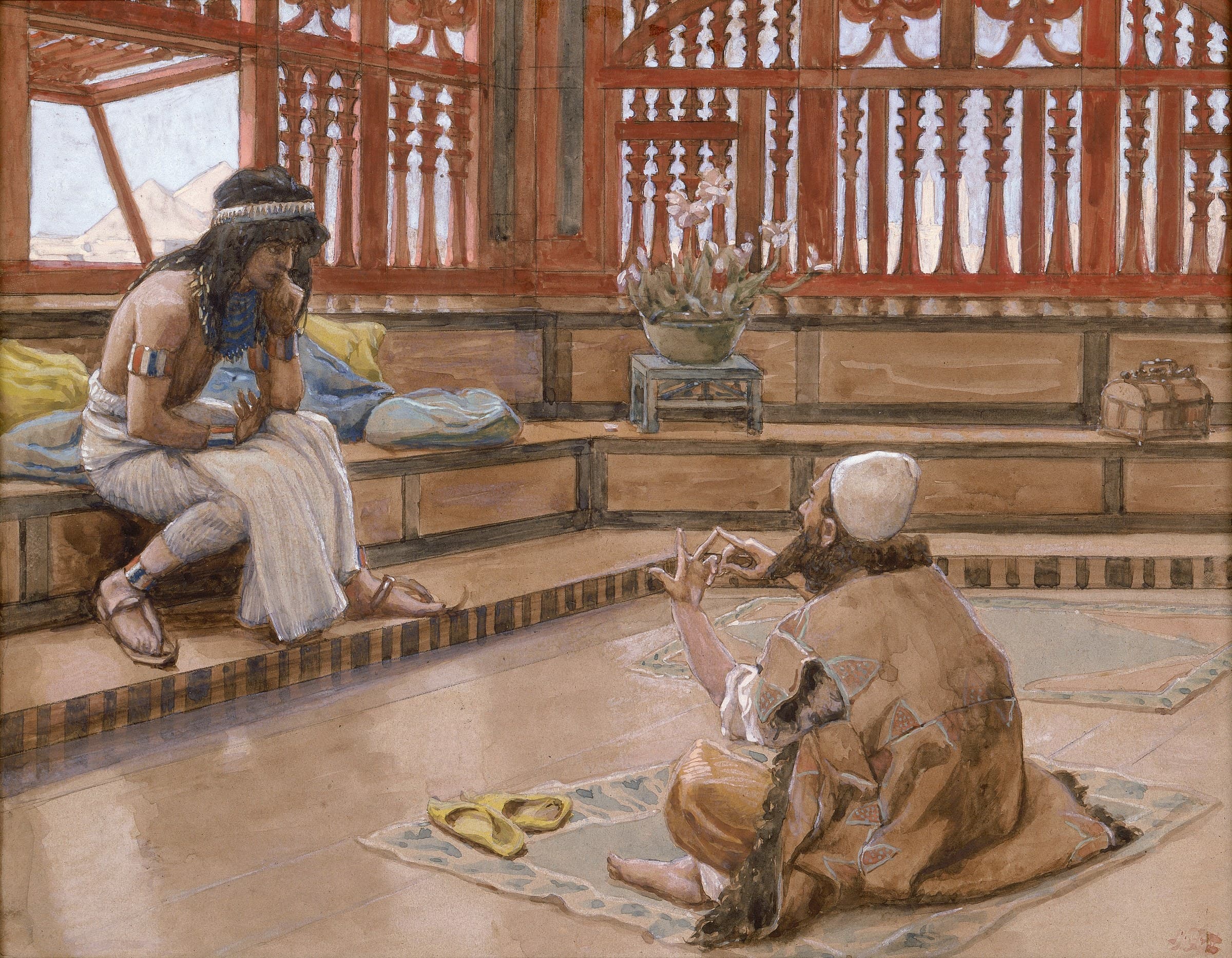
James Tissot, Joseph Converses with Judah, His Brother, between about 1896 and 1902, gouache on board, the Jewish Museum, New York. Public domain, via Wikimedia Commons.
THE ARTWORKTissot paints Judah seated on a mat below Joseph during the plea of Genesis 44:18 to 34. Joseph listens with his hand at his chin, and he has not yet made himself known to his brothers.
The brother who once sold Joseph into Egypt later begged to stay there as a slave in Benjamin's place.
Summary
Judah is the son of Jacob to whom Genesis 49 gives the scepter and the lion.
- He married a Canaanite woman, and the LORD put two of their three sons to death.
- His daughter-in-law Tamar bore him twin sons, Perez and Zerah.
- He guaranteed Benjamin's safety to his father and took the guilt on himself if the boy did not return.
Where Judah Stands in Scripture
Genesis names him first at his birth and last in his father's blessing.
And once more she conceived and gave birth to a son and said, “This time I will praise the LORD.” So she named him Judah. Then Leah stopped having children.This birth closes the first four that Leah bears to Jacob.
Judah, your brothers shall praise you. Your hand shall be on the necks of your enemies; your father’s sons shall bow down to you.Jacob promises that his father's sons will bow down to Judah.
The Life, Turn by Turn
Eleven turns run from his birth to his father's blessing, each with its verse.
- Born to Leahafter Reuben, Simeon and Levi, Genesis 35:23
- Proposes selling Josephto the Ishmaelites, Genesis 37:27
- Leaves his brothersnear Hirah the Adullamite, Genesis 38:1
- Marries, and his firstborn is namedEr, Genesis 38:3
- Sends Tamar hometo wait for Shelah, Genesis 38:11
- Condemns Tamar, then confesseshis own pledge, Genesis 38:26
- Father of twinsPerez and Zerah, Genesis 38:29
- Stands surety for Benjaminbefore Jacob, Genesis 43:9
- Offers himself as a slavebefore Joseph, Genesis 44:33
- Sent ahead of the familyto Goshen, Genesis 46:28
- Given the scepterin Jacob's blessing, Genesis 49:10
Chapter 38 alone holds five of the eleven turns.
From Dothan to Egypt
Genesis 37 to 45 tells his part in four scenes.
Judah first speaks at Dothan, where he talks his brothers out of killing Joseph and into selling him.
In Genesis 38 he lives apart from his brothers, and when his widowed daughter-in-law is found pregnant, the pledge he gave her proves the child is his.
When famine sends the brothers back to Egypt and the cup is found in Benjamin's sack, Judah pleads before Joseph for the boy's release.
The pit at DothanGenesis 37:26 to 35
Then Judah said to his brothers, “What profit will we gain if we kill our brother and cover up his blood? Come, let us sell him to the Ishmaelites and not lay a hand on him; for he is our brother, our own flesh.” And they agreed.His argument rests on profit and on kinship, and the brothers agree to it.
His father recognized it and said, “It is my son’s robe! A vicious animal has devoured him. Joseph has surely been torn to pieces!” Then Jacob tore his clothes, put sackcloth around his waist, and mourned for his son many days. All his sons and daughters tried to comfort him, but he refused to be comforted. “No,” he said. “I will go down to Sheol mourning for my son.” So his father wept for him.Jacob's refusal to be comforted is the grief Judah later pleads to spare him.
Judah and TamarGenesis 38
Then Judah said to his daughter-in-law Tamar, “Live as a widow in your father’s house until my son Shelah grows up.” For he thought, “He may die too, like his brothers.” So Tamar went to live in her father’s house.After the deaths of Er and Onan, Judah's fear for Shelah is the reason Tamar is left waiting in her father's house.
Tamar sits veiled on the road to Timnah, and Judah, taking her for a prostitute, sleeps with her and leaves her a pledge.
About three months later, Judah was told, “Your daughter-in-law Tamar has prostituted herself, and now she is pregnant.” “Bring her out!” Judah replied. “Let her be burned to death!” As she was being brought out, Tamar sent a message to her father-in-law: “I am pregnant by the man to whom these items belong.” And she added, “Please examine them. Whose seal and cord and staff are these?” Judah recognized the items and said, “She is more righteous than I, since I did not give her to my son Shelah.” And he did not have relations with her again.The man who sentenced Tamar to the fire is the first to name his own fault.
But when he pulled his hand back and his brother came out, she said, “You have broken out first!” So he was named Perez. Then his brother came out with the scarlet thread around his wrist, and he was named Zerah.The twin who breaks out first is Perez, the son through whom Matthew's line runs.
The pledge for BenjaminGenesis 42:37 to 43:10
Then Reuben said to his father, “You may kill my two sons if I fail to bring him back to you. Put him in my care, and I will return him.” But Jacob replied, “My son will not go down there with you, for his brother is dead, and he alone is left. If any harm comes to him on your journey, you will bring my gray hair down to Sheol in sorrow.”Jacob refuses the firstborn's offer, so the pledge falls to Judah.
And Judah said to his father Israel, “Send the boy with me, and we will go at once, so that we may live and not die—neither we, nor you, nor our children. I will guarantee his safety. You may hold me personally responsible. If I do not bring him back and set him before you, then may I bear the guilt before you all my life.Reuben offered his two sons, and Judah offers to bear the guilt before his father all his life.
The verb of the pledge is arav, which Strong's Hebrew lexicon glosses as to give to be security. The noun from the same root, erabon, is the pledge Tamar asked of Judah in Genesis 38:17.
Rashi, the French commentator of the eleventh century, in his commentary on Genesis, follows Midrash Tanchuma in making Judah the brother who told the others to leave their father alone until the bread ran out.
The plea before JosephGenesis 44:14 to 45:4
“What can we say to my lord?” Judah replied. “How can we plead? How can we justify ourselves? God has exposed the iniquity of your servants. We are now my lord’s slaves—both we and the one who was found with the cup.”Judah speaks for every brother and confesses an iniquity, though none of them took the cup.
Ephrem the Syrian, in his Commentary on Genesis, takes the iniquity Judah confesses to be the old sin against Joseph, for which the brothers were now being repaid.
Indeed, your servant guaranteed the boy’s safety to my father, saying, ‘If I do not return him to you, I will bear the guilt before you, my father, all my life.’ Now please let your servant stay here as my lord’s slave in place of the boy. Let him return with his brothers. For how can I go back to my father without the boy? I could not bear to see the misery that would overwhelm him.”Judah grounds his offer to stay in the pledge he gave his father in Genesis 43:9.
Then Joseph said to his brothers, “Please come near me.” And they did so. “I am Joseph, your brother,” he said, “the one you sold into Egypt!When Joseph makes himself known, he names the sale that Judah proposed.
What Genesis Sets Beside the Plea
Genesis records three smaller sayings of Judah beside his plea.
HE SPOKE FOR THE BROTHERS
Judah is the brother who tells Jacob that they will not go down to Egypt without Benjamin, though Reuben is the firstborn.
HIS FATHER'S WORDS ABOUT JOSEPH
In the plea Judah repeats to Joseph, without knowing who he is, Jacob's words that one son was torn to pieces.
HE FEARED BEING LAUGHED AT
When Hirah cannot find the woman, Judah lets her keep his pledge rather than become a laughingstock.
The World of Genesis 38
The chapter turns on a widow's claim on her husband's brother and on a pledge left in her hand.
Then Judah said to Onan, “Sleep with your brother’s wife. Perform your duty as her brother-in-law and raise up offspring for your brother.”Judah's own words to Onan set the duty he later fails to keep with Shelah.
The duty of a brother-in-lawJamieson, Fausset and Brown; Adam Clarke
Jamieson, Fausset and Brown, in their Commentary Critical and Explanatory of 1871, call Judah's charge to Onan the first instance of a custom later taken into the laws of Moses.
Adam Clarke, in his Commentary on the Bible, holds that Onan's crime was his refusal to raise up offspring for his brother.
The seal, the cord and the staffGenesis 38:18
“What pledge should I give you?” he asked. She answered, “Your seal and your cord, and the staff in your hand.” So he gave them to her and slept with her, and she became pregnant by him.Tamar asks for the three things that would name their owner when she needed them.
Clarke explains the seal as an instrument for making impressions to mark property, and the staff as either a walking stick or the ensign of his tribe.
The Family of Judah
Each of Judah's ten ties of kin stands with the verse that names it.
| Person | Tie to Judah | Verse |
|---|---|---|
| Jacob | His father, also called Israel. | Genesis 43:8 |
| Leah | His mother, who bore him fourth of her sons. | Genesis 35:23 |
| Reuben | His eldest brother, the firstborn of Israel. | 1 Chronicles 5:1 |
| Joseph | His brother by Rachel, whom he called our own flesh. | Genesis 37:27 |
| Benjamin | Rachel's younger son, for whom he stood surety. | Genesis 43:9 |
| The daughter of Shua | His Canaanite wife. | Genesis 38:2 |
| Er and Onan | His first two sons, put to death by the LORD. | Genesis 38:7 |
| Shelah | His third son, born at Chezib. | Genesis 38:5 |
| Tamar | The wife Judah acquired for Er, his firstborn. | Genesis 38:6 |
| Perez and Zerah | His twin sons by Tamar. | Genesis 38:29 |
- Person
- Jacob
- Tie to Judah
- His father, also called Israel.
- Verse
- Genesis 43:8
- Person
- Leah
- Tie to Judah
- His mother, who bore him fourth of her sons.
- Verse
- Genesis 35:23
- Person
- Reuben
- Tie to Judah
- His eldest brother, the firstborn of Israel.
- Verse
- 1 Chronicles 5:1
- Person
- Joseph
- Tie to Judah
- His brother by Rachel, whom he called our own flesh.
- Verse
- Genesis 37:27
- Person
- Benjamin
- Tie to Judah
- Rachel's younger son, for whom he stood surety.
- Verse
- Genesis 43:9
- Person
- The daughter of Shua
- Tie to Judah
- His Canaanite wife.
- Verse
- Genesis 38:2
- Person
- Er and Onan
- Tie to Judah
- His first two sons, put to death by the LORD.
- Verse
- Genesis 38:7
- Person
- Shelah
- Tie to Judah
- His third son, born at Chezib.
- Verse
- Genesis 38:5
- Person
- Tamar
- Tie to Judah
- The wife Judah acquired for Er, his firstborn.
- Verse
- Genesis 38:6
- Person
- Perez and Zerah
- Tie to Judah
- His twin sons by Tamar.
- Verse
- Genesis 38:29
The Places of His Life
Seven places mark his life, from Dothan to Goshen in Egypt.
| Place | What happened there | Verse |
|---|---|---|
| Dothan | Joseph found his brothers there. | Genesis 37:17 |
| Adullam | Judah settled near Hirah, an Adullamite. | Genesis 38:1 |
| Chezib | His wife gave birth to Shelah there. | Genesis 38:5 |
| Timnah | He went up to his sheepshearers there. | Genesis 38:12 |
| Enaim | Tamar sat at its entrance on the way to Timnah. | Genesis 38:14 |
| Egypt | He fell to the ground with his brothers at Joseph's house. | Genesis 44:14 |
| Goshen | Jacob's family arrived there after Judah went ahead. | Genesis 46:28 |
- Place
- Dothan
- What happened there
- Joseph found his brothers there.
- Verse
- Genesis 37:17
- Place
- Adullam
- What happened there
- Judah settled near Hirah, an Adullamite.
- Verse
- Genesis 38:1
- Place
- Chezib
- What happened there
- His wife gave birth to Shelah there.
- Verse
- Genesis 38:5
- Place
- Timnah
- What happened there
- He went up to his sheepshearers there.
- Verse
- Genesis 38:12
- Place
- Enaim
- What happened there
- Tamar sat at its entrance on the way to Timnah.
- Verse
- Genesis 38:14
- Place
- Egypt
- What happened there
- He fell to the ground with his brothers at Joseph's house.
- Verse
- Genesis 44:14
- Place
- Goshen
- What happened there
- Jacob's family arrived there after Judah went ahead.
- Verse
- Genesis 46:28
Questions the Life Raises
Readers have asked three questions of Judah's chapters.
Why does Genesis 38 stand inside Joseph's story?Genesis 37:31 to 33 and Genesis 38:17 to 26
The chapter opens with the words about that time, tying it to the sale of Joseph just told.
It shares that story's marks, for a young goat's blood stains Joseph's robe and a young goat is the price Judah promises Tamar.
The brothers' request that Jacob examine the robe and Tamar's request that Judah examine the pledge use one Hebrew verb, nakar. The same verb tells how Jacob recognized the robe and how Judah recognized his seal, his cord and his staff.
Who is Shiloh?Genesis 49:10
The scepter will not depart from Judah, nor the staff from between his feet, until Shiloh comes and the allegiance of the nations is his.This verse makes the scepter Judah's until Shiloh comes, and every reading of the name starts from it.
Strong's Hebrew lexicon calls Shiloh an epithet of the Messiah. Jamieson, Fausset and Brown, in their Commentary of 1871, call the word obscure and give its senses as the sent one, the seed and the peaceable one, each read as the Messiah. The meaning of the word remains contested.
Did Judah repent?John Wesley, 1765
John Wesley finds the answer in the pledge of Genesis 43:9.
“Judah's conscience had lately smitten him for what he had done a great while ago against Joseph; and as an evidence of the truth of his repentance, he is ready to undertake, as far as a man could do it, for Benjamin's security.”
John Wesley · Explanatory Notes upon the Old Testament · on Genesis 43:9Evangelical
What Genesis Leaves Unsaid
Genesis records what Judah did and leaves most of his inner life unstated.
Genesis records no word of Judah's about Joseph between the sale and the famine, and it gives his age at no point in his life.
His wife and his mourning
Genesis names his wife only as the daughter of Shua, and when she dies it records only that he finished mourning.
The moment Joseph made himself known
Genesis gives Judah no reply when Joseph makes himself known, since the brothers are too terrified to answer.
How the New Testament Reads His Line
Matthew 1, Hebrews 7 and Revelation 5 each name Judah.
Judah was the father of Perez and Zerah by Tamar, Perez the father of Hezron, and Hezron the father of Ram.Matthew writes Tamar's name into the line of the Messiah beside Judah's twins.
For it is clear that our Lord descended from Judah, a tribe as to which Moses said nothing about priests.Hebrews builds on this descent to show that the Lord is a priest in the order of Melchizedek and not of Aaron.
Then one of the elders said to me, “Do not weep! Behold, the Lion of the tribe of Judah, the Root of David, has triumphed to open the scroll and its seven seals.”Revelation takes the lion of Genesis 49:9 as a title of Christ, joined to the Root of David.
Voices on Judah, Earliest First
Five teachers speak in their own words, from Ambrose to Wesley.
“This text appears to be directed to the patriarch Judah, indeed, but more so that later Judah is meant, the true confessor who was born of that tribe and who alone is praised by his brothers; of them he says, ‘I will declare your name to my brothers.’ He is the Lord by nature but a brother by grace; his hands, which he stretched out to an unbelieving people, are on the back of his enemies.”
Ambrose of Milan · On the Blessings of the Patriarchs · on Genesis 49:8Patristic
“This passage clearly refers to Judah. It appears that until the birth of Christ there was no lack of princes from the family of Judah or of heads from its sides, until Herod came, who according to the history written by Josephus was a foreigner and usurped the throne of Judea through his plots. As soon as this happened and a head from the sides of Judah was lacking, the one to whom the kingdom had been reserved immediately came.”
Tyrannius Rufinus · The Blessings of the Patriarchs 1.7 · on Genesis 49:10Patristic
Three more voicesJohn Calvin, Matthew Henry, John Wesley
“What is here related, so far from inflating the minds of the sons of Judah, ought rather to cover them with shame. Now although, at first sight, the dignity of Christ seems to be somewhat tarnished by such dishonor: yet since here also is seen that ‘emptying’ of which St. Paul speaks, it rather redounds to his glory, than, in the least degree, detracts from it.”
John Calvin · Commentaries · on Genesis 38:1Reformed
“Note, it is a common thing for men to be severe against those very sins in others in which yet they allow themselves; and so, in judging others, they condemn themselves, Rom. ii. If he designed that she should be burnt to death, perhaps, under pretence of zeal against the sin, he was contriving how to get rid of his daughter-in-law, being loath to marry Shelah to her.”
Matthew Henry · Commentary on the Whole Bible · on Genesis 38:24Puritan
“By this it is foretold that the tribe of Judah should become very formidable, and should not only obtain great victories but should peaceably enjoy what was got by those victories. Judah is compared not to a lion rampant, always raging but to a lion couching, enjoying the satisfaction of his success, without creating vexation to others.”
John Wesley · Explanatory Notes upon the Old Testament · on Genesis 49:9Evangelical
Did Tamar Act in Faith?
Readers have judged Tamar's act at Enaim in two ways.
Genesis records the disguise at Enaim and Judah's verdict on it, and it adds no verdict of its own.
She acted for the promiseAdam Clarke, 1832; Ephrem the Syrian, fourth century
Adam Clarke, in his Commentary on the Bible, judges that Tamar wanted children who might be heirs of the promise made to Abraham, and that Judah's delay over Shelah broke his word and wronged her. Ephrem the Syrian, in his Commentary on Genesis, has Tamar praying to God before Judah came out and saw her, and reads his turning aside to her as the answer to her prayer.
The objection: Genesis 38:14 gives her reason as Shelah withheld from her, and it names no hope in the promise to Abraham.
Her act was sin, and grace pardoned itMatthew Henry, 1710
Matthew Henry, in his Commentary on the Whole Bible, holds that her sinful practice was pardoned and her good intention accepted. He adds that this magnifies the grace of God and can by no means be taken to justify the like.
The objection: Judah, who knew the whole matter, called her more righteous than himself.
Books to Read Next
Five works, from Jerome's to an English Rashi of the 1930s, read Judah's chapters closely.
Hebrew Questions on Genesis
Jerome · about 391
Jerome explains the Hebrew of the places in Genesis 38, Chezib and Enaim among them.
Exposition of the Old Testament
John Gill · 1748 to 1763
Gill sets the readings of the Targums beside the Hebrew of Judah's chapters.
Commentary on the Bible
Adam Clarke · 1832
Clarke gives the Hebrew of the words he treats beside the English of the King James Version.
Commentary on the Whole Bible
Matthew Henry · 1710
Henry goes through Judah's chapters verse by verse.
READ IT FREE AT CCEL →Pentateuch with Rashi's Commentary
M. Rosenbaum and A. M. Silbermann · 1929 to 1934
This English edition of Rashi gives the rabbinic readings of Judah's words in Genesis 43 and 44.
In print: find it wherever books are sold.
The Guarantee of a Better Covenant
Joseph answered the plea by telling his brothers that God had sent him ahead of them to save lives.
Hebrews 7:22 calls Jesus the guarantee of a better covenant, and its Greek word, engyos, names a bondsman, one bound for another. Hebrews 7:25 says that He is able to save completely those who draw near to God through Him, and so it asks the reader to draw near to God through Him.
Keep studying
Doctrines5
Peoples and groups3