
John 2:13 to 22 · Passage · Zeal
Zeal for Your House
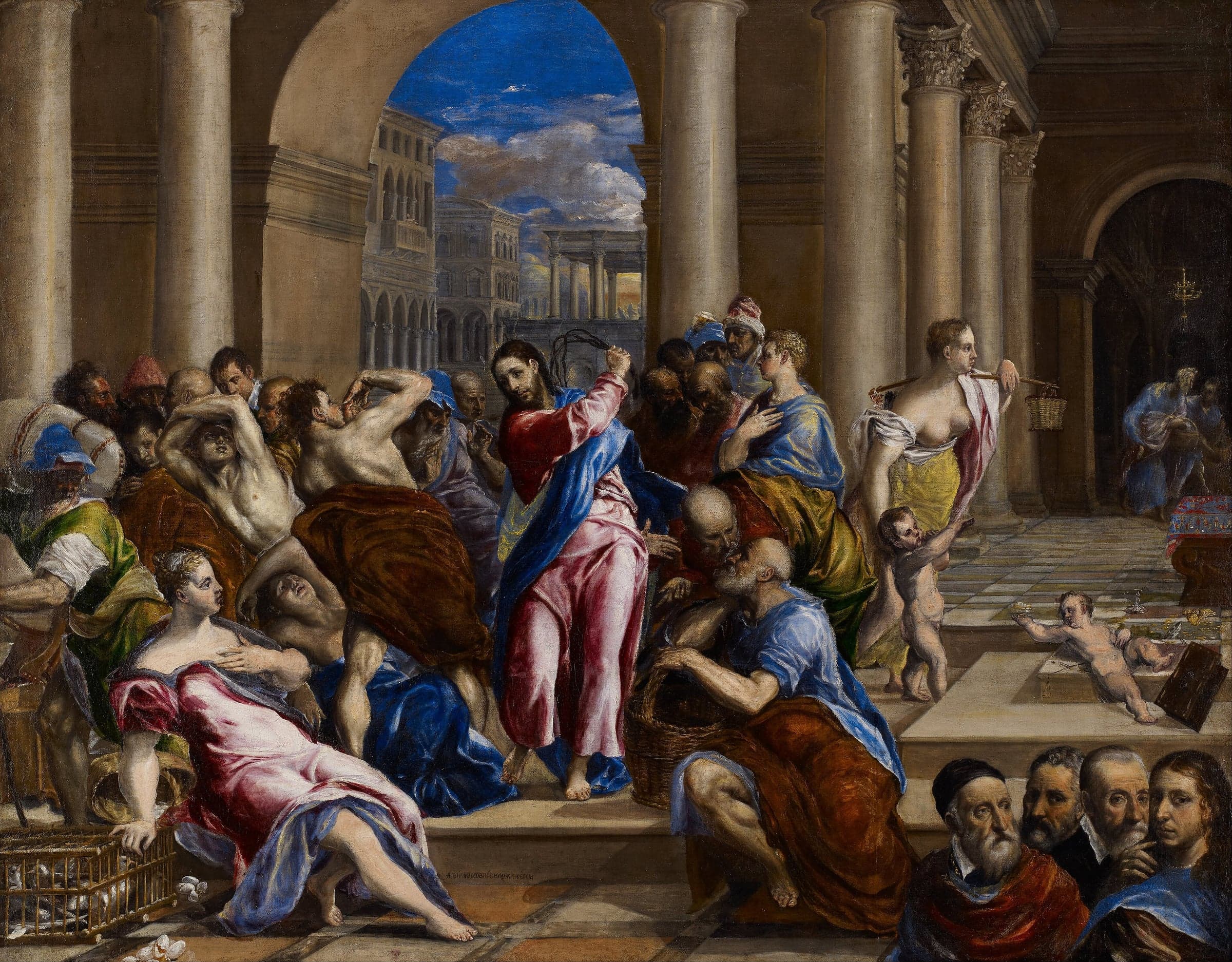
At a Passover early in His ministry Jesus drove the traders out of the temple courts in Jerusalem, as John 2:13 to 22 records.
In John's account Jesus cites no prophet as He clears the courts, while in Matthew, Mark and Luke He answers the traders with a line of Isaiah.
His disciples remembered that it is written: “Zeal for Your house will consume Me.”
- The passage
- John 2:13 to 22, Psalm 69:9
- Books
- John, Psalms
Summary
Asked for a sign, Jesus answered with a saying about the temple, which His hearers took of the building and John took of His body. In the scene the disciples recalled Psalm 69:9, the cry of a sufferer who bore insults for God's sake, and John sets that zeal at the head of the ministry. The disciples grasped the saying only after the resurrection.
- The courts He cleared are the hieron, the whole precinct, and the temple He would raise is the naos, the sanctuary, which John says was His body.
- John alone tells of the whip of cords and the sheep and cattle.
- The disciples read a psalm of suffering as a word about Jesus, and Paul reads the same verse of His bearing insults.
- Readers since the fourth century have asked whether He cleared the temple once or twice.
The Scene in the Temple Courts
The scene turns on the name Jesus gives the temple.
Zeal for Your House belongs to the value of zeal, because John 2:17 names a zeal that consumes the one who has it, in the words of Psalm 69:9.
The question this study answers is what Jesus did in the temple and what the disciples meant by the psalm they remembered. It gives the scene from the Berean text and the four Gospel accounts side by side. It sets out the two Greek words for the temple, the market and its law, what the Gospels leave untold and Jesus' answer to the demand for a sign. It also gives the two readings of one cleansing or two and the teachers who have read the text.
When the Jewish Passover was near, Jesus went up to Jerusalem. In the temple courts He found men selling cattle, sheep, and doves, and money changers seated at their tables. So He made a whip out of cords and drove all from the temple courts, both sheep and cattle. He poured out the coins of the money changers and overturned their tables. To those selling doves He said, “Get these out of here! How dare you turn My Father’s house into a marketplace!”John gives the act and Jesus' own words for it, so the reader hears why He did it.
Years before, at twelve, Jesus had told His mother, “Did you not know that I had to be in My Father’s house?” (Luke 2:49).
Four Accounts of the Cleansing
Each Gospel records a cleansing of the temple courts, and each sets it in its own place in the story of Jesus.
John sets the cleansing at the first Passover of the ministry, and Matthew, Mark and Luke set it after the entry into Jerusalem.
| Account | Setting | What it records | The words of Jesus |
|---|---|---|---|
| John 2:13 to 22 | The first Passover of the ministry, after the wedding at Cana | The whip of cords, the sheep and cattle driven out, the coins poured out, and the demand for a sign | He calls the temple “My Father’s house” and the trade “a marketplace” (John 2:16) |
| Matthew 21:12 to 17 | The last week, after the entry into Jerusalem | The tables and the dove sellers' seats overturned, then the blind and the lame healed and the children's Hosanna | “It is written: ‘My house will be called a house of prayer.’ But you are making it ‘a den of robbers.’” |
| Mark 11:15 to 18 | The last week, on arriving in Jerusalem | The tables and seats overturned, no one allowed to carry merchandise through the courts, and the chief priests' plot | “Is it not written: ‘My house will be called a house of prayer for all the nations’? But you have made it ‘a den of robbers.’” |
| Luke 19:45 to 46 | The last week, after Jesus wept over the city | The sellers driven out | “It is written: ‘My house will be a house of prayer.’ But you have made it ‘a den of robbers.’” |
Destroy This Temple
Of the four accounts of the cleansing, John's alone gives this saying in the temple scene.
On account of this, the Jews demanded, “What sign can You show us to prove Your authority to do these things?” Jesus answered, “Destroy this temple, and in three days I will raise it up again.” “This temple took forty-six years to build,” the Jews replied, “and You are going to raise it up in three days?” But Jesus was speaking about the temple of His body.These verses stand here because the saying in them is the one the charge at His trial would later twist.
At His trial the saying came back as a charge: “This man said, ‘I am able to destroy the temple of God and rebuild it in three days’” (Matthew 26:61). In John, Jesus tells His hearers to destroy the temple, and in the charge He is made to say that He is able to destroy it.
Paul later uses the same word for the sanctuary of the church: “Do you not know that you yourselves are God’s temple, and that God’s Spirit dwells in you?” (1 Corinthians 3:16).
The Courts and the Market
The Greek of the passage uses two words for the temple, and the law of the half shekel stood behind the money tables.
The New Testament uses hieron more often than naos, and John's account of the cleansing uses each in its own verses.
| Word | Strong's | Uses in the New Testament | Where John 2 uses it | What it names |
|---|---|---|---|---|
| hieron | G2411 | 70 | John 2:14 and John 2:15 | The whole temple precinct with its courts |
| naos | G3485 | 45 | John 2:19, John 2:20 and John 2:21 | The sanctuary, which John says was the temple of His body |
Jamieson, Fausset and Brown, in their Commentary Critical and Explanatory (1871), read the temple of John 2:14 as “the temple-court”, as against the temple of John 2:19 to 21.
The law required everyone counted in Israel to pay “a half shekel, according to the sanctuary shekel” (Exodus 30:13). Matthew Henry, in his Commentary on the Whole Bible (1710), gave two reasons for the trade on Matthew 21:12. Animals were sold for those who found it easier to bring money than a beast, and money was changed for those who owed the half shekel.
The money changers are kollybistai, a word that stands only in Matthew 21:12, Mark 11:15 and John 2:15. The robbers of Matthew 21:13 are lestai, the word John uses of Barabbas, whom the Berean calls “an insurrectionist” (John 18:40).
What the Gospels Leave Untold
The four accounts are brief, and much that a reader pictures in the scene is in none of them.
No Gospel says how many traders were driven out, whether anyone resisted, how long the courts stayed clear or whether the temple guard acted. The only answer John records from the authorities is their demand for a sign (John 2:18).
The Greek word for the whip, phragellion, stands nowhere else in the New Testament. Jamieson, Fausset and Brown quote Grotius on it: “Not by this slender whip but by divine majesty was the ejection accomplished, the whip being but a sign of the scourge of divine anger”.
Zeal for Your House Will Consume Me
The verse the disciples remembered has two halves, and the New Testament quotes each of them.
because zeal for Your house has consumed me, and the insults of those who insult You have fallen on me.The verse stands here because it is the Scripture the disciples heard in what Jesus did in the courts.
The Hebrew verb of the psalm is glossed “it has consumed me”, and the Greek verb of John 2:17 is glossed “will consume”. John's quotation looks forward to what the zeal would cost Jesus.
Paul quotes the second half of the same verse of Christ in Romans 15:3: “The insults of those who insult You have fallen on Me.”
After He was raised from the dead, His disciples remembered that He had said this. Then they believed the Scripture and the word that Jesus had spoken.The verse stands here because it is the second time in John 2 that John says the disciples remembered, and it joins the psalm to the saying about the temple.
John notes the same late understanding after the entry into Jerusalem: “after Jesus was glorified they remembered what had been done to Him” (John 12:16).
John counts the wine at Cana as “the first of His signs” (John 2:11), and the temple scene follows it in the same chapter.
How the Text Has Been Taught
Two commentators of the eighteenth and nineteenth centuries read the court of the trade, the temple of His body and the zeal of John 2:17.
1697 to 1771 · John Gill
John Gill, in his Exposition of the New Testament (1746 to 1748), set the trade “in the court of the Gentiles, or the outward court”. He read the temple of John 2:21 as the fulfilment of the building and called the body of Jesus “the antitype of the material temple”.
1798 to 1870 · Albert Barnes
Albert Barnes, in his Notes, Explanatory and Practical (1832 to 1869), read the zeal of John 2:17 as concern for pure worship. He wrote that it “means extraordinary concern for the temple of God; intense solicitude that the worship there should be pure, and such as God would approve.”
Once or Twice
Chrysostom and Augustine held that Jesus cleared the temple twice, and the scholars Heinrich Meyer lists hold that the Gospels tell one event in two places.
Two cleansings, one at each end of the ministryJohn Chrysostom, Augustine of Hippo and John Charles Ryle
John Chrysostom, in his twenty-third homily on John, argued from the two rebukes that the act was done twice.
“They do not in this contradict each other, but show that he did this a second time, and that both these expressions were not used on the same occasion, but that He acted thus once at the beginning of His ministry, and again when He had come to the very time of His Passion. Therefore, (on the latter occasion,) employing more strong expressions, He spoke of it as (being made) ‘a den of thieves,’ but here at the commencement of His miracles He does not so, but uses a more gentle rebuke; from which it is probable that this took place a second time.”
John Chrysostom · Homily on the Gospel of John 23 · on John 2:15 to 16Patristic
Augustine, in his Harmony of the Gospels (book 2, chapter 67), drew the same conclusion from the order of John's account.
“This account of the multitude of sellers who were cast out of the temple is given by all the Evangelists, but John introduces it in a remarkably different order. After recording the testimony borne by John the Baptist to Jesus and mentioning that he went into Galilee at the time when he turned the water into wine, and after he has also noticed the sojourn of a few days in Capernaum, John proceeds to tell us that he went up to Jerusalem at the season of the Jews' Passover, and when he had made a scourge of small cords, drove out of the temple those who were selling in it. This makes it evident that this act was performed by the Lord not on a single occasion but twice over; but that only the first instance is put on record by John, and the last by the other three.”
Augustine of Hippo · Harmony of the Gospels 2.67.129 · on John 2:13Patristic
John Charles Ryle, in his Expository Thoughts on the Gospels (1869), wrote that Jesus found the same profanation “once at the beginning of His ministry and once at the end”.
The objection: no Gospel records two cleansings, and each records one.
One cleansing, placed by John or by the other threeHeinrich Meyer's list of holders; Marcus Dods
Heinrich Meyer, in his Commentary on the Gospel of John, lists the scholars who admit only one cleansing. Some, he writes, decide for the Synoptic account, “Strauss, Weisse, Baur, Hilgenfeld, Scholten, Schenkel”, and some for John's, “Lücke, De Wette, Ammon, Krabbe, Brückner, Ewald, Weizsäcker, and many others”.
Marcus Dods, in the Expositor's Greek Testament, notes that the harmonists hold two cleansings, citing Calvin, and he judges, “On the whole it seems more appropriate at the beginning.”
The objection: the settings differ, with John's at the first Passover and the forty-six years of John 2:20. The words differ too, a marketplace in John and a den of robbers in the other three.
Readers have also asked what zeal may do with its hands. Augustine, as the Catena Aurea prints him, taught that the Christian zealous for God's house corrects what he can, “and, if he cannot correct, endures and mourns”. John Wesley answered in his sermon On Zeal that “the spirit of persecution” is “totally inconsistent with” true zeal.
The Temple of His Body
The scene ends with the disciples' belief, and the saying about the temple stands at the centre of John's account.
Jesus cleared the courts of the building, and He spoke of a sanctuary that would be destroyed and raised in three days. John wrote that He meant His own body, so the scene that begins with zeal for the house ends with the cross and the empty tomb in view.
Sources
Scripture is the Berean Standard Bible.
- STEP Bible, Translators Brief lexicon of Extended Strongs for Hebrew and for Greek (Tyndale House, Cambridge), CC BY 4.0.
- Robert Jamieson, A. R. Fausset and David Brown, Commentary Critical and Explanatory on the Whole Bible (1871), on John 2:14 and John 2:15.
- John Gill, Exposition of the New Testament (1746 to 1748), on John 2:14 and John 2:21.
- Matthew Henry, Commentary on the Whole Bible (1710), on Matthew 21:12.
- Albert Barnes, Notes, Explanatory and Practical, on the Old and New Testaments (1832 to 1869), on John 2:17.
- John Chrysostom, Homilies on the Gospel of John, homily 23, on John 2:15 to 16 (Nicene and Post-Nicene Fathers, first series, volume 14)
- Augustine of Hippo, The Harmony of the Gospels, book 2, chapter 67, section 129.
- John Charles Ryle, Expository Thoughts on the Gospels: John (1869), on John 2:12 to 25.
- Heinrich August Wilhelm Meyer, Critical and Exegetical Commentary on the Gospel of John, English translation, note on John 2:13 to 17.
- Marcus Dods, The Gospel of St. John, in The Expositor's Greek Testament, on John 2.
- Augustine of Hippo, Tractates on John, tractate 10, as printed in Thomas Aquinas, Catena Aurea on the Gospel of John (English translation, Oxford, 1841)
- John Wesley, Sermon 92, On Zeal, in The Works of John Wesley (1872 edition)
Keep Studying
Read it4
Studies5
In this value4
People and groups9