
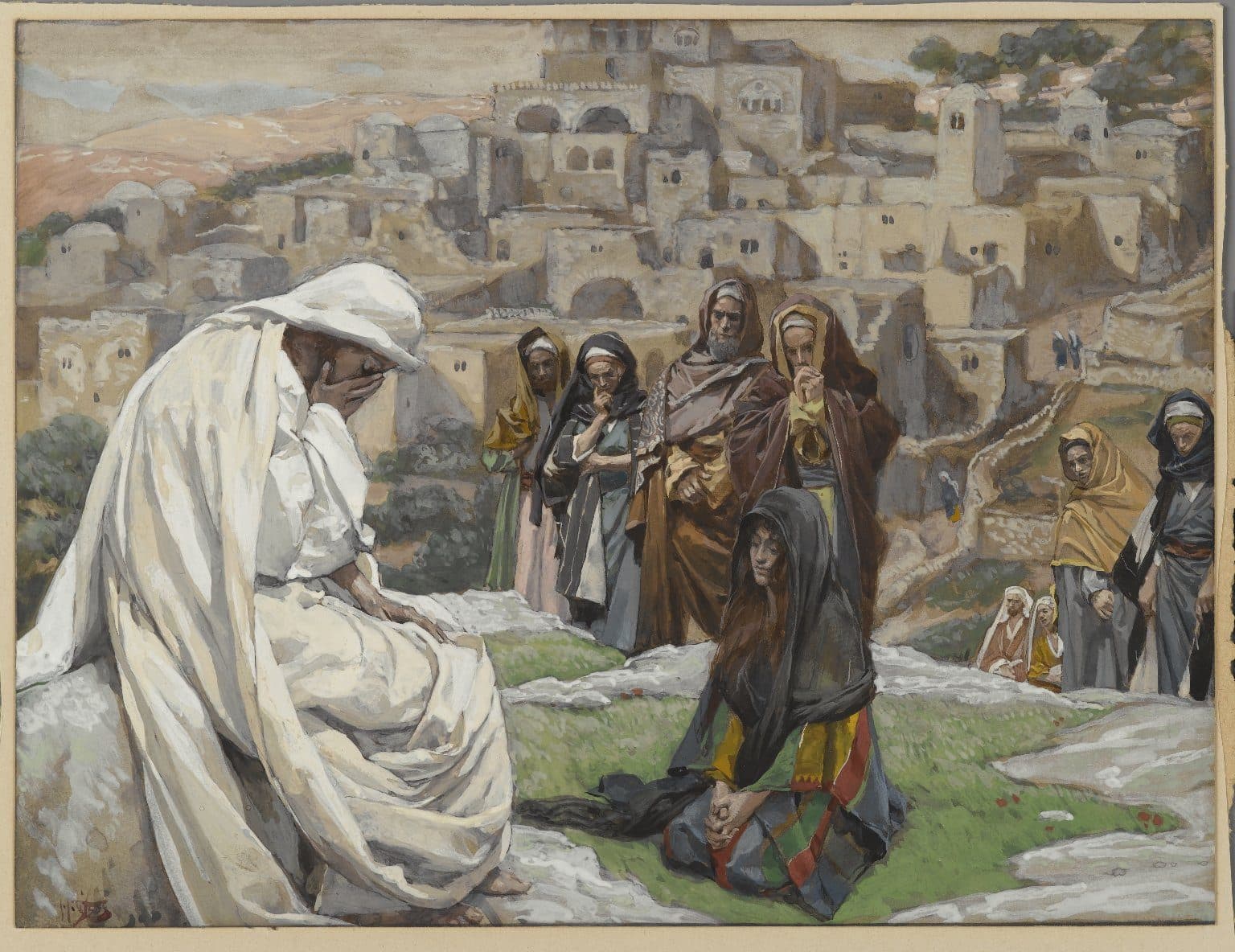
John 11 · Trial 2 of 21 · Featured Study
Grief and Loss
Grief is the sorrow that follows loss, above all the death of someone loved.
When Jacob died, “Joseph fell upon his father’s face, wept over him, and kissed him” (Genesis 50:1).
The LORD is near to the brokenhearted; He saves the contrite in spirit.
- Anchor text
- John 11:35 “Jesus wept.”
- The lament
- Psalm 42:5 “Why are you downcast, O my soul? Why…”
- Hold in memory
- Psalm 34:18, Revelation 21:4
Summary
Scripture gives grief room. Abraham mourned Sarah, David wept for his sons, and Naomi asked to be called bitter. The church is told to share the weeping of its members. God raised Jesus from the dead, so a believer grieves with honest sorrow and with a hope that grief cannot take away.
- Death entered the world through sin, and Paul calls it the last enemy to be destroyed (1 Corinthians 15:26).
- The laments of Scripture show that a believer may bring tears, complaint and questions to God in prayer.
- Isaiah called the coming Servant a man of sorrows, and Jesus wept for Lazarus though He was about to raise him.
- Paul told a grieving church that their dead in Christ will rise when the Lord comes (1 Thessalonians 4:13 to 18).
- Scripture closes with God's promise to end death, mourning and crying for His people.
What Grief Is
Six Hebrew and Greek words name mourning, weeping and sorrow, each with its count of uses.
A loss may be the death of a husband, a wife, a child or a friend, or the end of a home, health or a hope. This study asks what Scripture says to the one who grieves. It gives the words the Bible uses for mourning, the account Scripture gives of where death and sorrow come from, and the places where Christ Himself bore grief. It sets out the key texts, a psalm of lament, and the people and stories of loss. It gives the voices of the church, the questions on which readers differ and what Scripture gives a mourner to do.
ʼEbel, mourning
24 uses in the canon
The Hebrew noun ʼebel (H60) names mourning and the rites of lament. At the threshing floor of Atad, “Joseph mourned for his father seven days.”
ʼAbal, to mourn
39 uses in the canon
The verb ʼabal (H56), from the same root, means to bewail and to mourn. Nehemiah used it of the news from Jerusalem: “I sat down and wept. I mourned for days.”
Bakah, to weep
114 uses in the canon
The verb bakah (H1058) is the common Hebrew word for weeping aloud. When Saul and Jonathan fell, “They mourned and wept and fasted until evening.”
Yagon, sorrow
14 uses in the canon
The noun yagon (H3015) names the sorrow that weighs on the heart. David asked, “How long must I wrestle in my soul, with sorrow in my heart each day?”
Lype, grief
16 uses in the canon
The Greek noun lype (G3077) names grief and sadness. Jesus told His disciples, “You will grieve, but your grief will turn to joy.”
Dakryo, to shed tears
1 use in the canon
The verb dakryo (G1145) means to shed tears and stands once in the New Testament, of Jesus on His way to the tomb of Lazarus. Around Him Mary and the mourners weep aloud with the verb klaio (John 11:33).
ʼEbel, mourning, ʼAbal, to mourn, Bakah, to weep, Yagon, sorrow, Lype, grief, Dakryo, to shed tears, The Words Evel and Lupe, the study in brief
The Key Texts of Grief
Texts from the Psalms, the Prophets, the Gospels, the letters and Revelation speak to the mourner.
Prophets
He will swallow up death forever. The Lord GOD will wipe away the tears from every face and remove the disgrace of His people from the whole earth. For the LORD has spoken.
Paul quotes this verse at the close of his chapter on the resurrection (1 Corinthians 15:54).
Isaiah 25:8BSB
Gospels
Blessed are those who mourn, for they will be comforted.
The saying stands among the Beatitudes that open the Sermon on the Mount.
Matthew 5:4BSB
Letters
Blessed be the God and Father of our Lord Jesus Christ, the Father of compassion and the God of all comfort,
Paul wrote it after an affliction in Asia so severe that he despaired of life (2 Corinthians 1:8).
Letters
Brothers, we do not want you to be uninformed about those who sleep in death, so that you will not grieve like the rest, who are without hope.
The verse opens Paul's answer to a church whose members had died before the Lord's coming.
Revelation
‘He will wipe away every tear from their eyes,’ and there will be no more death or mourning or crying or pain, for the former things have passed away.”
The verse stands last because it belongs to the new heaven and new earth at the close of the Bible.
Matthew 5:4, 2 Corinthians 1:3, 1 Thessalonians 4:13, Revelation 21:4
Where Grief Comes From, and Christ Who Bore It
Scripture traces death to the curse of Genesis 3 and sets it under God's rule, and Christ carried sorrow and rose from death.
By the sweat of your brow you will eat your bread, until you return to the ground—because out of it were you taken. For dust you are, and to dust you shall return.”The word to Adam stands first because it is the first sentence of death in Scripture.
Therefore, just as sin entered the world through one man, and death through sin, so also death was passed on to all men, because all sinned.Paul reads the death of every person as the result of the sin that entered through one man.
We know that the whole creation has been groaning together in the pains of childbirth until the present time. Not only that, but we ourselves, who have the firstfruits of the Spirit, groan inwardly as we wait eagerly for our adoption as sons, the redemption of our bodies.Paul wrote these verses to set present suffering against the glory to come (Romans 8:18).
See now that I am He; there is no God besides Me. I bring death and I give life; I wound and I heal, and there is no one who can deliver from My hand.The Song of Moses places death and healing in the hand of the one God.
Precious in the sight of the LORD is the death of His saints.The psalm shows that God sees and values the death of those who belong to Him.
The last enemy to be destroyed is death.The verse closes the ground because it promises that death itself will end.
He carried our sorrowsIsaiah 53
Philip began from Isaiah 53 when he told an Ethiopian official the good news about Jesus (Acts 8:32 to 35).
He was despised and rejected by men, a man of sorrows, acquainted with grief. Like one from whom men hide their faces, He was despised, and we esteemed Him not. Surely He took on our infirmities and carried our sorrows; yet we considered Him stricken by God, struck down and afflicted.
Isaiah 53:3 to 4BSB The verses stand here because they make the Servant's grief part of the work He did for others.
He wept at BethanyJohn 11
Jesus had told Martha, “I am the resurrection and the life” (John 11:25). He still wept on the way to the tomb, as He later wept over the city: “As Jesus approached Jerusalem and saw the city, He wept over it” (Luke 19:41).
When Jesus saw her weeping, and the Jews who had come with her also weeping, He was deeply moved in spirit and troubled.
John 11:33BSB John records how the grief of Mary and the mourners moved Jesus before He wept.
His soul was sorrowful in GethsemaneMatthew 26
On the night He was betrayed, Jesus took Peter, James and John further into the garden and told them of His sorrow.
He took with Him Peter and the two sons of Zebedee and began to be sorrowful and deeply distressed. Then He said to them, “My soul is consumed with sorrow to the point of death. Stay here and keep watch with Me.”
Matthew 26:37 to 38BSB Matthew uses the verb lypeo for the sorrow of Jesus before the cross.
He rose as the firstfruits1 Corinthians 15
Paul answered those at Corinth who said there is no resurrection of the dead by pointing to the risen Christ.
But Christ has indeed been raised from the dead, the firstfruits of those who have fallen asleep.
1 Corinthians 15:20BSB Paul's answer stands here because the risen Christ is the ground of Christian hope in grief.
He sympathizes as our High PriestHebrews 4
Hebrews was written to believers under pressure who were tempted to fall away.
For we do not have a high priest who is unable to sympathize with our weaknesses, but we have one who was tempted in every way that we are, yet was without sin.
Hebrews 4:15BSB The verse stands last because it shows the risen Christ still at work for His people.
Read the page on Jesus 33 sections, 35 verses set out
He wept at Bethany (John 11), His soul was sorrowful in Gethsemane (Matthew 26), He rose as the firstfruits (1 Corinthians 15), He sympathizes as our High Priest (Hebrews 4)
Romans 8:22 to 23, Deuteronomy 32:39, Psalm 116:15, 1 Corinthians 15:26, Isaiah 53:3 to 4, John 11:33, Matthew 26:37 to 38, 1 Corinthians 15:20 and 1 more
Who Grieved
Six people of the Bible are known by their grief for a wife, children, a household, a nation and a Lord.

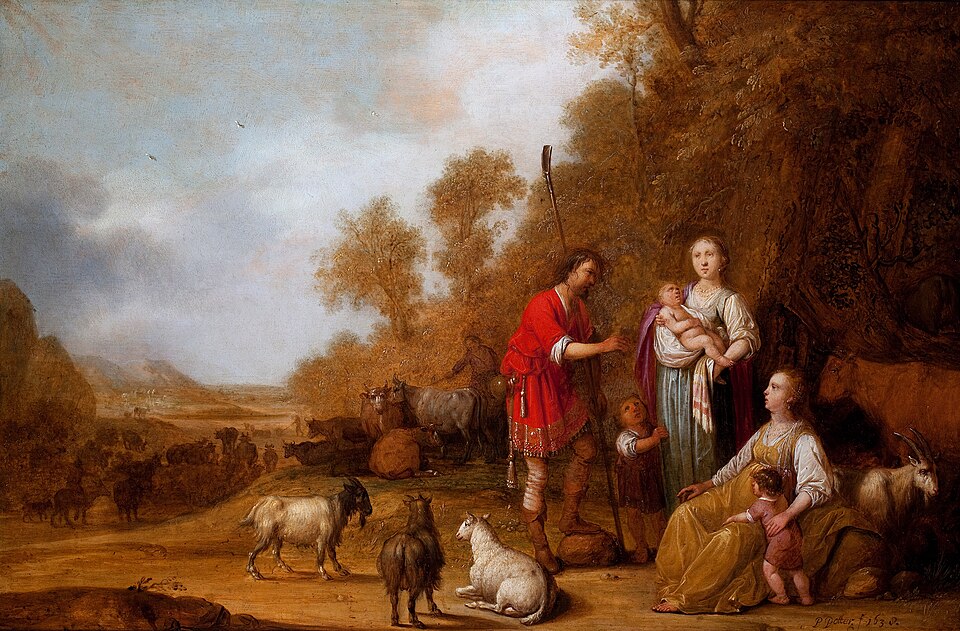
Jeremiah heard “Rachel weeping for her children, and refusing to be comforted, because they are no more.”
Jeremiah 31:15

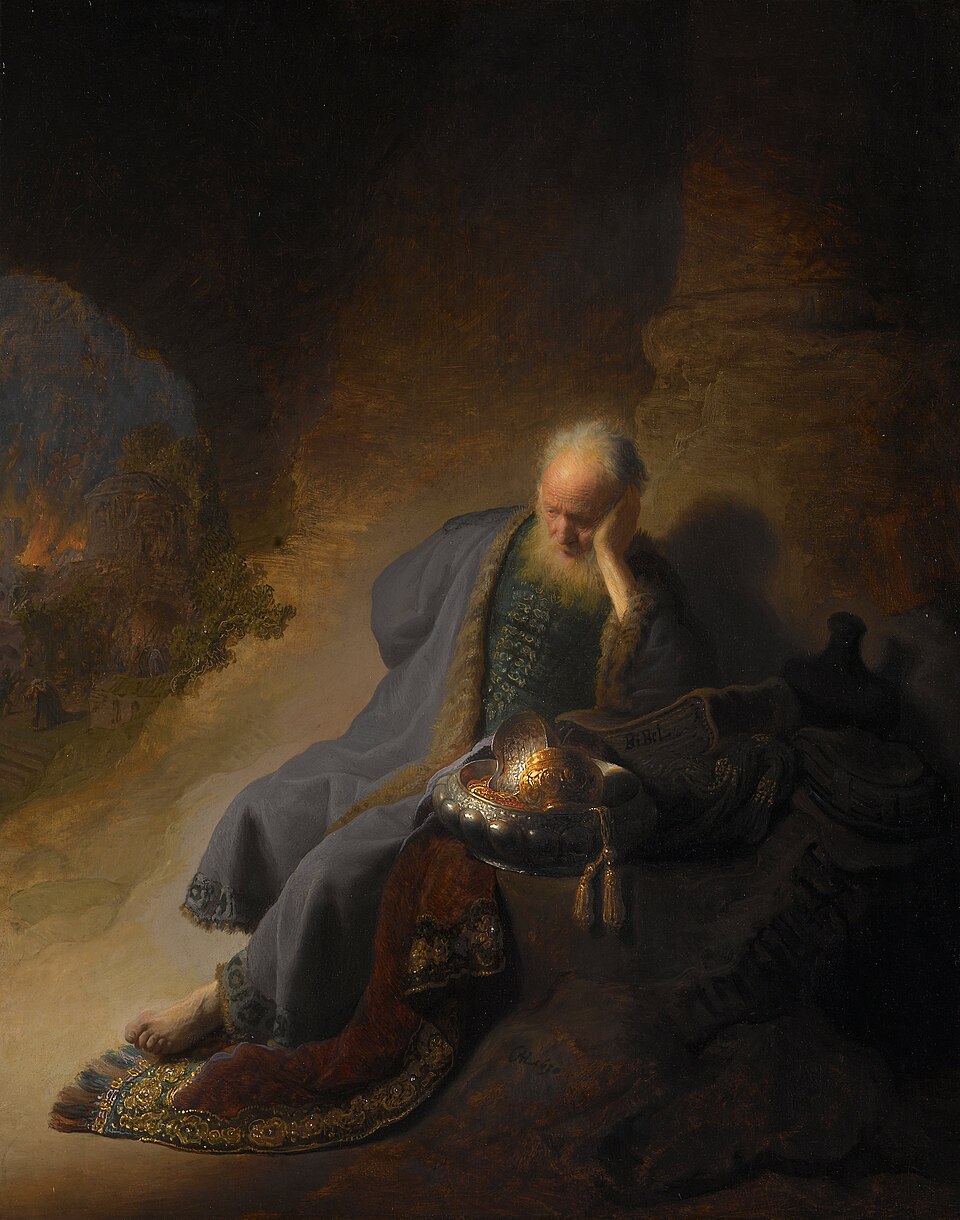
The prophet wished for “a fountain of tears” to “weep day and night over the slain daughter of my people.”
Jeremiah 9:1
Hannah, Job, Jeremiah, Mary Magdalene
What Scripture Gives the Grieving to Do
Scripture names five things to do in grief, each in the words of the verse that gives it.
- 1Bring your tears to GodThe psalmist asks God, “Put my tears in Your bottle”, and trusts that God keeps count of them.Psalm 56:8
- 2Pour out your heart before Him“Trust in Him at all times, O people; pour out your hearts before Him. God is our refuge.”Psalm 62:8
- 3Cast your care on Him“Cast all your anxiety on Him, because He cares for you.”1 Peter 5:7
- 4Weep with those who weep“Rejoice with those who rejoice; weep with those who weep.”Romans 12:15
- 5Pass on the comfort you receivedGod “comforts us in all our troubles, so that we can comfort those in any trouble with the comfort we ourselves have received from God.”2 Corinthians 1:4
Pour out your heart before Him, Cast your care on Him, Weep with those who weep, Pass on the comfort you received
Grief that does not lift, that takes away sleep and food for months, or that brings thoughts of death calls for a physician or a counsellor beside prayer and never in its place.
The Lament: Psalm 42
Psalm 42 is the lament of a worshipper far from the house of God.
The psalmist remembers leading the procession to the house of God, and those around him mock his faith. His refrain stands again in Psalm 42:11 and Psalm 43:5.
My tears have been my food both day and night, while men ask me all day long, “Where is your God?”The verse stands first because grief and mockery arrive together in it, as they often do.
I say to God my Rock, “Why have You forgotten me? Why must I walk in sorrow because of the enemy’s oppression?”The question stands as a pattern for speaking to God plainly in sorrow.
Why are you downcast, O my soul? Why the unease within me? Put your hope in God, for I will yet praise Him for the salvation of His presence.The refrain stands last because the psalm returns to it three times.
The Prayers of the Grieving, the study in brief
Grief in the Stories of the Bible
Three stories tell of a father who would not be comforted, a widow who came home empty and a king who lost a child.
Jacob mourns JosephGenesis 37
Joseph's brothers sold him into Egypt and brought his robe home dipped in a goat's blood. Jacob took the robe as proof that a wild animal had torn his son to pieces. He wore sackcloth for many days, and he would not let his children comfort him. Joseph was alive the whole time, and Jacob did not see him again for more than twenty years.
Then Jacob tore his clothes, put sackcloth around his waist, and mourned for his son many days. All his sons and daughters tried to comfort him, but he refused to be comforted. “No,” he said. “I will go down to Sheol mourning for my son.” So his father wept for him.
Genesis 37:34 to 35BSB Jacob's refusal of comfort is the first long grief for a child that Scripture records.
Read the page on Jacob 14 sections, 26 verses set out
Naomi comes home as MaraRuth 1
Naomi went to Moab with her husband and two sons in a famine, and all three men died there. She came back to Bethlehem with Ruth, her Moabite daughter-in-law. When the women of the town greeted her by name, she told them to call her Mara, which means bitter, and said the LORD had brought her back empty.
“Do not call me Naomi,” she replied. “Call me Mara, because the Almighty has dealt quite bitterly with me.
Ruth 1:20BSB Naomi names her grief honestly and lays it before the Almighty.
Read the study of Naomi: Call Me Mara 7 sections, 6 verses set out
David fasts for his son2 Samuel 12
After Nathan rebuked David for taking Bathsheba and killing Uriah, the son she bore became ill. David fasted and lay on the ground for seven days, and his servants feared to tell him when the child died. When he learned it, he rose, washed, worshiped and ate, and explained to them why.
But now that he is dead, why should I fast? Can I bring him back again? I will go to him, but he will not return to me.”
2 Samuel 12:23BSB David's answer to his servants is one of the texts most read at the death of a child.
Read the study of David and the Child Who Died 8 sections, 4 verses set out
Naomi comes home as Mara (Ruth 1), David fasts for his son (2 Samuel 12)
Grief in the Church's History
Two accounts tell of a son who wept for his mother at Ostia and a father who lost four daughters at sea.
Augustine weeps for Monica387
Augustine's mother Monica died at Ostia as the two of them waited to sail home to Africa. In book 9 of his Confessions he wrote that he held back his tears through her funeral. Afterward, in the translation of J. G. Pilkington (1887), “it was pleasant to me to weep in Your sight, for her and for me, concerning her and concerning myself.”
Horatio Spafford and It Is Well with My Soul1873
The French steamer Ville du Havre sank in the Atlantic in November 1873 after the iron sailing ship Lochearn struck it, and the four daughters of the Chicago lawyer Horatio Spafford drowned. His wife Anna was picked up from the sea and cabled him from Cardiff, “Saved alone.” His hymn It Is Well with My Soul was printed with Philip Bliss's music in Gospel Hymns No. 2 in 1876, and in 1881 the family moved to Jerusalem.
Read the story of It Is Well with My Soul 8 sections, 2 verses set out
Voices on Grief, by Century
Five quotations from the third century to the nineteenth, each under the line it teaches.
died 253 · Origen of Alexandria
COMMENTARY ON THE EPISTLE TO THE ROMANS
A third-century reading: Christian tears are joined to the sorrows of others, though not to every kind of weeping.
The quotation1 quotation
“To rejoice with those who rejoice, to weep with those who weep. Here too a suitable and fitting distinction must be maintained. For the joys of Christians are not to be joined to just any joys, nor are our tears to be joined to just any weeping. For if I should see someone rejoicing over a gain of money, or over the extent of his possessions, or over the eminence of worldly honor, I ought not to congratulate such people, since I know that mourning and tears follow joys of this kind.”
Origen of Alexandria · Commentary on the Epistle to the Romans · on Romans 12:15Patristic
died 367 · Hilary of Poitiers
Catena Aurea by Aquinas
A fourth-century reading: the mourners Jesus blesses are those who weep for their sins.
The quotation1 quotation
“Those that mourn, that is, not loss of kindred, affronts, or losses, but who weep for past sins.”
Hilary of Poitiers · Catena Aurea by Aquinas · on Matthew 5:4Patristic
1662 to 1714 · Matthew Henry
Commentary on the Whole Bible
An eighteenth-century reading: love takes the sorrows of others as its own.
The quotation1 quotation
“True love will interest us in the sorrows and joys of one another, and teach us to make them our own. Observe the common mixture in this world, some rejoicing, and others weeping (as the people, Ezra iii. 12, 13 ), for the trial, as of other graces, so of brotherly love and Christian sympathy.”
Matthew Henry · Commentary on the Whole Bible · on Romans 12:15Puritan
1834 to 1892 · Charles Spurgeon
The Treasury of David, Vol. 2
A nineteenth-century reading: broken hearts think God far away when He is nearest to them.
The quotation1 quotation
“The Lord is nigh unto them that are of a broken heart. Near in friendship to accept and console. Broken hearts think God far away, when he is really most near them; their eyes are holden so that they see not their best friend. Indeed, he is with them, and in them, but they know it not. They run hither and thither, seeking peace in their own works, or in experiences, or in proposals and resolutions, whereas the Lord is nigh them, and the simple act of faith will reveal him. And saveth such as be of a contrite spirit. What a blessed token for good is a repentant, mourning heart! Just when the sinner condemns himself, the Lord graciously absolves him. If we chasten our own spirits the Lord will spare us. He never breaks with the rod of judgment those who are already sore with the rod of conviction. Salvation is linked with contrition.”
Charles Spurgeon · The Treasury of David, Vol. 2 · on Psalm 34:18
1802 to 1910 · Jamieson, Fausset & Brown
Commentary Critical and Explanatory on the Whole Bible
A nineteenth-century reading: behind the tears at Bethany stood the law that the wages of sin is death.
The quotation1 quotation
“But was there nothing in those tears beyond sorrow for human suffering and death? Could these effects move Him without suggesting the cause? Who can doubt that in His ear every feature of the scene proclaimed that stern law of the Kingdom, ‘The wages of sin is death’ (Ro 6:23), and that this element in His visible emotion underlay all the rest?”
Jamieson, Fausset & Brown · Commentary Critical and Explanatory on the Whole Bible · on John 11:35Reformed
Matthew Henry, Charles Spurgeon, Jamieson, Fausset & Brown
How Grief Has Been Taught
Ambrose of Milan in the fourth century and John Calvin in the sixteenth taught how a believer may mourn.
Ambrose taught that natural grief is no sin, though distrustful sadness is.1 paragraph
Ambrose of Milan preached On the Death of Satyrus at the funeral of his brother. In the translation of H. de Romestin and his colleagues (1896) he said, “Not all weeping proceeds from unbelief or weakness. Natural grief is one thing, distrustful sadness is another.” Later in the same sermon he set a limit: “Let them, therefore, weep who cannot have the hope of the resurrection.”
Calvin taught that Paul requires moderation in mourning and does not forbid it.1 paragraph
John Calvin wrote on 1 Thessalonians 4:13 that Paul “does not, however, forbid us altogether to mourn, but requires moderation in our mourning.” The translation is John Pringle's. He rejected a “Stoical indifference” among Christians and wrote, “Let, therefore, the grief of the pious be mixed with consolation, which may train them to patience.”
What the Studies of Bereavement Find
Four studies in medical journals measure what bereavement costs the body and the mind.
A meta-analysis by Moon and colleagues (PLoS One, 2011) of fifteen cohort studies found the risk of death raised among the widowed, most of all in the first six months. Mostofsky and colleagues (Circulation, 2012) found the onset of a heart attack 21.1 times more likely in the day after the death of someone significant. A review by Lundorff and colleagues (Journal of Affective Disorders, 2017) found prolonged grief in about one in ten adults bereaved by a death that was not violent. Stroebe, Schut and Stroebe (The Lancet, 2007) concluded that the majority come through bereavement with no professional psychological treatment. The studies show associations across groups and say nothing of the cause of any one death.
Grief and the Body, the study in brief
The Studies of Grief and Loss
Each study takes one text, story, word or finding of grief into more depth.
The texts
3 studies
- Passages and psalms · 10 verses set outNot as Those without Hope
Paul tells the church at Thessalonica that believers grieve their dead in the hope of the resurrection.
- Passages and psalms · 11 verses set outThe Prayers of the Grieving
Psalm 6, Psalm 31 and Lamentations 3 are prayers spoken to God from sickness, siege and the ruin of a city.
- Passages and psalms · 11 verses set outThe Lament Form in the Psalter
Psalms 6, 13, 22, 44 and 88 show where a lament turns from complaint to trust, and where it never turns.
- Passages and psalms · 10 verses set outNot as Those without Hope
The stories
3 studies
- Stories · 4 verses set outDavid and the Child Who Died
David fasted and wept while his son was ill, and when the child died he rose, worshiped and ate.
- Stories · 2 verses set outIt Is Well with My Soul
Philip Bliss named the tune of It Is Well with My Soul Ville du Havre, after the ship on which Horatio Spafford's daughters died.
- Stories · 6 verses set outNaomi: Call Me Mara
Naomi came home to Bethlehem from Moab a widow and asked the women of the town to call her Mara.
- Stories · 4 verses set outDavid and the Child Who Died
The words
1 study
- Symbols and words · 7 verses set outThe Words Evel and Lupe
Words for mourning and grief stand in the law, the prophets, the Gospels, the letters and Revelation.
- Symbols and words · 7 verses set outThe Words Evel and Lupe
The practice
1 study
- Doctrines · 15 verses set outMourning and Burial in Israel
How Israel grieved its dead and laid them in the grave, from Abraham's purchase of a family tomb to the law of the priests and the hope of the resurrection.
- Doctrines · 15 verses set outMourning and Burial in Israel
The science
1 study
- Doctrines · 2 verses set outGrief and the Body
Eight studies of bereavement measured the heart, the immune system, sleep and lasting grief after a death.
- Doctrines · 2 verses set outGrief and the Body

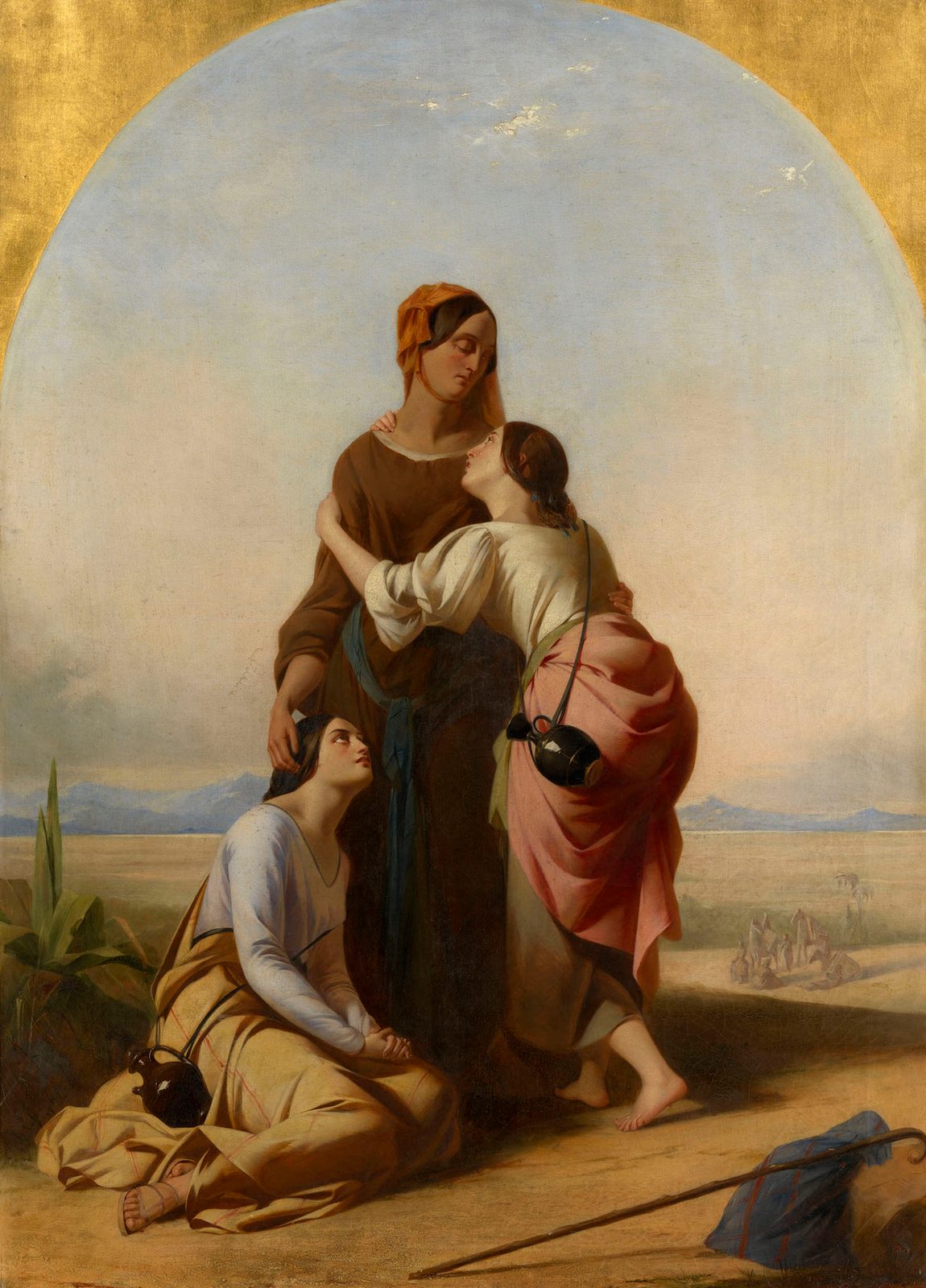

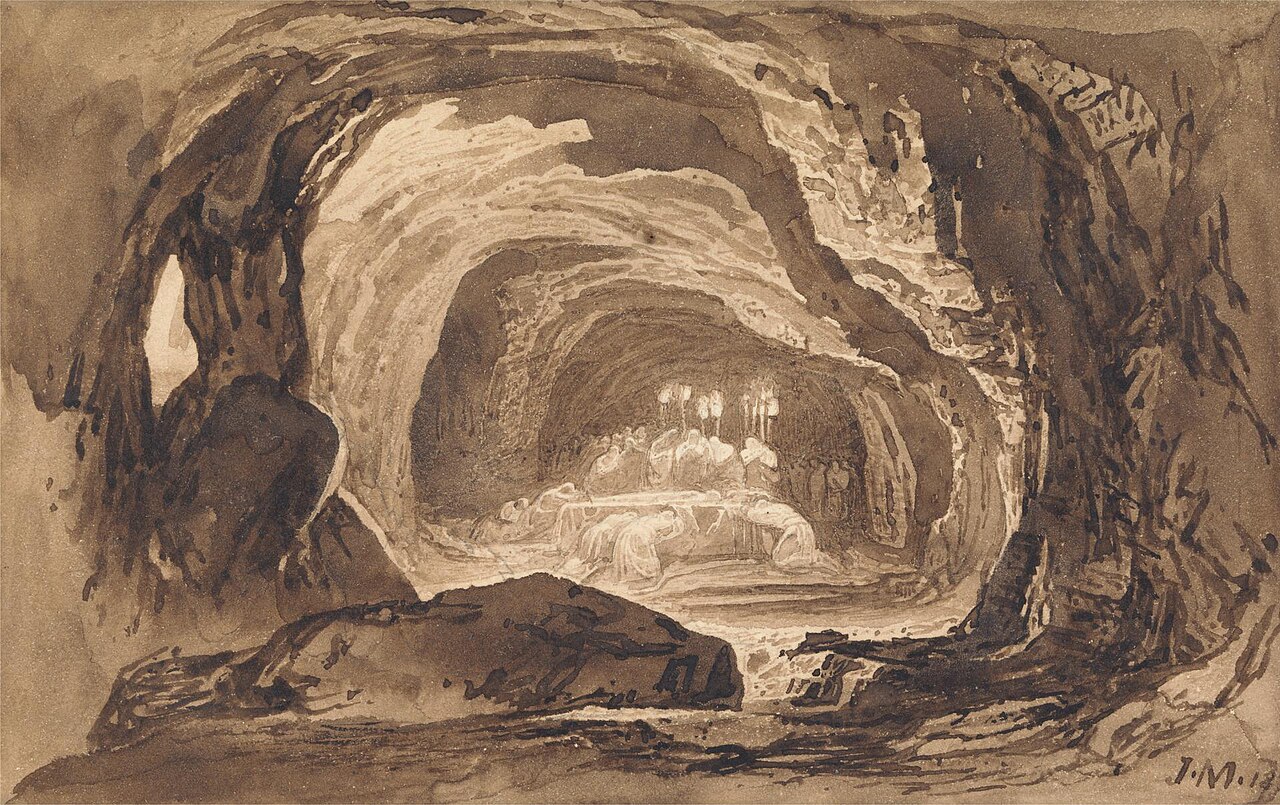
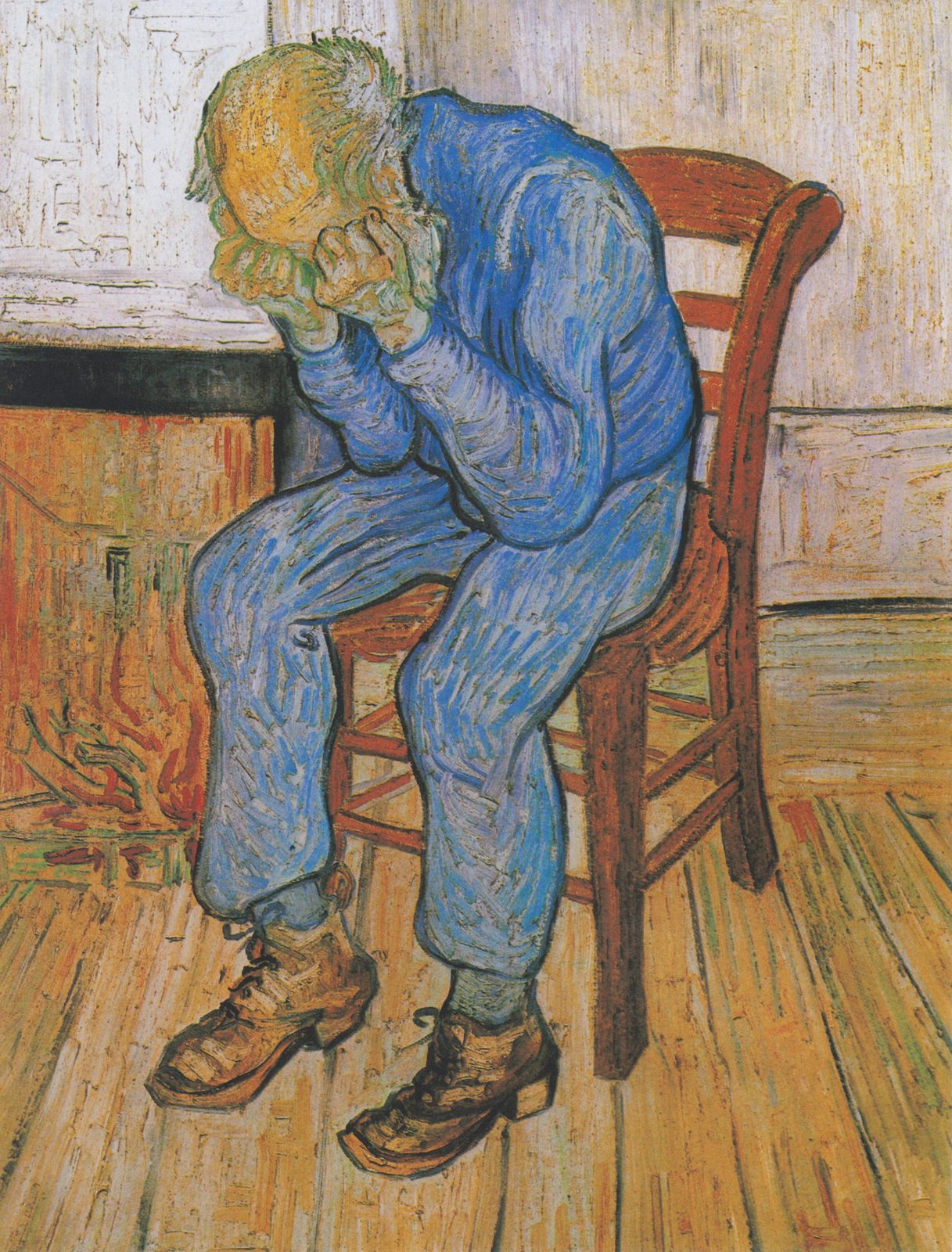
The Prayers of the Grieving, The Lament Form in the Psalter, David and the Child Who Died, It Is Well with My Soul, Naomi: Call Me Mara, The Words Evel and Lupe, Mourning and Burial in Israel, Grief and the Body
Where Readers Disagree
Seven readings answer three questions, each with its holders, the work that argues it and the objection raised against it.
Why Jesus wept at the tomb of Lazarus
| Reading | Held by | Work | Objection |
|---|---|---|---|
| Out of sympathy with the mourners, to teach His people to weep with those who weep | Hippolytus of Rome; Augustine of Hippo (Greek and Latin patristic writing) | Hippolytus, On the Gospel of John and the Resurrection of Lazarus; Augustine, as printed in Thomas Aquinas, Catena Aurea on John 11:35 | John records that Jesus was “deeply moved in spirit and troubled” (John 11:33), which speaks of more than an example set for others. |
| At the ruin that sin and death had brought on those made in God's image | Cyril of Alexandria; Jamieson, Fausset and Brown (Greek patristic writing; Scottish Presbyterian commentary) | Cyril of Alexandria, Commentary on John, book 7, on John 11:35; Jamieson, Fausset and Brown, Commentary Critical and Explanatory (1871), on John 11:35 | John sets the tears directly after Jesus sees Mary and the mourners weeping (John 11:33), which ties them to their grief. |
| For both reasons at once | John Wesley (Methodist) | John Wesley, Explanatory Notes upon the New Testament (1755), on John 11:35 | The text gives no reason for the tears, so any reason assigned goes beyond what John wrote. |
At the ruin that sin and death had brought on those made in God's image, For both reasons at once
Who “those who mourn” are in Matthew 5:4
| Reading | Held by | Work | Objection |
|---|---|---|---|
| Those who mourn for sin | Hilary of Poitiers; Jerome; Albert Barnes (Latin patristic writing; American Presbyterian) | Hilary, as printed in the Catena Aurea on Matthew 5:4; Jerome, Commentary on Matthew, on Matthew 5:4; Albert Barnes, Notes (1832 to 1869), on Matthew 5:4 | The promise of comfort answers the grief of the mourners of Zion in Isaiah 61:2 to 3, which Jesus' words echo. |
| Those whose natural mourning God sanctifies | Matthew Henry (English Presbyterian) | Matthew Henry, Commentary on the Whole Bible (1710), on Matthew 5:4 | The Beatitudes describe the disciple's character, so a grief any person may suffer does not fit the list. |
What David meant by “I will go to him” (2 Samuel 12:23)
Read the study of David and the Child Who Died 8 sections, 4 verses set out
| Reading | Held by | Work | Objection |
|---|---|---|---|
| He expected to meet the child again | Matthew Henry; John Wesley (English Presbyterian; Methodist) | Matthew Henry, Commentary (1710), on 2 Samuel 12:23; John Wesley, Explanatory Notes upon the Old Testament (1765), on 2 Samuel 12:23 | The Old Testament says little of life after death at this point, and David's words may mean no more than his own death. |
| He would die and join the child in the grave | Adam Clarke (Methodist) | Adam Clarke, Commentary on the Bible (1832), on 2 Samuel 12:23 | David rose from mourning and worshiped, which reads more naturally as comfort than as resignation to the grave. |
Every Text on Grief and Loss
Two verses and four essays that the site's earlier grief and loss pages gathered.
Two verses from Job and 2 Samuel.2 verses
Then they sat on the ground with him for seven days and seven nights, but no one spoke a word to him because they saw how intense his suffering was.The friends' silence beside Job is the first comfort his story records.
The king was shaken and went up to the gate chamber and wept. And as he walked, he cried out, “O my son Absalom! My son, my son Absalom! If only I had died instead of you, O Absalom, my son, my son!”David's cry for Absalom is the grief of a father for a son who had turned against him.
Four essays, carried as they stood.20 paragraphs
The grief page at /tag/grief carried the essay that follows.
Scripture never rushes grief. It gives sorrow room to be fully itself before it says a word about comfort, and that pattern starts early. When Sarah dies, Abraham does not simply arrange a burial; he comes to mourn for her and to weep for her (Genesis 23:2), taking time to feel the loss before he does anything practical about it. When Jacob believes Joseph is dead, his sons try to comfort him and cannot; he refuses to be comforted, and weeps for his son (Genesis 37:35). Grief that deep does not obey anyone's timetable, not even a loving family's.
Job's friends understand this, at least at first. When they see the scale of his suffering, they do not offer explanations. They sit with him on the ground seven days and seven nights, and none of them speaks a word, because they see that his grief is very great (Job 2:13). Silence, not solutions, is their first and best gift: a gift they later abandon when they start talking.
The Psalms give grief its own language, one raw enough to still be used today. God stays nigh to the brokenhearted (Psalm 34:18): not a promise that grief will be avoided, but a promise that God stays close inside it. Ecclesiastes states plainly that mourning has its appointed place in a life, alongside everything else: a time to weep, and a time to mourn (Ecclesiastes 3:4).
Isaiah's prophecy of the coming Messiah does not skip grief either; it walks straight through the middle of it. He is described as "a man of sorrows, and acquainted with grief" (Isaiah 53:3). Before Jesus ever wept himself, Scripture had already said he would be no stranger to weeping. That word finds its fulfillment centuries later, at a graveside outside Bethany. Jesus arrives after his friend Lazarus has already died, sees Mary and the mourners weeping, and the Gospel records the shortest, heaviest sentence in the whole Bible: "Jesus wept" (John 11:35). He knew he was about to raise Lazarus back to life within minutes. He wept anyway. Grief was not a failure of faith for him; it was the honest response to death, even death he was about to undo.
That same honesty is asked of his followers. Paul does not tell the Roman church to skip past sorrow; he tells them to enter into each other's, to weep with them that weep (Romans 12:15). Grief shared is grief carried differently than grief carried alone.
None of this is the end of the story. Isaiah also promises beauty for ashes, the oil of joy for mourning (Isaiah 61:3), and the last book of the Bible finishes what the first books started: God will wipe away every tear, and there will be no more death, sorrow, or crying (Revelation 21:4). Scripture never pretends grief isn't real. It simply insists grief isn't forever, because the one who wept at a tomb is the same one who walked out of his own.
On /tag/loss this essay stood as the text of the page.
Loss enters the Bible early and never really leaves it. Death, separation, and grief run through nearly every book, because Scripture does not look away from what it costs to lose someone or something that mattered. It treats loss as real, not as a problem to be explained away.
Jacob loses his son Joseph and refuses every attempt at comfort, saying he will go down to the grave mourning him (Genesis 37:35). He does not know, of course, that Joseph is alive. But his grief is not written as foolish or excessive. It is simply what a father's loss looks like, left on the page without correction.
Job loses everything in a single day (his children, his wealth, his health) and his first response becomes one of the most quoted lines in Scripture: the LORD gave, and the LORD has taken away, blessed be the name of the LORD (Job 1:21). That is not a man pretending the loss does not hurt. It is a man choosing, in the middle of the worst day of his life, to keep trusting the character of God even when he cannot see the reason for what happened.
Naomi loses her husband and both her sons in a foreign land, and comes home changed enough that she asks people to stop calling her by her old name. Call her Mara, she says, because the Almighty has dealt bitterly with her (Ruth 1:20). Scripture lets her say this. It does not rush her past her grief toward the happier ending that is actually coming for her.
David loses a child born from his sin with Bathsheba and grieves hard while the boy is still alive, fasting and praying. But once the child dies, David gets up, washes, and eats, explaining that he cannot bring his son back, but one day he will go to him (2 Samuel 12:23). Later, David loses his son Absalom under far worse circumstances, a son who had rebelled against him and tried to take his throne, and his grief is just as raw (2 Samuel 18:33). Loss in Scripture is not measured out according to whether the person deserved to be mourned.
Even Jesus grieved. Standing at the tomb of his friend Lazarus, knowing full well that he was about to raise him from the dead within minutes, he wept anyway (John 11:35). Knowing the ending did not stop him from feeling the loss in the moment. That single, short verse says something enormous: grief is not a failure of faith. God himself, in the flesh, grieved.
Paul later told believers not to grieve the way people grieve who have no hope (1 Thessalonians 4:13). He does not tell them not to grieve at all. Hope changes the shape of grief; it does not erase it.
And Scripture ends with a promise aimed directly at loss itself. A day is coming when God will wipe every tear from every eye, and death, sorrow, and crying will be no more (Revelation 21:4). Until then, loss is treated honestly, named for what it costs, and never dismissed, because the God who allowed Jesus to weep at a grave is not a God who asks anyone to pretend that loss does not hurt.
The topic /topics/grief gave its subject one paragraph.
Grief is the experience of loss and mourning described throughout Scripture as torn clothes, weeping, ashes, and the absence of comfort. The Bible does not treat grief as weakness: the psalms of lament, the book of Lamentations, and Jesus' own weeping at Lazarus's tomb name it as part of the life of faith. Every biblical response to grief holds sorrow and hope together without collapsing one into the other.
The topic /topics/loss summarized loss in these words.
Loss in Scripture takes many forms — death, exile, displacement, failed harvests, betrayal, the loss of God's sensed presence. The Bible lets each loss speak (Job, Naomi, David, the exilic community) rather than rushing to silence the lament. Habakkuk's closing hymn (3:17–18) is the characteristic biblical posture: the fig tree fails, the harvest fails, and yet I will rejoice.
Sources
Scripture is the Berean Standard Bible.
- STEP Bible brief lexicons of Extended Strongs for Hebrew and for Greek (Tyndale House, Cambridge), CC BY 4.0, with their glosses.
- Augustine of Hippo, Confessions, book 9, chapter 12, translated by J. G. Pilkington, Nicene and Post-Nicene Fathers, first series, volume 1 (Buffalo: Christian Literature Publishing, 1887)
- Ambrose of Milan, On the Death of Satyrus, book 1, sections 10 and 70, translated by H. de Romestin, E. de Romestin and H. T. F. Duckworth, Nicene and Post-Nicene Fathers, second series, volume 10 (Buffalo: Christian Literature Publishing, 1896)
- John Calvin, Commentaries on the Epistles of Paul to the Philippians, Colossians, and Thessalonians, on 1 Thessalonians 4:13, translated by John Pringle.
- Origen of Alexandria, Commentary on the Epistle to the Romans, on Romans 12:15.
- Thomas Aquinas, Catena Aurea on the Gospels (English translation, Oxford, 1841 to 1845), printing Hilary of Poitiers on Matthew 5:4 and Augustine on John 11:35.
- Matthew Henry, Commentary on the Whole Bible (1710), on Romans 12:15, Matthew 5:4 and 2 Samuel 12:23.
- John Wesley, Explanatory Notes upon the New Testament (1755), on John 11:35, and Explanatory Notes upon the Old Testament (1765), on 2 Samuel 12:23.
- Charles Spurgeon, The Treasury of David, volume 2 (1870), on Psalm 34:18.
- Albert Barnes, Notes, Explanatory and Practical, on the Old and New Testaments (1832 to 1869), on John 11:35 and Matthew 5:4.
- Robert Jamieson, A. R. Fausset and David Brown, Commentary Critical and Explanatory on the Whole Bible (1871), on John 11:35.
- Hippolytus of Rome, On the Gospel of John and the Resurrection of Lazarus.
- Cyril of Alexandria, Commentary on the Gospel of John, book 7, on John 11:35.
- Jerome, Commentary on Matthew, on Matthew 5:4.
- Adam Clarke, Commentary on the Bible (1832), on 2 Samuel 12:23.
- Library of Congress, The American Colony in Jerusalem, exhibition sections Family Tragedy and On to Jerusalem.
- P. P. Bliss and Ira D. Sankey, Gospel Hymns No. 2 (New York: Biglow and Main; Cincinnati: John Church and Co., 1876), No. 76.
- J. R. Moon, N. Kondo, M. M. Glymour and S. V. Subramanian, Widowhood and mortality: a meta-analysis, PLoS One volume 6, number 8 (2011), article e23465.
- E. Mostofsky, M. Maclure, J. B. Sherwood, G. H. Tofler, J. E. Muller and M. A. Mittleman, Risk of acute myocardial infarction after the death of a significant person in one's life, Circulation volume 125, number 3 (2012), pages 491 to 496.
- M. Lundorff, H. Holmgren, R. Zachariae, I. Farver-Vestergaard and M. O'Connor, Prevalence of prolonged grief disorder in adult bereavement: a systematic review and meta-analysis, Journal of Affective Disorders volume 212 (2017), pages 138 to 149.
- M. Stroebe, H. Schut and W. Stroebe, Health outcomes of bereavement, The Lancet volume 370, number 9603 (2007), pages 1960 to 1973.
- The essay of /tag/grief, as it stood.
- The essay of /tag/loss, as it stood.
- The summary of /topics/grief, as it stood.
- The summary of /topics/loss, as it stood.
Keep Studying
Studies5
People and groups29
Show the next 6 titles
Show the next 6 titles
Doctrines3
Subjects3
In this trial9
Values1
Trials of life1