
Deuteronomy 27 · Subject · Featured Study
Gerizim and Ebal: the blessing and the curse
The ceremony marked Israel as the people of the LORD, as Moses declared in Deuteronomy 27:9.
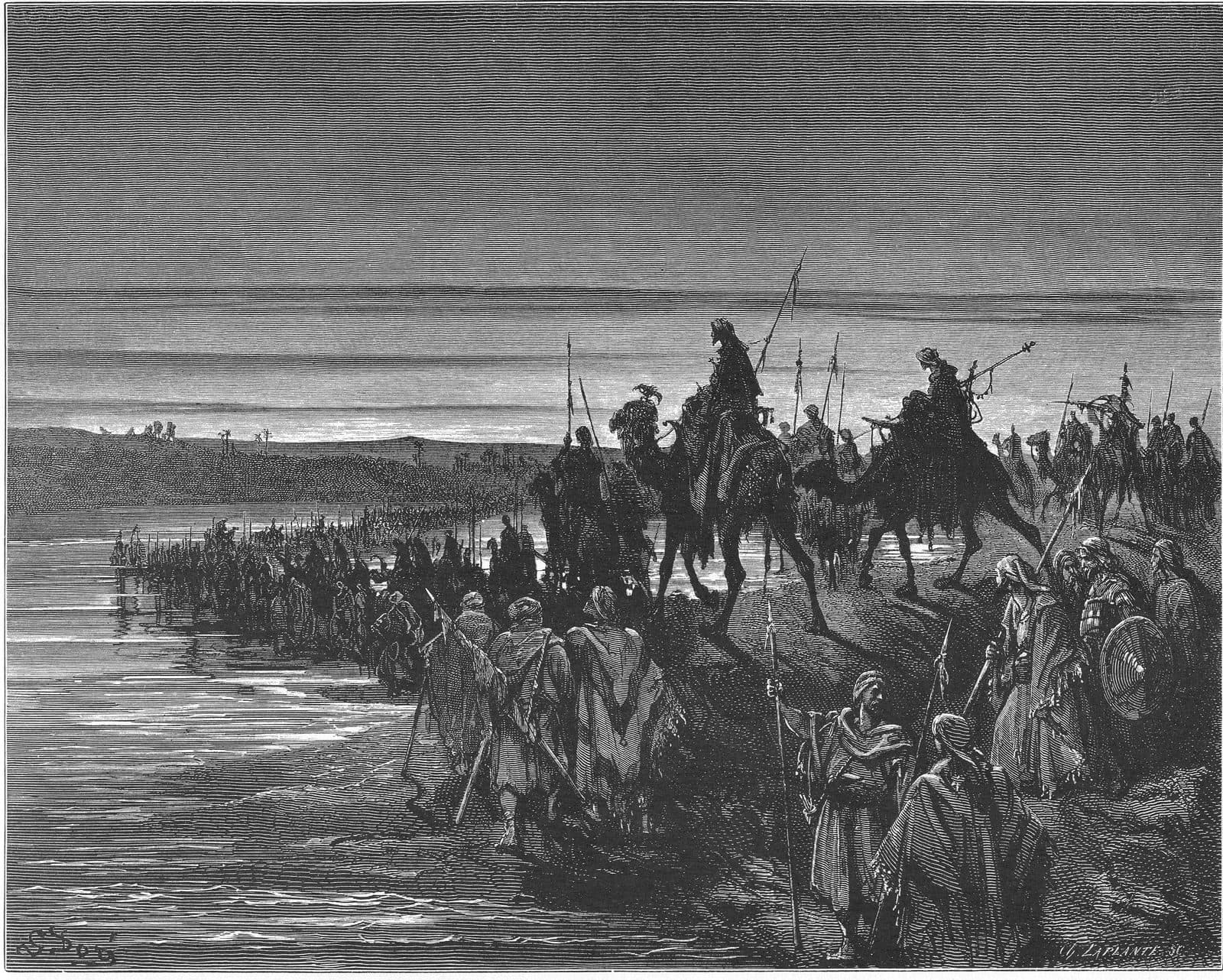
Gustave Doré, The Israelites Cross the Jordan River, 1866, from Doré's English Bible. Public domain, via Wikimedia Commons.
THE ARTWORKDoré drew the column of Israel winding along the river's edge toward the far bank at dusk. Riders on camels carry lances in the middle ground, and men in striped cloaks walk with spears and a round shield in the foreground.
The altar and the written law stood on Ebal, the mountain of the curse.
Summary
At two mountains near Shechem the twelve tribes heard the law spoken as a blessing and a curse, with the Levites calling it out between them.
- Moses gave the command on the plains of Moab, before Israel crossed the Jordan.
- Each of twelve curses ends with the whole people saying Amen.
- Joshua read every word of the law to men, women, children and foreigners.
- After the exile Ezra read the law to the people again in Jerusalem.
- In Galatians 3 Paul sets the curse spoken at Ebal beside the cross.
The Command Given at Moab
Deuteronomy 11 and 27 give the command before the crossing
The command first comes in Deuteronomy 11, before the laws of chapters 12 to 26.
See, today I am setting before you a blessing and a curse—Three verses later the choice is given a place.
When the LORD your God brings you into the land you are entering to possess, you are to proclaim the blessing on Mount Gerizim and the curse on Mount Ebal.Chapter 27, after the laws, sets out the day itself and what Israel was to build.
And when you have crossed the Jordan, you are to set up these stones on Mount Ebal, as I am commanding you today, and you are to coat them with plaster. Moreover, you are to build there an altar to the LORD your God, an altar of stones. You must not use any iron tool on them.Who Stood Where
Five places, from the foot of each mountain to the altar on Ebal
| Place | Who stood there | What they did |
|---|---|---|
| Before Gerizim | Simeon, Levi, Judah, Issachar, Joseph and Benjamin | Stood for the blessing |
| Before Ebal | Reuben, Gad, Asher, Zebulun, Dan and Naphtali | Stood for the curse |
| Between the two halves | The Levitical priests carrying the ark | Called out the curses in a loud voice |
| On both sides of the ark | All Israel, foreigners and citizens alike | Answered Amen after each curse |
| On Ebal | Joshua | Built the altar and wrote a copy of the law on the stones |
- Place
- Before Gerizim
- Who stood there
- Simeon, Levi, Judah, Issachar, Joseph and Benjamin
- What they did
- Stood for the blessing
- Place
- Before Ebal
- Who stood there
- Reuben, Gad, Asher, Zebulun, Dan and Naphtali
- What they did
- Stood for the curse
- Who stood there
- The Levitical priests carrying the ark
- What they did
- Called out the curses in a loud voice
- Who stood there
- All Israel, foreigners and citizens alike
- What they did
- Answered Amen after each curse
- Place
- On Ebal
- Who stood there
- Joshua
- What they did
- Built the altar and wrote a copy of the law on the stones
How the tribes were dividedAlbert Barnes; John Wesley
Albert Barnes, in his Notes on Deuteronomy 27:12 to 27:13, traces the six tribes set for the blessing to Jacob's wives Leah and Rachel. He notes that the four tribes from the handmaids all stand at Ebal.
John Wesley explains why Joseph counts as one tribe in this list.
“Joseph is here put for both his sons and tribes Manasseh and Ephraim, which are reckoned as one tribe, because Levi is here numbered; but when Levi is omitted, as it is where the division of the land is made, there Manasseh and Ephraim pass for two tribes.”
John Wesley · Explanatory Notes upon the Old Testament · on Deuteronomy 27:12Evangelical
Where the people and the priests stoodAdam Clarke; John Gill
Deuteronomy 27:12 sets the tribes on the mountains, and Joshua 8:33 sets them in front of the mountains. Adam Clarke, in his Commentary on the Bible of 1832, reads the Hebrew particle al in Deuteronomy 27:12 as by, so that the people stood on the plain over against them.
John Gill, in his Exposition of the Old Testament on Deuteronomy 27:14, places the priests in the valley between the mountains, where every tribe could hear them.
The Ceremony Through Scripture
Joshua 8, Nehemiah 8 and Galatians 3, in canon order
Joshua carried out the command after Israel took Ai.
At that time Joshua built an altar on Mount Ebal to the LORD, the God of Israel, just as Moses the servant of the LORD had commanded the Israelites. He built it according to what is written in the Book of the Law of Moses: “an altar of uncut stones on which no iron tool has been used.” And on it they offered burnt offerings to the LORD, and they sacrificed peace offerings.The reading followed in the same ceremony.
Afterward, Joshua read aloud all the words of the law—the blessings and the curses—according to all that is written in the Book of the Law.After the exile Ezra did the same in Jerusalem.
So Ezra read it aloud from daybreak until noon as he faced the square before the Water Gate, in front of the men and women and those who could understand. And all the people listened attentively to the Book of the Law.Paul quotes the twelfth curse in his letter to the Galatians.
All who rely on works of the law are under a curse. For it is written: “Cursed is everyone who does not continue to do everything written in the Book of the Law.”What the Text Says
Two details often passed over, and the ceremony as the rabbis taught it
THE WHOLE PEOPLE
Deuteronomy 31:12 names the men, women, children and foreigners for the reading of the law every seventh year.
SINS DONE IN SECRET
The first curse and the tenth both name a sin done in secret, where no witness could bring a charge.
Rashi, Rabbi Shlomo Yitzchaki of Troyes (1040 to 1105), the standard medieval Jewish commentator on the Torah, gives the ceremony as the Talmud sets it out in Sotah 32a. Six tribes went up to the top of Gerizim and six to the top of Ebal.
The Levites turned toward Gerizim and spoke each line as a blessing, beginning with the man who does not make a carved image, and both halves answered Amen. Then they turned toward Ebal and spoke the same line as a curse, through to the last one.
Why the women and children were thereAdam Clarke
Adam Clarke gives a reason for each group the verse names.
“With the women and the little ones - It was necessary that all should know that they were under the same obligations to obey; even the women are brought forward, not only because of their personal responsibility, but because to them was principally intrusted the education of the children. The children also witness this solemn transaction, that a salutary fear of offending God might be early, diligently, and deeply impressed upon their hearts.”
Adam Clarke · Commentary on the Bible · on Joshua 8:35Evangelical
The law written for all to seeMatthew Henry
“It is a great mercy to any people to have the law of God in writing, and it is fit that the written law should be exposed to common view in a known tongue, that it may be seen and read of all men.”
Matthew Henry · Commentary on the Whole Bible · on Joshua 8:32Puritan
Three sets of stones and seventy languagesRashi on Deuteronomy 27:2 and 27:8
Rashi reads Deuteronomy 27:2 with Sotah 35b as three sets of stones: twelve set up in the Jordan, twelve at Gilgal and twelve on Mount Ebal, built into the altar. On Deuteronomy 27:8 he takes the command to write the words distinctly to mean writing them in seventy languages, after Sotah 32a.
Eleven curses for eleven tribesRashi on Deuteronomy 27:24
Rashi, on Deuteronomy 27:24, cites Rabbi Moses the Preacher for the reading that eleven of the curses answer to eleven tribes, with none for Simeon. Moses gave Simeon no blessing before his death in chapter 33, and so on this reading he gave him no curse either.
The Pass at Shechem
The place of the ceremony, its ground and what was dug there
Deuteronomy 11:30 places the two mountains near the Oak of Moreh, so the law was read where Abram first heard the promise of the land.
Ebal stands on the north side of a pass in the central hill country and Gerizim on the south, with the mound of Shechem at the eastern mouth. The two summits are about 3.7 kilometres apart in a straight line.
Abram traveled through the land as far as the site of the Oak of Moreh at Shechem. And at that time the Canaanites were in the land. Then the LORD appeared to Abram and said, “I will give this land to your offspring.” So Abram built an altar there to the LORD, who had appeared to him.Fruitful Gerizim and barren EbalAdam Clarke; Albert Barnes
Adam Clarke, on Deuteronomy 11:29, looks for the sense of the ceremony in the two mountains themselves.
“Thou shalt put the blessing upon Mount Gerizim, and the curse upon Mount Ebal - The etymology of these names may be supposed to cast some light on this institution. גרזים gerizzim, from גרז garaz, to cut, cut off, cut down; hence גרזים gerizzim, the cutters down, fellers, and reapers or harvest-men, this mountain being supposed to have its name from its great fertility, or the abundance of the crops it yielded, which is a possible case. Of עיבל ebal or eybal the root is not found in Hebrew; but in Arabic abala signifies rough, rugged, curled, etc.; and abalo, from the same root, signifies white stones, and a mountain in which such stones are found; alabalo, the mount of white stones. See Giggeius and Golius. And as it is supposed that the mountain had this name because of its barrenness, on this metaphorical interpretation the sense of the passage would appear to be the following: God will so superintend the land, and have it continually under the eye of his watchful providence, that no change can happen in it but according to his Divine counsel, so that its fertility shall ever be the consequence of the faithful obedience of its inhabitants, and a proof of the blessing of God upon it; on the contrary, its barrenness shall be a proof that the people have departed from their God, and that his curse has in consequence fallen upon the land. See the manner of placing these blessings and curses, Deu 27:12, etc. That Gerizim is very fruitful, and that Ebal is very barren, is the united testimony of all who have traveled in those parts. See Ludolf, Reland, Rab, Benjamin, and Mr. Maundrell. […]”
Adam Clarke · Commentary on the Bible · on Deuteronomy 11:29Evangelical
Albert Barnes, in his Notes on Deuteronomy 11:29, says Gerizim is barren like Ebal, and he gives the southern place of Gerizim as the reason it took the blessing.
What was dug on EbalAdam Zertal; Scott Stripling; Gershon Galil; Aren Maeir; Christopher Rollston
Adam Zertal excavated a stone structure on the northeastern ridge of Ebal from 1982 to 1989. It measured about 9 by 7 metres, had a ramp, and held ash and a large quantity of animal bone, and he dated it to Iron Age I.
From 2019 the excavation team of Scott Stripling recovered a small inscribed lead object from material discarded by Zertal's excavation. Stripling, Gershon Galil, Ivana Kumpova, Jaroslav Valach, Pieter Gert van der Veen and Daniel Vavrik read it as an early Hebrew curse text. Their article, You are Cursed by the God YHW, appeared in Heritage Science in 2023.
Aren Maeir and Christopher Rollston answered in the Israel Exploration Journal in 2023 that the images show no discernible letters, and the reading of the inscription is still contested.
The Words of Blessing and Curse
Four Hebrew words and one Greek word from the passages
Deuteronomy 11:26 pairs berakah, a blessing, with qelalah, a curse. Each of the twelve curses in chapter 27 opens with arur, a form of the verb arar, to curse, and the people's answer is amen, which Strong's Hebrew dictionary defines as sure.
Paul's Greek word for cursed, in Galatians 3:10 and again in Galatians 3:13, is epikataratos.
What the Text Leaves Unsaid
Three questions the verses leave open
The words spoken toward Gerizim are never given; the nearest are the blessings of obedience in Deuteronomy 28:1 to 28:14.
How much of the law went onto the stones is left unstated.
Moses gives no reason for choosing Ebal over Gerizim for the altar.
The Altar on the Mountain of the Curse
Where the voices see the ceremony pointing
Wesley explains why the sacrifices were offered on Ebal.
“Here the sacrifices are to be offered, to shew that there is no way to be delivered from this curse, but by the blood of Christ, which all these sacrifices did typify, and by Christ's being made a curse for us.”
John Wesley · Explanatory Notes upon the Old Testament · on Deuteronomy 27:4Evangelical
Paul answers the curse three verses after he quotes it.
Christ redeemed us from the curse of the law by becoming a curse for us. For it is written: “Cursed is everyone who is hung on a tree.” He redeemed us in order that the blessing promised to Abraham would come to the Gentiles in Christ Jesus, so that by faith we might receive the promise of the Spirit.Matthew Henry on the true GerizimCommentary on the Whole Bible, 1710
“The curses are here expressed, but not the blessings; for as many as were under the law were under the curse, but it was a honour reserved for Christ to bless us, and so to do that for us which the law could not do, in that it was weak. In Christ's sermon upon the mount, which was the true Mount Gerizim, we have blessings only, Matt. v. 3 , &c.”
Matthew Henry · Commentary on the Whole Bible · on Deuteronomy 27:12-13Puritan
Tertullian on the only Blessed OneOf Patience, about 220
“The Lord Himself was ‘cursed’ in the eye of the law; and yet is He the only Blessed One.”
Tertullian · Of Patience · on Galatians 3:13Patristic
Charles Spurgeon on the twelfth curseSermon No. 873, 1869
“The Apostle had been showing to the Galatians that salvation is in no degree by works. He proved this all-important Truth of God, in the verses which precede the text, by a very conclusive form of double reasoning. He showed, first, that the Law could not give the blessing of salvation, for, since all had broken it, all that the Law could do was to curse. He quotes the substance of the 27th chapter of Deuteronomy, ‘Cursed is everyone that continues not in all things which are written in the book of the Law to do them.’”
Charles Spurgeon · The Metropolitan Tabernacle Pulpit, Sermon No. 873: “Christ Made a Curse for Us” (lightly modernized text, CCEL edition) · on Galatians 3:13
Voices on the Ceremony
Six voices, from Gregory of Nazianzus in the fourth century to J. I. Packer in 1974
John Calvin, commenting on Deuteronomy 28:9, sets out the condition attached to the blessings.
“Although their adoption was gratuitous, still, inasmuch as they were called unto purity, it is not without reason that God promises that what He had spoken should be sure, if by keeping the Law the Israelites themselves should continue in the covenant; as much as to say, that their sanctification should be firm and perpetual if they walked in the commandments of the Law.”
John Calvin · Commentaries · on Deuteronomy 28:9Reformed
Wesley, on Deuteronomy 27:15, explains what the people meant by their Amen.
“But how could they say it to the curses? It was both a profession of their faith in the truth of it, and an acknowledgment of the equity of these curses. So that when they said Amen, they did in effect Say, not only, it is certain it shall be so, but it is just it should be so.”
John Wesley · Explanatory Notes upon the Old Testament · on Deuteronomy 27:15Evangelical
Jamieson, Fausset and Brown, in their commentary of 1871, comment on the grammar of the curses.
“These curses attendant on disobedience to the divine will, which had been revealed as a law from heaven, be it observed, are given in the form of a declaration, not a wish, as the words should be rendered, ‘Cursed is he,’ and not, ‘Cursed be he.’”
Jamieson, Fausset & Brown · Commentary Critical and Explanatory on the Whole Bible · on Deuteronomy 27:11-13Reformed
Charles Spurgeon, in The Treasury of David, brings the two mountains into Psalm 148.
“Mountains, and all hills. Towering steeps and swelling knolls alike declare their Creator. ‘All hills’ are to be consecrated; we have no longer Ebal and Gerizim, the hill of the curse and the hill of the blessing, but all our Ebals are turned to Gerizims. Tabor and Hermon, Lebanon and Carmel, rejoice in the name of the Lord. The greater and the lesser mounts are one in their adoration. Not only the Alps and the mountains of the Jura thunder out his praise; but our own Cotswolds and Grampians are vocal with songs in his honour.”
Charles Spurgeon · The Treasury of David, Vol. 7 · on Psalms 148:9
J. I. Packer, in What Did the Cross Achieve? of 1974, defines the curse of Galatians 3:13.
“The curse is the divine condemnation of sin which leads to death. To this curse we lay exposed; but Christ on his cross identified himself with the doom impending on sinners that, through his act, the curse passes away and we go free.”
J.I. Packer · What Did the Cross Achieve? The Logic of Penal Substitution · on Galatians 3:13Reformed Anglican
Gregory of Nazianzus on the uncut stonesOration 18.10
Gregory of Nazianzus drew on the altar of uncut stones in the funeral oration for his father in 374.
“It was once counted a glory for the altar that no axe had been lifted upon it, no stonecutter's tool seen or heard. The higher meaning was that whatever was consecrated to God should be natural and free from artifice.”
Gregory of Nazianzus · ORATION 18.10 · on Deuteronomy 27:5Patristic
Where Readers Disagree
Three open questions, each with its holders and the strongest objection
Which mountain Deuteronomy 27:4 namesAlbert Barnes; Benjamin Kennicott, as Adam Clarke reports
The Hebrew text reads Ebal at Deuteronomy 27:4, and the Samaritan Pentateuch reads Gerizim. Albert Barnes, in his Notes, Explanatory and Practical, held that Ebal is the original reading.
Adam Clarke reports that Benjamin Kennicott defended the Samaritan reading at length in his second dissertation on the Hebrew text. A writer Clarke names only as Parry answered him for the Hebrew in The Case between Gerizim and Ebal Fairly Stated, and J. H. Verschuir in his Dissertatio Critica. Each community reads its own text, and the objection to each reading is the other text.
Where the Ebal account stands in JoshuaEugene Ulrich; Albert Barnes; John Wesley
The Hebrew text keeps the altar at Joshua 8:30, the Septuagint carries it after Joshua 9:2, and the Qumran scroll 4QJoshua-a places it near the crossing of the Jordan. Eugene Ulrich published the fragments in Discoveries in the Judaean Desert, volume 14, in 1995, and argued that its order is the older one.
“The account of this solemnity is very brief. An acquaintance with Deut. 27 is evidently presupposed; and the three several acts of which the solemnity consisted are only so far distinctly named as is necessary to show that the commands of Moses there given were fully carried out by Joshua. It is difficult to escape the conviction that these verses are here out of their proper and original place.”
Albert Barnes · Notes, Explanatory and Practical, on the Old and New Testaments (1832-1869) · on Joshua 8:30Evangelical
John Wesley, on Joshua 8:30, comments on the ceremony where the Hebrew sets it, as a covenant renewed as soon as it could be.
What the structure on Ebal wasAdam Zertal; Aharon Kempinski
Zertal identified the structure with the altar of Joshua 8:30 in Biblical Archaeology Review in 1985. Aharon Kempinski answered in the same journal in 1986 that it reads better as an Iron Age I watchtower or farmstead.
Zertal's reply ran beside Kempinski's article in that 1986 issue, and the purpose of the structure is still argued over.
Books to Read Next
Three commentaries in the public domain that read the ceremony verse by verse
Commentary on the Whole Bible
Matthew Henry · 1710
Henry reads Deuteronomy 27 and Joshua 8 and draws the line to Christ.
Explanatory Notes upon the Old Testament
John Wesley · 1765
Wesley explains the stones, the altar and the Amen in short notes.
Commentary Critical and Explanatory on the Whole Bible
Robert Jamieson, A. R. Fausset and David Brown · 1871
The commentary sets the ceremony against the customs of the ancient world.
The Curse Carried
The people who said Amen to the curse at Ebal also ate their peace offerings there, rejoicing before the LORD.
The reader of Galatians 3 stands where Israel stood at Ebal, owning the curse with an Amen, and is sent to Christ for the blessing.
Keep studying
Doctrines7
Peoples and groups2