
Genesis 1:26 to 28 · Debate · Featured Study
The Kingdom and Culture: Dominion, Transformation and Separation
Dominion, transformation and separation are each still taught, and each reads Genesis 1:28 and the words of Christ in its own way.
Every believer who works, votes, raises children or prays for a city has already taken a position on how the kingdom of Christ meets the culture around it.
- The question
- What does Christ ask of His people toward the culture around them: to rule it, to remake it, or to stand apart from it?
- The texts
- Genesis 1:28, Jeremiah 29:7, John 17:15, Romans 12:2
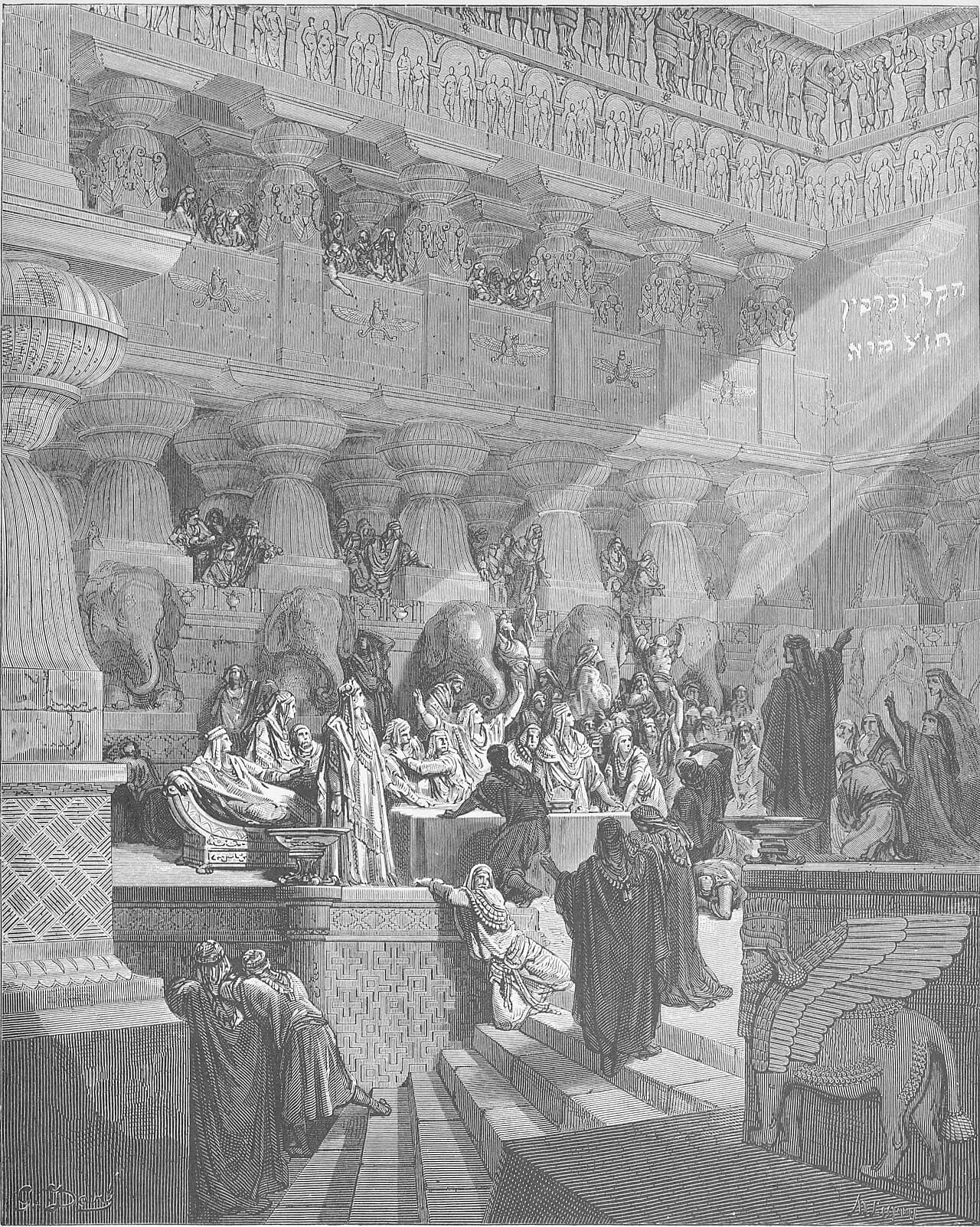
Gustave Doré, Daniel Interprets the Writing on the Wall, La Grande Bible de Tours, 1866. Public domain.
THE ARTWORKDoré engraved the scene of Daniel 5, in which Daniel, an exile from Judah, reads the writing on the wall to King Belshazzar at his feast.
Summary
Christians have read what Christ asks of them in the world in three main ways, called dominion, transformation and separation.
- Dominion holds that the commission of Genesis 1:28 still binds believers, and it takes three distinct forms: Abraham Kuyper's sphere sovereignty, R. J. Rushdoony's theonomy and the Seven Mountain teaching of Lance Wallnau and Johnny Enlow.
- Transformation holds that Christ converts a culture that sin has turned, the reading of Augustine's City of God, of Calvin's Geneva and of H. Richard Niebuhr's Christ and Culture (1951).
- Separation holds that the church is a people kept apart from the sword and the oath of the world. It is the reading of the Schleitheim Confession (1527), the Mennonite and Amish churches, and Resident Aliens (1989) by Stanley Hauerwas and William Willimon.
The Texts Every Position Reads
Six passages, from Genesis to Romans, set the terms of the question, and each position has to account for all six.
God blessed them and said to them, “Be fruitful and multiply, and fill the earth and subdue it; rule over the fish of the sea and the birds of the air and every creature that crawls upon the earth.”This blessing sets the command to subdue the earth beside the command to rule its creatures, and the positions divide over how far it reaches.
Then the LORD God took the man and placed him in the Garden of Eden to cultivate and keep it.The first work given to the man is to cultivate and keep the garden, and every position reads human labour from this verse.
Seek the prosperity of the city to which I have sent you as exiles. Pray to the LORD on its behalf, for if it prospers, you too will prosper.”Every position has to say whether the church now lives as these exiles did, seeking the prosperity of a city that does not worship God.
Then Jesus came to them and said, “All authority in heaven and on earth has been given to Me. Therefore go and make disciples of all nations, baptizing them in the name of the Father, and of the Son, and of the Holy Spirit, and teaching them to obey all that I have commanded you. And surely I am with you always, even to the end of the age.”Every position begins from the authority the risen Christ claims here, and they differ over what making disciples of all nations includes.
I am not asking that You take them out of the world, but that You keep them from the evil one. They are not of the world, just as I am not of the world. Sanctify them by the truth; Your word is truth. As You sent Me into the world, I have also sent them into the world.This prayer holds both halves of the question at once, since the disciples are not of the world and are sent into it.
Do not be conformed to this world, but be transformed by the renewing of your mind. Then you will be able to test and approve what is the good, pleasing, and perfect will of God.Every position has to say what being conformed to this world means and what the renewing of the mind changes.
Four Texts Read Three Ways
Dominion, transformation and separation each give their own reading of Genesis 1:28, Jeremiah 29:7, Matthew 5:13 to 16 and 2 Corinthians 6:17.
| The text | Dominion | Transformation | Separation |
|---|---|---|---|
| Genesis 1:28. Does the command to fill the earth and subdue it still bind the church? | It does. Sphere sovereignty lays it on every believer in every sphere of life, and the Seven Mountain teaching joins it to Matthew 28 as a charge to influence the seven spheres of a nation. | The commission stands, and sin has turned what human work makes. Christ restores that work by converting the people who do it and reforming what they make. | The commission of creation is kept in work, marriage and the household. The church's own charge is the one Christ gave in Matthew 28, and it is carried out without the sword. |
| Jeremiah 29:7. What does the command to seek the prosperity of the city ask of believers now? | Believers are to rise to influence in the spheres of their nation for Christ, as Joseph rose to rule over Egypt under Pharaoh. | The pilgrim city of Augustine makes use of the peace of the earthly city while it waits for its own. Seeking the good of the city is the church's work in every age. | The church prays for the city and does good to it, and it keeps apart from the city's sword and its gods, as Daniel kept from the king's food. |
| Matthew 5:13 to 16. What do salt and light do? | Salt and light are influence. A believer who serves in government, education or the media is salt within that sphere. | Salt keeps a society from corruption and light shows it the way. Wesley wrote that all who are holy are the salt of the earth and are to season others. | The city on a hill is the church itself, and its visible life together is the light the world sees. |
| 2 Corinthians 6:17. From what does the church come out? | It comes out from sin and idolatry and from no sphere of life, since sphere sovereignty claims every sphere for Christ. | It comes out from the evil in a culture, while each believer stays in his calling and works to reform it. | It comes out from the world's way of life and keeps a visible boundary between the church and its neighbours. |
- Dominion
- It does. Sphere sovereignty lays it on every believer in every sphere of life, and the Seven Mountain teaching joins it to Matthew 28 as a charge to influence the seven spheres of a nation.
- Transformation
- The commission stands, and sin has turned what human work makes. Christ restores that work by converting the people who do it and reforming what they make.
- Separation
- The commission of creation is kept in work, marriage and the household. The church's own charge is the one Christ gave in Matthew 28, and it is carried out without the sword.
- The text
- Jeremiah 29:7. What does the command to seek the prosperity of the city ask of believers now?
- Dominion
- Believers are to rise to influence in the spheres of their nation for Christ, as Joseph rose to rule over Egypt under Pharaoh.
- Transformation
- The pilgrim city of Augustine makes use of the peace of the earthly city while it waits for its own. Seeking the good of the city is the church's work in every age.
- Separation
- The church prays for the city and does good to it, and it keeps apart from the city's sword and its gods, as Daniel kept from the king's food.
- Dominion
- Salt and light are influence. A believer who serves in government, education or the media is salt within that sphere.
- Transformation
- Salt keeps a society from corruption and light shows it the way. Wesley wrote that all who are holy are the salt of the earth and are to season others.
- Separation
- The city on a hill is the church itself, and its visible life together is the light the world sees.
- Dominion
- It comes out from sin and idolatry and from no sphere of life, since sphere sovereignty claims every sphere for Christ.
- Transformation
- It comes out from the evil in a culture, while each believer stays in his calling and works to reform it.
- Separation
- It comes out from the world's way of life and keeps a visible boundary between the church and its neighbours.
The Three Positions
Dominion has three forms with separate founders, and transformation and separation each reach back more than four centuries.
Dominion as Kuyper's sphere sovereignty1898, Reformed
Abraham Kuyper, the Dutch theologian who later served as prime minister of the Netherlands, taught sphere sovereignty in Lectures on Calvinism. Under it the family, the university, the arts, the state and the church each answer to God directly, and no sphere rules another. The believer serves Christ in every one of them, so the work of the farm, the laboratory and the parliament is a calling.
Dominion as theonomy1973, Reformed
R. J. Rushdoony, in The Institutes of Biblical Law (1973), held that the law of Moses, its case laws included, is God's standard for every civil order today. Greg Bahnsen defended the same reading in Theonomy in Christian Ethics (1977). They read the dominion of Genesis 1:28 as a task carried out under God's law, and they expect the gospel to bring the nations under that law over long ages before Christ returns.
Dominion as the Seven Mountain teaching2001 onward, charismatic
The Seven Mountain teaching names seven spheres of a nation: media, government, education, the economy, the family, religion and the arts. Johnny Enlow set it out in The Seven Mountain Prophecy, and Lance Wallnau brought it to a wide public with Bill Johnson. Harold Eberle, in Victorious Eschatology (2006, with Martin Trench), teaches that the kingdom of Christ advances in history until every enemy is put under His feet, and Wallnau and Enlow share that hope.
TransformationAD 413 onward, Catholic and Reformed
Augustine held in The City of God that two cities run through all of history, one built on the love of self and one on the love of God. John Calvin's Ecclesiastical Ordinances set the worship, the teaching of the youth and the discipline of Geneva under the word of God. H. Richard Niebuhr, in Christ and Culture (1951), named this reading Christ the transformer of culture, in which the world is fallen and still God's and Christ converts what sin has turned.
Separation1527 onward, Anabaptist
In the Schleitheim Confession of the Swiss Brethren, article 4 calls believers to separate from the evil the devil has planted in the world. Its articles 6 and 7 refuse the sword of the magistrate and the oath to the believer. The Mennonite churches take their name from Menno Simons, and the Amish churches from Jakob Ammann. Stanley Hauerwas and William Willimon gave the separation reading a new hearing in Resident Aliens (1989).
The site's tradition is Wesleyan-Pentecostal and premillennial. Scripture leaves this question open to more than one faithful reading, and the site gives no verdict between dominion, transformation and separation.
What the Texts Say
Seven passages carry words and settings that each position has to weigh.
Rule and subdue in Genesis 1 and Psalm 82 passages
The two verbs of the commission are strong ones. Strong's dictionary defines radah, rule, as to tread down or subjugate, and kabash, subdue, as to tread down or conquer.
Then God said, “Let Us make man in Our image, after Our likeness, to rule over the fish of the sea and the birds of the air, over the livestock, and over all the earth itself and every creature that crawls upon it.”God names the rule in the same sentence as His image, so the commission belongs to what man is.
You made him ruler of the works of Your hands; You have placed everything under his feet:David's psalm returns to the commission, and Hebrews 2:8 to 9 reads it as fulfilled in Jesus, crowned with glory and honor.
The exiles told to settle in Babylon1 passage
Jeremiah wrote this letter to the exiles in Babylon while other prophets promised them a quick return. Jamieson, Fausset & Brown note that he told them the captivity would be long, which is why they were to build houses there.
This is what the LORD of Hosts, the God of Israel, says to all the exiles who were carried away from Jerusalem to Babylon: “Build houses and settle down. Plant gardens and eat their produce. Take wives and have sons and daughters. Take wives for your sons and give your daughters in marriage, so that they too may have sons and daughters. Multiply there; do not decrease.God's command reaches marriage and children, so that the people would multiply in Babylon and not decrease.
Come out and be separate2 passages
Paul's call in 2 Corinthians 6:17 is drawn from Isaiah 52:11. In Corinth the setting is the temple of God set against idols (2 Corinthians 6:16), so the line Paul draws runs between the worship of God and the worship of idols.
“Therefore come out from among them and be separate, says the Lord. Touch no unclean thing, and I will receive you.”The verse ends with a promise, that the Lord will receive those who come out.
Depart, depart, go out from there! Touch no unclean thing; come out from it, purify yourselves, you who carry the vessels of the LORD.Isaiah first gave this call to the people leaving Babylon, who carried the vessels of the LORD home.
Citizens of heaven and exiles on earth2 passages
John Wesley read the word Paul uses in Philippians 3:20 as citizenship. Albert Barnes reads the word Peter uses for foreigners in 1 Peter 2:11 as a sojourner who lives beside others without the rights of a citizen. Peter tells the same exiles to submit to every human institution and to honor the king (1 Peter 2:13 to 17).
But our citizenship is in heaven, and we eagerly await a Savior from there, the Lord Jesus Christ,Paul writes to a church in a Roman colony that its citizenship is in heaven.
Beloved, I urge you, as foreigners and exiles, to abstain from the desires of the flesh, which war against your soul.Peter's appeal to holiness comes first, before his commands about the king and the governors.
Daniel in the Court of Babylon
The first and fifth chapters of Daniel show an exile in a pagan court who served its kings and kept the law of his God.
Daniel was taken to Babylon as a young man, taught the language and literature of the Chaldeans, and trained for three years to enter the king's service (Daniel 1:3 to 5). Adam Clarke gives three likely reasons he refused the royal food, and the third is that the animals had first been offered as sacrifices to the gods of Babylon. Daniel kept that line and still served, and he remained in the court until the first year of King Cyrus (Daniel 1:21).
But Daniel made up his mind that he would not defile himself with the king’s food or wine. So he asked the chief official for permission not to defile himself.Daniel drew his line at the king's table while he accepted the king's training and service.
In response, Daniel said to the king, “You may keep your gifts for yourself and give your rewards to someone else. Nevertheless, I will read the inscription for the king and interpret it for him.Daniel refused Belshazzar's gifts and still read the inscription for him, the scene Doré engraved.
How the Question Came Down
Twelve dated marks trace the three positions from Augustine to the Seven Mountain teaching, and Niebuhr's five types of 1951 stand beside them.
From Augustine to Calvin's Genevafour marks, AD 413 to 1541
| When | Position | What |
|---|---|---|
| AD 413 to 426 | Transformation | Augustine writes The City of God. |
| 1527 | Separation | The Swiss Brethren meet at Schleitheim and agree on seven articles. |
| 1536 | Separation | Menno Simons, a Catholic priest in Friesland, leaves his parish to shepherd the scattered Anabaptists. |
| 1541 | Transformation | John Calvin returns to Geneva. |
- When
- AD 413 to 426
- Position
- Transformation
- What
- Augustine writes The City of God.
- When
- 1527
- Position
- Separation
- What
- The Swiss Brethren meet at Schleitheim and agree on seven articles.
- When
- 1536
- Position
- Separation
- What
- Menno Simons, a Catholic priest in Friesland, leaves his parish to shepherd the scattered Anabaptists.
- When
- 1541
- Position
- Transformation
- What
- John Calvin returns to Geneva.
From the Amish to the twenty-first centuryeight marks, 1693 to 2013
| When | Position | What |
|---|---|---|
| 1693 | Separation | The Amish divide from the Swiss Mennonites. |
| 1898 | Dominion | Abraham Kuyper gives the Stone Lectures at Princeton, published as Lectures on Calvinism. |
| 1951 | Transformation | H. Richard Niebuhr publishes Christ and Culture. |
| 1973 | Dominion | R. J. Rushdoony publishes The Institutes of Biblical Law. |
| 1989 | Separation | Stanley Hauerwas and William Willimon publish Resident Aliens. |
| 2001 | Dominion | C. Peter Wagner invites Lance Wallnau to teach the seven-mountain idea to apostolic leaders. |
| 2008 | Dominion | Johnny Enlow publishes The Seven Mountain Prophecy. |
| 2013 | Dominion | Lance Wallnau and Bill Johnson publish Invading Babylon. |
- When
- 1693
- Position
- Separation
- What
- The Amish divide from the Swiss Mennonites.
- When
- 1898
- Position
- Dominion
- What
- Abraham Kuyper gives the Stone Lectures at Princeton, published as Lectures on Calvinism.
- When
- 1951
- Position
- Transformation
- What
- H. Richard Niebuhr publishes Christ and Culture.
- When
- 1973
- Position
- Dominion
- What
- R. J. Rushdoony publishes The Institutes of Biblical Law.
- When
- 1989
- Position
- Separation
- What
- Stanley Hauerwas and William Willimon publish Resident Aliens.
- When
- 2001
- Position
- Dominion
- What
- C. Peter Wagner invites Lance Wallnau to teach the seven-mountain idea to apostolic leaders.
- When
- 2008
- Position
- Dominion
- What
- Johnny Enlow publishes The Seven Mountain Prophecy.
- When
- 2013
- Position
- Dominion
- What
- Lance Wallnau and Bill Johnson publish Invading Babylon.
Niebuhr's five types1951, Christ and Culture
| Type | What it holds | Niebuhr's examples |
|---|---|---|
| Christ against culture | The church stands apart from a culture it judges fallen. | Tertullian; Leo Tolstoy; the First Letter of John |
| The Christ of culture | Christ fulfils the best hopes of a culture. | The Gnostics; Peter Abelard; Albrecht Ritschl |
| Christ above culture | Culture is good, and grace completes it from above. | Clement of Alexandria; Thomas Aquinas |
| Christ and culture in paradox | The believer lives under two authorities at once until the end. | Paul; Martin Luther |
| Christ the transformer of culture | Christ converts a fallen culture to its true end. | The Gospel of John; Augustine; F. D. Maurice |
- Type
- Christ against culture
- What it holds
- The church stands apart from a culture it judges fallen.
- Niebuhr's examples
- Tertullian; Leo Tolstoy; the First Letter of John
- Type
- The Christ of culture
- What it holds
- Christ fulfils the best hopes of a culture.
- Niebuhr's examples
- The Gnostics; Peter Abelard; Albrecht Ritschl
- Type
- Christ above culture
- What it holds
- Culture is good, and grace completes it from above.
- Niebuhr's examples
- Clement of Alexandria; Thomas Aquinas
- Type
- Christ and culture in paradox
- What it holds
- The believer lives under two authorities at once until the end.
- Niebuhr's examples
- Paul; Martin Luther
- Type
- Christ the transformer of culture
- What it holds
- Christ converts a fallen culture to its true end.
- Niebuhr's examples
- The Gospel of John; Augustine; F. D. Maurice
What the Text Leaves Unsaid
Scripture gives the commission, the exile and the prayer of Jesus, and it leaves three questions open.
Genesis 1:28 gives humankind rule over the fish, the birds and every creature that crawls, and it names no rule of one people over another. The New Testament gives no plan for the law of a nation and no list of the spheres of a culture. The Old Testament shows Joseph set over Egypt and Daniel serving in Babylon, and neither Testament says how far a believer may go in the service of a court that does not know God.
What All Three Hold
Every position holds four things about Christ, His people and the world they live in.
CHRIST IS LORD OF ALL
Every position confesses that God put everything under the feet of Christ and made Him head over everything for the church.
THE CHURCH IS SENT
Every position holds that Christ sends His people into the world as the Father sent Him.
GOOD DEEDS ARE SEEN
Every position expects the conduct of believers to answer the slander of those around them.
THE KINGDOM IS HIS
Every position waits for the day when the kingdom of the world becomes the kingdom of our Lord and of His Christ.
How the Teachers Read It
Matthew Henry, Jamieson, Fausset & Brown and Dietrich Bonhoeffer read the texts of exile, submission, salt and light.
Matthew Henry on the peace of the land of captivity1710
“And, if they were to pray for and seek the peace of the land of their captivity, much more reason have we to pray for the welfare of the land of our nativity, where we are a free people under a good government, that in the peace thereof we and ours may have peace. Every passenger is concerned in the safety of the ship.”
Matthew Henry · Commentary on the Whole Bible · on Jeremiah 29:7Puritan
Jamieson, Fausset & Brown on salt and on submission1871
“The restoration or non-restoration of grace, or true living Christianity, to those who have lost it, has, in our judgment, nothing at all to do here. The question is not, If a man lose his grace, how shall that grace be restored to him? but, Since living Christianity is the only ‘salt of the earth,’ if men lose that, what else can supply its place?”
Jamieson, Fausset & Brown · Commentary Critical and Explanatory on the Whole Bible · on Matthew 5:13 to 16Reformed
“But lest they should think themselves so ennobled by faith as to be raised above subordination to human authorities, he tells them to submit themselves for the sake of Christ, who desires you to be subject, and who once was subject to earthly rulers Himself, though having all things subject to Him, and whose honor is at stake in you as His earthly representatives.”
Jamieson, Fausset & Brown · Commentary Critical and Explanatory on the Whole Bible · on 1 Peter 2:13Reformed
Dietrich Bonhoeffer on the visible community1937
“The call of Jesus Christ means either that we are the salt of the earth, or else we are annihilated; either we follow the call or we are crushed beneath it. There is no question of a second chance.”
Dietrich Bonhoeffer · The Cost of Discipleship · on Matthew 5:13Confessing Church
“A community of Jesus which seeks to hide itself has ceased to follow him.”
Dietrich Bonhoeffer · The Cost of Discipleship · on Matthew 5:14 to 16Confessing Church
“Jesus does not say that men will see God; they will see the good works and glorify God for them.”
Dietrich Bonhoeffer · The Cost of Discipleship · on Matthew 5:16Confessing Church
The Positions Weighed
Each of the five forms meets one objection from a named holder and work, and its own holders answer it.
| Position | Held by | Tradition | Representative work |
|---|---|---|---|
| Dominion as sphere sovereignty | Abraham Kuyper | Dutch Reformed; neo-Calvinist | Lectures on Calvinism (1898) |
| Dominion as theonomy | R. J. Rushdoony; Greg Bahnsen | Reformed; postmillennial | The Institutes of Biblical Law (1973) |
| Dominion as the Seven Mountain teaching | Lance Wallnau; Johnny Enlow; with Harold Eberle's victorious eschatology | Charismatic; apostolic and prophetic | The Seven Mountain Prophecy (2008); Invading Babylon (2013) |
| Transformation | Augustine; John Calvin; H. Richard Niebuhr; John Wesley on Matthew 5:13 | Catholic; Reformed; Methodist | The City of God (413 to 426); Christ and Culture (1951) |
| Separation | The Swiss Brethren; Menno Simons; Jakob Ammann; Stanley Hauerwas and William Willimon | Anabaptist; Mennonite; Amish | The Schleitheim Confession (1527); Resident Aliens (1989) |
- Position
- Dominion as sphere sovereignty
- Held by
- Abraham Kuyper
- Tradition
- Dutch Reformed; neo-Calvinist
- Representative work
- Lectures on Calvinism (1898)
- Position
- Dominion as theonomy
- Held by
- R. J. Rushdoony; Greg Bahnsen
- Tradition
- Reformed; postmillennial
- Representative work
- The Institutes of Biblical Law (1973)
- Position
- Dominion as the Seven Mountain teaching
- Held by
- Lance Wallnau; Johnny Enlow; with Harold Eberle's victorious eschatology
- Tradition
- Charismatic; apostolic and prophetic
- Representative work
- The Seven Mountain Prophecy (2008); Invading Babylon (2013)
- Position
- Transformation
- Held by
- Augustine; John Calvin; H. Richard Niebuhr; John Wesley on Matthew 5:13
- Tradition
- Catholic; Reformed; Methodist
- Representative work
- The City of God (413 to 426); Christ and Culture (1951)
- Position
- Separation
- Held by
- The Swiss Brethren; Menno Simons; Jakob Ammann; Stanley Hauerwas and William Willimon
- Tradition
- Anabaptist; Mennonite; Amish
- Representative work
- The Schleitheim Confession (1527); Resident Aliens (1989)
Sphere sovereignty and the magistrate's office
The Schleitheim Confession holds in article 6 that a Christian may not serve as a magistrate, since magistracy is an office after the flesh and the Christian is after the Spirit. Kuyper answered in his lecture on Calvinism and politics that all the powers that be, in empires or republics, in cities or states, rule by the grace of God.
Theonomy and the Westminster Confession
The Westminster Confession (1646) holds in chapter 19 that the judicial laws given to Israel as a body politic expired together with the state of that people. The same section binds no other people by those laws further than their general equity may require. Greg Bahnsen answered in By This Standard (1985), his summary of Theonomy in Christian Ethics, that this general equity is what theonomy applies.
The Joseph anointing and the Lord who would not be king
In On Idolatry, chapter 18, Tertullian answered Christians who cited Joseph and Daniel that their case is not the believer's. They were slaves, and the believer is the slave of Christ alone and acts after his Lord's pattern. Johnny Enlow answers in The Seven Mountain Mantle (2010) that believers who enter the systems of a pagan nation carry a Joseph anointing to influence those systems for Christ.
Then Jesus, realizing that they were about to come and make Him king by force, withdrew again to a mountain by Himself.Tertullian reads this withdrawal of Jesus from those who would make Him king as the example He gave His own.
Transformation and the power of the state
Hauerwas and Willimon hold in Resident Aliens (1989) that the American church, in its public and its private forms alike, stayed Constantinian and took the support of American democracy as its first social task. In their reading it took on the habits of the power it served. Augustine answers in The City of God that no empire is the kingdom, so a church that serves a city has no reason to mistake that city for the city of God.
Separation and the lawful magistrate
The Westminster Confession holds in chapter 23 that it is lawful for Christians to accept and execute the office of a magistrate when called to it. In chapter 22 it holds that a lawful oath is a part of religious worship. Hauerwas and Willimon answer in Resident Aliens that the church's own life together is its witness, a social alternative the world cannot know on its own terms.
Read the Great Books
These nine works include at least two from each position.
The City of God
Augustine of Hippo · AD 413 to 426
Augustine wrote it to answer those who blamed the sack of Rome in 410 on the abandoning of the old gods.
The Schleitheim Confession
The Swiss Brethren · 1527
Zwingli wrote that almost every Anabaptist had a copy, and he translated the seven articles into Latin.
Lectures on Calvinism
Abraham Kuyper · 1898
In these lectures Kuyper applies the lordship of Christ to religion, politics, science and art in turn.
The Cost of Discipleship
Dietrich Bonhoeffer · 1937
Bonhoeffer reads the Sermon on the Mount as the call of Christ to a visible community.
In print: find it wherever books are sold.
Christ and Culture
H. Richard Niebuhr · 1951
Niebuhr's five types gave the whole debate the names it still uses.
In print: find it wherever books are sold.
The Institutes of Biblical Law
R. J. Rushdoony · 1973
Rushdoony opens the book with a commentary of some 650 pages on the Ten Commandments, taking each one in turn.
In print: find it wherever books are sold.
Resident Aliens
Stanley Hauerwas and William H. Willimon · 1989
The book argues that the church is a colony in a foreign land whose first task is to be the church.
In print: find it wherever books are sold.
Victorious Eschatology: A Partial Preterist View
Harold R. Eberle and Martin Trench · 2006
The book is the fullest statement of the partial preterist hope in the charismatic churches.
In print: find it wherever books are sold.
The Seven Mountain Prophecy
Johnny Enlow · 2008
The book is Enlow's foundational statement of the Seven Mountain teaching.
In print: find it wherever books are sold.
Light Before Others
Matthew 5:16 gives one charge to every believer, whichever position he holds.
Jeremiah and Jesus add charges that hold under every position. The believer is to seek the good of the city where God has placed him and to pray for it. He lives there under the prayer of Jesus that the Father keep His own from the evil one. Christ, who holds all authority in heaven and on earth, has promised to be with His people to the end of the age.
In the same way, let your light shine before men, that they may see your good deeds and glorify your Father in heaven.Keep studying
Studies9