
Jesus Christ · The Sermon on the Mount
The Law Fulfilled
Right after telling His people what they already are , salt, light : Jesus turns to what He came to do with the Law and the Prophets: not to tear them down, but to bring them to their intended fullness. “Think not that I am come to destroy… I am not come to destroy, but to fulfil.” Not one letter of it is being cancelled , and yet everything about how it is kept is about to change.
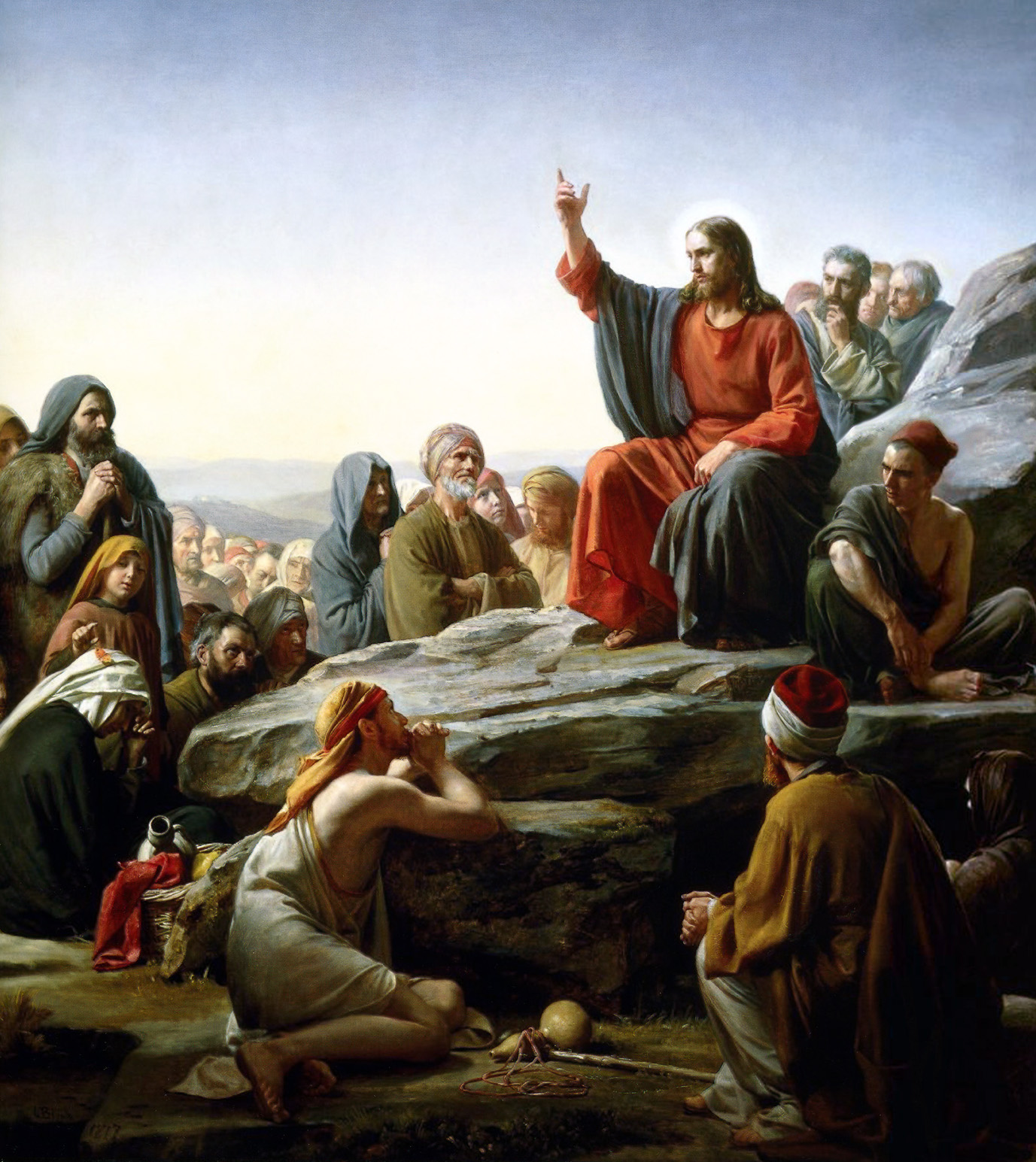
Carl Bloch, The Sermon on the Mount, 1877. Public domain.
THE ARTWORKBloch paints the moment this saying belongs to : Jesus seated on the mountain, teaching a crowd that already knew the Law and the Prophets by heart. What He says next (5:17–20) is the claim that governs everything Bloch's crowd is about to hear: not one letter set aside, and yet everything about to change.
Summary
Matthew 5:17-20, the Sermon on the Mount's hinge, is walked clause by clause: not one jot or tittle set aside, yet a righteousness that must exceed the scribes and Pharisees. The page names three ways the church has read what 'fulfil' means for how a Christian relates to the Law now, without picking one.
- The key Greek contrast is plēroō, to fill up, against katalyō, to destroy: Jesus rules out abolishing the Law before saying what He does instead
- Jot and tittle are named as the smallest possible marks in the Hebrew text, and neither is being annulled
- Three positions are held side by side: fulfillment as completion, as intensification, and the dispensational kingdom-offer reading
- Romans 10:4, Galatians 3:24, and Hebrews 8:6 are brought in to show the same claim made elsewhere in Scripture
The Text
Matthew 5:17–20
Do not think that I have come to abolish the Law or the Prophets. I have not come to abolish them, but to fulfill them.Not destroy , fulfil. The claim that governs everything after it.
For I tell you truly, until heaven and earth pass away, not a single jot, not a stroke of a pen, will disappear from the Law until everything is accomplished.Not one jot, not one tittle , the smallest letter and stroke of the Law.
So then, whoever breaks one of the least of these commandments and teaches others to do likewise will be called least in the kingdom of heaven; but whoever practices and teaches them will be called great in the kingdom of heaven.Least and great in the kingdom , measured against these commandments.
For I tell you that unless your righteousness exceeds that of the scribes and Pharisees, you will never enter the kingdom of heaven.A righteousness that exceeds the scribes and Pharisees, or no entry at all.
This is the sermon's hinge. “The law and the prophets” , the exact phrase Jesus uses here , does not appear again until 7:12, the Golden Rule: “for this is the law and the prophets.” Everything between 5:17 and 7:12 , the antitheses, almsgiving, prayer, fasting, treasure, anxiety, judging , sits inside the frame those two verses open and close. What fulfilled righteousness looks like is the whole sermon's subject.
The Jot and the Tittle
the smallest mark, inspected
Jot: the yod, smallest letter of the Hebrew alphabet. Tittle: keraia, “little horn,” the smallest decorative stroke that tells one Hebrew letter from another.
Not to destroy, but to fulfil
MATTHEW 5:17
The Word He Rules Out First
fulfil, not destroy
Jesus rules out one word before He does anything else with the Law: He is not come to destroy it. What He does instead, He names with a different word , and the difference between the two words carries the weight of the whole passage.
Fulfil, not destroy , the Greekplēroō vs. katalyō
“Fulfil” translates plēroō: to fill up, to complete, to bring something to its intended fullness. Jesus rules out the opposite word, katalyō, “destroy” , to tear down, dissolve, annul. He is not cancelling the Law and the Prophets; He is the one in whom they reach the goal they were always aimed at.
Jot and tittle , the smallest marksiota and keraia
“Jot” (Greek iota) is the smallest letter of the Hebrew alphabet, yod; “tittle” (Greek keraia, “little horn”) is the smallest decorative stroke that distinguishes one Hebrew letter from another. Jesus is not speaking loosely : He names the smallest mark that could possibly be dropped from the text, and says not even that is being annulled.
Three Ways the Church Reads “Fulfil”
named positions, no house verdict
Every tradition agrees Jesus is not cancelling the Law. Where they differ is what “fulfil” means for how a Christian relates to it now.
Fulfillment as completionthe majority Reformed / evangelical reading
The ceremonial law , sacrifice, priesthood, temple , reaches its terminus in Christ; the moral law's authority continues, now read at the level of the heart, not merely the outward act. This reading goes back to Calvin's threefold division of the Law (moral, ceremonial, judicial) and remains the majority position across Reformed and evangelical commentary.
Fulfillment as intensificationa stress within the majority view
A stress within the completion reading: the antitheses that follow (“Ye have heard… but I say unto you”) are Jesus raising the Law's bar, not merely relocating it to the heart. Anger stands under the same judgment as murder; a deliberate lustful look under the same judgment as adultery. Fulfilling the Law means the Law now reaches further, not less.
Dispensational distinctiona kingdom offer, not yet the church age
The Sermon addresses Israel under a kingdom offer not yet inaugurated; the church age that follows operates under the apostolic epistles. On this reading the moral substance of what Jesus teaches carries over in full, but the framework : Law as the governing covenant , does not. Associated with classic dispensationalism, including Scofield's notes.
The Voices on “I Am Come to Fulfil”
the church hears Matthew 5:17
(Verse 17.) Do not think that I have come to abolish the law or the prophets. I have not come to abolish, but to fulfill. Whether it is that he has fulfilled the prophecies about himself through others, or because by his preaching he has fulfilled those things which before were crude and imperfect on account of the weakness of those who heard them, taking away wrath and excluding retaliation, and suppressing hidden desire in the mind.
Jerome · Commentary on Matthew (420), on Matt 5:17
Think not that I am come ... - Our Saviour was just entering on his work. It was important for him to state what he came to do. By his setting up to be a teacher in opposition to the scribes and Pharisees, some might charge him with an intention to destroy their law, and to abolish the customs of the nation. He therefore told them that he did not come for that end, but really to fulfill or accomplish what was in the law and the prophets.
Albert Barnes · Notes, Explanatory and Practical, Matt 5:17
He here asserts two things; He denies that He was come to subvert the Law, and affirms that He was come to fulfil it.
Remigius of Rheims · Catena Aurea by Aquinas, on Matt 5:17
The Voices on Jot and Tittle
the church hears Matthew 5:18
It is the expression manifestly, of supreme legislative authority; and as the subject in connection with which it is uttered is the Moral Law, no higher claim to an authority strictly divine could be advanced.
Jamieson, Fausset & Brown · Commentary Critical and Explanatory on the Whole Bible (1871), Matt 5:18
But the "one dot" is not only the iota of the Greeks but also that which among the Hebrews is called the yod. And the "one iota" or "one dot" can symbolically be said to be Jesus, since the beginning of his name is written not only by Greeks with an iota but also by Hebrews with a yod. So Jesus will be the one dot, the Word of God in the law which does not pass from the law until all is accomplished. But the iota might also be (as he himself says) the Ten Commandments of the law, for everything else passes away, but these do not pass away. But neither does Jesus pass away; if he "falls to the ground" he does so willingly, in order to bear much fruit. Again, the "one iota" or "one dot" has mastery over things both in heaven and on earth.
Origen of Alexandria · Fragment 99 (253), on Matt 5:18
For verily I say unto you, Till heaven - In the very commencement of his ministry, Jesus Christ teaches the instability of all visible things. The heaven which you see, and which is so glorious, and the earth which you inhabit and love, shall pass away; for the things which are seen are temporal, προσκαιρα, are for a time; but the things which are not seen are eternal αιωνια, ever-during, 2Co 4:18. And the Word of the Lord endureth for ever. One jot or one tittle - One yod, (י), the smallest letter in the Hebrew alphabet.
Adam Clarke · Commentary on the Bible (1832), Matt 5:18
The Voices on the Least Commandments
the church hears Matthew 5:19
With a beautiful introduction Christ moves beyond the work of the law. He does not intend to abolish it but to enhance it by fulfilling it. He declares that his apostles will not be able to enter heaven unless their righteousness exceeds that of the Pharisees. Therefore he bypasses what is laid down in the law, not for the sake of abolishing it, but for the sake of fulfilling it.
Hilary of Poitiers · Commentary on Matthew 4.16 (367), on Matt 5:19
Whoever sets aside "one of the least of the commandments" of the law is set aside by God as God's enemy and as an inventor of laws opposed to God. And now out of the law of the gospel that one receives the retribution which, under the ancient law, was not defined. For this reason Christ fittingly says, "I am not come to destroy but to fulfill." For that which then was lacking, here is made full. It is said in the law: "Stand in the presence of the elderly" and "If you see the beast of your enemy fallen under its load, go help him lift it up." If anyone transgressed these commandments, there was no retribution specified under the law. So Christ makes up this lack when he says that in the kingdom of heaven such a person will be treated with scorn.
Cyril of Alexandria · Fragment 48.19 (444), on Matt 5:19
If even an honourable man blushes to be found in a falsehood, and a wise man lets not fall empty any word he has once spoken, how could it be that the words of heaven should fall to the ground empty? Hence He concludes, Whoso shall break the least of these commandments, &c. And, I suppose, the Lord goes on to reply Himself to the question, Which are the least commandments? Namely, these which I am now about to speak. Otherwise; the precepts of Moses are easy to obey; Thou shall not kill. Thou shall not commit adultery. The very greatness of the crime is a check upon the desire of committing it; therefore the reward of observance is small, the sin of transgression great. But Christ's precepts, Thou shalt not be angry, Thou shalt not lust, are hard to obey, and therefore in their reward they are great, in their transgression, 'least.' It is thus He speaks of these precepts of Christ, such as Thou shall not be angry, Thou shalt not lust, as 'the least;' and they who commit these lesser sins, are the least in the kingdom of God; that is, he who has been angry and not sinned grievously is secure from the punishment of eternal damnation; yet he does not attain that glory which they attain who fulfil even these least.
Pseudo-Chrysostom · Catena Aurea by Aquinas, on Matt 5:19
The Voices on a Righteousness That Exceeds
the church hears Matthew 5:20
And let us be diligent, if we would attain unto the kingdom, to show forth something more than the old commandments; since we cannot otherwise lay hold of the things of Heaven. For if we arrive but at the same measure, that of the ancients, we shall stand without that threshold; for "except your righteousness shall exceed the righteousness of the Scribes and Pharisees, ye cannot enter into the kingdom of Heaven." Yet, although so heavy a threat is set down, there are some who so far from over-passing this righteousness, even come short of it; so far from shunning oaths, they even swear falsely; so far from avoiding an unchaste gaze, they even fall into the very act of wickedness. And all the rest of the things which are forbidden, they dare to do, as though past feeling: waiting for one thing only, the day of punishment, and the time when they are to pay the most extreme penalty for their misdoings.
John Chrysostom · Homily on the Gospel of Matthew 17 (407), on Matt 5:20
Except your righteousness shall exceed - περισσευση, Unless your righteousness abound more - unless it take in, not only the letter, but the spirit and design of the moral and ritual precept; the one directing you how to walk so as to please God; the other pointing out Christ, the great Atonement, through and by which a sinner is enabled to do so - more than that of the scribes and Pharisees, who only attend to the letter of the law, and had indeed made even that of no effect by their traditions - ye shall not enter into the kingdom of heaven.
Adam Clarke · Commentary on the Bible (1832), Matt 5:20
Beautiful entrance He here makes to a teaching beyond the works of the Law, declaring to the Apostles that they should have no admission to the kingdom of heaven without a righteousness beyond that of Pharisees.
Hilary of Poitiers · Catena Aurea by Aquinas, on Matt 5:20
The Law Was Never the Destination
the same claim across Scripture
For Christ is the end of the law, to bring righteousness to everyone who believes.“Christ is the end of the law for righteousness” : Paul's own gloss on the same claim.
So the law became our guardian to lead us to Christ, that we might be justified by faith.The Law as a schoolmaster bringing us to Christ , pointing forward, not standing alone.
Now, however, Jesus has received a much more excellent ministry, just as the covenant He mediates is better and is founded on better promises.A better covenant on better promises , what the Law's fulfilment opens onto.
Paul, Hebrews, and Jesus Himself are describing the same shape from different angles: the Law was never the destination. Where the traditions divide is exactly how much of the old framework survives the fulfilment and in what form , the question the three positions above each answer differently.
What Changes, What Doesn't
Nothing in the Law and the Prophets is being set aside , not the least stroke of it. What changes is where it lands: no longer satisfied by the outward act alone, but reaching the anger behind the murder, the look behind the adultery, the heart behind the hand. The rest of the sermon is what that fulfilled righteousness looks like, lived out.
Notable art
— click a piece to enlargeKeep studying
Read it1
On this page
By subject
Obedience9 pages
Holiness12 pages
The Gospels68 pages