

Genesis 2 · Symbol · Featured Study
Wind and Breath
A symbol study of ruach and pneuma from Genesis 1 to Pentecost, with the Hebrew and Greek words and the readings in dispute.
The wind that drove back the sea in Exodus 14 and the Spirit over the waters in Genesis 1:2 have one name in Hebrew.
- The word
- רוּחַ (ruach), H7307
- First appears
- Genesis 1:2 “Now the earth was formless and void, and…”
Gaspard Dughet, Landscape with Elijah and the Angel on Mount Horeb, 1660. Public domain.
Summary
Scripture names wind, breath and spirit with one word in Hebrew and one in Greek. A single passage can move between all three senses.
- In Genesis 2 the LORD God breathed the breath of life into the man, and the man became a living being.
- Jesus tells Nicodemus that the wind blows where it wishes. The one word pneuma stands for both the wind and the Spirit.
- The risen Jesus breathed on His disciples in John 20. At Pentecost a sound like a rushing wind filled the house.
The Breath of Life
The Spirit hovers in the first chapter, and God breathes in the second.
Genesis uses two different words in these verses, ruach for the Spirit of God over the waters and neshamah for the breath God puts into the man.
Now the earth was formless and void, and darkness was over the surface of the deep. And the Spirit of God was hovering over the surface of the waters.The verse comes before the first word God speaks in Genesis 1:3.
Then the LORD God formed man from the dust of the ground and breathed the breath of life into his nostrils, and the man became a living being.Elihu draws on this verse in Job 33:4, as Adam Clarke notes.
The Wind on Horeb and in the Valley
Dughet drew the wind of 1 Kings 19, and Ezekiel 37 gives ruach three senses.
Dughet drew the storm that passed before Elijah, with the prophet small at its foot.
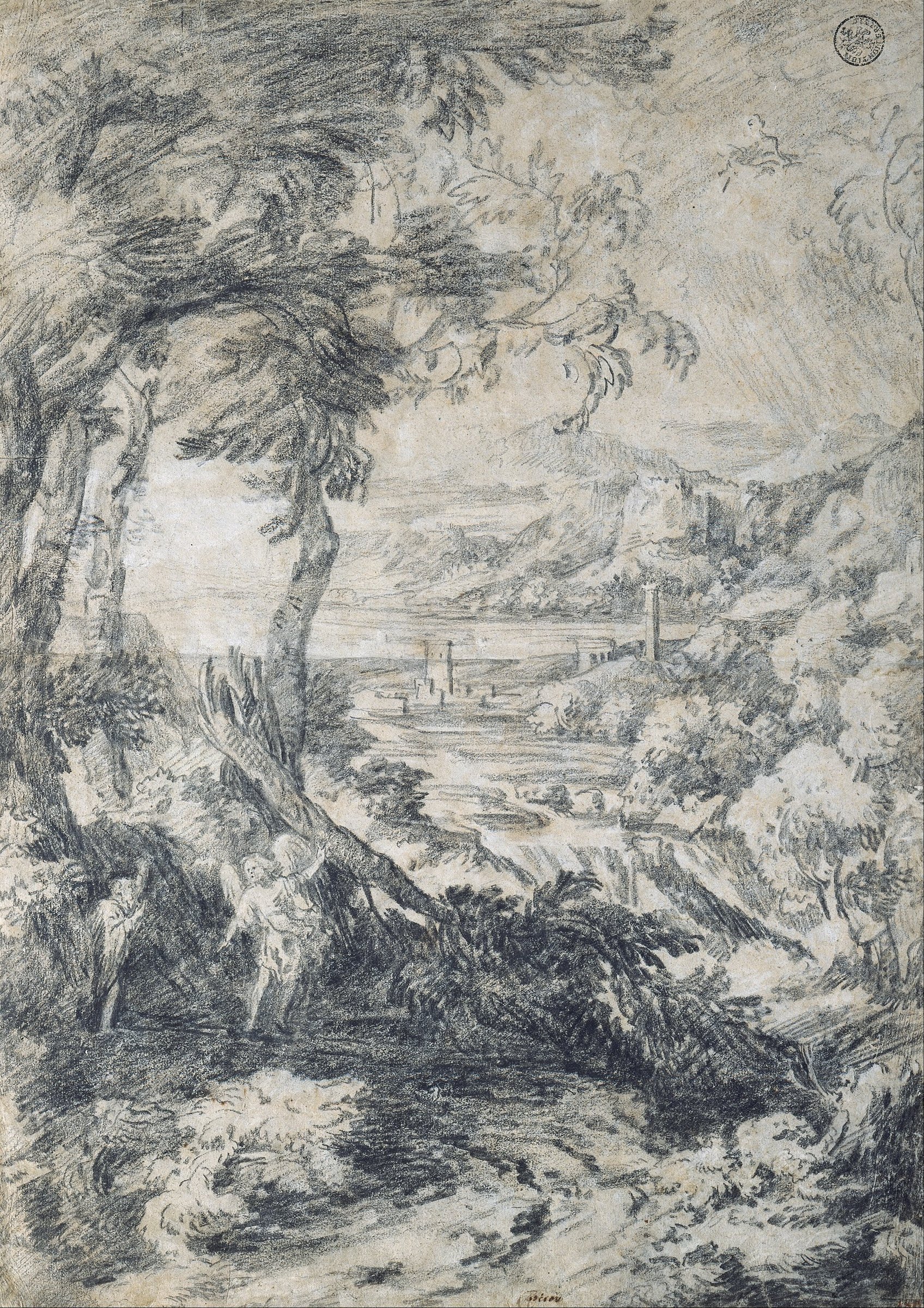
- The trees in the galeThe tall trees bend and toss to the right.1 Kings 19:11
- The mountainsHills rise across the valley under the storm.1 Kings 19:11
- The leaning treeA tree leans across the slope in the wind.1 Kings 19:11
- ElijahThe prophet stands in his cloak at the edge of the wood.1 Kings 19:13
- The angelA winged figure stands beside him.1 Kings 19:7
Gaspard Dughet, Landscape with Elijah and the Angel on Mount Horeb, 1660. Public domain.
Five parts of the drawing, each numbered where it stands, with the verse the part answers to.
Ezekiel 37 uses ruach as breath, as wind and as the Spirit of God within ten verses.
| Verse | The Berean word | The sense |
|---|---|---|
| Ezekiel 37:5 | breath | the life that enters the bones |
| Ezekiel 37:9 | the four winds | the winds that blow from every quarter |
| Ezekiel 37:14 | My Spirit | the Spirit that is the LORD's own |
Wind and Breath Through Scripture
Each stop names one wind or one breath.
The wind and the breath run from the waters of Genesis 1 to the house filled at Pentecost.
- Genesis 1The Spirit over the waters, Genesis 1:2
- Genesis 2The breath of life, Genesis 2:7
- Genesis 7All that had breath died, Genesis 7:22
- Genesis 8A wind over the earth, Genesis 8:1
- Exodus 14A strong east wind, Exodus 14:21
- Exodus 15You blew with Your breath, Exodus 15:10
- Numbers 11A wind brings the quail, Numbers 11:31
- 1 Kings 19The LORD not in the wind, 1 Kings 19:11
- Job 33The breath of the Almighty, Job 33:4
- Psalm 33The stars by the breath of His mouth, Psalm 33:6
- Psalm 104You send Your Spirit, Psalm 104:30
- Ecclesiastes 12The spirit returns to God, Ecclesiastes 12:7
- Ezekiel 37Come from the four winds, Ezekiel 37:9
- John 3The wind blows where it wishes, John 3:8
- John 20He breathed on them, John 20:22
- Acts 2A mighty rushing wind, Acts 2:2
One stop for each passage in canon order; each stop opens its verse in the reader.
The flood ended by a spiritAmbrose of Milan, On Noah and the Ark, on Genesis 8:1
Ambrose reads the ruach of Genesis 8:1 as the Spirit, on the ground that a wind could not have dried up the flood.
“And the Lord brought a spirit upon the earth, and the water ceased (Genesis VIII, 1). I do not think this is said in such a way that we should understand the spirit as the name for wind. For the wind could not have dried up the flood. Otherwise, since the sea is stirred up daily by winds, it would certainly be emptied.”
Ambrose of Milan · On Noah and the Ark, 16.58 · on Genesis 8:1Patristic
What Scripture Says of the Wind
Three verses where the wind or the breath stands for the Spirit, and two readings of the breath of John 20.
BORN OF THE SPIRIT
Jesus likens everyone born of the Spirit to the wind no one can trace.
MY SPIRIT IN YOU
God promises to put His Spirit in the people raised from the valley.
BREATHED ON THEM
The risen Jesus gives the Spirit with His breath.
The breath of John 20 and the breath of Genesis 2Adam Clarke and John Wesley on John 20:22
Adam Clarke, in his Commentary on the Bible, says Jesus alluded to the first creation, when God breathed into the man, so that the disciples were to be made new men for their work. John Wesley, in his Explanatory Notes, calls the breathing an earnest of Pentecost.
Ruach, Neshamah and Pneuma
The Hebrew and Greek words for wind and breath.
Ruach in Hebrew and pneuma in Greek each covers wind, breath and spirit.
| Word | Strong's number | Strong's definition | Uses |
|---|---|---|---|
| רוּחַ ruach | H7307 | “wind, and by resemblance breath; figuratively life and spirit” | 378 |
| נְשָׁמָה neshamah | H5397 | “a puff, wind, the breath of life, divine inspiration” | 24 |
| πνεῦμα pneuma | G4151 | “a current of air, breath or a breeze; figuratively a spirit” | 378 |
| πνέω pneo | G4154 | “to breathe hard, to blow” | 7 |
The breath of the Almighty in Job 33:4Adam Clarke on Job 33:4
Adam Clarke reads Job 33:4 as a plain allusion to Genesis 2:7, since Elihu uses the same word for breath, nishmath, and the same verb of giving life.
The Spirit of God has made me, and the breath of the Almighty gives me life.Elihu puts the Spirit of God and the breath of the Almighty side by side.
What the Text Does Not Say
Three questions about wind and breath that the text leaves open.
The passages name the wind's work and leave its source and its substance unexplained.
| What is not said | What the verse does say |
|---|---|
| What was the breath of life made of? | God breathed it into the man's nostrils. |
| Where does the wind come from, and where does it go? | No one knows where it comes from or where it is going. |
| Why was the LORD not in the wind? | The LORD was not in the wind, the earthquake or the fire. |
Breathed Into and Breathed On
The valley of Ezekiel 37 and the locked room of John 20 are set side by side.
Then He said to me, “Prophesy to the breath; prophesy, son of man, and tell the breath that this is what the Lord GOD says: Come from the four winds, O breath, and breathe into these slain, so that they may live!” So I prophesied as He had commanded me, and the breath entered them, and they came to life and stood on their feet—a vast army.The prophet speaks to the breath, and the slain stand up as an army.
When He had said this, He breathed on them and said, “Receive the Holy Spirit.The breath and the gift of the Spirit are given in one verse.
In both scenes life comes by a breath God sends to people who could not give it to themselves.
Voices on Wind and Breath
Ambrose, Basil, Matthew Henry and John Wesley, each with the work named.
died 379 · Basil of Caesarea
Basil of Caesarea, in On the Holy Spirit, reads Psalm 104:30 as the Spirit's work in raising the dead and in making sinners a new creation.
died 397 · Ambrose of Milan
Ambrose of Milan, in his Exposition of the Christian Faith, presses the words where it wishes to show that the Spirit breathes by His own will.
1662 to 1714 · Matthew Henry
Matthew Henry, in his Commentary on Acts 2:2, says the sign came as a wind because the way of the Spirit is like the wind. He joins it to the four winds of Ezekiel 37.
1703 to 1791 · John Wesley
John Wesley, in his Explanatory Notes upon the New Testament, on John 3:8, says the fact of the new birth is plain while the manner of the Spirit's working cannot be explained.
Matthew Henry, John Wesley
Two Open Questions
How the east wind divided the sea, and what the sound of Pentecost was.
The east wind worked by natural meansAlbert Barnes, Notes, Explanatory and Practical, on Exodus 14:21
Albert Barnes holds that the agency was natural and that the narrative is satisfied if the crossing took place near Suez.
The objection: Exodus 15:8 gives the walls of water to the blast of God's nostrils, and a natural wind does not stand water up like a wall.
The east wind required God's handJamieson, Fausset and Brown, Commentary Critical and Explanatory, on Exodus 14:21
Jamieson, Fausset and Brown hold that the idea of divine interposition is imperative, while they name a likely line of crossing where an east wind would cut the sea.
The objection: the text names the wind as the means and gives it all night to work, which reads as God using the wind.
The sound of Pentecost was thunder and a rush of airAdam Clarke, Commentary on the Bible, on Acts 2:2
Adam Clarke takes the sound from heaven as thunder, the sign of God's presence, and the rushing wind as air drawn in after a passage of electrical fire.
The objection: Luke says the sound was like a wind, a likeness, and says nothing of weather.
The sound of Pentecost was a sign to wake the sensesJohn Calvin, Commentary on Acts
John Calvin reads the sound as God waking the disciples' senses so that they would know the promised Spirit had come.
“For such is our slothfulness to consider the gifts of God, that unless he awake all our senses, his power shall pass away unknown. This was, therefore, a preparation that they might the better know that the Spirit was now come which Christ had promised.”
John Calvin · Commentaries · on Acts 2:2Reformed
The objection: the reading explains why the sound came and leaves open what it was.
Books to Read Next
Three works a student reads next, each free to read.
Commentary on the Bible
Adam Clarke · 1832
His notes on Genesis 2 and Job 33 follow the breath of God through the Hebrew.
READ HIS GENESIS NOTES →Commentary Critical and Explanatory
Jamieson, Fausset and Brown · 1871
Their notes on Exodus 14 weigh the east wind that divided the sea.
READ THEIR EXODUS NOTES →Notes, Explanatory and Practical
Albert Barnes · 1832 to 1869
His notes on Exodus 14 read the east wind as the means God used.
READ HIS EXODUS NOTES →Everything That Has Breath
Every breath in Scripture comes from God and goes back to Him.
The Psalter ends by giving that breath its use: let everything that has breath praise the LORD.
Sources
Scripture is the Berean Standard Bible.
- James Strong, Exhaustive Concordance of the Bible, 1890, entries H7307, H5397, G4151 and G4154, with each word's count of uses.
- Adam Clarke, Commentary on the Bible, 1832, on John 20:22.
- John Wesley, Explanatory Notes upon the New Testament, 1755, on John 20:22.
- Adam Clarke, Commentary on the Bible, 1832, on Job 33:4.
- Ambrose of Milan, Exposition of the Christian Faith 2.6.47, on John 3:8.
- Basil of Caesarea, On the Holy Spirit 19.49, on Psalm 104:30.
- Matthew Henry, Commentary on the Whole Bible, 1710, on Acts 2:2.
- John Wesley, Explanatory Notes upon the New Testament, 1755, on John 3:8.
- Albert Barnes, Notes, Explanatory and Practical, on Exodus 14:21.
- Jamieson, Fausset and Brown, Commentary Critical and Explanatory, 1871, on Exodus 14:21.
- Adam Clarke, Commentary on the Bible, 1832, on Acts 2:2.
- John Calvin, Commentary on Acts, on Acts 2:2.
Keep Studying
People and groups3
Places1
Symbols1