
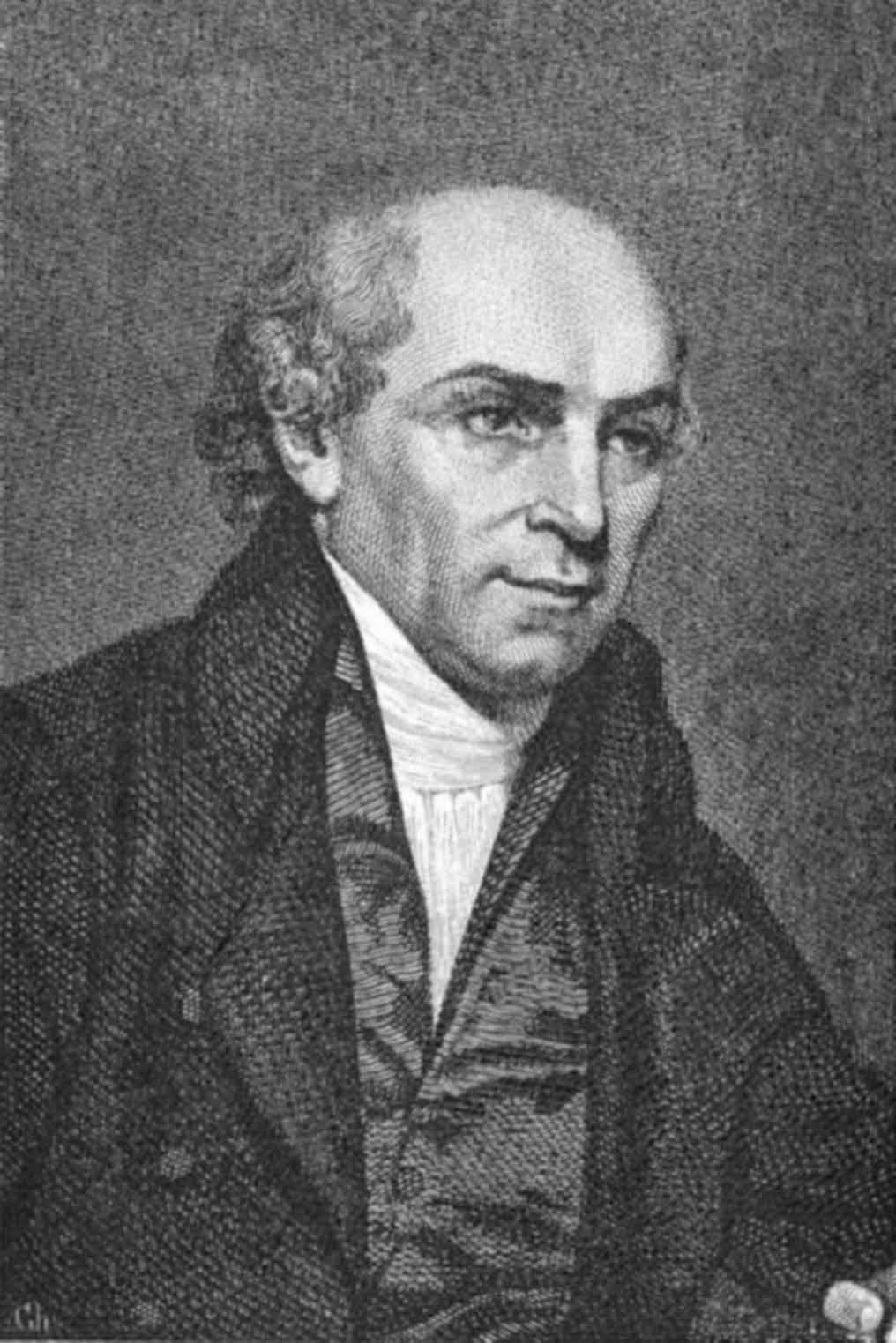
Unknown engraver, William Carey, 1887. Public domain.
Northamptonshire and Bengal, to 1834 · Person · Featured Study
William Carey
He published his Enquiry, sailed for India and worked in Bengal until he died.
A cobbler with a map of paper sheets on his wall asked whether Christ's command to teach all nations still bound the church, and a chairman called him an enthusiast.
“Enlarge the site of your tent, stretch out the curtains of your dwellings, do not hold back. Lengthen your ropes and drive your stakes in deep.
“Enlarge the site of your tent, stretch out the curtains of your dwellings, do not hold back. Lengthen your ropes and drive your stakes in deep.
- Born
- 17 August 1761 in Northamptonshire
- Died
- 9 June 1834 at Serampore
- Family
- first wife: Dorothy Placket; son: Felix Carey; nephew: Eustace Carey
- Places
- Paulerspury, Moulton, Leicester, Calcutta, Mudnabati, Serampore
Summary
William Carey made and mended shoes in Northamptonshire and became a Particular Baptist pastor. He published a book on the duty of sending missionaries and preached a sermon at Nottingham from Isaiah. That autumn his brethren formed a society at Kettering. He landed in Bengal and settled at Serampore. He died there without going home.
- His Enquiry asks whether Christ's commission to the apostles still binds the church.
- The famous heads of his sermon survive only in the reports of those who heard it.
- His first wife's illness and the death of his son Peter belong to his first years in India.
The Sermon on Isaiah 54
The association's minutes record that he preached at Nottingham on Isaiah 54:2 and 3.
The Northamptonshire Association met at Nottingham from 29 to 31 May 1792. Its printed minutes record that Brother Carey preached on the Wednesday morning from Isaiah 54:2 and 3. The text tells a barren woman to enlarge the place of her tent.
The question of this life is how a village cobbler with no college moved his church to send men to India. Most of what is known of his early years comes from his friends and from the nephew who wrote his memoir.
Therefore go and make disciples of all nations, baptizing them in the name of the Father, and of the Son, and of the Holy Spirit,The first section of his Enquiry asks whether this command still binds the church.
The Life in Order
The society's records give the founding years, and Smith's Life gives the forty-one years in Bengal.
He never saw England after 1793.
- 17 August 1761Born in the midlands of EnglandSmith, page 1
- About 1777 to 1789Twelve years at the cobbler's benchSmith, by the missionary brief
- 1786The question put to the ministers at NorthamptonMorris, as Smith reports him
- 1792An Enquiry published at LeicesterIts title page
- 30 or 31 May 1792The Nottingham sermonThe minutes; the Periodical Accounts
- 2 October 1792The society formed at KetteringThe Periodical Accounts, volume 1
- 11 November 1793Landing at CalcuttaMarshman, by the missionary brief
- 1794 to 1799An indigo factory in north BengalSmith, page 94
- 10 January 1800Residence taken up at SeramporeSmith, page 121
- 28 December 1800Krishna Pal baptized in the HooghlyMarshman, 1859
- 11 March 1812The printing office burnedSmith, 1885
- 9 June 1834Death at half past five in the morningSmith, page 431
Each step of the life stands with its witness.
11 November 1793, 1794 to 1799, 10 January 1800, 28 December 1800, 11 March 1812, 9 June 1834
From the Cobbler's Bench to Serampore
His friends tell the English years, and his letters tell the Indian ones.
William Carey was a self-taught village shoemaker who kept a home-made map of the world on the wall of his workroom. A visitor remembered sheets of paper pasted together, with a place drawn for every nation and notes on its people and religion.
At twenty he married Dorothy Placket at Piddington. He became minister at Moulton, where he kept a school by day, cobbled shoes by night and preached on Sunday, and later at Harvey Lane in Leicester.
An older minister rebuked him in 1786, as a friend later told it. He then wrote An Enquiry, preached at Nottingham, and helped found the Baptist Missionary Society.
Dorothy at first would not go. Smith writes that in the end she came, on condition that her sister came too. Carey and John Thomas boarded a Danish ship on 13 June 1793 and landed at Calcutta that November.
In India he buried a five-year-old son, endured his wife's mental collapse, and watched his printing house burn with years of translation work inside. He stayed forty-one years without once going home.
Peter died of dysentery while the family lived at the indigo works of Mudnabati, and caste made it hard to find anyone to dig his grave. Dorothy's illness became chronic and clouded the last twelve years of her life. She died on 7 December 1807.
In January 1800 he joined Joshua Marshman and William Ward at Serampore, a Danish settlement on the Hooghly. Their first Hindu convert, Krishna Pal, was baptized in the river that December, with Carey's eldest son Felix.
From Serampore he and his colleagues printed Scripture in many languages, thirty-four translations by Smith's count, and they founded a college in 1818. He taught Oriental languages at the College of Fort William in Calcutta, and he died at Serampore on 9 June 1834.
"I can plod," he told his nephew. "I can persevere in any definite pursuit. To this I owe every thing."
The Enquiry of 1792
His small book of five sections answered those who said the command to the apostles ended with them.
The title page reads An Enquiry into the Obligations of Christians, to use Means for the Conversion of the Heathens. It is dated in Roman numerals for that year, and it carries Paul's questions from Romans 10, how shall they hear without a preacher, and how shall they preach except they be sent.
The first section asks whether the commission given by our Lord to his disciples is still binding on us. Carey answers those who held that the apostles have no proper successors. The second section surveys missions from the apostles to his own day and names John Eliot and David Brainerd.
The third section sets out the world in tables of countries, with their length, breadth, people and religion. By his own estimate the world held about seven hundred and thirty-one million people, and four hundred and twenty million of them were still pagans.
In Their Own Words
Four sayings from his Enquiry and from his talk and letters in Bengal.
William Carey (1761 to 1834)
An Enquiry, Section I (1792)
The commission still binds
“This commission was as extensive as possible, and laid them under obligation to disperse themselves into every country of the habitable globe, and preach to all the inhabitants, without exception, or limitation.”
Particular Baptist
About this saying1 paragraph
This comes from the first section of the Enquiry, printed in 1792.
William Carey
An Enquiry into the Obligations of Christians to Use Means for the Conversion of the Heathens, section II, page 37
The Moravians first
“But none of the moderns have equalled the Moravian Brethren in this good work; they have sent missions to Greenland, Labrador, and several of the West-Indian Islands, which have been blessed for good.”
Particular Baptist
About this saying1 paragraph
In the second section of the same book he ranks the missions of his own century.
William Carey
a letter on hearing of the death of Dr. Ryland, pages 407 and 408
A vast blank
“Wherever I look in England, I see a vast blank; and were I ever to revisit that dear country, I should have an entirely new set of friendships to form. I, however, never intended to return to England when I left it, and unless something very unexpected were to take place I certainly shall not do it.”
Particular Baptist
About this saying1 paragraph
He wrote this after news came of John Ryland's death in 1825.
William Carey
his words to Eustace Carey, page 417
A plodder
“Eustace, if, after my removal, any one should think it worth his while to write my life, I will give you a criterion by which you may judge of its correctness. If he give me credit for being a plodder, he will describe me justly. Any thing beyond this will be too much. I can plod. I can persevere in any definite pursuit. To this I owe every thing.”
Particular Baptist
About this saying1 paragraph
His nephew Eustace Carey printed these words in his memoir of 1836.
The People Around Him
The witnesses name his family, the ministers who sent him and the brethren who worked beside him.
Three men at Serampore shared one house and one purse.
| Person | Tie to Carey | The witness |
|---|---|---|
| Dorothy Carey | His first wife, who sailed only with her sister beside her. | Smith, page 61 |
| Peter Carey | Their son of five, who died at Mudnabati. | Smith, page 95 |
| Felix Carey | The eldest son, who sailed with him and later went to Burma. | Smith, pages 60 and 181 |
| John Ryland the elder | The chairman of 1786, who never recalled the rebuke. | Smith, page 31 |
| Andrew Fuller | The friend who recorded the two heads of the sermon. | Eustace Carey, pages 49 and 50 |
| John Thomas | The medical missionary who sailed with him to Bengal. | The missionary brief, c59 |
| Joshua Marshman and William Ward | The colleagues who shared the Serampore household. | Smith, on Serampore |
| Krishna Pal | His baptism ended seven years without a convert. | The missionary brief, c61 |
Joshua Marshman and William Ward, Krishna Pal
The Places of His Life
His life runs from a Northamptonshire village to a Danish town on the Hooghly.
His English years were spent within a day's walk of Northampton.
| Place | What the witnesses say | The witness |
|---|---|---|
| Paulerspury | The village of his birth, eleven miles south of Northampton. | Smith, page 3 |
| Piddington | The church where he married at twenty. | Smith, page 21 |
| Moulton | His first pastorate, with a school and a cobbler's bench. | Smith, page 10 |
| Leicester | His Harvey Lane chapel, where the missionaries were set apart. | Smith, page 57 |
| Nottingham and Kettering | The towns of the sermon and of the society. | The Periodical Accounts |
| Mudnabati | The indigo works on the river Tangan where Peter died. | Smith, page 94 |
| Serampore | His home and press from 1800, and his grave. | Smith, from 1800 to 1834 |
Expect and Attempt
The two heads of the Nottingham sermon became the society's motto in several forms.
No text of the sermon survives. The society's first printed account, by 1800, says he pressed two things, that we should expect great things and that we should attempt great things.
Ryland, who heard it, wrote in 1816 that Carey sought to enforce the duty to expect great things from God and to attempt great things for God. Fuller's fragment, as Eustace Carey prints it, numbers the heads, "Expect great things from God" and "Attempt great things for God."
The reason he gave was the commission itself. If the command bound the apostles' successors, the church had to use means, and a society was a means.
How the Key Verse Was Taught
Jerome, John Calvin and Matthew Henry read the command to enlarge the tent.
Jerome (died 420)
Commentary on Isaiah
Jerome read the tent as the dwelling of a church on the move.
“Let us come to spiritual understanding. He who is in a tabernacle does not possess a firm and permanent dwelling; but he always changes places and hastens to go further, saying in the psalm: 'I will pass to the place of the wonderful tabernacle' (Ps. XLI, 5), forgetting the things that are past and extending himself into the future, until he reaches the reward of the heavenly calling. We read about this tabernacle and in another place: How lovely are your dwelling places, O LORD of hosts!”
on Isaiah 54:2Patristic
John Calvin (1509 to 1564)
Commentary on the Book of the Prophet Isaiah, volume 4, Pringle's English (1853)
John Calvin saw the promise begin under Cyrus and reach its full extent in Christ.
“This prophecy began to be fulfilled under Cyrus, who gave the people liberty to return, and afterwards extended to Christ, in whom it has its full accomplishment.”
Reformed
Matthew Henry (1662 to 1714)
Commentary on the Whole Bible, volume 4 (1712)
Matthew Henry tied the verse to the apostles' charge to disciple all nations.
“Thus it was in the first preaching of the gospel; it was the business of the apostles to disciple all nations, to stretch forth the curtains of the church's habitation, to preach the gospel where Christ had not yet been named […]”
Puritan
What the Witnesses Leave Open
Readers differ on the rebuke, the day and words of the sermon, and his title as a father of missions.
The rebuke of 1786John Morris; John Ryland the elder; George Smith
Smith takes the story from Morris of Clipstone, who was present. In that account the chairman called Carey a miserable enthusiast and said nothing could be done before another Pentecost. Smith adds that old Mr. Ryland always failed to recall it.
The day of the sermonthe association's minutes; John Ryland; the Periodical Accounts; George Smith
The minutes place the sermon on the Wednesday, 30 May, and Ryland gives 30 May. The society's own account and Smith give 31 May. Fuller's fragment says June.
The father of modern missionsThe Churchman; William Carey; Hutton; Carver
A New York paper printed the title over the news of his death in 1834. Carey himself ranked the Moravians first among the moderns. Hutton names the Moravian sending of 1732 as the first by a Protestant congregation, and Carver called Carey the father of organized missions in 1898.
Books to Read Next
An Enquiry into the Obligations of Christians
William Carey · 1792
This is his own case for missions, with his tables of the world.
Read the Enquiry free at Project GutenbergThe Life of William Carey, D.D., Shoemaker and Missionary
George Smith · 1885
Smith prints his letters and the record of the Serampore years.
Read Smith free at the Internet ArchiveWhat Carey Left
He left a missionary society, the Bengali Bible and the college at Serampore.
Sources
Scripture is the Berean Standard Bible.
- The Holy Bible, Berean Standard Bible (read 2026)
- William Carey, An Enquiry into the Obligations of Christians, to use Means for the Conversion of the Heathens (1792)
- George Smith, The Life of William Carey, D.D., Shoemaker and Missionary (London: John Murray, 1885)
- Eustace Carey, Memoir of William Carey, D.D. (Boston: Gould, Kendall and Lincoln, 1836)
- Jerome, Commentary on Isaiah, on Isaiah 54:2.
- John Calvin, Commentary on the Book of the Prophet Isaiah, volume 4, Pringle's English.
- Matthew Henry, Commentary on the Whole Bible, volume 4 (1712), on Isaiah 54:2.
Keep Studying
Studies1
People and groups7
Go further3
Church history2